
Written by Arthur Simitian | PartsAdvisory
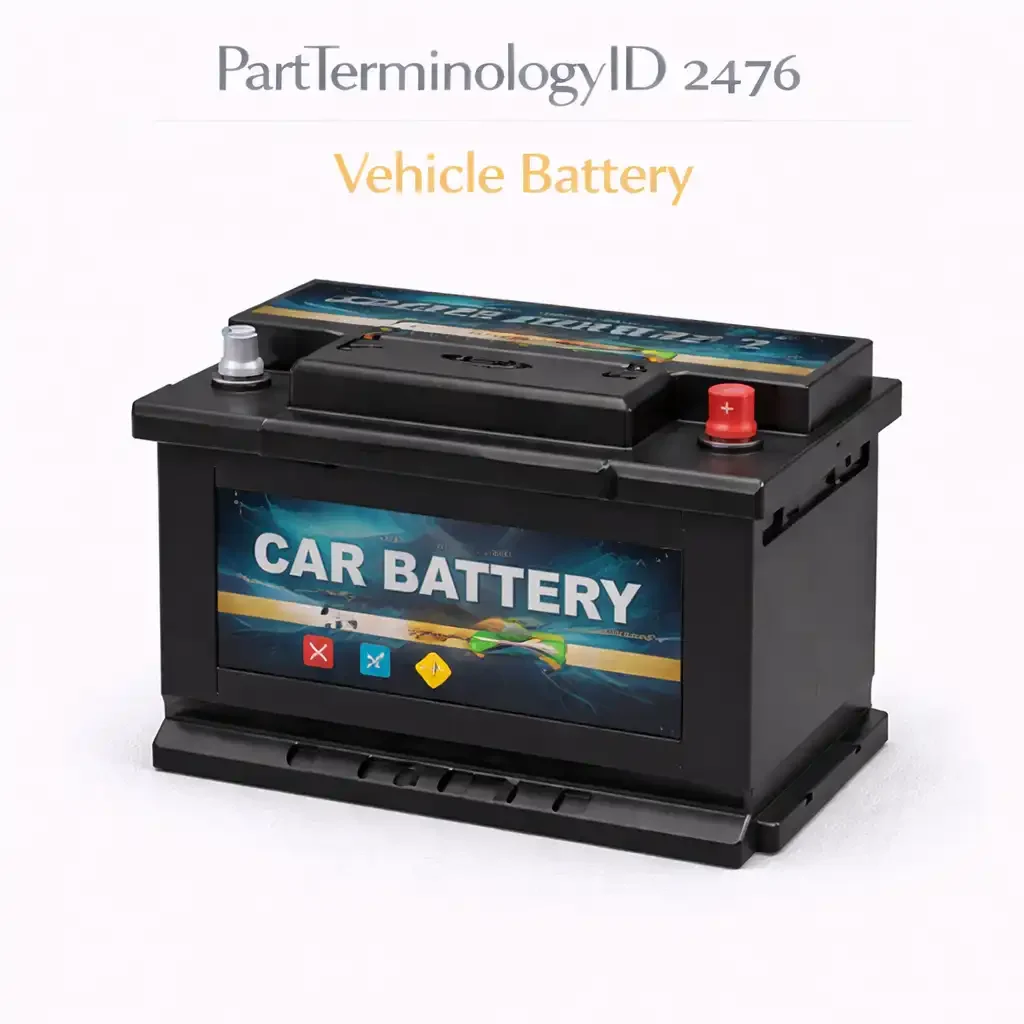
PartTerminologyID 2476, Vehicle Battery, is the electrochemical energy storage device that provides the cranking current to start the engine, supplies backup power to the vehicle's electrical system when the alternator output is insufficient to meet instantaneous demand, and maintains the continuous low-current supply required by memory-dependent electronics, security systems, telematics modules, and keep-alive circuits when the vehicle is parked and the engine is off. That definition covers the function correctly and leaves unresolved every question that determines whether the replacement battery fits the battery tray, delivers adequate cranking current to start the engine under the worst expected cold-weather conditions, provides sufficient reserve capacity to power the vehicle's electronics during extended key-off periods, is compatible with the vehicle's charging system voltage and charging strategy, is physically oriented correctly with the positive terminal in the correct position relative to the battery cables, and is the correct battery chemistry for vehicles equipped with advanced glass mat or enhanced flooded battery charging systems that require a specific battery type to function correctly. It does not specify the battery group size, the cold cranking ampere rating, the reserve capacity in minutes, the battery chemistry, whether it is a conventional flooded lead-acid battery, an enhanced flooded battery, an absorbent glass mat battery, or a lithium iron phosphate battery, the terminal type and position, whether the positive terminal is on the left or the right when viewed from the front of the battery, the terminal diameter, the battery height, whether the battery requires a hold-down bracket at the top or the base, the battery case material, the vent configuration, whether the battery is maintenance-free or requires periodic electrolyte level checks, the charging voltage requirement, whether the vehicle's charging system is calibrated for a conventional flooded battery or for an AGM battery with a higher absorption voltage, the battery sensor compatibility for vehicles with a battery current and temperature sensor at the negative terminal, or whether the vehicle has a battery management system that requires a coding procedure after battery replacement. A listing under PartTerminologyID 2476 that provides vehicle year, make, and model without the group size, the CCA rating, the reserve capacity, and the battery chemistry cannot be evaluated by any buyer who is standing in front of a dead or failing battery and needs to confirm the replacement before pulling the cables.
For sellers, PartTerminologyID 2476 is one of the highest-volume individual component listings in the aftermarket, second only to filters and brake pads in annual unit volume on most platforms. The volume creates scale pressure to simplify listings to year, make, model, and a single performance number, typically the CCA rating. That simplification is exactly where the highest-return-rate scenarios originate. A group size mismatch means the battery does not fit the tray. A chemistry mismatch on a vehicle with a dedicated AGM charging system means the replacement battery will be chronically undercharged or overcharged regardless of how well it was manufactured. A terminal position mismatch means the battery cables do not reach. A battery management system that was not recoded after replacement means the charging system continues to apply the degraded charging profile of the old battery to the new one, shortening the new battery's service life from the first charge cycle.
The additional complexity specific to PartTerminologyID 2476 compared to most other electrical component listings is the charging system chemistry matching argument. A vehicle with a factory AGM battery has a charging system calibrated for AGM's higher absorption voltage, typically 14.8 to 15.1 volts at full charge, and its lower internal resistance compared to a conventional flooded battery. Installing a conventional flooded replacement in an AGM charging system exposes the flooded battery to a charging voltage above its design limit, accelerating water loss from electrolysis and shortening the battery life to a fraction of its rated service interval. Installing an AGM battery in a conventional flooded charging system undercharges the AGM at the lower flooded-battery absorption voltage, producing chronic sulfation and premature capacity loss. The chemistry must match the charging system, not just the group size and the CCA.
For sellers, the listing under this PartTerminologyID is only useful if it specifies the group size, the CCA rating, the reserve capacity, the battery chemistry, the terminal position, the battery sensor compatibility, and the battery management system coding requirement. Without those seven attribute categories, the listing will generate returns from buyers who receive a battery that fits the tray but undermines the charging system, cables that do not reach the reversed terminals, or a new battery that ages prematurely because the BMS was never recoded.
What the Vehicle Battery Does
Providing cranking current at the moment of engine start
The starter motor draws the largest instantaneous current of any vehicle electrical load, typically 100 to 400 amperes depending on the engine displacement, the compression ratio, the starter motor efficiency, and the ambient temperature. The battery must deliver this current at the terminal voltage required to sustain starter motor speed above the minimum cranking RPM through the compression strokes until the engine fires. As the battery temperature decreases, its internal resistance increases and its available cranking current decreases simultaneously, making cold weather the worst-case condition for battery performance.
The cold cranking ampere rating quantifies the battery's ability to deliver cranking current at the standard test temperature of minus 18 degrees Celsius, which is 0 degrees Fahrenheit. At that temperature, the battery must deliver the rated CCA current for 30 seconds while maintaining a terminal voltage of at least 7.2 volts on a 12-volt battery. A battery with a CCA rating below the engine's minimum requirement will produce a slow, labored crank that may not sustain the compression strokes needed for ignition, or will deliver inadequate voltage to the engine control module during cranking, causing the ECM to reset or lose synchronization.
Supplying backup power during peak demand events
The alternator produces its rated output current only at rotor speeds above a threshold that corresponds to moderate engine RPM. At idle, particularly low idle during thermal soak conditions, the alternator may not produce sufficient current to supply all active electrical loads simultaneously. The battery supplies the deficit between alternator output and system demand during these events, accepting a partial discharge and then recovering as the alternator output increases with engine speed.
A battery with inadequate reserve capacity will reach a state of charge below the minimum for reliable ECM operation during extended low-speed or idle operation with high electrical loads, producing intermittent electronic faults that are not immediately traceable to a battery condition because the battery voltage recovers when the electrical load decreases. These intermittent faults, including transmission shift irregularities, infotainment system resets, and stability control interventions from voltage dips during cranking, are the diagnostic signature of a battery with declining reserve capacity operating near its minimum functional threshold.
Maintaining keep-alive power for memory-dependent systems
Modern vehicles have an increasing number of modules that require continuous low-current power to maintain memory, maintain security system monitoring, and maintain telematics connectivity when the vehicle is parked. The total key-off current draw on a modern vehicle with active telematics, keyless entry, and multiple keep-alive modules typically ranges from 15 to 80 milliamperes. Over a seven-day parking period, 50 milliamperes of key-off draw depletes approximately 8 ampere-hours from the battery, which represents a meaningful fraction of a battery's usable capacity on a cold-temperature winter morning.
A battery with adequate cold cranking amperes but insufficient reserve capacity will start the engine reliably after short parking intervals and fail to start after extended parking because the keep-alive drain has depleted the usable capacity before the next starting event. This failure pattern is commonly misdiagnosed as an intermittent battery cell failure rather than a capacity-versus-drain mismatch.
The battery chemistry argument
Conventional flooded lead-acid batteries use liquid sulfuric acid electrolyte that covers the lead plates. They are the lowest-cost battery chemistry and are adequate for vehicles without active battery management systems and without high key-off electrical loads. They require periodic electrolyte level checks on non-sealed designs and tolerate modest overcharging by venting hydrogen gas through the vent caps. Their limitation is sensitivity to vibration, which can cause plate shedding, and to chronic undercharging, which produces lead sulfate crystallization on the plates that permanently reduces capacity.
Enhanced flooded batteries are conventional flooded batteries manufactured to tighter tolerances with reinforced plate structures and improved paste formulations that provide better deep-cycle performance and vibration resistance than standard flooded batteries. They are compatible with conventional flooded charging systems and are a direct upgrade over standard flooded batteries in the same group size without requiring charging system changes.
Absorbent glass mat batteries immobilize the electrolyte in glass fiber mats between the plates, eliminating free liquid electrolyte entirely. AGM batteries have lower internal resistance than flooded batteries, which allows them to deliver higher cranking current from a smaller physical volume and to recover charge faster from partial discharge. They are sealed and maintenance-free and can be installed in any orientation. Their limitation is sensitivity to overcharging: an AGM battery charged above approximately 15.2 volts experiences accelerated water loss from the immobilized electrolyte that cannot be replenished, permanently reducing capacity.
Vehicles with factory AGM batteries have charging systems calibrated to the AGM voltage window. A conventional flooded replacement in an AGM charging system will experience the elevated absorption voltage on every full charge cycle, producing water loss and shortened life regardless of the flooded battery's quality.
Lithium iron phosphate batteries are used in a growing number of performance and weight-reduction applications. They have the highest energy density of any vehicle starting battery chemistry, the lowest weight, and the best cold-temperature performance retention compared to lead-acid chemistries. They require a dedicated lithium-compatible charger and charging system and are not compatible with standard lead-acid charging voltage profiles. A lithium battery in a conventional or AGM charging system will be either overcharged or undercharged depending on the charging voltage calibration.
The battery management system and the coding requirement
Many European vehicles, and an increasing number of domestic and Asian vehicles from approximately 2010 onward, are equipped with battery management systems that monitor the battery's state of health using a current and temperature sensor at the negative terminal. The BMS records the battery's capacity fade over its service life and adjusts the alternator's charging profile to compensate for the battery's declining efficiency.
When a new battery is installed without coding the BMS to recognize the new battery, the BMS continues to apply the degraded charging profile developed for the old battery. A new battery with full capacity receives a charging profile calibrated for a battery with 60 percent of its original capacity, resulting in chronic undercharging of the new battery from the first cycle. The undercharged new battery is then diagnosed as a defective battery and returned, when the root cause is a BMS that was not updated after the replacement.
The listing must identify whether the vehicle requires BMS coding after battery replacement and must direct the buyer to perform the coding procedure before the vehicle is returned to service.
Battery state-of-health testing and replacement timing
The most common battery replacement error in the opposite direction from chemistry mismatch is premature replacement of a serviceable battery that tested low on a surface-charge voltage check. A resting voltage measurement alone does not indicate a battery's state of health with any reliability. A battery that reads 12.4 volts at rest may have 80 percent of its rated capacity or 40 percent, depending on how recently it was last charged and how uniformly the charge is distributed across its cells. A battery that reads 12.6 volts at rest after being fully charged may have a shorted cell that will fail within the next two discharge cycles.
The correct instrument for battery state-of-health assessment is a conductance tester, also called a battery analyzer or a carbon pile tester at higher current levels. A conductance tester applies a small AC signal across the battery terminals and measures the battery's internal conductance, which correlates to its cold cranking ampere capacity and its state of health as a percentage of its original rated capacity. A battery testing below 60 percent of its rated CCA on a conductance tester should be replaced proactively. A battery testing above 60 percent with a fully charged voltage of 12.6 volts or higher is serviceable and should not be replaced based on age alone.
For sellers, the state-of-health testing argument matters because a buyer who replaces a serviceable battery and then installs the new battery into a vehicle with a failed alternator, a parasitic drain, or an uncoded BMS will return the new battery within months when the underlying fault drains or damages it. The new battery is not defective. The vehicle's charging system or keep-alive circuit defeated it. The listing should include a note directing buyers to test the alternator output voltage and measure the key-off current draw before installing the replacement battery to confirm the vehicle's charging and electrical systems are not the cause of the original battery's failure.
Climate zones and regional CCA selection
The BCI group size system and the CCA rating system were developed with a standard test temperature of minus 18 degrees Celsius as the reference point for cold weather performance. That reference temperature was selected as a reasonable worst-case condition for temperate North American climates. It is not the worst-case condition for buyers in northern Canada, northern Scandinavia, interior Alaska, or elevated mountain regions where ambient temperatures regularly reach minus 30 to minus 40 degrees Celsius during winter.
At minus 30 degrees Celsius, a battery delivers approximately 85 percent of its minus 18 Celsius CCA. At minus 40 degrees Celsius, a battery delivers approximately 70 percent of its minus 18 Celsius CCA. For a buyer in a climate that regularly reaches minus 30 Celsius, a battery rated at the engine's minimum CCA requirement at minus 18 Celsius will deliver only 85 percent of that requirement at the worst-case temperature. The engine may or may not start depending on how close the minimum CCA is to the rated value and how cold the engine oil is.
The practical guidance for cold climate buyers is to specify a battery with a CCA rating at least 25 percent above the engine's minimum requirement at minus 18 Celsius. That margin provides approximately the same cranking performance at minus 30 Celsius as a correctly rated battery at minus 18 Celsius. For minus 40 Celsius climates, a 40 to 50 percent CCA margin above the minimum is the more conservative target.
Heat is the second climate argument. Battery electrolyte at sustained high ambient temperatures, typically above 35 degrees Celsius as a continuous average, accelerates the positive plate corrosion and water loss that limit battery service life. A battery installed in the engine bay of a vehicle parked outdoors in a desert climate will have a shorter service life than the same battery in a temperate climate, regardless of the CCA margin. For hot climate applications, reserve capacity becomes the more important rating because heat-related capacity loss affects the sustained current delivery more than the peak cranking current performance. A battery sized for reserve capacity at 20 to 30 percent above the vehicle's minimum for the key-off load profile provides a useful margin against the capacity loss that heat accumulates over a three to four year service interval.
Why This Part Generates Returns
Buyers order the wrong vehicle battery because the group size is not specified and the replacement battery does not fit the battery tray or requires modification of the hold-down bracket, the battery chemistry does not match the charging system and the replacement battery either overcharges in an AGM system or undercharges in a conventional system producing premature capacity loss, the terminal position is reversed and the battery cables do not reach the reversed terminal positions, the CCA rating is below the engine's minimum requirement for the ambient temperature range of the buyer's location, the reserve capacity is not stated and the replacement battery has lower reserve capacity than the original producing key-off drain failures after extended parking, the BMS is not recoded after replacement and the new battery is chronically undercharged from the first cycle, the battery sensor at the negative terminal is not reregistered after replacement and the charging system continues using the old sensor calibration, and the battery height exceeds the tray clearance under the hood or the trunk lid and the cover cannot be fully closed.
Status in New Databases
PIES/PCdb: PartTerminologyID 2476, Vehicle Battery
PIES 8.0 / PCdb 2.0: No change in PartTerminologyID or terminology label. Internal systems keyed to 2476 do not require remapping at the PIES 8.0 transition.
Top Return Scenarios
Scenario 1: "AGM charging system, conventional flooded replacement, battery water loss within one year"
The vehicle has a factory AGM battery and an AGM-calibrated charging system with an absorption voltage of 14.9 volts. The replacement battery is a conventional flooded battery in the correct group size and CCA rating. The listing did not specify chemistry. Over the following year, every full charge cycle exposed the flooded battery to 14.9 volts during absorption, producing electrolyte loss from accelerated electrolysis. At 14 months, the battery failed from low electrolyte level and internal plate exposure. The battery was returned as defective, but the failure was caused by chemistry incompatibility with the charging system.
Prevention language: "Battery chemistry: [conventional flooded / enhanced flooded / AGM / lithium iron phosphate]. Charging system compatibility: [conventional flooded charging system only / AGM charging system required]. This vehicle was originally equipped with an AGM battery. Its charging system is calibrated for AGM chemistry with an absorption voltage of approximately 14.8 to 15.1 volts. Installing a conventional flooded battery in an AGM charging system will expose the flooded battery to above-specification charging voltage on every full charge cycle, causing accelerated electrolyte loss and shortened battery life. Specify an AGM replacement for AGM charging systems."
Scenario 2: "Terminal position reversed, positive cable does not reach positive terminal, cables crossed"
The replacement battery has the positive terminal on the right side when viewed from the front of the battery. The original battery has the positive terminal on the left side. The battery fits the tray correctly and the group size is correct. The positive cable is 80mm short of reaching the positive terminal on the right side. The buyer extended the positive cable with a jumper section, which added resistance to the cranking circuit and reduced the effective cranking voltage at the starter motor terminals.
Prevention language: "Terminal layout: positive terminal [left / right] when viewed from the front of the battery. Verify the terminal position matches your vehicle's cable routing before ordering. A reversed terminal position will require cable extension or replacement to reach the correct terminal. Do not extend the positive cranking cable with a jumper section: added resistance in the cranking circuit reduces the effective voltage at the starter motor and can prevent starting in cold weather."
Scenario 3: "BMS not recoded, new battery chronically undercharged, capacity at 65 percent within six months"
The vehicle requires BMS coding after battery replacement. The listing did not mention the coding requirement. The buyer installed the replacement battery without performing the coding procedure. The BMS continued to apply the charging profile developed for the original battery at the end of its service life, calibrated for a battery with approximately 55 percent of its original capacity. The new battery received a charging profile designed for a degraded battery and was chronically undercharged from the first cycle. At six months, the battery capacity was at 65 percent of rated due to sulfation from chronic undercharging. The battery was returned as defective.
Prevention language: "Battery management system coding: [required / not required]. This vehicle requires BMS coding after battery replacement. Without coding, the BMS applies the charging profile developed for the old battery to the new battery, producing chronic undercharging from the first cycle. Perform the BMS coding procedure using a compatible scan tool before returning the vehicle to service. Failure to code the BMS is the most common cause of premature failure of new batteries in vehicles equipped with battery management systems."
Scenario 4: "CCA rating adequate for temperate climate, insufficient for buyer's northern winter, slow crank at minus 25 Celsius"
The battery has a CCA rating of 550, which is adequate for the engine's starting requirement at the standard test temperature of minus 18 Celsius. The buyer is in a northern climate that regularly reaches minus 25 Celsius in January. At minus 25 Celsius, the battery's available cranking current is approximately 15 percent lower than at the test temperature, reducing the effective cranking current to approximately 467 amperes. The engine requires a minimum of 480 amperes to sustain adequate cranking RPM through the compression strokes at that temperature. The engine cranked slowly and failed to start on three consecutive mornings during the coldest week.
Prevention language: "CCA rating: [X] amperes at minus 18 Celsius. For operation in climates that regularly reach minus 25 Celsius or colder, a CCA rating at least 20 percent above the engine's minimum requirement at minus 18 Celsius is recommended to maintain adequate cranking current at extreme cold temperatures. The battery's available cranking current decreases approximately 1 percent per degree below the test temperature."
Scenario 5: "Reserve capacity below original, key-off drain from telematics depletes battery over 10-day parking period"
The original battery has a reserve capacity of 120 minutes. The replacement battery has a reserve capacity of 90 minutes, which was not stated in the listing. The vehicle has active telematics with a key-off current draw of 45 milliamperes. Over a 10-day parking period at an airport, the telematics draw depleted approximately 10.8 ampere-hours. The replacement battery with 90-minute reserve capacity has approximately 22 usable ampere-hours at the 25-ampere discharge rate. The 10.8 ampere-hour depletion left the battery at approximately 51 percent state of charge, which at winter temperatures was insufficient for a reliable cold start.
Prevention language: "Reserve capacity: [X] minutes. For vehicles with active telematics, keyless entry, and multiple keep-alive modules with a total key-off current draw above 30 milliamperes, a reserve capacity of at least [X] minutes is recommended to ensure reliable starting after extended parking intervals of 7 days or more. Verify the replacement reserve capacity matches or exceeds the original battery's reserve capacity."
Scenario 6: "Battery height exceeds tray clearance, hood cannot close fully, bracket interference"
The replacement battery is 2 inches taller than the original. The group size designation matches the vehicle specification but the replacement battery is from a manufacturer that uses the maximum allowable group size height. The original battery was a shorter variant within the same group size. The taller replacement contacts the hood liner when the hood is fully closed and prevents the hood from latching securely.
Prevention language: "Battery dimensions: [length X mm, width X mm, height X mm]. Group size designations define maximum dimensions but manufacturers may produce batteries at the minimum end of the group size height range. Verify the replacement battery height fits the battery tray and clears the hood or trunk lid before ordering. For applications with known height restrictions, specify the exact height required rather than relying on group size alone."
Scenario 7: "Lithium battery installed in standard charging system, overcharged, battery management circuit triggered protection shutdown"
The buyer purchased a lithium iron phosphate battery in the correct group footprint for a weight reduction application. The vehicle has a standard flooded battery charging system with an absorption voltage of 14.4 volts. The LiFePO4 battery's maximum charge voltage is 14.6 volts per cell pack, and the battery's internal BMS triggers a protection shutdown at 14.8 volts to prevent cell damage. During a long highway drive with full alternator output, the charging system voltage reached 14.7 volts and triggered the LiFePO4 battery's protection shutdown, disconnecting the battery from the charging circuit and causing the alternator warning light to illuminate.
Prevention language: "Battery chemistry: lithium iron phosphate. Charging system compatibility: requires a lithium-compatible charging system or a charging voltage that does not exceed [X.X] volts under any operating condition. A standard lead-acid charging system may produce charging voltages that trigger the LiFePO4 battery's internal protection circuit during full alternator output. Verify charging system compatibility with the battery manufacturer's specification before installing a lithium battery in a vehicle with a standard lead-acid charging system."
Scenario 8: "Battery sensor cracked during terminal removal, moisture ingress, erratic BMS charging degrades new battery within one year"
The vehicle has a battery current and temperature sensor clamped to the negative terminal. During battery removal, the negative terminal clamp was pried off aggressively and the sensor body cracked along its housing seam. The crack was hairline and not immediately visible. The replacement battery was installed, the BMS was coded correctly, and the sensor was reconnected. Over the following three months, moisture entered the sensor through the hairline crack and produced intermittent sensor fault codes. The BMS, receiving erratic current data from the damaged sensor, applied an irregular charging profile that alternated between overcharge and undercharge events, degrading the new battery's capacity to 70 percent within the first year.
Prevention language: "Battery current and temperature sensor: inspect the sensor body for cracks, deformation, or corrosion at every battery replacement event. The sensor is located at the negative terminal clamp and is damaged most frequently during terminal removal with a pry tool. Replace the sensor if any crack or housing damage is visible. A damaged sensor left in service after battery replacement will provide erratic current data to the BMS, producing an inconsistent charging profile that degrades the new battery's capacity prematurely regardless of the BMS coding procedure."
Scenario 9: "Side-post thread specification not confirmed, replacement battery has metric threads, OE cable bolt is SAE, thread stripped on first installation"
The original battery uses side-post terminals with SAE 5/16-18 thread. The replacement battery uses side-post terminals with metric M8 x 1.25 thread. Both batteries are in the correct BCI group size with correct CCA and chemistry. The listing did not state the side-post thread specification. The buyer attempted to install the OE SAE cable bolt into the metric terminal thread. The SAE bolt engaged the first two metric thread pitches before cross-threading and stripping the terminal. The battery terminal was permanently damaged.
Prevention language: "Terminal type: side post. Thread specification: [SAE 5/16-18 / metric M8 x 1.25]. Verify the side-post thread specification matches your vehicle's cable bolt specification before installation. SAE and metric side-post threads have similar diameters and will engage for two to three turns before cross-threading. Cross-threading a side-post terminal strips the terminal and requires battery replacement. Do not force a cable bolt that does not thread smoothly by hand."
What to Include in the Listing
Core essentials
PartTerminologyID: 2476
component: Vehicle Battery
battery group size (mandatory, in title)
cold cranking ampere rating at minus 18 Celsius (mandatory)
cranking ampere rating at 0 Celsius where available (mandatory)
reserve capacity in minutes at 25-ampere discharge (mandatory)
battery chemistry: conventional flooded, enhanced flooded, AGM, or lithium iron phosphate (mandatory)
charging system compatibility: flooded system or AGM system (mandatory)
terminal type: top post or side post (mandatory)
terminal position: positive terminal left or right when viewed from battery front (mandatory)
terminal diameter for top post: positive and negative post diameters in mm (mandatory)
terminal thread specification for side post applications: SAE or metric with size (mandatory)
battery dimensions: length, width, and height in mm (mandatory)
hold-down type: top hold-down or base hold-down (mandatory)
vent type: sealed maintenance-free or vented with vent caps (mandatory)
battery sensor compatibility for vehicles with negative terminal current sensors (mandatory)
BMS coding requirement: required or not required (mandatory)
BMS coding note directing buyer to perform coding before returning vehicle to service (mandatory where applicable)
start-stop compatibility designation where applicable (mandatory)
case material and color (mandatory)
warranty duration (mandatory)
new or reconditioned (mandatory)
quantity: 1
Fitment essentials
year/make/model/submodel
factory battery chemistry where the vehicle was available with both flooded and AGM options at different trim levels
engine designation where battery specification varies by engine
climate zone recommendation for CCA rating selection in extreme cold climates
telematics and key-off load note for vehicles with high key-off current draw
Dimensional essentials
battery length in mm
battery width in mm
battery height in mm
positive terminal post diameter in mm for top-post designs
negative terminal post diameter in mm for top-post designs
terminal spacing in mm for side-post designs
hold-down slot dimensions in mm
Image essentials
battery in isolation from the front showing terminal positions with positive and negative labeled
battery from the side showing height and hold-down tab positions
terminal detail showing post diameter for top-post designs or thread specification for side-post designs
group size label shown on the battery case with the group number visible
AGM label or chemistry designation shown clearly for chemistry-specific listings
BMS sensor shown at the negative terminal for vehicles requiring sensor registration
battery installed in the vehicle tray showing hold-down bracket engagement and cable routing
Catalog Checklist for ACES/PIES Teams
PartTerminologyID = 2476
require group size as primary fitment attribute (mandatory)
require CCA rating (mandatory)
require reserve capacity (mandatory)
require battery chemistry with charging system compatibility statement (mandatory)
require terminal position: positive terminal left or right (mandatory)
require terminal type: top post or side post (mandatory)
require side post thread specification: SAE or metric (mandatory for side post designs)
require battery dimensions: length, width, height (mandatory)
require hold-down type (mandatory)
require battery sensor compatibility note (mandatory)
require BMS coding note for applicable vehicles (mandatory)
require start-stop compatibility designation where applicable (mandatory)
require warranty duration (mandatory)
prevent chemistry-only fitment: a battery that matches the group size and CCA but mismatches the chemistry will fail prematurely in an incompatible charging system; chemistry must be a required attribute on every listing, not an optional attribute
prevent terminal position omission: a battery with reversed terminal position requires cable modification that adds cranking circuit resistance and may prevent reliable cold starts; terminal position must be stated as a required attribute on every listing
differentiate from battery charger: the battery charger maintains or restores battery charge; the vehicle battery is the energy storage device; both are in the charging system ecosystem but serve different functions under different PartTerminologyIDs
differentiate from battery hold-down bracket: the hold-down bracket secures the battery in the tray; the battery is the energy storage device; both are required for a secure installation but are separate components; the hold-down type required by the battery must be stated in the listing
differentiate from battery sensor: the battery current and temperature sensor at the negative terminal is a separate component from the battery; it must be inspected and replaced if damaged during battery removal; the battery sensor PartTerminologyID covers the sensor as an individual replacement
flag AGM chemistry mismatch as the highest-consequence return driver: a chemistry-incompatible battery in an AGM charging system will fail within 12 to 18 months under chronic overcharge, producing a warranty return that appears as a battery quality failure but is a charging system chemistry incompatibility; the chemistry statement in the listing prevents this
flag BMS coding as mandatory for all applicable vehicles: an uncoded BMS on a new battery produces chronic undercharging from the first cycle; the buyer will return the battery as defective within 6 months; the BMS coding note costs nothing to add and prevents the most common new battery premature failure on modern European and increasingly domestic vehicles
flag terminal position as mandatory: a reversed terminal position is discovered at installation and cannot be adapted without cable modification; it is the most immediately detectable return driver for this PartTerminologyID and is entirely preventable by one attribute statement
flag battery sensor inspection as mandatory installation note: a cracked sensor from aggressive terminal removal produces erratic BMS charging that defeats a correctly specified and correctly coded new battery; the sensor inspection note costs nothing and prevents the most delayed return scenario in the series
FAQ (Buyer Language)
How do I know if my vehicle needs an AGM battery or a conventional flooded battery?
The most reliable method is to inspect the original battery's label for the AGM designation. AGM batteries are almost always labeled clearly. If the original battery has been replaced previously and the replacement may not be the correct chemistry, check the vehicle owner's manual or the battery specification label in the engine bay, which is present on many vehicles from approximately 2008 onward. You can also confirm by scanning the vehicle with a compatible scan tool and checking whether the charging system module has AGM parameters rather than flooded parameters in its calibration. A charging voltage that regularly reaches 14.8 to 15.1 volts on a full charge cycle is characteristic of an AGM charging system.
What is the difference between CCA and reserve capacity, and which matters more?
Cold cranking amperes measures the battery's ability to deliver starting current at minus 18 Celsius. Reserve capacity measures how long the battery can supply 25 amperes of continuous current at 27 Celsius before dropping below 10.5 volts, which represents how long the vehicle can operate on battery power alone if the alternator fails or how long the battery can sustain key-off loads before dropping below the minimum starting voltage. Both matter but for different failure modes. If your primary concern is cold weather starting, prioritize a high CCA rating. If your primary concern is extended parking with high key-off loads, prioritize a high reserve capacity. For most buyers in moderate climates with modern vehicles, both the CCA and the reserve capacity should match or exceed the original battery's ratings.
My new battery was installed correctly but the charging warning light is on and the voltage reads low. What is wrong?
On vehicles with battery management systems, this is almost always a BMS coding issue. The BMS is applying a charging profile developed for the old battery to the new one, and the charging voltage it is commanding may be below the new battery's optimal absorption voltage. Connect a compatible scan tool, navigate to the charging system or battery module, and perform the battery registration or coding procedure that resets the BMS to recognize the new battery. On most vehicles, this procedure resets the learned battery degradation history and allows the BMS to apply the correct charging profile for a new battery of the specified chemistry and capacity.
Can I use a higher CCA battery than the vehicle specification requires?
Yes. A higher CCA battery than the minimum specification provides additional cold weather starting margin and does not harm the vehicle's electrical system or the charging system. The alternator charges the battery based on voltage rather than current capacity, so a higher CCA battery will be charged correctly by the existing charging system. The primary considerations with a higher CCA battery are physical fit within the group size, and for AGM upgrades, confirming that the charging system is compatible with the AGM chemistry as described above.
My battery fits the tray but the hold-down bracket does not engage the battery's hold-down ledge. What is wrong?
Group size designations define the maximum battery footprint but do not specify the hold-down configuration. Some batteries use a top hold-down bar that engages a ledge on the top of the battery case. Others use a base hold-down bracket that engages a flange at the base of the battery case. The original battery and the replacement must use the same hold-down type. A battery with a base hold-down flange cannot be secured by a top hold-down bar, and a battery with a top hold-down ledge cannot be secured by a base bracket. Verify the hold-down type in the listing before ordering.
How long should a vehicle battery last, and when should I replace it before it fails?
Most conventional flooded batteries have a service life of 3 to 5 years under normal operating conditions. AGM batteries typically last 4 to 6 years. Enhanced flooded batteries fall between the two. Battery life is shortened by chronic undercharging from frequent short trips that do not allow a full charge cycle, chronic overcharging from a failed voltage regulator, extreme heat which accelerates water loss and plate corrosion, and vibration which causes plate shedding. The best indicator that a battery is approaching end of life is a state-of-health test performed with a conductance tester rather than a simple voltage check: a battery that tests below 60 percent of its rated capacity should be replaced proactively rather than waiting for a failure to occur in cold weather.
What does a conductance tester result mean and when should I replace based on it?
A conductance tester expresses the battery's current state relative to its original rated capacity as a percentage of rated CCA. A result above 75 percent indicates a battery with strong remaining service life. A result between 60 and 75 percent indicates a battery in the middle portion of its service life that is serviceable but should be monitored at the next service interval. A result below 60 percent indicates a battery that has lost more than 40 percent of its original capacity and should be replaced proactively before a cold weather starting failure occurs. A result below 40 percent is a battery that may fail to start the engine in moderate cold weather and requires immediate replacement. The conductance result is most reliable when the battery has been fully charged within the last 24 hours: testing a partially discharged battery will produce a lower result than the battery's actual state of health.
My vehicle has a start-stop system. Does that change the battery specification?
Yes, significantly. Start-stop vehicles cycle the engine off at traffic stops and restart it through the starter motor or an integrated starter-generator dozens of times per day in urban driving. This cycling draws the battery down from full charge on every stop and requires recovery during the brief driving intervals between stops. Conventional flooded and standard AGM batteries are not designed for this cycling duty. Start-stop vehicles require Enhanced Flooded Batteries or AGM batteries specifically rated for start-stop duty, designated by the battery manufacturer with a start-stop compatibility marking. A standard AGM battery of the same group size and CCA installed in a start-stop vehicle will have a shorter service life than the start-stop rated AGM because standard AGM is not optimized for the deep partial-state-of-charge cycling that start-stop operation produces.
The battery I am replacing failed in less than two years. What should I check before installing the replacement?
Before installing the replacement battery, perform four checks. First, test the alternator output voltage at idle and at 2,000 RPM with all electrical loads off: the reading should be between 13.5 and 14.8 volts depending on the battery chemistry. A voltage above 15 volts indicates a failed voltage regulator that will damage the replacement battery. Second, perform a key-off current draw test by placing an ammeter in series with the negative battery cable after all doors are closed and the vehicle has gone to sleep, typically 10 to 15 minutes after key-off. A key-off draw above 80 milliamperes indicates a parasitic drain that will discharge the replacement battery during extended parking. Third, on BMS-equipped vehicles, confirm the BMS coding procedure is available and that the correct scan tool is ready before installing the battery. Fourth, inspect the battery tray, hold-down bracket, and terminal connections for corrosion that would increase circuit resistance and impede the charging system's ability to maintain the replacement battery at full charge.
Cross-Sell Logic
Alternator (PartTerminologyID 2412: a battery that has failed from chronic undercharging or overcharging may indicate a failed or mismatched alternator; test the alternator output voltage and the charging system chemistry calibration before installing the replacement battery)
Battery Sensor (the battery current and temperature sensor at the negative terminal on BMS-equipped vehicles is inspected at every battery replacement event; replace if physically damaged during cable removal or if the vehicle scan shows a sensor fault code)
Battery Hold-Down Bracket (the hold-down bracket is inspected at battery replacement; replace if corroded, cracked, or if the replacement battery requires a different hold-down type)
Battery Terminal Cleaner and Protector (clean and coat the terminal connections at every battery replacement to prevent corrosion-related resistance increase in the cranking circuit)
Battery Charger or Maintainer (for vehicles stored for extended periods or driven infrequently, a battery maintainer preserves the state of charge and prevents sulfation from chronic partial discharge)
Starter Motor (a battery that has been discharged below its minimum voltage multiple times from slow cranking events may have caused starter motor brush wear from the elevated current drawn during low-voltage cranking attempts; inspect the starter if the battery has failed repeatedly from slow crank events)
Frame as "the battery stores the charge the alternator produces. The alternator charges the battery to the voltage the charging system specifies. The battery sensor reports the battery's state to the BMS. The BMS controls the charging voltage the alternator applies. The hold-down keeps the battery in the tray through the vibration the charging cycle sustains. All are in the same energy storage and delivery system."
Final Take for PartTerminologyID 2476
Vehicle Battery (PartTerminologyID 2476) is the highest-volume individual component PartTerminologyID in the electrical system series and the one where chemistry mismatch and BMS coding omission together account for the highest rate of premature returns that appear as defective product complaints but are listing and installation failures. A chemistry-mismatched battery in an AGM charging system returns at 14 months looking like a manufacturing defect. An uncoded BMS on a new battery returns at six months looking like a capacity failure. A cracked battery sensor left in service after an aggressive terminal removal produces erratic BMS charging that defeats a correctly specified and correctly coded new battery within the first year. All three are entirely preventable by attribute statements and installation notes in the listing.
State the group size in the title. State the CCA rating with the climate zone guidance for extreme cold buyers. State the reserve capacity. State the chemistry and the charging system it is compatible with. State the terminal position. State the terminal type with thread specification for side-post designs. State the dimensions. State the hold-down type. State the BMS coding requirement with a direction to perform it before returning the vehicle to service. State the battery sensor inspection note. State the start-stop compatibility designation where applicable. State the alternator output and parasitic drain pre-installation check guidance. State the warranty. That is the same listing strategy as every other PartTerminologyID in this series: specific attributes at every level to become a listing buyers can act on without guessing. For PartTerminologyID 2476, chemistry matching, BMS coding, and sensor inspection are the three attributes that determine whether the new battery the buyer correctly selected, correctly installed, and correctly connected will still be in the vehicle in three years or will come back in 14 months looking like something went wrong in manufacturing when the fault was in the charging system or the sensor the whole time.