
Alternator Fan (PartTerminologyID 2464): Why Blade Count, Pitch Direction, and Shaft Bore Determine Thermal Survival
Written by Arthur Simitian | PartsAdvisory
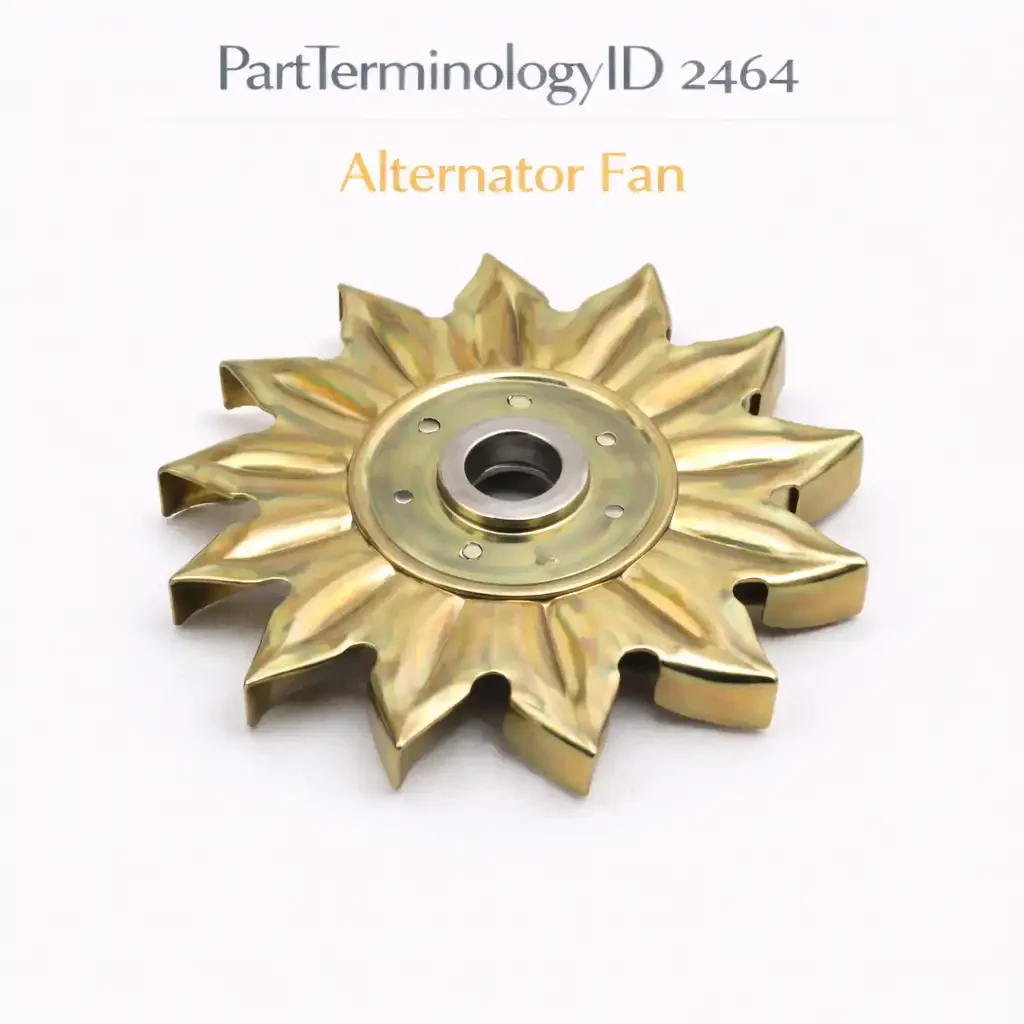
PartTerminologyID 2464, Alternator Fan, is the centrifugal or axial cooling fan mounted on the alternator rotor shaft that draws ambient air through the alternator housing to cool the stator windings, the rectifier bridge heat sinks, the voltage regulator, and the rotor bearings during alternator operation, preventing thermal degradation of the insulation, the diodes, and the bearing lubricant from the heat generated by resistive losses in the windings and the rectifier at full output current. That definition covers the function correctly. It does not specify the alternator manufacturer and model designation, the fan position on the rotor shaft, whether the fan is an external fan mounted at the front of the alternator behind the pulley, an internal fan mounted inside the rear housing, or both, the fan outer diameter, the blade count, the blade pitch direction, whether the blades are pitched for clockwise or counterclockwise rotation to direct airflow correctly for the alternator's rotation direction, the shaft bore diameter and bore type, whether the bore is a press fit, a keyed bore, or a splined bore, the fan material, whether it is stamped steel, cast aluminum, or injection-molded polymer, the airflow rating in cubic feet per minute at rated rotor speed, or whether the listing covers the fan alone or the fan as part of a pulley-fan assembly where both components are replaced together. A listing under PartTerminologyID 2464 that provides vehicle year, make, and model without the alternator model designation, the fan position, the blade pitch direction, and the shaft bore specification cannot be evaluated by a technician who has confirmed the fan as the failed or missing component before beginning reassembly.
For sellers, PartTerminologyID 2464 serves a technically specific buyer population that is smaller than the brush or rectifier bridge buyer population because alternator fan failure is less common than electrical component failure as a standalone diagnosis. The fan is most commonly replaced when it has been physically damaged from debris ingestion through the alternator housing vents, when the fan blades have fatigued and cracked from cyclic stress at high rotor speeds, or when the alternator is being rebuilt from a bare housing and the original fan was damaged during disassembly or is unavailable. The fan is also replaced when a thermal failure of the alternator's electrical components has been traced to inadequate cooling from a fan with incorrect blade pitch direction, which is the highest-consequence specification error specific to this PartTerminologyID.
For sellers, the listing under this PartTerminologyID is only useful if it specifies the alternator model designation, the fan position, the blade pitch direction matched to the alternator's rotation direction, and the shaft bore specification. Without those four attributes, the listing cannot prevent the blade pitch reversal that produces inadequate airflow and accelerated thermal degradation of every electrical component the fan is intended to protect.
What the Alternator Fan Does
Maintaining the alternator's thermal operating environment
The alternator generates heat from two primary sources: the resistive losses in the stator windings as current flows through the copper conductors, and the forward voltage drop across the six rectifier diodes as they conduct the output current. At full output on a 150-ampere alternator, the stator copper losses and the rectifier diode losses together produce approximately 100 to 150 watts of heat within the alternator housing. Without active cooling, this heat would raise the internal temperature of the housing to levels that degrade the stator winding insulation, soften the rectifier diode epoxy encapsulation, overheat the bearing lubricant, and accelerate the voltage regulator's thermal aging.
The cooling fan draws ambient air through the alternator housing at a rate sufficient to carry this heat away before it accumulates to damaging levels. The required airflow rate increases with alternator output current: a fan that provides adequate cooling at 80 percent of rated output may allow overheating at sustained full output if the airflow is marginal. The fan blade count, blade pitch angle, and rotor speed together determine the airflow rate at any given operating condition.
External versus internal fan position
Older alternator designs use an external fan mounted at the front of the alternator between the pulley and the front housing. The external fan draws air in through the front housing vents and exhausts it through the rear housing vents or through slots in the rear housing beside the output terminal. External fans are exposed to the engine bay environment and are therefore subject to debris ingestion, oil mist contamination, and physical impact from objects that enter the engine bay.
Modern sealed or semi-sealed alternator designs use one or two internal fans mounted on the rotor shaft inside the housing. Internal fans draw air through filtered or screened vents in the rear housing and direct it across the stator windings, the rectifier bridge, and the regulator before exhausting through the front housing vents. Internal fans are protected from direct debris ingestion but are subject to the thermal environment inside the housing and to the oil vapor that accumulates inside the housing over the alternator's service life.
Some alternator designs use both an external front fan and an internal rear fan simultaneously to maximize airflow through the housing. On these designs, both fans must be replaced if either is damaged, because the total airflow rate depends on both fans operating at their designed pitch and speed.
The blade pitch direction argument
The blade pitch angle determines the direction of airflow through the housing for a given rotation direction. A fan with blades pitched for clockwise rotation will draw air into the housing when the rotor turns clockwise and will exhaust air into the housing when the rotor turns counterclockwise, reversing the designed airflow direction. A reversed airflow direction does not stop the alternator from charging: the electrical function is independent of the airflow direction. The failure appears as a thermal event after sustained high-output operation when the reversed airflow provides inadequate heat removal from the hottest components in the housing.
On most domestic passenger vehicle alternators the rotor turns clockwise when viewed from the pulley end. On some transverse-engine installations the alternator is mounted with the opposite rotation direction. The fan blade pitch must match the specific alternator's rotation direction, not simply the rotation direction of most alternators. A fan sourced from a counterclockwise rotation application installed on a clockwise rotation alternator will appear correct visually: the blade count, the diameter, and the bore will all match. The airflow reversal will not be detectable without measuring the outlet velocity with an anemometer during alternator operation.
Fan material and fatigue life
Stamped steel fans are the most common on external alternator fan designs. They are durable, resistant to the oil mist environment of the engine bay, and do not degrade from UV exposure. Their limitation is susceptibility to corrosion in high-humidity or road-salt environments, where surface rust can propagate into fatigue cracks at the blade root radius.
Cast aluminum fans are used on performance alternators and on some heavy-duty applications where the additional mass of a steel fan would increase rotor rotational inertia beyond the acceptable limit for the alternator's speed range. Polymer fans are used on internal alternator designs where the protected environment inside the housing makes polymer degradation from UV and oil exposure less of a concern.
The listing must state the fan material so the buyer can confirm it matches the original material's thermal and mechanical properties for the specific installation environment.
The Specifications That Determine Correct Fan Fitment
Alternator model designation
Primary fitment attribute. The fan diameter, blade count, blade pitch, and bore specification are defined at the alternator model level.
Fan position
External front, internal rear, or both. State the position explicitly. A two-fan alternator requires both fans to be addressed if either is damaged.
Blade count and pitch direction
Blade count determines the airflow distribution around the rotor circumference. Pitch direction, clockwise or counterclockwise when viewed from the airflow inlet face, determines the airflow direction for a given rotation. State the pitch direction as matched to the alternator's rotation direction, not as an absolute direction.
Shaft bore specification
Bore diameter in millimeters to two decimal places for press-fit designs. Bore type: press-fit, keyed, or splined. The fan must be retained on the rotor shaft with the interference fit specified for the original design.
Fan outer diameter
In millimeters. Must clear the alternator housing bore by the designed running clearance. A fan with a larger diameter than the original will contact the housing bore and seize immediately on the first rotation.
Material
Stamped steel, cast aluminum, or polymer.
Fan alone or pulley-fan assembly
State whether the listing covers the fan only or a combined pulley and fan unit where both components are supplied together.
Status in New Databases
PIES/PCdb: PartTerminologyID 2464, Alternator Fan
PIES 8.0 / PCdb 2.0: No change
Top Return Scenarios
Scenario 1: "Blade pitch reversed, airflow direction incorrect, rectifier bridge overheated at sustained full output"
The replacement fan has the same blade count, the same diameter, and the same shaft bore as the original. The blade pitch is for counterclockwise rotation. The alternator rotates clockwise. The reversed blade pitch exhausts air into the housing rather than drawing it through, reversing the designed airflow path. The alternator charged correctly at normal loads. During a sustained 45-minute highway drive with air conditioning, rear window defrost, and headlights all active, the rectifier bridge temperature exceeded the diode junction limit and two diodes failed open circuit, producing a no-charge condition.
Prevention language: "Blade pitch direction: [clockwise rotation / counterclockwise rotation] when viewed from the airflow inlet face. Verify the pitch direction matches your alternator's rotation direction before ordering. A reversed blade pitch reverses the airflow through the housing. The alternator will charge correctly at normal loads. Overheating and electrical component failure will appear only during sustained high-output operation when the reversed airflow cannot remove the full thermal load."
Scenario 2: "Fan outer diameter 2mm oversize, fan contacted housing bore on first start, rotor locked"
The replacement fan has an outer diameter of 102mm. The alternator housing bore clearance is designed for a 100mm fan with a 1mm running clearance on each side. The 2mm oversize fan contacted the housing bore immediately on the first rotation and the rotor locked, blowing the serpentine belt off the drive system and stalling the engine.
Prevention language: "Fan outer diameter: [X]mm. Housing bore running clearance: [X]mm per side. Verify the fan outer diameter against the alternator housing bore before installation. A fan with an outer diameter more than 0.5mm larger than the original will contact the housing bore on the first rotation and lock the rotor. Measure the original fan diameter before ordering if the original fan is available."
Scenario 3: "Two-fan alternator, only one fan replaced, airflow rate below design, stator insulation degraded"
The alternator uses both an external front fan and an internal rear fan. The external front fan was damaged by debris ingestion. The buyer replaced only the external fan and did not source the internal rear fan, which was also showing blade stress cracking from the same debris event. The total airflow rate with a new front fan and a cracked rear fan was approximately 60 percent of the design rate. Over 25,000 miles, the reduced airflow allowed the stator winding insulation to operate above its rated temperature continuously, producing insulation breakdown and a shorted stator winding.
Prevention language: "Fan configuration: [single external front fan / single internal rear fan / dual fan, external front and internal rear]. If this alternator uses both an external and an internal fan, both fans must be assessed when either is replaced. A cracked internal fan combined with a new external fan will not restore the full designed airflow rate. Inspect both fan positions when addressing any fan failure."
What to Include in the Listing
Core essentials
PartTerminologyID: 2464
component: Alternator Fan
alternator model designation (mandatory)
fan position: external front, internal rear, or dual (mandatory)
blade count (mandatory)
blade pitch direction: clockwise or counterclockwise from inlet face matched to alternator rotation direction (mandatory)
alternator rotation direction: clockwise or counterclockwise from pulley end (mandatory)
fan outer diameter in mm (mandatory)
shaft bore type: press-fit, keyed, or splined (mandatory)
shaft bore diameter in mm to two decimal places for press-fit (mandatory)
fan material: stamped steel, cast aluminum, or polymer (mandatory)
fan alone or pulley-fan assembly (mandatory)
dual fan note where applicable: state that both fans must be assessed when either is replaced (mandatory)
quantity: 1
Catalog Checklist for ACES/PIES Teams
PartTerminologyID = 2464
require alternator model designation (mandatory)
require fan position (mandatory)
require blade pitch direction matched to alternator rotation direction (mandatory)
require fan outer diameter (mandatory)
require shaft bore specification (mandatory)
require material (mandatory)
require fan alone versus pulley-fan assembly designation (mandatory)
require dual fan note for two-fan alternator designs (mandatory)
differentiate from alternator pulley (PartTerminologyID 2448): the pulley transmits belt energy to the rotor shaft; the fan cools the alternator housing; on designs where the fan and pulley are a combined assembly both are replaced together, but on designs where they are separate components they are individual PartTerminologyIDs; state whether the listing covers the fan alone or the combined assembly
differentiate from alternator (PartTerminologyID 2412): the fan is a sub-component replacement appropriate when the housing, stator, rotor, and electrical components are serviceable; a complete alternator replacement is appropriate when the fan failure has allowed thermal damage to the stator windings or rectifier bridge
flag blade pitch direction as the highest-consequence attribute: a reversed pitch direction produces no immediate detectable fault and fails thermally only under sustained full-output operation, which may be weeks or months after installation; the delayed consequence makes pitch direction the most important attribute to state correctly in the listing
Final Take for PartTerminologyID 2464
Alternator Fan (PartTerminologyID 2464) is the alternator sub-component PartTerminologyID where the blade pitch direction is the attribute that produces the most delayed and the least obviously attributable failure in the series. A brush with the wrong material grade fails at 18,000 miles. A rectifier bridge with the wrong current rating fails at a detectable load threshold. A fan with the reversed blade pitch fails the electrical components it was cooling at an indeterminate point during sustained high-output operation, and the failure presents as a diode or stator failure rather than as a fan specification error.
State the alternator model. State the fan position. State the blade count and the pitch direction matched explicitly to the alternator's rotation direction. State the outer diameter. State the shaft bore specification. State the material. State whether the listing is the fan alone or a pulley-fan assembly. Note the dual fan inspection requirement for two-fan designs. That is the complete specification for a buyer who has the alternator on the bench and needs only the confirmation that the replacement fan will move air in the correct direction at the correct rate through the correct housing position.