
Written by Arthur Simitian | PartsAdvisory
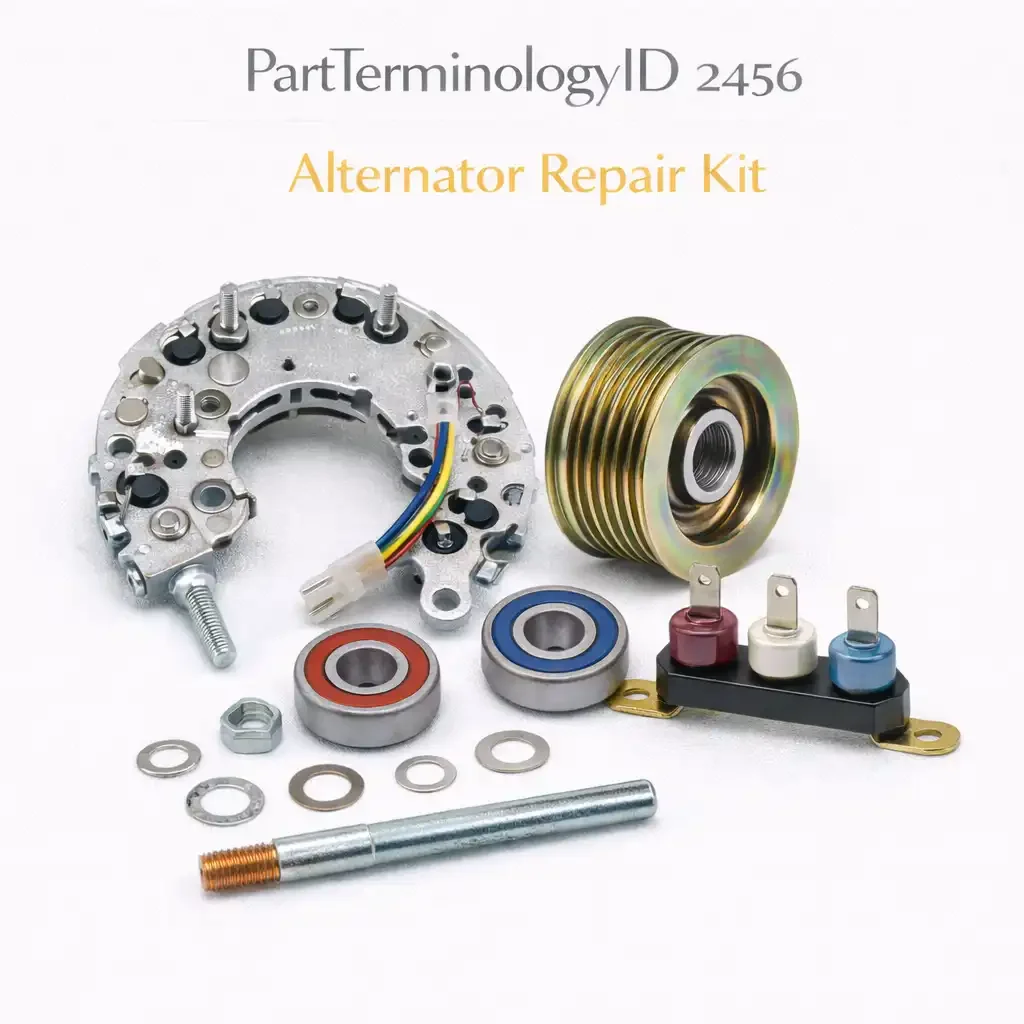
PartTerminologyID 2456, Alternator Repair Kit, is a bundled set of alternator sub-components sold together to support the rebuild or overhaul of a failed alternator, typically including some combination of brushes, brush holder, voltage regulator, rectifier bridge, diode trio, bearings, and hardware, packaged as a single purchase that covers the consumable and wear components replaced during a professional or advanced DIY alternator rebuild. That definition covers the function correctly and leaves unresolved every question that determines whether the kit matches the specific alternator on the vehicle, whether the kit contents cover the complete set of components the buyer intends to replace, and whether the kit quality level is appropriate for the intended service interval. It does not specify the alternator manufacturer and model designation the kit is assembled for, the exact component list by name and quantity, whether the brushes in the kit are the correct grade for the alternator's output variant as developed in the brush set post (2424), whether the rectifier bridge in the kit is a complete assembly with diodes pressed in or a bare plate as developed in the rectifier bridge post (2452), whether the bearings are the correct inner and outer diameter and load rating for the front and rear rotor shaft positions, whether the voltage regulator is compatible with the vehicle's smart charging system protocol as developed in the alternator post (2412), whether the kit includes the diode trio or only the main bridge, whether the kit includes hardware such as through-bolts, insulator washers, and terminal hardware, or whether the kit is a basic brush-and-regulator kit, a mid-level kit adding the rectifier bridge, or a comprehensive rebuild kit adding bearings, hardware, and all electrical sub-components. A listing under PartTerminologyID 2456 that provides vehicle year, make, and model and states rebuild kit without enumerating every included component cannot be evaluated by any technician who needs to confirm that a single order covers every component they have decided to replace before disassembling the alternator.
For sellers, PartTerminologyID 2456 is the kit PartTerminologyID in the alternator sub-component series where the bill of materials argument from the truck bed liner post (1008) applies in full: the kit contents list is not a marketing description, it is a contract between the seller and the buyer about exactly what is in the box. A buyer who orders an alternator repair kit expecting bearings and receives a brush-and-regulator kit will have a disassembled alternator on the bench and a missing bearing order pending while the vehicle sits. A buyer who orders a kit expecting a complete bridge assembly with diodes and receives a kit with a bare bridge plate will have the same problem from a different missing component. Both are returns caused by a contents list that was incomplete rather than a product that was incorrectly manufactured.
The additional complexity specific to PartTerminologyID 2456 compared to every individual sub-component PartTerminologyID in the alternator series is the scope matching problem. Each individual sub-component post addresses the specification requirements for one component in isolation. The repair kit post must address the specification requirements for every component in the kit simultaneously, and must additionally address whether the kit scope matches the buyer's intended rebuild scope. A buyer who intends to replace brushes, regulator, and bridge but not bearings needs a different kit than a buyer who intends a complete rebuild including bearings. A kit that includes bearings the buyer did not intend to replace is not a problem, but a kit that omits bearings the buyer did intend to replace forces a second order that defeats the kit's purpose of completing the rebuild in one purchase.
For sellers, the listing under this PartTerminologyID is only useful if it enumerates every included component by name, quantity, and specification, states the alternator model designation, identifies the kit scope level, and cross-references the individual sub-component posts for each included component's specification arguments. Without those four attribute categories, the listing cannot be used by a technician who is building a parts order before beginning the disassembly.
What the Alternator Repair Kit Does
Covering the consumable and wear components in a single order
The alternator repair kit provides the buyer with all components required for a defined scope of alternator rebuild in one purchase event. The purpose of the kit format is efficiency: a technician who knows they intend to replace brushes, regulator, and rectifier bridge on a specific alternator model can place one order rather than three separate orders for three separate PartTerminologyIDs, confirm that all three components are sourced before beginning disassembly, and receive all three in one shipment rather than waiting for the last of three separate arrivals before the vehicle can be returned to service.
The kit format is valuable precisely when the scope is clearly defined and the contents are explicitly listed. It loses its value when the scope is ambiguous and the contents are described generically, because a technician who cannot confirm from the listing that the kit covers their intended rebuild scope will order individual components anyway as insurance, duplicating the kit contents they were uncertain about.
The three kit scope levels
Alternator repair kits in the aftermarket are typically organized at three scope levels, though not all sellers use explicit scope level designations.
A basic kit covers the electrical consumables that wear through normal brush contact and thermal cycling: brushes, brush holder, and voltage regulator. These are the components that determine whether the alternator can sustain its output over its service life. A basic kit is appropriate when the rectifier bridge, the diode trio, and the bearings have been tested and confirmed serviceable, and the rebuild scope is limited to the brush and regulator system.
A mid-level kit adds the rectifier bridge and the diode trio to the brush and regulator contents of the basic kit. This scope is appropriate when the diagnostic process has confirmed that the brushes and regulator require replacement and that the bridge or trio has also degraded, but the bearings are within their serviceable limits and do not require replacement at this rebuild event.
A comprehensive kit adds front and rear bearings to the mid-level kit contents and may also include through-bolts, insulator washers, terminal hardware, and other mechanical components that are best replaced during a complete alternator disassembly when access to these components is available without additional labor. The comprehensive kit is appropriate for a high-mileage alternator where all wear components are replaced simultaneously to maximize the rebuilt alternator's service interval before the next rebuild event is required.
The listing must identify which scope level the kit represents and must enumerate every included component explicitly so the buyer can verify the scope matches their intended rebuild without assumption.
Why the kit contents list is the primary specification
Every individual component in the alternator repair kit carries the specification arguments developed in its own sub-component post. The brushes carry the material grade and output variant arguments from the brush set post (2424). The voltage regulator carries the smart charging system compatibility argument from the alternator post (2412). The rectifier bridge carries the complete assembly versus bare plate argument from the rectifier bridge post (2452). The bearings carry the bore diameter, load rating, and seal type arguments that determine whether the bearing survives the front bearing's combined belt tension and rotor radial load. The diode trio carries the alternator model and mounting configuration arguments from the diode trio post (2444).
A kit listing that states brushes, regulator, and bridge without specifying the brush material grade, the regulator protocol compatibility, and the bridge assembly scope has provided a component list that cannot be verified against any of the specification arguments that determine whether each individual component is the correct one. The kit contents list must be a bill of materials: component name, quantity, material or grade specification, and key dimensional or compatibility attribute for each item.
Bearing specification within the repair kit context
The bearings are the highest-consequence components in a comprehensive alternator repair kit because a bearing that is undersized at the bore, overloaded at the rated capacity, or unsealed for the alternator's operating environment will fail before any of the electrical components, producing a grinding or howling noise that returns the rebuilt alternator to the bench in a fraction of its expected service life.
The front bearing carries the belt tension load in addition to the rotor radial load. Belt tension on a correctly adjusted serpentine system is typically 80 to 120 pounds acting radially on the front bearing outer race. A front bearing rated only for the rotor radial load without accounting for the belt tension will be operated above its rated capacity at normal belt tension and will fail from spalling of the inner or outer race before the brushes reach their minimum serviceable length.
The kit listing must specify the front bearing bore diameter, the outer diameter, the width, the load rating, and the seal type. The rear bearing specifications must be listed separately because the front and rear bearings on most alternators are different sizes with different load ratings. A kit listing that states two bearings included without specifying front and rear dimensions separately has provided a bearing count rather than a bearing specification.
Hardware components in comprehensive kits
Some comprehensive alternator repair kits include the through-bolts that hold the front and rear alternator housings together, the insulator washers that electrically isolate the output terminal stud from the alternator housing, and the terminal nuts and washers at the B+ output terminal. These hardware components are not wear items in the same sense as brushes or bearings, but they are best replaced during a complete alternator disassembly because they are subject to corrosion, thread wear, and insulator degradation over the alternator's service life, and replacing them during the rebuild adds negligible cost compared to the labor already invested in the complete disassembly.
The kit listing must state whether hardware components are included by name and must not allow the buyer to assume that a comprehensive kit includes hardware when it does not. A buyer who reassembles the alternator with corroded through-bolts that strip during torquing will need to source hardware separately and partially disassemble the rebuilt unit to replace the stripped bolt, adding labor to a job that should have been completed.
Why This Part Generates Returns
Buyers order the wrong alternator repair kit because:
the kit contents are not enumerated and the buyer assumes a comprehensive scope when the kit is a basic brush-and-regulator set
the brush grade is not specified and the kit contains standard-output brushes for a high-output alternator application
the rectifier bridge in the kit is a bare plate without diodes and the buyer assumed a complete bridge assembly
the voltage regulator in the kit uses a conventional fixed-voltage regulator when the vehicle requires a LIN-bus smart charging compatible regulator
the bearing specifications are not stated and the kit bearings are the correct count but the wrong dimensions for the front and rear positions
the diode trio is not included in a kit that the buyer assumed covered all electrical sub-components
the kit is assembled for the standard output alternator variant and the vehicle has the high-output alternator with different brush, regulator, and bridge specifications
Status in New Databases
PIES/PCdb: PartTerminologyID 2456, Alternator Repair Kit
PIES 8.0 / PCdb 2.0: No change
Top Return Scenarios
Scenario 1: "Kit scope assumed comprehensive, bearing not included, alternator disassembled before discovering omission"
The listing described an alternator repair kit with a professional rebuild contents description. The buyer intended a complete rebuild including bearings on a 140,000-mile alternator. The kit contained brushes, brush holder, voltage regulator, rectifier bridge, and diode trio but no bearings. The buyer discovered the omission after fully disassembling the alternator, with the rotor shaft and front housing separated and the original bearings removed. A separate bearing order was required, extending the vehicle downtime by two days while the bearings shipped.
Prevention language: "Kit contents: [enumerate every component by name and quantity]. Bearings: [included, front bearing [spec] and rear bearing [spec] / not included]. This kit covers [basic / mid-level / comprehensive] rebuild scope. If your rebuild scope includes bearing replacement, verify bearing inclusion before ordering. Discovering a missing bearing after full alternator disassembly requires a separate order and extends vehicle downtime by the bearing shipping interval."
Scenario 2: "Voltage regulator in kit is conventional fixed-voltage, vehicle has LIN-bus smart charging, fault code P0620 on first start after rebuild"
The kit listing stated it included a voltage regulator compatible with the alternator model. The vehicle has a LIN-bus smart charging system. The replacement regulator in the kit is a conventional fixed-voltage type that does not respond to the ECM's LIN-bus voltage commands. On the first start after the rebuild, fault code P0620 appeared and the battery warning light illuminated. The alternator had to be disassembled again to replace the regulator with a LIN-bus compatible unit.
Prevention language: "Voltage regulator type: [conventional fixed-voltage / LIN-bus smart charging compatible / GM L-terminal compatible / other]. Verify the voltage regulator type matches your vehicle's charging system protocol before ordering. A conventional fixed-voltage regulator installed in a LIN-bus smart charging vehicle will set fault code P0620 on the first start. Confirm the vehicle's charging system type before specifying this kit."
Scenario 3: "Brush grade in kit is standard output, alternator is high-output variant, brushes at minimum length within 18,000 miles"
The kit was listed for the alternator model without distinguishing between the standard 120-ampere and the high-output 200-ampere variants as developed in the brush set post (2424). The kit contains standard-output brush grade. The vehicle has the 200-ampere high-output alternator. The higher field current in the high-output alternator produced contact zone temperatures that exceeded the standard-grade brush material's thermal limit. The brushes reached minimum serviceable length at 18,000 miles rather than the expected 60,000-mile interval.
Prevention language: "Alternator output variant: [120A standard output / 200A high-output]. Brush material grade: [standard output / high-output rated]. The brush grade in this kit is formulated for the [X]-ampere output variant of this alternator family. Verify your alternator's output variant before ordering. Standard-output brushes installed in a high-output alternator will fail prematurely from elevated field current thermal load."
Scenario 4: "Rectifier bridge in kit is bare plate, no diodes, buyer has no press tool, rebuild stalled"
The kit listing stated rectifier bridge included without specifying the assembly scope. The bridge in the kit is a bare heat sink plate without diodes. The buyer does not have a diode press tool and cannot press the original diodes from the failed bridge into the replacement plate without risking bond wire fracture. The rebuild stalled pending sourcing of either a complete bridge assembly or a diode press tool and new diodes.
Prevention language: "Rectifier bridge: [complete assembly with six new diodes pressed in / bare heat sink plate, diodes not included, diode press tool required for installation]. Verify the bridge assembly scope before ordering. A bare plate requires a diode press tool and correctly rated diodes to complete the installation. If the kit contains a bare plate and you do not have a press tool, source a complete bridge assembly separately."
Scenario 5: "Kit assembled for standard output alternator, high-output alternator in vehicle, bridge current rating insufficient"
The kit was built around components for a standard 120-ampere alternator. The vehicle has a 160-ampere high-output alternator. The rectifier bridge in the kit is rated for 120 amperes. At the high-output alternator's full load output, the bridge operates above its rated current. The bridge overheated and two diodes failed within 12,000 miles of the rebuild.
Prevention language: "Output variant compatibility: [120A standard output alternator / 160A high-output alternator]. All components in this kit are specified for the [X]-ampere output variant. The rectifier bridge current rating, the brush grade, and the voltage regulator field current capacity are all matched to the [X]-ampere specification. Do not install a standard-output kit in a high-output alternator."
Scenario 6: "Front and rear bearings swapped during installation, front bearing undersized for belt load, failed within 10,000 miles"
The kit includes front and rear bearings that are different sizes. The listing stated two bearings included without labeling which is front and which is rear. The technician installed the smaller rear bearing in the front position and the larger front bearing in the rear position. The smaller rear bearing in the front position was underloaded radially but overloaded from the belt tension force that the larger front bearing was rated to carry. The front bearing failed from race spalling within 10,000 miles.
Prevention language: "Front bearing specification: [bore diameter X mm, outer diameter X mm, width X mm, load rating X kN]. Rear bearing specification: [bore diameter X mm, outer diameter X mm, width X mm, load rating X kN]. The front and rear bearings are different sizes and are not interchangeable. The front bearing is the larger unit rated for the combined rotor radial load and belt tension load. Install the larger bearing in the front housing and the smaller bearing in the rear housing."
What to Include in the Listing
Core essentials
PartTerminologyID: 2456
component: Alternator Repair Kit
alternator manufacturer and model designation (mandatory)
alternator output variant: standard or high-output with amperage rating (mandatory)
kit scope level: basic, mid-level, or comprehensive (mandatory)
complete bill of materials: every included component by name, quantity, and key specification (mandatory)
brush material grade and output variant compatibility (mandatory for kits including brushes)
brush dimensions: length, width, depth in mm (mandatory)
brush spring inclusion status (mandatory)
voltage regulator type: conventional or smart charging protocol (mandatory)
smart charging system compatibility protocol for applicable vehicles (mandatory)
rectifier bridge assembly scope: complete with diodes or bare plate (mandatory)
rectifier bridge current rating (mandatory)
diode trio inclusion status: included or not included (mandatory)
front bearing specification: bore diameter, outer diameter, width, load rating, seal type (mandatory for kits including bearings)
rear bearing specification: bore diameter, outer diameter, width, load rating, seal type (mandatory, stated separately from front)
hardware inclusion: through-bolts, insulator washers, terminal hardware (mandatory, state included or not included for each)
installation notes for each bearing position to prevent front-rear swap (mandatory)
quantity: 1 kit
Fitment essentials
year/make/model/submodel
alternator model designation as primary fitment attribute
alternator output variant as secondary fitment attribute
engine designation where alternator specification varies by engine
Dimensional essentials for bearings
front bearing bore diameter in mm
front bearing outer diameter in mm
front bearing width in mm
front bearing dynamic load rating in kN
front bearing seal type: open, single-sealed, double-sealed
rear bearing bore diameter in mm
rear bearing outer diameter in mm
rear bearing width in mm
rear bearing dynamic load rating in kN
rear bearing seal type
Image essentials
all kit components laid out flat with every item labeled by name and quantity
brushes shown with length dimension callout against the minimum serviceable length marker
rectifier bridge shown to confirm complete assembly with diodes versus bare plate
front and rear bearings shown side by side with size difference visible and labeled
voltage regulator shown with communication terminal identified for smart charging variants
kit packaging shown with component count on the label to confirm no items missing in transit
Catalog Checklist for ACES/PIES Teams
PartTerminologyID = 2456
require alternator model designation (mandatory)
require output variant with amperage rating (mandatory)
require kit scope level designation (mandatory)
require complete bill of materials with every component named and quantified (mandatory)
require brush grade and output variant compatibility (mandatory)
require voltage regulator smart charging protocol (mandatory)
require rectifier bridge assembly scope (mandatory)
require diode trio inclusion status (mandatory)
require front and rear bearing specifications as separate attributes (mandatory)
require hardware inclusion status by component (mandatory)
differentiate from alternator brush set (PartTerminologyID 2424): the brush set is the brushes alone; the repair kit includes brushes as one of multiple components; a buyer who needs only brushes should use 2424; a buyer rebuilding the complete alternator should use 2456
differentiate from alternator rectifier bridge (PartTerminologyID 2452): the bridge is a standalone component; the repair kit includes the bridge as one of multiple components; a buyer who has confirmed only the bridge has failed should use 2452; a buyer replacing multiple components in one rebuild event should use 2456
differentiate from alternator (PartTerminologyID 2412): the repair kit supports rebuilding the existing alternator; the complete alternator is the alternative when the rotor, stator, or housing is damaged and the core is not rebuildable
flag bill of materials as the primary listing attribute: a kit listing without an enumerated bill of materials cannot be verified by any buyer before ordering; the bill of materials is the specification that justifies the kit format over individual component ordering
flag front and rear bearing as separate attributes: the front-rear bearing swap is the most consequential installation error in the comprehensive kit scope and is entirely preventable by labeling both bearings explicitly in the listing and in the packaging
flag output variant as mandatory: all component specifications in the kit are output-variant-specific; a standard-output kit installed on a high-output alternator will produce multiple concurrent specification errors across the brush grade, the bridge current rating, and the regulator field current capacity
FAQ (Buyer Language)
How do I choose between a basic, mid-level, and comprehensive repair kit?
The kit scope should match the components you have decided to replace based on your diagnostic findings. A basic kit is appropriate when you have tested the rectifier bridge and diode trio and confirmed them serviceable, and the only components below specification are the brushes and the regulator. A mid-level kit is appropriate when the bridge or trio has also failed or shows degradation alongside the brushes and regulator. A comprehensive kit is appropriate when the alternator is high-mileage and you want to replace all wear components simultaneously to maximize the rebuilt unit's service interval, or when bearing noise has been confirmed as a symptom alongside the electrical component failures. If you are uncertain, a comprehensive kit is the lower total-cost choice for an alternator with more than 100,000 miles of service because it avoids the probability of returning the alternator to the bench for a bearing replacement within a short interval after the electrical rebuild.
My vehicle has a smart charging system. How do I confirm the voltage regulator in the kit is compatible?
Identify your vehicle's charging system type using the method described in the alternator post: check for a dedicated communication wire to the alternator, observe whether the charging voltage varies between approximately 12.5 and 15 volts at different engine loads rather than holding a constant 14.4 volts, and scan for charging system control parameters with a scan tool. Confirm that the kit's voltage regulator specification states the matching smart charging protocol: LIN-bus for most European brands and some domestic brands from the mid-2000s onward, GM L-terminal for General Motors smart charging applications, or Ford FET switching for Ford applications. A kit that does not specify the regulator protocol for your vehicle's charging system type requires clarification from the seller before ordering.
Can I use the same alternator repair kit for the standard output and high-output versions of my alternator?
No. The brush grade, the rectifier bridge current rating, and the voltage regulator field current capacity are all specified for the alternator's output level. A standard-output kit installed in a high-output alternator will produce premature brush failure from elevated field current heat load, bridge overheating at full output, and potentially regulator failure from operating above its design field current range. Confirm your alternator's output rating from the nameplate on the alternator housing or from the OE part number before specifying the kit.
The kit includes two bearings but they are the same size. Is that correct?
On some alternator designs the front and rear bearings are the same dimensions. On most alternator designs they are different. Verify against the alternator service manual bearing specifications for your alternator model. If the manual specifies different front and rear bearing dimensions and the kit contains two bearings of the same size, the kit bearings do not match the specification and the front bearing will be underloaded or overloaded depending on which size was duplicated. Contact the seller for clarification before installing same-size bearings on an alternator that specifies different front and rear dimensions.
What tools do I need to complete a full alternator rebuild with a comprehensive kit?
A comprehensive rebuild requires a bearing puller or press to remove the original bearings from the rotor shaft and housing bores, a bearing installation tool to press the new bearings in without applying load to the bearing seals, a diode press tool if the kit includes a bare bridge plate rather than a complete bridge assembly, a brush retaining pin to hold the new brushes retracted during alternator reassembly so the slip rings can be inserted without crushing the new brushes, and a torque wrench for the through-bolts and the output terminal nut. Confirm all required tools are available before beginning disassembly. The most common rebuild interruption is discovering a missing tool after the alternator has been disassembled.
Cross-Sell Logic
Alternator (PartTerminologyID 2412: if the rotor, stator, or housing is damaged beyond what the repair kit addresses, the complete alternator replacement is the correct path; the repair kit is not a substitute for a damaged core)
Serpentine Belt (inspect and replace if the alternator was removed for the rebuild and the belt shows wear at the alternator pulley contact zone)
Belt Tensioner (inspect the tensioner damper at the belt removal event; replace if compressed or heat-discolored from previous decoupler pulley wear)
Alternator Pulley (PartTerminologyID 2448: inspect the pulley for decoupler spring wear or clutch ratcheting while the alternator is on the bench; replace if worn; the comprehensive rebuild is the correct time to address all alternator components simultaneously)
Battery (a battery that has caused the alternator to operate at sustained maximum output for extended periods, accelerating bridge and brush wear, must be tested and replaced if it cannot hold the rated charge; rebuilding the alternator without replacing a failed battery reproduces the failure condition)
Transmission Tail Shaft Seal (if the vehicle was also diagnosed with a tail shaft leak, address concurrent repairs while the vehicle is already in the shop)
Frame as "the repair kit covers the alternator's wear components. The alternator is the assembly the kit rebuilds. The belt and tensioner are the drive system the rebuilt alternator operates in. The battery is the storage system the rebuilt alternator charges. All are evaluated at the same service event for a high-mileage vehicle."
Final Take for PartTerminologyID 2456
Alternator Repair Kit (PartTerminologyID 2456) is the kit PartTerminologyID in the alternator sub-component series where the bill of materials is the primary specification and every other attribute is secondary. A kit that lists its scope level without enumerating every included component cannot be verified by any buyer before ordering. A kit that enumerates components without specifying the brush grade, the regulator protocol, the bridge assembly scope, and the bearing specifications for each position has provided component names without the specification confirmation that makes each name meaningful. Both are incomplete listings in different ways and both generate returns when the buyer opens the kit and finds a component that does not match what they needed.
State the alternator model and output variant. State the scope level. Enumerate every component by name, quantity, and key specification. Label the front and rear bearings separately with separate dimensional specifications. State the brush grade matched to the output variant. State the regulator protocol matched to the vehicle's charging system. State the bridge assembly scope. State the diode trio inclusion status. State the hardware inclusion status. That is the same listing strategy as every other PartTerminologyID in this series, applied to a kit format where the strategy must be executed simultaneously for every component in the kit rather than for one component in isolation.