
Written by Arthur Simitian | PartsAdvisory
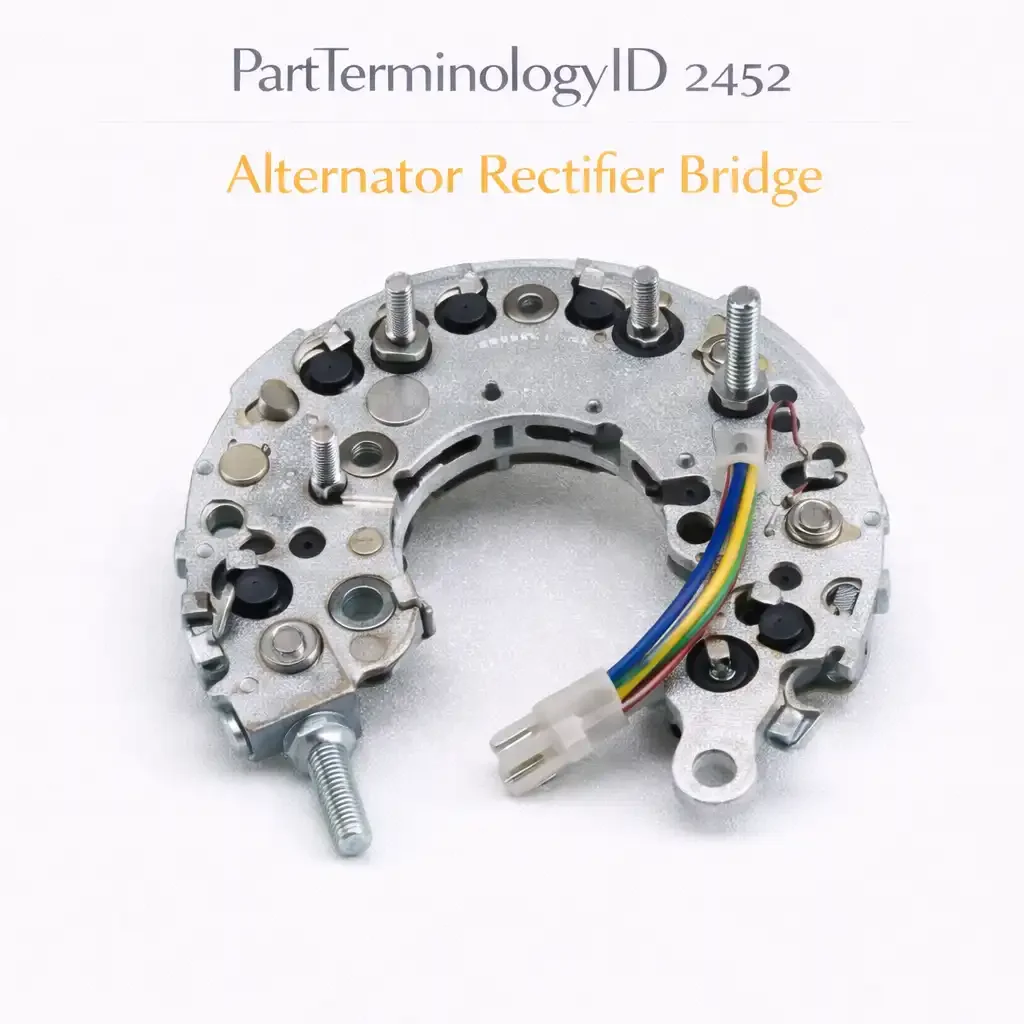
PartTerminologyID 2452, Alternator Rectifier Bridge, is the complete diode plate assembly inside the alternator that contains the six rectifier diodes, the positive and negative heat sinks, the stator connection terminals, and the output terminal connection, converting the alternator's three-phase alternating current output into the direct current that charges the battery and powers the vehicle electrical system. That definition covers the function correctly. It does not specify the alternator manufacturer and model designation the bridge is machined and assembled for, the bridge current rating in amperes, the positive heat sink configuration, the negative heat sink configuration, whether the heat sinks are separate plates or a combined assembly, the stator connection terminal count and type, whether the stator wires solder to the bridge terminals or connect through push-on or press-fit terminals, the output terminal stud diameter and thread specification, whether the diode trio is integrated into the bridge assembly or is a separate component, whether the voltage regulator mounts to the bridge or to a separate bracket, the bridge mounting stud positions and count within the alternator housing, or whether the listing covers the complete bridge assembly including new diodes or a bare replacement plate that requires the buyer to press in new diodes separately. A listing under PartTerminologyID 2452 that provides vehicle year, make, and model without the alternator model designation, the current rating, and the complete assembly scope cannot be evaluated by a technician who has confirmed the rectifier bridge as the failed component and is sourcing the replacement before opening the alternator.
For sellers, PartTerminologyID 2452 sits between the individual alternator diode listing (2440) and the complete alternator listing (2412) in the repair decision hierarchy. A technician who orders the rectifier bridge rather than individual diodes has made the decision that the complete plate replacement is more practical than pressing individual diodes into the existing plate, either because multiple diodes have failed simultaneously, because the plate itself is corroded or physically damaged, or because the labor cost of individual diode replacement on the specific alternator design exceeds the cost of the complete bridge assembly. A technician who orders the bridge rather than the complete alternator has confirmed that the stator, rotor, bearings, and brush assembly are all serviceable and that the bridge is the isolated failed component.
The additional complexity specific to this PartTerminologyID compared to the individual diode post (2440) is the assembly scope ambiguity. A rectifier bridge listing may cover a complete assembly with new diodes already pressed into the heat sinks and ready to install, or it may cover only the bare replacement heat sink plate that requires the buyer to press the original or new diodes into the new plate. The difference in labor and parts cost between these two options is substantial, and a buyer who orders a bare plate expecting a complete assembly will discover the difference when they open the packaging and find a plate without diodes.
For sellers, the listing under this PartTerminologyID is only useful if it specifies the alternator model designation, the current rating, the heat sink configuration, the stator connection terminal type, and the complete assembly scope with explicit diode inclusion status. Without those five attributes, the listing cannot confirm whether the replacement bridge matches the failed assembly or whether the buyer will need to source additional components to complete the repair.
What the Alternator Rectifier Bridge Does
Rectifying three-phase AC to DC at full output current
The rectifier bridge carries the full output current of the alternator through its six diodes and two heat sinks from the stator windings to the output terminal. On a 150-ampere alternator at full output, each of the six diodes conducts approximately 50 amperes during its one-third duty cycle. The heat sinks dissipate the power lost to the forward voltage drop across each diode, typically 0.6 to 1.0 volt per diode, which amounts to 30 to 50 watts of heat dissipated in the rectifier bridge at full output.
The heat sink mass, surface area, and thermal contact with the alternator rear housing determine how effectively the bridge dissipates this heat. An inadequately cooled bridge will reach a junction temperature that exceeds the diode's rated operating limit, accelerating diode degradation and producing premature failure. The current rating of the replacement bridge must match or exceed the alternator's rated output current to ensure adequate heat sink capacity for the thermal load.
Why the bridge fails and what conditions accelerate failure
Rectifier bridge failure is most commonly caused by one of three conditions: sustained operation above the rated output current from a chronically undercharged battery pulling maximum alternator output for extended periods, reverse voltage spikes from improper jump-starting or from disconnecting the battery while the alternator is producing full output, and moisture intrusion into the alternator housing that causes corrosion of the diode-to-heat-sink interface and increases the thermal resistance to the point where the junction temperature exceeds the rated limit at normal output current.
A replacement bridge installed without addressing the root cause of the original failure will reproduce the failure at an accelerated rate. If the original bridge failed from a chronically undercharged battery, the battery must be tested and replaced if it cannot hold the rated charge. If the original bridge failed from moisture intrusion, the alternator housing seals and vents must be inspected and the installation must prevent moisture entry. The listing should include a root cause note for each failure mode.
The diode trio integration argument
On many alternator designs, the diode trio, which supplies the self-excitation current to the voltage regulator field circuit as described in the diode trio post (2444), is integrated into the rectifier bridge assembly as a separate small diode cluster mounted on or adjacent to the main heat sink. On these designs, a complete bridge replacement includes a new trio. On designs where the trio is a separate clip-in module, the bridge replacement does not address the trio and the trio must be assessed separately.
The listing must state whether the diode trio is integrated into the bridge assembly or is separate. A buyer who has confirmed both the main bridge and the trio have failed needs to know whether one bridge replacement addresses both or whether separate trio sourcing is required.
The Specifications That Determine Correct Bridge Fitment
Alternator manufacturer and model designation
The primary fitment attribute. The bridge heat sink dimensions, the stator terminal count and type, and the mounting stud positions are all defined at the alternator model level.
Current rating
In amperes. The bridge current rating must match or exceed the alternator's rated output. A bridge rated below the alternator's output will overheat at full alternator load.
Heat sink configuration
Positive and negative heat sink shape, mounting stud count and position, and overall assembly dimensions. The bridge must fit within the alternator rear housing without contacting the rotor, the stator leads, or the brush holder.
Stator connection terminal type
Solder terminals, push-on terminals, or press-fit connections. The terminal type determines the installation procedure and the tools required.
Output terminal specification
B+ terminal stud diameter and thread pitch on the bridge assembly. Must match the charge cable terminal and the existing alternator housing port.
Assembly scope
Complete assembly with new diodes pressed in, or bare plate only. State explicitly.
Diode trio integration status
Integrated into bridge assembly or separate component. State explicitly.
Status in New Databases
PIES/PCdb: PartTerminologyID 2452, Alternator Rectifier Bridge
PIES 8.0 / PCdb 2.0: No change
Top Return Scenarios
Scenario 1: "Bare plate sent when complete assembly expected, diodes must be sourced separately"
The listing described a replacement rectifier bridge by alternator model without stating the assembly scope. The buyer expected a complete assembly with new diodes pressed in. A bare heat sink plate without diodes arrived. The buyer does not have a diode press tool and cannot press the original diodes into the new plate without risking bond wire fracture as described in the diode post (2440). The bridge installation was delayed pending sourcing of a complete assembly.
Prevention language: "Assembly scope: [complete assembly with six new diodes pressed in and ready to install / bare heat sink plate, diodes not included, buyer must press original or new diodes into replacement plate]. Verify the assembly scope before ordering. A bare plate requires a diode press tool and new diodes to complete the installation. A complete assembly is a drop-in replacement that requires only stator lead connection and mounting."
Scenario 2: "Current rating below alternator rated output, bridge overheated at full load within 15,000 miles"
The replacement bridge has a current rating of 90 amperes. The alternator is rated at 130 amperes. The vehicle operates frequently at full alternator output due to high electrical loads from an aftermarket audio amplifier and auxiliary lighting. The bridge operating temperature at full load exceeded the diode junction rating. Two diodes failed within 15,000 miles and the bridge required a second replacement.
Prevention language: "Bridge current rating: [X] amperes. Alternator rated output: [X] amperes. The bridge current rating must match or exceed the alternator rated output. A bridge rated below the alternator output will overheat at full alternator load and will fail prematurely on vehicles with high sustained electrical loads. Verify the bridge current rating against the alternator rated output before ordering."
Scenario 3: "Diode trio integrated into failed bridge, separate trio ordered unnecessarily, double parts cost"
The failed alternator has both a failed main bridge and a failed diode trio. The listing for the replacement bridge did not state whether the diode trio was integrated. The buyer ordered the bridge and the diode trio as separate parts. The replacement bridge arrived as a complete assembly with the diode trio integrated. The separately ordered trio was returned as unnecessary.
Prevention language: "Diode trio: [integrated into bridge assembly, no separate trio required / separate component, trio not included in this assembly]. If the diode trio is integrated into the bridge, a single bridge replacement addresses both the main rectifier and the excitation circuit. Verify trio integration status before ordering both components separately."
Scenario 4: "Bridge mounting studs at wrong positions, bridge contacts stator leads inside housing"
The replacement bridge has the correct alternator model designation in the listing but the heat sink mounting stud positions are from a different production run of the same alternator model. The studs are offset by 4mm from the housing mounting holes. The bridge was forced into position by elongating the mounting holes with a file. The repositioned bridge brought the positive heat sink edge into contact with one stator lead, creating an intermittent short circuit that destroyed the new bridge within 200 miles.
Prevention language: "Mounting stud positions: [X]mm center spacing, [X]mm from housing reference edge. Verify the replacement bridge mounting stud positions match your alternator housing mounting holes before installation. Do not elongate housing mounting holes to accommodate an offset bridge. A repositioned bridge may contact stator leads or the rotor, creating a short circuit that destroys the bridge immediately."
What to Include in the Listing
Core essentials
PartTerminologyID: 2452
component: Alternator Rectifier Bridge
alternator manufacturer and model designation (mandatory)
bridge current rating in amperes (mandatory)
heat sink configuration: positive and negative heat sink shape and mounting stud count (mandatory)
mounting stud positions and center spacing in mm (mandatory)
stator connection terminal count and type: solder, push-on, or press-fit (mandatory)
output terminal stud diameter and thread pitch (mandatory)
assembly scope: complete with diodes or bare plate (mandatory)
diode trio integration status: integrated or separate (mandatory)
voltage regulator mounting interface: integral or separate (mandatory where applicable)
root cause note for common failure modes: battery condition, reverse voltage protection, moisture intrusion (mandatory)
quantity: 1
Catalog Checklist for ACES/PIES Teams
PartTerminologyID = 2452
require alternator model designation (mandatory)
require current rating (mandatory)
require assembly scope with explicit diode inclusion status (mandatory)
require diode trio integration status (mandatory)
require mounting stud position specification (mandatory)
differentiate from alternator diode (PartTerminologyID 2440): individual diodes are appropriate when one or two diodes have failed and the plate is intact; the complete bridge is appropriate when multiple diodes have failed simultaneously, when the plate is corroded or damaged, or when the labor cost of individual diode pressing exceeds the bridge assembly cost
differentiate from alternator diode trio (PartTerminologyID 2444): the trio is a separate component on some alternator designs and is integrated into the bridge on others; the integration status determines whether both are addressed by a single bridge replacement
differentiate from alternator (PartTerminologyID 2412): the bridge is a sub-component repair appropriate when the stator, rotor, bearings, and brush assembly are confirmed serviceable; a complete alternator is appropriate when multiple sub-components are degraded
flag assembly scope as mandatory: bare plate versus complete assembly with diodes is the most consistent packaging expectation mismatch for this PartTerminologyID; one attribute line prevents a labor-stopping sourcing delay
flag current rating as mandatory: a bridge rated below the alternator output is a thermal failure waiting for the first sustained high-load event; the current rating must be verified against the alternator specification before ordering
Final Take for PartTerminologyID 2452
Alternator Rectifier Bridge (PartTerminologyID 2452) is the alternator sub-component PartTerminologyID where the assembly scope statement is the attribute that prevents the most common packaging expectation failure in the series: a bare plate arriving where a complete assembly was expected, stopping the repair until separate diodes and a press tool can be sourced. State it first in the attributes after the alternator model designation.
State the alternator model. State the current rating. State the heat sink configuration and mounting stud positions. State the stator terminal type. State the assembly scope explicitly. State the diode trio integration status. Include the root cause note. That is the complete specification for a technician who has confirmed the bridge as the failed component, has assessed the surrounding sub-components as serviceable, and needs only the confirmation that the replacement matches the assembly they are removing before beginning the disassembly.