
Written by Arthur Simitian | PartsAdvisory
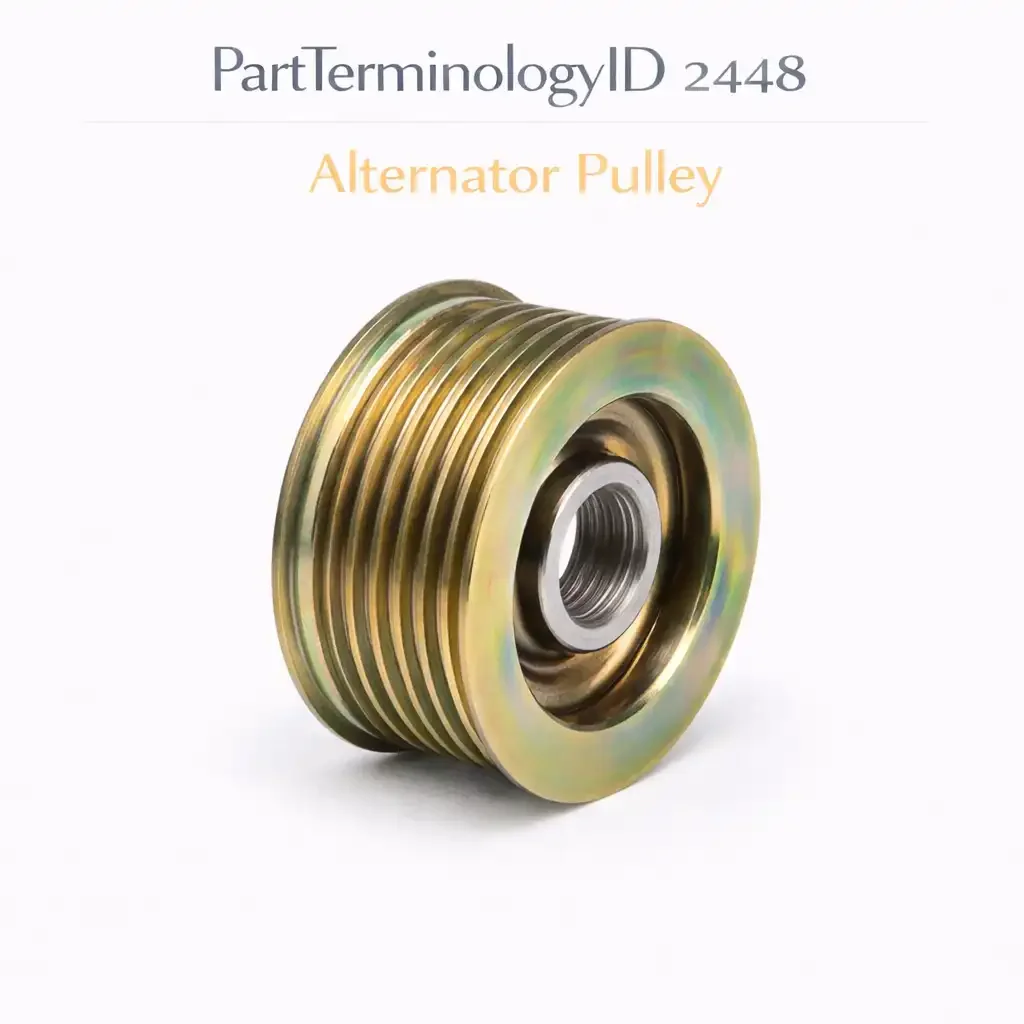
PartTerminologyID 2448, Alternator Pulley, is the belt-contact component pressed or threaded onto the alternator rotor shaft that receives mechanical energy from the engine's serpentine or V-belt drive system and transmits it to the rotor, driving the alternator at a speed determined by the ratio of the crankshaft pulley diameter to the alternator pulley diameter. That definition covers the function correctly. It does not specify the pulley type, whether it is a solid fixed pulley, an overrunning alternator pulley with a one-way clutch, or an overrunning alternator decoupler pulley with both a one-way clutch and a torsional spring, the shaft bore diameter and bore type, whether the bore is a smooth press fit, a keyed bore, or a threaded bore, the shaft thread specification for threaded retention, the pulley outer diameter, the groove profile, whether it is a multi-rib serpentine groove or a V-belt groove, the groove count for multi-rib applications, the groove width and pitch, the pulley width, the pulley material, whether the overrunning clutch engagement direction is clockwise or counterclockwise, what the spring rate is in the decoupler version, what the overrunning torque threshold is, whether the pulley is retained by a nut threaded onto the rotor shaft or by a press fit alone, or whether the listing is for the complete pulley assembly including the clutch and spring mechanism or only the outer pulley shell. A listing under PartTerminologyID 2448 that provides vehicle year, make, and model without the pulley type, the shaft bore specification, and the groove profile cannot be evaluated by any technician who has removed the alternator and is confirming the replacement pulley before pressing or threading it onto the rotor shaft.
For sellers, PartTerminologyID 2448 is the alternator component listing where the pulley type distinction is the most consequential single attribute, more consequential than any dimensional specification, because a solid pulley and a decoupler pulley of the same outer diameter and groove profile are physically interchangeable on the rotor shaft but functionally incompatible with the belt system they drive. An application designed for a decoupler pulley uses the decoupler's overrunning and spring functions to manage the belt tension spikes that occur during engine deceleration events. Removing the decoupler function by installing a solid pulley on a decoupler application does not produce an immediate installation failure: the system runs, the alternator charges, and the belt appears to track correctly. The failure appears as premature belt wear, tensioner damper wear, and eventually belt squeal or belt failure before the expected service interval, at a point removed enough from the pulley installation that the buyer does not connect the early belt failure to the solid pulley choice.
The additional complexity specific to this PartTerminologyID compared to the alternator post (2412) is that the pulley is a separately replaceable component on most alternator designs. A technician who has confirmed that the alternator itself is serviceable but the decoupler pulley has failed, either from clutch ratcheting noise, spring fatigue, or bearing failure within the decoupler mechanism, needs only the pulley, not the complete alternator. The pulley replacement is a lower-cost repair that preserves the serviceable alternator and restores the belt system to the correct dynamic behavior. A listing that does not distinguish between the solid and decoupler versions of the same diameter pulley will send the wrong type to buyers who have specifically diagnosed the decoupler as the failed component.
For sellers, the listing under this PartTerminologyID is only useful if it specifies the pulley type, the shaft bore specification, the pulley outer diameter, the groove profile and count, and the retention method. Without those five attribute categories, the listing cannot serve either the technician replacing a failed decoupler with the correct decoupler or the technician replacing a solid pulley with a dimensionally correct solid replacement.
What the Alternator Pulley Does
Transmitting belt drive energy to the rotor shaft
The pulley is the mechanical interface between the engine's accessory drive belt and the alternator rotor. The belt wraps around the pulley groove and transmits a tangential force that rotates the pulley and the rotor shaft together. The ratio of the crankshaft pulley diameter to the alternator pulley diameter determines the rotor speed at any given engine speed.
A smaller alternator pulley produces a higher rotor speed at the same engine RPM, which increases the alternator's output current at idle and at low engine speeds because the rotor cuts through the stator magnetic field at a higher rate. A larger alternator pulley produces a lower rotor speed, which reduces idle-speed output but keeps the rotor within its rated maximum speed at high engine RPM. The pulley diameter is therefore not an arbitrary dimension: it is the primary control parameter for the alternator's speed-versus-output-current curve and is matched to the alternator's stator winding design for the specific vehicle application.
Changing the pulley diameter from the OE specification to improve idle-speed charging without changing the stator winding will either overspeed the rotor at high engine RPM, exceeding the rotor's rated maximum speed and risking bearing fatigue and winding centrifugal stress, or will reduce the idle-speed output if a larger pulley is chosen for a different reason. The OE pulley diameter must be matched exactly unless the complete alternator specification is being changed simultaneously.
The solid pulley and its limitations on modern belt systems
A solid fixed pulley rotates at exactly the speed transmitted by the belt at all times. It has no mechanism to decouple from the belt during rapid deceleration events. When the engine speed drops rapidly during a fuel cut or during a coast-down event, the crankshaft decelerates and the belt decelerates with it. The alternator rotor, which has significant rotational inertia from its iron and copper mass, resists the deceleration. The rotor tends to continue rotating at the previous speed while the belt slows, creating a tension spike on the belt strand between the alternator pulley and the adjacent idler or tensioner.
This tension spike loads the belt, the tensioner spring, and the tensioner damper cyclically with every deceleration event. On engines with aggressive fuel cut strategies, which include most modern direct-injection engines and hybrid vehicles during regenerative braking events, the deceleration events are frequent and the tension spikes are large. A solid pulley on a system designed for a decoupler will produce tensioner damper wear and belt rib cracking from the repeated tension spikes before the expected belt service interval.
The overrunning alternator pulley
The overrunning alternator pulley, sometimes called a one-way alternator pulley, contains a one-way roller clutch inside the pulley bore. When the belt accelerates the pulley in the drive direction, the clutch engages and the pulley drives the rotor. When the belt decelerates, the clutch allows the pulley shell to slow with the belt while the rotor continues at the previous speed, decoupling the rotor inertia from the belt tension. The rotor coasts to the new belt speed rather than braking against the belt tension.
The overrunning pulley eliminates the deceleration tension spike entirely. The belt tension is determined only by the tensioner spring rate and the drive loads of the other accessories, not by the rotor inertia braking force. Belt life and tensioner damper life on systems with an overrunning pulley are significantly longer than on equivalent systems with a solid pulley.
The overrunning pulley does not contain a spring. It either engages and drives or overruns and coasts. There is no torsional compliance in the drive direction.
The overrunning alternator decoupler pulley
The overrunning alternator decoupler pulley contains both the one-way clutch and a torsional spring between the clutch and the outer pulley shell. The spring provides compliance in the drive direction: when the belt accelerates the pulley, the spring absorbs the initial acceleration torque and transmits it to the clutch and rotor progressively rather than as an instantaneous step input. This reduces the acceleration-direction belt tension spike as well as the deceleration-direction tension spike, providing bidirectional belt tension smoothing.
The spring rate determines the frequency range over which the decoupler is effective. A spring that is too stiff provides too little compliance and approaches the behavior of a solid pulley during acceleration events. A spring that is too soft allows excessive angular displacement between the outer shell and the rotor during drive, which can produce a chatter or ratcheting noise as the clutch intermittently re-engages at the end of the spring travel.
A worn decoupler spring that has taken a set and lost its design spring rate will allow the outer shell to travel further than designed before clutch engagement, producing a characteristic ratcheting noise under light throttle acceleration from low engine speeds. This noise is the diagnostic signature that distinguishes a worn decoupler from a worn belt or a worn tensioner.
The special tooling requirement for decoupler pulley installation and removal
Decoupler pulleys cannot be installed or removed with standard socket tools because the one-way clutch inside the pulley requires the application of the correct rotational direction to release or engage the clutch during installation and removal. Installing a decoupler pulley with the rotor stationary and turning the pulley shell in the incorrect direction will engage the clutch rather than allowing the shell to thread onto the shaft, preventing the pulley from seating correctly.
Most decoupler pulley manufacturers supply a dedicated splined tool that engages the internal spline in the pulley bore for installation and removal. The tool specification, typically a spline count and a drive size, must be stated in the listing so the buyer can confirm they have the correct tool before beginning the repair. A decoupler pulley installation attempted without the correct tool will either damage the pulley clutch mechanism or be abandoned mid-installation with the alternator partially disassembled.
The Specifications That Determine Correct Pulley Fitment
Pulley type
Solid, overrunning one-way clutch, or overrunning decoupler with clutch and spring. The primary classification attribute. State the pulley type in the listing title.
Shaft bore specification
The bore type determines the installation method. A press-fit bore requires a pulley press tool to seat the pulley on the smooth rotor shaft without damaging the shaft bearing or the alternator housing. A threaded bore is retained by a nut on the rotor shaft end and does not require pressing. A keyed bore uses a woodruff key on the shaft to prevent rotation and is retained by a nut. State the bore type and the bore diameter in millimeters to two decimal places for press-fit designs. For threaded retention, state the thread diameter, pitch, and the retention nut torque specification.
Pulley outer diameter
In millimeters. The OE diameter must be matched exactly for standard replacements. For applications where a modified diameter is being specified for a performance or idle-output upgrade, state the original OE diameter alongside the replacement diameter and note the idle-speed output change.
Groove profile and count
Multi-rib serpentine or V-belt. For multi-rib: groove count, groove width in millimeters, and groove pitch in millimeters. The groove profile must match the belt rib profile: a mismatched groove profile produces belt tracking instability, uneven rib wear, and belt noise.
Clutch engagement direction
For overrunning and decoupler pulleys: clockwise or counterclockwise engagement when viewed from the pulley face. Most domestic passenger vehicle alternators rotate clockwise when viewed from the front. State the engagement direction explicitly.
Spring rate for decoupler pulleys
In Newton-meters per degree of angular displacement. State the spring rate at the installed operating range.
Special tool requirement
For decoupler pulleys: state the installation and removal tool spline specification and the tool part number or supplier where available.
Retention nut torque specification
For threaded retention pulleys: state the retention nut torque in Newton-meters. The retention nut on a decoupler pulley is typically a left-hand thread to prevent loosening from the rotor's normal clockwise rotation tending to unscrew a conventional right-hand thread.
Material and coating
Aluminum alloy or steel. Painted, anodized, or bare. For overrunning and decoupler pulleys: state the bearing type and the bearing seal specification within the pulley mechanism.
Why This Part Generates Returns
Buyers order the wrong alternator pulley because:
a solid pulley is sent for a decoupler application because the listing did not specify the pulley type and the buyer ordered on outer diameter and groove count alone
the shaft bore diameter is not stated and the replacement bore is slightly smaller than the rotor shaft, requiring excessive press force that damages the alternator front bearing
the groove count is correct but the groove pitch is different and the belt ribs do not seat in the groove bottoms correctly, producing belt noise from the first start
the decoupler installation tool requirement is not disclosed and the buyer damages the clutch mechanism attempting installation with a standard socket
the retention nut thread is right-hand on the replacement when the application requires a left-hand thread, and the nut backs off under normal rotor rotation within the first drive cycle
the overrunning pulley engagement direction is reversed and the pulley freewheels in the drive direction rather than engaging, producing a no-charge condition from the first start
Status in New Databases
PIES/PCdb: PartTerminologyID 2448, Alternator Pulley
PIES 8.0 / PCdb 2.0: No change
Top Return Scenarios
Scenario 1: "Solid pulley sent for decoupler application, belt wear pattern appeared within 20,000 miles"
The listing specified an alternator pulley by vehicle year, make, and model without stating the pulley type. The application requires a decoupler pulley to manage the tension spikes from the engine's aggressive fuel cut strategy. A solid pulley was shipped. The buyer installed it without recognizing the type difference because the outer diameter and groove count matched visually. Within 20,000 miles, the serpentine belt developed longitudinal cracking across the rib roots and the tensioner damper showed the compressed, heat-discolored condition characteristic of repeated tension spike loading. Both required replacement.
Prevention language: "Pulley type: [solid / overrunning one-way clutch / overrunning decoupler with clutch and spring]. This application requires a [decoupler] pulley. A solid pulley installed on a decoupler application will not produce an immediate installation failure or a charging fault. The failure appears as premature serpentine belt wear and tensioner damper degradation from the repeated tension spikes that the decoupler's overrunning function was designed to absorb. Verify the pulley type before ordering."
Scenario 2: "Bore diameter 0.3mm undersized, press force damaged front bearing during installation"
The replacement pulley bore diameter is 0.3mm smaller than the OE rotor shaft diameter. The OE interference fit produces a press force of approximately 3 kilonewtons for correct installation. The undersized bore produced a press force of approximately 8 kilonewtons to fully seat the pulley. The excess press force transmitted through the rotor shaft into the front bearing inner race, displacing the bearing balls against the outer race and producing a preloaded condition that increased the bearing operating temperature by approximately 25 degrees Celsius above normal. The front bearing failed within 18,000 miles.
Prevention language: "Shaft bore diameter: [XX.XX]mm. OE rotor shaft diameter: [XX.XX]mm. Interference fit: [X.XX]mm. Verify the shaft bore diameter of the replacement pulley matches the OE specification before pressing. A bore that is more than 0.1mm undersize will require excessive press force that transmits axial load into the alternator front bearing, reducing bearing life. Do not press a pulley with an incorrect bore diameter onto the rotor shaft."
Scenario 3: "Groove pitch mismatch, belt rib bottoming in groove, noise from first start"
The replacement pulley has the correct outer diameter, the correct groove count, and the correct groove width but a groove pitch of 3.56mm compared to the OE belt rib pitch of 3.28mm. The belt ribs do not seat in the groove bottoms and instead ride on the groove flanks. The partial contact produces a high-frequency squealing noise from the first start that increases with belt load and decreases with belt tension.
Prevention language: "Groove profile: [X]-rib serpentine, groove pitch [X.XX]mm, groove width [X.XX]mm. Verify the groove pitch matches your serpentine belt rib pitch before ordering. A groove pitch mismatch of more than 0.1mm prevents the belt ribs from seating in the groove bottoms and produces belt noise from partial rib contact regardless of belt tension."
Scenario 4: "Decoupler installation without correct tool, clutch mechanism damaged, ratcheting noise on first start"
The listing did not state the decoupler installation tool requirement. The buyer attempted installation by holding the rotor stationary with a standard 17mm socket on the shaft nut and turning the pulley shell with channel-lock pliers. The incorrect installation direction engaged the clutch rather than allowing the shell to thread onto the shaft. The buyer applied increasing force in the incorrect direction, displacing the roller clutch elements within the pulley bore. The ratcheting noise that appeared on the first start confirmed that the clutch elements were damaged during installation.
Prevention language: "Installation tool required: [manufacturer] decoupler installation tool, spline specification [X]-spline [X]mm drive. The decoupler pulley clutch mechanism requires the correct splined installation tool to engage the internal pulley spline during installation and removal. The correct rotational direction for installation is [clockwise / counterclockwise] on the pulley shell with the rotor held stationary. Attempting installation with pliers, a strap wrench, or any tool that contacts the pulley outer surface rather than the internal spline will damage the clutch mechanism."
Scenario 5: "Engagement direction reversed, pulley freewheels in drive direction, no charge condition"
The replacement overrunning pulley has a counterclockwise engagement direction. The application requires a clockwise engagement direction because the rotor turns clockwise when viewed from the pulley face. With a counterclockwise-engaging pulley on a clockwise-rotating rotor, the pulley freewheels in the drive direction: the belt drives the pulley shell but the one-way clutch does not engage to drive the rotor. The rotor does not turn and the alternator produces no output from the first start.
Prevention language: "Clutch engagement direction: [clockwise / counterclockwise] when viewed from the pulley face. The engagement direction must match the alternator's rotation direction. An overrunning pulley with the reversed engagement direction will freewheel in the drive direction and will not transmit belt force to the rotor. The alternator will produce no output. Verify the engagement direction before ordering."
Scenario 6: "Left-hand retention nut thread required, right-hand nut on replacement, nut backed off within 500 miles"
The application uses a left-hand thread retention nut to prevent the nut from loosening as the rotor turns clockwise. The replacement pulley retention nut has a standard right-hand thread. With a clockwise-rotating rotor, the right-hand thread nut is turned in the loosening direction by the reaction torque from the drive load. Within 500 miles, the nut had backed off sufficiently for the pulley to be loose on the shaft, producing an intermittent squealing noise and fluctuating alternator output as the pulley slipped on the shaft.
Prevention language: "Retention nut thread: [left-hand thread / right-hand thread]. Retention nut torque: [X] Newton-meters. This application uses a [left-hand] thread retention nut. A right-hand thread nut will loosen progressively during normal rotor rotation because the clockwise rotor direction tends to unscrew a right-hand thread. Do not substitute a right-hand thread nut on a left-hand thread application. Verify the thread direction before ordering."
What to Include in the Listing
Core essentials
PartTerminologyID: 2448
component: Alternator Pulley
pulley type: solid, overrunning one-way clutch, or overrunning decoupler with clutch and spring (mandatory, in title)
shaft bore type: press-fit, keyed, or threaded (mandatory)
shaft bore diameter in mm to two decimal places for press-fit designs (mandatory)
interference fit specification in mm for press-fit designs (mandatory)
pulley outer diameter in mm (mandatory)
groove profile: multi-rib serpentine or V-belt (mandatory)
groove count for multi-rib (mandatory)
groove pitch in mm (mandatory)
groove width in mm (mandatory)
pulley width in mm (mandatory)
clutch engagement direction: clockwise or counterclockwise from pulley face for overrunning and decoupler types (mandatory)
spring rate in Newton-meters per degree for decoupler pulleys (mandatory)
installation tool specification: spline count and drive size for decoupler pulleys (mandatory)
retention nut thread direction: left-hand or right-hand (mandatory for threaded retention)
retention nut torque in Newton-meters (mandatory)
material: aluminum alloy or steel (mandatory)
compatible alternator model designation (mandatory)
quantity: 1
Fitment essentials
year/make/model/submodel
alternator model designation as primary fitment attribute alongside vehicle application
engine designation where pulley specification varies by engine within the same vehicle model
output variant where pulley diameter or type varies between standard and high-output alternator variants
Dimensional essentials
shaft bore diameter in mm to two decimal places
pulley outer diameter in mm
pulley width in mm
groove pitch in mm
groove width in mm
groove count
overall pulley depth in mm
Image essentials
pulley from the belt face showing groove count, groove profile, and outer diameter callout
pulley from the bore side showing bore type and bore diameter callout
decoupler pulley cross-section showing the clutch roller elements and the torsional spring position within the pulley body
solid pulley and decoupler pulley shown side by side at the same scale for visual type distinction
installation tool shown engaging the decoupler pulley internal spline
retention nut shown with thread direction indicated for left-hand thread applications
worn decoupler pulley shown alongside new unit with clutch element displacement visible for diagnostic reference
Catalog Checklist for ACES/PIES Teams
PartTerminologyID = 2448
require pulley type in title and type attribute field (mandatory)
require shaft bore type and bore diameter for press-fit designs (mandatory)
require pulley outer diameter (mandatory)
require groove profile, count, pitch, and width (mandatory)
require clutch engagement direction for overrunning and decoupler types (mandatory)
require spring rate for decoupler pulleys (mandatory)
require installation tool specification for decoupler pulleys (mandatory)
require retention nut thread direction for threaded retention designs (mandatory)
require retention nut torque specification (mandatory)
differentiate from alternator (PartTerminologyID 2412): the alternator is the complete generating assembly; the pulley is the separately replaceable belt-contact component; a decoupler pulley that has failed from clutch ratcheting or spring fatigue can be replaced without replacing the complete alternator if the alternator output is confirmed serviceable; a listing for the pulley as a standalone replacement must be distinct from the complete alternator listing
differentiate from serpentine belt (PartTerminologyID varies): the belt drives the pulley; the pulley drives the rotor; both are in the same drive system and are evaluated concurrently but are separate components under separate PartTerminologyIDs; note groove profile compatibility between the belt and the pulley in both listings
differentiate from belt tensioner (PartTerminologyID varies): the tensioner maintains belt tension against the pulley; on systems with a decoupler pulley, the tensioner damper experiences less cyclic loading than on solid pulley systems; replacing a failed decoupler with a solid pulley increases the tensioner load and should prompt concurrent tensioner inspection
flag pulley type as mandatory in title: the most consistent return driver for this PartTerminologyID is a solid pulley shipped for a decoupler application; the type distinction in the title is the single highest-impact change a listing can make to reduce this return category
flag decoupler installation tool as mandatory: a decoupler pulley installation attempted without the correct splined tool damages the clutch mechanism in a way that is not visible from the outside and is not detected until the ratcheting noise appears on the first start; the tool note prevents a labor-intensive double removal
flag clutch engagement direction as mandatory: a reversed engagement direction produces a no-charge condition from the first start in a way that is indistinguishable from a complete alternator failure without knowing the pulley type was installed with the wrong engagement direction
flag retention nut thread direction as mandatory: a right-hand nut on a left-hand thread application backs off within a few hundred miles; the failure appears as a loose pulley noise and intermittent charging rather than as a thread-related symptom, and the root cause is not obvious without removing the pulley
FAQ (Buyer Language)
How do I identify whether my alternator has a solid pulley or a decoupler pulley?
With the serpentine belt removed, attempt to rotate the alternator pulley by hand in the drive direction. On a solid pulley, the pulley turns the rotor with resistance from the rotor and bearing drag. The resistance is smooth and consistent in both directions. On an overrunning pulley, the pulley turns freely in the overrunning direction and engages with resistance in the drive direction. On a decoupler pulley, the pulley turns with a springy, progressive resistance in the drive direction as the torsional spring compresses, and turns freely in the overrunning direction. If you feel a springy resistance that increases progressively before clutch engagement, the pulley is a decoupler.
My decoupler pulley makes a ratcheting noise under light throttle. Is the pulley worn or is this normal?
A ratcheting noise under light throttle acceleration from low engine speeds is the diagnostic signature of a worn decoupler spring. The spring has taken a permanent set and allows the outer pulley shell to travel further than designed before the clutch re-engages. The ratcheting sound is the clutch re-engaging at the end of the excessive spring travel. This noise is not normal and indicates the decoupler pulley requires replacement. A worn decoupler spring also allows the belt tension spikes that the decoupler was designed to absorb, so belt and tensioner inspection is warranted at the same service event.
Can I replace a decoupler pulley with a solid pulley to save money?
Yes mechanically, but not without consequences. A solid pulley on a decoupler application will charge correctly and will not produce an immediate fault. The consequences appear over the belt service interval: more frequent belt replacement from tension spike fatigue cracking, earlier tensioner damper replacement from the increased cyclic load, and in some cases increased belt noise from the tension fluctuations that the decoupler was absorbing. The cost difference between a solid and decoupler pulley is typically smaller than one early belt replacement, which makes the correct decoupler pulley the lower total-cost choice over the service interval.
What is a left-hand thread and how do I identify it on my retention nut?
A left-hand thread tightens counterclockwise and loosens clockwise, the reverse of a standard right-hand thread. On an alternator retention nut, the thread direction is used to prevent the nut from loosening as the rotor rotates. Look for an L, LH, or left-hand marking stamped on the nut face or on the rotor shaft end. If no marking is visible, attempt to turn the nut counterclockwise with a wrench while holding the rotor stationary: if it tightens, it is a left-hand thread. If your replacement pulley and retention nut are not marked, verify the thread direction against the OE part number before installation.
Why does my alternator pulley need a special tool for removal and installation?
The decoupler pulley's one-way clutch mechanism means that applying torque to the outer pulley shell in the wrong direction engages the clutch rather than threading or unthreading the retention nut. The correct removal and installation procedure requires simultaneously holding the outer pulley shell stationary with the splined tool engaged in the internal spline and applying the correct rotational direction to the rotor shaft end. Standard sockets, strap wrenches, and channel-lock pliers applied to the outer pulley surface cannot apply the correct simultaneous counter-rotation and will either damage the clutch elements or be unable to develop the required removal torque without slipping.
Cross-Sell Logic
Serpentine Belt (the belt drives the alternator pulley; replace the belt when replacing a solid pulley on a system that had a worn decoupler, as the previous tension spike loading may have fatigued the belt ribs regardless of apparent external condition)
Belt Tensioner (the tensioner is inspected at every serpentine belt removal; on systems transitioning from a worn decoupler to a new decoupler, inspect the tensioner damper for compression set from the previous elevated cyclic loading)
Alternator (PartTerminologyID 2412: if the alternator front bearing has been damaged by an incorrectly pressed undersized bore pulley, the alternator may require replacement concurrent with the correctly specified pulley)
Decoupler Pulley Installation Tool (the splined installation and removal tool for the specific pulley design; cross-reference alongside every decoupler pulley listing as a mandatory concurrent purchase for buyers who do not already own the tool)
Retention Nut (the retention nut for threaded alternator pulleys is typically a torque-to-yield fastener that should be replaced at every pulley removal; cross-reference the correct thread direction and torque specification alongside the pulley listing)
Frame as "the pulley receives the belt energy and delivers it to the rotor. The belt wraps the pulley groove that the rotor spins in. The tensioner keeps the belt tight against the pulley. The decoupler spring between them absorbs the tension spikes that would otherwise load all three. All four are evaluated at the same service event when the pulley is replaced."
Final Take for PartTerminologyID 2448
Alternator Pulley (PartTerminologyID 2448) is the accessory drive component PartTerminologyID where the pulley type in the listing title is the single highest-impact attribute change available to a seller who wants to reduce returns on this SKU. A solid pulley shipped for a decoupler application does not fail at installation. It fails at 20,000 miles when the belt is worn and the tensioner is compressed, and the buyer returns the belt and the tensioner rather than the pulley that caused their early failure. That delayed, misattributed consequence is exactly what a one-word type designation in the title prevents.
The shaft bore diameter resolves the press force calculation before the pulley reaches the alternator. The groove pitch resolves the belt contact geometry before the belt is installed. The clutch engagement direction resolves the no-charge condition before the first start. The installation tool note resolves the clutch damage before the ratcheting noise appears. The retention nut thread direction resolves the backing-off failure before the first few hundred miles.
State the pulley type in the title. State the shaft bore type and diameter. State the outer diameter. State the groove profile with pitch and count. State the clutch engagement direction. State the spring rate for decouplers. State the installation tool specification. State the retention nut thread direction and torque. That is the same listing strategy as every other PartTerminologyID in this series: specific attributes at every level to become a listing buyers can act on without guessing. For PartTerminologyID 2448, the pulley type is the attribute that determines whether the belt system runs correctly for its designed service life or begins failing prematurely in a way that never points back to the pulley that started it.