
Alternator Diode Trio (PartTerminologyID 2444): Why Alternator Designation and Current Rating Determine Excitation Circuit Function
Written by Arthur Simitian | PartsAdvisory
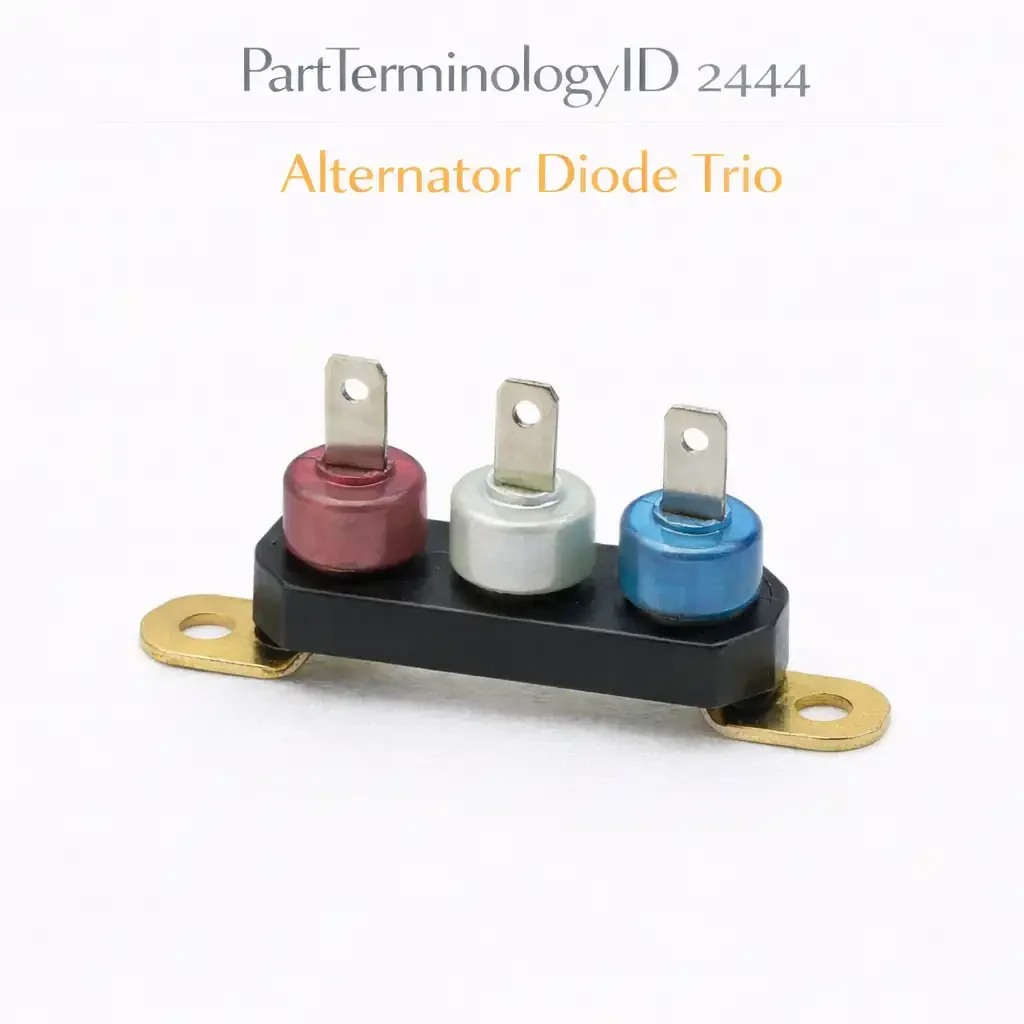
PartTerminologyID 2444, Alternator Diode Trio, is the secondary rectifier assembly inside the alternator that provides the self-excitation current to the voltage regulator and the field winding after initial alternator startup, allowing the alternator to sustain its own field current from its own output rather than drawing field current continuously from the battery. That definition covers the function accurately. It does not specify the alternator manufacturer and model designation the trio is designed for, the trio current rating, the trio forward voltage drop at rated current, the physical mounting configuration inside the alternator housing, whether the trio mounts to the main rectifier plate or to a separate bracket, the terminal connection type for the regulator excitation circuit, the number of diodes in the trio assembly, which is always three but the physical arrangement varies between alternator families, or whether the failed trio is producing a no-charge condition from loss of excitation or a battery drain condition from a shorted trio diode. A listing under PartTerminologyID 2444 that provides vehicle year, make, and model without the alternator model designation and the mounting configuration cannot be evaluated by a technician who has confirmed the trio as the failed component and is sourcing the replacement before reassembling the alternator.
For sellers, PartTerminologyID 2444 serves the same technically specific buyer population as the diode post (2440) but at a more specific diagnostic level. A technician who has identified the diode trio as the failed component has already tested the main rectifier bridge diodes individually, confirmed they are serviceable, and then tested the trio diodes and found one or more open or shorted. This is a two-step diagnostic process that narrows the buyer to a small population of alternator rebuilders and advanced DIY technicians. The listing must provide the specification confirmation this buyer needs without requiring them to cross-reference the alternator model manually from vehicle fitment.
What the Alternator Diode Trio Does
Supplying self-excitation current after initial startup
When the engine is first started, the alternator requires an initial field current from the battery to begin generating output. This initial excitation current flows from the battery through the charge warning light circuit or through a dedicated excitation wire to the voltage regulator and then to the rotor field winding. Once the alternator begins generating output, the diode trio taps three points from the stator windings, one from each phase, and rectifies a small portion of the stator output to supply the field current internally. The alternator is then self-sustaining: it generates its own field current from its own output without continuing to draw from the battery excitation circuit.
The trio diodes are separate from the main rectifier bridge diodes. The main bridge diodes rectify the full output current for battery charging and vehicle electrical load supply. The trio diodes rectify only the small current required for the field excitation circuit, typically 2 to 5 amperes depending on the alternator design and output rating.
Trio failure modes and their diagnostic signatures
A trio diode that fails open circuit removes one of the three excitation current sources from the self-excitation circuit. The alternator may continue to charge but at a reduced output because the field current is insufficient to magnetize the rotor fully. The charge warning light may remain on at idle and extinguish at higher engine speeds as the remaining two trio diodes supply marginally adequate excitation current at higher stator output voltages.
A trio diode that fails short circuit creates a direct path from that stator phase through the shorted trio diode to the regulator excitation circuit and then to ground. This produces an alternating current component on the excitation circuit that can damage the voltage regulator, and in some alternator designs, it creates a battery drain path through the shorted trio diode when the engine is off.
The diagnostic distinction between a main bridge diode failure and a trio diode failure is important for correct part selection: a main bridge diode failure produces a larger ripple on the DC output and a greater reduction in maximum output current than a trio diode failure. A trio diode failure produces a more pronounced effect on field excitation and charging warning light behavior than on the main output current.
The Specifications That Determine Correct Fitment
Alternator manufacturer and model designation
The primary fitment attribute. The trio current rating, the mounting configuration, and the terminal type are all defined at the alternator model level.
Trio current rating
In amperes per diode. The trio handles a fraction of the main bridge current but must still be rated for the field excitation current of the specific alternator output variant.
Mounting configuration
Whether the trio mounts to the main rectifier plate as an integral subassembly or as a separate clip-in module attached to the rear housing. State the mounting method to confirm the replacement seats correctly in the housing.
Terminal connection type
The connection between the trio output and the voltage regulator excitation input. Solder connection, push-on terminal, or integral connector block.
Status in New Databases
PIES/PCdb: PartTerminologyID 2444, Alternator Diode Trio
PIES 8.0 / PCdb 2.0: No change
Top Return Scenarios
Scenario 1: "Trio for wrong alternator model, mounting tab positions do not align with housing"
The listing specified the diode trio by vehicle year, make, and model without the alternator model designation. The vehicle was equipped with a high-output alternator variant that uses a different trio mounting configuration than the standard output alternator for the same vehicle. The replacement trio has mounting tabs spaced for the standard output alternator housing. The mounting tabs do not align with the bracket holes in the high-output alternator rear housing.
Prevention language: "Alternator model designation: [X]. Output variant: [standard / high-output]. Trio mounting configuration: [integral to rectifier plate / separate clip-in module]. Verify the alternator model designation and output variant before ordering. The diode trio mounting configuration varies between output variants of the same alternator family and is not interchangeable between variants."
Scenario 2: "Shorted trio diode, main bridge confirmed serviceable, charge warning light diagnosis led to main bridge replacement instead"
The charge warning light remained on at all engine speeds. The technician tested the main bridge diodes first, found them serviceable, and then tested the trio diodes, finding one shorted. A replacement trio was ordered. The listing for the trio did not include the diagnostic signature of a shorted trio diode. The technician had initially ordered main bridge diodes before the correct diagnosis was confirmed, incurring an unnecessary return.
Prevention language: "Diode trio failure diagnostic signature: a shorted trio diode produces a charging warning light that remains on at all engine speeds and may produce a small battery drain with the engine off. A failed open trio diode produces a charging warning light at idle that extinguishes at higher engine speeds. If the main bridge diodes test serviceable and these symptoms are present, the diode trio is the likely failed component. Test the trio diodes in diode test mode before ordering main bridge diodes."
Catalog Checklist for ACES/PIES Teams
PartTerminologyID = 2444
require alternator model designation (mandatory)
require output variant where trio configuration differs between variants (mandatory)
require trio current rating per diode (mandatory)
require mounting configuration: integral to rectifier plate or separate module (mandatory)
require terminal connection type (mandatory)
differentiate from alternator diode (PartTerminologyID 2440): the main bridge diodes rectify the full output current; the trio diodes rectify only the small excitation current for the field circuit; the two components are in different locations in the alternator, carry different current ratings, and produce different diagnostic signatures when they fail; they are not interchangeable
differentiate from alternator (PartTerminologyID 2412): the diode trio is a sub-component repair appropriate when the main bridge, stator, rotor, and bearings are confirmed serviceable and the trio is the isolated failed component
flag alternator model designation as mandatory: the mounting configuration difference between standard and high-output variants of the same alternator family is the most consistent fitment error for this PartTerminologyID
include diagnostic signature note: the diode trio is the least commonly diagnosed alternator sub-component; a listing that includes the diagnostic signature of trio failure prevents the unnecessary main bridge diode order that precedes the correct trio diagnosis on many repair events
Final Take for PartTerminologyID 2444
Alternator Diode Trio (PartTerminologyID 2444) is the most narrowly specified listing in the alternator sub-component series. The buyer has already tested the main bridge, confirmed it serviceable, and diagnosed the trio specifically. The listing's job is to confirm the alternator model designation, the output variant, the mounting configuration, and the current rating so the buyer can proceed without cross-referencing a separate source. Include the diagnostic signature note. The technician who arrives at this PartTerminologyID without a clear diagnostic framework has almost certainly ordered main bridge diodes first and returned them before reaching the correct diagnosis, and a one-paragraph diagnostic note in the listing prevents that sequence.