
Written by Arthur Simitian | PartsAdvisory
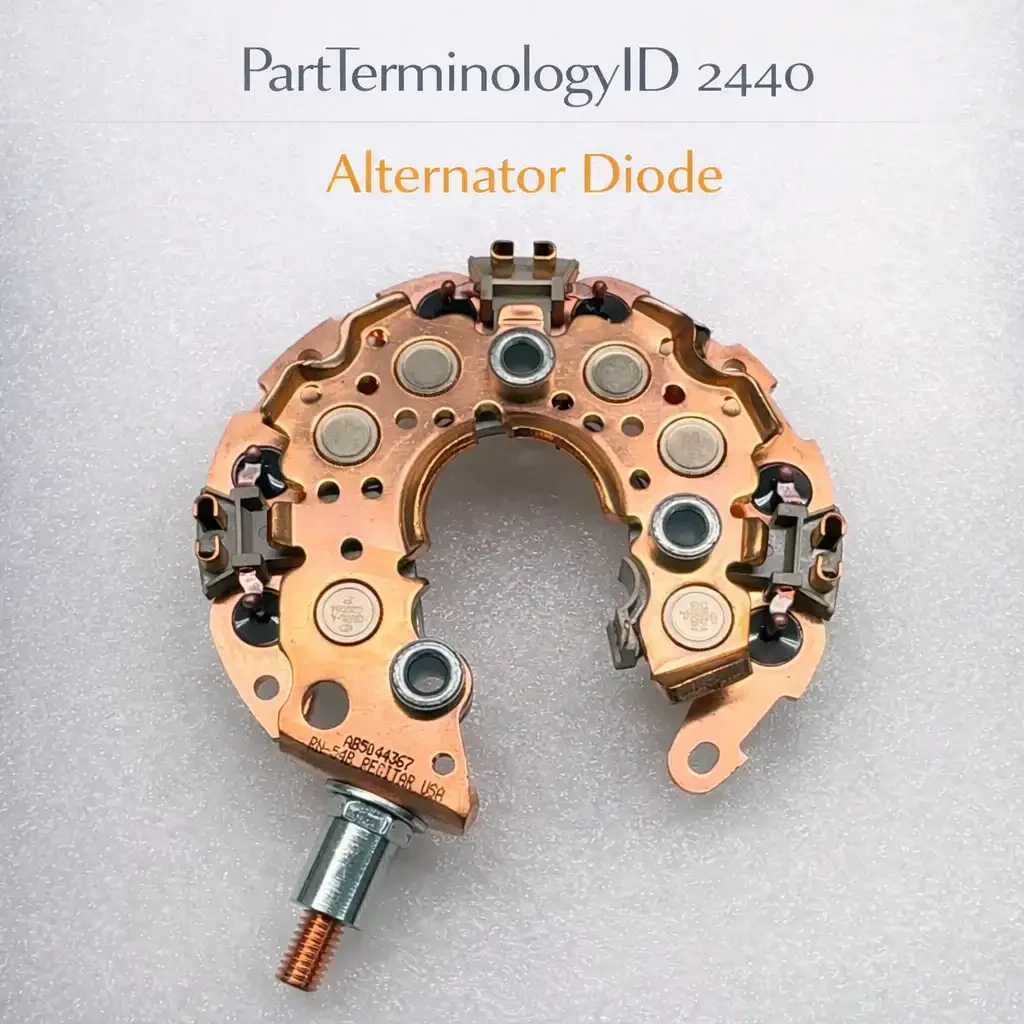
PartTerminologyID 2440, Alternator Diode, is the semiconductor rectifier element pressed into the diode plate or heat sink of the alternator's rectifier bridge assembly, conducting current in one direction only and blocking reverse voltage to convert the alternator's three-phase alternating current output into the direct current that charges the battery and powers the vehicle's electrical system. That definition covers the function correctly. It does not specify the alternator manufacturer and model designation, the diode current rating in amperes, the peak inverse voltage rating, the press-fit body diameter, the body length, the terminal type at the cathode end, whether the diode is a positive or negative rectifier diode for the corresponding heat sink in the bridge, the forward voltage drop at rated current, the thermal resistance from junction to case, whether the diode is sold individually or as a complete set of six covering all positions in the three-phase bridge, or whether the diode is a press-fit type requiring a diode press tool for installation or a bolt-in type requiring no special tooling. A listing under PartTerminologyID 2440 that provides the alternator model without the current rating, the voltage rating, the press-fit diameter, and the polarity cannot be evaluated by any technician who has identified a failed diode in the rectifier bridge and is sourcing the replacement before pressing the new diode into the heat sink.
For sellers, PartTerminologyID 2440 is the most technically demanding of the alternator sub-component listings because a diode failure diagnosis requires electrical testing with a multimeter in diode test mode and a clear understanding of which of the six positions in the three-phase bridge has failed. A technician who has correctly identified a single failed diode and wants to replace only that diode rather than the complete rectifier plate is a highly specific buyer who knows the alternator model, knows the diode position, and knows the polarity of the failed diode before searching. The listing must provide the specification confirmation that buyer needs in fewer attributes than the brush set or brush holder posts require, because the buyer population is narrower and more technically confident.
The additional complexity specific to this PartTerminologyID is the complete set versus individual diode argument. A single failed diode in a six-diode rectifier bridge that has accumulated 100,000 miles of service has five other diodes at the same age and the same thermal and electrical stress history. Replacing only the failed diode and reinstalling the alternator with five original diodes is a repair that will likely require a repeat service within a short interval when an adjacent diode fails from the same accumulated stress. The listing should present both the individual diode and the complete six-diode set and should recommend the complete set replacement as the best-practice repair.
For sellers, the listing under this PartTerminologyID is only useful if it specifies the alternator model, the current rating, the peak inverse voltage rating, the press-fit body diameter, the polarity, and whether the listing is for an individual diode or a complete set. Without those six attributes, the listing cannot confirm the replacement matches the failed diode the technician has removed and tested.
What the Alternator Diode Does
Rectifying alternating current to direct current
The three-phase stator of the alternator produces three sinusoidal alternating current waveforms, each offset from the others by 120 degrees of electrical rotation. The six diodes in the rectifier bridge, three positive and three negative, are connected in a full-wave bridge configuration that conducts the positive half-cycle of each phase through the positive heat sink to the output terminal and the negative half-cycle through the negative heat sink to the ground return. The result is a pulsating direct current with a ripple frequency six times the fundamental alternating frequency of any single phase.
Each diode conducts for approximately one-third of each complete rotor revolution during normal operation, carrying the full output current of the alternator through its one-third duty cycle. A 120-ampere alternator at full output passes approximately 40 amperes through each diode during its conduction interval. The diode junction must conduct that current with a forward voltage drop low enough that the power dissipated in the diode does not overheat the junction beyond its rated operating temperature.
Diode failure modes and their diagnostic signatures
A diode can fail in two modes: open circuit and short circuit. An open-circuit diode failure removes one of the six rectification paths from the bridge, reducing the alternator's maximum output current and increasing the ripple amplitude on the DC output. The symptom is a reduced charging voltage at high electrical loads, a battery that slowly discharges during extended high-load operation, and an increased audio system whine from the higher ripple amplitude. The charging voltage may appear adequate at light loads and only drop below the battery's requirement during heavy loads such as air conditioning, headlights, and heating blower running simultaneously.
A short-circuit diode failure provides a reverse current path from the battery through the failed diode into the stator winding and back to ground, continuously discharging the battery even when the engine is off. The symptom is a battery that drains overnight or within a few days of parking. A short-circuit diode failure is confirmed by disconnecting the main charge cable from the alternator B+ terminal and measuring current flow from the battery through the disconnected cable to the alternator: any measurable current with the engine off confirms a shorted diode or a shorted rectifier plate.
The heat sink polarity and diode orientation
The six diodes in a three-phase rectifier bridge are divided into two groups of three: three positive diodes pressed into the positive heat sink with the cathode connected to the heat sink, and three negative diodes pressed into the negative heat sink with the anode connected to the heat sink. The physical difference between a positive and negative diode of the same current rating is the direction of the semiconductor junction relative to the body and terminal: in a positive diode the cathode is the press-fit body that contacts the heat sink, and in a negative diode the anode is the press-fit body.
Installing a positive diode in a negative heat sink position, or vice versa, reverses the rectification function of that position and produces an immediate short-circuit failure when the alternator is run, because the reversed diode provides a direct conduction path for reverse current rather than blocking it.
The polarity must be stated in the listing as positive or negative, and the heat sink position must be confirmed before the diode is pressed into place.
The press-fit installation and the diode press tool requirement
Press-fit diodes are installed by pressing the diode body into a precision-bored hole in the heat sink with a force fit that provides both mechanical retention and thermal contact between the diode body and the heat sink. The press-fit requires a diode press tool, which is a stepped cylindrical driver sized to bear against the diode body rim rather than the diode terminal, preventing the axial load of the press operation from being transmitted through the terminal into the semiconductor junction.
Pressing a diode into the heat sink without a diode press tool, using a socket or a bolt and nut arrangement that contacts the terminal rather than the body rim, transmits the press load through the terminal pin into the junction. The resulting stress fractures the junction bond wires inside the diode body, producing a diode that passes electrical testing immediately after installation but fails open circuit within a few hours of operation from the fractured bond wire.
The listing must state that a diode press tool is required for press-fit diode installation and must identify the correct driver diameter for the specific diode body size.
The Specifications That Determine Correct Diode Fitment
Alternator manufacturer and model designation
Primary fitment attribute. The diode current rating, voltage rating, and press-fit diameter are defined at the alternator model level.
Current rating
In amperes at the operating junction temperature. For a 120-ampere alternator with six diodes, each diode must be rated for the peak phase current, which exceeds the average output current. State the rated current and the junction temperature at which it is rated.
Peak inverse voltage rating
The maximum reverse voltage the diode must block without avalanche breakdown. For 12-volt system alternators, the minimum PIV rating is typically 50 to 100 volts to accommodate load dump transients as described in the capacitor post (2432). State the PIV rating explicitly.
Press-fit body diameter
In millimeters to two decimal places. The interference fit between the diode body and the heat sink bore provides the thermal contact that conducts junction heat to the heat sink. An undersized diode body will seat loosely in the bore, producing high thermal resistance and junction overheating at rated current.
Polarity
Positive or negative. State which heat sink position the diode is designed for.
Individual or complete set
Whether the listing covers one diode or the complete six-diode set for all positions in the bridge. State the set quantity and whether it includes both positive and negative diodes.
Diode press tool requirement and driver diameter
State that a diode press tool is required and specify the correct driver diameter for this diode body size.
Status in New Databases
PIES/PCdb: PartTerminologyID 2440, Alternator Diode
PIES 8.0 / PCdb 2.0: No change
Top Return Scenarios
Scenario 1: "Wrong polarity, reversed diode in heat sink, immediate short-circuit failure on first run"
The listing specified a diode by alternator model without stating the polarity. The buyer needed a negative heat sink diode. The positive diode arrived. The reversed diode was pressed into the negative heat sink position and the alternator was reassembled and installed. On the first start, the reversed diode conducted reverse current through the negative heat sink, immediately overheating and failing short-circuit. The rectifier plate was destroyed beyond the individual diode replacement threshold and the complete plate required replacement.
Prevention language: "Diode polarity: [positive heat sink / negative heat sink]. Verify the polarity before pressing the diode into the heat sink. A positive diode installed in a negative heat sink position will conduct reverse current on the first alternator run and will fail immediately, destroying the rectifier plate. Polarity is not visible from the diode body exterior and must be confirmed from the part specification before installation."
Scenario 2: "Press-fit with socket driver, terminal loaded, bond wire fractured, diode failed open within 4 hours"
The technician pressed the replacement diode into the heat sink bore using a deep socket that contacted the diode terminal rather than the body rim. The press load was transmitted through the terminal pin into the semiconductor junction. The bond wire connecting the terminal pin to the silicon junction fractured under the axial load. The diode passed a multimeter diode test immediately after installation. Within four hours of alternator operation, the fractured bond wire separated completely and the diode failed open circuit, reproducing the original reduced-output symptom.
Prevention language: "Installation tool required: diode press tool with [X.X]mm driver diameter. The press tool must contact the diode body rim only, not the terminal. A socket or improvised driver that contacts the terminal transmits the press load through the terminal pin to the semiconductor junction, fracturing the internal bond wires. A bond wire fracture produces a diode that passes electrical testing at installation and fails open circuit within a few hours of operation."
Scenario 3: "Individual diode replaced, adjacent diode failed within 8,000 miles, alternator removed twice"
The buyer replaced one failed diode and reinstalled the alternator with the original five remaining diodes at 115,000 miles. At 123,000 miles, an adjacent diode failed from the same accumulated thermal stress. The alternator was removed, disassembled, and the second diode replaced. Total labor for two individual diode replacements exceeded the labor for a single complete set replacement that would have addressed all six positions simultaneously.
Prevention language: "Individual diode or complete set: [individual / complete 6-diode set]. At high mileage, all six diodes in the rectifier bridge have accumulated the same thermal and electrical stress history. Replacing only the failed diode and reinstalling with five original diodes is likely to require a repeat removal and disassembly within a short interval when an adjacent diode fails from the same accumulated stress. Complete set replacement at the first diode failure is the lower total-labor repair on high-mileage alternators."
What to Include in the Listing
Core essentials
PartTerminologyID: 2440
component: Alternator Diode
alternator manufacturer and model designation (mandatory)
current rating in amperes at junction temperature (mandatory)
peak inverse voltage rating in volts (mandatory)
press-fit body diameter in mm to two decimal places (mandatory)
body length in mm (mandatory)
polarity: positive or negative heat sink (mandatory)
terminal type at cathode or anode end (mandatory)
forward voltage drop at rated current in volts (mandatory)
individual diode or complete six-diode set (mandatory)
set composition for complete sets: positive diode count and negative diode count (mandatory)
diode press tool requirement and correct driver diameter (mandatory)
quantity: 1 or 6 (mandatory)
Catalog Checklist for ACES/PIES Teams
PartTerminologyID = 2440
require alternator model designation (mandatory)
require current rating (mandatory)
require peak inverse voltage rating (mandatory)
require press-fit body diameter (mandatory)
require polarity (mandatory)
require individual versus complete set designation (mandatory)
require diode press tool note with driver diameter (mandatory)
differentiate from alternator rectifier (PartTerminologyID varies): the rectifier is the complete diode plate assembly including the heat sinks, the six diodes, and the plate structure; the individual diode is the semiconductor element pressed into the plate; a cracked or corroded plate requires rectifier replacement; a failed diode with an intact plate allows individual diode replacement under 2440
differentiate from alternator (PartTerminologyID 2412): individual diode replacement is appropriate only when the stator, rotor, bearings, and plate are confirmed serviceable; a complete alternator replacement is appropriate when multiple components are degraded
flag polarity as the highest-consequence attribute: a reversed diode destroys the rectifier plate on the first start; no other single attribute error in the alternator sub-component series produces an irreversible failure at the moment of first use
flag press tool requirement as mandatory: a bond wire fracture from terminal-loaded pressing produces a diode that passes electrical testing and fails in service, generating a warranty return that appears to be a defective part but is an installation damage event
Final Take for PartTerminologyID 2440
Alternator Diode (PartTerminologyID 2440) is the alternator sub-component PartTerminologyID where polarity is the attribute that determines whether the repair succeeds or destroys the rectifier plate on the first start, and where the press tool requirement is the attribute that determines whether a correctly specified diode survives its first four hours of operation. Both are invisible in a product photo. Both must be stated.
State the alternator model. State the current rating and the PIV rating. State the press-fit body diameter. State the polarity. State individual or complete set. State the press tool driver diameter. Recommend the complete set at high mileage. That is the complete specification for the technically confident buyer who has already diagnosed the failed position and needs only the confirmation before pressing the replacement into the heat sink.