
Written by Arthur Simitian | PartsAdvisory
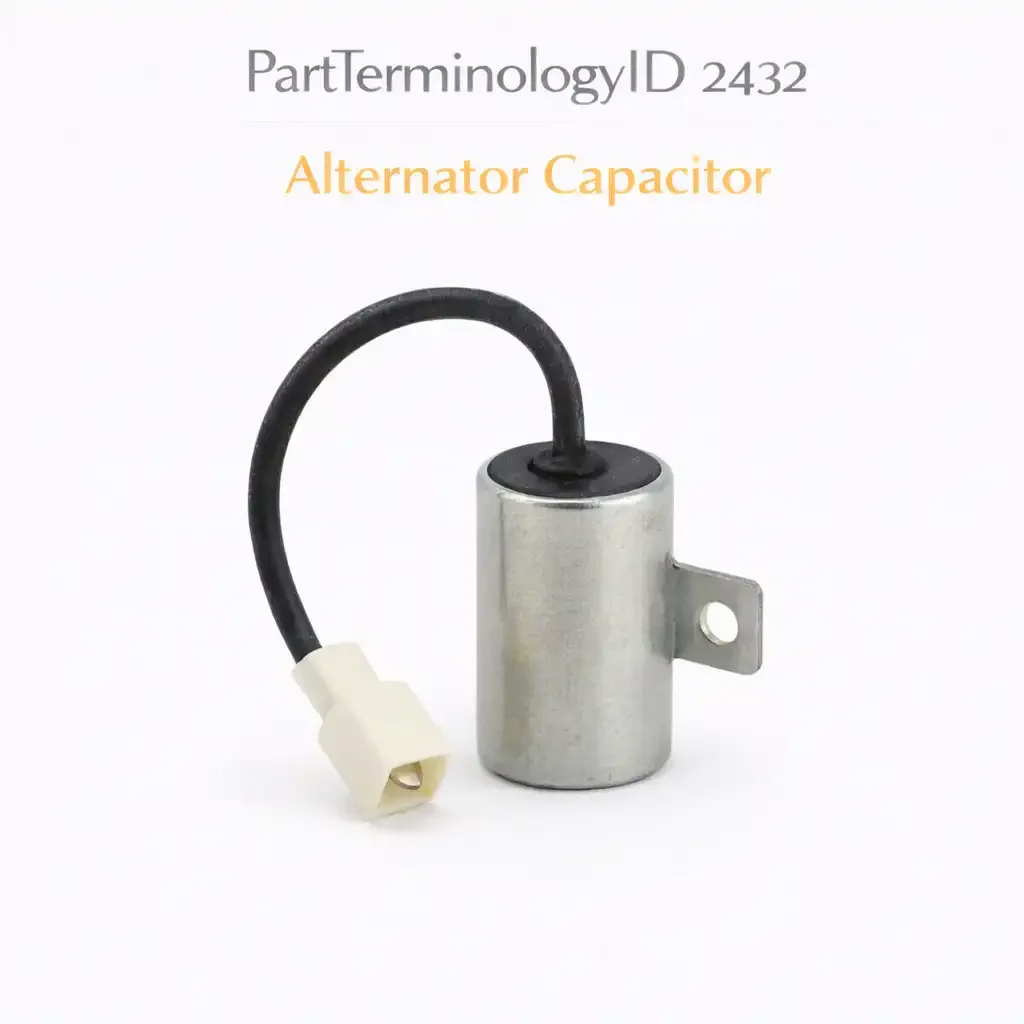
PartTerminologyID 2432, Alternator Capacitor, is the radio frequency suppression capacitor mounted at or near the alternator output terminal that filters the high-frequency electrical noise generated by the alternator's rectifier diodes and prevents that noise from propagating through the vehicle's electrical system into the audio system, the radio receiver, and other sensitive electronics. That definition covers the function accurately. It does not specify the capacitance value in microfarads, the voltage rating, the terminal type and connection method, the physical mounting configuration, which alternator or vehicle application the capacitor is designed for, whether the capacitor mounts directly to the alternator B+ terminal stud, to a bracket near the alternator, or to the battery positive terminal, or whether the capacitor is a direct OE replacement for a factory-installed suppression component or an aftermarket addition to a vehicle that was not originally equipped with one. A listing under PartTerminologyID 2432 that does not state the capacitance value, the voltage rating, and the terminal connection method cannot be evaluated by any technician who is diagnosing an alternator whine in the audio system and is sourcing the correct suppression component before beginning the installation.
For sellers, PartTerminologyID 2432 serves two distinct buyer populations with different needs. The first is a technician replacing a failed OE suppression capacitor on an alternator that was originally equipped with one from the factory. This buyer needs an exact OE-equivalent replacement with the same capacitance, the same voltage rating, and the same terminal configuration as the original. The second is a buyer adding aftermarket radio frequency suppression to a vehicle that produces alternator whine in the audio system after an aftermarket head unit or amplifier installation. This buyer needs a capacitor with adequate capacitance and voltage rating for the application but has more flexibility on the physical configuration because they are fabricating their own installation rather than replacing an OE component.
The listing must identify which buyer population it serves and provide the corresponding specification depth.
What the Alternator Capacitor Does
Filtering rectifier ripple from the electrical system
The alternator's rectifier bridge converts three-phase alternating current to direct current using six diodes. The switching action of the diodes as each phase conducts and then blocks produces a high-frequency voltage ripple on the DC output. This ripple, typically in the range of 50 to 400 millivolts peak-to-peak at normal charging voltage, is superimposed on the 14-volt DC supply and propagates through the charge cable to the battery bus and from there to every electrical circuit in the vehicle.
Audio systems, AM and FM radio receivers, and digital electronics are sensitive to this ripple because its frequency falls within the audible range or within the radio frequency interference range depending on the engine speed and the number of diode pairs in the rectifier. The symptom is an alternator whine from the audio system that changes pitch proportionally with engine speed and is present whenever the engine is running and the audio system is on.
The suppression capacitor shunts the high-frequency ripple component to ground at the alternator output terminal, preventing it from entering the main electrical bus. A capacitor with adequate capacitance and a low equivalent series resistance at the ripple frequency provides a low-impedance path for the ripple current that bypasses the audio system and the radio receiver.
The capacitance value and its relationship to ripple frequency
The capacitance value determines the impedance the capacitor presents to the ripple frequency. A higher capacitance produces a lower impedance at the same frequency, providing more effective shunting of the ripple current to ground. For typical alternator ripple frequencies in the 300 to 2,000 Hz range, a capacitance of 0.47 to 2.2 microfarads is the typical effective range for audio frequency suppression.
A capacitor with inadequate capacitance for the ripple frequency will not provide sufficient attenuation and the whine will persist at reduced amplitude. A capacitor with excessive capacitance for the application introduces no harm but adds unnecessary cost and physical bulk.
The voltage rating safety requirement
The capacitor voltage rating must exceed the maximum voltage the alternator output terminal can produce under any operating condition, including load dump transients. A load dump transient occurs when a high-current electrical load is suddenly disconnected while the alternator is producing full output current. The resulting voltage spike can reach 60 to 80 volts on a 12-volt system for a brief duration. A capacitor rated for only 16 volts will fail immediately from a load dump transient, short-circuiting the alternator output and potentially blowing the main fuse.
The minimum voltage rating for an alternator suppression capacitor on a 12-volt system is 50 volts. A 100-volt rating provides additional margin for severe load dump conditions.
The Specifications That Determine Correct Fitment
Capacitance value
In microfarads. State the value and the tolerance. For OE replacement applications, match the OE value exactly. For aftermarket suppression applications, state the minimum effective value for the vehicle's ripple frequency range.
Voltage rating
Minimum 50 volts for 12-volt system applications. State the actual rating of the specific capacitor.
Terminal type and connection method
Direct stud mount to the alternator B+ terminal, ring terminal for cable connection, or bracket mount with lead wire. State the terminal inner diameter for stud-mount designs.
OE replacement or aftermarket suppression
State which buyer population the listing serves. For OE replacement, provide the OE part number cross-reference. For aftermarket suppression, state the installation position recommendation: alternator B+ terminal or battery positive terminal.
Status in New Databases
PIES/PCdb: PartTerminologyID 2432, Alternator Capacitor
PIES 8.0 / PCdb 2.0: No change
Top Return Scenarios
Scenario 1: "Voltage rating too low, capacitor failed on load dump transient, main fuse blown"
The replacement capacitor was rated for 16 volts. A sudden disconnection of the rear window defroster at full alternator output produced a load dump transient that exceeded the capacitor's voltage rating. The capacitor failed short-circuit, blowing the main alternator fuse and leaving the vehicle without charging until the fuse was replaced and the failed capacitor was removed.
Prevention language: "Voltage rating: [X] volts. Minimum voltage rating for 12-volt system alternator suppression: 50 volts. Load dump transients on a 12-volt system can reach 60 to 80 volts for brief durations when high-current loads are suddenly disconnected at full alternator output. A capacitor rated below 50 volts will fail destructively on a load dump transient."
Scenario 2: "Capacitance too low, whine attenuated but not eliminated, buyer returned as ineffective"
The capacitor has a capacitance of 0.1 microfarads. The listing described it as an alternator noise suppression capacitor without stating the capacitance value. At the vehicle's alternator ripple frequency of approximately 800 Hz, the 0.1 microfarad capacitor presents an impedance too high to effectively shunt the ripple current to ground. The whine amplitude was reduced by approximately 40 percent but remained audible. The buyer returned the capacitor as not working.
Prevention language: "Capacitance value: [X.X] microfarads. For effective suppression of alternator ripple in the 300 to 2,000 Hz range, a capacitance of 0.47 microfarads minimum is recommended. A capacitance below 0.47 microfarads will reduce but not eliminate audible alternator whine in most audio system applications."
Catalog Checklist for ACES/PIES Teams
PartTerminologyID = 2432
require capacitance value in microfarads with tolerance (mandatory)
require voltage rating with minimum 50-volt note for 12-volt system applications (mandatory)
require terminal type and connection method (mandatory)
require OE replacement or aftermarket suppression designation (mandatory)
differentiate from alternator (PartTerminologyID 2412): the capacitor is a suppression accessory, not a generating component; a failed capacitor does not prevent alternator output but allows ripple noise into the electrical system; an alternator that produces whine in the audio system is not necessarily a failed alternator
flag voltage rating as the safety-critical attribute: a capacitor rated below 50 volts on a 12-volt system is a load dump failure waiting for the first high-current disconnect event; the voltage rating must be stated prominently and the 50-volt minimum must be noted
Final Take for PartTerminologyID 2432
Alternator Capacitor (PartTerminologyID 2432) is the shortest listing in the alternator sub-component series and the one where the voltage rating is the only safety-critical attribute. The capacitance value determines whether the suppression is effective. The voltage rating determines whether the capacitor survives the electrical environment it is installed in. Both must be stated. A listing that states neither and relies on a product photo and a vehicle fitment line will sell capacitors to buyers who install them, experience a load dump failure, blow a main fuse, and return the capacitor as defective when it was simply undersized for the transient voltage environment of any 12-volt charging system.