
Written by Arthur Simitian | PartsAdvisory
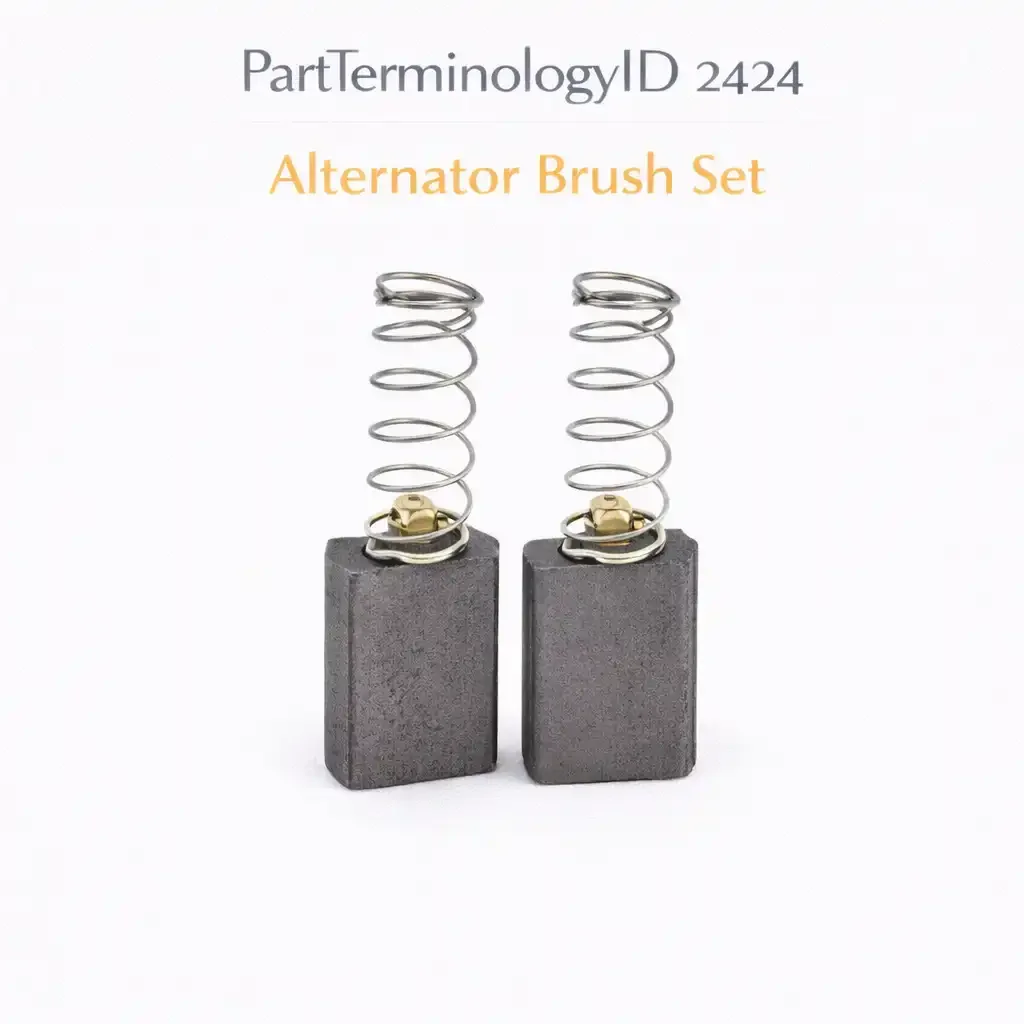
PartTerminologyID 2424, Alternator Brush Set, is the pair of carbon composite blocks that conduct field current from the stationary voltage regulator circuit to the rotating rotor winding through continuous sliding contact with the slip rings on the rotor shaft. That definition covers the function correctly. It does not specify the alternator manufacturer and model designation the brush dimensions are machined for, the brush length, width, and depth in millimeters, the minimum serviceable brush length below which reliable contact cannot be maintained, the brush material grade and carbon composite formulation, the spring type and spring force at the installed brush length, whether the set includes the springs or requires the original springs to be reused, the brush terminal type, whether the terminals are soldered pigtails or press-fit clips, the pigtail wire gauge and length where pigtail terminals are used, the brush holder compatibility for the specific alternator model, or whether the brush set is for the standard output alternator or for a high-output variant of the same alternator family that uses a different brush grade to handle the higher field current. A listing under PartTerminologyID 2424 that provides vehicle year, make, and model without the alternator model designation and the brush dimensions cannot be evaluated by a technician who has the worn brushes on the bench and is measuring against the minimum serviceable length before ordering the replacement set.
For sellers, PartTerminologyID 2424 serves the same technically specific buyer population as the brush holder post (2420): a technician who has opened the alternator, confirmed the brushes are below the minimum serviceable length or are chipped and contaminated, and has decided to perform a component-level repair rather than replace the complete alternator. The brush set is the lowest-cost repair option in the alternator sub-component series and is appropriate when the rotor slip rings are within serviceable limits, the brush holder is undamaged, and the rest of the alternator passes electrical testing. A brush set replacement on a confirmed-serviceable alternator extends the alternator's service life by the full brush wear interval, which on most passenger vehicle and light truck alternators is 50,000 to 80,000 additional miles.
The additional complexity specific to this PartTerminologyID compared to the brush holder post is the brush material grade argument. Carbon brushes for alternator applications are not a single material: they are a composite of carbon, graphite, copper, and proprietary additives blended in proportions that determine the brush's electrical conductivity, the wear rate against the slip ring, the coefficient of friction, and the thermal resistance. A brush set with the correct dimensions but the wrong material grade will produce one of two failure modes: it will wear the slip rings faster than the OE brush grade, requiring slip ring resurfacing or rotor replacement that costs far more than the alternator itself, or it will wear itself faster than the OE grade and reach the minimum serviceable length before the expected service interval, producing a no-charge condition that the buyer attributes to a defective brush set rather than a material grade mismatch.
For sellers, the listing under this PartTerminologyID is only useful if it specifies the alternator model designation, the brush dimensions, the minimum serviceable length, the brush material grade, the spring specification and inclusion status, and the terminal type. Without those six attributes, the listing cannot prevent the slip ring wear consequence that a dimensionally correct but grade-incorrect brush set produces over its service life.
What the Alternator Brush Set Does
Conducting field current through sliding contact
The field current that magnetizes the rotor's iron core and creates the magnetic field the stator windings cut through is supplied to the rotating rotor winding through the two slip rings and the two brushes. The brushes press against the slip rings under spring tension and maintain electrical contact through the full rotation of the rotor at speeds ranging from approximately 2,000 RPM at engine idle to 10,000 RPM or more at high engine speeds.
The contact is a sliding electrical contact, not a rolling contact. The brush surface slides against the slip ring surface continuously, wearing both surfaces at a rate determined by the contact pressure, the surface speed, the current density, and the material pairing between the brush composite and the slip ring material. The contact pressure from the spring must be high enough to maintain electrical contact through rotor vibration and through the slight eccentricity that develops in the slip rings as the rotor ages, but low enough to avoid accelerating brush and slip ring wear beyond the designed rate.
The slip ring condition as a prerequisite for brush replacement
A brush set replacement that is performed without inspecting and resurfacing the slip rings will reproduce the original failure pattern faster than the first brush set wore out if the slip rings are grooved, eccentricity, or contaminated from the worn original brushes. Carbon dust from brushes that are worn to the minimum serviceable length coats the slip ring surface and can be pressed into the slip ring material under the spring load, creating a contamination layer that acts as an abrasive against the new brushes.
The correct procedure before installing a new brush set is to clean the slip ring surface with electrical contact cleaner, measure the slip ring diameter against the minimum serviceable specification, and check for groove depth and eccentricity with a dial indicator. A slip ring that is below the minimum diameter, grooved deeper than 0.3mm, or eccentric beyond 0.05mm TIR requires resurfacing on a lathe before the new brushes are installed. A brush set installed on damaged slip rings will wear out in a fraction of the designed service interval.
The listing must include a slip ring inspection note as part of the installation instruction.
The high-output alternator brush grade argument
Many alternator families are produced in standard output and high-output variants. A 120-ampere standard output alternator and a 200-ampere high-output alternator may share the same housing, the same rotor and stator dimensions, and the same brush holder, but the field current required to produce 200 amperes of output is higher than the field current for 120 amperes of output. The higher field current passes through the brushes and produces more resistive heating at the brush-to-slip-ring contact zone.
A brush set rated for the standard output field current installed in a high-output alternator will experience accelerated thermal degradation at the contact zone because the brush material is not formulated for the higher current density. The brush composite softens at the elevated temperature and the wear rate increases. The slip ring develops a polished, slightly concave wear pattern from the softened brush material rather than the uniform flat contact of a correctly rated brush.
The listing must state whether the brush set is rated for the standard output or high-output variant of the alternator family, and must not allow substitution between output variants under the same listing.
The spring specification and spring inclusion status
The brush spring maintains the contact pressure between the brush face and the slip ring surface throughout the brush wear interval from full length to minimum serviceable length. As the brush wears shorter, the spring extends from its compressed installed position toward its free length, and the contact force changes as a function of the spring rate and the extension distance.
A spring with a rate that is too high will produce excessive contact pressure that accelerates both brush and slip ring wear. A spring with a rate that is too low will produce inadequate contact pressure that allows the brush to bounce on the slip ring surface at high rotor speeds, producing arcing at the contact zone that pits the slip ring and burns the brush face.
The spring rate and the installed contact force at the new brush length and at the minimum serviceable brush length must both be within the alternator manufacturer's specification. A spring that meets the contact force specification at the new brush length but falls below the minimum contact force before the brush reaches minimum serviceable length will produce a contact loss failure before the brush is fully consumed, wasting the remaining brush material.
Whether the springs are included in the brush set or must be reused from the original must be stated explicitly. Springs that have been in service through the previous brush wear interval may have taken a set and no longer produce the design contact force at the minimum brush extension. Best practice is to replace the springs at every brush replacement event regardless of visible condition, and the listing should recommend this.
The Specifications That Determine Correct Brush Set Fitment
Alternator manufacturer and model designation
The primary fitment attribute. The brush dimensions, the material grade, and the spring specification are all defined at the alternator model level.
Brush dimensions
Length, width, and depth in millimeters. All three dimensions must match the brush holder bore exactly. A brush that is narrower than the bore will tilt in the bore and produce uneven contact across the brush face width. A brush that is wider than the bore will bind in the bore and intermittently stick rather than sliding freely under spring pressure.
Minimum serviceable brush length
The length in millimeters below which the spring can no longer maintain adequate contact force against the slip ring. State this dimension to allow technicians to assess whether original brushes are still serviceable before ordering a replacement set.
Brush material grade
The carbon composite formulation code or grade designation. For OE-equivalent replacements, state the OE grade specification. For performance or extended-service grades, compare the wear rate and slip ring compatibility to the OE specification.
Output variant compatibility
Standard output or high-output. State the field current rating the brush material is formulated for.
Spring specification and inclusion
Spring rate in Newtons per millimeter, contact force at new brush length and at minimum serviceable length, and whether springs are included in the set.
Terminal type
Soldered pigtail with wire gauge and length, or press-fit clip. State the terminal type and the connection method at the brush holder.
Set quantity
Two brushes per set for standard single rotor alternators. State the quantity explicitly.
Status in New Databases
PIES/PCdb: PartTerminologyID 2424, Alternator Brush Set
PIES 8.0 / PCdb 2.0: No change
Top Return Scenarios
Scenario 1: "Correct dimensions, wrong material grade, slip rings grooved within 20,000 miles"
The replacement brush set has the correct length, width, and depth for the alternator model. The material grade is a generic carbon composite rather than the OE copper-graphite grade specified for this alternator. The generic grade has a higher copper content that produces a lower brush wear rate but a higher slip ring wear rate than the OE specification. Within 20,000 miles, the slip rings developed a 0.4mm groove at the brush contact track. The slip rings required lathe resurfacing to remove the groove before another brush set could be installed. The resurfacing cost exceeded the cost of the brush set itself.
Prevention language: "Brush material grade: [OE-equivalent copper-graphite composite / grade code]. The brush material grade determines the wear rate against the slip ring surface as well as the brush wear rate. A brush grade with a higher copper content than the OE specification will wear the slip rings faster than the designed rate, producing grooves that require slip ring resurfacing before the next brush set reaches the end of its service life. Specify only the OE-equivalent material grade for standard service applications."
Scenario 2: "High-output alternator, standard-grade brushes, brush face softened from field current heat, premature failure at 15,000 miles"
The vehicle has a 200-ampere high-output alternator. The brush set was listed for the alternator model without distinguishing between the standard 120-ampere and the 200-ampere high-output variants. The standard-grade brushes were installed in the high-output alternator. The higher field current produced elevated temperatures at the brush-to-slip-ring contact zone that exceeded the standard-grade brush material's thermal limit. The brush face softened and the wear rate increased. The brushes reached minimum serviceable length at 15,000 miles rather than the expected 60,000-mile interval.
Prevention language: "Output variant: [120A standard output / 200A high-output]. This brush set is rated for the [X]-ampere output variant of the [alternator model]. The high-output and standard output variants of this alternator family use different brush material grades because the field current and contact zone temperature differ between variants. Do not install standard-output brush grades in a high-output alternator."
Scenario 3: "Springs not included, original springs reused, contact force below minimum at mid-brush-life, intermittent charge loss"
The brush set listing did not state spring inclusion status. The buyer assumed springs were included. No springs were in the packaging. The buyer reused the original springs, which had taken a permanent set over the previous brush wear interval. At approximately half the new brush length, the extended original springs no longer produced the minimum specified contact force against the slip rings. The brushes began to bounce at high rotor speeds, producing intermittent arcing and a charging warning light that appeared at highway speed and cleared at idle.
Prevention language: "Springs: [included / not included]. Replace the brush springs at every brush replacement event. Springs that have been in service through the previous brush wear interval may have taken a permanent set and will no longer produce the minimum contact force at the extended position corresponding to mid-brush wear. A spring below the minimum contact force allows the brush to bounce on the slip ring at high rotor speed, producing arcing that damages the slip ring surface and the brush face."
Scenario 4: "Slip rings not inspected, grooved from original worn brushes, new brushes at minimum length within 12,000 miles"
The original brushes had worn to the minimum serviceable length and left a carbon dust contamination layer on the slip rings. The buyer replaced the brushes without cleaning or measuring the slip rings. The abrasive carbon contamination pressed into the slip ring surface accelerated the new brush wear rate by approximately four times. The new brushes reached minimum serviceable length at 12,000 miles.
Prevention language: "Slip ring inspection required before brush installation. Clean the slip ring surface with electrical contact cleaner and inspect for groove depth, eccentricity, and contamination before installing new brushes. Carbon dust from worn brushes pressed into the slip ring surface acts as an abrasive against new brushes and produces premature brush failure. A slip ring with grooves deeper than 0.3mm or eccentricity greater than 0.05mm TIR requires lathe resurfacing before new brush installation."
Scenario 5: "Brush width wider than holder bore, brush binds intermittently, no-charge condition at hot soak"
The replacement brushes are 0.3mm wider than the brush holder bore dimension for this alternator model. At room temperature, the brushes slide freely enough to seat against the slip rings under spring pressure. After the alternator reaches operating temperature, the brush material expands thermally and the brushes bind in the holder bore, sticking in the retracted position rather than following the spring extension. The alternator produced no output after the first 20 minutes of operation when the alternator reached full operating temperature.
Prevention language: "Brush width: [X.X]mm. Brush holder bore width: [X.X]mm. Verify the brush dimensions match the holder bore exactly. A brush that is even 0.2mm wider than the bore will bind in the bore at operating temperature due to thermal expansion of the brush material. A bound brush held in the retracted position by bore friction produces a no-charge condition that appears only after the alternator warms to operating temperature and disappears when it cools, which is the diagnostic signature of a brush dimension mismatch rather than a rotor or stator failure."
What to Include in the Listing
Core essentials
PartTerminologyID: 2424
component: Alternator Brush Set
alternator manufacturer and model designation (mandatory)
output variant: standard or high-output with field current rating (mandatory)
brush length in mm (mandatory)
brush width in mm (mandatory)
brush depth in mm (mandatory)
minimum serviceable brush length in mm (mandatory)
brush material grade or OE-equivalent designation (mandatory)
spring included: yes or no (mandatory)
spring rate in N/mm and contact force at new and minimum brush length (mandatory)
terminal type: soldered pigtail with wire gauge and length, or press-fit clip (mandatory)
slip ring inspection note (mandatory)
quantity: 2 brushes per set (mandatory)
compatible brush holder designation cross-reference (mandatory)
Catalog Checklist for ACES/PIES Teams
PartTerminologyID = 2424
require alternator model designation (mandatory)
require output variant with field current rating (mandatory)
require all three brush dimensions: length, width, depth (mandatory)
require minimum serviceable brush length (mandatory)
require brush material grade (mandatory)
require spring inclusion status with spring specification (mandatory)
require slip ring inspection note (mandatory)
differentiate from alternator brush holder (PartTerminologyID 2420): the brush holder retains the brushes in position; the brush set is the consumable carbon composite blocks that wear against the slip rings; both may be replaced concurrently but are separate components under separate PartTerminologyIDs
differentiate from alternator (PartTerminologyID 2412): the brush set is a sub-component repair; the complete alternator replacement is appropriate when the rotor, stator, or bearings are damaged beyond the brush and holder service; the brush set is appropriate only when those components are confirmed serviceable
flag output variant as mandatory: standard and high-output brush grades for the same alternator model are not interchangeable; a standard-grade brush in a high-output application is the most consistent premature failure driver for this PartTerminologyID
flag spring inclusion as mandatory: reused springs below minimum contact force at extended position is the second most consistent premature failure driver; a one-line inclusion statement prevents it
Final Take for PartTerminologyID 2424
Alternator Brush Set (PartTerminologyID 2424) is the alternator sub-component PartTerminologyID where the brush material grade is as consequential as the brush dimensions, because a dimensionally correct brush of the wrong grade either destroys the slip rings from the outside in or destroys itself from the inside out before the expected service interval. The grade argument is invisible in a product photo and is never deduced from a dimension alone. It must be stated.
State the alternator model designation. State the output variant. State all three brush dimensions and the minimum serviceable length. State the material grade. State whether springs are included with the contact force specification. State the terminal type. Include the slip ring inspection note. That is the complete specification for a buyer who has done the diagnostic work and needs only the confirmation that the replacement matches the OE grade that kept the slip rings serviceable for the previous brush interval.