
Written by Arthur Simitian | PartsAdvisory
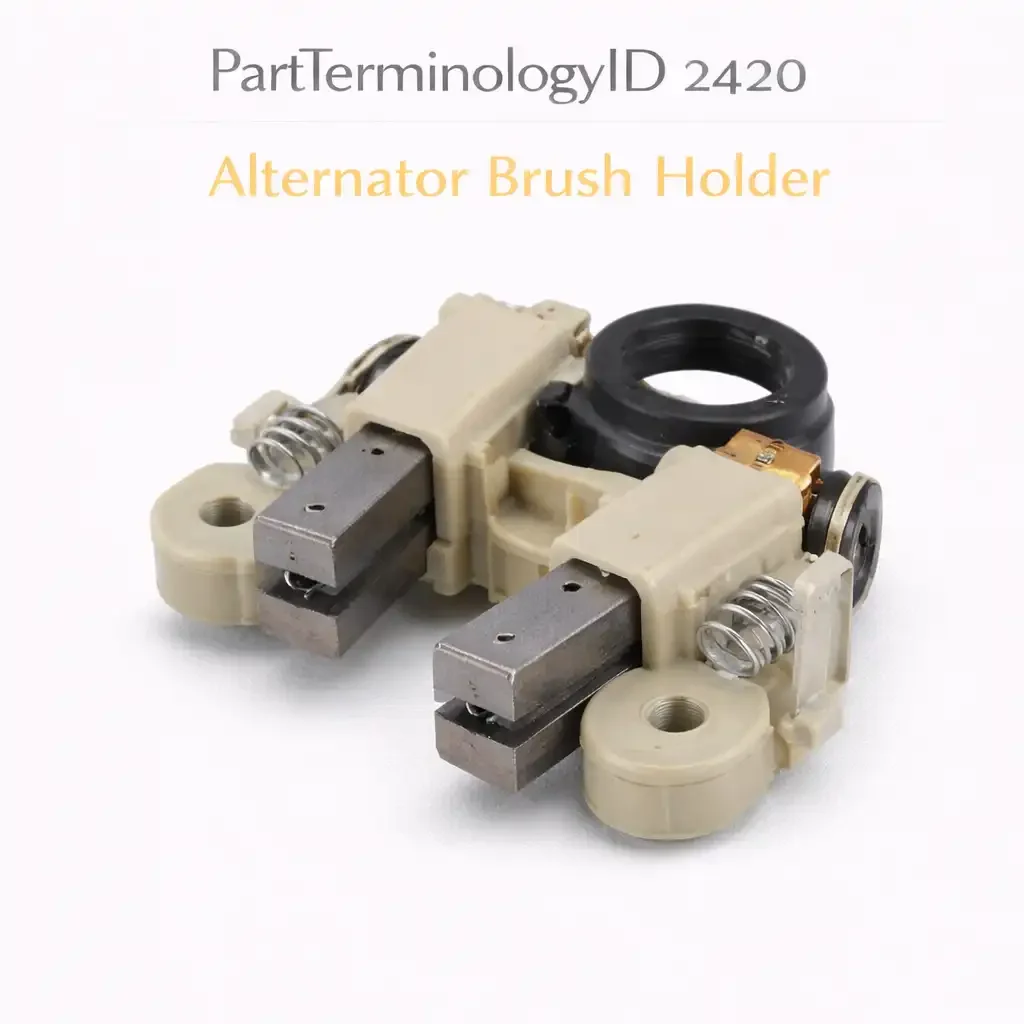
PartTerminologyID 2420, Alternator Brush Holder, is the plastic or composite component inside the alternator that retains the carbon brushes in correct alignment against the rotor slip rings and maintains the spring tension that keeps the brushes in continuous contact with the slip ring surfaces. That definition covers the function accurately. It does not specify the alternator manufacturer and model designation, the brush bore diameter and spacing, the brush spring specification, whether the holder is sold with or without brushes, the terminal configuration for the regulator circuit connections, the holder retention method inside the alternator housing, or whether the holder is an individual serviceable component on the specific alternator design or is integrated into the voltage regulator assembly such that a holder replacement requires a regulator replacement. A listing under PartTerminologyID 2420 that provides vehicle year, make, and model without the alternator designation and the brush bore specification cannot be evaluated by a technician who has disassembled the alternator and confirmed the brush holder as the failed component.
For sellers, PartTerminologyID 2420 serves a technically specific buyer who has already opened the alternator, inspected the slip rings, measured the brush length against the minimum serviceable specification, and confirmed that the brushes and holder require replacement while the rotor, stator, and bearings remain serviceable. This buyer is not replacing the complete alternator: they are performing a component-level repair that extends the alternator's service life at a fraction of the cost of a complete replacement. The listing must serve that buyer's need to confirm exact component compatibility before ordering.
What the Alternator Brush Holder Does
Maintaining brush contact against the slip rings
The carbon brushes conduct the field current from the stationary regulator circuit to the rotating rotor winding through the slip rings on the rotor shaft. The brush holder aligns each brush perpendicular to its slip ring surface and applies spring pressure to maintain continuous contact as the brush wears. As the brush wears shorter over its service life, the spring extends to maintain the contact force until the brush reaches its minimum length and can no longer make reliable contact.
A brush holder with a cracked bore, a collapsed spring, or a melted terminal insulator produces intermittent field current supply to the rotor, which produces an intermittent or absent alternator output. The symptom is a battery warning light that comes and goes rather than a consistent no-charge condition, which is the diagnostic signature that distinguishes a brush holder or brush failure from a diode failure in the rectifier bridge.
Holder integration with the voltage regulator
On many alternator designs, particularly Bosch and Valeo units common on European vehicle applications, the brush holder is a separate serviceable component that can be unclipped or unbolted from the rear housing without removing the voltage regulator. On Delco-style alternators common on GM applications and on many Denso units, the brush holder and the voltage regulator are integrated into a single assembly. On integrated designs, replacing only the brush holder requires sourcing the complete regulator-holder assembly, which is listed under the voltage regulator PartTerminologyID rather than the brush holder PartTerminologyID.
The listing must state whether the brush holder is a standalone serviceable component or is integrated with the voltage regulator, and must direct the buyer to the correct PartTerminologyID if the integrated design applies.
The Specifications That Determine Correct Fitment
Alternator manufacturer and model designation
The primary fitment attribute. Brush bore diameter, spacing, and spring specification are all defined by the alternator model.
Brush bore diameter and spacing
State in millimeters. Two bores must align with the two slip rings on the rotor shaft. An offset bore positions the brush off-center on the slip ring and produces uneven wear and intermittent contact.
Brush inclusion
Brushes included or brushes not included. State explicitly. A buyer who needs brushes and a holder and orders a holder without brushes must source the brushes separately, which delays the repair.
Terminal configuration
The solder, clip, or screw terminal connections for the regulator field circuit. The terminal positions must match the alternator's internal wiring layout.
Integration status
Standalone holder or integrated regulator-holder assembly. If integrated, cross-reference the correct voltage regulator PartTerminologyID.
Status in New Databases
PIES/PCdb: PartTerminologyID 2420, Alternator Brush Holder
PIES 8.0 / PCdb 2.0: No change
Top Return Scenarios
Scenario 1: "Integrated regulator design, standalone holder ordered, holder is not a separate component on this alternator"
The listing specified a brush holder by vehicle year, make, and model without stating the integration status. The alternator in the vehicle is a Delco SI-series with an integrated regulator-holder assembly. There is no standalone brush holder available for this alternator: the holder is part of the regulator casting. The buyer disassembled the alternator expecting to unclip a standalone holder and found no separable holder component.
Prevention language: "Brush holder integration: [standalone, separable from voltage regulator / integrated, brush holder and voltage regulator are a single assembly]. This alternator uses an [integrated] regulator-holder design. The brush holder is not available as a separate component. Replace the complete voltage regulator assembly, which includes the brush holder."
Scenario 2: "Brushes not included, buyer assumed complete repair kit, second order required"
The listing stated brush holder without noting brush inclusion. The buyer assumed brushes were included because replacing the holder without new brushes is not a complete repair. The holder arrived without brushes. A second order for the brush set was required, extending the vehicle downtime.
Prevention language: "Brushes: [included / not included]. If brushes are not included, specify brush set [part number] for a complete brush and holder repair. Installing a new holder with worn original brushes that are below the minimum serviceable length will reproduce the original failure within a short service interval."
Catalog Checklist for ACES/PIES Teams
PartTerminologyID = 2420
require alternator manufacturer and model designation (mandatory)
require brush bore diameter and spacing (mandatory)
require brush inclusion status (mandatory)
require integration status with cross-reference to voltage regulator PartTerminologyID for integrated designs (mandatory)
differentiate from alternator (PartTerminologyID 2412): the brush holder is a serviceable sub-component; the complete alternator is the assembly; specify the brush holder only when the rotor, stator, and bearings are confirmed serviceable and the brush holder is the isolated failed component
differentiate from voltage regulator (PartTerminologyID varies): on integrated designs, the brush holder is part of the regulator assembly and is listed under the regulator PartTerminologyID, not 2420
Final Take for PartTerminologyID 2420
Alternator Brush Holder (PartTerminologyID 2420) is the alternator sub-component PartTerminologyID where the integration status disclosure is the attribute that prevents a disassembled alternator from sitting on the bench waiting for a part that does not exist as a separate component. State the alternator designation. State the bore dimensions. State whether brushes are included. State whether the holder is standalone or integrated. For integrated designs, cross-reference the voltage regulator listing. That is the complete specification for a buyer who has already done the diagnostic work and needs only the confirmation that the replacement matches what they removed.