
Alternator Bracket (PartTerminologyID 2416): Where Engine Designation, Mounting Point Geometry, and Adjustment Slot Configuration
Written by Arthur Simitian | PartsAdvisory
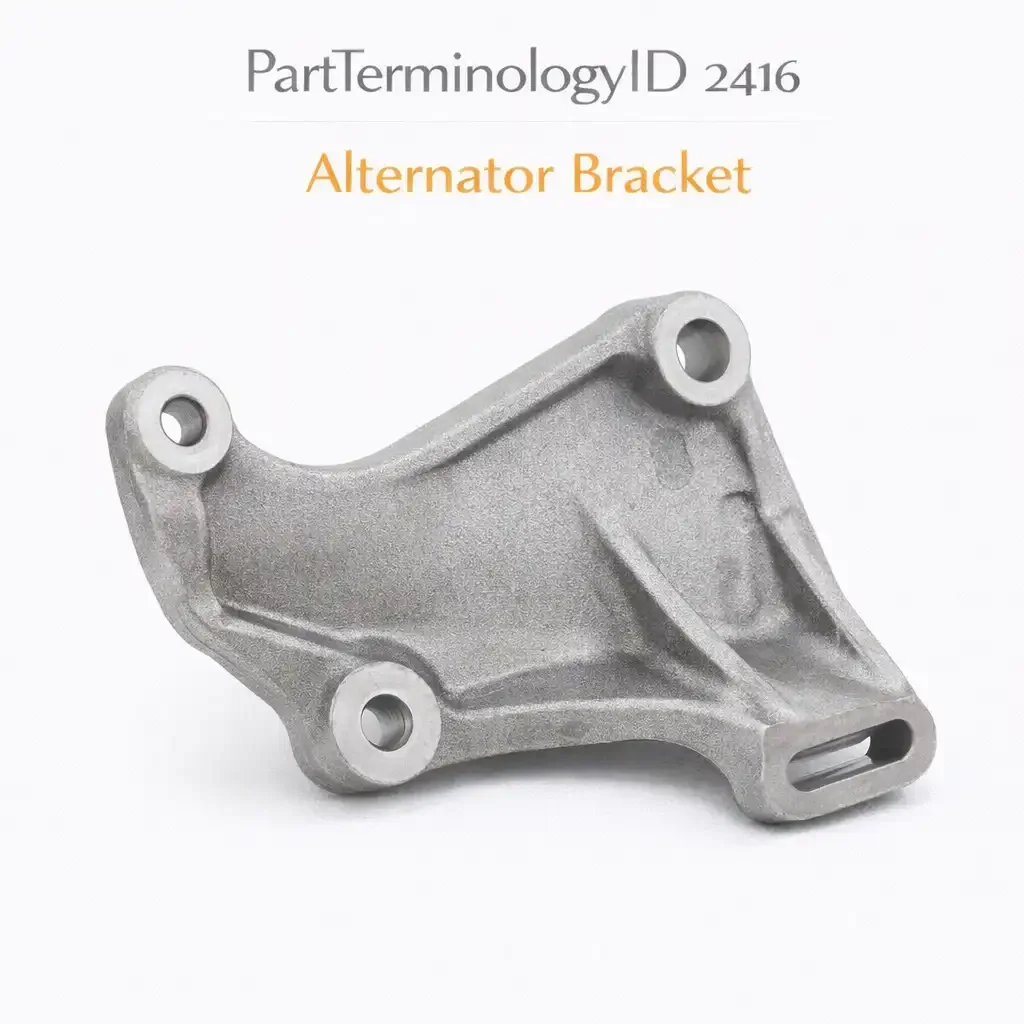
PartTerminologyID 2416, Alternator Bracket, is the structural casting or fabricated steel component that mounts the alternator to the engine block, cylinder head, or accessory drive structure and positions the alternator in the correct location relative to the serpentine belt or V-belt drive system. That definition locates the bracket at the engine-to-alternator interface. It does not specify the engine designation, the bracket mounting point positions on the engine block or head, the alternator ear mounting hole positions and diameters on the bracket face, the bracket material, whether the bracket is a fixed-position bracket or an adjustable bracket with a belt tension adjustment slot, the adjustment slot length and arc, whether the bracket is a pivot bracket or a tensioner bracket in a two-bracket adjustment system, the bolt specifications at each engine mounting point, the belt system type the bracket supports, whether the bracket includes an integral tensioner provision or works in conjunction with a separate automatic tensioner, or whether the bracket is a direct OE replacement or an aftermarket fabricated bracket for a custom engine swap application. A listing under PartTerminologyID 2416 that provides vehicle year, make, and model without the engine designation, the mounting point geometry, and the adjustment configuration cannot be evaluated by any technician who has a cracked or missing bracket and is confirming the replacement before removing the alternator and the belt.
For sellers, PartTerminologyID 2416 is a lower-volume but high-consequence listing compared to the alternator itself (PartTerminologyID 2412). The bracket is typically replaced only when it is cracked from impact damage, stripped at a mounting hole thread from overtorquing, corroded beyond serviceable condition, or missing from an engine that is being rebuilt or swapped. Because the bracket is replaced infrequently compared to the alternator, the buyer population is concentrated at the technically specific end: rebuilders, engine swap fabricators, and shops replacing a damaged bracket after an accessory drive failure. These buyers have the original bracket in hand or a clear photograph of the original, and they are matching dimensions rather than relying on a general vehicle fitment description.
The additional complexity specific to this PartTerminologyID is the engine designation dependency. A single vehicle platform may have been offered with two, three, or more engine options across its production run, and each engine may have a different alternator bracket design because the accessory drive layout, the belt routing, and the alternator mounting position are all specific to the engine configuration rather than the vehicle body. A listing that specifies the vehicle year, make, and model without the engine designation cannot resolve which bracket applies when the vehicle was available with multiple engine options that use different bracket designs.
For sellers, the listing under this PartTerminologyID is only useful if it specifies the engine designation, the bracket type and position in the accessory drive system, the mounting point geometry, the alternator ear mounting dimensions, the adjustment configuration, and the bolt specifications at each mounting point. Without those six attribute categories, the listing cannot be evaluated against the specific bracket position the buyer has identified.
What the Alternator Bracket Does
Positioning the alternator in the accessory drive system
The alternator bracket performs two functions simultaneously: it provides structural support for the alternator against the belt tension load and the alternator's own weight, and it positions the alternator at the correct location relative to the belt drive system so that the alternator pulley is aligned with the other pulleys in the drive path.
Belt alignment is critical for both belt longevity and bearing longevity in the alternator. A pulley that is out of plane with the adjacent pulleys by more than approximately one degree of angular misalignment produces a tracking force on the belt that drives the belt toward one edge of the pulley groove, accelerating edge wear on the belt ribs and producing a lateral load on the alternator front bearing that shortens bearing life. The alternator bracket must position the alternator pulley in the same plane as the crankshaft pulley, the idler pulleys, and the other accessory pulleys within the angular tolerance specified by the belt manufacturer.
A cracked or bent bracket that has shifted the alternator position even slightly from the designed location may not be immediately obvious from belt noise or vibration, but it will produce accelerated belt and bearing wear that appears as a recurring serpentine belt failure before the expected service interval.
The pivot bracket and tensioner bracket system
On V-belt accessory drive systems and on some older serpentine belt systems, belt tension is adjusted manually by pivoting the alternator away from the engine on a pivot bracket and locking it in the tensioned position with a separate tensioner bracket. The pivot bracket provides the pivot point at one end of the alternator mounting and the tensioner bracket provides the adjustment slot through which a bolt is tightened to lock the alternator at the tensioned belt position.
On these two-bracket systems, the pivot bracket and the tensioner bracket are distinct components with different mounting point geometries and different functions. A listing for one bracket must clearly identify whether it is the pivot bracket or the tensioner bracket, because the two components are not interchangeable even when they appear similar in overall dimensions.
On modern serpentine belt systems with an automatic spring-loaded tensioner, the alternator is typically mounted on a fixed bracket without an adjustment slot because the automatic tensioner maintains belt tension without any manual adjustment. The fixed bracket positions the alternator at a single defined location and the automatic tensioner absorbs belt length variation from wear and temperature changes. On these systems, a bracket replacement is a direct dimensional swap with no belt tension adjustment required after installation.
The bracket as a structural component in the accessory drive load path
The alternator bracket carries the belt tension load from the alternator pulley back into the engine structure. On a serpentine belt system with a 100-pound belt tension at the alternator pulley, the bracket must transmit that 100-pound load through its mounting points to the engine block or head without deflecting beyond the alignment tolerance of the pulley system.
A bracket that is undersized in cross-section for the belt tension load will flex under operating conditions, causing the alternator pulley to move cyclically with each belt tension variation. This dynamic misalignment produces a belt tracking instability that manifests as a belt squeal that comes and goes with engine load changes rather than being a constant noise.
The bracket material and cross-section must be adequate for the belt tension load of the specific engine and accessory drive configuration. A fabricated steel bracket for a high-output engine with a heavy belt tension must use the correct material grade and cross-section rather than being scaled from a bracket designed for a lower-output engine.
Bracket mounting to the engine block versus cylinder head
Alternator brackets mount to the engine block, the cylinder head, or both, depending on the engine design and the alternator position in the accessory drive. A bracket that mounts to the cylinder head must use the correct thread pitch and bolt length for the head bolt holes, because using a bolt that is too long in a cylinder head threaded hole can contact an internal passage or a coolant jacket, producing a coolant leak or a distorted head bolt hole that compromises head gasket sealing.
The listing must specify at each mounting point whether the bolt threads into the engine block or the cylinder head, the thread diameter and pitch at each point, and the maximum bolt length at each point to prevent bottoming in a blind hole or contacting an internal passage in a through-hole.
The Specifications That Determine Correct Bracket Fitment
Engine designation
The engine designation is the primary fitment attribute. State the displacement, the configuration, and the production year range. For engines where the accessory drive layout changed within the same displacement and configuration during the production run, state the production date break that defines the correct bracket.
Bracket type and position
Pivot bracket, tensioner bracket, or fixed-position bracket. For two-bracket adjustment systems, state which bracket this listing covers. For fixed-position brackets on automatic tensioner systems, state that the belt tension adjustment is performed by the automatic tensioner rather than the bracket.
Alternator ear mounting dimensions
The bolt hole positions and diameters on the bracket face where the alternator ears attach. State the distance between the upper and lower alternator ear bolt hole centers in millimeters, the bolt hole diameters, and whether the holes are round for fixed-position brackets or slotted for adjustment brackets.
Adjustment slot specification
For adjustable brackets: the slot length in millimeters, the slot width in millimeters, and the arc radius of the slot if it follows a curved adjustment path rather than a straight slot.
Engine mounting point positions and bolt specifications
The bolt hole positions on the bracket where it attaches to the engine. State the bolt hole diameters, the thread pitch at each mounting point, and the maximum bolt length at each point. State whether each mounting point threads into the block or the head.
Material
Cast iron, cast aluminum, stamped steel, or fabricated steel. The material affects the weight, the corrosion resistance, and the structural rigidity of the bracket under belt tension loading.
Why This Part Generates Returns
Buyers order the wrong alternator bracket because:
the engine designation is not specified and the vehicle was available with multiple engines that use different bracket designs
the pivot bracket and the tensioner bracket for the same engine are confused and the wrong bracket in the two-bracket set is ordered
the alternator ear mounting hole positions on the replacement bracket are slightly different from the original and the alternator will not bolt to the bracket without elongating the holes
the engine mounting point bolt hole threads are a different pitch from the engine's tapped holes and the mounting bolts do not engage correctly
the bracket is ordered for a fixed-position automatic tensioner system but the engine uses a manual adjustment pivot bracket, and the replacement has no adjustment slot
Status in New Databases
PIES/PCdb: PartTerminologyID 2416, Alternator Bracket
PIES 8.0 / PCdb 2.0: No change
Top Return Scenarios
Scenario 1: "Multiple engine options on same vehicle platform, wrong engine designated, bracket mounting holes do not align with block"
The vehicle was available with a 4.6-liter and a 5.4-liter V8 engine. The two engines have different accessory drive layouts and different alternator bracket mounting point positions on the engine block. The listing specified the vehicle year, make, and model without the engine designation. The buyer's vehicle has the 5.4-liter. The replacement bracket was cast for the 4.6-liter engine mounting point positions. The bracket will not bolt to the 5.4-liter block because the mounting holes do not align.
Prevention language: "Engine designation: [4.6L V8 / 5.4L V8]. Bracket mounting point positions are specific to the engine designation and are not interchangeable between engines in the same vehicle platform. Verify your engine displacement and configuration before ordering. The alternator bracket for the 4.6L and the 5.4L are different castings with different mounting point geometries."
Scenario 2: "Pivot bracket ordered when tensioner bracket needed, adjustment system incomplete"
The engine uses a two-bracket manual belt adjustment system consisting of a pivot bracket at the lower alternator mount and a tensioner bracket with an adjustment slot at the upper mount. The listing offered both brackets under the same PartTerminologyID without distinguishing the bracket type. The buyer ordered one unit expecting the tensioner bracket with the adjustment slot. The pivot bracket arrived. The belt cannot be tensioned without the adjustment slot of the tensioner bracket.
Prevention language: "Bracket type: [pivot bracket, lower alternator mount / tensioner bracket with adjustment slot, upper alternator mount]. This engine uses a two-bracket belt adjustment system. The pivot bracket and the tensioner bracket are separate components. Verify which bracket position requires replacement before ordering. The pivot bracket has round bolt holes and no adjustment slot. The tensioner bracket has a slotted adjustment arc. They are not interchangeable."
Scenario 3: "Alternator ear hole positions offset from original, technician elongated holes, belt misalignment"
The replacement bracket has alternator ear bolt hole positions that are 5mm offset from the original bracket's positions. The alternator's lower ear bolt hole aligns correctly but the upper ear bolt hole is 5mm too high on the replacement bracket face. The technician elongated the upper hole to achieve alignment. The alternated bolt hole allowed the alternator to sit slightly lower than the designed position. The alternator pulley is now 3mm out of plane with the adjacent idler pulley. Belt tracking noise appeared within 5,000 miles.
Prevention language: "Alternator ear mounting hole positions: upper hole center [X]mm from bracket reference face, lower hole center [X]mm from bracket reference face. Hole diameter: [X]mm. Verify alternator ear bolt hole positions against your original bracket before installation. Do not elongate alternator ear mounting holes to achieve alignment: a mispositioned alternator produces pulley misalignment that causes belt tracking noise and accelerated belt and bearing wear."
Scenario 4: "Head bolt hole thread pitch mismatch, mounting bolt cross-threaded into cylinder head"
The replacement bracket's upper mounting point threads into a cylinder head bolt hole. The original bracket used an M10x1.25 bolt at this position. The replacement bracket's hole is dimensioned for M10x1.25 but the technician used an M10x1.5 bolt from the hardware assortment in the shop. The coarser pitch M10x1.5 bolt cross-threaded into the M10x1.25 head hole on the second turn. The head hole thread was damaged and required a Heli-Coil insert before the correct bolt could be installed.
Prevention language: "Upper mounting point thread specification: M10x1.25. Do not substitute an M10x1.5 bolt at the cylinder head mounting point. The head threads are M10x1.25 fine pitch. An M10x1.5 coarse pitch bolt will cross-thread the head hole on installation. Use only the specified thread pitch at each engine mounting point."
Scenario 5: "Fixed-position bracket sent for manual adjustment engine, no slot, belt cannot be tensioned"
The engine uses a manual pivot-and-tension belt adjustment system. The replacement bracket is a fixed-position bracket designed for an automatic tensioner system and has no adjustment slot. With a fixed bracket and no adjustment slot, the belt length cannot be adjusted by pivoting the alternator. The serpentine belt cannot be installed at the correct tension with a fixed bracket on a manual adjustment engine.
Prevention language: "Belt tension system: [manual pivot adjustment, adjustment slot required / automatic tensioner, fixed-position bracket]. Verify your engine's belt tension system before ordering. A fixed-position bracket is only correct for engines with an automatic spring-loaded belt tensioner. An engine with a manual pivot adjustment system requires a bracket with an adjustment slot of the correct length and arc radius."
What to Include in the Listing
Core essentials
PartTerminologyID: 2416
component: Alternator Bracket
engine designation: displacement, configuration, and production year range (mandatory)
production date break where bracket design changed within the same engine designation (mandatory where applicable)
bracket type: pivot bracket, tensioner bracket, or fixed-position bracket (mandatory)
position in two-bracket systems: lower pivot or upper tensioner (mandatory)
belt tension system: manual pivot adjustment or automatic tensioner (mandatory)
alternator ear mounting hole positions: distance between hole centers in mm (mandatory)
alternator ear mounting hole diameters in mm (mandatory)
adjustment slot length and width in mm for adjustable brackets (mandatory)
adjustment slot arc radius in mm for curved adjustment paths (mandatory)
engine mounting point positions and bolt hole diameters in mm (mandatory)
thread specification at each engine mounting point: diameter, pitch (mandatory)
mounting target at each point: engine block or cylinder head (mandatory)
maximum bolt length at each mounting point in mm (mandatory)
material: cast iron, cast aluminum, stamped steel, or fabricated steel (mandatory)
finish: natural cast, painted, powder coated, or plated (mandatory)
compatible alternator amperage range where bracket design limits alternator size (mandatory)
new or remanufactured (mandatory)
quantity: 1
Fitment essentials
year/make/model/submodel
engine designation as primary fitment attribute
production date range for mid-production design changes
belt system type: serpentine or V-belt
Dimensional essentials
alternator ear upper hole center position from reference face in mm
alternator ear lower hole center position from reference face in mm
alternator ear hole diameter in mm
adjustment slot length in mm
adjustment slot width in mm
overall bracket length in mm
overall bracket width in mm
bracket thickness at mounting ear in mm
engine mounting hole diameter in mm at each point
distance between engine mounting holes in mm
Image essentials
bracket in isolation from the alternator-facing side showing ear mounting holes and adjustment slot
bracket from the engine-facing side showing engine mounting hole positions
adjustment slot shown with length and arc callouts for adjustable brackets
pivot bracket and tensioner bracket shown side by side for two-bracket system listings
installed context showing the bracket on the engine with the alternator mounted and the belt routed
thread specification shown at each mounting point with pitch callout
head versus block mounting point identified for brackets that span both surfaces
Catalog Checklist for ACES/PIES Teams
PartTerminologyID = 2416
require engine designation as primary fitment attribute (mandatory)
require bracket type: pivot, tensioner, or fixed-position (mandatory)
require position in two-bracket systems (mandatory)
require belt tension system type (mandatory)
require alternator ear hole positions and diameters (mandatory)
require adjustment slot specification for adjustable brackets (mandatory)
require engine mounting point thread specification at each point (mandatory)
require mounting target at each point: block or head (mandatory)
require maximum bolt length at each mounting point (mandatory)
differentiate from alternator (PartTerminologyID 2412): the alternator is the generating unit the bracket supports; the bracket is the structural component that positions the alternator; both are required for a complete installation but the bracket is only replaced when it is damaged or missing; a bracket failure is typically caused by impact, overtorqued mounting bolts, or corrosion rather than normal wear
differentiate from belt tensioner (PartTerminologyID varies): the automatic belt tensioner maintains belt tension through a spring-loaded pulley on modern serpentine belt systems; the alternator bracket is the structural mount for the alternator; on older manual adjustment systems, the alternator bracket provides the belt tension adjustment function that the automatic tensioner performs on modern systems; the two are complementary on modern engines and sequential on older engines
differentiate from alternator bracket kit (some catalog implementations bundle the pivot bracket and tensioner bracket as a kit under a single listing): if selling both brackets together, list kit contents explicitly and state whether the listing covers one bracket or both; the two-bracket kit and the individual bracket listings should not be confused
flag engine designation as mandatory primary attribute: vehicle fitment without engine designation is incomplete for this PartTerminologyID on every platform with multiple engine options; the bracket mounting geometry is specific to the engine casting, not the vehicle body
flag pivot versus tensioner bracket distinction as mandatory: the two brackets in a two-bracket adjustment system are frequently confused and have different functions; stating both the bracket type and the position in the system prevents the order where the buyer receives the component that was not causing the problem
flag thread pitch at head mounting points as mandatory: a metric fine pitch head bolt hole damaged by a coarse pitch substitution requires a Heli-Coil repair that costs more in labor than the bracket itself; the thread specification note prevents this
FAQ (Buyer Language)
How do I identify whether my alternator uses a one-bracket or two-bracket mounting system?
Look at the alternator mounting points. If the alternator has one fixed bolt at the bottom and one bolt through a slotted hole at the top or side, it is a two-bracket system: the fixed lower bolt is the pivot and the slotted upper bolt is the adjustment. If the alternator has two fixed bolts with no slotted hole and there is a separate spring-loaded tensioner pulley elsewhere on the belt path, it is a fixed-bracket system with an automatic tensioner. If you can manually swing the alternator toward or away from the engine when the adjustment bolt is loosened, it is a manual pivot system.
My bracket is cracked at one of the engine mounting holes. Can I repair it with welding rather than replacing it?
On cast iron brackets, welding is unreliable without preheat and controlled cooling and is not recommended for a structural accessory drive component. On cast aluminum brackets, welding requires TIG equipment and the repaired area will have different material properties than the surrounding casting. On stamped steel brackets, welding is feasible but the heat-affected zone may reduce the material strength at the weld. In all cases, a cracked bracket at a mounting hole is a fatigue crack that will propagate further regardless of repair, because the crack location is at a stress concentration point. Replacement is the correct approach for a cracked bracket at any mounting hole.
What is the correct bolt torque for alternator bracket mounting bolts at the cylinder head?
Refer to the engine service manual for the specific thread size and material at each mounting point. For M10x1.25 aluminum cylinder head threads, the typical torque range is 30 to 45 Newton-meters depending on the bolt grade and the thread engagement length. For cast iron block threads, the range is typically 40 to 55 Newton-meters for M10 fasteners. Do not apply the same torque to a cast aluminum head as to a cast iron block: aluminum threads strip at a lower torque than iron threads of the same diameter. Always use the engine-specific torque specification rather than a generic hardware torque table for alternator bracket fasteners.
Cross-Sell Logic
Alternator (PartTerminologyID 2412: if the alternator is being removed to access the bracket, inspect the alternator bearings and brushes at the same event and replace the alternator concurrently if it is near the end of its service life)
Serpentine Belt (the belt is removed to access the alternator bracket and is inspected for wear at the same event; replace if it shows cracking, glazing, or rib wear)
Belt Tensioner (the automatic tensioner is inspected when the belt is removed for bracket access; replace if the damper is worn or the spring rate is below specification)
Mounting Bolt Set (the bracket mounting bolts at the engine block and cylinder head are replaced at the bracket replacement event; do not reuse bolts that have been torqued into aluminum head threads)
Alternator Bracket Kit (where the pivot bracket and tensioner bracket are sold together as a matched set for a two-bracket manual adjustment system)
Frame as "the alternator bracket holds the alternator in position so the pulley stays in plane with the belt. The belt drives the alternator pulley the bracket positions. The tensioner keeps the belt tight against the pulley the bracket locates. The alternator produces the current the belt drives it to produce. The bracket is the structural foundation the entire accessory drive charging path rests on."
Final Take for PartTerminologyID 2416
Alternator Bracket (PartTerminologyID 2416) is the PartTerminologyID where the engine designation as the primary fitment attribute is more consequential than on any other accessory drive component in the series, because the bracket mounting geometry is cast into the engine block interface and cannot be adapted when it is wrong. A seal that is slightly the wrong diameter can be identified at installation before any damage is done. A bracket with mounting holes that do not align with the engine block cannot be installed at all and is returned immediately, but only after the original bracket has already been removed and the alternator and belt are off the engine.
The pivot versus tensioner bracket distinction resolves the two-bracket system confusion that produces orders where the buyer receives the correct system bracket at the wrong position. The thread pitch specification at cylinder head mounting points resolves the cross-threading event that costs more in Heli-Coil repair labor than the bracket itself. The adjustment slot specification resolves the fixed-bracket-on-manual-adjustment-engine failure that prevents belt installation regardless of how correct the bracket's other dimensions are.
State the engine designation first. State the bracket type and its position in the adjustment system. State the alternator ear hole positions and diameters. State the adjustment slot specification for adjustable brackets. State the thread specification at each engine mounting point with the block or head designation. State the maximum bolt length at each point. State the material. That is the same listing strategy as every other PartTerminologyID in this series: specific attributes at every level to become a listing buyers can act on without guessing. For PartTerminologyID 2416, the engine designation is the attribute that resolves the platform-level fitment ambiguity that no vehicle year, make, and model combination alone can resolve when multiple engines were offered under the same hood.