
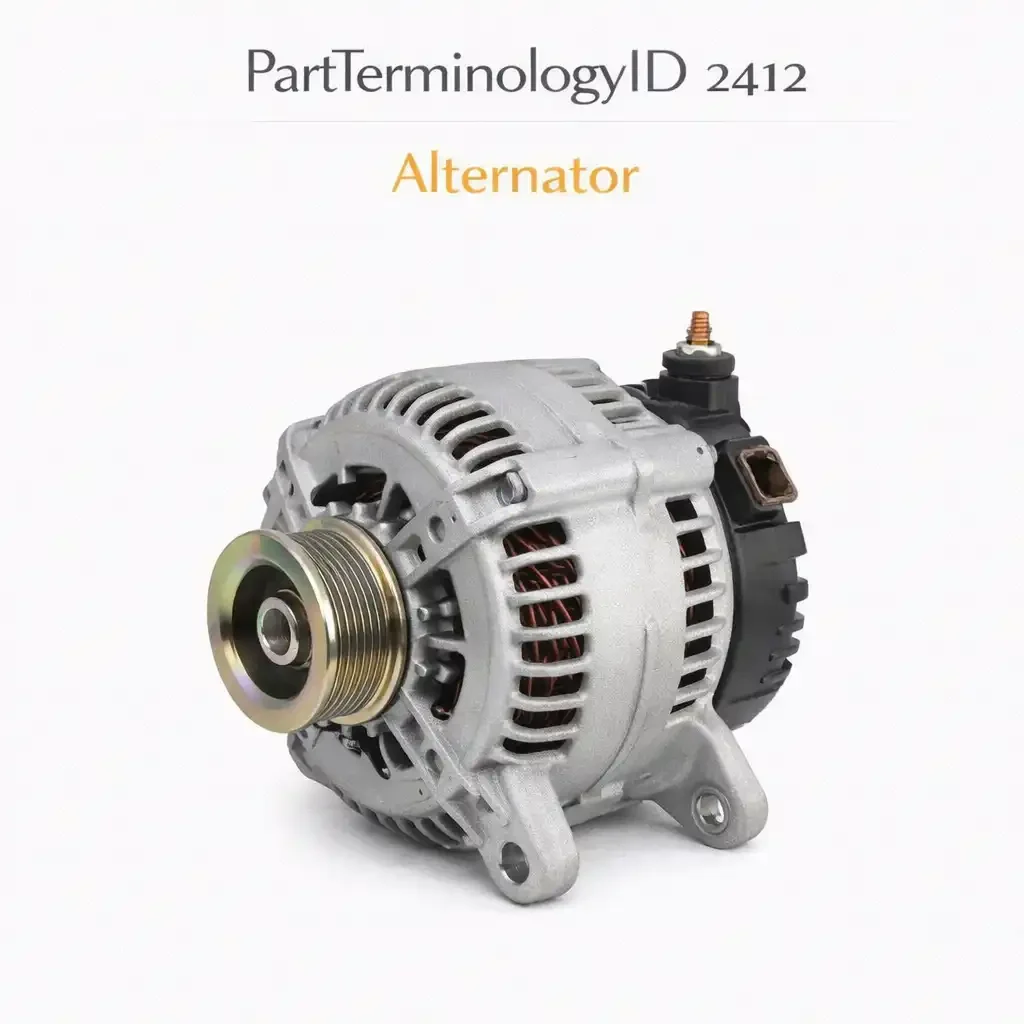
Alternator (PartTerminologyID 2412): Where Amperage Rating, Mounting Configuration, and Regulator Type Determine Whether the Electrical System Stays Charged Under Every Load Condition
Written by Arthur Simitian | PartsAdvisory
PartTerminologyID 2412, Alternator, is the engine-driven generator that converts mechanical energy from the engine crankshaft into alternating current, which the internal rectifier converts to direct current for charging the vehicle battery and powering the electrical system while the engine is running. That definition covers the function accurately and leaves unresolved every question that determines whether the replacement alternator fits the mounting bracket, produces adequate current for the vehicle's electrical load, communicates correctly with the vehicle's charging system management circuit, and survives the thermal and vibration environment of the specific engine bay installation. It does not specify the vehicle application, the alternator amperage rating, the mounting configuration, the number and position of mounting ears, the pulley type and diameter, the pulley groove configuration, the output terminal type and location, the sense terminal configuration, the voltage regulator type, whether the regulator is internal or external, the communication protocol for vehicles with smart charging systems, the housing configuration, whether the unit is new or remanufactured, what the core charge policy is on remanufactured units, the rotation direction, the cooling fan type and position, or whether the alternator is a direct OE replacement or an upgrade unit with a higher amperage rating than the factory specification. A listing under PartTerminologyID 2412 that provides vehicle year, make, and model without the amperage rating, the mounting configuration, the pulley specification, and the regulator type cannot be evaluated by any technician who has a failed alternator on the bench and is confirming the replacement before beginning the installation.
For sellers, PartTerminologyID 2412 is one of the highest-volume individual electrical component listings in the aftermarket because alternators are wear components with a finite service life determined by brush wear in the voltage regulator, bearing fatigue in the rotor shaft bearings, diode degradation in the rectifier bridge, and winding insulation breakdown from thermal cycling. On most passenger vehicles and light trucks, alternator service life ranges from 80,000 to 150,000 miles under normal operating conditions and shortens significantly under high electrical load applications including vehicles with aftermarket audio systems, auxiliary lighting, refrigeration units, or emergency vehicle equipment. The replacement buyer population is correspondingly broad: it includes professional technicians replacing a confirmed failed alternator with a like-for-like replacement, performance buyers upgrading to a higher amperage unit for an aftermarket electrical system, and fleet maintenance managers replacing alternators on a scheduled basis before failure in commercial vehicle applications.
The return economics for alternators are particularly unfavorable on remanufactured units because most remanufactured alternators carry a core charge that is refunded when the old unit is returned in the correct condition. A remanufactured alternator that is returned as the wrong part generates a shipping cost in both directions, a core processing cost, and a potential core credit dispute if the returned core does not match the unit that was shipped. A listing that is not specific enough about the mounting configuration, the pulley specification, and the regulator type produces returns from buyers who discover the mismatch at installation after the original unit has already been removed and the core has been packaged for return.
The additional complexity specific to this PartTerminologyID is the smart charging system argument. From approximately the mid-2000s onward, many vehicle manufacturers introduced variable voltage charging systems that vary the alternator output voltage in response to engine load, battery state of charge, and driver demand rather than regulating to a fixed 13.5 to 14.5 volt output. These systems require the alternator to communicate with the engine control module through a dedicated communication wire using a manufacturer-specific protocol. A conventional fixed-voltage replacement alternator installed in a smart charging system vehicle will either charge at a constant voltage regardless of the ECM's command, triggering a fault code and a charging system warning light, or will fail to charge at all if the ECM disables the alternator circuit when it does not receive the expected communication response. The smart charging system compatibility must be stated in every alternator listing for vehicles produced in the smart charging era.
For sellers, the listing under this PartTerminologyID is only useful if it specifies the amperage rating, the mounting configuration, the pulley specification, the regulator type, the smart charging system compatibility, and whether the unit is new or remanufactured with the core charge policy. Without those six attribute categories, the listing cannot serve either the technician making a direct replacement or the buyer upgrading to a higher output unit.
What the Alternator Does
Generating current for the battery and the electrical system
The alternator produces alternating current through electromagnetic induction as the rotor's magnetic field sweeps past the stator windings. The rotor is driven by the engine through the serpentine belt and pulley. As engine speed increases, the rotor spins faster, the rate of magnetic field change across the stator windings increases, and the induced voltage and current output increases. The voltage regulator monitors the system voltage and adjusts the current supplied to the rotor field winding to maintain the output voltage within the design range, typically 13.5 to 14.8 volts on a conventional fixed-voltage charging system.
The rectifier bridge converts the three-phase alternating current from the stator to direct current using six diodes, three positive and three negative, one pair per stator phase. The diodes conduct in only one direction, blocking the reverse voltage of each AC half-cycle and allowing only the forward voltage to pass to the output terminal. The resulting pulsating DC is smoothed by the vehicle's battery, which acts as a large capacitor in the circuit.
The alternator output current curve and its relationship to amperage rating
The amperage rating stated on an alternator is the maximum output current the unit can produce at a specified rotor speed, typically measured at a hot temperature to represent worst-case service conditions. The alternator does not produce its rated current at idle speed: a 200-ampere alternator typically produces 60 to 90 amperes at idle and reaches its rated output at highway driving speed where the engine RPM and the pulley ratio combine to spin the rotor at its rated speed.
This means the amperage rating is only the full-speed maximum output, not the idle-speed output. A vehicle with a high electrical load, such as a law enforcement vehicle with radios, computers, and emergency lighting, may demand more current at idle than the alternator can produce at idle speed, depleting the battery during sustained idle operation even when the alternator is functioning correctly. Selecting an alternator with the highest possible idle-speed output, rather than the highest rated maximum output, is the correct upgrade strategy for high-idle-load applications.
The listing should state both the rated maximum output current and the idle-speed output current where both specifications are available from the manufacturer.
The voltage regulator and the charging system communication protocol
The voltage regulator is the component that maintains the alternator output within the design voltage range by varying the field current. On most modern alternators, the voltage regulator is an internal component integrated into the alternator housing. On some older designs and some heavy-duty applications, the regulator is an external component mounted separately in the engine bay.
On vehicles with smart charging systems, the voltage regulator communicates with the engine control module through a dedicated signal wire rather than operating autonomously. The ECM varies the voltage setpoint in response to battery state of charge data from a battery sensor, engine load data, and fuel economy optimization algorithms. The communication wire uses a manufacturer-specific protocol: Ford uses a communication signal called Field Effect Transistor switching, General Motors uses a signal called the L-terminal or computer command voltage, Chrysler uses a TIPM-integrated charging control, and European manufacturers use a LIN-bus communication protocol.
A replacement alternator must use the same communication protocol as the original to function correctly in a smart charging system vehicle. A conventional fixed-voltage regulator replacement in a LIN-bus smart charging vehicle will not respond to the ECM's voltage commands and will either set a fault code or cause the ECM to enter a failsafe charging mode. The listing must identify the communication protocol and confirm smart charging system compatibility for all vehicles produced with smart charging systems.
The rotor bearing and its service life in the alternator
The rotor shaft is supported at each end by a ball bearing pressed into the front and rear housing. The front bearing carries the belt tension load from the pulley in addition to the rotor radial load, making it the higher-stressed of the two bearings. Belt tension on a correctly adjusted serpentine belt system is substantial: typically 80 to 120 pounds of tension force acting on the front bearing continuously at all engine speeds.
A remanufactured alternator that uses the original worn bearings rather than new bearings will reproduce the original failure pattern within a short service interval after installation. The bearing condition in a remanufactured unit is the most variable quality factor between remanufacturers at different price points. A listing for a remanufactured alternator must state whether new bearings are installed as part of the remanufacturing process or whether the original bearings are reused.
The pulley and decoupler pulley systems
The pulley is the belt-contact component on the alternator rotor shaft. Pulley diameter determines the alternator rotor speed for a given engine speed and belt configuration. A smaller pulley produces a higher rotor speed at the same engine RPM, which increases the alternator's output current at idle and at low engine speeds but may exceed the rotor's rated maximum speed at high engine RPM.
Many modern alternators use a decoupler pulley, also called an overrunning alternator pulley or an alternator decoupler pulley, rather than a solid pulley. The decoupler pulley contains a one-way clutch and a torsional spring that allows the pulley to overrun the rotor during deceleration events, such as when the engine speed drops rapidly after a fuel cut. The overrunning function reduces the belt tension spike that occurs when the rotor's rotational inertia resists the deceleration of the engine, extending serpentine belt and tensioner service life on engines with aggressive fuel cut strategies.
A replacement alternator for a vehicle that uses a decoupler pulley must include or be compatible with the correct decoupler pulley for the vehicle. Installing a solid pulley on a vehicle with a decoupler pulley system will shorten serpentine belt life and may produce belt noise from the tension spikes that the decoupler was designed to absorb. Installing a decoupler pulley of the wrong internal spring rate will either underperform the overrunning function or produce a ratcheting noise from the one-way clutch engaging prematurely.
The listing must specify the pulley type, whether solid or decoupler, the pulley outer diameter, the groove profile and count for the serpentine belt, and whether the decoupler pulley is included with the unit or must be transferred from the original.
The Specifications That Determine Correct Alternator Fitment
Amperage rating
The rated maximum output current in amperes. State both the maximum output at rated speed and the idle-speed output where available. For upgrade applications, compare the replacement unit's output curve to the original unit's output curve rather than comparing rated maximums only.
Mounting configuration
The number, position, and geometry of the mounting ears. Most alternators have two or three mounting points. The mounting ear bolt hole diameters, the distance between mounting points, and the angular relationship between mounting ears are all specific to the vehicle platform. A replacement alternator that is the correct amperage and pulley configuration but has mounting ears at slightly different positions will not bolt into the factory bracket without modification.
State the mounting ear count, the bolt hole diameters, and whether the mounting configuration matches the OE bracket directly without any adaptation.
Pulley specification
Pulley type: solid or decoupler. Pulley outer diameter in millimeters. Groove profile: serpentine multi-rib or V-belt. Groove count. Whether the pulley is included with the unit or must be transferred from the original alternator.
For decoupler pulleys: internal spring rate, overrunning torque threshold, and whether the decoupler is a new unit or a reused original.
Output terminal configuration
The main output terminal, also called the B+ terminal, is the large-diameter post that connects the alternator output to the vehicle battery and main electrical bus through the charge cable. The terminal diameter, the stud thread specification, and the terminal position on the housing determine whether the factory charge cable reaches and connects without modification.
Additional terminals on the alternator housing vary by manufacturer and application: the L terminal for the charge warning light circuit, the S terminal for the remote voltage sense circuit, the F terminal for the field control circuit, and the communication terminal for smart charging systems. The connector body type for the multi-pin terminal must match the factory harness connector exactly.
State the B+ terminal stud diameter and thread pitch, the multi-pin connector body type and pin count, and whether the connector is in the correct position to engage the factory harness without rerouting.
Voltage regulator type and smart charging system compatibility
Internal regulator, external regulator, or ECM-controlled smart charging. For smart charging applications, state the communication protocol: LIN bus, Ford FET switching, GM L-terminal, Chrysler TIPM, or other. Confirm that the replacement unit's regulator is programmed for the vehicle platform's charging voltage setpoints.
New versus remanufactured
State explicitly whether the unit is new or remanufactured. For remanufactured units, state what components are replaced as part of the remanufacturing process: brushes, bearings, diodes, rectifier, regulator, or complete rewind. State the core charge amount and the core return policy.
Rotation direction
Clockwise or counterclockwise when viewed from the pulley end. Most passenger vehicle alternators rotate clockwise when viewed from the front. Some applications, particularly certain transverse-mounted engines with specific belt routing, use a counterclockwise-rotation alternator. A clockwise alternator in a counterclockwise application will produce output in the correct polarity but the cooling fan blade pitch will be incorrect, reducing cooling airflow and elevating operating temperature.
Why This Part Generates Returns
Buyers order the wrong alternator because:
the mounting ear configuration matches the specification but the bolt hole positions are slightly different and the unit will not bolt directly into the factory bracket
the smart charging system compatibility is not stated and a conventional regulator unit is installed in a LIN-bus vehicle, setting a fault code and triggering a charging warning light
the pulley is a solid unit shipped for a decoupler pulley application, causing belt noise and shortened belt life
the output terminal connector body does not match the factory harness connector and the harness cannot be connected without modification
the amperage rating is the only specification checked and the idle-speed output of the replacement unit is lower than the original, depleting the battery during high-load idle applications
the remanufactured unit uses original worn bearings and the front bearing fails within 15,000 miles, producing a noise complaint that is attributed to a defective new unit
the core return policy is not stated and the buyer discards the original unit before learning that a core charge has been applied to the replacement purchase
Status in New Databases
PIES/PCdb: PartTerminologyID 2412, Alternator
PIES 8.0 / PCdb 2.0: No change in PartTerminologyID or terminology label. Internal systems keyed to 2412 do not require remapping at the PIES 8.0 transition.
Top Return Scenarios
Scenario 1: "Smart charging vehicle, conventional regulator replacement, fault code P0620 on first start"
The vehicle is a 2014 GM truck with a two-wire LIN-bus smart charging system. The replacement alternator has a conventional internal regulator that maintains a fixed 14.4-volt output without responding to the ECM's voltage commands. On first start after installation, the ECM detected the absence of the expected LIN communication response and set fault code P0620, generator control circuit malfunction, and illuminated the battery warning light. The alternator charges correctly in terms of voltage output but the charging system fault code remains active and the system does not vary voltage for fuel economy optimization.
Prevention language: "Charging system type: [conventional fixed-voltage / smart charging with LIN-bus communication / smart charging with GM L-terminal communication / other]. This vehicle uses a [LIN-bus] smart charging system that requires the alternator to communicate with the ECM through the communication wire. A conventional fixed-voltage regulator replacement will set fault code [P0620] and prevent the smart charging system from operating as designed. Specify a replacement alternator with confirmed [LIN-bus] smart charging system compatibility for this vehicle."
Scenario 2: "Decoupler pulley vehicle, solid pulley on replacement unit, serpentine belt worn within 20,000 miles"
The vehicle's original alternator uses a decoupler pulley. The replacement alternator arrived with a solid pulley. The listing did not specify pulley type. The installation proceeded without transferring the original decoupler pulley. Without the decoupler's overrunning function, the tension spikes from deceleration events loaded the serpentine belt and tensioner at every engine speed change. The serpentine belt developed longitudinal cracks and glazing within 20,000 miles of the alternator replacement and required early replacement.
Prevention language: "Pulley type: [solid pulley included / decoupler pulley included / decoupler pulley not included, transfer original decoupler pulley from original alternator]. This vehicle uses a decoupler pulley on the alternator. The decoupler's overrunning function reduces belt tension spikes during deceleration and extends serpentine belt life. If the replacement unit ships with a solid pulley, the original decoupler pulley must be transferred to the replacement unit before installation. Failure to transfer the decoupler pulley will accelerate serpentine belt and tensioner wear."
Scenario 3: "Mounting ear position offset 8mm from OE bracket, unit would not bolt in without elongating bracket hole"
The replacement alternator has a mounting configuration described as direct fit. The lower mounting ear bolt hole is positioned 8mm closer to the output terminal than the OE unit. The factory lower bracket bolt hole does not align with the replacement unit's lower ear. The technician elongated the bracket hole with a file to achieve alignment. The elongated hole does not provide full clamping area for the mounting bolt and the unit vibrates audibly at high RPM from the loose lower mount.
Prevention language: "Mounting configuration: lower ear bolt hole position [X]mm from housing centerline, upper ear bolt hole position [X]mm from housing centerline. Verify mounting ear positions match your factory bracket hole positions before installation. A mounting ear that is offset from the bracket hole by more than 2mm will require bracket modification. Do not elongate bracket holes: an under-clamped alternator will vibrate and accelerate bearing wear."
Scenario 4: "Remanufactured unit, original bearings reused, front bearing failed within 12,000 miles"
The remanufactured alternator listing stated professionally remanufactured and included a 12-month warranty. The remanufacturing process at this price point replaced the brushes and the rectifier diodes but reused the original front and rear bearings. The front bearing, which had accumulated the original belt tension load for 110,000 miles, was at the end of its service life when the unit was installed. The front bearing produced a grinding noise within 12,000 miles of installation and the unit was returned under warranty.
Prevention language: "Remanufacturing scope: [brushes replaced / diodes replaced / rectifier replaced / bearings replaced with new / complete stator rewind]. Verify the remanufacturing scope includes new bearings. A remanufactured alternator that reuses original bearings will reproduce the bearing wear failure in a fraction of the mileage of a unit with new bearings installed. For long-term reliability, specify a remanufactured unit with new front and rear bearings as part of the remanufacturing process."
Scenario 5: "Harness connector body mismatch, three-pin connector on replacement versus two-pin on factory harness"
The replacement alternator has a three-pin multi-connector body for the sense and communication terminals. The factory harness has a two-pin connector body. The two-pin factory connector will not seat in the three-pin replacement body. The charge warning light circuit and the voltage sense circuit cannot be connected. The alternator charges by default but the charge warning light illuminates because the lamp terminal connection is missing.
Prevention language: "Multi-pin connector type: [two-pin / three-pin / four-pin]. Connector body: [specify body style]. The factory harness connector must match the replacement alternator's connector body type exactly. A two-pin factory connector will not seat in a three-pin replacement body. Verify the connector pin count and body style before ordering. If the replacement connector does not match the factory harness, a pigtail adapter harness is required."
Scenario 6: "High-idle-load vehicle, replacement unit lower idle output than original, battery depleted after 45-minute idle"
The vehicle is a police patrol unit with radio, laptop, dashcam, and auxiliary lighting drawing approximately 85 amperes continuously. At patrol idle speed of approximately 750 RPM engine speed, the original high-output alternator produced 95 amperes. The replacement unit has the same 220-ampere maximum rated output but a different stator winding configuration that produces only 70 amperes at idle. After a 45-minute stationary patrol session with all equipment running, the battery state of charge had dropped below 80 percent.
Prevention language: "Idle-speed output: [X] amperes at [X] RPM engine speed. Maximum rated output: [X] amperes at [X] RPM. For high-electrical-load idle applications including law enforcement, emergency services, and vehicles with high-draw auxiliary equipment, idle-speed output is the critical specification, not maximum rated output. Verify the idle-speed output of the replacement unit matches or exceeds the original unit's idle-speed output for the vehicle's sustained idle electrical load."
Scenario 7: "Core charge not disclosed, original unit discarded, core credit denied"
The remanufactured alternator was ordered without any core charge mentioned in the listing or in the checkout process. The buyer removed the original alternator, installed the replacement, and discarded the original in the household trash before the replacement's packaging was fully reviewed. The replacement's box contained a core return label and a notice of a $75 core charge that had been added to the purchase. The buyer no longer had the original unit to return and the core charge was not refunded.
Prevention language: "Core charge: [$XX]. A core charge is included in the purchase price of this remanufactured alternator and will be refunded when the original alternator is returned in rebuildable condition. Do not discard the original alternator before reviewing the core return instructions. Core return shipping label: [included / buyer arranges return shipping]. Core return condition requirements: [unit must be complete, not disassembled, free of external damage, same amperage rating as replacement]. Core credit will not be issued for units that do not meet the return condition requirements."
What to Include in the Listing
Core essentials
PartTerminologyID: 2412
component: Alternator
amperage rating: maximum output at rated speed in amperes (mandatory)
idle-speed output in amperes at stated engine RPM (mandatory for high-load applications)
mounting configuration: ear count, bolt hole diameters, and ear position dimensions (mandatory)
pulley type: solid or decoupler (mandatory)
pulley outer diameter in millimeters (mandatory)
pulley groove count and profile: multi-rib serpentine or V-belt (mandatory)
pulley inclusion: included with unit or transfer from original required (mandatory for decoupler pulley applications)
output terminal: B+ stud diameter and thread pitch (mandatory)
multi-pin connector type: pin count and body style (mandatory)
terminal position on housing: confirm factory harness reach without rerouting (mandatory)
voltage regulator type: internal fixed-voltage, external, or ECM-controlled smart charging (mandatory)
smart charging protocol: LIN bus, GM L-terminal, Ford FET, Chrysler TIPM, or other (mandatory for smart charging applications)
rotation direction: clockwise or counterclockwise from pulley end (mandatory)
cooling fan type: internal, external, or both (mandatory)
housing configuration: Delco-style, Bosch-style, Mitsubishi-style, Denso-style, or other (mandatory)
new or remanufactured (mandatory)
remanufacturing scope for remanufactured units: list every replaced component (mandatory)
core charge amount for remanufactured units (mandatory)
core return policy: condition requirements, return window, and shipping method (mandatory)
warranty duration and coverage scope (mandatory)
OE part number cross-reference where available (mandatory)
quantity: 1
Fitment essentials
year/make/model/submodel
engine designation: displacement, configuration, and fuel type
transmission type where alternator specification varies by transmission
factory electrical package where amperage rating varies by option
police package or upfitter package where applicable for high-output applications
Dimensional essentials
overall housing length in mm
overall housing diameter in mm
mounting ear bolt hole diameter in mm
distance between mounting ear centers in mm
B+ terminal stud diameter and thread pitch
multi-pin connector body width and height in mm
pulley outer diameter in mm
pulley width in mm
shaft thread specification for pulley retention nut
Image essentials
alternator in isolation from the pulley side showing pulley type, groove count, and cooling fan
alternator from the terminal side showing B+ terminal position, multi-pin connector position, and connector body style
mounting ears shown with bolt hole positions and diameters called out
decoupler pulley cross-section showing internal clutch and spring mechanism
smart charging communication wire identified on the multi-pin connector
remanufacturing scope shown as component photos: new brushes, new bearings, new diodes, new rectifier
core return label and packaging shown for remanufactured unit listings
installation context showing the alternator in the factory bracket with the harness connected and the belt routed
Catalog Checklist for ACES/PIES Teams
PartTerminologyID = 2412
require amperage rating as primary performance attribute (mandatory)
require idle-speed output where available (mandatory for high-load applications)
require mounting configuration with ear position dimensions (mandatory)
require pulley type and specification (mandatory)
require decoupler pulley inclusion status (mandatory for decoupler applications)
require output terminal specification (mandatory)
require multi-pin connector type and body style (mandatory)
require voltage regulator type (mandatory)
require smart charging protocol for all vehicles produced after approximately 2006 (mandatory)
require rotation direction (mandatory)
require new or remanufactured designation (mandatory)
require remanufacturing scope for remanufactured units (mandatory)
require core charge disclosure for remanufactured units (mandatory)
require core return policy (mandatory)
differentiate from alternator brush set (PartTerminologyID varies): the brush set is an individual component replacement for the voltage regulator brushes; PartTerminologyID 2412 covers the complete alternator assembly; a brush set replacement is appropriate when the alternator housing, stator, rotor, and bearings are serviceable and only the brushes are worn; a complete alternator replacement is appropriate when the rotor, stator, or bearings are damaged
differentiate from alternator voltage regulator (PartTerminologyID varies): the internal voltage regulator is a serviceable component on some alternator designs where the regulator is accessible without complete disassembly; PartTerminologyID 2412 covers the complete alternator; a regulator replacement is appropriate when the alternator charges at an incorrect voltage but passes all other component tests
differentiate from alternator pulley (PartTerminologyID varies): the decoupler pulley and the solid pulley are individually replaceable components on many alternator designs without replacing the complete alternator; PartTerminologyID 2412 covers the complete alternator; a pulley replacement alone is appropriate when the pulley fails but the alternator output is confirmed serviceable
flag smart charging system compatibility as mandatory for all post-2006 applications: a conventional regulator in a smart charging system vehicle sets a fault code that cannot be cleared by resetting alone because the root cause remains present; this is the highest-volume post-installation complaint for alternators on modern vehicles and is fully preventable by a compatibility statement in the listing
flag decoupler pulley disclosure as mandatory: the decoupler pulley versus solid pulley distinction is not visible in a product photo without a cross-section; a buyer who cannot see the internal clutch mechanism has no way to confirm the pulley type without a listing statement
flag remanufacturing scope as mandatory: bearing inclusion is the single quality differentiator that most strongly predicts whether a remanufactured alternator will produce a warranty claim within the first year; a listing that states professional remanufacture without specifying bearing replacement leaves the quality question unanswered
flag core charge as mandatory with prominent placement: a core charge that is not disclosed in the listing but appears in the box will produce a return or a dispute regardless of product quality; disclose the core charge amount in the listing attributes and in the product description before checkout
FAQ (Buyer Language)
How do I know if my vehicle has a smart charging system?
The most reliable method is to check whether your vehicle has a dedicated communication wire connected to the alternator in addition to the main charge cable and the multi-pin sense connector. On GM smart charging vehicles, there is a small-diameter wire connected to the alternator's L-terminal that carries the computer voltage command signal from the ECM. On vehicles with LIN-bus charging systems, which include most European brands and some domestic brands from the mid-2000s onward, the communication wire is one pin in the multi-pin connector rather than a separate wire. If your vehicle has a dashboard display that shows battery voltage in real time and you have observed the displayed voltage varying between approximately 12.5 and 15 volts at different engine loads rather than holding a constant 14.4 volts, your vehicle almost certainly has a smart charging system. Confirm by checking whether your scan tool can read charging system control module data and whether the ECM has parameters related to generator control.
My new alternator is charging but the battery warning light is still on. What is wrong?
On conventional charging systems, a battery warning light that stays on after a new alternator is installed usually indicates a wiring issue: the L-terminal or charge lamp terminal on the alternator is not connected, the charge lamp bulb circuit is open, or the multi-pin connector is not fully seated. On smart charging system vehicles, a warning light after alternator replacement almost always indicates a communication protocol mismatch: the replacement alternator does not respond to the ECM's LIN-bus or equivalent commands. Connect a scan tool and check for active fault codes in the charging system module. A code P0620 or equivalent generator control circuit code confirms a communication issue rather than a wiring issue.
Can I install a higher-amperage alternator than the factory specification?
Yes, with some considerations. A higher-amperage alternator with the correct mounting configuration, pulley specification, and smart charging system compatibility is a direct installation upgrade. The additional amperage capacity does not harm the battery or the electrical system: the alternator only produces the current the system demands, and the higher capacity unit simply has a larger reserve for peak loads. The primary concerns with a high-output upgrade are pulley sizing and idle-speed output. If the upgrade alternator uses the same pulley as the original, the rotor speed will be the same at any given engine speed and the idle-output improvement will come from the higher-capacity stator winding rather than from increased rotor speed. Confirm that the upgrade unit's idle-speed output meets your application's idle-load requirement before purchasing.
What is the difference between a new alternator and a remanufactured one?
A new alternator is manufactured entirely from new components with no reused parts. A remanufactured alternator starts with an original core that is disassembled, cleaned, and rebuilt with replacement components for the worn parts. The quality of a remanufactured unit depends entirely on what is replaced during the remanufacturing process. A remanufactured unit that replaces only the brushes and the diodes while reusing the original bearings, stator, and rotor is essentially a brush and diode service on a used alternator. A remanufactured unit that replaces brushes, diodes, bearings, and the rectifier bridge and performs electrical testing of the stator and rotor before assembly is a substantially more comprehensive rebuild that approaches the reliability of a new unit. Ask specifically what is replaced before purchasing a remanufactured unit and do not rely on descriptors like professional remanufacture or premium rebuild without component-level disclosure.
My alternator is making a whining noise that changes pitch with engine speed. Is this an alternator problem or a belt problem?
An alternating-pitch whine that changes with engine RPM and is present at all engine temperatures is most commonly caused by one of three sources: a worn alternator front bearing, a worn alternator decoupler pulley, or a misaligned or glazed serpentine belt at the alternator pulley. To distinguish between them, remove the serpentine belt and spin the alternator pulley by hand. Roughness or grinding in the pulley rotation indicates a bearing problem. Ratcheting or intermittent resistance during hand rotation of the pulley indicates a worn decoupler clutch. A smooth, quiet pulley under hand spin with belt noise that appeared after recent belt or tensioner work indicates a belt alignment or tension issue rather than an alternator component failure.
What does the core charge policy mean and what condition does the core need to be in?
The core charge is a deposit included in the price of a remanufactured alternator that is refunded when you return the original alternator to the remanufacturer. The core provides the raw material for remanufacturing future units. Core return condition requirements vary by supplier but typically require that the original unit be the same amperage rating and mounting configuration as the replacement unit, be complete without missing mounting ears, housings, or terminal hardware, not be disassembled, and not have external damage from collision or fire. Units that have been cut open for diagnosis, had mounting ears broken off, or were damaged in a vehicle fire typically do not qualify for core credit. Pack the original unit in the replacement unit's packaging using the same foam inserts to prevent transit damage that would disqualify the core.
Cross-Sell Logic
Serpentine Belt (the serpentine belt drives the alternator and is inspected at every alternator replacement; replace if it shows cracking, glazing, or rib wear within 20,000 miles of the expected remaining service life)
Belt Tensioner (the belt tensioner maintains correct belt tension against the alternator pulley; a worn tensioner spring produces variable belt tension that accelerates alternator bearing wear; replace concurrently if the tensioner shows damper wear or spring rate loss)
Decoupler Pulley (PartTerminologyID varies: if the alternator ships without a decoupler pulley and the original decoupler is worn, the new decoupler pulley is a mandatory concurrent purchase before the new alternator can be correctly installed)
Battery (a battery that has been deeply discharged from a failing alternator may have suffered sulfation damage that reduces its capacity below the specification even after the alternator is replaced and the battery is recharged; test the battery state of health after alternator replacement and replace if it does not hold its rated capacity)
Battery Sensor (on smart charging system vehicles with a battery current and temperature sensor at the battery negative terminal, the sensor is inspected at the battery replacement event and replaced if it has been physically damaged or shows a fault code)
Charge Cable (the heavy-gauge cable from the alternator B+ terminal to the battery positive terminal is inspected for heat damage, chafing, and terminal corrosion at every alternator replacement; a charge cable with corroded terminals or heat-damaged insulation should be replaced at the same event)
Voltage Regulator (for alternator designs where the internal regulator is externally accessible and individually replaceable; if the alternator output voltage is outside specification but the stator, rotor, and bearings are confirmed serviceable, a regulator replacement is a lower-cost alternative to complete alternator replacement)
Frame as "the alternator generates the current that keeps the battery charged. The serpentine belt delivers the mechanical energy to the alternator that it converts to electrical energy. The tensioner keeps the belt tight against the alternator pulley. The battery stores the charge the alternator produces and supplies current during peak demand. The charge cable carries the alternator's output to the battery. All are in the same charging system and are all evaluated at the same service event."
Final Take for PartTerminologyID 2412
Alternator (PartTerminologyID 2412) is the electrical system PartTerminologyID where the smart charging system compatibility argument separates a correctly specified listing from one that will generate a fault code complaint on every modern vehicle it is installed in. A listing that provides the amperage rating and the mounting configuration but omits the smart charging protocol is a listing that is complete for 2003 and earlier vehicles and incomplete for the majority of vehicles in the current operating fleet. The smart charging protocol is not a fine-print specification: it is the attribute that determines whether the replacement alternator communicates with the ECM in the same language as the original or triggers a charging system fault the moment the engine is started.
The decoupler pulley disclosure resolves the belt wear consequence that appears 20,000 miles after installation when the solid-pulley replacement begins producing the tension spikes the original decoupler absorbed. The remanufacturing scope resolves the bearing quality question that determines whether the unit will be back on the warranty returns desk within the first year. The core charge disclosure resolves the dispute that begins when a buyer discards the original unit before learning that a refundable deposit was included in the purchase price.
State the amperage rating and the idle-speed output. State the mounting configuration with ear position dimensions. State the pulley type and include the decoupler disclosure. State the output terminal specification. State the connector body type. State the voltage regulator type and the smart charging protocol. State the rotation direction. State new or remanufactured with the full remanufacturing scope. State the core charge amount and the core return policy. State the warranty. That is the same listing strategy as every other PartTerminologyID in this series: specific attributes at every level to become a listing buyers can act on without guessing. For PartTerminologyID 2412, the smart charging protocol is the attribute that no amperage rating substitutes for, because a correctly rated alternator that does not speak the ECM's charging language will set a fault code on the first start and return to the warehouse on the first truck.