
Written by Arthur Simitian | PartsAdvisory
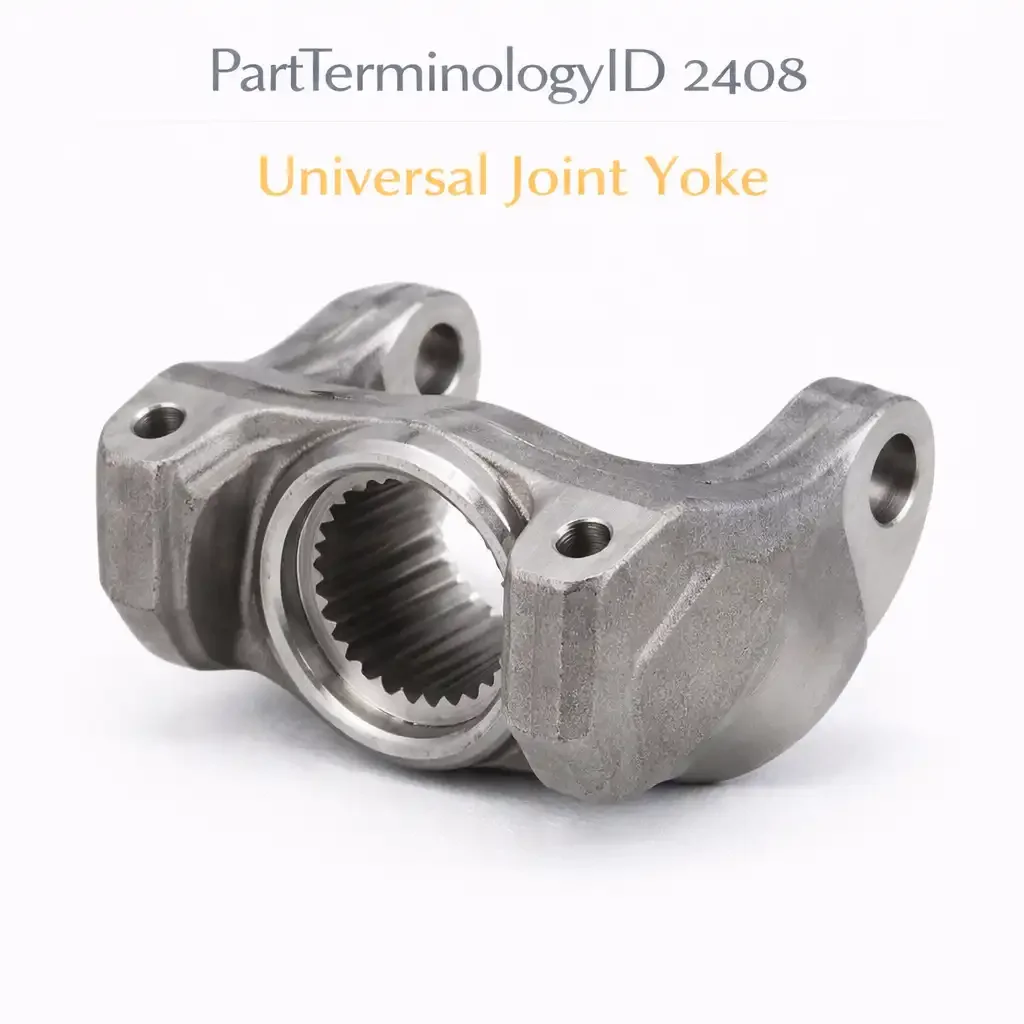
PartTerminologyID 2408, Universal Joint Yoke, is the forked component that connects a universal joint to a rotating shaft or to a companion flange, providing the bearing cup seats that accept the U-joint cross trunnions and transmitting torque between the shaft and the U-joint assembly. That definition locates the yoke at the interface between the shaft and the U-joint. It does not specify the yoke type, whether the yoke is a slip yoke that slides axially on a splined shaft to accommodate driveline length changes, a flange yoke that bolts to a companion flange face, a weld yoke that is permanently attached to a shaft tube by welding, a tube yoke that connects the yoke ears to a propshaft tube, or an end yoke that connects the driveshaft to the differential pinion or the transfer case output. It does not specify the U-joint series the yoke is machined for, the bearing cup bore diameter, the bearing cup bore depth, the U-joint retention method built into the yoke, whether the yoke uses inside snap ring grooves, U-bolt saddles, or strap bolt holes, the spline count and pitch for slip yokes, the companion flange bolt circle and bolt count for flange yokes, the shaft tube outer diameter and wall thickness for weld yokes, the yoke material, the surface finish at the bearing cup bores, or whether the yoke is a new replacement or a remanufactured unit. A listing under PartTerminologyID 2408 that specifies the vehicle year, make, and model without the yoke type, the U-joint series, the bearing cup bore dimensions, the retention method, and the spline or flange specification cannot be evaluated by any technician who has a worn or damaged yoke in hand and is confirming the replacement before removing the driveshaft.
For sellers, PartTerminologyID 2408 is the driveshaft hardware PartTerminologyID that sits between the universal joint (2392) and the drive shaft assembly (2308) in the catalog hierarchy. The U-joint is the cross-and-bearing assembly that pivots inside the yoke. The drive shaft is the complete propshaft assembly including the yoke, the tube, and all U-joints as a unit. The yoke as an individual replacement component is sourced when the yoke itself is damaged, worn at the bearing cup bores, or cracked at the yoke ears, while the U-joints and the shaft tube remain serviceable. A technician who finds a yoke with elongated bearing cup bores from a loose U-joint that was not caught before the cups began rotating in the bores needs the yoke as an individual replacement, not a complete drive shaft assembly.
The buyer population for PartTerminologyID 2408 is technically specific. A slip yoke replacement on a transmission tail shaft is a job that requires withdrawing the slip yoke from the transmission output shaft, which drains transmission fluid and requires a seal replacement at the same event. A flange yoke replacement at a differential or transfer case requires removing the companion flange nut and setting the pinion bearing preload, the same procedure described in the differential pinion seal post (2376). A weld yoke replacement requires a driveshaft shop with a balancing machine because the yoke is welded to the tube and the completed assembly must be balanced before reinstallation. Each yoke type therefore has a different labor scope, a different concurrent parts requirement, and a different buyer sophistication level, and the listing must reflect the specific yoke type's requirements rather than treating all yoke types as equivalent replacement hardware.
For sellers, the listing under this PartTerminologyID is only useful if it specifies the yoke type, the U-joint series, the bearing cup bore diameter and depth, the U-joint retention method, and the type-specific dimensional attributes for the spline, the flange bolt circle, or the tube outer diameter. Without those five attribute categories, the listing cannot be evaluated against the yoke position the buyer has identified.
What the Universal Joint Yoke Does
Providing the bearing cup seats that hold the U-joint in the drivetrain
The yoke is the component that anchors the U-joint to the drivetrain. Without the yoke, the U-joint cross has no surface to pivot against and no path through which torque can flow from the shaft to the joint. The yoke's two ears, each with a precision-bored cylindrical bore, accept the bearing cups of one plane of the U-joint cross. The cross pivots in those bearing cups as the driveshaft articulates through its working angle. The precision of the bearing cup bore diameter and the integrity of the bore surface are the dimensional foundation of the entire U-joint assembly's function.
When a bearing cup is loose in a yoke bore because the bore has worn oversize or because the U-joint was installed without adequate retention, the cup rotates in the bore rather than being held stationary while the cross pivots inside it. A rotating cup produces a bore that wears progressively larger and an outer surface on the cup that galls and seizes against the bore wall. Within a few thousand miles, the bore is damaged beyond the tolerance that allows a standard replacement cup to seat with adequate press fit. At that point the yoke requires replacement, because no cup of the correct series outer diameter can be retained in a bore that has been worn oversize.
The slip yoke and its unique axial motion requirement
The slip yoke is the yoke installed on the splined tail shaft of the transmission or transfer case. It slides axially on the splined shaft to accommodate the length change in the driveshaft as the rear suspension travels through its range. Every suspension jounce or rebound cycle moves the rear axle toward or away from the transmission, and the slip yoke accommodates that length change by sliding in and out on the transmission output shaft splines.
The slip yoke therefore performs two functions simultaneously: it transmits torque through its engagement with the shaft splines, and it accommodates axial length change through its sliding motion on those same splines. The spline engagement must be deep enough to transmit the full drivetrain torque without stripping under peak load, and the sliding clearance must be adequate to accommodate the full suspension travel range without the yoke bottoming out on the output shaft or pulling off the shaft end at full droop.
The slip yoke also carries the transmission tail shaft seal on its outer surface. The seal contacts the smooth outer diameter of the slip yoke behind the splined section as described in the drive shaft seal post (2352). A worn or grooved slip yoke outer surface produces a tail shaft seal leak that cannot be addressed by replacing the seal alone. The slip yoke replacement resolves both the spline wear and the seal surface damage simultaneously.
The flange yoke and its companion flange interface
The flange yoke connects the driveshaft to a rotating companion flange at the differential pinion or the transfer case output. The flange yoke has a flat mounting face with a bolt circle that matches the companion flange bolt circle. The two flanges are bolted face to face with the U-joint bearing cups captured between the yoke ears of both flanges.
On some designs, what is described as a flange yoke is actually an end yoke with an integral companion flange: the yoke ears and the flange face are a single casting or forging rather than two separate bolted pieces. On these designs, the end yoke replaces the entire connection between the driveshaft and the differential or transfer case, and the replacement must match both the U-joint series and the companion flange bolt circle simultaneously.
The weld yoke and the balancing requirement
The weld yoke is permanently attached to the propshaft tube by a circumferential weld at the tube insertion point. It cannot be replaced without cutting the original weld, pressing or machining the old yoke from the tube, pressing or fitting the new yoke onto the tube, welding the new yoke in position at the correct phase angle relative to the opposite yoke, and balancing the completed assembly on a driveshaft balancing machine.
The phase angle requirement for a weld yoke replacement is the same as the phase angle described in the U-joint post (2392): the yoke ears of the new weld yoke must be in the same plane as the yoke ears at the opposite end of the shaft. An incorrectly phased weld yoke produces the second-order velocity variation vibration at highway speed that a misphased U-joint installation produces, and the correction requires returning the shaft to the shop and rewelding rather than simply repositioning the yoke.
This means a weld yoke replacement is not a field repair. It is a driveshaft shop repair that requires professional equipment. The listing must state this requirement explicitly.
The Specifications That Determine Correct Yoke Fitment
Yoke type
Slip yoke, flange yoke, weld yoke, tube yoke, or end yoke. The yoke type is the primary classification attribute because each type has a different installation procedure, a different set of dimensional attributes, and a different concurrent parts requirement.
U-joint series designation
The U-joint series the yoke's bearing cup bores are machined for. This determines the bearing cup outer diameter that must fit the bore with the correct press fit interference. A yoke machined for a 1310 series cup will not correctly retain a 1350 series cup because the 1350 cup outer diameter is larger than the 1310 bore diameter.
Bearing cup bore diameter and depth
State in millimeters to two decimal places. The bore diameter determines the press fit for the bearing cup. The bore depth determines the maximum cup length that can be retained within the bore with the snap ring groove engaged.
U-joint retention method
Inside snap ring grooves, U-bolt saddle seats, or strap bolt holes. The retention method is built into the yoke machining and cannot be changed without remachining the yoke. A yoke with inside snap ring grooves cannot be used with U-bolt retention hardware.
Spline specification for slip yokes
Spline count, spline pitch, and major diameter. The spline specification must match the transmission or transfer case output shaft spline exactly. A slip yoke with the correct spline count but the wrong pitch will not engage the shaft splines correctly and will strip under load.
Companion flange bolt circle for flange and end yokes
Bolt circle diameter in inches or millimeters, bolt count, and bolt diameter. The bolt circle must match the companion flange exactly. A flange yoke with a 3.125-inch bolt circle will not bolt to a companion flange with a 2.750-inch bolt circle.
Tube outer diameter and wall thickness for weld yokes
In inches and millimeters. The yoke insertion diameter must match the tube inner diameter for a correctly fitted weld joint.
Seal surface outer diameter for slip yokes
The outer diameter of the smooth section behind the splines where the transmission tail shaft seal contacts. Grooves or wear steps on this surface require a repair sleeve before the new seal can be installed.
Material
Nodular iron, forged steel, or billet steel. Nodular iron is the most common OE material for passenger vehicle and light truck yokes. Forged steel is used on heavy-duty and performance applications. Billet steel is used on high-performance aftermarket yokes for maximum strength at the ear root radius.
Why This Part Generates Returns
Buyers order the wrong universal joint yoke because:
the yoke type is not specified and a slip yoke is sent for a flange yoke position or vice versa
the U-joint series is not stated and the bearing cup bore diameter does not match the replacement U-joint's cup outer diameter
the spline count is correct but the spline pitch is wrong and the slip yoke does not engage the output shaft correctly
the companion flange bolt circle does not match and the flange yoke cannot be bolted to the differential or transfer case
the retention method is not stated and a snap ring groove yoke is sent for a U-bolt saddle application
the seal surface condition is not addressed and a replacement seal leaks immediately because the original yoke's seal surface was grooved
Status in New Databases
PIES/PCdb: PartTerminologyID 2408, Universal Joint Yoke
PIES 8.0 / PCdb 2.0: No change
Top Return Scenarios
Scenario 1: "Slip yoke sent for end yoke position at differential, spline engagement attempted on smooth pinion shaft"
The listing specified a slip yoke by vehicle year, make, and model without stating the yoke type or position. The buyer needed the end yoke at the differential pinion. The slip yoke arrived with internal splines for transmission output shaft engagement. The differential pinion shaft is a smooth taper with a splined section for the companion flange, not a splined shaft for a slip yoke. The slip yoke cannot be installed at the differential end.
Prevention language: "Yoke type: [slip yoke / end yoke / flange yoke / weld yoke]. Driveshaft position: [transmission end / differential end / transfer case front output / transfer case rear output]. Verify the yoke type and driveshaft position before ordering. A slip yoke with internal splines is designed for the transmission or transfer case output shaft only. An end yoke or flange yoke is required at the differential and transfer case companion flange positions."
Scenario 2: "1310 series bore, buyer has 1350 series U-joint, cup outer diameter too large for bore"
The listing stated universal joint yoke with no series designation. The buyer is replacing a 1350-series U-joint and assumes the yoke will accommodate any U-joint. The yoke bore is machined for a 1310-series cup outer diameter. The 1350-series replacement cup has a larger outer diameter than the 1310 bore. The cup cannot be pressed into the bore without destroying the cup outer surface.
Prevention language: "U-joint series compatibility: [1310 series only / 1350 series only / other]. Bearing cup bore diameter: [X.XX]mm. This yoke is machined for [1310] series bearing cups only. A [1350] series cup has a larger outer diameter and cannot be pressed into this bore. Verify your replacement U-joint series matches the yoke bore series before ordering."
Scenario 3: "Slip yoke spline count matched, spline pitch wrong, yoke cocked on output shaft under torque"
The replacement slip yoke has the same spline count as the original but a different spline pitch. The yoke slides onto the transmission output shaft and appears to engage the splines. Under the first torque load, the mismatched pitch allows the yoke to cam slightly under load rather than transmitting torque cleanly. The yoke cocks on the shaft and the U-joint operating angle changes mid-torque-application, producing a vibration that worsens under load and disappears at idle.
Prevention language: "Spline specification: [X]-spline, [X/X] pitch, [X.XXX]-inch major diameter. All three spline dimensions must match the transmission output shaft. A yoke with the correct spline count but incorrect pitch will appear to engage the shaft correctly but will cam under torque, producing a load-dependent vibration and accelerated spline wear on both the yoke and the output shaft."
Scenario 4: "Weld yoke replacement, buyer attempted field swap, phase angle incorrect, highway vibration"
The buyer purchased a replacement weld yoke intending to cut and reweld the driveshaft in their driveway without a balancing machine. The new weld yoke was welded at a phase angle 45 degrees off from the opposite end yoke. The resulting velocity variation vibration appeared at highway speed immediately. The driveshaft had to be sent to a driveshaft shop for rewelding and balancing.
Prevention language: "Yoke type: weld yoke. Weld yoke replacement requires professional driveshaft shop service. The replacement yoke must be welded at the correct phase angle relative to the opposite end of the shaft, and the completed assembly must be dynamically balanced on a driveshaft balancing machine before installation. Do not attempt weld yoke replacement without access to a driveshaft shop with welding and balancing capability. An incorrectly phased or unbalanced driveshaft produces a highway vibration that is unsafe at speed."
Scenario 5: "Slip yoke seal surface grooved, new seal installed with original yoke, immediate leak"
The original slip yoke had a wear groove 0.15mm deep at the transmission tail shaft seal contact zone from the original seal's service life. The buyer replaced the transmission tail shaft seal without replacing the yoke. The new seal leaked immediately from the groove on the original yoke's seal surface. The seal and the yoke installation labor were both lost to the groove that should have been identified before the job began.
Prevention language: "Seal surface inspection required before seal installation. Inspect the slip yoke outer surface at the seal contact zone for grooves or scoring from the original seal before installing a new tail shaft seal. A groove deeper than 0.05mm will cause the new seal to leak immediately. If the seal surface is grooved, replace the slip yoke or install a repair sleeve over the grooved surface before installing the new seal."
What to Include in the Listing
Core essentials
PartTerminologyID: 2408
component: Universal Joint Yoke
yoke type: slip yoke, flange yoke, weld yoke, tube yoke, or end yoke (mandatory, in title)
driveshaft position: transmission end, differential end, transfer case front output, or transfer case rear output (mandatory)
U-joint series: 1310, 1330, 1350, 1410, or other (mandatory)
bearing cup bore diameter in mm to two decimal places (mandatory)
bearing cup bore depth in mm (mandatory)
U-joint retention method: inside snap ring grooves, U-bolt saddle, or strap bolt holes (mandatory)
spline count and pitch for slip yokes (mandatory)
spline major diameter in inches for slip yokes (mandatory)
companion flange bolt circle diameter, bolt count, and bolt diameter for flange and end yokes (mandatory)
tube outer diameter and wall thickness for weld yokes (mandatory)
seal surface outer diameter for slip yokes (mandatory)
yoke material: nodular iron, forged steel, or billet steel (mandatory)
surface finish at bearing cup bores (mandatory)
weld yoke professional installation note (mandatory for weld yokes)
concurrent parts note: tail shaft seal for slip yoke replacements, pinion nut for end yoke replacements (mandatory)
new or remanufactured (mandatory)
quantity: 1
Fitment essentials
year/make/model/submodel
transmission or transfer case designation for slip yoke spline matching
axle designation for end yoke flange circle matching
driveshaft position for multi-shaft drivetrain vehicles
Dimensional essentials
bearing cup bore diameter in mm to two decimal places
bearing cup bore depth in mm
spline count and pitch for slip yokes
spline engagement length in mm for slip yokes
seal surface outer diameter in mm for slip yokes
companion flange bolt circle in inches and mm for flange yokes
tube outer diameter in inches for weld yokes
overall yoke width across ears in mm
ear thickness in mm at bearing cup bore centerline
Image essentials
yoke in isolation showing ear geometry, bearing cup bores, and retention groove or saddle
spline detail for slip yokes with spline count visible
flange face shown for flange and end yokes with bolt circle and bolt count visible
seal surface section of slip yoke identified with callout
worn bore shown alongside new bore for the bore elongation failure mode illustration
phase angle diagram for weld yoke listings showing correct yoke ear alignment requirement
concurrent parts shown alongside yoke: tail shaft seal for slip yokes, pinion nut and crush sleeve for end yokes
Catalog Checklist for ACES/PIES Teams
PartTerminologyID = 2408
require yoke type in title and type attribute field (mandatory)
require driveshaft position (mandatory)
require U-joint series (mandatory)
require bearing cup bore diameter and depth (mandatory)
require retention method (mandatory)
require spline specification for slip yokes (mandatory)
require companion flange bolt circle for flange and end yokes (mandatory)
require tube specification for weld yokes (mandatory)
require seal surface diameter for slip yokes (mandatory)
require weld yoke professional installation note (mandatory)
differentiate from universal joint (PartTerminologyID 2392): the U-joint is the cross-and-bearing assembly; the yoke is the component the U-joint bearing cups seat in; both are in the same driveshaft assembly but are separate replacement components; a worn yoke bore requires yoke replacement; a worn U-joint cross or bearing requires U-joint replacement; the failed component determines which PartTerminologyID applies
differentiate from drive shaft assembly (PartTerminologyID 2308): the drive shaft assembly includes the yoke as a component; PartTerminologyID 2408 covers the yoke as an individual replacement when the shaft tube and U-joints are serviceable but the yoke is damaged
differentiate from universal joint C-clip (PartTerminologyID 2400) and U-bolt kit (PartTerminologyID 2404): the retention hardware PartTerminologyIDs cover the clips and U-bolts that retain the cups in the yoke bores; the yoke itself is PartTerminologyID 2408; a damaged yoke bore requires 2408; intact yoke bores with worn retention hardware require 2400 or 2404
flag yoke type as mandatory in title: a slip yoke sent for an end yoke position is incompatible at the most fundamental level; yoke type in the title prevents the majority of wrong-position orders
flag spline specification completeness as mandatory: spline count alone is insufficient; spline count plus pitch plus major diameter is the complete spline specification for a slip yoke; a listing with count only will produce pitch-mismatch installations that are discovered under first torque load
flag weld yoke professional installation note as mandatory: a weld yoke listing without the professional shop requirement note will attract buyers who attempt field replacement without balancing capability; the resulting unbalanced driveshaft is a safety issue at highway speed
flag seal surface condition note as mandatory for slip yoke listings: a grooved slip yoke seal surface is the most common reason a correctly installed new tail shaft seal leaks immediately; the pre-installation inspection note costs nothing to add and prevents the double-labor cost of a second seal installation
FAQ (Buyer Language)
How do I identify which yoke type I need?
The yoke at the transmission end of the rear driveshaft is almost always a slip yoke on passenger vehicles and light trucks: it slides on the transmission output shaft splines and has a smooth outer cylindrical section where the tail shaft seal contacts it. The yoke at the differential end is typically an end yoke or flange yoke that bolts to the companion flange: it has a flat bolt face rather than internal splines. On two-piece driveshafts, there is also a center joint yoke at the center support bearing. Identify which end of the driveshaft has the worn yoke and confirm the yoke type before ordering.
My slip yoke is worn at the splines. Do I need to replace the transmission output shaft too?
Inspect the transmission output shaft splines for burrs, flattened teeth, or reduced tooth height before ordering only the yoke. If the output shaft splines show the same wear as the yoke splines, the shaft has worn as well and both components require replacement. If the output shaft splines are sharp, correctly profiled, and at full tooth height, the shaft is serviceable and yoke replacement alone is sufficient. On high-mileage vehicles where the slip yoke has been running dry from a failed tail shaft seal, inspect the output shaft splines carefully because dry spline contact accelerates wear on both mating surfaces simultaneously.
Can I replace a slip yoke without draining the transmission?
Not completely. When the slip yoke is withdrawn from the transmission output shaft, transmission fluid will drain from the output shaft bore until the shaft bore is above the fluid level in the pan. The volume depends on the transmission design and the fluid level, but it is typically between half a quart and one and a half quarts. Have a drain container ready before withdrawing the slip yoke and top up the transmission fluid after the new yoke is installed. Replace the tail shaft seal at the same time, since the yoke must be removed to access the seal and both components are at the same replacement event.
My end yoke at the differential is worn. Do I need to reset the pinion bearing preload?
Yes. The pinion nut must be removed to withdraw the end yoke from the pinion shaft, and the pinion nut on most modern axles is a torque-to-yield fastener that must be replaced at every removal as described in the differential pinion seal post. Removing the pinion nut and withdrawing the end yoke also releases the pinion bearing preload. The preload must be measured and reset to the correct specification when the new end yoke is installed. This requires an inch-pound torque wrench and a pinion holding tool. If you are not equipped for pinion preload service, have the end yoke replacement performed by a shop with differential service capability.
Cross-Sell Logic
Universal Joint (PartTerminologyID 2392: a yoke with worn bearing cup bores indicates a U-joint that was loose in the bore; replace the U-joint concurrently with the yoke)
Transmission Tail Shaft Seal (PartTerminologyID 2352: replace at every slip yoke removal event; the slip yoke must be withdrawn to access the seal and both are at the same labor event)
Pinion Nut (torque-to-yield replacement required at every end yoke removal; cross-reference alongside every end yoke listing)
Crush Sleeve (replaced at every pinion nut removal on axles with collapsible preload systems; cross-reference alongside end yoke listings)
Universal Joint C-Clip Set (PartTerminologyID 2400: new clips for the new yoke bores at the same installation event)
Universal Joint U-Bolt Kit (PartTerminologyID 2404: for U-bolt retention yokes; new U-bolts are single-use and must be replaced with the yoke)
Drive Shaft Assembly (PartTerminologyID 2308: if the propshaft tube is also damaged or out of balance, replace the complete assembly rather than the yoke alone)
Frame as "the yoke holds the U-joint. The U-joint transmits the torque the yoke receives from the shaft. The tail shaft seal seals the bore the slip yoke slides in. The pinion nut holds the end yoke against the pinion bearing. The U-joint clips retain the cups in the yoke bores. All are in the same service event when the yoke is replaced."
Final Take for PartTerminologyID 2408
Universal Joint Yoke (PartTerminologyID 2408) is the driveshaft component where the yoke type in the title resolves the majority of wrong-position orders before any dimension is checked. A slip yoke and an end yoke for the same vehicle are both Universal Joint Yokes under PartTerminologyID 2408, and they are completely incompatible with each other's installation position. The slip yoke has internal splines that engage the transmission output shaft. The end yoke has a flat bolt face that mates to the companion flange. Neither can substitute for the other regardless of how closely they match in U-joint series or bearing cup bore dimensions.
The U-joint series determines which cup outer diameter the bore is machined for, and a cup that is too large to press into the bore is a discovery made at installation rather than at ordering. The spline specification for slip yokes requires count plus pitch plus major diameter, because count alone produces installations where the yoke engages the shaft under no load and cams under torque. The seal surface condition note for slip yoke listings prevents the double-labor event where a correctly installed new seal leaks immediately from a groove the technician did not inspect before beginning the job.
State the yoke type in the title. State the driveshaft position. State the U-joint series. State the bearing cup bore diameter and depth. State the retention method. State the complete spline specification for slip yokes. State the flange bolt circle for end and flange yokes. State the seal surface diameter for slip yokes. State the weld yoke professional installation requirement. State the concurrent parts requirements. That is the same listing strategy as every other PartTerminologyID in this series: specific attributes at every level to become a listing buyers can act on without guessing. For PartTerminologyID 2408, the yoke type is the attribute that no dimension substitutes for, because a dimensionally identical yoke of the wrong type cannot be installed at the position the buyer has identified regardless of how well the bore and series match.