
Written by Arthur Simitian | PartsAdvisory
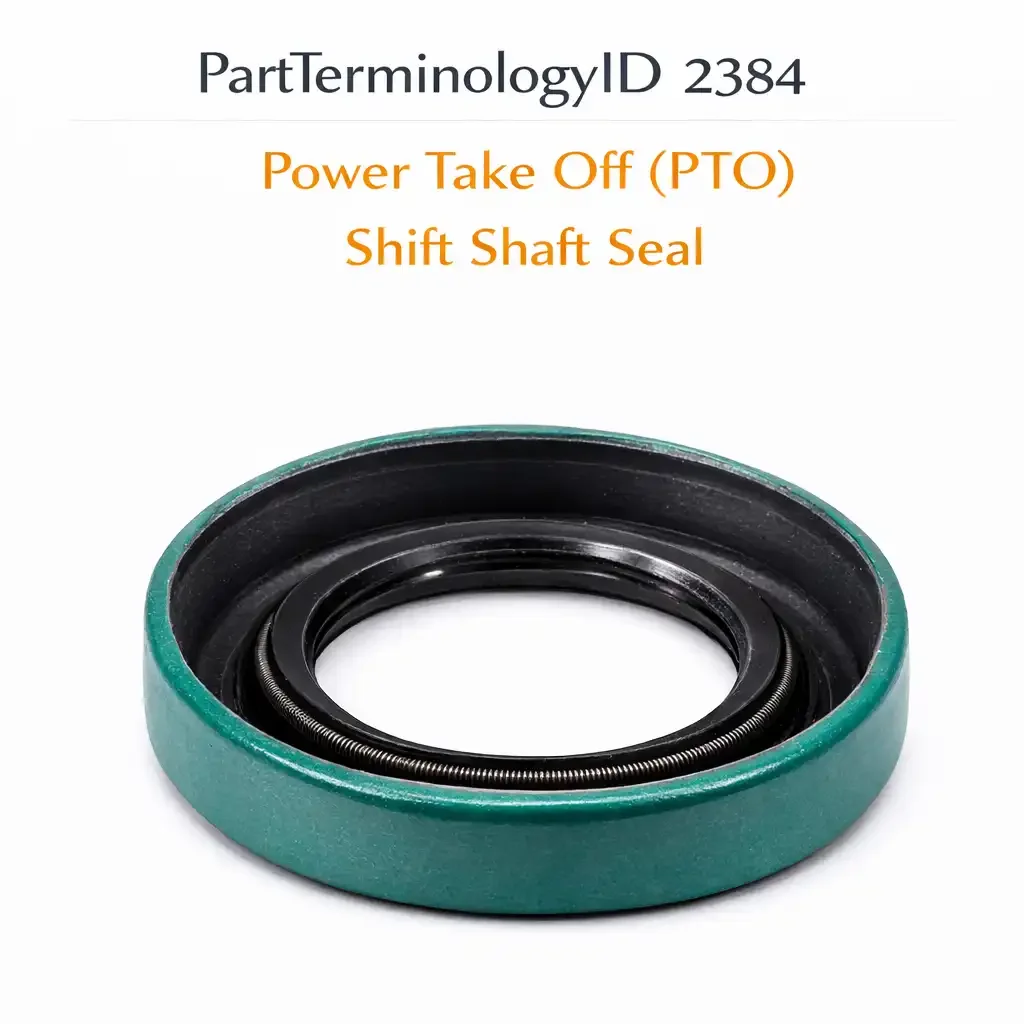
PartTerminologyID 2384, Power Take Off (PTO) Shift Shaft Seal, is a seal that prevents gear oil from escaping the PTO housing along the shift shaft at the point where the shift shaft exits the housing through the shift mechanism bore. That definition locates the seal correctly at the shift shaft exit. It does not specify the PTO unit manufacturer and model designation, the compatible transmission model, the shift shaft diameter at the seal contact zone, the housing bore diameter, the seal width, whether the seal is a rotary lip seal or a reciprocating shaft seal, whether the shift shaft rotates or only translates axially through the bore during engagement and disengagement, what the gear oil compatibility requirement is, or whether the seal is accessible with the PTO mounted on the transmission or requires PTO removal. A listing under PartTerminologyID 2384 that provides fitment without the PTO designation, the shift shaft diameter, and the seal type cannot be evaluated by any technician who has identified a leak at the shift shaft position and is sourcing the replacement before beginning the repair.
For sellers, PartTerminologyID 2384 is the seal PartTerminologyID in the PTO series that is most easily overlooked in a catalog build. The input shaft seal, the intermediate shaft seal, the countershaft seal, and the output shaft seal are all at rotating shaft positions that produce visible gear oil traces when they fail. The shift shaft seal is at a non-rotating or only partially rotating shaft position that moves only during PTO engagement and disengagement rather than continuously. A leak at the shift shaft bore is often intermittent: it appears as a fresh gear oil seep around the shift mechanism when the PTO is engaged or disengaged and dries between operating cycles, which means it may be dismissed as a minor seep or attributed to a loose shift linkage fitting rather than identified as a failed shift shaft seal.
The buyer who arrives at PartTerminologyID 2384 has traced a gear oil leak to the shift shaft bore specifically, which requires either a dye trace inspection or a careful visual inspection during PTO engagement that identifies the shift shaft bore as the origin. That diagnostic specificity means this buyer knows the PTO model and the shift shaft position and needs only the seal specification confirmed before ordering.
For sellers, the listing under this PartTerminologyID is only useful if it specifies the PTO unit designation, the shift shaft type, the shaft diameter, the bore diameter, the seal type, the seal width, and the gear oil compatibility. Without those seven attributes, the listing cannot be evaluated against the specific shift shaft bore the buyer has identified.
What the PTO Shift Shaft Seal Does
Sealing a shaft that moves axially rather than rotationally
The shift shaft in a PTO is the mechanical element that engages and disengages the PTO drive gear from the transmission drive gear. When the operator activates the PTO engagement control, the shift shaft moves axially within its bore to slide the engagement collar or the shift fork into the engaged position. When the PTO is disengaged, the shift shaft returns to its neutral position. The shift shaft does not rotate continuously like the input, intermediate, or output shafts. It translates axially, and on some PTO designs it may also rotate slightly as part of a cam engagement mechanism, but its primary motion is linear.
The seal at the shift shaft bore must accommodate this axial translation rather than the continuous rotation that a standard rotary lip seal is designed for. A rotary lip seal installed at a reciprocating shaft position will have adequate sealing during the stationary periods between engagements but will be subjected to axial scraping forces during each engagement and disengagement cycle that progressively wear the lip in the axial direction rather than the circumferential direction that a rotary seal is designed to resist. Over thousands of engagement cycles, a rotary lip seal at a reciprocating shaft position develops a worn flat on the lip at the shaft contact zone and begins to leak at the worn flat.
The correct seal type for a purely translating shift shaft is a lip seal designed for reciprocating motion, which has a lip geometry that accommodates axial shaft movement and a lip material with lower friction in the axial direction. For shift shafts that combine axial translation with a small rotational component, a seal designed for combined reciprocating and rotary motion is appropriate. The listing must specify the shift shaft motion type and the correct seal type for that motion.
The relationship between the shift shaft seal and the shift mechanism lubrication
On some PTO designs, the shift shaft bore is within the main gear oil circuit and the shift shaft is lubricated by the same gear oil that lubricates the PTO gears and bearings. On those designs, the shift shaft seal retains the main gear oil circuit against external escape at the shift bore. On other PTO designs, the shift shaft operates in a dry bore or in a separate grease-lubricated cavity, and the shift shaft seal is at the boundary between the dry or grease-lubricated shift mechanism and the gear oil circuit inside the housing. A seal failure at this boundary on a dry-bore design allows gear oil to migrate into the shift mechanism cavity, which can contaminate the shift linkage, interfere with the shift mechanism operation, and cause gear oil to appear at the external shift control fitting rather than at the PTO housing face.
The listing must specify whether the shift shaft seal is retaining gear oil from escaping externally or separating a gear oil cavity from a dry or grease-lubricated shift mechanism cavity.
The shift shaft seal as a low-frequency failure with disproportionate diagnostic effort
The shift shaft seal fails more slowly than any other seal in the PTO because the shift shaft moves only during engagement and disengagement rather than continuously. On a vehicle that engages and disengages the PTO ten times per operating day, the shift shaft seal accumulates ten reciprocating cycles per day compared to the continuous rotation cycles at the input and output shafts. The seal material fatigue at the shift shaft position is therefore driven by cycle count and axial wear rather than by continuous rotational contact and temperature.
The slow failure rate means the seal may seep for weeks or months before the leak is substantial enough to be noticed at a service inspection. The intermittent nature of the seep, appearing fresh after each engagement cycle and drying between cycles, makes it easy to overlook during routine walk-around inspections. When the leak is finally identified and the shift shaft seal is diagnosed as the source, the gear oil level in the PTO may have dropped incrementally over the period of the slow seep, potentially stressing the PTO bearings and gears during the same period.
The Specifications That Determine Correct Seal Fitment
PTO unit designation and transmission model
The PTO unit designation is the primary fitment attribute. The shift shaft diameter and the housing bore at the shift shaft exit are specific to the PTO model. The transmission model confirms the PTO application.
Shift shaft motion type
Purely axial translation, combined axial and rotary, or rotary only. The motion type determines whether a reciprocating seal, a combined-motion seal, or a standard rotary lip seal is required.
Shaft diameter and bore diameter
State in millimeters to two decimal places. The shift shaft is typically smaller in diameter than the input or output shafts because it carries no torque: it carries only the axial force of the engagement mechanism.
Seal type
Reciprocating lip seal, combined reciprocating and rotary seal, or standard rotary lip seal. State the seal type explicitly rather than leaving it to be inferred from the lip geometry in a product image.
Seal width
In millimeters. For a reciprocating seal, the seal width determines the contact band length over which the lip accommodates the axial shift stroke. A seal that is narrower than the full shift stroke will allow the shaft end to exit the seal contact zone at full engagement travel, which defeats the seal at the end of the engagement stroke.
Gear oil compatibility
The same lip material argument as the other PTO seal PartTerminologyIDs: nitrile for conventional GL-4 and GL-5 mineral gear oil, HNBR for synthetic gear oil, polyacrylate for full-synthetic extended-service gear oil.
Cavity type on the seal's external face
Gear oil circuit on both sides, or gear oil circuit on the internal face and dry or grease cavity on the external face. This determines whether the failure mode is an external leak or an internal contamination of the shift mechanism.
Why This Part Generates Returns
Buyers order the wrong PTO shift shaft seal because:
the PTO unit designation is not specified and the shift shaft diameter does not match the replacement seal
a standard rotary lip seal is ordered for a reciprocating shift shaft position and the lip wears flat from axial scraping within a short service period
the seal width is narrower than the shift shaft stroke and the shaft exits the contact zone at full engagement, allowing gear oil to escape at the end of each engagement cycle
the cavity type on the external face is not specified and the buyer does not understand that the seal failure is causing internal contamination of the shift mechanism rather than an external leak
the gear oil compatibility is not specified and a mineral oil rated seal is installed in a PTO running synthetic gear oil
Status in New Databases
PIES/PCdb: PartTerminologyID 2384, Power Take Off (PTO) Shift Shaft Seal
PIES 8.0 / PCdb 2.0: No change
Top Return Scenarios
Scenario 1: "Rotary lip seal installed on reciprocating shift shaft, lip wore flat within 3,000 engagement cycles"
A standard rotary lip seal was ordered for the shift shaft position because the listing did not specify the seal type or the shift shaft motion type. The shift shaft translates axially through the seal bore during each engagement. The rotary lip seal lip contacted the shaft at a single circumferential line calibrated for rotary contact. Each engagement cycle scraped the lip axially across the shaft surface. After approximately 3,000 engagement cycles, the lip had worn a flat at the contact line and the seal began seeping gear oil with each engagement stroke.
Prevention language: "Shift shaft motion type: [axial translation / combined axial and rotary / rotary only]. Seal type required: [reciprocating lip seal / combined motion seal / rotary lip seal]. This shift shaft translates axially during PTO engagement and disengagement. A standard rotary lip seal is not appropriate for this position. The axial scraping motion during engagement cycles wears the rotary lip flat at the contact zone. Specify a reciprocating lip seal designed for axial shaft motion."
Scenario 2: "Seal narrower than shift stroke, gear oil escapes at full engagement travel"
The replacement seal is 8mm wide. The shift shaft stroke from the disengaged to the fully engaged position is 12mm. At full engagement, the shaft has translated 12mm through the seal bore. The 8mm seal cannot maintain contact over the full 12mm stroke, and the shaft exits the rear of the seal contact zone at full engagement. Gear oil escapes from the rear of the seal bore at the end of each engagement stroke.
Prevention language: "Shift shaft stroke: [X]mm. Minimum seal width required to maintain contact at full engagement: [X]mm. Verify the seal width exceeds the full engagement stroke before ordering. A seal narrower than the shift stroke will allow the shaft to exit the seal contact zone at full engagement and will leak at the end of each engagement cycle."
Scenario 3: "Dry-bore shift mechanism, seal failed, gear oil contaminated shift linkage, engagement became unreliable"
The shift shaft operates in a dry bore adjacent to the gear oil circuit. The shift shaft seal separates the gear oil cavity from the dry shift mechanism bore. The seal failed and gear oil migrated into the dry shift mechanism bore. The gear oil contaminated the shift linkage pivot and the engagement detent mechanism, reducing the detent friction below the threshold required to hold the PTO in the engaged position under vibration. The PTO began disengaging spontaneously during sustained operation.
Prevention language: "Seal cavity type: [gear oil on internal face, dry bore on external face]. A failed shift shaft seal on this PTO allows gear oil to migrate from the gear oil cavity into the dry shift mechanism bore. Gear oil contamination of the shift mechanism can cause spontaneous PTO disengagement by reducing the detent friction that holds the engagement mechanism in position. If the PTO has been disengaging spontaneously, clean the shift mechanism bore of gear oil contamination after replacing the seal."
What to Include in the Listing
Core essentials
PartTerminologyID: 2384
component: PTO Shift Shaft Seal
PTO unit designation (mandatory)
compatible transmission model (mandatory)
shift shaft motion type: axial, combined, or rotary (mandatory)
seal type: reciprocating, combined, or rotary (mandatory)
shaft diameter in mm to two decimal places (mandatory)
housing bore diameter in mm to two decimal places (mandatory)
seal width in mm (mandatory)
shift shaft stroke in mm (mandatory, must be less than seal width)
cavity type on external seal face: external environment, dry bore, or grease cavity (mandatory)
lip material (mandatory)
gear oil compatibility (mandatory)
access requirement: PTO mounted or removal required (mandatory)
quantity: 1
Catalog Checklist for ACES/PIES Teams
PartTerminologyID = 2384
require PTO unit designation (mandatory)
require shift shaft motion type (mandatory)
require seal type: reciprocating, combined, or rotary (mandatory)
require shaft diameter and bore diameter (mandatory)
require seal width confirmed greater than shift shaft stroke (mandatory)
require cavity type on external face (mandatory)
require gear oil compatibility (mandatory)
differentiate from PTO input shaft seal (PartTerminologyID 2356): the input shaft seal is at a continuously rotating shaft; the shift shaft seal is at a non-rotating or intermittently moving shaft that translates axially during engagement
differentiate from PTO output shaft seal (PartTerminologyID 2372): the output shaft seal is at the highest-torque rotating exit; the shift shaft seal is at the engagement mechanism shaft that carries no torque and moves only during mode changes
flag seal type as mandatory: a rotary lip seal ordered for a reciprocating shift shaft produces a predictable wear failure within a defined cycle count; the failure mode is fully preventable by stating the seal type in the listing
FAQ (Buyer Language)
How do I confirm whether my PTO shift shaft is a reciprocating or rotary design?
With the PTO accessible and the shift linkage visible, activate the engagement control slowly by hand if possible and observe the shift shaft motion. A shaft that moves straight in and out without turning is purely reciprocating. A shaft that rotates as it advances is a combined-motion design. The PTO service manual will also state the engagement mechanism type. If neither observation nor the service manual is available, contact the PTO manufacturer with the PTO model designation and serial number for confirmation before ordering the seal.
My PTO engages and disengages normally but leaves a fresh gear oil seep around the shift shaft every time I engage. Is this a shift shaft seal or could it be the shift linkage fitting?
If the seep appears at the PTO housing bore where the shift shaft passes through the housing wall, the shift shaft seal is the source. If the seep appears at the threaded fitting where the shift linkage cable or air cylinder connects to the shift shaft end outside the housing, the fitting O-ring or thread sealant is the source. Wipe the entire shift mechanism area dry, engage and disengage the PTO once, and inspect immediately with a bright light or UV lamp if dye is in the gear oil. The seep will appear at its origin point before it spreads.
Cross-Sell Logic
PTO Input Shaft Seal (PartTerminologyID 2356: the complete PTO seal service replaces all shaft seals at the same event)
PTO Output Shaft Seal (PartTerminologyID 2372: inspected and replaced concurrently)
PTO Gear Oil (drained and replaced at every PTO opening for seal replacement)
PTO Gasket Set (if multiple seals require replacement at the same event, a complete gasket set is more efficient)
Shift Linkage O-ring or Fitting Seal (the shift linkage connection at the shift shaft external end uses a separate O-ring or fitting seal that is inspected at the same event as the shift shaft seal replacement)
Final Take for PartTerminologyID 2384
PTO Shift Shaft Seal (PartTerminologyID 2384) is the seal PartTerminologyID in the PTO series where the seal type is as consequential as the seal dimensions. A seal with the correct diameter and width but the wrong motion type produces a wear failure within a predictable cycle count that a correctly specified seal would have prevented for the full service life of the PTO. The shift shaft motion type, whether purely axial, combined axial and rotary, or rotary only, determines the seal design requirement before any dimension is consulted, and a listing that omits the motion type cannot prevent the rotary seal on a reciprocating shaft failure that is this PartTerminologyID's most consistent return driver.
State the PTO unit designation. State the shift shaft motion type. State the seal type. State the shaft diameter and bore diameter. State the seal width confirmed against the shift shaft stroke. State the cavity type on the external face. State the gear oil compatibility. That is the same listing strategy as every other PartTerminologyID in this series: specific attributes at every level to become a listing buyers can act on without guessing. For PartTerminologyID 2384, the seal type attribute is the one that no shaft dimension substitutes for, and the listing that omits it sends a rotary seal to a reciprocating application every time the buyer defaults to the most familiar seal design in the category.