
Differential Pinion Seal (PartTerminologyID 2376): Where Axle Designation, Pinion Shaft Diameter, and Lip Material Determine Whether the Differential Stays Full at Highway Speed
Written by Arthur Simitian | PartsAdvisory
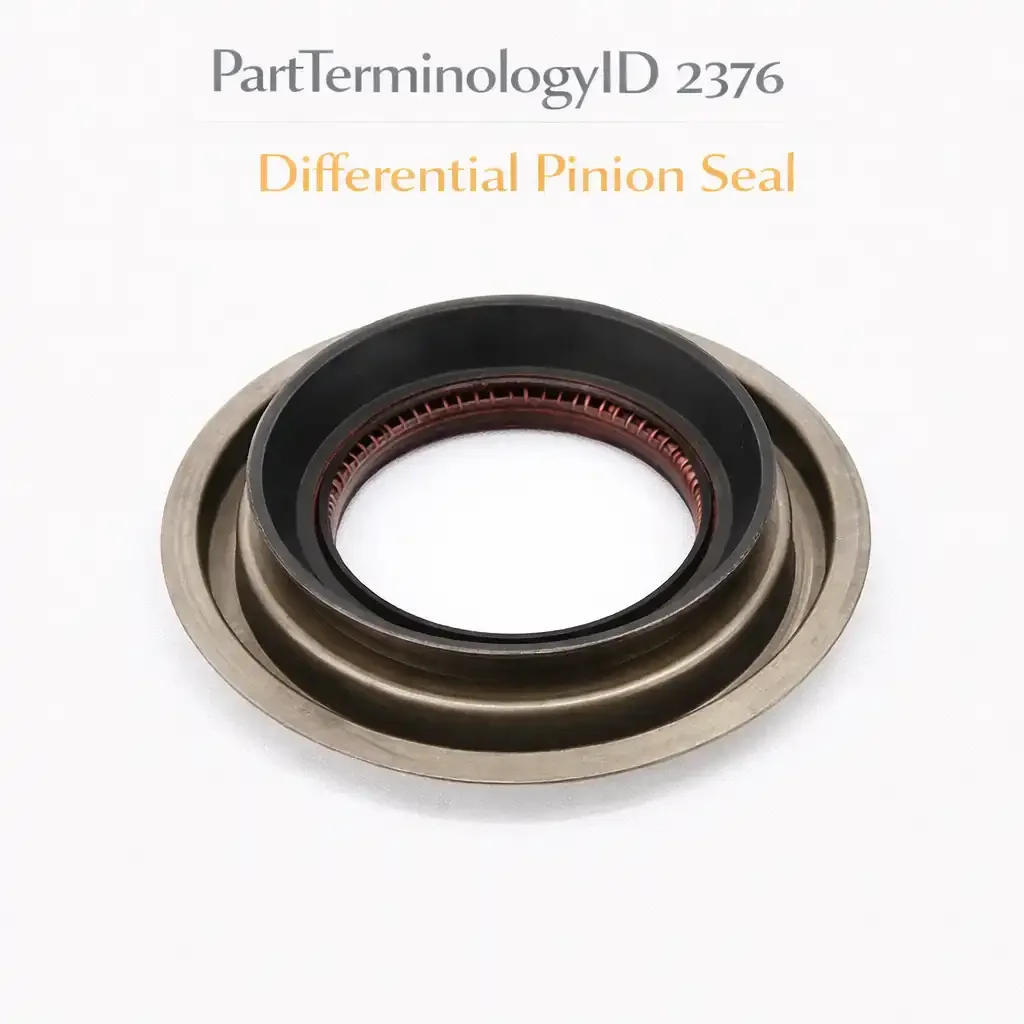
PartTerminologyID 2376, Differential Pinion Seal, is a rotary lip seal that prevents gear oil from escaping the differential housing along the pinion shaft at the point where the pinion shaft exits the housing toward the propshaft companion flange. That definition places the seal correctly at the front of the differential housing, at the pinion shaft exit bore, facing the driveshaft. It does not specify the axle designation, the pinion shaft diameter at the seal contact zone, the housing bore diameter, the seal width, the lip material, the gear oil compatibility, whether the pinion shaft is a solid shaft or a hollow shaft, what the pinion shaft surface speed is at the seal contact zone, whether the companion flange is a pressed-fit flange or a slip-fit flange retained by the pinion nut, whether the pinion nut is a torque-to-yield fastener that must be replaced at every removal, what the pinion bearing preload specification is and how it must be verified after the new seal is installed, whether the seal is a single-lip or double-lip design, what the shaft surface finish specification is at the lip contact zone, or whether a repair sleeve is available for applications where the pinion shaft contact zone has been grooved by the original seal. A listing under PartTerminologyID 2376 that provides vehicle year, make, and model without the axle designation, the pinion shaft diameter, the bore diameter, and the lip material cannot be evaluated by any technician who has identified a pinion seal leak and is preparing for the repair.
For sellers, PartTerminologyID 2376 is the most commonly replaced individual differential seal in the passenger vehicle and light truck market. The pinion seal is the seal that most buyers and most technicians think of first when they hear the phrase differential seal, because the pinion shaft exit is the most accessible seal position on a conventional solid rear axle and because the pinion shaft rotates at a higher speed than the axle shaft seals on the same axle, accelerating the wear rate of the pinion seal lip relative to the side seals. On a vehicle with a 3.73 axle ratio driving at 65 miles per hour, the pinion shaft is rotating at approximately 3,500 RPM while the axle shafts are rotating at approximately 940 RPM. The pinion seal lip is contacting the shaft surface at 3.73 times the rotational speed of the side seals, and it wears proportionally faster.
The high replacement frequency of this PartTerminologyID means the listing is encountered by a wide range of buyers, from experienced technicians who know the axle designation and shaft dimensions before they search, to first-time do-it-yourself buyers who know only the vehicle year, make, and model and are relying entirely on the listing to confirm they have the correct part before they drain the differential and remove the companion flange. Both buyer populations are served by the same listing, and the listing must provide enough information for the experienced technician to verify the dimensions and enough guidance for the first-time buyer to complete the installation correctly without damaging the pinion bearing from an incorrect preload.
The pinion seal is the one differential seal where a correct seal installation is not sufficient for a correct repair. The pinion nut must be replaced on most modern axles because it is a torque-to-yield fastener, and the pinion bearing preload must be verified after installation because the preload determines the longevity of the pinion bearings. A listing that delivers a correctly dimensioned seal without alerting the buyer to the pinion nut replacement requirement and the preload verification procedure is a listing that has set up a delayed pinion bearing failure for a buyer who did not know what they did not know.
For sellers, the listing under this PartTerminologyID is only useful if it specifies the axle designation, the pinion shaft diameter, the bore diameter, the seal width, the lip material, the gear oil compatibility, the pinion nut replacement requirement, and the preload verification procedure. Without those eight attributes, the listing cannot serve either buyer population correctly and cannot prevent the returns and the downstream bearing failures that incomplete listings produce.
What the Differential Pinion Seal Does
Retaining differential gear oil at the highest shaft speed position on the axle
The differential pinion seal is at the pinion shaft exit bore on the front face of the differential housing, between the pinion shaft bearing and the companion flange. The pinion shaft passes through the seal bore, and the companion flange is pressed or slipped onto the shaft end outboard of the seal. The seal lip contacts the pinion shaft surface or the companion flange hub surface, depending on the axle design, and retains the gear oil inside the differential housing against both the static head pressure of the oil above the pinion shaft centerline and the dynamic pressure from the gear oil splash generated by the rotating ring gear.
At highway speed, the pinion shaft surface speed at the seal lip contact zone is the product of the shaft RPM and the shaft circumference at the contact diameter. A pinion shaft with a 32mm contact diameter rotating at 3,500 RPM has a lip surface speed of approximately 5.9 m/s. This surface speed is at the upper limit of the standard nitrile seal's rated range and is why pinion seals on high-ratio axles operating at sustained highway speed have a shorter service life than axle shaft seals on the same housing.
The companion flange and its role in pinion seal function
The companion flange is the yoke that connects the propshaft U-joint to the pinion shaft. On most modern axles, the companion flange is a slip-fit component that slides onto the splined end of the pinion shaft and is retained by the pinion nut. The pinion seal lip contacts either the smooth cylindrical hub of the companion flange outboard of the splines, or the smooth cylindrical section of the pinion shaft between the bearing and the spline start, depending on the axle design.
On axles where the seal contacts the companion flange hub rather than the pinion shaft directly, the companion flange condition is as important as the pinion shaft condition for seal success. A companion flange hub that is worn or grooved at the seal contact zone will defeat a new seal as quickly as a grooved pinion shaft. The listing must note the companion flange inspection requirement alongside the pinion shaft inspection requirement.
On some performance and heavy-duty axles, the companion flange is a pressed-fit component that cannot be removed without a puller and that is replaced rather than reinstalled when it is grooved. On those designs, the companion flange is a concurrent purchase with the pinion seal whenever the flange contact zone is damaged.
The pinion nut and the crush sleeve: the preload system
The pinion bearing preload is maintained by a crush sleeve or a solid spacer between the inner and outer pinion bearings within the housing. When the pinion nut is tightened, it draws the companion flange against the outer bearing race through the crush sleeve, which is designed to collapse by a controlled amount to set the correct bearing preload as the nut is tightened. The crush sleeve is a one-use component: once collapsed, it cannot be returned to its original length and cannot be reused to set the preload again.
The pinion nut on most modern axles is a torque-to-yield fastener that stretches by a controlled amount when tightened to the specified torque. A used torque-to-yield nut that is retightened to the original torque specification does not produce the original clamp load because the nut has already stretched and has a lower yield point for the second installation. Reusing a torque-to-yield pinion nut produces an incorrect preload that is typically lower than specification, which allows the pinion bearing to run with excessive clearance and to wear at an accelerated rate. The bearing noise from an incorrectly preloaded pinion appears as a low-frequency whine that increases with vehicle speed and is often misdiagnosed as a wheel bearing problem before the differential is identified as the source.
The listing must state explicitly that the pinion nut is a torque-to-yield fastener, must state whether the nut is included in the listing or must be purchased separately, and must note that the crush sleeve is replaced whenever the pinion nut is removed on axles that use a collapsible crush sleeve.
Measuring and setting pinion bearing preload
Pinion bearing preload is measured as the rolling torque at the pinion shaft in the absence of the companion flange and the ring gear. The measurement is taken with an inch-pound beam-type or dial-type torque wrench attached to the pinion shaft end, rotating the shaft slowly and reading the torque required to maintain rotation. The correct preload specification for a used bearing set is lower than for a new bearing set because used bearing races have polished contact surfaces that have lower rolling friction than new surfaces.
The typical preload for a used bearing set on a passenger vehicle or light truck rear axle is 3 to 8 inch-pounds. The typical preload for a new bearing set is 8 to 14 inch-pounds, depending on the axle. Setting the preload requires tightening the pinion nut in small increments and measuring the rolling torque between each increment until the torque falls within the used-bearing specification. Overtightening collapses the crush sleeve beyond the correct preload range, and the only correction is to replace the crush sleeve and start over.
A buyer who does not have an inch-pound torque wrench and does not know the preload specification for their axle cannot complete a pinion seal replacement correctly on an axle with a crush sleeve preload system. The listing must alert this buyer to the tool and knowledge requirement before they drain the differential and remove the companion flange.
The hollow pinion shaft and its seal design difference
Some axle designs, particularly on light trucks and crossovers with independent front differentials, use a hollow pinion shaft rather than a solid shaft. The hollow shaft is lighter and provides better packaging in a compact front differential housing. The seal for a hollow pinion shaft may have a different inner bore profile than a solid shaft seal because the shaft wall thickness produces a different shaft outer diameter at the seal contact zone for the same overall shaft diameter designation.
A listing that does not distinguish between solid and hollow pinion shaft designs for applications where both exist will produce a mismatch when the hollow shaft seal is sent for a solid shaft application or vice versa.
The front differential pinion seal on a four-wheel-drive vehicle
On a four-wheel-drive vehicle with a solid front axle, the front differential has a pinion shaft that exits the front differential housing toward the front propshaft. The front differential pinion seal seals this exit in the same way as the rear differential pinion seal seals the rear exit. However, the front differential pinion seal is in a more contaminated environment than the rear: the front axle faces forward into road spray, mud, and debris kicked up by the front tires and the steering action. A double-lip seal with an exclusion lip is more appropriate for the front differential pinion position on vehicles used in off-road service than for the equivalent rear differential position in clean road use.
The front differential pinion shaft may also be a different diameter from the rear differential pinion shaft on the same vehicle, because the front differential is a different axle assembly with its own gear ratio and shaft sizing. A listing that covers both front and rear pinion seals under the same part number must confirm that the shaft diameters and bore diameters are identical before doing so.
The Specifications That Determine Correct Seal Fitment
Axle designation
The axle designation is the primary fitment attribute. Common domestic axle designations where PartTerminologyID 2376 applies include Dana 30, Dana 35, Dana 44, Dana 60, Dana 70, GM 7.5-inch, GM 8.5-inch, GM 8.6-inch, GM 9.5-inch, Ford 7.5-inch, Ford 8.8-inch, Ford 9.75-inch, Ford 10.5-inch, Chrysler 8.25-inch, Chrysler 9.25-inch, Toyota 7.5-inch, and Toyota 8-inch, among others. The pinion shaft diameter is specific to the axle designation and cannot be determined from the vehicle year, make, and model alone when the vehicle was available with multiple axle options.
Pinion shaft diameter at the seal contact zone
State in millimeters to two decimal places. The pinion shaft diameter at the seal contact zone determines the seal inner diameter. Confirm whether the seal contacts the pinion shaft directly or the companion flange hub, and state the contact surface diameter accordingly.
Housing bore diameter
State in millimeters to two decimal places. The bore diameter at the pinion seal installation point in the differential housing front face. The bore diameter determines the seal outer diameter with the correct press fit interference.
Seal width
In millimeters. The available bore depth at the pinion seal installation point. The seal must fit within the bore depth without protruding beyond the housing face, which would prevent the companion flange from seating correctly against the outer pinion bearing race.
Lip material and gear oil compatibility
Nitrile for conventional GL-5 mineral gear oil. HNBR for synthetic GL-5 gear oil and high-temperature applications, particularly on high-ratio axles operating at sustained highway speed. Polyacrylate for full-synthetic 75W-140 gear oil on towing and performance applications. State the API GL rating and mineral or synthetic specification.
Single-lip versus double-lip with exclusion
Single-lip for rear differential pinion positions in clean road environments. Double-lip with exclusion for front differential pinion positions on off-road vehicles and for rear differential pinion positions on vehicles used in severe contamination environments.
Pinion nut and crush sleeve inclusion and replacement requirement
State whether the pinion nut is included. State whether the crush sleeve is included. State the torque-to-yield replacement requirement for the pinion nut. State the preload measurement procedure requirement and the tool specification for the inch-pound torque wrench.
Shaft or companion flange repair sleeve availability
State whether a repair sleeve is available for the application and the sleeve outer diameter. Note whether the sleeve fits the pinion shaft or the companion flange hub, depending on which surface the seal contacts.
Why This Part Generates Returns
Buyers order the wrong differential pinion seal because:
the axle designation is not specified and the vehicle was available with multiple axle options that have different pinion shaft diameters
the companion flange hub diameter differs from the pinion shaft diameter on this axle design and the buyer measures the shaft rather than the flange hub at the seal contact zone
the lip material is not specified and a conventional gear oil rated seal is installed on a differential filled with full-synthetic 75W-140, accelerating lip hardening on a towing application
the pinion shaft contact zone is grooved and the new seal leaks immediately, and the repair sleeve availability was not disclosed in the listing
the pinion nut is reused without replacement, the preload is incorrect, and the pinion bearing fails within 20,000 miles with a noise that is not connected to the seal replacement event
the crush sleeve is not replaced and the preload is set using the original collapsed sleeve, producing an incorrect preload
the seal is too wide and the companion flange cannot seat against the outer pinion bearing race, producing an incorrectly retained bearing
Status in New Databases
PIES/PCdb: PartTerminologyID 2376, Differential Pinion Seal
PIES 8.0 / PCdb 2.0: No change
Top Return Scenarios
Scenario 1: "Multiple axle options on same vehicle, wrong axle designation, pinion shaft diameter mismatch"
The vehicle was available with a Dana 44 axle and a Dana 60 axle depending on the engine and towing package option. The listing specified the seal by vehicle year, make, and model without stating the axle designation. The buyer's vehicle has the Dana 60. The replacement seal was for the Dana 44, which has a smaller pinion shaft diameter. The Dana 44 seal inner diameter is too small for the Dana 60 pinion shaft.
Prevention language: "Axle designation: [Dana 44 / Dana 60]. Pinion shaft diameter: [Dana 44: X.XX]mm / [Dana 60: X.XX]mm. This vehicle was produced with two different axle options. Verify your axle designation before ordering. The axle designation is typically stamped on a tag on the differential housing or cast into the housing. The pinion seal dimensions differ between the Dana 44 and Dana 60 and the seals are not interchangeable."
Scenario 2: "Seal contacts companion flange hub, buyer measured pinion shaft, inner diameter mismatch"
The axle design positions the seal outboard of the bearing and the seal lip contacts the companion flange hub rather than the pinion shaft directly. The companion flange hub has a larger outer diameter than the pinion shaft journal behind it. The buyer removed the companion flange and measured the pinion shaft rather than the companion flange hub. The replacement seal was ordered to the pinion shaft diameter. The seal inner diameter is too small for the companion flange hub and cannot be installed without destroying the lip.
Prevention language: "Seal contact surface: [pinion shaft journal / companion flange hub]. Seal contact surface diameter: [X.XX]mm. On this axle, the seal contacts the companion flange hub rather than the pinion shaft. The companion flange hub diameter is larger than the pinion shaft journal. Measure the companion flange hub outer diameter at the seal contact zone, not the pinion shaft, when ordering this seal."
Scenario 3: "Pinion nut reused, preload incorrect, pinion bearing whine within 15,000 miles"
The buyer replaced the pinion seal and reused the original pinion nut. The original nut is a torque-to-yield fastener that had already stretched during its original installation. When retightened to the original torque specification, the stretched nut produced a clamp load lower than specification. The pinion preload was set below the correct range. The pinion bearing developed an audible whine within 15,000 miles from the insufficient preload. The bearing noise was diagnosed as a rear wheel bearing and both rear wheel bearings were replaced before the differential was identified as the source.
Prevention language: "Pinion nut: [included / not included, purchase separately]. Pinion nut type: [torque-to-yield, single use only]. The pinion nut on this axle is a torque-to-yield fastener that must be replaced every time the companion flange is removed. Reusing the original nut will not achieve the correct pinion bearing preload. Incorrect preload produces a pinion bearing whine that typically appears between 10,000 and 20,000 miles after the seal replacement and is often misdiagnosed as a wheel bearing failure before the differential is identified as the source."
Scenario 4: "Full-synthetic 75W-140 gear oil, nitrile seal, lip hardened on towing application within 20,000 miles"
The differential is filled with full-synthetic 75W-140 gear oil, which is the manufacturer's specification for this application with a trailer towing package. The replacement seal uses a standard nitrile lip. The synthetic 75W-140 formulation at the elevated operating temperature generated by sustained towing cycles degraded the nitrile lip within 20,000 miles. The hardened lip lost its contact interference with the pinion shaft and the differential developed a pinion seal leak during a towing trip.
Prevention language: "Lip material: [nitrile / HNBR / polyacrylate]. Gear oil compatibility: [GL-5 mineral / GL-5 synthetic compatible / 75W-140 synthetic compatible]. This application specifies full-synthetic 75W-140 gear oil for towing duty. Standard nitrile lips are not rated for full-synthetic 75W-140 at the elevated operating temperatures generated by sustained towing cycles. Specify a polyacrylate or HNBR seal for towing applications using synthetic 75W-140."
Scenario 5: "Grooved pinion shaft, no repair sleeve disclosed, new seal leaked immediately"
The original pinion seal failed and the seal lip wore a groove 0.12mm deep into the pinion shaft at the contact zone over its service life. The buyer replaced the seal without inspecting the shaft. The new seal leaks immediately because the groove provides a fluid path past the lip contact band. No repair sleeve is available for this axle's pinion shaft. The correct repair requires replacing the pinion shaft and companion flange as an assembly, which the buyer was not aware of before beginning the job.
Prevention language: "Shaft surface inspection required before installation. Inspect the pinion shaft at the seal contact zone for grooves or scoring from the original seal. A groove deeper than 0.05mm will cause the new seal to leak immediately. Repair sleeve availability for this application: [sleeve available, outer diameter X.XX mm / no sleeve available for this axle, pinion shaft replacement required for a grooved contact zone]. Verify the shaft condition before ordering."
Scenario 6: "Crush sleeve not replaced, preload could not be set correctly, bearing overloaded"
The buyer replaced the pinion seal and the pinion nut but did not replace the crush sleeve. The original crush sleeve had already been collapsed to its service dimension during the original assembly. When the new pinion nut was tightened against the already-collapsed sleeve, the nut reached the torque-to-yield point before the sleeve collapsed further to set the preload. The resulting preload was higher than specification, overloading the pinion bearings. The differential developed a low-frequency rumble under load within 8,000 miles.
Prevention language: "Crush sleeve: [included / not included, purchase separately]. The crush sleeve on this axle is a single-use component that must be replaced whenever the pinion nut is removed. The original crush sleeve is already collapsed to its minimum length from the original installation. Tightening a new pinion nut against the original collapsed sleeve will not produce the correct preload. Replace the crush sleeve at every pinion seal replacement."
Scenario 7: "Front differential pinion seal, single-lip, off-road use, contaminant ingress through pinion seal, gear oil contaminated"
The vehicle is used for regular off-road driving. The front differential pinion seal faces forward toward the front propshaft in an environment of mud, water, and debris from the front tires during off-road operation. The replacement seal is a single-lip design. Water and mud entered the front differential housing through the single-lip seal during a sustained off-road section. The gear oil emulsified from the water contamination and the front differential ring and pinion sustained corrosion pitting within 4,000 miles of the off-road event.
Prevention language: "Seal lip configuration: [single-lip / double-lip with exclusion lip]. Application note: the front differential pinion seal faces forward into road spray, mud, and debris on four-wheel-drive vehicles. Off-road applications require a double-lip seal with an exclusion lip to prevent contamination ingress from the driven equipment environment. Specify the double-lip design for front differential pinion seal replacement on any vehicle used in off-road service."
What to Include in the Listing
Core essentials
PartTerminologyID: 2376
component: Differential Pinion Seal
axle designation: manufacturer and model (mandatory)
axle position: front differential or rear differential on four-wheel-drive applications (mandatory)
seal contact surface: pinion shaft journal or companion flange hub (mandatory)
contact surface diameter in mm to two decimal places (mandatory)
housing bore diameter in mm to two decimal places (mandatory)
seal width in mm (mandatory)
available bore depth in mm (mandatory)
lip material: nitrile, HNBR, or polyacrylate (mandatory)
gear oil compatibility: GL-5 mineral, GL-5 synthetic, or 75W-140 synthetic (mandatory)
lip configuration: single-lip or double-lip with exclusion (mandatory)
garter spring: present or springless (mandatory)
pinion shaft type: solid or hollow (mandatory where both exist for the axle designation)
pinion nut type: torque-to-yield or reusable (mandatory)
pinion nut included: yes or no (mandatory)
crush sleeve type: collapsible or solid spacer (mandatory)
crush sleeve included: yes or no (mandatory)
preload measurement tool required: inch-pound torque wrench, yes (mandatory note)
shaft surface finish requirement in Ra micrometers (mandatory)
repair sleeve availability: available with outer diameter or not available (mandatory)
companion flange inspection note (mandatory)
quantity: 1
Fitment essentials
year/make/model/submodel
axle designation (primary fitment attribute)
axle position: front or rear on four-wheel-drive applications
engine option and towing package when axle designation varies by option
gear ratio range when seal specification changes with ratio on some axle designations
Dimensional essentials
contact surface diameter in mm to two decimal places
seal inner diameter before installation in mm
housing bore diameter in mm
seal outer diameter in mm
seal width in mm
available bore depth in mm
press fit interference in mm
lip contact band width in mm
garter spring inner diameter in mm
repair sleeve outer diameter in mm where available
Image essentials
seal in isolation showing lip configuration
cross-section showing inner lip, garter spring, and exclusion lip for double-lip designs
differential housing front face shown with companion flange removed and pinion seal bore visible
companion flange shown alongside the pinion shaft with the seal contact surface identified
grooved shaft surface shown under magnification for the shaft inspection guidance
repair sleeve shown alongside seal where a sleeve is available
pinion nut and crush sleeve shown alongside the seal for the concurrent replacement note
inch-pound torque wrench shown for the preload measurement procedure illustration
Catalog Checklist for ACES/PIES Teams
PartTerminologyID = 2376
require axle designation (mandatory)
require axle position: front or rear for four-wheel-drive applications (mandatory)
require seal contact surface: pinion shaft or companion flange hub (mandatory)
require contact surface diameter in mm to two decimal places (mandatory)
require housing bore diameter in mm (mandatory)
require seal width and bore depth (mandatory)
require lip material with gear oil compatibility (mandatory)
require lip configuration (mandatory)
require pinion shaft type: solid or hollow where relevant (mandatory)
require pinion nut type and inclusion status (mandatory)
require crush sleeve type and inclusion status (mandatory)
require preload measurement note (mandatory)
require shaft and companion flange inspection note (mandatory)
require repair sleeve availability (mandatory)
differentiate from differential seal (PartTerminologyID 2344): 2344 covers differential seals broadly across all shaft positions including pinion and axle shaft; 2376 is the specific PartTerminologyID for the pinion seal position only; in a catalog implementation that uses both PartTerminologyIDs, the pinion seal is listed under 2376 and the axle shaft seals are listed under 2344
differentiate from axle differential bearing and seal kit (PartTerminologyID 2224): the complete kit includes the pinion seal as part of a full rebuild package; 2376 covers the pinion seal as an individual replacement for a targeted repair without a full rebuild
differentiate from differential cover gasket (PartTerminologyID 2306): the cover gasket seals the removable rear cover; the pinion seal seals the rotating pinion shaft exit at the front; both contain differential fluid but from different interface types at opposite ends of the housing
flag axle designation as mandatory: the same vehicle platform was often produced with multiple axle options of different sizes; the axle designation resolves the pinion shaft diameter where vehicle fitment alone cannot
flag seal contact surface as mandatory: some axles position the seal against the companion flange hub rather than the pinion shaft; measuring the wrong surface produces a seal inner diameter mismatch that is discovered only at installation
flag pinion nut torque-to-yield as mandatory: the most consequential installation error for this PartTerminologyID is reusing the original pinion nut, which produces an incorrect preload that causes a bearing failure attributable to the seal replacement event in the vehicle's service history
flag crush sleeve replacement as mandatory: the second most consequential installation error is retightening against a collapsed original crush sleeve, which produces an over-preloaded bearing on the same timeline
flag synthetic 75W-140 compatibility as mandatory: towing package vehicles frequently specify synthetic 75W-140 that degrades standard nitrile; this fluid specification change corresponds to a lip material upgrade requirement that must be stated in the listing
FAQ (Buyer Language)
How do I identify my axle designation to confirm the correct pinion seal?
The axle designation is typically on a tag attached to the differential housing or cast into the housing. On Dana axles, the tag is on the carrier housing and includes the axle model, the gear ratio, and the build date. On GM axles, the axle designation can be decoded from the axle tag on the housing cover or from the RPO code on the vehicle's service parts identification label in the glove box or trunk. On Ford axles, the axle tag is typically on the driver's side of the differential housing. If the tag is missing, the axle can be identified by measuring the ring gear diameter: a ring gear measuring approximately 8.5 inches in diameter on a GM rear axle is likely an 8.5-inch ten-bolt, for example, though measurement alone is not definitive and a VIN decoder cross-referencing the axle option code is the most reliable identification method.
Do I need a special tool to set the pinion bearing preload?
Yes. An inch-pound torque wrench is required to measure the rolling torque at the pinion shaft. A standard foot-pound torque wrench is not sensitive enough to measure the 3 to 8 inch-pound preload range accurately. An inch-pound beam-type torque wrench is the most affordable option and is accurate enough for this procedure. A dial-type or digital inch-pound torque wrench provides an easier reading in the confined space under the vehicle. You will also need a pinion flange holding tool to prevent the companion flange from rotating while the pinion nut is tightened. Do not substitute an impact wrench for this procedure: the impact action does not allow controlled incremental tightening and will over-collapse the crush sleeve in a single impact pulse.
Can I replace the pinion seal without replacing the pinion nut and crush sleeve?
On axles with a solid spacer preload system rather than a collapsible crush sleeve, yes. A solid spacer is machined to a precise thickness and does not change dimension when the pinion nut is tightened. The preload on a solid spacer system is set by selecting the correct spacer thickness at original assembly and does not change when the pinion nut is removed and retightened, provided the original nut is also replaced with a new torque-to-yield nut. The pinion nut must still be replaced even on solid spacer systems. On axles with a collapsible crush sleeve, the crush sleeve must be replaced every time the pinion nut is removed, without exception. Verify whether your axle uses a collapsible sleeve or a solid spacer before deciding whether to purchase the crush sleeve.
My differential has been whining since I replaced the pinion seal six months ago. Could the seal replacement be the cause?
Yes. A pinion bearing whine that began after a pinion seal replacement is the most common sign of an incorrect pinion bearing preload from a reused torque-to-yield pinion nut, a non-replaced crush sleeve, or a preload that was set outside the specification. The whine typically appears between 8,000 and 25,000 miles after the seal replacement and increases in intensity with vehicle speed. It is often first noticed at 50 to 70 miles per hour as a low-frequency hum from the rear of the vehicle. A pinion bearing whine that varies with vehicle speed but does not change when the vehicle is coasted in neutral at highway speed is more likely a pinion bearing issue than a wheel bearing issue, which is the most common misdiagnosis. Confirm by draining the differential fluid and inspecting for metallic debris on the magnetic drain plug.
What is the difference between a seal with a garter spring and a springless seal for the pinion position?
A garter spring seal maintains its lip contact force through the full service life of the seal because the spring compensates for the gradual wear and relaxation of the lip material at the contact zone. As the lip wears, the spring draws the lip inward to maintain the contact interference on the shaft. A springless seal relies entirely on the elastic memory of the lip material to maintain contact. Springless seals are used in applications where the shaft surface speed is so high that a garter spring would be centrifugally loaded outward and reduce the lip contact force at speed rather than increase it. For most passenger vehicle and light truck pinion seal applications, a garter spring seal is the correct specification. A springless seal should only be specified when the pinion shaft surface speed at rated operating conditions exceeds the garter spring's rated surface speed for the seal lip material.
The companion flange on my differential is worn at the seal contact zone. Should I replace the flange or use a repair sleeve?
If the wear groove on the companion flange hub is less than 0.10mm deep and the flange is otherwise undamaged, a repair sleeve pressed over the contact zone is the more economical repair. The sleeve provides a new finished surface at the correct outer diameter for the new seal. If the groove is deeper than 0.10mm, the wall of the sleeve over the groove may not have adequate thickness to maintain the correct outer diameter under the seal contact force, and companion flange replacement is the correct approach. If the companion flange is also worn at the U-joint bearing cup bores, replace the entire flange regardless of the seal groove depth, because a worn U-joint bore will allow propshaft vibration that defeats any seal at the pinion position.
Cross-Sell Logic
Pinion Nut (the most predictable concurrent purchase for any pinion seal listing; torque-to-yield replacement at every seal service on most modern axles; state in the listing whether the nut is included)
Crush Sleeve (replaced at every pinion seal removal on axles with a collapsible preload system; state in the listing whether the sleeve is included)
Companion Flange (inspected at every pinion seal replacement for groove wear at the seal contact zone and U-joint bore wear; replace if either is outside specification)
Shaft Repair Sleeve (mandatory first purchase if the pinion shaft or companion flange hub contact zone is grooved; source before beginning the installation to confirm availability before the differential is drained)
Differential Gear Oil (the gear oil is drained and replaced at every pinion seal service; verify the correct API GL rating, viscosity grade, and synthetic or mineral specification, and add friction modifier if the axle uses a limited-slip differential)
Axle Shaft Seals (PartTerminologyID 2344: the axle shaft seals are at the same mileage as the pinion seal; inspect both sides and replace concurrently if they show any seepage)
Differential Cover Gasket (PartTerminologyID 2306: if the cover is removed for a fluid change at the same service event, replace the cover gasket concurrently)
Frame as "the pinion seal retains the gear oil at the pinion shaft exit. The gear oil lubricates the ring and pinion gears and the carrier bearings inside the housing the seal protects. The pinion nut maintains the preload the pinion bearings require. The crush sleeve allows the preload to be set correctly. The companion flange is the surface the seal contacts and the component whose condition determines whether a new seal can function at all."
Final Take for PartTerminologyID 2376
Differential Pinion Seal (PartTerminologyID 2376) is the highest-volume individual differential seal listing in the passenger vehicle and light truck category and the one where the installation procedure consequence is most disproportionate to the component cost. The seal itself is a low-cost consumable. The pinion nut and crush sleeve that must accompany it are also low-cost. The inch-pound torque wrench required to set the preload correctly is a one-time tool purchase that serves every pinion seal replacement the buyer will ever perform. The pinion bearing failure that results from skipping the nut replacement, the sleeve replacement, or the preload verification is a repair that costs 20 to 50 times the cost of the seal and associated consumables and that occurs 10,000 to 25,000 miles after the seal replacement event, far enough removed in time that the connection to the seal replacement is not always made.
The axle designation resolves the dimensional fit when the vehicle was produced with multiple axle options of different sizes. The seal contact surface identification resolves whether the buyer should measure the pinion shaft or the companion flange hub before ordering. The lip material and gear oil compatibility resolve whether the seal survives the synthetic gear oil in a towing application. The repair sleeve availability resolves whether a grooved shaft can be reconditioned without replacing the entire shaft assembly. The pinion nut and crush sleeve notes resolve the installation procedure requirements that the seal listing is the buyer's last opportunity to communicate before the differential is drained and the companion flange is removed.
State the axle designation. State the seal contact surface and its diameter. State the bore diameter. State the seal width and bore depth. State the lip material and gear oil compatibility. State the lip configuration. State the pinion nut type and replacement requirement. State the crush sleeve type and replacement requirement. State the preload tool requirement. State the repair sleeve availability. That is the same listing strategy as every other PartTerminologyID in this series: specific attributes at every level to become a listing buyers can act on without guessing. For PartTerminologyID 2376, the pinion nut and preload notes are the attributes that no seal dimension can substitute for, because they are the ones that determine whether the installation that follows is a completed repair or the beginning of a bearing failure the buyer will not connect to this listing for another 15,000 miles.