
Written by Arthur Simitian | PartsAdvisory
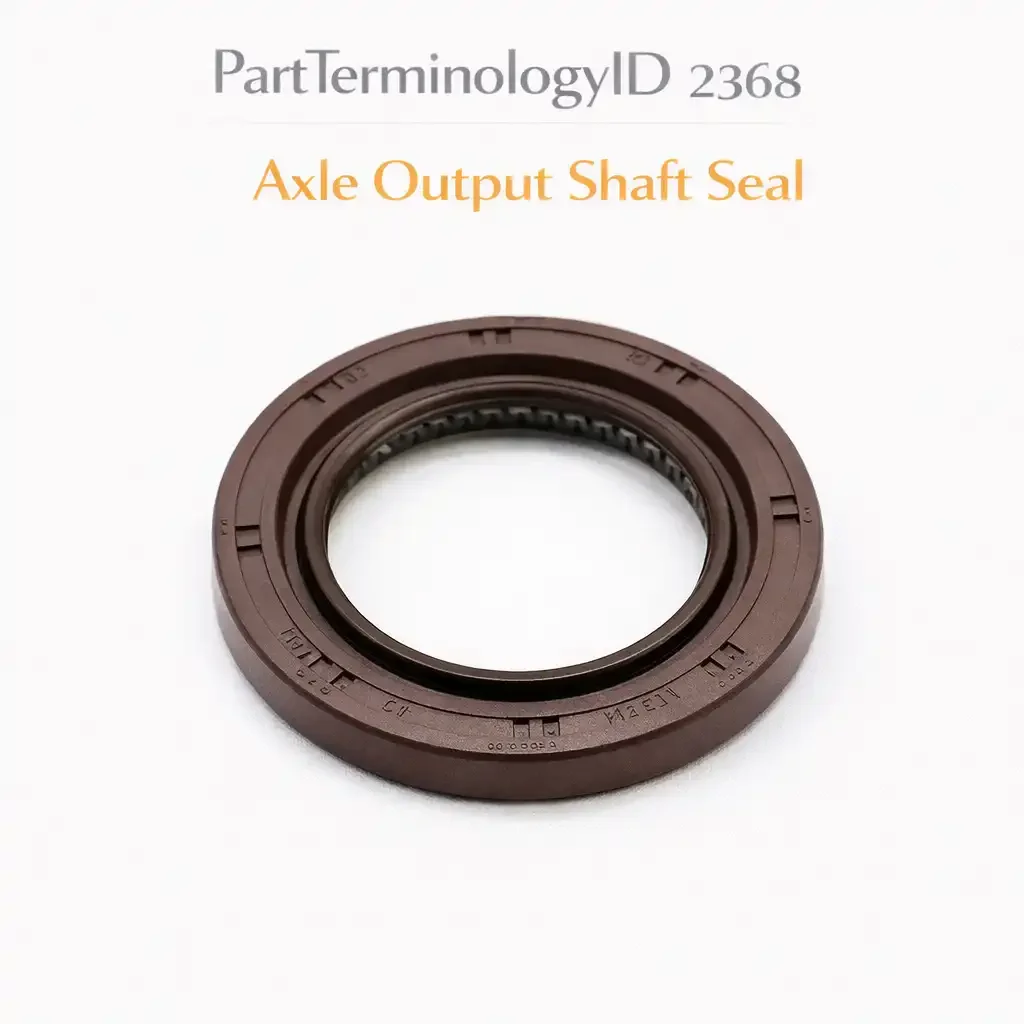
PartTerminologyID 2368, Axle Output Shaft Seal, is a rotary lip seal that prevents fluid from escaping a drive axle assembly, transfer case, or integrated drive unit at the point where an output shaft exits that assembly toward the driven component. That definition covers the function accurately and leaves unresolved the question that every buyer brings to this listing: which output shaft, on which assembly, in which drivetrain position. The word output in PartTerminologyID 2368 is doing the work that the word axle is not. Every drivetrain assembly has at least one output shaft. A conventional rear axle has two output shafts at the axle tube ends, each sealed where the shaft exits the differential housing. A transfer case has a front output shaft and a rear output shaft, both sealed at their respective housing exits. An independent rear drive unit has two output shafts sealed at the housing exits toward the rear halfshafts. An all-wheel-drive power transfer unit has an output shaft toward the rear driveshaft. A portal axle has output shafts at the wheel end reduction gear sets.
A listing under PartTerminologyID 2368 that does not specify which assembly the seal is in and which output shaft position within that assembly the seal covers cannot be evaluated by any buyer who has a leaking output shaft in hand and needs to match the replacement seal to a specific bore.
For sellers, PartTerminologyID 2368 extends the drivetrain seal series into territory that is partly covered by adjacent PartTerminologyIDs and partly distinct from them. PartTerminologyID 2341 covers the CV axle shaft seal at the transaxle exit, which is an output shaft seal at the transaxle differential output position. PartTerminologyID 2344 covers the axle shaft seal at the side gear exit of a solid axle differential. PartTerminologyID 2352 covers the drive shaft seal at the transfer case output and transmission tail shaft. PartTerminologyID 2368 covers the axle output shaft seal where the above PartTerminologyIDs do not resolve the position, most commonly on independent rear drive units, power transfer units, portal axle output positions, and disconnecting front axle output positions where the shaft exits the drive unit toward an intermediate shaft, a halfshaft, or a reduction gear set rather than directly to a wheel hub.
The catalog consequence of this boundary relationship is that a seal for the rear output of an independent rear differential on a rear-wheel-drive performance vehicle may be listed correctly under PartTerminologyID 2368 if the catalog team has determined that 2344 is reserved for solid axle differential seals in their taxonomy. The same seal on the same vehicle might be listed under 2344 in a different catalog implementation. What cannot happen, in any catalog implementation, is a listing that leaves the assembly designation and the shaft position unspecified. Regardless of which PartTerminologyID a catalog team assigns a specific seal to, the assembly and the shaft position must be in the listing for the buyer to evaluate the part.
For sellers, the listing under this PartTerminologyID is only useful if it specifies the drive unit designation, the output shaft position, the shaft diameter, the bore diameter, the seal width, the lip material, and the fluid compatibility. Without those seven attributes, the listing cannot distinguish the dozens of output shaft seal positions this PartTerminologyID may cover across the full range of drivetrain architectures it applies to, and cannot prevent the position confusion and dimensional mismatch that produce returns across every one of those architectures.
What the Axle Output Shaft Seal Does
Retaining drive unit fluid at every output shaft exit point
Every drive unit in the drivetrain fills with a lubricant specific to its function: gear oil in a differential, ATF in a transaxle, dedicated transfer case fluid in a transfer case, hypoid gear oil in an independent rear drive unit. The output shaft that carries torque from the drive unit to the next component in the drivetrain passes through the housing wall at the output shaft bore. The rotary lip seal at this bore maintains the fluid level inside the housing by preventing the fluid from migrating along the rotating shaft surface to the exterior.
The output shaft seal is the most exposed seal in the drive unit because it is at the outermost boundary of the fluid containment system. The shaft outboard of the seal is exposed to the external environment: road spray, mud, salt, thermal cycling, and in the case of independent rear drive units, the heat from nearby exhaust components. The seal must maintain its lip contact force and its lip material integrity through this environment for the full service interval of the drive unit.
A drive unit that loses fluid slowly from a failing output shaft seal may not show any immediate operational symptoms. The fluid level drops gradually, the lubricating film at the bearings and gears thins, the component temperatures rise slightly, and the wear rate increases by a small margin per operating cycle. None of those changes are perceptible to the driver until the fluid level has dropped far enough that the bearing noise or the gear whine becomes audible, at which point the wear has already been accumulating for thousands of miles. The relationship between output shaft seal failure and delayed drive unit failure is the most underappreciated consequence in the drivetrain seal category.
The independent rear drive unit output shaft seal
The independent rear drive unit is the housing found on rear-wheel-drive and all-wheel-drive vehicles with independent rear suspension. The differential gear set is inside the housing, and two output shafts exit the housing toward the rear halfshafts, which then connect to the rear wheel hubs through CV joints. The seals at the output shaft exits prevent the rear differential gear oil from escaping along the output shafts.
On rear-wheel-drive performance vehicles with a longitudinally mounted differential, the output shaft seal position is at the rear of the differential housing, facing rearward toward the rear axle area. On all-wheel-drive vehicles with an independent rear drive unit that is also connected to the transfer case by a propshaft, the same housing has an additional input shaft seal at the front, but the output shaft seals at the two lateral exits are the primary containment for the hypoid gear oil in the unit.
The output shaft diameter at the independent rear drive unit exit is specific to the housing design and the shaft sizing for the torque capacity of the application. A seal ordered without the drive unit designation and the shaft diameter cannot be evaluated against the correct housing bore.
The power transfer unit output shaft seal
The power transfer unit (PTU) on a transverse all-wheel-drive vehicle is a separate housing that connects to the transaxle on one side and routes torque rearward toward the rear drive module via a propshaft. The PTU has an output shaft that exits the housing toward the rear propshaft. The seal at this output shaft bore retains the PTU lubricant, which may be the same ATF as the transaxle or a dedicated PTU fluid specific to the vehicle manufacturer's specification.
On some transverse all-wheel-drive vehicles, the PTU is an integrated module that cannot be serviced without removal from the transaxle, and the output shaft seal is accessible only after PTU removal. On others, the PTU output seal is accessible from the exterior after removing the companion flange or output yoke. The service access requirement must be stated in the listing.
The PTU output shaft seal failure is a high-consequence failure on transverse AWD vehicles because the PTU fluid level is not part of a routine service check on most maintenance schedules. A slow PTU output shaft seal leak can deplete the PTU fluid level over 20,000 to 40,000 miles of driving without any dashboard warning, and the PTU failure from fluid starvation that follows is a multi-thousand dollar repair on a platform where the PTU is not easily or cheaply replaced.
The portal axle output shaft seal
On a portal axle, each wheel end has a reduction gear set that reduces the output speed from the axle shaft to the wheel hub. The axle shaft enters the portal gear housing and a separate output shaft exits the portal housing toward the wheel hub. The seal at this output shaft exit prevents the portal gear oil from escaping along the output shaft toward the wheel hub.
The portal axle output shaft seal is at a more contaminated position than any other output shaft seal in the series because it is at the wheel end, directly adjacent to the wheel hub, the brake assembly, and the road surface. Double-lip seals with exclusion lips are mandatory for portal axle output shaft applications in any environment that involves water, mud, or road debris, which is virtually every application where portal axles are specified.
The portal gear oil specification may differ from the central differential oil specification in the same axle, as established in the axle differential seal post (2348). The seal lip material must be compatible with the portal gear oil specification, not with the central differential specification.
The disconnecting front axle output shaft seal
On four-wheel-drive vehicles with a disconnecting front axle, the front axle differential connects to the front wheel hubs through output shafts that can be disconnected to reduce parasitic drag in two-wheel-drive mode. The output shaft seal at the differential housing exit must accommodate both the engaged condition, where the shaft rotates at wheel speed, and the disengaged condition, where the shaft behavior depends on the specific disconnect mechanism design.
On vacuum-actuated axle disconnect systems, the right front output shaft is stationary in two-wheel-drive mode because the disconnect mechanism locks the shaft relative to the housing. The seal at that position seals a stationary shaft in two-wheel-drive mode and a rotating shaft in four-wheel-drive mode, which is a less demanding duty cycle than a continuously rotating seal position but requires that the seal maintain adequate lip contact force against the shaft regardless of whether the shaft is rotating or stationary.
On electric-actuated disconnect systems where the inner shaft continues to rotate even when the outer shaft is disconnected at the hub, the differential output shaft seal seals against a continuously rotating shaft in all driving modes, which is the same duty cycle as a conventional non-disconnecting axle output shaft seal.
Shaft surface finish at the output shaft seal contact zone
The output shaft seal contact zone on an axle output shaft is subject to the same degradation mechanisms as every other rotary seal contact zone in the drivetrain: the lip wears a shallow groove into the shaft surface over its service life, and a replacement seal installed on a grooved shaft leaks immediately. The groove depth that defeats a new seal is typically 0.05mm or greater, which is shallow enough to be invisible to casual inspection and detectable only by fingernail test or profilometer measurement.
On some drive units, the output shaft is integral to the differential side gear or to the carrier, and cannot be replaced separately when the seal contact zone is grooved. On those designs, a shaft repair sleeve pressed over the contact zone is the only option short of replacing the entire side gear assembly. The listing must state whether a repair sleeve is available for the application and what the sleeve outer diameter is.
Fluid compatibility at elevated temperature in high-performance applications
Independent rear drive units on performance vehicles operate in close proximity to the exhaust system. On mid-engine vehicles where the rear drive unit is between the engine and the transaxle, the ambient temperature around the output shaft seal positions can exceed 120 degrees Celsius in sustained track use. Standard nitrile seals are typically rated to 100 to 110 degrees Celsius continuous operating temperature. A seal installed at an output shaft position where the ambient temperature from exhaust proximity regularly exceeds the nitrile rating will harden and lose contact interference within a short service period.
HNBR seals are rated to approximately 150 degrees Celsius continuous and are the minimum specification for output shaft seal positions on high-performance vehicles where exhaust proximity raises the ambient temperature above the nitrile limit. PTFE-lipped seals have the highest temperature rating of standard seal materials and are appropriate for positions where the ambient temperature regularly exceeds 150 degrees Celsius in motorsport or severe-duty commercial applications.
The listing must state the maximum continuous temperature rating of the seal alongside the lip material.
The Specifications That Determine Correct Seal Fitment
Drive unit designation and output shaft position
The drive unit designation is the primary fitment attribute. It may be an independent rear drive unit model, a power transfer unit designation, a portal axle model, or a front axle disconnect unit. The output shaft position within the drive unit, whether left or right lateral output, front or rear output, or wheel-end portal output, must be stated alongside the unit designation.
Shaft diameter and bore diameter
State in millimeters to two decimal places. Output shaft diameters vary by application torque rating and by the specific design of the drive unit. Left and right output shafts on the same drive unit may have different diameters if the unit is asymmetrically designed or if one side incorporates a disconnect mechanism that changes the shaft diameter at the seal contact zone.
Seal width
In millimeters. The available bore depth at the output shaft exit determines the maximum usable seal width. State the bore depth in the listing.
Lip material with temperature rating
Nitrile for standard applications below 110 degrees Celsius ambient. HNBR for high-temperature applications between 110 and 150 degrees Celsius. PTFE for applications above 150 degrees Celsius or for worn shaft surfaces that do not meet the standard Ra finish requirement. State the maximum continuous temperature rating alongside the lip material designation.
Fluid compatibility
State the drive unit fluid specification: gear oil API GL rating and mineral or synthetic, ATF generation and specification, or dedicated fluid designation. On PTU applications where the fluid specification is specific to the vehicle manufacturer, state the manufacturer's fluid designation explicitly rather than a generic approximation.
Single-lip versus double-lip with exclusion
Single-lip for clean operating environments. Double-lip with exclusion for wheel-end portal applications, off-road differential output positions, and any output shaft position exposed to road spray or water immersion in regular service.
Service access: component in place or removal required
State whether the output shaft seal is accessible with the drive unit in the vehicle or whether drive unit removal is required. On PTU applications this is particularly important because the access requirement affects the labor estimate significantly.
Shaft repair sleeve availability
State whether a repair sleeve is available for the application and the sleeve outer diameter. On drive units where the output shaft is integral to a carrier component and cannot be replaced separately, the repair sleeve availability determines whether a grooved shaft can be reconditioned without complete unit replacement.
Why This Part Generates Returns
Buyers order the wrong axle output shaft seal because:
the drive unit designation is not specified and the output shaft diameter does not match the replacement seal
the left and right output shaft positions are not distinguished and the seals have different inner diameters due to an asymmetric drive unit design
the PTU fluid specification is not stated and a generic ATF-rated seal is installed where a dedicated PTU fluid requires a different lip material
the lip temperature rating is not stated and a nitrile seal is installed at an exhaust-adjacent output shaft position on a high-performance vehicle where the ambient temperature exceeds the nitrile limit
the seal is too wide for the bore depth and the companion flange or output yoke cannot seat against the housing face
the output shaft contact zone is grooved and the new seal leaks immediately, and no repair sleeve is available for the application, requiring complete drive unit disassembly
the disconnect front axle output shaft position and mode are not specified and a seal designed for a continuously rotating shaft is installed at a position that alternates between rotating and stationary
Status in New Databases
PIES/PCdb: PartTerminologyID 2368, Axle Output Shaft Seal
PIES 8.0 / PCdb 2.0: No change
Top Return Scenarios
Scenario 1: "Left and right output shaft seals specified as identical, right side larger diameter, seal lip torn on installation"
The independent rear drive unit has a left output shaft and a right output shaft. The right output shaft is larger in diameter than the left because the right side incorporates the ring gear side bearing journal, which is machined to a larger diameter to accommodate a larger bearing. The listing specified one seal for both sides. The buyer installed the smaller left-side seal on the right output shaft. The smaller seal inner diameter overstressed the lip during installation and tore the lip before the shaft reached the correct installation depth.
Prevention language: "Left output shaft diameter: [X.XX]mm. Right output shaft diameter: [X.XX]mm. This drive unit uses different output shaft diameters on the left and right sides. The left and right output shaft seals are not interchangeable. Verify the output shaft position and diameter before ordering."
Scenario 2: "PTU dedicated fluid, generic ATF seal installed, lip degraded within 12,000 miles"
The power transfer unit specifies Motorcraft PTFE-based fluid, which is a dedicated PTU fluid with a different additive package from standard Dexron ATF. The replacement seal uses an EPDM inner tube rated for Dexron ATF. The PTFE-based fluid chemistry degraded the EPDM at operating temperature. The lip lost elasticity and contact interference within 12,000 miles.
Prevention language: "PTU fluid specification: [Motorcraft PTFE-based PTU fluid / Mopar ATF+4 / other manufacturer-specific fluid]. Lip material compatibility: [compatible with specified PTU fluid]. Do not substitute a generic ATF-rated seal for this application. The PTU uses a dedicated fluid with a different chemical composition from standard Dexron ATF. Verify the seal lip material is specifically rated for the manufacturer's PTU fluid designation."
Scenario 3: "Nitrile seal at exhaust-adjacent rear drive unit position, lip hardened at 18,000 miles on track-driven vehicle"
The independent rear drive unit on a mid-engine performance vehicle is mounted between the engine and the gearbox. The output shaft positions are adjacent to the exhaust headers. In sustained track use, the ambient temperature at the output shaft seal positions exceeds 130 degrees Celsius. The replacement seal uses a standard nitrile lip rated to 110 degrees Celsius. The lip hardened within 18,000 miles of mixed road and track use and began seeping hypoid gear oil along the output shaft.
Prevention language: "Lip material: [nitrile, rated to 110 degrees C / HNBR, rated to 150 degrees C / PTFE, rated to 200 degrees C]. Application note: the output shaft seal positions on this drive unit are adjacent to the exhaust system. Ambient temperatures at these positions can exceed 110 degrees Celsius during sustained high-load operation. Standard nitrile seals are not adequate for this application. Specify an HNBR seal rated to at least 150 degrees Celsius for vehicles used on track or under sustained high-load conditions."
Scenario 4: "Output shaft contact zone grooved, no repair sleeve available, drive unit required full disassembly"
The original seal failed and wore a groove into the output shaft at the seal contact zone. The buyer replaced the seal. The new seal leaked immediately from the groove. A shaft repair sleeve is not available for this specific drive unit because the output shaft is integral to the differential side gear and cannot be sleeved without removing the side gear from the carrier. The buyer was not informed that the repair sleeve was unavailable for this application. The correct repair required full drive unit disassembly to replace the side gear assembly.
Prevention language: "Shaft repair sleeve availability: [sleeve available, outer diameter X.XX mm / sleeve not available for this application]. Note: the output shaft on this drive unit is integral to the differential side gear. If the shaft contact zone is grooved, a repair sleeve cannot be installed without removing the side gear assembly from the carrier, which requires full drive unit disassembly. Inspect the shaft surface before ordering the seal. A shaft with a groove deeper than 0.05mm at the seal contact zone requires side gear replacement."
Scenario 5: "PTU output seal too wide, companion flange will not seat against PTU housing"
The replacement seal is 5mm wider than the original. The seal protrudes 5mm beyond the PTU output bore face. The companion flange that connects the PTU output to the rear propshaft cannot seat flat against the PTU housing face with the protruding seal in position. The companion flange retaining nut draws the flange toward the housing but the protruding seal is compressed between the flange face and the housing bore shoulder rather than being retained correctly within the bore.
Prevention language: "Seal width: [X]mm. Available bore depth at PTU output position: [X]mm. Verify the seal width does not exceed the bore depth before installation. A seal wider than the bore depth will protrude from the housing face and prevent the companion flange from seating correctly. An incorrectly seated companion flange transmits propshaft vibration forces to the PTU housing rather than to the bearing, accelerating output shaft bearing wear."
Scenario 6: "Portal axle output seal, single-lip, operating in off-road service, water ingress destroyed portal gear set"
The vehicle is used for regular off-road driving including deep water crossings. The portal gear housing output shaft seals are single-lip designs. During a water crossing where the axle was submerged, water entered the portal gear housing through the output shaft seal exclusion path. The water contaminated the portal gear oil, which emulsified and provided inadequate lubrication to the portal reduction gear set. The portal gears failed within 2,000 miles of the water crossing.
Prevention language: "Seal lip configuration: [single-lip / double-lip with exclusion lip]. Application note: portal axle output shaft seals are at the wheel end in direct contact with road debris, mud, and water. Off-road applications, water crossings, and any operation where the axle may be submerged require a double-lip seal with an exclusion lip at all portal output shaft positions. A single-lip seal at a portal output shaft position does not provide adequate protection against water or contamination ingress in off-road service."
Scenario 7: "Disconnecting front axle output shaft, seal designed for continuous rotation, lip extrudes inward in two-wheel-drive stationary mode"
The front axle disconnect mechanism locks the right output shaft stationary relative to the housing in two-wheel-drive mode. The replacement seal is designed for continuous shaft rotation, where the hydrodynamic film lubricates the lip and prevents dry contact. In stationary mode, there is no hydrodynamic film at the lip contact zone and the lip contacts the stationary shaft in dry running. Over extended two-wheel-drive driving, the lip extrudes inward from the combined effect of thermal expansion and static contact pressure without hydrodynamic relief.
Prevention language: "Front axle disconnect type: [vacuum-actuated, right shaft stationary in 2WD / electric-actuated, continuous shaft rotation in all modes]. Seal type required: [standard rotary lip seal for continuous rotation / stationary-compatible lip design for intermittent rotation]. Verify the disconnect mechanism type before ordering. A seal designed for continuous rotation is not appropriate for positions where the shaft is stationary for extended periods in two-wheel-drive mode."
What to Include in the Listing
Core essentials
PartTerminologyID: 2368
component: Axle Output Shaft Seal
drive unit type: independent rear drive unit, power transfer unit, portal axle, disconnecting front axle, or other (mandatory)
drive unit manufacturer and model designation (mandatory)
output shaft position: left lateral, right lateral, front output, rear output, or portal wheel-end output (mandatory)
disconnect mode for disconnecting axle applications: continuous rotation or stationary in 2WD (mandatory)
shaft diameter in mm to two decimal places (mandatory)
housing bore diameter in mm to two decimal places (mandatory)
seal width in mm (mandatory)
available bore depth in mm (mandatory)
lip material: nitrile, HNBR, polyacrylate, or PTFE (mandatory)
maximum continuous temperature rating in degrees Celsius (mandatory)
fluid compatibility: gear oil API GL rating, ATF specification, or dedicated fluid designation (mandatory)
lip configuration: single-lip or double-lip with exclusion lip (mandatory)
garter spring: present or springless (mandatory)
shaft surface finish requirement in Ra micrometers (mandatory)
shaft repair sleeve availability: available with outer diameter or not available (mandatory)
service access: drive unit in vehicle or removal required (mandatory)
quantity: 1
Fitment essentials
year/make/model/submodel
drive unit designation (primary fitment attribute)
output shaft position within drive unit
drivetrain: RWD, AWD, or 4WD
front axle disconnect mechanism type for disconnecting applications
proximity to exhaust system: note when exhaust adjacent position requires elevated temperature rating
Dimensional essentials
shaft diameter in mm to two decimal places
seal inner diameter before installation in mm
housing bore diameter in mm
seal outer diameter in mm
seal width in mm
available bore depth in mm
press fit interference in mm
lip contact band width in mm
garter spring inner diameter in mm
repair sleeve outer diameter in mm where available
Image essentials
seal in isolation showing lip configuration: single-lip, double-lip, or PTFE-lipped
cross-section showing inner lip, garter spring, and exclusion lip for double-lip designs
drive unit housing shown with output shaft bore positions identified and labeled
left and right output shaft seals shown side by side for units with different shaft diameters at each side
PTU housing shown with companion flange removed and output seal bore visible
portal axle wheel end shown with the output shaft seal position at the wheel hub exit
exhaust proximity note shown on image for high-temperature applications
repair sleeve shown alongside seal where a sleeve is available for the application
Catalog Checklist for ACES/PIES Teams
PartTerminologyID = 2368
require drive unit type and model designation (mandatory)
require output shaft position within drive unit (mandatory)
require shaft diameter in mm to two decimal places (mandatory)
require housing bore diameter in mm (mandatory)
require seal width and bore depth (mandatory)
require lip material with maximum temperature rating (mandatory)
require fluid compatibility with specific fluid designation for PTU applications (mandatory)
require lip configuration (mandatory)
require shaft repair sleeve availability (mandatory)
require service access requirement (mandatory)
define boundary with adjacent PartTerminologyIDs: seals at the lateral output shaft exits of a solid axle differential are PartTerminologyID 2344; seals at the CV halfshaft exits of a transaxle are PartTerminologyID 2341; seals at the transfer case output and transmission tail shaft are PartTerminologyID 2352; seals at the axle differential sub-assembly outputs in commercial modular axles are PartTerminologyID 2348; PartTerminologyID 2368 covers output shaft seals at independent rear drive units, power transfer units, portal axle wheel ends, and disconnecting front axle outputs where the above PartTerminologyIDs do not apply in the catalog implementation
differentiate from drive shaft seal (PartTerminologyID 2352): the transfer case output seal is at the transfer case housing exit toward the propshaft; the axle output shaft seal under 2368 is at the drive axle unit housing exit toward the halfshaft or wheel hub; both are output shaft seals but at different assemblies in the drivetrain
differentiate from differential seal (PartTerminologyID 2344): solid axle lateral output shaft seals are 2344; independent rear drive unit lateral output shaft seals are 2368 in most catalog implementations; the assembly type distinguishes the two
flag left versus right shaft diameter as mandatory for asymmetric drive units: asymmetric design in independent rear drive units produces different output shaft diameters at each side; treating both sides as identical produces a torn seal lip on installation at the larger-diameter side
flag temperature rating as mandatory: exhaust proximity at independent rear drive unit output positions on mid-engine and rear-engine vehicles produces ambient temperatures that exceed the nitrile lip rating; the temperature rating is an attribute with no equivalent in any other seal PartTerminologyID in the series
flag PTU fluid specification as mandatory: dedicated PTU fluids from vehicle manufacturers use chemical compositions that are incompatible with generic ATF lip materials; the specific fluid designation must be stated, not a generic ATF approximation
flag repair sleeve availability as mandatory: an integral output shaft that cannot be sleeved when grooved requires full drive unit disassembly rather than a sleeve repair; the buyer must know this before beginning the installation
FAQ (Buyer Language)
How do I identify my independent rear drive unit model designation?
The drive unit model designation is typically stamped on an identification tag attached to the housing or cast into the housing casting. On BMW rear drive units, the designation is on the front face of the housing. On Mercedes-Benz rear drive units, it is on a tag on the housing cover. On domestic vehicles with Eaton or American Axle independent rear differentials, the tag is typically on the side of the housing. If the tag is missing or illegible, the drive unit can be identified from the vehicle VIN by the axle ratio code and the build option code, which cross-reference to the drive unit designation in the vehicle's production records.
My PTU output shaft seal is leaking. Can I replace it without removing the PTU from the transaxle?
On some transverse AWD platforms, yes. If the PTU output yoke or companion flange is accessible from under the vehicle without removing the PTU from the transaxle, the seal can be replaced by removing the yoke, driving out the old seal, pressing in the new seal, and reinstalling the yoke. On platforms where the PTU is an integrated module with the output seal bore inside the transaxle bell housing, the PTU must be removed from the transaxle to access the output seal bore. Verify the service procedure for your specific platform before committing to the repair scope. The labor difference between the two access scenarios on most transverse AWD platforms is four to six hours.
My rear drive unit is adjacent to the exhaust on a performance car. The seal I installed last year lasted only 14,000 miles. What should I specify for the replacement?
The short service life from the previous replacement suggests the lip material was not rated for the ambient temperature at your drive unit's output shaft position. Measure the temperature at the seal position under sustained high-load driving using a contact thermometer or an infrared thermometer if you have access to the vehicle on a lift. If the temperature exceeds 110 degrees Celsius regularly, specify an HNBR seal with a 150 degree Celsius rating for the replacement. If the temperature exceeds 150 degrees Celsius in track use, specify a PTFE-lipped seal. PTFE-lipped seals do not require the shaft surface finish Ra specification that standard lip seals require, which is an additional benefit if the shaft contact zone shows any marginal surface condition from the previous seal's wear.
Can I use a seal from a related vehicle platform if my specific application's seal is on backorder?
Only if the shaft diameter, bore diameter, seal width, lip material, and fluid compatibility are confirmed to match. Do not substitute a seal based on visual similarity or general application overlap without measuring both the original seal and the proposed substitute against all five dimensional and material attributes. Even within the same vehicle manufacturer's platform family, the output shaft seal dimensions may vary by model year, engine option, or torque rating. A substitute that is 0.5mm smaller in inner diameter than the original may appear to install correctly and will leak within the first heat cycle because the contact interference is insufficient.
After installing a new output shaft seal on my rear drive unit, I notice a small wet ring around the shaft after the first drive. Is this normal?
A thin wet ring at the shaft immediately after the first drive is often caused by the initial break-in of the seal lip against the shaft surface. During the first few heat cycles, the lip material conforms to minor surface irregularities in the shaft at the contact zone, and a very thin film of fluid may appear at the lip edge during this break-in period. If the wet ring does not grow beyond a 2 to 3mm wet band after the first 200 to 300 miles of operation, the seal is functioning correctly and the break-in process is complete. If the wet ring grows into a running drip or a fluid accumulation under the vehicle, inspect the shaft surface for scoring, verify the seal installation depth is correct, and confirm the seal dimensions match the shaft and bore specifications.
The output shaft on my portal axle is grooved at the seal contact zone. Is a repair sleeve available?
Repair sleeve availability for portal axle output shafts varies by manufacturer and by whether the output shaft is a separate component or integral to the portal gear housing output gear. On most portal axle designs where the output shaft is a separate component that can be removed from the portal housing, a repair sleeve of the correct outer diameter can be pressed onto the shaft at the contact zone. On designs where the output shaft is integral to the portal output gear, the gear assembly must be replaced. Contact the portal axle manufacturer or the vehicle manufacturer's parts department to confirm repair sleeve availability for your specific portal axle model before deciding on the repair approach.
Cross-Sell Logic
Drive Unit Fluid (the fluid is drained and replaced at every output shaft seal replacement; verify the specific fluid designation, API rating, viscosity, and manufacturer approval for the drive unit)
Output Shaft Companion Flange or Yoke (the companion flange is inspected for wear at the seal contact surface when the seal is replaced; replace if grooved or worn to an undersized diameter)
Yoke Retaining Nut (the yoke or companion flange retaining nut is a torque-to-yield fastener on some independent rear drive units and PTUs; replace at every removal)
Shaft Repair Sleeve (if the output shaft contact zone is grooved and a sleeve is available for the application, the sleeve is the mandatory first purchase before the seal can be installed successfully)
Input Shaft Seal for same drive unit (the input shaft seal and the output shaft seals are in the same housing; if one seal has failed, the others are at a similar age and mileage and should be inspected concurrently)
Drive Unit Gasket Set (if the drive unit cover or inspection plate is removed at the same service event, the cover gasket is replaced concurrently)
Portal Axle Gear Oil (portal axle output shaft seal replacement requires draining the portal gear oil and refilling with the correct specification; portal gear oil specification may differ from the central differential specification on the same axle)
Frame as "the output shaft seal retains the fluid that lubricates the gears and bearings inside the drive unit. The output shaft passes through the seal to carry torque to the halfshaft or wheel hub. The companion flange or yoke connects the output shaft to the propshaft or halfshaft. The drive unit fluid lubricates every component the seal is protecting. All are in the same service path when the output seal is replaced."
Final Take for PartTerminologyID 2368
Axle Output Shaft Seal (PartTerminologyID 2368) is the broadest and most architecturally diverse seal PartTerminologyID in the drivetrain seal series. It covers output shaft seals across independent rear drive units, power transfer units, portal axle wheel ends, and disconnecting front axle outputs, which span passenger performance vehicles, transverse all-wheel-drive vehicles, heavy-duty off-road vehicles, and military-specification equipment. The breadth of that coverage makes the drive unit designation and the output shaft position the mandatory first attributes not as a catalog convention but as a functional necessity: a seal for the right lateral output of a BMW rear drive unit and a seal for the portal output of a Mercedes-Benz portal axle are both axle output shaft seals under PartTerminologyID 2368 and share no dimensions, no fluid compatibility, and no installation procedure.
Within each specific application, five attributes determine whether the replacement seal performs for its full service life or fails within a fraction of it. The shaft diameter resolves the dimensional fit. The fluid compatibility resolves whether the lip material survives the chemistry of the fluid it contacts. The temperature rating resolves whether the lip material survives the ambient temperature of the installation position, which on exhaust-adjacent drive units at the rear of mid-engine performance vehicles can exceed the nitrile limit regularly in normal spirited driving, not only in track use. The repair sleeve availability resolves whether a grooved shaft can be reconditioned without complete drive unit disassembly. The service access requirement resolves the labor scope before the buyer commits to the repair.
State the drive unit type and model designation. State the output shaft position. State the shaft diameter and bore diameter. State the seal width and bore depth. State the lip material with its temperature rating. State the fluid compatibility with the specific fluid designation for PTU applications. State the lip configuration. State the repair sleeve availability. State the service access requirement. That is the same listing strategy as every other PartTerminologyID in this series: specific attributes at every level to become a listing buyers can act on without guessing. For PartTerminologyID 2368, the temperature rating is the attribute that no other seal PartTerminologyID in the series requires and that this one cannot omit, because it is the attribute that determines whether a correctly dimensioned seal survives the thermal environment of the specific installation or degrades silently at operating temperature until the drive unit it protects runs dry.