
Written by Arthur Simitian | PartsAdvisory
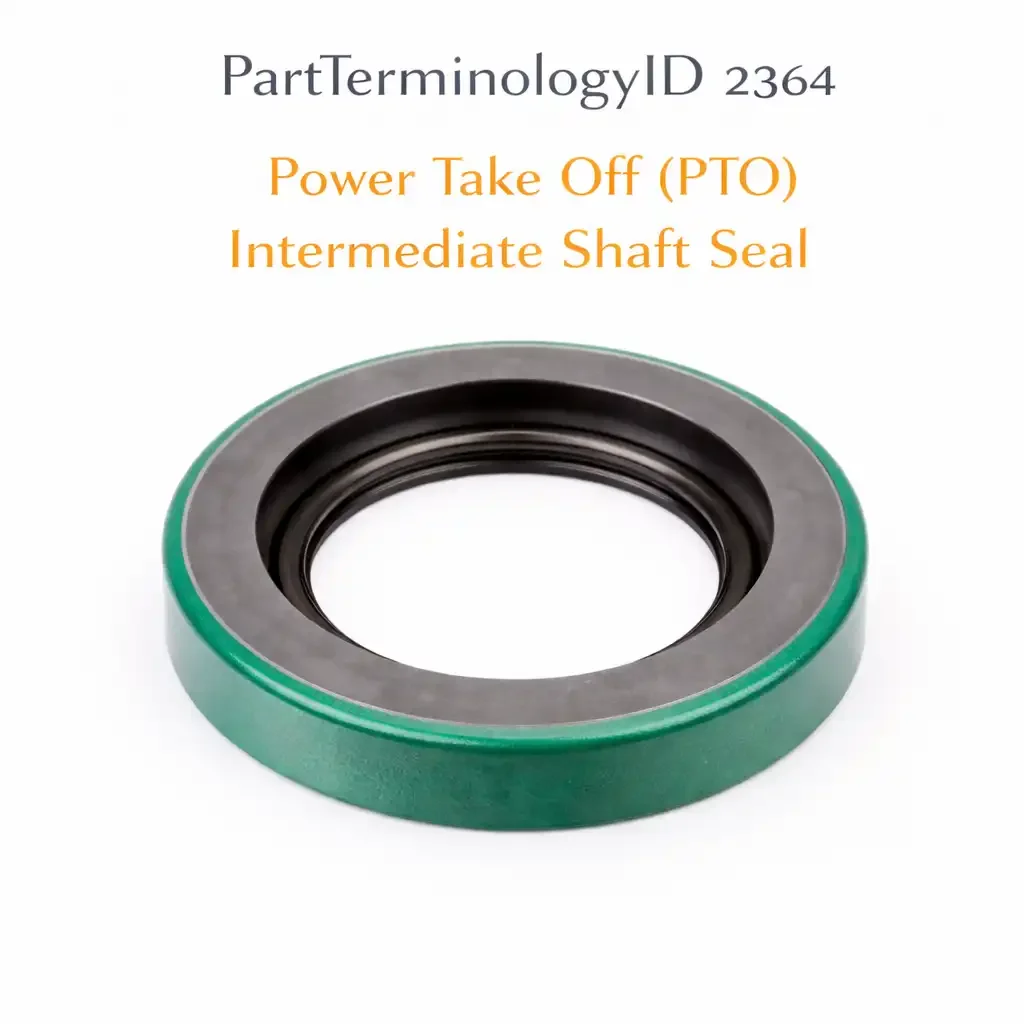
PartTerminologyID 2364, Power Take Off (PTO) Intermediate Shaft Seal, is a rotary lip seal that prevents gear oil from escaping the PTO housing along the intermediate shaft at the point where the intermediate shaft passes through a housing wall or bearing retainer plate within the PTO unit. That definition locates the seal at the intermediate shaft position inside the PTO housing. It does not specify the PTO unit manufacturer and model designation, the compatible transmission model, which housing wall or retainer plate the intermediate shaft passes through, what the intermediate shaft diameter is at the seal contact zone, what the bore diameter is at the seal installation point, what the seal width is, what the lip material is, what the gear oil formulation compatibility is, whether the seal is at the input-side wall, the output-side wall, or an intermediate partition within a multi-stage PTO, whether the intermediate shaft rotates at the same speed as the input shaft or at a reduced speed through a gear reduction stage, or whether the seal is accessible with the PTO mounted on the transmission or requires PTO removal and partial disassembly. A listing under PartTerminologyID 2364 that provides fitment by vehicle year, make, and model without the PTO designation, the intermediate shaft diameter, the bore diameter, and the seal position within the housing cannot be evaluated by any technician who has the PTO disassembled and the failed seal in hand.
For sellers, PartTerminologyID 2364 sits between PartTerminologyID 2356, the PTO input shaft seal, and what would be a PTO output shaft seal PartTerminologyID, in the torque path through the PTO unit. The input shaft seal is at the transmission-facing housing wall where the torque enters the PTO. The output shaft seal is at the output-facing housing wall where the torque exits to the driven equipment. The intermediate shaft seal is at neither the input nor the output boundary: it is at the shaft that carries torque between the input gear and the output gear within the PTO housing interior. That position within the torque path defines both the buyer who arrives at this PartTerminologyID and the diagnostic path they have followed to get here.
A buyer ordering under PartTerminologyID 2364 has already removed the PTO from the transmission, has opened the PTO housing to inspect the internals, and has identified the intermediate shaft seal as the leak source. This is not a buyer who observed a fluid trace on the outside of the PTO and is guessing at the source. This is a buyer who has the PTO on the bench, has located the intermediate shaft within the housing, and has confirmed that the seal at the intermediate shaft bore is the failed component. The listing for PartTerminologyID 2364 serves a more technically advanced buyer than any other seal PartTerminologyID in this series, and the listing must match that level of specificity.
The additional complexity specific to this PartTerminologyID is that multi-stage and multi-output PTO units may have more than one intermediate shaft, each with its own seal, and the seals at different intermediate shaft positions within the same PTO housing may have different shaft diameters, different bore diameters, and different shaft surface speeds depending on where in the gear reduction sequence each intermediate shaft sits. A listing that specifies only the PTO model without the intermediate shaft position within the housing cannot be evaluated by a buyer whose PTO has two intermediate shafts with different seal specifications at each position.
For sellers, the listing under this PartTerminologyID is only useful if it specifies the PTO unit designation, the intermediate shaft position within the housing, the shaft diameter, the bore diameter, the seal width, the lip material, the gear oil compatibility, and the shaft surface speed at the seal contact zone. Without those eight attributes, the listing cannot distinguish between multiple intermediate shaft positions within a complex PTO and cannot serve the technically advanced buyer population that this PartTerminologyID attracts.
What the PTO Intermediate Shaft Seal Does
Sealing the intermediate stage of the PTO torque path
In a single-stage PTO, the torque path is direct: the input gear meshes with the output gear and the output shaft carries the torque to the driven equipment. In a single-stage PTO there is no intermediate shaft and no intermediate shaft seal. PartTerminologyID 2364 therefore applies only to multi-stage PTO units where a gear reduction or a gear direction change is accomplished through one or more intermediate shaft and gear combinations between the input and the output.
In a two-stage PTO, the input gear meshes with an intermediate gear on the intermediate shaft, and the intermediate gear meshes with the output gear on the output shaft. The intermediate shaft runs parallel to both the input and the output shaft and is supported at each end by bearings in the housing walls. Where the intermediate shaft passes through a housing wall or a bearing retainer plate, a seal at the bore prevents gear oil from escaping along the shaft surface.
The intermediate shaft in a two-stage PTO rotates at a speed determined by the gear ratio between the input gear and the intermediate gear. If the input gear has 20 teeth and the intermediate gear has 10 teeth, the intermediate shaft rotates at twice the input shaft speed. If the ratio is inverted, the intermediate shaft rotates at half the input shaft speed. The shaft surface speed at the intermediate shaft seal contact zone is the product of the intermediate shaft RPM and the shaft circumference at the seal contact diameter. A small-diameter intermediate shaft rotating at twice the input speed may have a higher seal lip surface speed than a large-diameter input shaft rotating at input speed, which affects the lip material specification and the seal design.
The position of the intermediate shaft seal within the housing
On a two-stage PTO with a through-shaft intermediate design, the intermediate shaft passes through both end walls of the housing and has a seal at each end wall passage. The seal at the input-side end wall is on the same housing face as the input shaft seal but at a different bore location. The seal at the output-side end wall is on the same housing face as the output shaft seal but at a different bore. If the PTO has a bearing retainer plate in the interior of the housing to support the midpoint of the intermediate shaft, there may be a third seal or a simple bore bushing at the internal retainer.
The most common failure point for an intermediate shaft seal is at the end wall bore that is closest to the driven equipment, because that end of the PTO is exposed to more vibration from the driven equipment and more thermal cycling from the proximity to the output shaft's heat generation under sustained load. The seal at the output-side end wall of the intermediate shaft typically shows more wear than the seal at the input-side end wall on the same housing.
The listing must specify which end wall or which retainer bore the seal covers.
Gear oil pressure at the intermediate shaft seal position
The gear oil pressure at the intermediate shaft bore differs from the pressure at the output shaft seal position. The output shaft seal seals against the gear oil at the output shaft bearing cavity, which is typically at or above the splash lubrication level and may be under positive pressure when the PTO is operating at full load. The intermediate shaft bore may be at a lower gear oil pressure if the intermediate shaft runs in a splash lubrication zone rather than in a pressurized oil circuit.
On some PTO designs, the intermediate shaft runs in a separate cavity from the output shaft, with its own oil level maintained by the housing geometry. A seal failure at the intermediate shaft bore that allows gear oil to escape may deplete the oil level in the intermediate shaft cavity without immediately affecting the output shaft lubrication, which can lead to intermediate shaft bearing failure from oil starvation before any external leak is visible at the PTO exterior.
The listing should note the lubrication arrangement for the intermediate shaft position to alert the buyer to inspect the intermediate shaft bearing when the seal is replaced.
Multi-output PTO intermediate shaft configurations
Some heavy-duty PTO units designed for dual or triple output applications have multiple intermediate shafts arranged within the housing to route torque to multiple output positions simultaneously. Each intermediate shaft may have seals at both ends and possibly at an internal partition, producing several distinct intermediate shaft seal positions within a single PTO housing.
On a dual-output PTO where one output is forward-facing and one is side-facing, the intermediate shaft that routes torque from the main input gear to the side-facing output gear passes through housing walls in a different plane from the intermediate shaft that routes torque to the forward-facing output. The two intermediate shafts in this configuration may have different shaft diameters, different bore diameters, and different shaft speeds.
A listing under PartTerminologyID 2364 for a dual-output PTO must specify which intermediate shaft and which end of that shaft the seal covers. Without that specificity, the listing cannot be evaluated by a technician who has identified a specific intermediate shaft seal failure in a multi-output housing.
The Specifications That Determine Correct Seal Fitment
PTO unit designation and transmission model
The PTO unit designation is the primary fitment attribute. The transmission model confirms the PTO-to-transmission application and is particularly important for identifying the gear ratio within the PTO, which determines the intermediate shaft rotational speed and therefore the seal lip surface speed.
Intermediate shaft position within the housing
Input-side end wall, output-side end wall, or internal bearing retainer. For multi-output PTOs, specify which intermediate shaft and which position along that shaft.
Shaft diameter and bore diameter
State in millimeters to two decimal places. On multi-stage PTOs where the intermediate shaft has been machined to different diameters at each end to match the respective bearing inner races, the shaft diameter at the seal contact zone at each end may differ even for the same intermediate shaft.
Seal width
In millimeters. The available bore depth at each housing wall position determines the maximum seal width. Internal retainer bores typically have less available depth than external housing wall bores.
Lip material and gear oil compatibility
Nitrile for conventional GL-4 and GL-5 mineral gear oil. HNBR for synthetic gear oil or high-temperature intermediate shaft positions. Polyacrylate for full-synthetic gear oil specifications on extended commercial service intervals. State the API GL rating and mineral or synthetic base.
Shaft surface speed at the seal contact zone
State in meters per second. The intermediate shaft rotational speed may be higher or lower than the input shaft speed depending on the gear ratio of the first reduction stage. A higher intermediate shaft speed requires a higher surface speed rated lip material. Standard nitrile is typically rated to approximately 4 to 6 m/s. HNBR extends the surface speed rating to 8 to 10 m/s at elevated temperature.
Single-lip versus double-lip
Single-lip for internal housing wall positions where the external face of the seal is not exposed to road contamination. Double-lip with exclusion for external housing wall positions where the end of the intermediate shaft exits the housing to the external environment.
Why This Part Generates Returns
Buyers order the wrong PTO intermediate shaft seal because:
the intermediate shaft position within the housing is not specified and the input-side bore seal and the output-side bore seal for the same intermediate shaft have different dimensions
the PTO unit designation is not specified and the intermediate shaft diameter does not match the replacement seal
the shaft surface speed at the intermediate shaft position is not stated and a standard nitrile seal is specified for a position where the intermediate shaft rotates at a speed that exceeds the nitrile surface speed rating
the gear oil compatibility is not specified and a mineral oil rated seal degrades in synthetic gear oil at the operating temperature of a high-duty-cycle commercial PTO
the seal covers a multi-output PTO and the intermediate shaft designation is not stated, sending the seal for the forward-output intermediate shaft to a technician who needs the side-output intermediate shaft seal
the available bore depth is not stated and the replacement seal is wider than the bore, preventing the bearing retainer from seating correctly
Status in New Databases
PIES/PCdb: PartTerminologyID 2364, Power Take Off (PTO) Intermediate Shaft Seal
PIES 8.0 / PCdb 2.0: No change
Top Return Scenarios
Scenario 1: "Input-side and output-side intermediate shaft bores have different diameters, wrong end specified"
The intermediate shaft is machined to 28mm at the input-side end and 32mm at the output-side end to match different bearing sizes at each end. The listing specified an intermediate shaft seal by PTO model without stating the shaft position. The buyer needed the output-side seal. The replacement arrived as the input-side seal with the 28mm inner diameter. The 32mm output-side shaft does not fit through the 28mm seal.
Prevention language: "Intermediate shaft seal position: [input-side housing wall / output-side housing wall]. Shaft diameter at this position: [X.XX]mm. The intermediate shaft on this PTO is machined to different diameters at the input and output ends to match different bearing sizes. The input-side and output-side intermediate shaft seals are different sizes. Specify the housing wall position when ordering."
Scenario 2: "Intermediate shaft speed exceeds nitrile surface speed rating, seal lip wore through within 6,000 miles"
The intermediate shaft gear ratio produces a shaft speed that is 2.4 times the input shaft speed. At full PTO operating speed, the intermediate shaft rotates at 3,600 RPM. The intermediate shaft diameter at the seal contact zone is 22mm. The lip surface speed is approximately 4.1 m/s, which is at the upper limit of the standard nitrile rating. The PTO is used in sustained commercial duty at full operating speed for extended periods. The combination of elevated surface speed and high operating temperature from sustained load wore through the nitrile lip within 6,000 miles of commercial service.
Prevention language: "Intermediate shaft surface speed at this position: [X.X] m/s at rated PTO speed. Lip material minimum surface speed rating required: [X.X] m/s. Standard nitrile lips are rated to approximately 4 to 6 m/s at elevated temperature. For commercial duty applications at sustained rated PTO speed, specify an HNBR lip seal rated to 8 to 10 m/s to provide an adequate speed margin at operating temperature."
Scenario 3: "Multi-output PTO, forward-output intermediate shaft seal received, side-output intermediate shaft seal needed"
The PTO is a dual-output unit with one forward-facing output and one side-facing output. The listing specified the intermediate shaft seal by PTO model without identifying which intermediate shaft. The buyer needed the seal for the side-output intermediate shaft. The forward-output intermediate shaft is a different diameter from the side-output intermediate shaft. The received seal does not fit the side-output bore.
Prevention language: "PTO output configuration: [single output / dual output: forward and side / other]. Intermediate shaft designation: [forward-output intermediate shaft / side-output intermediate shaft]. This PTO has two intermediate shafts with different diameters routing torque to the forward and side outputs. Specify the output configuration and the intermediate shaft designation when ordering."
Scenario 4: "Intermediate shaft bearing failed from oil starvation after seal failure, bearing not replaced at same event"
The intermediate shaft seal failed and allowed gear oil to drain from the intermediate shaft cavity. The intermediate shaft bearing ran without adequate lubrication for several hundred miles before the external leak was large enough to be noticed. The seal was replaced but the intermediate shaft bearing was not inspected. The bearing, which had been running dry, failed within 3,000 miles of the seal replacement.
Prevention language: "Bearing inspection required: when replacing the intermediate shaft seal, inspect the intermediate shaft bearing for roughness, discoloration, or pitting from heat or dry running. A seal that has been leaking for an extended period may have depleted the gear oil in the intermediate shaft cavity, causing the adjacent bearing to run without adequate lubrication. Replace the intermediate shaft bearing concurrently if it shows any evidence of heat exposure or dry running."
Scenario 5: "Seal too wide for internal bearing retainer bore depth, retainer plate will not seat"
The replacement seal is 5mm wide. The internal bearing retainer bore at the intermediate shaft midpoint has only 3mm of available depth. The seal protrudes 2mm beyond the retainer face. The retainer plate bolts down against the seal face rather than against the housing shoulder, compressing the seal beyond its designed range and distorting the lip geometry.
Prevention language: "Seal width: [X]mm. Available bore depth at this position: [X]mm. An internal bearing retainer bore typically has less available depth than an external housing wall bore. Verify the seal width against the available bore depth before installation. A seal that is wider than the bore depth will be compressed beyond its design range when the retainer is torqued, distorting the lip and degrading the seal's contact geometry."
What to Include in the Listing
Core essentials
PartTerminologyID: 2364
component: PTO Intermediate Shaft Seal
PTO unit manufacturer and model designation (mandatory)
compatible transmission model (mandatory)
PTO stage configuration: two-stage, three-stage, or multi-output (mandatory)
intermediate shaft designation for multi-output PTOs (mandatory)
intermediate shaft position within housing: input-side wall, output-side wall, or internal retainer (mandatory)
shaft diameter at this position in mm to two decimal places (mandatory)
housing bore diameter at this position in mm to two decimal places (mandatory)
seal width in mm (mandatory)
available bore depth in mm (mandatory)
lip material (mandatory)
gear oil compatibility: API GL rating and mineral or synthetic (mandatory)
intermediate shaft surface speed at rated PTO speed in m/s (mandatory)
lip surface speed rating in m/s (mandatory)
lip configuration: single-lip or double-lip with exclusion lip (mandatory)
intermediate shaft bearing inspection note (mandatory)
access requirement: PTO mounted or removal and disassembly required (mandatory)
quantity: 1
Fitment essentials
commercial vehicle year/make/model or equipment designation
PTO unit designation (primary fitment attribute)
compatible transmission model
PTO output configuration for multi-output units
intermediate shaft designation within the PTO for multi-output units
Dimensional essentials
shaft diameter at seal contact zone in mm to two decimal places
seal inner diameter before installation in mm
housing bore diameter in mm
seal outer diameter in mm
seal width in mm
available bore depth in mm
press fit interference in mm
lip contact band width in mm
garter spring inner diameter in mm
Image essentials
seal in isolation with shaft diameter and width callouts
PTO housing cross-section showing the intermediate shaft position and the seal bore location relative to the input shaft and output shaft positions
input-side and output-side intermediate shaft seal bores shown separately for PTOs where the shaft diameters differ between ends
internal bearing retainer shown with bore depth callout for retainer-position seals
intermediate shaft bearing shown alongside the seal for the bearing inspection concurrent replacement recommendation
multi-output PTO housing diagram showing both intermediate shaft paths for dual-output unit listings
Catalog Checklist for ACES/PIES Teams
PartTerminologyID = 2364
require PTO unit designation (mandatory)
require PTO stage configuration (mandatory)
require intermediate shaft designation for multi-output PTOs (mandatory)
require intermediate shaft position within housing (mandatory)
require shaft diameter at position in mm to two decimal places (mandatory)
require housing bore diameter in mm (mandatory)
require seal width and available bore depth (mandatory)
require lip material with gear oil compatibility (mandatory)
require intermediate shaft surface speed and lip surface speed rating (mandatory)
require intermediate shaft bearing inspection note (mandatory)
require access requirement (mandatory)
differentiate from PTO input shaft seal (PartTerminologyID 2356): the input shaft seal is at the transmission-facing housing wall where torque enters the PTO; the intermediate shaft seal is at the shaft that carries torque between the input and output stages within the housing; both are rotary shaft seals in the PTO but at different torque path positions with different shaft diameters and shaft speeds
differentiate from PTO output shaft seal (PartTerminologyID varies): the output shaft seal is at the output-facing housing wall where the driven equipment connects; the intermediate shaft seal is at an internal shaft position between input and output; the output shaft typically has the largest diameter in the PTO and the lowest shaft speed in a reduction PTO
differentiate from PTO countershaft seal (PartTerminologyID 2340): some catalog implementations use countershaft and intermediate shaft interchangeably for the shaft between input and output in a two-stage PTO; where both PartTerminologyIDs are in use for the same PTO model, verify with the PTO manufacturer's parts documentation whether the countershaft and intermediate shaft are the same component or separate shafts in different positions
differentiate from PTO mounting gasket (PartTerminologyID 2324): the mounting gasket seals the flat face between the PTO and the transmission; the intermediate shaft seal is an internal rotary seal within the PTO housing; a buyer who opens the PTO housing to replace the intermediate shaft seal should also inspect the mounting gasket at the same event
flag intermediate shaft position as mandatory: input-side and output-side bores for the same intermediate shaft may have different diameters; a listing without the position sends the wrong seal on every asymmetric intermediate shaft application
flag shaft surface speed as mandatory: this is the only seal PartTerminologyID in the series where the intermediate shaft may rotate faster than the input shaft due to a step-up gear ratio; a standard nitrile seal can be undersized for the surface speed requirement at this position without any dimensional mismatch
flag bearing inspection as mandatory: seal failure that depletes the intermediate shaft cavity oil produces a bearing failure that appears after the seal replacement if the bearing is not replaced concurrently
FAQ (Buyer Language)
How do I determine the rotational speed of the intermediate shaft in my PTO?
The intermediate shaft rotational speed depends on the gear ratio between the input gear and the intermediate gear in your PTO. Find the tooth count of the input gear and the tooth count of the intermediate gear in your PTO service manual or parts diagram. Divide the input gear tooth count by the intermediate gear tooth count to get the speed ratio. If the input gear has 24 teeth and the intermediate gear has 16 teeth, the intermediate shaft rotates at 24 divided by 16, or 1.5 times the input shaft speed. Multiply the transmission output speed at your typical PTO operating condition by 1.5 to get the intermediate shaft speed. Multiply the intermediate shaft RPM by the shaft circumference in meters (shaft diameter in mm times pi divided by 1,000) to get the lip surface speed in meters per second.
My PTO has two intermediate shafts. How do I identify which one has the failed seal?
With the PTO removed from the transmission and the housing cover removed, rotate each intermediate shaft by hand and listen for roughness at the bearings. A bearing that has been running without adequate lubrication from a seal failure will feel rough or gritty under hand rotation. Inspect the gear oil level and appearance in each intermediate shaft cavity if the housing design separates them. Fresh gear oil in one cavity and depleted or contaminated oil in another confirms which cavity had the seal failure. The intermediate shaft in the depleted cavity is the one with the failed seal.
Can I replace the intermediate shaft seal without fully disassembling the PTO?
On PTOs where the intermediate shaft seal is accessible through a bearing retainer plate that can be removed from the exterior of the housing, yes. Remove the retainer plate bolts, withdraw the retainer, drive out the old seal from the retainer bore, press the new seal into the retainer, reinstall the retainer against the housing, and torque the retainer bolts. On PTOs where the intermediate shaft seal is in the main housing casting without a separate retainer, the housing must be split to access the seal bore. Verify the service manual for your specific PTO model before beginning.
The PTO service manual specifies a gear oil viscosity I cannot find locally. Can I substitute?
Use the viscosity grade specified in the PTO service manual. The viscosity is specified to ensure adequate film thickness at the gear tooth contact zones and at the bearings throughout the PTO's operating temperature range. A lower viscosity than specified will produce an inadequate film at high temperature and under high load, accelerating gear and bearing wear. A higher viscosity than specified will increase churning losses and operating temperature. If the specified grade is not locally available, contact the PTO manufacturer for an approved substitute. Do not substitute based on viscosity grade alone without confirming the API GL rating and any specific additive requirements of the original specification.
After replacing the intermediate shaft seal, how long should I wait before restarting the PTO?
If the seal was installed with a light coat of gear oil on the lip, the PTO can be operated immediately. Allow the gear oil to reach operating temperature during the first operating cycle and inspect the seal for any seepage at the housing wall or retainer plate. A correctly installed seal will show no seepage after the first heat cycle as the lip material conforms to the shaft surface. If a sealer or thread locker was applied to any of the retainer bolts, follow the cure time specified for that product before operating the PTO under full load.
Cross-Sell Logic
PTO Intermediate Shaft Bearing (the intermediate shaft bearing is the most critical concurrent replacement when the seal has been leaking for an extended period and may have depleted the intermediate shaft cavity oil; replace the bearing at the same disassembly event)
PTO Input Shaft Seal (PartTerminologyID 2356: if the PTO is open for intermediate shaft seal replacement, inspect the input shaft seal at the same event and replace concurrently if it shows any lip wear or hardening)
PTO Mounting Gasket (PartTerminologyID 2324: the mounting gasket is inspected whenever the PTO is removed from the transmission and replaced if it shows any compression set or surface damage)
PTO Gear Oil (drained and replaced at every PTO opening; verify the correct API GL rating, viscosity, and synthetic or mineral specification)
PTO Gasket Set (if multiple seals and gaskets require replacement at the same service event, a complete PTO gasket set is more efficient than sourcing components individually)
Frame as "the intermediate shaft seal retains the gear oil in the cavity around the shaft that carries torque between the input and output stages. The intermediate shaft bearing supports that shaft in the cavity the seal seals. The gear oil lubricates the bearing and the gears in the cavity. The input shaft seal seals the entry point at the same event. All open at the same disassembly and are inspected and replaced together."
Final Take for PartTerminologyID 2364
PTO Intermediate Shaft Seal (PartTerminologyID 2364) is the narrowest-application and most technically advanced seal PartTerminologyID in the drivetrain seal series. The buyer who arrives here has already removed the PTO from the transmission, opened the housing, and identified the specific intermediate shaft seal as the failed component. That buyer knows the PTO model designation, has identified the intermediate shaft position within the housing, and needs the listing to confirm the seal specification at that position before ordering.
The PTO unit designation and the intermediate shaft position within the housing resolve which of potentially several seals within the same housing the listing covers. The shaft diameter resolves the dimensional fit at the identified position. The shaft surface speed and lip surface speed rating resolve whether the lip material is adequate for the speed at which the intermediate shaft rotates, which may be faster than the input shaft if the first reduction stage is a step-up ratio. The bearing inspection note resolves the most common consequence of a seal that has been leaking long enough to deplete the intermediate shaft cavity oil before it was diagnosed.
State the PTO unit designation. State the PTO stage configuration and the intermediate shaft designation for multi-output units. State the intermediate shaft position within the housing. State the shaft diameter and bore diameter. State the seal width and bore depth. State the lip material and gear oil compatibility. State the shaft surface speed and lip surface speed rating. State the bearing inspection requirement. That is the same listing strategy as every other PartTerminologyID in this series: specific attributes at every level to become a listing that the technically advanced buyer who has the PTO on the bench can evaluate and act on without guessing.