
Written by Arthur Simitian | PartsAdvisory
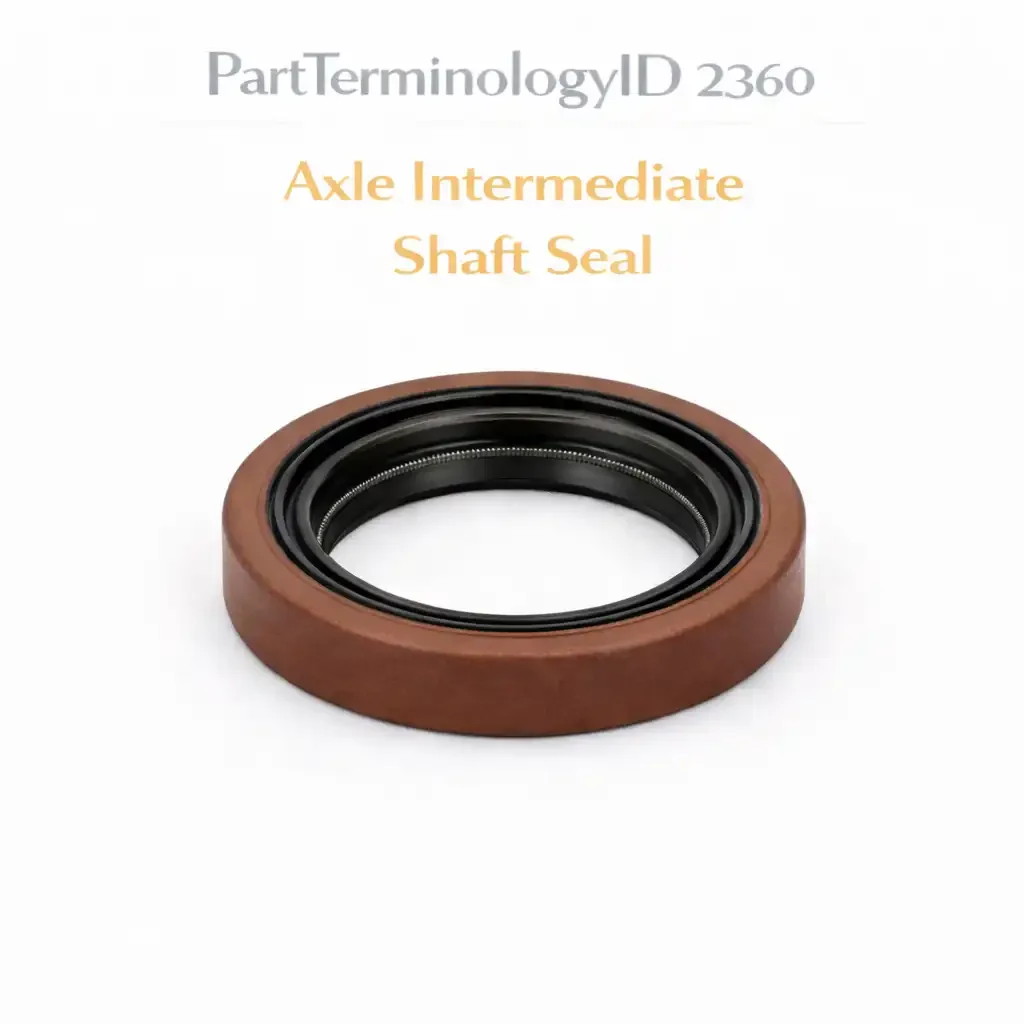
PartTerminologyID 2360, Axle Intermediate Shaft Seal, is a rotary lip seal that prevents fluid from escaping the transaxle or differential housing along the intermediate shaft at the point where the intermediate shaft exits the housing on the long side of an offset differential. That definition places the seal correctly. It does not specify the vehicle platform or transaxle designation, the intermediate shaft outer diameter at the seal contact zone, the housing bore diameter, the seal width, the lip material, what fluid the seal contacts, whether the fluid is ATF or differential gear oil, whether the seal is a single-lip or double-lip design, what the shaft surface speed is at the intermediate shaft seal contact zone compared to the opposite side axle shaft seal, or whether the intermediate shaft support bearing is inboard or outboard of the seal. A listing under PartTerminologyID 2360 that provides vehicle year, make, and model without the transaxle designation, the intermediate shaft diameter, and the lip material with fluid compatibility cannot be evaluated by any technician who has identified an intermediate shaft seal leak and is matching the replacement before removing the intermediate shaft.
For sellers, PartTerminologyID 2360 addresses a specific fitment problem that was identified in the CV axle shaft seal post (PartTerminologyID 2341) and flagged there as the highest-frequency mismatch error for that PartTerminologyID: the left and right axle shaft seals on an offset transaxle differential have different shaft diameters because the right side uses an intermediate shaft rather than a halfshaft directly. PartTerminologyID 2341 covers both sides of the transaxle exit, but the intermediate shaft seal at the right side is a specifically different component from the left side axle shaft seal not just in diameter but in function. The intermediate shaft is a separate shaft that passes through the transaxle housing and is supported at its outboard end by a bearing bracket on the engine block or cylinder head, and then connects at its outboard end to the right inner CV joint. The seal at the transaxle housing exit seals the intermediate shaft as it exits the housing, and this shaft typically has a larger diameter than the left halfshaft because it is a heavier-gauge shaft designed to span the longer distance to the right wheel hub.
PartTerminologyID 2360 is the specific PartTerminologyID for this seal position when it is cataloged as a distinct component from the left-side axle shaft seal. A listing for the right-side seal under 2341 and a listing for the same seal under 2360 may coexist in a catalog, but the 2360 listing should carry the intermediate shaft designation and the intermediate shaft diameter to make its position unambiguous.
For sellers, the listing under this PartTerminologyID is only useful if it specifies the transaxle designation, the intermediate shaft designation, the shaft diameter, the bore diameter, the seal width, the lip material, and the fluid compatibility. Without those seven attributes, the listing will be confused with the left-side axle shaft seal for the same vehicle.
What the Axle Intermediate Shaft Seal Does
Sealing the transaxle exit of the longer halfshaft circuit
On most front-wheel-drive transaxle designs, the engine and transmission are mounted transversely with the differential carrier offset to one side within the transmission housing. The left halfshaft exits the transaxle at the differential carrier side gear on the left and is a relatively short shaft that spans directly to the left wheel hub. The right halfshaft must span the longer distance to the right wheel hub from the offset carrier. If the right halfshaft were a single shaft spanning the full distance, it would be a long, unsupported shaft that would flex and vibrate at highway speed. To prevent this, the right halfshaft is divided into two sections: a shorter outer section from the right wheel hub to the intermediate shaft bracket, and an intermediate shaft that spans from the bracket to the transaxle housing exit.
The intermediate shaft exits the transaxle housing through its own bore, which has the intermediate shaft seal. The seal prevents the ATF or differential fluid in the transaxle from escaping along the intermediate shaft surface at the housing exit. The intermediate shaft rotates at wheel speed, the same as the left halfshaft, but its larger diameter means the shaft surface speed at the seal contact zone is higher than the left-side axle shaft seal contact zone for the same wheel speed.
The intermediate shaft support bearing and its relationship to the seal
The intermediate shaft is supported at its outboard end by a bracket bearing mounted on the engine block, the cylinder head, or a structural bracket on the engine assembly. This bearing maintains the intermediate shaft in its correct rotational axis and prevents the shaft from deflecting radially at the point between the transaxle housing exit and the outer CV joint.
A worn intermediate shaft support bearing allows the shaft to deflect radially at the support point, which produces a corresponding wobble at the transaxle housing exit where the seal contacts the shaft. A wobbling shaft contacts the seal lip eccentrically, producing uneven lip wear and an early seal failure on the side of the bore where the shaft deflects toward the lip. The same mechanism described for the slip yoke bushing in the drive shaft seal post (2352) applies here: a worn support bearing produces a repeat seal failure with a new seal.
The listing must note the intermediate shaft support bearing inspection requirement alongside the seal specification.
ATF versus differential gear oil at the intermediate shaft seal
On transaxle designs where the differential shares fluid with the main transmission circuit, the intermediate shaft seal contacts ATF. On designs where the differential has a separate fluid circuit with its own fill and drain provisions, the intermediate shaft seal contacts differential gear oil. The distinction determines the lip material requirement.
Most front-wheel-drive passenger vehicle transaxles share ATF between the transmission and the differential cavities. The intermediate shaft seal on those applications contacts ATF and the lip material must be compatible with the ATF formulation specified for the transaxle. Some Honda, Subaru, and European transaxle designs use separate differential fluids that differ from the main ATF specification, and the intermediate shaft seal on those applications contacts the differential fluid rather than the ATF.
The listing must specify which fluid the seal contacts and the compatibility of the lip material with that fluid formulation.
The Specifications That Determine Correct Seal Fitment
Transaxle designation and intermediate shaft designation
The transaxle designation is the primary fitment attribute. The intermediate shaft designation within the transaxle application confirms the shaft at the seal contact zone, because some transaxle applications have been revised during production with a different intermediate shaft diameter or a different bore geometry at the housing exit.
Shaft diameter and bore diameter
State in millimeters to two decimal places. The intermediate shaft outer diameter at the seal contact zone is larger than the left halfshaft diameter for the same vehicle. The bore diameter in the transaxle housing at the intermediate shaft exit is matched to the seal outer diameter for the correct press fit.
Seal width
In millimeters. The available bore depth determines the maximum usable seal width.
Lip material and fluid compatibility
For ATF-sharing transaxles: specify the Dexron generation or manufacturer ATF specification compatibility. For separate differential fluid transaxles: specify the gear oil API rating and synthetic or mineral base. Distinguish Dexron-VI synthetic from Dexron-III mineral explicitly, as developed in the CV axle shaft seal post (2341).
Single-lip versus double-lip
Single-lip for standard on-road applications. Double-lip for high-contamination environments.
Support bearing inspection note
The intermediate shaft support bearing must be inspected at every intermediate shaft seal replacement and replaced if it shows any roughness, radial play, or discoloration from heat or contamination.
Why This Part Generates Returns
Buyers order the wrong axle intermediate shaft seal because:
the intermediate shaft diameter is not stated and the buyer orders the left-side axle shaft seal for the same vehicle, which has a different inner diameter
the transaxle designation is not specified and the intermediate shaft diameter changed during production within the same vehicle model generation
the fluid compatibility is not specified and an ATF-incompatible lip material is installed in a transaxle where the seal contacts ATF
the seal is confused with the left-side axle shaft seal and the buyer receives the wrong seal for the right side
the intermediate shaft support bearing is worn and the new seal fails early from eccentric shaft deflection
Status in New Databases
PIES/PCdb: PartTerminologyID 2360, Axle Intermediate Shaft Seal
PIES 8.0 / PCdb 2.0: No change
Top Return Scenarios
Scenario 1: "Left-side axle shaft seal ordered for right-side intermediate shaft position, inner diameter too small"
The buyer needed the right-side seal for the intermediate shaft. The listing for the left-side seal and the right-side intermediate shaft seal both appeared under the same vehicle fitment without clearly distinguishing the two. The buyer ordered the left-side seal. The intermediate shaft diameter is 6mm larger than the left halfshaft diameter. The left-side seal inner diameter is too small to press onto the intermediate shaft without tearing the lip.
Prevention language: "Seal position: [right side, intermediate shaft]. Intermediate shaft diameter: [X.XX]mm. Left-side axle shaft diameter for this vehicle: [X.XX]mm. This seal is for the right-side intermediate shaft, which is larger in diameter than the left halfshaft. Do not confuse with the left-side CV axle shaft seal for the same vehicle. Verify the shaft position and diameter before ordering."
Scenario 2: "Worn intermediate shaft support bearing, new seal failed within 8,000 miles"
The intermediate shaft support bracket bearing was worn and allowed the shaft to deflect 0.3mm radially at the support point. The deflection produced a corresponding wobble at the transaxle housing exit. The new seal wore unevenly around its circumference from the eccentric shaft contact and began seeping ATF within 8,000 miles.
Prevention language: "Intermediate shaft support bearing inspection required. Inspect the intermediate shaft support bracket bearing for radial play and roughness before installing the new seal. A worn support bearing allows the intermediate shaft to deflect eccentrically at the transaxle housing exit, producing uneven seal lip wear and early seal failure. Replace the support bearing concurrently if it shows any radial play."
Scenario 3: "Dexron-III rated seal in Dexron-VI transaxle, lip hardened at 15,000 miles"
The transaxle uses Dexron-VI full-synthetic ATF. The replacement seal is rated for Dexron-III mineral-based ATF only. The Dexron-VI formulation degraded the lip elasticity within 15,000 miles. The lip hardened and lost contact interference with the intermediate shaft, producing a slow ATF seep that coated the right side of the engine block with a thin film of ATF.
Prevention language: "ATF compatibility: [Dexron-VI synthetic compatible]. Verify the seal's ATF compatibility matches your transaxle's fluid specification. This transaxle uses Dexron-VI full-synthetic ATF. A seal rated only for Dexron-III will degrade in Dexron-VI at operating temperature. Specify a seal with confirmed Dexron-VI compatibility."
Scenario 4: "Intermediate shaft diameter changed mid-production, early-production seal ordered for late-production shaft"
The transaxle was updated mid-production with a larger-diameter intermediate shaft. The listing did not specify the production date range for each shaft diameter. The buyer's vehicle is a late-production model. The early-production seal inner diameter is too small for the late-production intermediate shaft.
Prevention language: "Intermediate shaft diameter: [early production: X.XX]mm / [late production: X.XX]mm. Production date break: [model year / VIN range / build date]. Verify your vehicle's production date or VIN against the diameter specification before ordering. The intermediate shaft diameter changed during the production run of this transaxle. Early and late-production seals are not interchangeable."
Scenario 5: "Seal installed, ATF leak continued, source was the differential side gear bore not the intermediate shaft bore"
The buyer observed ATF leaking from the right side of the transaxle and diagnosed an intermediate shaft seal leak. The intermediate shaft seal was replaced. The leak continued because the actual source was the right differential side gear bore within the transaxle housing, which is a separate seal position from the intermediate shaft exit bore. Both produce ATF at the right side of the transaxle.
Prevention language: "Diagnostic note: ATF leaks at the right side of the transaxle may originate from the intermediate shaft seal at the housing exit bore or from the differential side gear seal within the housing. These are different seal positions. Use fluorescent dye and UV light to confirm the exact leak origin before ordering. The intermediate shaft exit bore and the side gear bore produce fluid in overlapping areas that converge at the drip point."
What to Include in the Listing
Core essentials
PartTerminologyID: 2360
component: Axle Intermediate Shaft Seal
explicit statement that this is the right-side intermediate shaft seal, not the left-side axle shaft seal (mandatory)
transaxle designation (mandatory)
intermediate shaft designation or part number cross-reference (mandatory)
production date range when intermediate shaft diameter changed (mandatory)
intermediate shaft diameter at seal contact zone in mm to two decimal places (mandatory)
left-side axle shaft diameter for comparison (recommended to prevent confusion)
housing bore diameter in mm to two decimal places (mandatory)
seal width in mm (mandatory)
lip material (mandatory)
fluid type at seal contact: ATF or differential gear oil (mandatory)
fluid compatibility: Dexron generation or gear oil API rating (mandatory)
lip configuration: single-lip or double-lip (mandatory)
intermediate shaft support bearing inspection note (mandatory)
quantity: 1
Fitment essentials
year/make/model/submodel
transaxle designation (primary fitment attribute)
production date range when shaft diameter changed
drivetrain: FWD or AWD
intermediate shaft designation
Dimensional essentials
intermediate shaft diameter in mm to two decimal places
seal inner diameter before installation in mm
housing bore diameter in mm
seal outer diameter in mm
seal width in mm
press fit interference in mm
left-side axle shaft seal inner diameter for comparison
Image essentials
seal in isolation with shaft diameter callout
right-side and left-side seals shown side by side to illustrate the diameter difference
transaxle housing right-side exit bore shown with the intermediate shaft in position
intermediate shaft support bracket and bearing shown with the radial play inspection method illustrated
installed context showing the seal at correct depth with the intermediate shaft through the bore
Catalog Checklist for ACES/PIES Teams
PartTerminologyID = 2360
require explicit intermediate shaft position statement, not left-side axle shaft (mandatory)
require transaxle designation (mandatory)
require intermediate shaft diameter in mm to two decimal places (mandatory)
require production date range when diameter changed (mandatory)
require fluid type and compatibility (mandatory)
require support bearing inspection note (mandatory)
differentiate from CV axle shaft seal (PartTerminologyID 2341): 2341 covers both axle shaft exit positions including the intermediate shaft in some catalog implementations; 2360 is the specific PartTerminologyID for the intermediate shaft seal when cataloged separately from the left-side seal; the diameter callout in 2360 explicitly distinguishes it from the left-side seal listed under 2341
differentiate from axle intermediate shaft bearing (PartTerminologyID 2248): the bearing supports the intermediate shaft radially at the support bracket; the seal retains fluid at the transaxle housing exit; both are in the intermediate shaft assembly but at different positions
flag intermediate shaft diameter versus left-side diameter as mandatory comparison: the most common order error for this PartTerminologyID is ordering the left-side seal for the right-side position; the explicit diameter comparison prevents this
flag support bearing inspection as mandatory: worn support bearing is the most common reason a new intermediate shaft seal fails early; the listing must connect the seal replacement to the bearing inspection
FAQ (Buyer Language)
How do I confirm my vehicle uses an intermediate shaft on the right side?
Look under the vehicle at the right front halfshaft. A vehicle with an intermediate shaft will have a visible support bracket with a bearing mounted on the engine block or a structural bracket between the transaxle housing exit and the outer CV joint on the right side. The intermediate shaft will run from this bracket to the transaxle housing, and a shorter outer shaft will run from the bracket to the right wheel hub. A vehicle without an intermediate shaft will have a single halfshaft running from the transaxle housing directly to the right wheel hub, similar in appearance to the left side.
Can I replace the intermediate shaft seal without removing the intermediate shaft from the transaxle?
On most designs, no. The intermediate shaft must be withdrawn from the transaxle housing to expose the seal bore and allow the old seal to be driven out. Withdrawing the intermediate shaft requires disconnecting the outer CV joint from the right wheel hub and sliding the intermediate shaft out of the transaxle bore. The intermediate shaft support bearing bracket may also need to be unbolted to allow full withdrawal. Verify the service procedure for your specific transaxle before beginning.
My right side is leaking ATF but I replaced the intermediate shaft seal and the leak continued. What else should I check?
The right side of the transaxle has multiple potential leak points. The intermediate shaft seal is at the housing exit bore for the intermediate shaft. The right side differential side gear bore within the housing is a separate seal position. The right side differential bearing preload adjustment shim cover is another potential static gasket. Use fluorescent dye in the ATF and UV light inspection to trace the exact origin. If the dye does not originate at the intermediate shaft bore after seal replacement, the leak is at one of the other right-side positions.
Cross-Sell Logic
Axle Intermediate Shaft Bearing (PartTerminologyID 2248: the support bracket bearing is replaced concurrently with the intermediate shaft seal when it shows radial play or roughness)
CV Axle Shaft Seal left side (PartTerminologyID 2341: if the transaxle is being opened for right-side intermediate shaft seal replacement, inspect the left-side axle shaft seal at the same service event)
Automatic Transmission Fluid (the ATF level is checked and topped up whenever the intermediate shaft is removed; if the ATF is contaminated or degraded, a full fluid service is performed)
Intermediate Shaft Assembly (if the intermediate shaft itself is worn at the seal contact zone or at the CV joint connections, the complete intermediate shaft assembly is replaced at the same event)
CV Joint Boot (PartTerminologyID 2284: the inner CV joint boot on the intermediate shaft is inspected when the shaft is removed and replaced if cracked or leaking)
Frame as "the intermediate shaft seal retains the ATF at the transaxle exit. The intermediate shaft support bearing keeps the shaft from deflecting at the seal. The intermediate shaft connects the transaxle to the outer CV joint through the support bearing. The ATF the seal retains lubricates the differential that drives the intermediate shaft. All are in the same removal event."
Final Take for PartTerminologyID 2360
Axle Intermediate Shaft Seal (PartTerminologyID 2360) is the PartTerminologyID that resolves the left-right asymmetry problem introduced in the CV axle shaft seal post (2341) into its own specific listing. The intermediate shaft is larger in diameter than the opposite-side halfshaft because it serves a different function: it is a precision shaft spanning a longer distance and supported at an intermediate bearing bracket, not a halfshaft that connects directly from differential to wheel hub. That functional and dimensional distinction makes the intermediate shaft seal a component that cannot safely be listed as identical to the left-side seal and cataloged under 2341 alone without producing mismatches on every vehicle where the two shaft diameters differ.
The transaxle designation and the explicit intermediate shaft diameter resolve the dimensional fitment and prevent the left-side seal from being ordered for the right-side position. The fluid compatibility resolves whether the lip material survives the ATF or differential gear oil chemistry it contacts. The support bearing inspection note resolves the most common reason a correctly specified new seal fails early.
State the transaxle designation. State the intermediate shaft diameter explicitly alongside the left-side shaft diameter for comparison. State the fluid type and compatibility. State the seal width and bore depth. State the lip configuration. State the support bearing inspection requirement. That is the same listing strategy as every other PartTerminologyID in this series: specific attributes at every level to become a listing buyers can act on without guessing. For PartTerminologyID 2360, the intermediate shaft diameter is the attribute that separates this seal from every left-side seal for the same vehicle in the catalog, and the listing that omits it cannot prevent the right-seal-wrong-side mismatch that is this PartTerminologyID's dominant return driver.