
Written by Arthur Simitian | PartsAdvisory
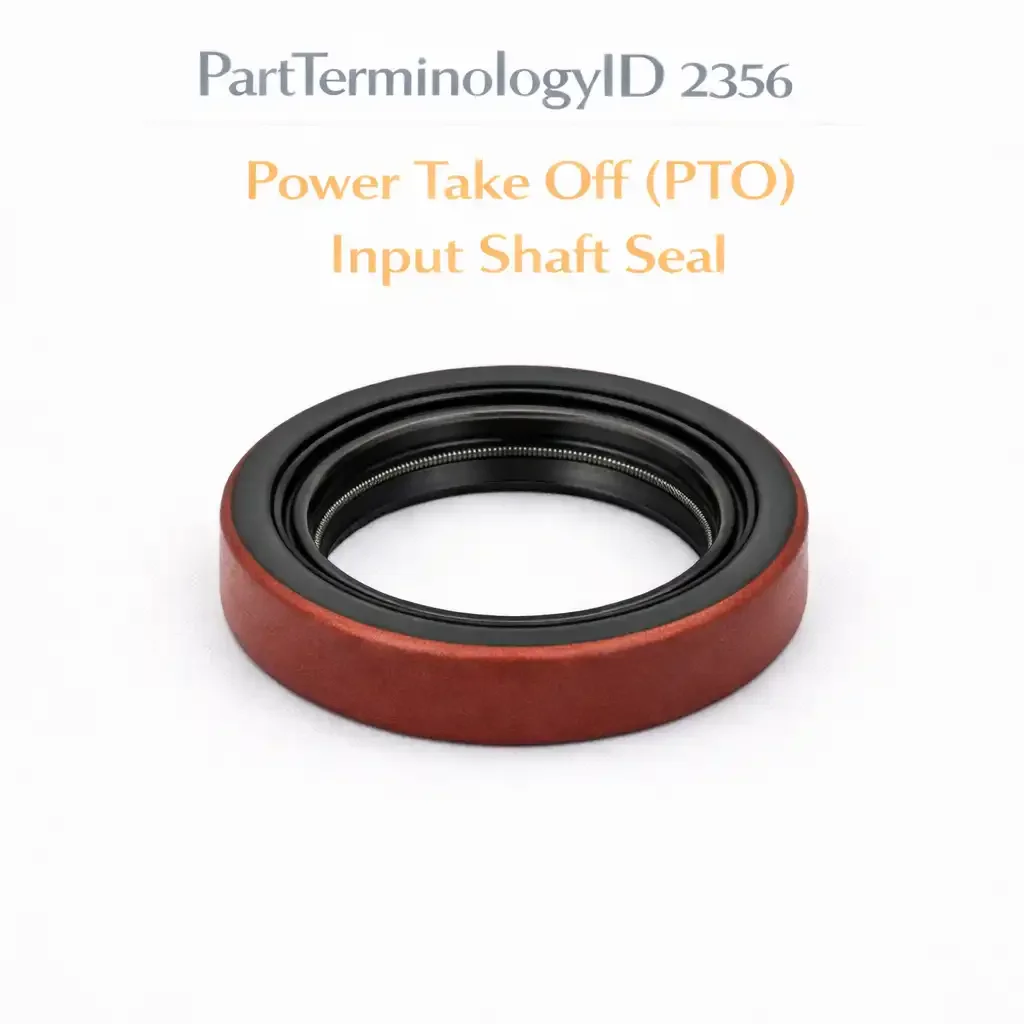
PartTerminologyID 2356, Power Take Off (PTO) Input Shaft Seal, is a rotary lip seal that prevents gear oil from escaping the PTO housing along the input shaft at the point where the input shaft enters or exits the PTO housing from the transmission side. That definition locates the seal at the transmission-to-PTO interface. It does not specify the PTO unit manufacturer and model designation, the compatible transmission model, the shaft diameter at the seal contact zone, the housing bore diameter, the seal width, the lip material, whether the seal is a single-lip or double-lip design, whether the input shaft is a splined stub shaft that does not rotate relative to the PTO housing or a rotating input shaft that turns with the transmission drive gear, what fluid the seal is retaining against, or whether the seal is accessible with the PTO mounted on the transmission or requires PTO removal. A listing under PartTerminologyID 2356 that provides fitment information without the PTO unit designation, the shaft diameter, the bore diameter, and the lip material cannot be evaluated by any technician who has identified an input shaft seal leak and needs to confirm the replacement before opening the PTO housing.
For sellers, PartTerminologyID 2356 sits in close proximity to several other PTO seal PartTerminologyIDs in the series. PartTerminologyID 2340 covers the PTO countershaft seal, which is at the intermediate shaft within the PTO housing. PartTerminologyID 2356 covers the input shaft seal, which is at the transmission-facing end of the PTO where the drive connection from the transmission enters the unit. The input shaft seal and the countershaft seal are both within the PTO housing, but the input shaft seal is at the first shaft position in the torque path, immediately adjacent to the transmission mounting face, while the countershaft seal is at an intermediate shaft further along the torque path inside the housing.
The buyer arriving at PartTerminologyID 2356 has diagnosed a leak at the input shaft position. The leak at this position is visible at or near the PTO mounting face on the transmission side, which means it can be confused with a leaking PTO mounting gasket (PartTerminologyID 2324) because both produce fluid at the same general location. The distinction is that the mounting gasket leak originates at the flat face joint between the PTO housing and the transmission housing, while the input shaft seal leak originates at the rotating shaft bore within that joint. Confirming the leak source before ordering prevents the buyer from replacing the gasket when the seal is leaking or replacing the seal when the gasket is leaking.
For sellers, the listing under this PartTerminologyID is only useful if it specifies the PTO unit designation, the compatible transmission model, the shaft diameter, the bore diameter, the seal width, the lip material, and the fluid compatibility. Without those seven attributes, the listing cannot serve the commercially oriented buyer population that this PartTerminologyID attracts.
What the PTO Input Shaft Seal Does
Sealing the first rotating interface in the PTO torque path
When the PTO is engaged, the transmission's internal drive gear meshes with the PTO input gear and transmits torque into the PTO unit. The shaft that carries this input torque from the transmission into the PTO housing is the input shaft. At the point where the input shaft passes through the PTO housing wall on the transmission side, the input shaft seal prevents the gear oil inside the PTO housing from escaping along the shaft surface.
On most PTO designs, the input shaft is a rotating shaft that turns continuously when the PTO is engaged. The input shaft seal therefore contacts a rotating surface and operates as a conventional rotary lip seal with the hydrodynamic film, the garter spring contact force, and the lip wear mechanism described in the countershaft seal post (2340). On some PTO designs, the input is through a splined adapter that does not rotate relative to the housing because it connects directly to the PTO gear rather than to a separate input shaft. On those designs, what appears to be an input shaft seal may function as a static face seal rather than a rotary lip seal, and the replacement must match the design type.
Distinguishing the input shaft seal from the mounting gasket
The PTO mounting gasket (PartTerminologyID 2324) seals the flat interface between the PTO housing mounting face and the transmission housing mounting face. The input shaft seal seals the rotating shaft bore within the PTO housing on the same side of the housing. Both can produce fluid at or near the transmission-side of the PTO.
A mounting gasket leak produces fluid that seeps uniformly from the flat joint around the perimeter of the PTO mounting face, or from specific points along the joint where the bolt clamping force is lowest. An input shaft seal leak produces fluid that tracks from a specific bore location within the mounting face area, following the shaft centerline outward.
The diagnostic method for distinguishing the two is the same as for any differential or PTO leak: fluorescent dye in the gear oil, several heat cycles of operation, and UV light inspection. The dye will reveal whether the fluid originates at the flat face joint or at the shaft bore within the joint.
The input shaft seal and ATF compatibility on automatic transmission PTO applications
On PTO units mounted to automatic transmissions, the input shaft of the PTO enters the transmission housing through the PTO opening and meshes with the transmission's internal drive gear. The PTO opening on an automatic transmission is within the ATF circuit, and the input shaft of the PTO is exposed to ATF at the transmission mounting interface. On some PTO designs, the input shaft seal contacts ATF from the transmission side and gear oil from the PTO side simultaneously, because the seal is positioned at the boundary between the two fluid circuits.
A seal that is rated for gear oil but not for ATF will degrade from ATF contact on its inboard face. A seal that is rated for ATF but not for the gear oil formulation in the PTO will degrade from gear oil contact on its outboard face. For automatic transmission PTO applications, the lip material must be compatible with both the ATF specification of the transmission and the gear oil specification of the PTO unit.
The listing must specify the fluid on each side of the seal for automatic transmission PTO applications.
The Specifications That Determine Correct Seal Fitment
PTO unit designation and transmission model
The PTO unit designation and the compatible transmission model are the co-primary fitment attributes. The input shaft diameter is specific to the PTO model, and the seal must fit the PTO housing bore. The compatible transmission model confirms the PTO-to-transmission interface geometry, which affects whether the input shaft seal is at a rotating or non-rotating position.
Shaft diameter and bore diameter
State in millimeters to two decimal places. The input shaft diameter at the seal contact zone and the PTO housing bore diameter at the seal installation point. Both are required because the seal inner diameter fits the shaft and the seal outer diameter fits the bore.
Seal width
In millimeters. The available bore depth in the PTO housing at the input shaft seal position determines the maximum usable seal width.
Lip material and fluid compatibility
For manual transmission PTO applications: nitrile for conventional gear oil, HNBR for synthetic gear oil or high-temperature applications, polyacrylate for full-synthetic gear oil. For automatic transmission PTO applications: specify compatibility with both the ATF type and the PTO gear oil type.
Single-lip versus double-lip
Single-lip for standard applications. Double-lip with exclusion lip for off-road and high-contamination applications where road debris, mud, or water exposure at the transmission mounting area is a regular operating condition.
Access for replacement: PTO mounted or PTO removed
State whether the input shaft seal is accessible with the PTO unit mounted on the transmission or whether PTO removal is required. On some PTO designs, the input shaft seal can be replaced by removing only the input shaft bearing retainer from the transmission-side face of the PTO housing while the PTO remains on the transmission. On others, the seal bore is within the main housing casting and requires full PTO removal and partial disassembly.
Why This Part Generates Returns
Buyers order the wrong PTO input shaft seal because:
the PTO unit designation is not specified and the input shaft diameter or bore diameter does not match
the seal is ordered to address a mounting gasket leak that was misdiagnosed as an input shaft seal leak, and the mounting gasket (PartTerminologyID 2324) is what is actually needed
the fluid type on each side of the seal is not specified for automatic transmission PTO applications, and an ATF-incompatible lip material is installed at the ATF-to-gear-oil boundary
the seal width is not stated and the replacement is wider than the bore depth, preventing the bearing retainer from seating against the housing face
the input shaft is non-rotating on this PTO design and a rotary lip seal is ordered when a static seal is required
Status in New Databases
PIES/PCdb: PartTerminologyID 2356, Power Take Off (PTO) Input Shaft Seal
PIES 8.0 / PCdb 2.0: No change
Top Return Scenarios
Scenario 1: "Mounting gasket replaced, leak continued, input shaft seal was the actual source"
The buyer observed fluid at the transmission-side face of the PTO and diagnosed a mounting gasket leak. The mounting gasket was replaced. The leak continued because the source was the input shaft seal bore within the mounting face, not the flat face joint. The input shaft seal was leaking along the rotating shaft surface through the bore, and the fluid traced to the mounting face area and was indistinguishable from a gasket leak without dye tracing.
Prevention language: "Diagnostic note: fluid at the transmission-side face of a PTO unit may originate from the mounting gasket at the flat face joint or from the input shaft seal at the rotating shaft bore within that face. Use fluorescent dye and UV light to confirm the leak source before ordering. A mounting gasket leak originates at the flat joint perimeter. An input shaft seal leak originates at the shaft bore center."
Scenario 2: "ATF-side of seal degraded, automatic transmission PTO, lip material rated for gear oil only"
The PTO is mounted on a Ford 5R110W automatic transmission. The input shaft of the PTO enters the transmission's ATF circuit at the PTO opening. The replacement seal uses a nitrile lip rated for gear oil. The ATF from the transmission contacts the inboard face of the lip. The nitrile material degraded from the ATF chemistry at operating temperature, producing a slow seep at the input shaft bore.
Prevention language: "Automatic transmission PTO application. Fluid on transmission side of seal: [ATF, Ford Mercon SP specification]. Fluid on PTO side of seal: [gear oil, GL-5]. Lip material compatibility required for both fluids. A lip rated only for gear oil will degrade from ATF contact on the transmission side of the bore. Verify the lip material is rated for both the ATF specification of the transmission and the gear oil in the PTO unit."
Scenario 3: "PTO unit designation not specified, input shaft diameter mismatch, seal too small to press onto shaft"
The listing specified the seal by vehicle year, make, and model only. Two PTO models were available for this transmission application with different input shaft diameters. The buyer received the seal for the smaller-shaft PTO. The buyer's PTO has the larger input shaft. The seal inner diameter is too small to press onto the larger shaft without destroying the seal lip.
Prevention language: "PTO unit designation: [Chelsea 442 / Parker Commercial P72 / other]. Input shaft diameter: [X.XX]mm. Verify your PTO model designation matches before ordering. Multiple PTO models are available for this transmission application with different input shaft diameters. The input shaft seal is specific to the PTO model, not the transmission model alone."
Scenario 4: "Seal wider than bore depth, input shaft bearing retainer will not seat"
The replacement seal is 3mm wider than the bore depth at the input shaft position. The seal protrudes 3mm from the PTO housing face. The input shaft bearing retainer that bolts over the seal bore to retain the input shaft bearing cannot seat flat against the housing with the protruding seal.
Prevention language: "Seal width: [X]mm. Bore depth at input shaft position: [X]mm. Verify the seal width does not exceed the bore depth. A seal wider than the bore depth protrudes from the housing face and prevents the bearing retainer from seating. An unseated bearing retainer allows the input shaft bearing to move axially, producing rapid bearing wear and eventual input shaft failure."
Scenario 5: "Non-rotating input design, rotary lip seal ordered, static seal required"
The PTO uses a splined adapter connection at the input rather than a rotating input shaft. The splined adapter does not rotate relative to the PTO housing. A rotary lip seal was ordered for this position. The rotary lip seal contacts the stationary splined surface at its lip contact zone and is compressed against the housing face rather than functioning as a dynamic seal. The lip is not designed for static contact and the seal does not conform to the splined surface geometry.
Prevention language: "Input shaft type: [rotating shaft / non-rotating splined adapter]. Seal type required: [rotary lip seal / static face seal or O-ring]. Verify your PTO's input connection type before ordering. A non-rotating splined adapter at the input position requires a static face seal or O-ring, not a rotary lip seal. A rotary lip seal installed on a non-rotating adapter will not conform to the splined surface and will not seal."
What to Include in the Listing
Core essentials
PartTerminologyID: 2356
component: PTO Input Shaft Seal
PTO unit manufacturer and model designation (mandatory)
compatible transmission model (mandatory)
input shaft type: rotating or non-rotating splined adapter (mandatory)
shaft diameter in mm to two decimal places (mandatory)
housing bore diameter in mm to two decimal places (mandatory)
seal width in mm (mandatory)
bore depth in mm (mandatory)
lip material (mandatory)
fluid on transmission side of seal (mandatory for automatic transmission PTO applications)
fluid on PTO side of seal (mandatory)
lip configuration: single-lip or double-lip with exclusion lip (mandatory)
access for replacement: PTO mounted or PTO removal required (mandatory)
quantity: 1
Fitment essentials
commercial vehicle year/make/model or equipment designation
PTO unit designation (primary fitment attribute)
compatible transmission model
drivetrain: manual transmission or automatic transmission PTO application
Dimensional essentials
shaft diameter in mm to two decimal places
seal inner diameter before installation in mm
housing bore diameter in mm
seal outer diameter in mm
seal width in mm
bore depth in mm
press fit interference in mm
Image essentials
seal in isolation with lip configuration visible
PTO housing shown with the input shaft bore and mounting face visible
transmission-side view of the PTO mounting face showing the input shaft bore location relative to the mounting bolt pattern
installed context with the input shaft in position and the bearing retainer seated against the housing
Catalog Checklist for ACES/PIES Teams
PartTerminologyID = 2356
require PTO unit designation (mandatory)
require compatible transmission model (mandatory)
require input shaft type: rotating or non-rotating (mandatory)
require shaft diameter and bore diameter in mm (mandatory)
require seal width and bore depth (mandatory)
require lip material with fluid compatibility for both sides on automatic transmission PTO applications (mandatory)
require access requirement: PTO mounted or removal required (mandatory)
differentiate from PTO mounting gasket (PartTerminologyID 2324): the gasket seals the flat face joint; the input shaft seal seals the rotating shaft bore within that joint; both produce fluid at the transmission-side face of the PTO; include diagnostic guidance to distinguish the two
differentiate from PTO countershaft seal (PartTerminologyID 2340): the countershaft seal is at the intermediate shaft inside the PTO housing; the input shaft seal is at the first shaft position at the transmission-side housing wall; the input shaft seal is in the torque path before the countershaft
differentiate from PTO output shaft seal (PartTerminologyID varies): the output shaft seal is at the PTO output where the driven equipment connects; the input shaft seal is at the transmission connection; both are rotary shaft seals in the same PTO but at opposite ends of the torque path
flag input shaft type as mandatory: a rotary lip seal ordered for a non-rotating splined adapter is incompatible and will not seal
flag dual fluid compatibility as mandatory for automatic transmission PTO applications: ATF on the transmission side and gear oil on the PTO side require a lip material rated for both
FAQ (Buyer Language)
How do I confirm the leak is at the input shaft seal and not the mounting gasket?
Drain the PTO gear oil and the transmission fluid to below the PTO opening level. Add fluorescent dye to both the PTO gear oil and the ATF. Refill both to their correct levels and operate the vehicle under PTO load for several heat cycles. Inspect the PTO mounting face area with a UV light. If the dye traces from the flat perimeter joint, the mounting gasket is leaking. If the dye traces from the shaft bore at the center of the mounting face, the input shaft seal is leaking. Replace the component that shows the dye origin.
Can I replace the PTO input shaft seal with the PTO still on the transmission?
On PTO designs where the input shaft bearing retainer is a separate bolted plate on the transmission-side face of the housing, yes. Remove the retainer, withdraw the input shaft if required, drive out the old seal, press in the new seal, reinstall the shaft and retainer, and the job is complete with the PTO mounted. On designs where the input shaft seal is inside the main housing casting without a separate retainer plate, the PTO must be removed from the transmission and partially disassembled to access the seal bore. Verify the service manual procedure for your specific PTO model.
My PTO is on an automatic transmission. What fluid compatibility should I look for in the input shaft seal?
Verify the ATF specification in your transmission service manual and the gear oil specification in your PTO service manual. For Allison transmissions, the ATF specification is Allison TES 295 approved fluid. For Ford TorqShift, it is Mercon SP or Mercon LV depending on the model year. The PTO gear oil is typically a conventional or synthetic GL-4 or GL-5 gear oil specified by the PTO manufacturer. The input shaft seal lip must be compatible with both the ATF and the gear oil. If your PTO supplier does not specify the dual fluid compatibility, consult the PTO manufacturer's service documentation for the correct seal material specification.
Cross-Sell Logic
PTO Mounting Gasket (PartTerminologyID 2324: always inspect the mounting gasket when the PTO is removed for input shaft seal access; replace if any compression set or surface damage is visible)
PTO Countershaft Seal (PartTerminologyID 2340: if the PTO is being opened for input shaft seal replacement, inspect the countershaft seal at the same time and replace concurrently)
PTO Gear Oil (drained and replaced at every PTO opening for seal replacement)
Input Shaft Bearing (the input shaft bearing is adjacent to the input shaft seal and is inspected for roughness or discoloration when the seal is replaced; replace if any wear is evident)
PTO Gasket Set (if multiple seals and gaskets require replacement at the same service event, a complete PTO gasket set is more efficient than ordering components individually)
Frame as "the input shaft seal retains the gear oil at the first shaft entry point. The mounting gasket seals the housing face the shaft passes through. The input shaft bearing supports the shaft the seal contacts. The gear oil lubricates the gears the seal retains. All are at the same end of the PTO and are inspected at the same opening event."
Final Take for PartTerminologyID 2356
PTO Input Shaft Seal (PartTerminologyID 2356) is a component where the diagnostic accuracy of the buyer before ordering determines whether the correct part is ordered at all. A buyer who has confirmed by dye trace that the leak is at the rotating input shaft bore, not at the flat mounting face joint, is ordering the correct PartTerminologyID. A buyer who observed fluid at the transmission-side face of the PTO and assumed the mounting gasket without dye tracing may be ordering PartTerminologyID 2324 when they need 2356, or ordering 2356 when they need 2324.
The listing's job is to help the buyer confirm both the diagnosis and the part. The diagnostic guidance in the listing, distinguishing shaft bore leak from face joint leak, serves the buyer who has not yet performed the dye trace. The PTO unit designation, the shaft diameter, the bore diameter, the lip material, and the dual fluid compatibility serve the buyer who has confirmed the diagnosis and needs to verify the replacement before ordering.
State the PTO unit designation and transmission model. State the input shaft type. State the shaft diameter and bore diameter. State the seal width and bore depth. State the lip material and both fluid compatibilities for automatic transmission applications. State the access requirement. That is the same listing strategy as every other PartTerminologyID in this series: specific attributes at every level to become a listing buyers can act on without guessing.