
Written by Arthur Simitian | PartsAdvisory
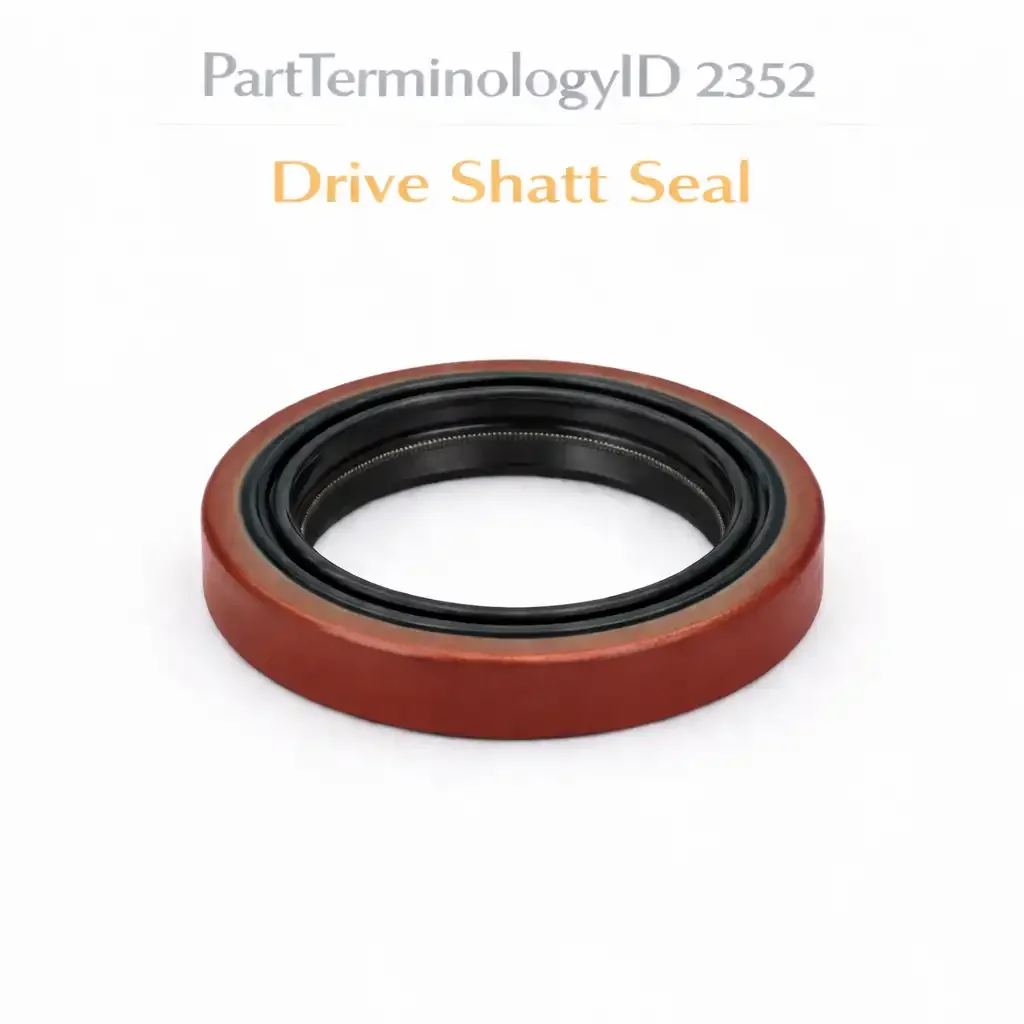
PartTerminologyID 2352, Drive Shaft Seal, is a rotary lip seal that prevents fluid from escaping a transfer case, transmission, or differential housing at the point where a drive shaft or slip yoke exits the housing. That definition covers the function. It does not specify which housing the seal is in, whether the seal is at the front output shaft of a transfer case, the rear output shaft of a transfer case, the transmission tail shaft, the front differential pinion shaft, or the rear differential pinion shaft, what the shaft diameter is at the seal contact zone, what the housing bore diameter is, what the seal width is, what the lip material is, what fluid the seal is retaining, whether the seal is a single-lip or double-lip design, what the shaft surface speed is at the seal contact zone, or whether the shaft is a fixed rotating shaft or a slip yoke that also translates axially through the seal bore. A listing under PartTerminologyID 2352 that provides vehicle year, make, and model without the housing designation, the shaft position, the shaft diameter, the bore diameter, and the lip material cannot be evaluated by any technician who has identified a specific shaft seal leak and needs to confirm the replacement before the housing is drained.
For sellers, PartTerminologyID 2352 occupies the drivetrain seal territory that is not resolved by the other seal PartTerminologyIDs in this series. PartTerminologyID 2341 covers CV axle shaft seals on transaxles and independent suspension halfshaft applications. PartTerminologyID 2344 covers differential seals at the pinion and axle shaft positions on solid axles and independent rear differentials. PartTerminologyID 2348 covers axle differential seals in commercial and heavy-duty modular axle architectures. PartTerminologyID 2352 covers the drive shaft seals at the rotating shaft exits of the transfer case and the transmission tail shaft, which are the seals that see the highest shaft surface speeds in the drivetrain because the transfer case output shafts and the transmission tail shaft operate at transmission output speed before the reduction through the axle gear ratio.
The buyer population for PartTerminologyID 2352 is concentrated in the four-wheel-drive and all-wheel-drive vehicle service market, where the transfer case has two output shaft exits, each requiring a seal, and where a leaking transfer case output seal is one of the most common fluid loss failure modes reported by four-wheel-drive vehicle owners. A transfer case that loses fluid from a leaking output seal can destroy the viscous coupling, the chain drive, or the planetary gear set inside the case before the fluid loss is noticed if the leak is slow enough to evade detection until the transfer case runs dry. The consequences are disproportionate to the cost of the seal and the cost of the seal replacement.
For sellers, the listing under this PartTerminologyID is only useful if it specifies the housing designation, the shaft position, the shaft diameter, the bore diameter, the seal width, the lip material, and the fluid compatibility. Without those seven attributes, the listing cannot prevent the position confusion and the dimensional mismatch that produce the returns, and cannot prevent the fluid compatibility failure that produces the delayed destruction of the housing the seal was installed to protect.
What the Drive Shaft Seal Does
Retaining fluid at the highest shaft surface speed position in the drivetrain
The drive shaft seal at the transfer case output or the transmission tail shaft operates at a higher shaft surface speed than any other seal in the drivetrain except the engine crankshaft seals. The transfer case front output shaft and rear output shaft rotate at transmission output speed, which at highway velocity on a vehicle with a 3.73 axle ratio corresponds to a pinion shaft speed of approximately 3,500 to 4,000 RPM. The shaft surface speed at the seal lip contact zone is the product of the shaft RPM and the shaft circumference at the seal contact diameter.
At these shaft surface speeds, the hydrodynamic film of fluid between the seal lip and the shaft surface is critical to seal longevity. A seal that is incorrectly installed, that has a damaged lip, or that is on a shaft with an inadequate surface finish will run with insufficient hydrodynamic lubrication and will wear the lip surface rapidly. A worn lip that loses its contact interference allows the fluid to escape, and at transfer case output shaft speed, the fluid loss from a failing seal can accumulate into a measurable puddle under the vehicle within a single driving cycle.
The transfer case front output seal versus the rear output seal
On a four-wheel-drive vehicle with a transfer case, the front output shaft exits the transfer case toward the front propshaft and the front differential. The rear output shaft exits the transfer case toward the rear propshaft and the rear differential. Both output shafts have seals at their respective exits from the transfer case housing.
On most transfer cases, the front output shaft and the rear output shaft have different diameters. The rear output shaft is typically larger in diameter because it carries the full torque output of the transfer case in two-wheel-drive mode and in four-wheel-drive high mode, while the front output shaft carries only the torque directed to the front axle, which on many part-time four-wheel-drive transfer cases is zero in two-wheel-drive mode. The front output seal and the rear output seal are therefore different sizes on most transfer cases, and a listing that does not specify front or rear will produce a mismatch on every application where the two shafts have different diameters.
On some full-time all-wheel-drive transfer cases, the front and rear output shafts may be the same diameter because both carry torque continuously in all operating modes, producing a more symmetric shaft sizing. Even on those applications, the front and rear exits may have different bore diameters in the housing casting, requiring different seal outer diameters.
The transmission tail shaft seal
The transmission tail shaft seal is at the rear exit of the transmission output shaft on a rear-wheel-drive or four-wheel-drive vehicle with a conventional longitudinal driveline. The transmission output shaft passes through the tail housing and the slip yoke of the rear propshaft slides onto the output shaft and through the tail shaft seal bore. The seal is therefore sealing against a slip yoke rather than a fixed shaft: the yoke slides in and out of the seal bore by up to several inches as the suspension travels, and the seal must maintain contact with the yoke outer surface through the full range of slip yoke travel.
The transmission tail shaft seal is the one position in the drivetrain series where the seal contacts a reciprocating and rotating surface simultaneously rather than a purely rotating surface. The slip yoke moves fore and aft through the seal bore with every suspension compression and extension cycle while also rotating continuously with the driveshaft. The seal lip must accommodate both motions without losing contact or extruding into the bore.
A slip yoke that is worn or scored at the seal contact zone produces an immediate leak with a new seal because the yoke surface finish cannot support the hydrodynamic film required for correct seal operation. The yoke surface condition is as important as the seal dimensions for a successful tail shaft seal replacement. A listing for a transmission tail shaft seal must note the yoke surface inspection requirement alongside the seal specification.
Transfer case chain drive fluid versus planetary gear fluid
Transfer cases use different internal mechanisms to split torque between the front and rear outputs. Chain drive transfer cases use a roller chain that runs in automatic transmission fluid or a specific transfer case fluid. Planetary gear transfer cases use a gear set that runs in the same fluid or in a different specification fluid. Viscous coupling transfer cases use a silicone fluid in the viscous unit that may be separate from the main transfer case lubricant circuit.
The seal at each output shaft exit contacts whatever fluid is in the transfer case main circuit. The lip material must be compatible with that fluid. Common transfer case fluid specifications include Dexron ATF, dedicated transfer case fluid such as Mopar NV-247 fluid or Toyota transfer case oil, and conventional gear oil on some older part-time cases. A seal with a lip material rated for conventional gear oil but installed in a transfer case that requires full-synthetic ATF-based transfer case fluid will degrade at the elevated operating temperature of the synthetic fluid.
The listing must specify the transfer case fluid type compatibility alongside the lip material.
The slip yoke bushing and its relationship to the tail shaft seal
The slip yoke bushing in the transmission tail housing supports the slip yoke radially as it translates through the tail bore. The bushing is inboard of the tail shaft seal. A worn bushing allows the slip yoke to deflect radially within the tail bore, which causes the yoke to wobble eccentrically through the seal contact zone. An eccentrically wobbling yoke contacts the seal lip unevenly around its circumference, producing a leak on the side of the bore where the yoke deflects toward the lip.
A tail shaft seal replacement that does not include a bushing replacement when the bushing is worn will produce a repeat seal failure from the same eccentric yoke deflection. The listing must note the bushing inspection requirement and cross-reference the tail shaft bushing (PartTerminologyID 2279) as a concurrent replacement item when the bushing shows wear.
The Specifications That Determine Correct Seal Fitment
Housing designation and shaft position
The transfer case model designation and the shaft position, front output or rear output, are the primary fitment attributes. The transmission model and the tail shaft designation are the primary attributes for transmission tail shaft seals. State both the housing designation and the shaft position because the same transfer case model has different seal specifications at the front and rear output positions.
Shaft diameter
The shaft diameter at the seal lip contact zone in millimeters to two decimal places. The front output shaft diameter and the rear output shaft diameter differ on most transfer cases. The transmission output shaft diameter at the tail seal contact zone is specific to the transmission model.
Housing bore diameter
The housing bore diameter at the seal installation point in millimeters to two decimal places. The bore diameter at the front output and the rear output of the same transfer case may differ even when the shaft diameters are similar, because the bore is machined for the seal outer diameter with the correct press fit, and the seal design may differ between the two positions.
Seal width
The seal width in millimeters. The available bore depth at each position determines the maximum seal width. State the bore depth for the buyer to verify before installation.
Lip material and fluid compatibility
Nitrile for conventional gear oil and most mineral-based ATF transfer case fluids. HNBR for high-temperature applications and synthetic ATF-based transfer case fluids. Polyacrylate for full-synthetic dedicated transfer case fluids. State the fluid specification compatibility explicitly alongside the lip material: the transfer case fluid specification, not just the lip material designation, determines whether the seal is appropriate for the application.
Single-lip versus double-lip
Single-lip for standard applications. Double-lip with exclusion lip for off-road and high-contamination environments at the transfer case output shaft positions. The transfer case front output shaft seal on a vehicle used for off-road driving is exposed to mud, water, and debris from the front axle environment and benefits from a double-lip design.
Shaft surface speed rating
For transfer case output shaft seals, the shaft surface speed at highway velocity should be within the seal's rated surface speed for the lip material. State the maximum rated surface speed in meters per second. HNBR and polyacrylate lips have higher surface speed ratings than standard nitrile at elevated temperature, which is why they are specified for high-output shaft speed positions.
Why This Part Generates Returns
Buyers order the wrong drive shaft seal because:
the housing designation is not specified and the seal dimensions match a different transfer case model that was available on the same vehicle
the shaft position is not specified and the front output seal is sent for a rear output application where the shaft diameter is larger
the transmission model is not specified for tail shaft seals and the output shaft diameter varies between transmission options available on the same vehicle
the fluid compatibility is not specified and a mineral oil rated seal is installed in a transfer case that requires a synthetic ATF-based transfer case fluid
the seal width is not stated and the replacement is wider than the bore depth, preventing the yoke retainer or output flange from seating against the housing
the tail shaft seal is replaced without inspecting the slip yoke surface, and the grooved yoke causes the new seal to leak immediately
the slip yoke bushing is worn and the eccentric yoke deflection defeats the new tail shaft seal within a short service period
Status in New Databases
PIES/PCdb: PartTerminologyID 2352, Drive Shaft Seal
PIES 8.0 / PCdb 2.0: No change
Top Return Scenarios
Scenario 1: "Front output seal sent for rear output position, rear output shaft larger diameter"
The listing specified a transfer case drive shaft seal by vehicle year, make, and model without stating the output shaft position. The buyer needed the rear output seal. The front output shaft on this transfer case is 30mm in diameter. The rear output shaft is 35mm in diameter. The front output seal inner diameter is too small to press onto the rear output shaft without destroying the seal lip.
Prevention language: "Transfer case model: [NP246]. Shaft position: [front output / rear output]. Shaft diameter at this position: [X]mm. The NP246 front and rear output shafts have different diameters. The front and rear output seals are not interchangeable. Specify the shaft position when ordering."
Scenario 2: "Dedicated synthetic transfer case fluid, nitrile lip, seal hardened and leaked within 20,000 miles"
The transfer case requires Mopar NV-247 transfer case fluid, which is a full-synthetic formulation. The replacement seal uses a standard nitrile lip. The synthetic formulation degraded the nitrile lip at operating temperature. The lip hardened and lost its contact interference with the output shaft within 20,000 miles.
Prevention language: "Lip material: [nitrile / HNBR / polyacrylate]. Transfer case fluid compatibility: [Dexron ATF compatible / synthetic transfer case fluid compatible / all formulations]. This transfer case requires [Mopar NV-247 / equivalent full-synthetic transfer case fluid]. Verify the seal lip material is rated for the synthetic formulation in your transfer case. Standard nitrile lips degrade in full-synthetic transfer case fluids at operating temperature."
Scenario 3: "Tail shaft seal replaced, slip yoke grooved, new seal leaked immediately"
The original tail shaft seal failed and the seal lip wore a groove into the slip yoke surface at the contact zone. The buyer replaced only the seal without inspecting the yoke surface. The new seal lip cannot bridge the groove and leaks immediately.
Prevention language: "Slip yoke surface inspection required before installing this seal. Inspect the yoke outer surface at the seal contact zone for grooves or scoring from the original seal. A groove deeper than 0.05mm will cause the new seal to leak immediately. Options: replace the slip yoke, install a yoke repair sleeve over the contact zone, or install a speedi-sleeve of the correct outer diameter to provide a new finished surface."
Scenario 4: "Seal too wide, output yoke retainer will not seat against transfer case housing"
The replacement seal is 4mm wider than the original. The seal protrudes 4mm beyond the output bore face. The output shaft yoke retaining nut and the companion flange cannot seat against the housing face with the protruding seal in position. The yoke is not correctly retained.
Prevention language: "Seal width: [X]mm. Available bore depth: [X]mm. Verify the seal width does not exceed the bore depth before installation. A seal wider than the bore depth protrudes from the housing face and prevents the output yoke retainer from seating against the housing. An unretained output yoke will separate from the transfer case under driveshaft torque."
Scenario 5: "Worn tail shaft bushing, eccentric yoke deflection, new seal failed within 6,000 miles"
The slip yoke bushing in the transmission tail housing is worn beyond its service clearance. The worn bushing allows the slip yoke to deflect up to 0.4mm eccentrically as it rotates. The new tail shaft seal contacts the yoke unevenly around its circumference from the eccentric deflection. The seal lip wears prematurely on one side and leaks within 6,000 miles.
Prevention language: "Slip yoke bushing inspection required at tail shaft seal replacement. Inspect the tail housing bushing for wear clearance before installing the new seal. A bushing worn beyond its service clearance allows the slip yoke to deflect eccentrically, producing uneven seal lip contact that defeats the new seal within a short service period. Replace the slip yoke bushing (refer to PartTerminologyID 2279) concurrently with the tail shaft seal."
Scenario 6: "All-wheel-drive transfer case, both output shaft seals identical diameter but different bore depths, seal installed too deep"
The front and rear output shafts on this all-wheel-drive transfer case have the same diameter. The buyer used the same seal for both positions. The front output bore depth is 12mm. The rear output bore depth is 18mm. The seal is 14mm wide. At the front output position the seal protrudes 2mm. At the rear output position the seal seats correctly. The buyer installed the front seal too deep by driving it to the bottom of the rear bore depth, placing the seal contact zone past the designed shaft contact area.
Prevention language: "Front output bore depth: [X]mm. Rear output bore depth: [X]mm. Correct installation depth: flush to [X]mm below the bore face. Even when the shaft diameter is the same between front and rear output positions, the bore depths may differ. Drive the seal to the correct depth using a depth stop on the seal driver. Do not drive the seal to the bottom of the bore if the bore is deeper than the seal width."
What to Include in the Listing
Core essentials
PartTerminologyID: 2352
component: Drive Shaft Seal
housing designation: transfer case model or transmission model (mandatory)
shaft position: front output, rear output, or tail shaft (mandatory)
shaft type: fixed rotating shaft or slip yoke for tail shaft listings (mandatory)
shaft diameter in mm to two decimal places (mandatory)
housing bore diameter in mm to two decimal places (mandatory)
seal width in mm (mandatory)
available bore depth in mm (mandatory)
lip material: nitrile, HNBR, or polyacrylate (mandatory)
fluid compatibility: transfer case fluid specification or transmission fluid specification (mandatory)
lip configuration: single-lip or double-lip with exclusion lip (mandatory)
garter spring: present or springless (mandatory)
shaft surface finish requirement in Ra micrometers (mandatory)
slip yoke bushing inspection note for tail shaft seal listings (mandatory)
shaft surface speed rating in meters per second (mandatory)
quantity: 1
Fitment essentials
year/make/model/submodel
transfer case model or transmission model (primary fitment attribute)
shaft position: front output, rear output, or tail shaft
drivetrain: part-time four-wheel-drive, full-time four-wheel-drive, or all-wheel-drive for transfer case applications
transfer case fluid specification when fluid type varies within the same transfer case model family
Dimensional essentials
shaft diameter in mm to two decimal places
seal inner diameter before installation in mm
housing bore diameter in mm
seal outer diameter in mm
seal width in mm
available bore depth in mm
press fit interference in mm
lip contact band width in mm
garter spring inner diameter in mm
Image essentials
seal in isolation showing lip configuration
cross-section showing inner lip, garter spring, and exclusion lip for double-lip designs
transfer case housing shown with front and rear output bore positions identified
transmission tail housing shown with the tail shaft seal bore and bushing bore visible
slip yoke shown with the seal contact zone identified and the acceptable surface finish described
installed context showing the seal at the correct depth in the bore with the shaft or yoke in position
Catalog Checklist for ACES/PIES Teams
PartTerminologyID = 2352
require housing designation: transfer case model or transmission model (mandatory)
require shaft position: front output, rear output, or tail shaft (mandatory)
require shaft type: fixed or slip yoke for tail shaft listings (mandatory)
require shaft diameter in mm to two decimal places (mandatory)
require housing bore diameter in mm (mandatory)
require seal width and available bore depth (mandatory)
require lip material with fluid compatibility (mandatory)
require lip configuration (mandatory)
require shaft surface speed rating (mandatory)
require slip yoke bushing inspection note for tail shaft listings (mandatory)
define boundary with PartTerminologyID 2344: the pinion seal at the front of the differential housing is a differential seal under 2344; the propshaft companion flange yoke seal at the differential pinion is 2344; the output shaft seal at the transfer case housing is 2352; the transmission tail shaft seal is 2352; the boundary is the housing: differential housing seals are 2344, transfer case and transmission housing seals are 2352
differentiate from drive shaft bushing (PartTerminologyID 2279): the drive shaft bushing supports the slip yoke radially in the tail housing bore; the drive shaft seal retains the transmission fluid at the same bore; both are at the tail shaft exit and both require inspection and often replacement at the same service event
differentiate from transmission tail shaft seal when listed separately: some catalogs list the transmission tail shaft seal under PartTerminologyID 2352 and the transfer case output seal under the same PartTerminologyID; both are correct applications of 2352; the housing designation and shaft position attributes distinguish them within the PartTerminologyID
flag shaft position as mandatory: front and rear output seals on the same transfer case have different shaft diameters on most part-time four-wheel-drive applications; a listing without the shaft position produces a size mismatch on every asymmetric transfer case application
flag fluid compatibility as mandatory: dedicated synthetic transfer case fluids degrade standard nitrile lips at operating temperature in a failure mode that presents no visible lip damage until the lip has already lost its contact interference
flag slip yoke bushing inspection as mandatory for tail shaft listings: bushing wear is the most common reason a new tail shaft seal fails within a short service period; the listing must connect the seal replacement to the bushing inspection
FAQ (Buyer Language)
How do I identify my transfer case model to confirm the correct drive shaft seal?
The transfer case model is typically on a metal identification tag attached to the transfer case housing, or it is cast into the housing itself. On GM and Chrysler vehicles, the transfer case model is often visible on the driver's side of the case. On Ford vehicles, it is typically on the driver's side or the bottom of the case. The VIN decoder for the vehicle will also identify the transfer case option code, which cross-references to the transfer case model designation. Common domestic transfer case models include the NP231, NP242, NP246, NP261, NP263, BorgWarner 4405, BorgWarner 4407, and Borg Warner 4417. Each has specific front and rear output shaft diameters and seal specifications.
My transfer case is leaking from the front output but I drive primarily on-road. Do I need a double-lip seal?
A single-lip seal is adequate for on-road use where the transfer case front output shaft is not exposed to mud, standing water, or road spray from off-road environments. If the vehicle occasionally encounters gravel roads, dirt roads, or wet road conditions, a double-lip seal with an exclusion lip provides additional protection without any operational downside. The double-lip seal costs marginally more than a single-lip design and provides meaningfully better contamination exclusion in all conditions. For a seal that will be in service for 50,000 to 100,000 miles, the additional cost of the double-lip design is negligible relative to the protection it provides.
My transmission tail shaft seal leaks only at highway speed and stops when the vehicle is parked. Is that normal?
A tail shaft seal that leaks at highway speed and seals at low speed or when parked is consistent with a seal that has lost some lip contact force but still provides marginal sealing at low shaft surface speeds. At highway speed, the slip yoke is rotating at the transmission output speed, which generates a higher centrifugal force on the fluid at the seal contact zone. A marginally effective seal lip that can hold the static fluid head at low speed cannot hold the dynamic pressure of the fluid at the yoke contact zone at highway shaft speed. The correct repair is seal replacement, with a concurrent inspection of the slip yoke surface and the tail shaft bushing.
Can I replace a transfer case output seal without draining the transfer case?
On most transfer cases, no. The output shaft seal bore is at or below the fluid level when the transfer case is filled to the correct level. Removing the output yoke or the companion flange while the transfer case is full of fluid will allow the fluid to drain out of the seal bore as soon as the seal is removed. Drain the transfer case fluid before beginning the seal replacement and refill with fresh fluid of the correct specification after the seal is installed and the output yoke is reinstalled and torqued.
The output shaft on my transfer case has no visible scoring but the new seal leaks. What else could cause this?
If the shaft surface is within specification and the seal dimensions are correct, consider the following possibilities. First, verify the seal was installed at the correct depth: a seal driven too deep places the lip contact zone on a section of the shaft that is not the designed contact surface and may have a different finish. Second, verify the seal was installed squarely in the bore: a cocked seal produces uneven lip contact around the circumference and leaks on the side where the lip is furthest from the shaft. Third, inspect the housing bore for corrosion or pitting that may have prevented the seal outer diameter from achieving full press fit contact. Fourth, verify the transfer case fluid level was not overfilled: an overfilled transfer case increases the fluid pressure at the output seal bore and can overwhelm a marginally installed seal.
Cross-Sell Logic
Drive Shaft Bushing (PartTerminologyID 2279: the slip yoke bushing is replaced concurrently with the tail shaft seal on every tail shaft seal service; state the concurrent replacement in the listing)
Transfer Case Fluid (the transfer case fluid is drained at every output seal replacement and refilled with fresh fluid of the correct specification; verify the fluid specification before ordering)
Output Yoke or Companion Flange (the output yoke at the seal exit is inspected for wear at the seal contact surface when the seal is replaced; a grooved yoke requires replacement or a repair sleeve before the new seal can function)
Yoke Retaining Nut (the output yoke retaining nut is inspected for stretch or thread damage and replaced if it does not meet the torque specification for correct preload retention)
Shaft Repair Sleeve (if the output shaft or slip yoke contact zone is grooved, a repair sleeve is required before the new seal can seal correctly)
Transfer Case Chain or Service Kit (if the transfer case was low on fluid from the leaking seal for an extended period, the chain, the planetary components, or the viscous coupling may have been damaged; inspect for wear at the same service event)
Frame as "the drive shaft seal retains the fluid the transfer case or transmission needs to protect its internal components. The output yoke passes through the seal on every revolution. The slip yoke bushing keeps the yoke centered in the bore the seal seals. The transfer case fluid lubricates the chain or gears the seal is protecting. All are in the same service path when the seal is replaced."
Final Take for PartTerminologyID 2352
Drive Shaft Seal (PartTerminologyID 2352) is the seal PartTerminologyID that covers the highest shaft surface speed positions in the drivetrain outside the engine itself. A transfer case output shaft seal operates at transmission output speed, which at highway velocity on a typical four-wheel-drive vehicle is faster than the pinion shaft on the rear axle by the factor of the axle gear ratio run in reverse. A seal lip that is marginally adequate at low shaft surface speeds will fail progressively faster as the shaft speed increases, which means the drive shaft seal is the most speed-sensitive seal in the drivetrain series and the one where fluid compatibility at elevated temperature matters most.
The housing designation and shaft position resolve which of the multiple shaft exit points in the drivetrain the seal covers and prevent the front-output versus rear-output confusion that produces a size mismatch on asymmetric transfer cases. The shaft diameter and bore diameter resolve the dimensional fit. The fluid compatibility resolves whether the lip material survives the specific transfer case fluid chemistry at operating temperature. The seal width and bore depth resolve whether the output yoke retainer can seat correctly after installation. The slip yoke bushing inspection note for tail shaft listings resolves the most common reason a correctly specified new seal fails within a short service period.
State the housing designation and shaft position. State the shaft diameter and bore diameter. State the seal width and the bore depth. State the lip material and fluid compatibility. State the lip configuration. State the shaft surface speed rating. Include the slip yoke bushing note for tail shaft listings. That is the same listing strategy as every other PartTerminologyID in this series: the generic PartTerminologyID requires specific attributes at every level to become a listing buyers can act on without guessing. For PartTerminologyID 2352, the shaft position is the attribute that prevents a front output seal from arriving at a rear output bore, and the fluid compatibility is the attribute that determines whether the seal survives until the vehicle's next scheduled service or degrades silently at operating temperature until the transfer case runs dry.