
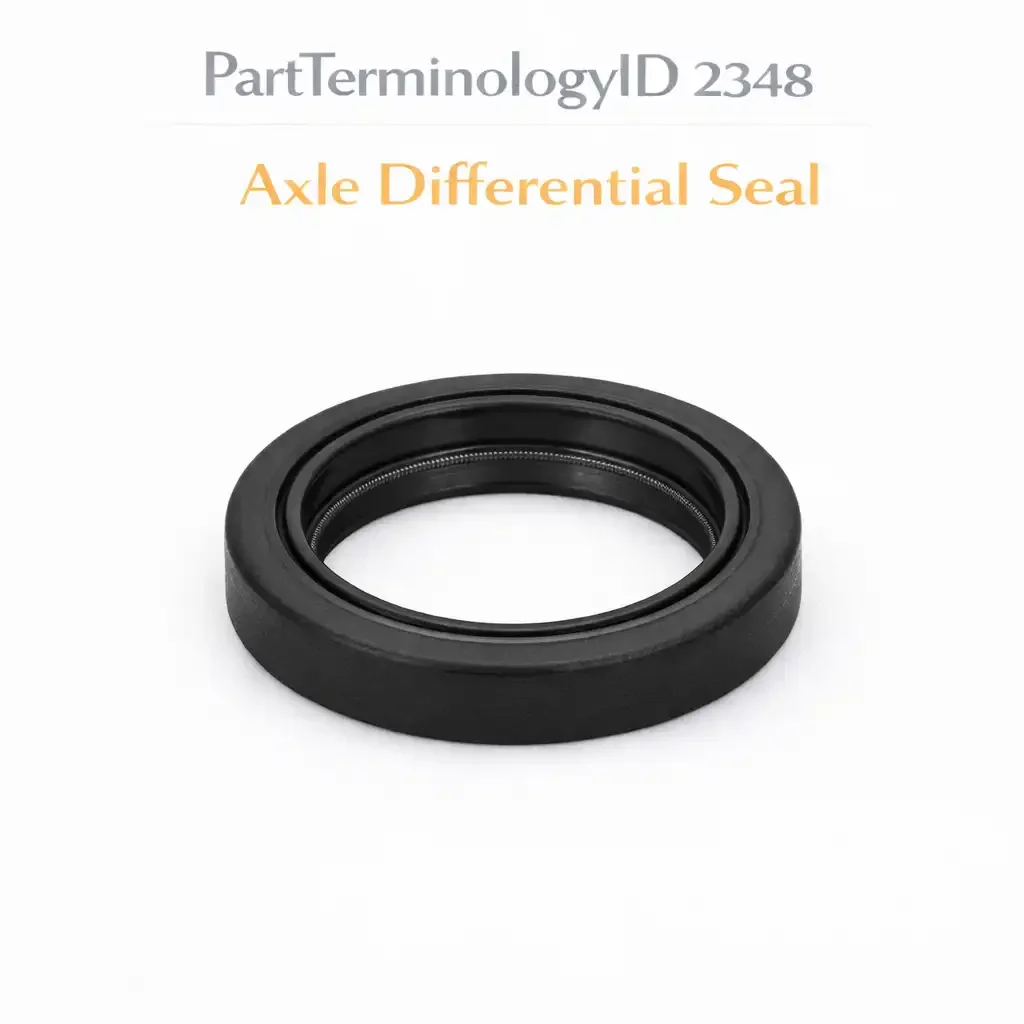
Axle Differential Seal (PartTerminologyID 2348): Where Axle Designation, Shaft Position, and Lip Configuration Determine Whether the Housing Stays Sealed
Written by Arthur Simitian | PartsAdvisory
PartTerminologyID 2348, Axle Differential Seal, is a rotary lip seal that prevents gear oil from escaping an axle differential housing at a rotating shaft exit point. That definition establishes the function. It does not resolve the distinction that separates PartTerminologyID 2348 from PartTerminologyID 2344. Both PartTerminologyIDs describe rotary lip seals at differential shaft exit points. Both use the word differential in their name. A catalog team that has not defined the boundary between them will list the same seals under both, producing duplicate listings that confuse buyers, or will leave one unpopulated while the other is overcrowded with applications it was not intended to cover.
The distinction that most reliably separates the two PartTerminologyIDs in practice is the drivetrain architecture. PartTerminologyID 2344, Differential Seal, covers the full range of differential seal positions across all drivetrain configurations, including the pinion seal, the axle shaft seals, and any additional shaft exit seals on the main differential housing. PartTerminologyID 2348, Axle Differential Seal, is more specifically associated with the seals at the axle differential itself as a sub-assembly within a larger drivetrain architecture, most commonly the seals at the differential unit within an independent front or rear axle module, a portal axle assembly, a disconnecting front axle assembly on a four-wheel-drive vehicle with vacuum or electric actuated axle disconnect, or a military-style axle with an integrated differential at the wheel end. In those applications, the axle differential is a discrete assembly within the larger axle structure, and the seals that isolate the differential cavity from adjacent cavities or from the external environment are specific to that sub-assembly rather than to the full housing.
For sellers, the practical catalog consequence of this distinction is that PartTerminologyID 2348 most commonly applies to commercial vehicle, heavy-duty, agricultural, and military axle applications where the differential is an identifiable sub-assembly within an axle housing that also contains other identifiable components. It appears less frequently in the passenger vehicle and light truck catalog, where the differential seals are more typically listed under PartTerminologyID 2344. A listing under PartTerminologyID 2348 that specifies the axle designation, the differential sub-assembly designation within that axle, the seal position within the sub-assembly, the shaft diameter, the bore diameter, the seal width, and the lip material will serve the correct buyer population without overlap into PartTerminologyID 2344 territory.
For sellers, the listing under this PartTerminologyID is only useful if it specifies the axle designation, the differential sub-assembly designation, the seal position within the sub-assembly, the shaft diameter, the bore diameter, the seal width, the lip material, and the gear oil or lubricant compatibility. Without those eight attributes, the listing cannot be distinguished from a general differential seal listing and cannot be evaluated by a commercial vehicle technician or agricultural equipment service technician who has diagnosed a specific seal failure within the axle differential sub-assembly.
What the Axle Differential Seal Does
Sealing the differential sub-assembly within a larger axle architecture
In a conventional passenger vehicle rear axle, the differential housing is the primary structural housing of the entire axle. The ring and pinion, the carrier, the axle shafts, and all associated seals are within or mounted to a single housing casting. The differential is the housing.
In a heavy-duty commercial vehicle axle, an agricultural drive axle, or a military-specification axle, the architecture is more modular. The differential may be a discrete gear assembly that is housed within a carrier casting that is in turn mounted within a larger axle beam or housing. The seals that isolate the differential carrier cavity from adjacent sections of the axle structure, from the axle tube sections, from the wheel end planetary gear sets, or from the external environment at the carrier mounting face are specific to the differential sub-assembly boundaries rather than to the overall axle housing.
On a tandem drive axle found in Class 6 through Class 8 commercial trucks, the forward-rear axle has an inter-axle differential or a power divider that distributes torque between the forward and rear axle in the tandem pair. The seals at the power divider output shaft and at the inter-axle differential carrier are axle differential seals in the most precise sense of the PartTerminologyID: they seal the differential function within the larger axle assembly rather than at the external housing boundary of the entire axle.
On a disconnecting front axle used in four-wheel-drive passenger vehicles and light trucks, the front axle differential assembly may be a discrete module that is isolated from the outer axle tubes by internal seals. When the front axle disconnects the right outer axle shaft to reduce parasitic drag in two-wheel-drive mode, the differential carrier and its associated seals must maintain the differential cavity isolation on one side while allowing the disconnected shaft to spin freely. The internal seals at the differential carrier boundary within this architecture are axle differential seals specific to that sub-assembly design.
The inter-axle differential seal in a tandem drive axle
The inter-axle differential in a tandem drive axle is a geared torque splitter mounted at the forward-rear axle input. The input shaft from the propshaft drives both the forward-rear axle's ring gear and the through-drive shaft that connects to the rear-rear axle. The inter-axle differential allows different speeds between the two rear axles during turns and on uneven terrain when the axle lock is not engaged.
The inter-axle differential has its own input and output shaft exit points, each requiring a seal to retain the gear oil within the differential carrier. The input shaft seal at the forward end of the carrier seals against the input yoke. The output shaft seal at the rear of the carrier seals against the through-drive shaft that exits toward the rear-rear axle. Both are axle differential seals specific to the inter-axle differential sub-assembly within the forward-rear axle.
The shaft diameters, bore diameters, and seal widths at the inter-axle differential input and output positions differ from the main axle pinion seal on the same axle, and the two sets of seals are not interchangeable. A listing that does not identify the inter-axle differential as the sub-assembly and the input or output position as the seal location cannot be distinguished from a main axle pinion seal listing.
The portal axle differential seal
A portal axle is a reduction gear set at each wheel end that allows the axle housing to be positioned above the wheel centerline, providing increased ground clearance. Portal axles are used on military vehicles, heavy-duty off-road trucks, and some agricultural equipment. The differential in a portal axle is at the center of the axle beam and drives both portal gear sets through axle shafts. The seals at the differential carrier within the portal axle beam are axle differential seals that isolate the central differential cavity from the portal gear cavities at each wheel end.
The lubrication arrangements in a portal axle may include separate lubricant specifications for the central differential cavity and the portal gear cavities. A seal failure at the central differential boundary allows lubricant to migrate between the two cavities, potentially contaminating the lubricant specifications or depleting one cavity while flooding the other. The lip material specification for a portal axle differential seal must be compatible with whichever lubricant the differential side of the seal contacts.
The disconnecting front axle differential seal
On four-wheel-drive vehicles with a vacuum or electrically actuated front axle disconnect, the right front axle shaft is disconnected from the front differential carrier when the vehicle is in two-wheel-drive mode. The disconnecting mechanism is typically within the front differential housing, where an internal collar or fork engages and disengages the right axle shaft from the differential side gear.
The seal at the right side of the disconnecting differential carrier must maintain the carrier cavity seal both when the right shaft is engaged and when it is disengaged and spinning at road speed in two-wheel-drive mode. The seal design on the right side of a disconnecting front differential must accommodate the shaft rotation in both modes and must seal reliably against the differential gear oil in both conditions. This is a more demanding seal specification than a conventional static-shaft-speed axle shaft seal, and the seal design may be specific to the disconnecting differential module rather than interchangeable with the seal on the left side of the same housing.
Lubricant compatibility across multiple cavities
On axle differential assemblies that are sub-components within a larger axle structure, the lubricant in the differential cavity may differ from the lubricant in the adjacent cavities. A tandem axle inter-axle differential may use a hypoid gear oil in the differential cavity while the through-drive shaft runs in a separate oil circuit with a different viscosity. A portal axle may use different viscosity grades in the central differential and the portal gear sets. The seal lip material must be compatible with the lubricant on the differential side of the seal. If the seal separates two different lubricant cavities, the primary lip must be rated for the differential cavity lubricant and the exclusion lip or secondary lip must be rated for the adjacent cavity lubricant.
A listing that does not specify which lubricant the seal contacts on each face cannot be evaluated for lip material compatibility on multi-lubricant axle applications.
The Specifications That Determine Correct Seal Fitment
Axle designation and differential sub-assembly designation
The axle designation is the first fitment attribute. Common commercial axle designations where PartTerminologyID 2348 applies include Meritor RT-40, Meritor RS-17, Dana Spicer S-135, Eaton DS404, Rockwell SQHD, and equivalent designations from other manufacturers. Within those axle designations, the differential sub-assembly has its own designation: inter-axle differential, main carrier, power divider, or portal gear differential. Both the axle designation and the differential sub-assembly designation must be stated because the same axle may have multiple differential seal positions with different specifications.
Seal position within the differential sub-assembly
Input shaft seal, output shaft seal, side shaft seal left, side shaft seal right, or carrier-to-housing seal if the seal is at the differential carrier boundary rather than at a rotating shaft. The position determines the shaft diameter and the bore diameter, which differ between positions even within the same sub-assembly.
Shaft diameter and bore diameter
Both stated to two decimal places in millimeters. The shaft diameter at the inter-axle differential input differs from the shaft diameter at the inter-axle differential output on the same carrier. The bore diameter at each position reflects the machined bore in the carrier casting, which is specific to the sub-assembly design.
Seal width
In millimeters. The available bore depth determines the maximum seal width. A seal wider than the bore depth protrudes from the carrier face and prevents adjacent components from seating correctly.
Lip material and lubricant compatibility
For commercial axle differential applications, the primary lip materials are nitrile, HNBR, and polyacrylate. The lubricant compatibility argument follows the same structure as in the differential seal post (2344) but must additionally account for the possibility of two different lubricants on opposite faces of the seal in multi-lubricant axle architectures.
Single-lip versus double-lip versus lip-and-exclude configuration
On commercial vehicle axle differentials in off-road, construction, or agricultural applications, the contamination environment is severe and double-lip seals with exclusion lips are typically specified for any position where the external face of the seal is exposed to road contamination. On internal seals between two lubricant cavities, the seal may use a double-lip configuration where both lips contact lubricant on one side each, rather than an exclusion lip that contacts contamination.
Axle lock status for inter-axle differential seals
On inter-axle differentials with a lockout mechanism, the axle lock engages the inter-axle differential to split torque equally between the two tandem axles. The shaft position within the inter-axle differential does not change when the lock is engaged, so the seal specification is not affected by the lock status. However, the listing should note the axle lock compatibility to confirm the seal is correct for both locked and unlocked operating conditions.
Why This Part Generates Returns
Buyers order the wrong axle differential seal because:
the axle designation is specified without the differential sub-assembly designation, and the seal position in the main carrier is confused with the seal position in the inter-axle differential
the seal position within the sub-assembly is not specified and the input shaft seal and output shaft seal are confused, producing a dimensional mismatch because the two shafts have different diameters
the lubricant type on the differential side of the seal is not specified and a mineral-oil-rated nitrile seal is installed in a carrier using a full-synthetic hypoid gear oil
the seal is too wide for the bore depth in the carrier casting and the adjacent component cannot seat against the carrier face
the inter-axle differential model changed during the axle's production run and the seal bore dimensions changed with it, but the listing does not specify the inter-axle differential model year or production date range
the seal is a double-lip internal cavity separator and a single-lip external seal is ordered by mistake, allowing lubricant to migrate between adjacent cavities
Status in New Databases
PIES/PCdb: PartTerminologyID 2348, Axle Differential Seal
PIES 8.0 / PCdb 2.0: No change
Top Return Scenarios
Scenario 1: "Main carrier pinion seal received, needed inter-axle differential output seal, shaft diameters different"
The listing specified a Meritor RT-40 axle differential seal without identifying the differential sub-assembly. The buyer needed the inter-axle differential output seal at the through-drive shaft. The replacement arrived as the main carrier pinion seal for the same axle. The through-drive shaft is smaller in diameter than the main carrier pinion shaft. The main carrier pinion seal inner diameter is too large for the through-drive shaft, producing no contact interference.
Prevention language: "Axle designation: [Meritor RT-40]. Differential sub-assembly: [inter-axle differential / main carrier / power divider]. Seal position within sub-assembly: [input shaft / output shaft / left side / right side]. The RT-40 axle has multiple differential assemblies with different seal specifications. State the sub-assembly and position when ordering. The inter-axle differential output seal and the main carrier pinion seal are not interchangeable."
Scenario 2: "Inter-axle differential input and output seals confused, output seal too large for input shaft"
The input and output shafts of the inter-axle differential have different diameters. The listing stated the position only as inter-axle differential seal without specifying input or output. The buyer received the output shaft seal. The input shaft is smaller than the output shaft. The output seal inner diameter is too large for the input shaft.
Prevention language: "Inter-axle differential seal position: [input shaft seal / output shaft seal]. Shaft diameter at this position: [X.XX]mm. The inter-axle differential input shaft and output shaft have different diameters on this axle model. The input and output seals are different sizes. Specify the shaft position when ordering."
Scenario 3: "Portal axle differential seal, lubricant migrated from differential cavity to portal gear cavity, gear oil specifications mixed"
The seal at the differential carrier boundary in a portal axle failed. The differential cavity uses SAE 80W-90 GL-5 gear oil. The portal gear cavity uses SAE 90W GL-4 gear oil. Lubricant migrated from the higher-pressure differential cavity into the portal gear cavity. The mixed lubricant depleted the friction modifier package in the differential and raised the viscosity in the portal gear cavity above specification.
Prevention language: "Seal position: [differential carrier to portal gear cavity boundary]. Lubricant on differential side: [SAE 80W-90 GL-5]. Lubricant on portal gear side: [SAE 90W GL-4]. This seal separates two different lubricant cavities. Lip material compatibility must be verified for both lubricants. A failed seal at this position allows lubricant migration between cavities with different specifications, contaminating both circuits."
Scenario 4: "Seal too wide, inter-axle differential cover will not seat against carrier face"
The replacement seal is 5mm wider than the available bore depth in the inter-axle differential carrier. The seal protrudes 5mm beyond the carrier face. The differential cover that retains the inter-axle differential input shaft bearing cannot seat flat against the carrier face with the protruding seal in position. The bearing is not correctly retained.
Prevention language: "Seal width: [X]mm. Available bore depth at this position: [X]mm. Verify the seal width does not exceed the bore depth. A seal wider than the bore depth protrudes from the carrier face and prevents the cover or bearing retainer from seating correctly. An incorrectly retained bearing at the inter-axle differential input position will fail from inadequate preload retention within a short service period."
Scenario 5: "Synthetic hypoid gear oil, nitrile lip, seal degraded within 25,000 miles of commercial duty"
The inter-axle differential uses a full-synthetic SAE 75W-90 hypoid gear oil specified by the commercial vehicle manufacturer for extended drain intervals. The replacement seal uses a standard nitrile lip. The synthetic hypoid formulation degraded the nitrile at the elevated operating temperature of the commercial duty cycle. The seal began weeping at 25,000 miles, well short of the expected service interval.
Prevention language: "Lip material: [nitrile / HNBR / polyacrylate]. Lubricant compatibility: [mineral GL-5 only / synthetic GL-5 compatible]. This axle specifies full-synthetic hypoid gear oil. Standard nitrile lips degrade in synthetic hypoid formulations at commercial operating temperatures. Specify a polyacrylate or HNBR lip seal for axles running synthetic gear oil on extended commercial drain intervals."
Scenario 6: "Disconnecting front axle right side seal, single-lip installed, oil seepage in two-wheel-drive mode"
The disconnecting front differential right side seal requires a design that seals reliably whether the right shaft is engaged or spinning freely in two-wheel-drive mode. The replacement is a standard single-lip axle shaft seal not designed for the disconnecting mechanism. In two-wheel-drive mode, the disengaged shaft spins at road speed in the differential carrier. The standard single-lip seal is not retained correctly in the disconnecting carrier bore geometry and seeps gear oil at the shaft exit point in two-wheel-drive mode.
Prevention language: "Differential type: [disconnecting front axle differential]. Seal position: [right side shaft seal]. This position requires a seal specifically designed for the disconnecting front differential carrier. The right side seal must maintain sealing contact when the shaft is engaged and when the shaft is disengaged and spinning freely in two-wheel-drive mode. A standard single-lip axle shaft seal is not interchangeable with the disconnecting differential seal at this position."
Scenario 7: "Inter-axle differential updated mid-production, bore dimensions changed, pre-update seal received"
The Meritor RT-46 inter-axle differential was updated during production with a change to the input shaft bore diameter and seal specification. The listing covered the RT-46 without a production date range. The buyer's axle is a post-update unit. The pre-update seal outer diameter is 2mm smaller than the updated bore, producing insufficient press fit.
Prevention language: "Inter-axle differential production date range: [pre-update: prior to serial number XXXXXX / post-update: serial number XXXXXX and later]. The RT-46 inter-axle differential seal bore was updated during production. Verify your axle serial number against the production date break before ordering. Pre-update and post-update seals are not interchangeable."
What to Include in the Listing
Core essentials
PartTerminologyID: 2348
component: Axle Differential Seal
axle manufacturer and model designation (mandatory)
axle production date range when seal specification changed (mandatory)
differential sub-assembly designation: inter-axle differential, main carrier, power divider, portal gear differential, or disconnecting differential (mandatory)
seal position within the sub-assembly: input shaft, output shaft, left side, right side, or carrier boundary (mandatory)
shaft diameter in mm to two decimal places (mandatory)
housing bore diameter in mm to two decimal places (mandatory)
seal width in mm (mandatory)
lip material: nitrile, HNBR, or polyacrylate (mandatory)
lubricant compatibility on differential side: mineral GL-4, GL-5, synthetic GL-5, or other (mandatory)
lubricant compatibility on adjacent cavity side for internal cavity separator seals (mandatory)
lip configuration: single-lip, double-lip with exclusion, or double-lip cavity separator (mandatory)
garter spring: present or springless (mandatory)
seal retention: press fit only or press fit with retaining feature (mandatory)
shaft surface finish requirement in Ra micrometers (mandatory)
quantity: 1
Fitment essentials
commercial vehicle year/make/model or equipment designation
axle manufacturer and model (primary fitment attribute)
axle serial number range when bore specification changed mid-production
differential sub-assembly designation
seal position within sub-assembly
lubricant specification on each side of the seal for internal cavity separator designs
Dimensional essentials
shaft diameter in mm to two decimal places
seal inner diameter before installation in mm
housing bore diameter in mm
seal outer diameter in mm
seal width in mm
press fit interference in mm
lip contact band width in mm
garter spring inner diameter in mm
bore depth in mm for width verification
Image essentials
seal in isolation showing lip configuration: single lip, double lip with exclusion, or double lip cavity separator
cross-section showing inner lip and spring arrangement
inter-axle differential carrier shown with the input and output shaft positions identified for tandem axle listings
portal axle cross-section showing the differential cavity and portal gear cavity boundaries for portal axle listings
installed context showing the seal correctly pressed into the sub-assembly bore
serial number plate location on the axle housing for production date range identification guidance
Catalog Checklist for ACES/PIES Teams
PartTerminologyID = 2348
require axle designation (mandatory)
require production date range when bore specification changed (mandatory)
require differential sub-assembly designation (mandatory)
require seal position within sub-assembly (mandatory)
require shaft diameter in mm to two decimal places (mandatory)
require housing bore diameter in mm (mandatory)
require seal width in mm (mandatory)
require lip material (mandatory)
require lubricant compatibility on differential side (mandatory)
require lubricant compatibility on adjacent side for internal cavity separator seals (mandatory)
require lip configuration (mandatory)
define the boundary between PartTerminologyID 2348 and PartTerminologyID 2344: 2344 covers differential seals in passenger vehicle and light truck solid axle and IRS applications where the differential is the primary housing structure; 2348 covers axle differential seals in commercial, agricultural, military, and heavy-duty axle architectures where the differential is a discrete sub-assembly within a larger axle structure; when in doubt, use the sub-assembly designation as the differentiator: if the differential has its own sub-assembly designation distinct from the overall axle model, use 2348
differentiate from CV axle shaft seal (PartTerminologyID 2341): 2341 is specific to CV halfshaft transaxle and IRS applications; 2348 covers commercial and heavy-duty axle differential seal positions
differentiate from differential seal (PartTerminologyID 2344): as described above; the practical catalog rule is that passenger vehicle and light truck differential seals use 2344 and commercial, agricultural, and heavy-duty axle differential sub-assembly seals use 2348
differentiate from axle differential bearing and seal kit (PartTerminologyID 2224): the kit covers all seals and bearings for a complete differential rebuild; 2348 covers individual seals for targeted replacement
flag sub-assembly designation as mandatory: the most consequential listing error for this PartTerminologyID is applying a main carrier seal to an inter-axle differential position or vice versa; both are axle differential seals on the same axle but with entirely different dimensions
flag production date range as mandatory: commercial axle manufacturers update bore specifications during production runs; a seal that fits early-production units will not achieve correct press fit in late-production units with updated bore dimensions
flag lubricant compatibility on both faces for cavity separator seals: a seal that separates two different lubricant cavities must be rated for both lubricants; a listing that states only one lubricant compatibility for a two-cavity separator seal is incomplete
FAQ (Buyer Language)
How do I identify the inter-axle differential model on a tandem drive axle?
The inter-axle differential model is typically cast into the inter-axle differential carrier housing or is identified on a tag attached to the carrier. On Meritor tandem axles, the axle model designation on the vehicle data plate identifies the full tandem axle model number, which encodes the inter-axle differential type. On Dana Spicer tandem axles, the axle serial number stamped on the axle beam can be decoded against Dana's axle serial number lookup tool to identify the inter-axle differential model. If neither the casting marks nor the data plate are legible, the inter-axle differential can be identified by measuring the input and output shaft diameters and comparing them to the dimension tables in the axle service manual for the axle model.
My portal axle has separate lubricant cavities in the differential and the portal gear sets. How do I know which lubricant the differential seal contacts?
Remove the differential cavity fill plug and the portal gear cavity fill plug and compare the lubricants. If the fill plug for one cavity is at a different location from the other, the two cavities are separate and use separate lubricants. Verify the lubricant specification for each cavity in the vehicle or equipment service manual. The differential cavity fill plug is typically on the axle beam at the differential carrier position, and the portal gear cavity fill plug is at the wheel end. The seal at the carrier boundary contacts the differential cavity lubricant on its inner face. If the seal is a double-lip type that also contacts the portal gear cavity lubricant on its outer face, both lubricant specifications must be verified against the seal's compatibility rating.
What is the service interval for axle differential seals on a commercial vehicle tandem drive axle?
Most commercial vehicle axle manufacturers specify differential seal inspection at each major service interval, typically at each axle oil change. The inter-axle differential seals should be inspected for leakage at every axle oil change service. A seal that shows any weeping or wet film at the shaft exit should be replaced at the next scheduled service before it progresses to an active leak. On extended drain interval synthetic oil programs, where the gear oil may not be changed for 500,000 miles or more, the seal condition should be verified visually at each preventive maintenance interval regardless of the oil drain schedule. A seal that fails on a vehicle enrolled in an extended drain synthetic oil program will cause the synthetic oil to drain from the carrier, defeating the extended drain benefit entirely.
Can I replace an inter-axle differential seal without removing the inter-axle differential from the axle?
On some tandem axle designs, yes. The input shaft seal at the forward face of the inter-axle differential is often accessible after removing the input yoke and the yoke retaining nut, which allows the seal to be driven out and the replacement pressed in without disassembling the inter-axle differential. The output shaft seal at the rear of the carrier typically requires the through-drive shaft to be withdrawn, which may be accessible from the rear of the forward-rear axle after removing the rear axle shaft and related components. Verify the service manual procedure for the specific tandem axle model before beginning. On some designs, full removal of the inter-axle differential is required to access both seals.
My disconnecting front axle differential is seeping gear oil only in two-wheel-drive mode. Why does the seal behavior change between modes?
In four-wheel-drive mode, the right front axle shaft is engaged and rotating at wheel speed within the differential carrier. The shaft rotation creates the hydrodynamic film that lubricates the seal lip and maintains the sealing contact. In two-wheel-drive mode, the right shaft is disengaged from the carrier. On some disconnecting designs, the disengaged shaft is stationary while the carrier continues to rotate. On other designs, the disengaged shaft rotates at road speed but is no longer engaged to the carrier. In either case, the hydrodynamic film conditions at the seal are different from the engaged condition. A seal that is marginally effective in the engaged condition, where the film is robust, may seep in the disengaged condition where the film is thinner or absent. A seal that seeps only in two-wheel-drive mode needs replacement with a seal designed for the specific disconnecting differential carrier geometry rather than a standard axle shaft seal.
The axle differential seal bore on my heavy-duty axle shows corrosion pitting. Can I install a new seal in a pitted bore?
A pitted bore is a sealing problem at the outer diameter of the seal, which is where the seal achieves its press fit against the housing. If the pitting is on the bore surface rather than at the seal contact depth, the press fit may still be achievable below the surface pitting. If the pitting extends to the full depth of the seal bore, the seal outer diameter may not achieve full circumferential contact with the bore surface, producing a leak path between the seal outer diameter and the bore. Options depend on the depth and extent of the pitting: light surface oxidation can sometimes be removed by light honing to clean metal within the dimensional tolerance; deep pitting that removes material beyond the bore diameter tolerance requires bore repair by sleeve insertion or carrier replacement.
Cross-Sell Logic
Axle Differential Bearing and Seal Kit (PartTerminologyID 2224: if multiple seals and bearings are being replaced at the same service event, the complete kit is more efficient than ordering individual seals)
Inter-Axle Differential Lock Actuator (for tandem axle applications: the lock actuator is inspected when the inter-axle differential is opened for seal replacement and replaced if the engagement is unreliable)
Axle Input Yoke (the input yoke at the inter-axle differential is inspected for wear at the seal contact surface when the input seal is replaced; replace if the yoke contact zone is grooved)
Yoke Retaining Nut (the input yoke retaining nut is a torque-to-yield fastener on some tandem axle models and requires replacement whenever the yoke is removed for seal access)
Gear Oil and Friction Modifier (the gear oil in the differential sub-assembly is drained and replaced at every seal replacement service; verify the correct API rating, viscosity, and any friction modifier requirement for the specific sub-assembly)
Shaft Repair Sleeve (if the shaft contact zone is grooved from a failed seal, a repair sleeve is required before the new seal can function correctly)
Frame as "the axle differential seal retains the gear oil in the sub-assembly that the seal isolates. The gear oil lubricates the differential gears and bearings the seal protects. The input yoke carries the torque into the sub-assembly past the seal. The yoke retaining nut holds the yoke against the bearing the seal sits beside. All are in the same service path when the carrier is opened for seal replacement."
Final Take for PartTerminologyID 2348
Axle Differential Seal (PartTerminologyID 2348) is the PartTerminologyID in the differential seal series where the catalog boundary question is as important as the specification attributes themselves. Every listing decision for this PartTerminologyID begins with a prior question: does this seal belong under 2348 or under 2344. The practical rule that resolves that boundary is the sub-assembly test. If the differential has its own sub-assembly designation distinct from the overall axle model, and if the seals in question are specific to that sub-assembly rather than to the overall axle housing boundary, the listing belongs under 2348.
Once the PartTerminologyID boundary is resolved, the specification attributes follow the same mandatory structure as the broader differential seal post. The differential sub-assembly designation and the seal position within that sub-assembly replace the seal position designation from 2344. The axle production date range is elevated in importance relative to passenger vehicle applications because commercial axle manufacturers update bore specifications during production runs in ways that change the seal dimensions while leaving the axle model designation unchanged. The lubricant compatibility on both faces of the seal becomes relevant for internal cavity separator seals that do not exist in passenger vehicle differential architecture.
State the axle designation and the differential sub-assembly designation. State the seal position within the sub-assembly. State the shaft diameter and bore diameter. State the seal width. State the lip material and lubricant compatibility on each face. State the lip configuration. State the production date range when the bore specification changed. That is the same listing strategy as every other PartTerminologyID in this series: the generic PartTerminologyID requires specific attributes at every level to become a listing buyers can act on without guessing. For PartTerminologyID 2348, the sub-assembly designation is the attribute that converts a generic axle differential seal listing into one the commercial vehicle technician can evaluate against the specific carrier they have on the bench.