
Written by Arthur Simitian | PartsAdvisory
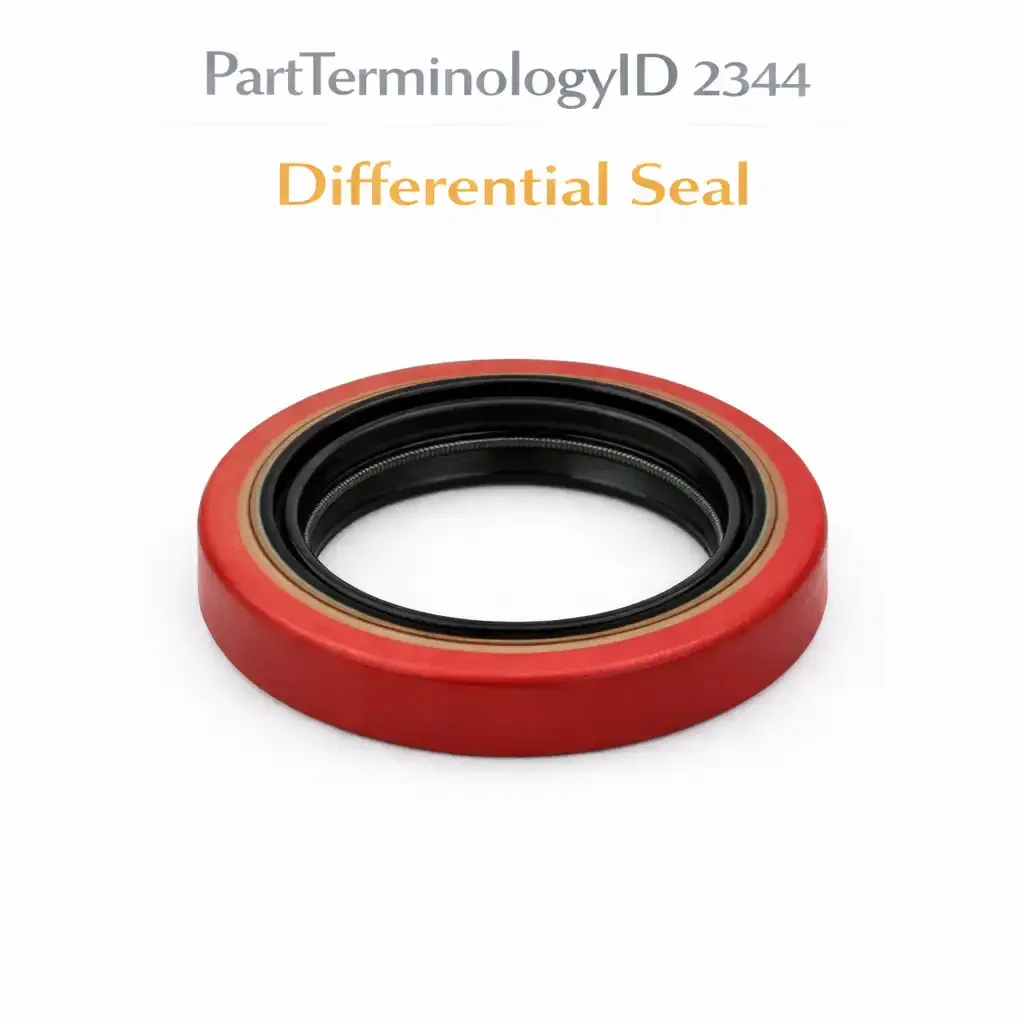
PartTerminologyID 2344, Differential Seal, is a rotary lip seal that prevents gear oil from escaping a differential housing at one of several rotating shaft exit points. That definition is accurate and nearly useless for catalog purposes because it leaves unresolved the most consequential question any buyer brings to this listing: which seal position is this. A differential housing has multiple rotating shaft exit points. The pinion shaft exits the front of the housing through the pinion seal bore. Each axle shaft exits the housing through an axle shaft seal bore on the left and right sides. On some differentials, a power take off output shaft exits through a fourth bore. On four-wheel-drive transfer cases with integrated differentials, additional shaft exits exist. A listing under PartTerminologyID 2344 that does not specify the seal position within the differential cannot be evaluated by any buyer who has identified which seal is leaking and needs a replacement that fits that specific bore.
For sellers, PartTerminologyID 2344 occupies a broader scope than the CV axle shaft seal (PartTerminologyID 2341) that precedes it in the series. Where 2341 is specific to CV halfshaft applications on front-wheel-drive and independent suspension drivetrains, PartTerminologyID 2344 covers differential seals in all drivetrain configurations: solid rear axles on rear-wheel-drive trucks and SUVs, front differentials on four-wheel-drive vehicles with solid front axles, independent rear differentials on rear-wheel-drive performance vehicles and all-wheel-drive vehicles, and integrated transfer case differentials. The buyer population spans passenger car do-it-yourself buyers replacing a leaking pinion seal on a solid rear axle, four-wheel-drive technicians replacing front axle shaft seals, and performance vehicle technicians replacing rear differential seals on independent rear suspension applications.
The breadth of this application population makes the seal position the mandatory first attribute in every listing under this PartTerminologyID. Before shaft diameter, before bore diameter, before lip material, the listing must state which position in the differential housing the seal occupies. A pinion seal and an axle shaft seal for the same differential axle are both differential seals under PartTerminologyID 2344, and they have entirely different shaft diameters, bore diameters, seal widths, and lip designs. Sending one when the other is needed produces an installation failure that is discovered at the housing with the differential drained and the original seal removed.
For sellers, the listing under this PartTerminologyID is only useful if it specifies the seal position, the axle designation, the shaft diameter, the bore diameter, the seal width, the lip material, and the gear oil compatibility. Without those seven attributes, the listing cannot serve the broad buyer population of this PartTerminologyID without producing the position confusion and dimensional mismatch that are the two primary return drivers.
What the Differential Seal Does
Retaining gear oil at each rotating shaft exit in the differential housing
The differential housing is a sealed casting filled with gear oil to a level that lubricates the ring and pinion gears, the carrier bearings, the side gears, and the pinion shaft bearings. The oil level is maintained by filling through a fill plug until oil runs out of the fill plug hole, which confirms the level is at the fill port height. The differential cannot maintain this oil level if any of the rotating shaft exit points allows oil to escape past the shaft surface.
Each rotary lip seal at a shaft exit point maintains a thin hydrodynamic film of gear oil between the seal lip and the rotating shaft, which lubricates the lip and allows the shaft to rotate freely while the lip maintains sealing contact. The garter spring behind the primary lip maintains the contact force as the lip wears over its service life. The combination of spring-loaded contact and hydrodynamic lubrication allows a correctly installed seal to maintain the gear oil level against the static head pressure of the oil above the seal and against the dynamic pressure of the oil splash from the rotating ring gear.
A differential that loses gear oil slowly enough that the driver does not notice is typically losing oil through one or more of these seal positions. The consequences of low differential gear oil are the same as for any gear drive operating without adequate lubrication: the gear and bearing surfaces lose their protective oil film, metal-to-metal contact increases, wear accelerates, and the differential eventually fails from bearing seizure or gear damage at a repair cost that is orders of magnitude higher than the cost of the seal that allowed the oil level to drop.
The pinion seal as the most commonly replaced differential seal
The pinion seal seals the pinion shaft where it exits the front of the differential housing toward the propshaft companion flange. The pinion shaft rotates at the driveshaft speed, which is higher than wheel speed by the factor of the axle gear ratio. A 3.73 ratio axle rotates the pinion shaft at 3.73 times the wheel speed. At highway speed, the pinion shaft may be rotating at 3,000 to 4,000 RPM, which is significantly higher than the axle shaft speed at the side seals. The higher rotational speed at the pinion seal position means the seal lip operates at a higher surface speed than the axle shaft seals, which accelerates lip wear.
The pinion seal is also the most accessible of the differential seals for replacement because it is at the front of the housing accessible from under the vehicle without removing the axle shafts or the differential cover. Pinion seal replacement requires only removing the companion flange, which is retained by the pinion nut. The pinion nut is a torque-to-yield fastener on most modern axles, meaning it must be replaced rather than reused, and the pinion preload must be set correctly when the nut is reinstalled. A listing for a pinion seal replacement that does not note the pinion nut replacement requirement and the preload procedure sends a buyer to an installation that will require either a preload measurement tool or a return trip for a new pinion nut.
The axle shaft seal on a solid axle
The axle shaft seal on a solid rear axle is at the inboard end of the axle tube, where the axle shaft passes through the tube end and enters the differential side gear. The seal prevents gear oil from migrating outward along the axle shaft within the tube toward the wheel bearing and brake assembly. Gear oil contamination of a drum brake assembly from a failed axle shaft seal is one of the most consequential downstream failures in the differential seal category: the contaminated brake shoes lose friction coefficient and the braking effectiveness on that wheel is severely reduced.
On a solid axle with semi-floating axle shafts, the axle shaft seal is inboard of the wheel bearing. On a solid axle with full-floating axle shafts, the axle shaft seal is at the differential side gear position and the axle tube contains no gear oil beyond the seal. The seal position and the shaft diameter differ between semi-floating and full-floating configurations even within the same axle designation.
The axle shaft seal on an independent rear differential
An independent rear differential has a separate housing that connects to the rear halfshafts through CV joints in the same arrangement as a front-wheel-drive transaxle. The seals at the halfshaft exits of an independent rear differential are the same in function as the CV axle shaft seals on a transaxle but are sealing against rear differential gear oil rather than ATF. The shaft diameter and bore diameter are specific to the rear differential housing design.
On performance vehicles with a rear-mounted differential, the axle shaft seals may be in a high-temperature zone near the exhaust system. The lip material must be rated for the elevated ambient temperature at the seal position on those applications.
The front axle shaft seal on a solid front axle
Four-wheel-drive vehicles with a solid front axle have axle shaft seals at the differential side gear exits within the front axle housing. The front axle shaft seals are subject to the same contamination environment as the wheel-end components on the front axle, which is more severe than the rear axle environment because the front wheel wells generate more road spray and the front axle is more frequently submerged in water crossings on off-road applications.
Front axle shaft seals on four-wheel-drive vehicles used in off-road service should use double-lip designs with exclusion lips for the same reasons described for the PTO countershaft seal (2340) and the CV axle shaft seal (2341) in contaminated operating environments.
The Specifications That Determine Correct Seal Fitment
Seal position within the differential
The mandatory first attribute. Pinion seal, axle shaft seal (specifying left, right, or both on symmetric designs), front axle shaft seal, or other position. The seal position determines the shaft diameter, the bore diameter, the seal width, and the expected shaft surface speed, all of which differ between positions on the same axle.
Axle designation
The axle designation determines the dimensional specifications at each seal position. The same seal position on different axle designations has different shaft diameters and bore diameters. A Dana 44 pinion seal has different dimensions from a Dana 60 pinion seal, which has different dimensions from a GM 8.5-inch pinion seal, even though all three are pinion seals on solid rear axles.
Shaft diameter
The shaft diameter at the seal lip contact zone. State in millimeters to two decimal places. The pinion shaft diameter at the seal contact zone is different from the axle shaft diameter at the side seal contact zone on the same axle.
Housing bore diameter
The bore diameter at the seal installation point. State in millimeters to two decimal places. The pinion bore diameter and the axle tube bore diameter are different on the same axle.
Seal width
The seal width in millimeters. The pinion seal width and the axle shaft seal width are typically different on the same axle even if the bore diameters are similar.
Lip material and gear oil compatibility
Nitrile for conventional GL-5 mineral gear oil. HNBR for high-temperature applications and some synthetic gear oils. Polyacrylate for full-synthetic gear oil formulations. The listing must state the lip material and specify the gear oil API rating and mineral or synthetic base.
Single-lip versus double-lip with exclusion lip
Single-lip for clean operating environments. Double-lip with exclusion for off-road, construction, and high-contamination applications. Front axle shaft seals and differential seals on off-road vehicles should default to double-lip.
Pinion nut inclusion and preload note for pinion seal listings
The pinion nut is a torque-to-yield fastener on most modern axles and must be replaced whenever the pinion flange is removed. The listing must state whether the pinion nut is included and must note the preload procedure requirement. A buyer who replaces the pinion seal without replacing the pinion nut and setting the preload correctly risks a pinion bearing failure from incorrect preload that develops over thousands of miles before the consequences become apparent.
Why This Part Generates Returns
Buyers order the wrong differential seal because:
the seal position is not specified and the buyer receives a pinion seal when they need an axle shaft seal, or vice versa, with entirely different dimensions
the axle designation is not specified and the shaft diameter or bore diameter does not match the replacement seal
the semi-floating versus full-floating axle configuration is not identified and the axle shaft seal position and shaft diameter are different between the two configurations on the same axle designation
the lip material is not specified and a conventional gear oil rated seal is installed on a differential filled with synthetic gear oil, accelerating lip hardening
the pinion nut is not included and not disclosed, and the buyer discovers mid-installation that the torque-to-yield nut cannot be reused
the front axle shaft seal is a single-lip design used on an off-road vehicle that requires the exclusion lip of a double-lip design
the shaft surface at the pinion seal contact zone is grooved from the worn seal and the new seal leaks immediately
Status in New Databases
PIES/PCdb: PartTerminologyID 2344, Differential Seal
PIES 8.0 / PCdb 2.0: No change
Top Return Scenarios
Scenario 1: "Pinion seal received, needed axle shaft seal, dimensions completely different"
The listing specified a differential seal by vehicle year, make, and model without stating the seal position. The buyer needed the left axle shaft seal. The replacement arrived as a pinion seal. The pinion seal inner diameter is the pinion shaft diameter, which is larger than the axle shaft diameter. The bore diameter is also different. No dimension matches the left axle shaft bore.
Prevention language: "Seal position: [pinion seal / left axle shaft seal / right axle shaft seal]. Verify the seal position before ordering. A differential housing has multiple seal positions with different shaft diameters and bore diameters. The pinion seal and the axle shaft seals are not interchangeable even on the same axle. Specify the position when ordering."
Scenario 2: "Semi-floating axle, full-floating seal received, seal too large for semi-floating tube bore"
The axle designation was specified but the semi-floating versus full-floating configuration was not. The buyer has a semi-floating GM 14-bolt axle. The listing covers the full-floating 14-bolt, which has a different axle tube bore diameter and a different seal size. The full-floating seal outer diameter is larger than the semi-floating tube bore.
Prevention language: "Axle shaft configuration: [semi-floating / full-floating]. The GM 14-bolt axle was produced in both semi-floating and full-floating versions. The axle shaft seal dimensions differ between the two configurations. Verify your axle shaft configuration before ordering. The full-floating axle has a larger axle tube and a larger seal than the semi-floating version."
Scenario 3: "Pinion nut not included, original nut reused, pinion preload incorrect, bearing noise within 15,000 miles"
The listing did not state whether the pinion nut was included or note the torque-to-yield replacement requirement. The buyer reused the original pinion nut. The used nut did not achieve the correct preload specification when tightened to the original torque value because the torque-to-yield nut had already stretched. The incorrect preload produced a pinion bearing noise within 15,000 miles.
Prevention language: "Pinion nut: [included / not included, replacement required]. The pinion nut on this axle is a torque-to-yield fastener that must be replaced whenever the pinion flange is removed. Reusing the original nut will not achieve the correct pinion bearing preload. Incorrect preload accelerates pinion bearing wear. A new pinion nut and a preload measurement procedure using an inch-pound torque wrench are required at every pinion seal replacement."
Scenario 4: "Synthetic gear oil, nitrile lip seal installed, lip hardened within 18,000 miles"
The listing did not specify the lip material or gear oil compatibility. The buyer's rear differential is filled with a full-synthetic 75W-140 gear oil. The replacement seal uses a standard nitrile lip rated for conventional mineral gear oil. The synthetic base oil chemistry degraded the nitrile at operating temperature. The lip hardened within 18,000 miles and the seal began weeping gear oil along the pinion shaft.
Prevention language: "Lip material: [nitrile / HNBR / polyacrylate]. Gear oil compatibility: [GL-5 mineral / GL-5 synthetic compatible]. Verify the lip material is rated for your differential's gear oil specification. Full-synthetic 75W-140 and 75W-90 gear oils degrade standard nitrile lip seals at operating temperature. Specify a polyacrylate or HNBR seal for differentials filled with full-synthetic gear oil."
Scenario 5: "Single-lip front axle seal, off-road use, water ingress contaminated front differential"
The listing specified a single-lip front axle shaft seal. The vehicle is used for regular off-road driving including water crossings. The single-lip seal allowed water to enter the front differential housing through the front axle shaft bores during a river crossing. The gear oil emulsified and the front differential carrier bearings failed from corrosion and inadequate lubrication within 3,000 miles after the crossing.
Prevention language: "Seal lip configuration: [single-lip / double-lip with exclusion lip]. Application note: single-lip seals are appropriate for on-road use in clean environments. Off-road applications including water crossings, mud, and regular pressure washing require a double-lip seal with an exclusion lip at the front axle shaft positions. Specify the double-lip design for any four-wheel-drive vehicle used in off-road service."
Scenario 6: "Grooved pinion shaft, new pinion seal leaks immediately at groove"
The original pinion seal failed and the seal lip wore a groove into the pinion shaft at the contact zone. The buyer replaced the seal without inspecting the shaft surface. The new seal lip cannot bridge the 0.2mm groove worn by the old lip and leaks gear oil along the groove immediately.
Prevention language: "Shaft surface inspection required before installation. Inspect the pinion shaft at the seal contact zone for grooves or scoring from the original seal. A groove depth greater than 0.05mm will allow the new seal to leak immediately. Options: install a pinion shaft repair sleeve over the contact zone to provide a new finished surface, or replace the pinion shaft and yoke assembly. Do not install a new seal on a grooved shaft."
Scenario 7: "Gear oil contaminated rear brake shoes from axle shaft seal failure, brakes ineffective"
The rear axle shaft seal failed slowly over several months on a vehicle with drum rear brakes. The gear oil migrated outward along the axle shaft within the axle tube and contacted the rear brake drum and shoes. The contaminated brake shoes lost friction coefficient and the right rear brake was nearly ineffective. The differential leak was not noticed until the brake performance degraded significantly.
Prevention language: "Application note for solid rear axle axle shaft seal replacement: inspect the rear brake assembly for gear oil contamination at the same service event as the seal replacement. Gear oil that has migrated past a failed axle shaft seal will contaminate the brake drum and shoes on semi-floating axle applications. Contaminated brake shoes must be replaced: brake shoes cannot be cleaned of gear oil contamination and restored to their original friction coefficient. Inspect both the seal and the brake assembly before returning the vehicle to service."
What to Include in the Listing
Core essentials
PartTerminologyID: 2344
component: Differential Seal
seal position: pinion, left axle shaft, right axle shaft, both axle shafts if identical, or other (mandatory)
axle designation: Dana, GM, Ford, Chrysler, Toyota designation (mandatory)
axle shaft configuration: semi-floating or full-floating for axle shaft seal listings (mandatory)
shaft diameter in mm to two decimal places (mandatory)
housing bore diameter in mm to two decimal places (mandatory)
seal width in mm (mandatory)
lip material: nitrile, HNBR, or polyacrylate (mandatory)
gear oil compatibility: GL-5 mineral, GL-5 synthetic, or all formulations (mandatory)
lip configuration: single-lip or double-lip with exclusion lip (mandatory)
garter spring: present or springless (mandatory)
pinion nut included: yes or no, with torque-to-yield replacement note for pinion seal listings (mandatory)
shaft surface finish requirement in Ra micrometers (mandatory)
shaft repair sleeve available: yes or no (mandatory)
quantity: 1
Fitment essentials
year/make/model/submodel
axle designation (primary fitment attribute)
axle position: front or rear on four-wheel-drive applications
seal position within the axle (mandatory)
semi-floating or full-floating configuration for solid axle shaft seal listings
gear ratio range when the seal specification changes with gear ratio on some axle designations
Dimensional essentials
shaft diameter in mm to two decimal places
seal inner diameter before installation in mm
housing bore diameter in mm
seal outer diameter in mm
seal width in mm
press fit interference in mm
lip contact band width in mm
garter spring inner diameter in mm
Image essentials
seal in isolation showing lip configuration with single or double-lip visible
cross-section showing inner lip, garter spring, and exclusion lip for double-lip designs
pinion shaft shown with the companion flange removed and the seal bore visible for pinion seal listings
axle tube end shown with the axle shaft withdrawn and the seal bore visible for axle shaft seal listings
installed context showing the seal correctly installed with the shaft or pinion flange in position
repair sleeve shown alongside seal for listings where a sleeve is available
pinion nut shown alongside the seal for listings that include the nut
Catalog Checklist for ACES/PIES Teams
PartTerminologyID = 2344
require seal position as first attribute (mandatory)
require axle designation (mandatory)
require semi-floating or full-floating configuration for solid axle shaft seal listings (mandatory)
require shaft diameter in mm to two decimal places (mandatory)
require housing bore diameter in mm (mandatory)
require seal width in mm (mandatory)
require lip material with gear oil compatibility (mandatory)
require lip configuration: single or double with exclusion lip (mandatory)
require pinion nut inclusion and torque-to-yield replacement note for pinion seal listings (mandatory)
require shaft surface finish specification (mandatory)
differentiate from CV axle shaft seal (PartTerminologyID 2341): 2341 is specific to CV halfshaft applications on transaxles and independent suspension drivetrains sealing against ATF or independent differential gear oil; 2344 covers differential seals in all drivetrain configurations including solid axle applications with conventional gear oil; the application type determines which PartTerminologyID applies
differentiate from differential pinion bearing (PartTerminologyID 2264): the pinion bearing supports the pinion shaft radially and axially within the housing; the pinion seal prevents oil escape at the shaft exit point; both are at the pinion shaft but serve different functions and have different replacement triggers
differentiate from differential cover gasket (PartTerminologyID 2306): the cover gasket is a static face seal at the removable rear cover; the differential seal is a rotary lip seal at a rotating shaft exit; a differential that leaks at the rear cover requires the cover gasket; a differential that leaks at the pinion shaft or axle shaft exits requires the corresponding rotary seal
differentiate from axle differential bearing and seal kit (PartTerminologyID 2224): the kit includes all differential seals for a complete rebuild; PartTerminologyID 2344 covers individual seals for targeted replacement of a specific failed seal without a full rebuild
flag seal position as mandatory first attribute: pinion and axle shaft seals for the same axle have entirely different dimensions; a listing without the position cannot be evaluated
flag semi-floating versus full-floating as mandatory for axle shaft seal listings: the two configurations use different seal dimensions on the same axle designation
flag pinion nut inclusion and torque-to-yield note as mandatory for pinion seal listings: incorrect pinion preload from a reused torque-to-yield nut produces a delayed bearing failure that is the most consequential installation error for pinion seal replacement
flag synthetic gear oil compatibility as mandatory: full-synthetic 75W-140 gear oils used in performance and towing applications degrade standard nitrile seals within 18,000 to 25,000 miles
FAQ (Buyer Language)
How do I know if my differential is leaking from the pinion seal or from an axle shaft seal?
The pinion seal leak will produce a gear oil trace that originates at the front of the differential housing, at the companion flange where the driveshaft connects. The oil typically runs down the front face of the differential housing and drips from the lowest point of the companion flange or the housing front face. An axle shaft seal leak will produce a gear oil trace at the sides of the housing, at the axle tube ends. On semi-floating axle applications, the oil may migrate along the axle shaft toward the wheel bearing and brake assembly, which produces a gear oil smell from the rear brakes or a visible wet ring on the inside of the brake drum. Use fluorescent dye in the gear oil and a UV light to trace the exact leak origin if the source is ambiguous.
My differential pinion seal replacement guide says I need to set the pinion preload. How do I do that?
Pinion preload is set by tightening the pinion nut to a torque specification that crushes the crush sleeve between the two pinion bearings to a defined preload. The preload is verified by measuring the rolling torque at the pinion flange with an inch-pound beam-type or dial-type torque wrench before the companion flange is installed. The rolling torque specification for a used bearing set is typically 3 to 5 inch-pounds less than for a new bearing set because used bearings have slightly lower friction from the polished contact surfaces. Setting the preload for a used bearing set: start with the new crush sleeve and a new pinion nut, tighten incrementally in small steps, and measure the rolling torque between each tightening step until the rolling torque is within the used-bearing specification. Do not exceed the specification: an over-preloaded pinion cannot be corrected without replacing the crush sleeve and starting over.
Can I replace a differential axle shaft seal without removing the differential cover?
On most solid axle designs, yes. The axle shaft seal is at the axle tube end, which is accessible by withdrawing the axle shaft from the tube after removing the wheel, the brake drum or rotor, and the axle retainer plate bolts. The seal can be driven out of the tube bore and the replacement pressed in without removing the differential cover or disturbing the carrier. On independent rear differential applications, the halfshaft inner CV joint must be withdrawn from the housing to expose the seal bore, which requires disconnecting the outboard end of the halfshaft from the wheel hub. The access procedure varies by application and should be confirmed in the vehicle service manual before beginning.
The gear oil in my differential is contaminated with water. Can I just replace the seals and refill?
Replace the seals, drain the contaminated gear oil completely, flush the housing with clean gear oil of the correct specification, drain the flush oil, and refill with fresh gear oil. Inspect the magnetic drain plug for metallic debris from any bearing or gear damage that may have occurred from the water-contaminated lubrication. If the debris is abnormal or if the gear oil shows signs of bearing race or gear material, the differential should be disassembled and inspected before returning to service. Water contamination that is caught early, before the bearing surfaces are pitted or the gear oil additive package is depleted, can often be resolved by a complete fluid flush and seal replacement without internal component replacement.
My rear differential has a limited slip clutch pack. Does that affect the seal specification?
No. The axle shaft seals and the pinion seal are in the differential housing at the shaft exit points, which are external to the carrier assembly. The limited slip clutch pack is inside the carrier. The seal specifications for a limited slip differential are the same as for an open differential of the same axle designation. The gear oil specification, however, is different: a limited slip differential requires a friction modifier additive in the gear oil that an open differential does not. When replacing the seals and refilling with fresh gear oil, verify whether your axle uses a limited slip differential and add the correct friction modifier if it does.
What is the minimum shaft surface finish required for a differential pinion seal and how do I verify it?
The standard shaft surface finish requirement at the seal lip contact zone is Ra 0.2 to 0.4 micrometers, achieved by the ground or precision-turned finish of the OE pinion shaft. In the field, a surface profilometer is the accurate measurement method, but few service technicians have one. The practical field assessment is to run a fingernail across the shaft surface at the seal contact band perpendicular to the shaft axis. A surface that catches the fingernail in any direction indicates a scratch or groove that exceeds the acceptable finish. A surface that feels uniformly smooth in all directions is likely within specification. If the shaft shows any tactile irregularity at the contact band, a shaft repair sleeve is the safest approach before installing the new seal.
Cross-Sell Logic
Pinion Nut (for pinion seal listings: the torque-to-yield pinion nut must be replaced at every pinion seal replacement; the most predictable concurrent purchase for any pinion seal listing)
Crush Sleeve (for pinion seal listings: the crush sleeve is replaced when the pinion preload must be reset during seal replacement on axles with a collapsible spacer design)
Axle Differential Bearing and Seal Kit (PartTerminologyID 2224: if the differential is being opened for a complete rebuild rather than targeted seal replacement, the complete kit is more efficient than ordering individual seals)
Shaft Repair Sleeve (if the pinion shaft or axle shaft contact zone is grooved, a repair sleeve must be installed before the new seal; source before beginning the installation)
Gear Oil and Friction Modifier (the gear oil is replaced whenever the differential is opened for seal replacement; verify the correct API rating, viscosity, and friction modifier requirement for the specific axle)
Brake Shoes or Brake Pads (for axle shaft seal listings on semi-floating solid axles: if the failed seal contaminated the rear brake assembly, the brake shoes or pads must be replaced at the same service event)
Differential Cover Gasket (PartTerminologyID 2306: if the differential cover is removed for inspection during the seal replacement service, the cover gasket is replaced at the same event)
Frame as "the differential seal retains the gear oil at the shaft exit. The gear oil lubricates the gears and bearings the seal protects. The pinion nut maintains the preload the pinion bearings need. The crush sleeve allows the preload to be set. The brake assembly is what the axle shaft seal failure contaminates if the seal is not replaced promptly on solid axle applications."
Final Take for PartTerminologyID 2344
Differential Seal (PartTerminologyID 2344) is the broadest-scope individual seal listing in the drivetrain series. It covers every rotating shaft exit point in every differential configuration across every drivetrain layout, from the pinion seal on a solid rear axle of a half-ton pickup to the axle shaft seal on the front differential of a solid-axle four-wheel-drive vehicle to the output seal of an independent rear differential on a rear-wheel-drive performance car. The breadth of that scope means the seal position is not a secondary attribute that can be inferred from the vehicle fitment: it is the primary attribute that determines which of three or four entirely different seals within the same differential housing the listing covers.
The seal position resolves the dimensional category. The axle designation resolves the specific dimensions within the position category. The semi-floating versus full-floating configuration resolves the axle shaft seal dimensions within the axle designation. The lip material and gear oil compatibility resolve whether the seal survives the fluid chemistry it contacts. The single versus double-lip configuration resolves whether the seal protects the housing from the contamination environment of the application. The pinion nut note resolves whether the pinion seal replacement will be completed correctly without a bearing failure developing months later from an incorrectly set preload.
State the seal position first. State the axle designation. State the semi-floating or full-floating configuration for axle shaft seals. State the shaft diameter and bore diameter. State the seal width. State the lip material and gear oil compatibility. State the lip configuration. Include the pinion nut and preload note for pinion seal listings. State the shaft surface finish requirement. That is the same listing strategy as every other PartTerminologyID in this series: the generic PartTerminologyID requires specific attributes at every level to become a listing buyers can act on without guessing. For PartTerminologyID 2344, the seal position is the attribute that converts a generic differential seal listing into one that a buyer who has already identified which shaft is leaking can evaluate and act on before the housing is open and the gear oil is drained.