
Written by Arthur Simitian | PartsAdvisory
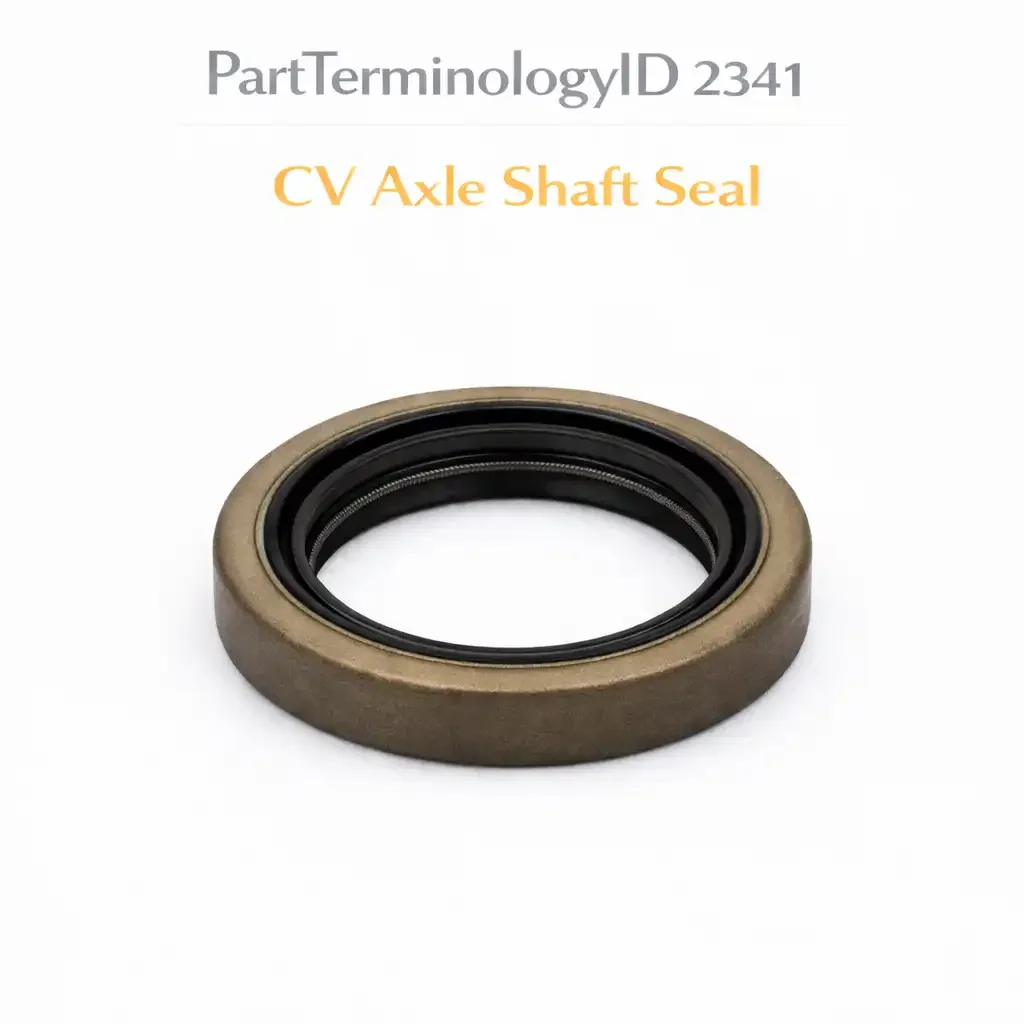
PartTerminologyID 2341, CV Axle Shaft Seal, is the rotary lip seal that prevents differential gear oil or automatic transmission fluid from escaping the differential housing or transaxle housing along the CV axle shaft at the point where the shaft exits the housing. That definition locates the seal at the housing exit point. It does not specify whether the seal is for the front differential, the rear differential, the transaxle, or the power transfer unit on an all-wheel-drive vehicle, what the shaft diameter is at the seal lip contact surface, what the housing bore diameter is, what the seal width is, what the lip material is, whether the seal is a single-lip or double-lip design, whether the seal has a dust exclusion lip, what the fluid it is sealing against is, whether the sealed fluid is gear oil or automatic transmission fluid, what the fluid compatibility requirement is for the lip material, what the shaft surface finish specification is at the lip contact zone, whether the seal is retained by press fit alone or by a retaining ring, or whether the seal is accessible for replacement with the halfshaft in place or requires halfshaft removal. A listing under PartTerminologyID 2341 that provides vehicle year, make, and model without the axle position, the shaft diameter, the bore diameter, the seal width, and the lip material cannot be evaluated by any technician who has the original seal in hand and is matching the replacement before beginning disassembly.
For sellers, the CV axle shaft seal is one of the highest-volume individual seal listings in the drivetrain category because it applies to every front-wheel-drive vehicle, every all-wheel-drive vehicle, and every rear-wheel-drive vehicle with independent rear suspension that uses CV halfshafts. The application population is broad and the failure rate is consistent: a seal that has been in service for 100,000 miles in the wet, contaminated environment of the wheel well will eventually harden, crack at the lip, or lose its spring-loaded contact force and allow the differential fluid to migrate along the shaft. The buyer population is correspondingly broad: it includes professional technicians doing transaxle service, do-it-yourself buyers replacing a leaking seal before a differential fluid change, and fleet operations servicing a large number of identical vehicles on a scheduled basis.
The breadth of the application population makes the specification attributes more important, not less, because the same vehicle platform may use different seal specifications at the left and right axle exits due to differential offset, or at the front and rear axles due to different differential housing designs, or at the inner and outer positions if the halfshaft has two differential-side connections. A listing that specifies the vehicle but not the axle position and shaft diameter will produce mismatches on every platform where those attributes vary within the same vehicle model.
The additional complication specific to this PartTerminologyID is the fluid compatibility requirement. On a front-wheel-drive transaxle, the CV axle shaft seal may be sealing against automatic transmission fluid rather than gear oil, because the inner CV joint on many transaxles is immersed in ATF from the main transmission circuit rather than in a separate differential gear oil. A seal with a lip material rated for gear oil but not for ATF, or rated for mineral-based ATF but not for synthetic ATF, will degrade in the fluid it is exposed to and fail prematurely. The listing must specify whether the seal is sealing against gear oil or ATF and what the fluid compatibility of the lip material is.
For sellers, the listing under this PartTerminologyID is only useful if it specifies the axle position, the shaft diameter, the housing bore diameter, the seal width, the lip material, the fluid type the seal contacts, and the fluid compatibility. Without those seven attributes, the listing cannot prevent the dimensional mismatch and the fluid incompatibility failures that are the two primary return drivers for this PartTerminologyID.
What the CV Axle Shaft Seal Does
Retaining differential fluid at the highest-exposure seal position in the drivetrain
The CV axle shaft seal is the outermost seal in the differential or transaxle fluid circuit. Every other seal in the differential assembly, the pinion seal, the carrier seals, and the differential cover gasket, is further inside the assembly and is protected from the external environment by the components outboard of them. The CV axle shaft seal has no such protection: it is at the outermost edge of the differential housing, directly exposed to road spray, mud, water, salt, and the centrifugal effects of the rotating shaft.
The seal lip contacts the rotating axle shaft at a controlled interference and is maintained in contact by a garter spring behind the primary lip. The shaft rotation at the seal contact zone creates a thin hydrodynamic film of differential fluid between the lip and the shaft, which lubricates the lip and prevents the dry contact that would wear the lip rapidly. This hydrodynamic film is the normal operating condition of a correctly installed rotary lip seal on a rotating shaft.
When the differential fluid level drops below the bottom of the seal contact zone, the hydrodynamic film is lost and the lip runs dry. Dry running destroys the seal lip surface within a short operating period and accelerates the seal failure that the low fluid level was warning about. A CV axle shaft seal that fails in the absence of visible external damage, with no cracking or extrusion visible on the lip, may have been destroyed by dry running from a differential that was already low on fluid from a different leak source. Replacing the seal without addressing the root cause of the low fluid level will produce a second seal failure on the same timeline.
The transaxle CV axle shaft seal and ATF compatibility
On front-wheel-drive vehicles with transaxles, the inner CV joint on each side exits the transaxle housing through the CV axle shaft seal. On most transaxle designs, the differential carrier is immersed in the same ATF circuit as the main transmission. The CV axle shaft seal on a transaxle is therefore sealing against ATF, not against gear oil, and the lip material must be compatible with the ATF formulation in the transaxle.
On all-wheel-drive vehicles with a separate rear differential, the rear CV axle shaft seals are sealing against the rear differential gear oil, which is typically a conventional GL-5 mineral or synthetic gear oil. The front CV axle shaft seals may be sealing against the front differential fluid, which on some all-wheel-drive platforms is the same ATF as the transaxle and on others is a separate transfer case fluid.
A listing under PartTerminologyID 2341 must specify which fluid the seal is designed to contact. A seal purchased for a transaxle application that is rated only for gear oil will degrade in ATF. A seal purchased for a rear differential application that is rated only for ATF will be exposed to a gear oil with a different chemical composition and different additive package, which may or may not degrade the lip material depending on the specific formulation.
Left versus right seal and the offset differential
On most front-wheel-drive transaxles, the differential carrier is not centered within the housing. The carrier is offset to one side to accommodate the transmission gear stack and the engine position in the engine bay. The result is that the left and right halfshafts have different lengths to reach their respective wheel hubs from the offset differential. The shaft diameter at the differential exit point may also differ between left and right if the longer shaft uses an intermediate shaft with a support bearing, which changes the shaft diameter at the transaxle seal exit on that side.
On transaxles where the right halfshaft uses an intermediate shaft, the seal on the right side of the transaxle seals against the intermediate shaft rather than the halfshaft directly. The intermediate shaft is typically a different diameter from the halfshaft, and the right seal has a different inner diameter from the left seal. A listing that does not specify left versus right and does not state the shaft diameter cannot be verified against the correct side of the transaxle.
The listing must specify the axle position as left, right, or both where both sides use an identical seal, and must state the shaft diameter for each position where they differ.
Seal retention: press fit versus retaining ring
Most CV axle shaft seals are retained in the housing bore by press fit interference alone. The seal outer diameter is slightly larger than the housing bore, and the press fit holds the seal stationary against the rotation of the shaft. On some differential designs, particularly on heavier-duty rear differentials, the seal is retained by a combination of press fit and a retaining ring or a bearing plate that bolts over the seal and prevents it from walking out of the bore under the axial force of the shaft movement.
A replacement seal must have the same retention configuration as the original. A press-fit-only seal installed in a bore designed for a retaining ring may walk out of the bore under the axial forces from the CV joint plunge motion of the inner joint. The listing must specify the retention method and whether the retaining ring is included.
The exclusion lip and its importance at the wheel-end environment
The CV axle shaft seal operates in the most contaminated environment of any seal in the drivetrain. The wheel well exposes the seal to road spray, standing water, mud, salt, brake dust, and tire debris. An exclusion lip outboard of the primary sealing lip prevents this contamination from reaching the primary lip and the differential housing bore.
On passenger vehicle transaxles operated in normal road conditions, a single-lip seal with no exclusion lip is typical OE specification because the shaft speed and the housing geometry provide some natural protection from water ingress at the primary lip. On vehicles operated in severe conditions, including regular off-road use, frequent water crossings, or operation in heavy salt environments, a double-lip seal with a dedicated exclusion lip provides significantly better protection against contamination-accelerated lip wear.
The listing must specify the lip count and whether an exclusion lip is present.
The Specifications That Determine Correct Seal Fitment
Axle position
Left front, right front, left rear, right rear. On platforms where the left and right seals are identical, state both sides. On platforms where they differ due to differential offset and intermediate shaft design, state each side separately with its own shaft diameter.
Shaft diameter
The shaft diameter at the seal lip contact zone. This is the most critical dimensional attribute. A seal with an inner diameter that is too large will not achieve the required lip contact interference and will leak immediately. A seal with an inner diameter that is too small will overstress the lip and accelerate wear at the contact zone. State the shaft diameter in millimeters to two decimal places.
Housing bore diameter
The bore diameter determines the seal outer diameter with the correct press fit interference. State in millimeters to two decimal places. An undersized outer diameter spins in the bore. An oversized outer diameter will not press in without damaging the seal body.
Seal width
The seal width must fit within the bore depth. State in millimeters. A seal wider than the bore depth protrudes from the housing face and prevents the halfshaft snap ring from engaging its groove on some designs, or prevents the bearing retainer plate from seating on others.
Lip material and fluid compatibility
Nitrile (NBR) for conventional gear oil and most mineral-based ATF formulations. HNBR for high-temperature applications and some synthetic gear oils. Polyacrylate (ACM) for synthetic gear oil and synthetic ATF formulations including Dexron-VI and equivalent. PTFE-coated lip for applications where the shaft surface finish does not meet the standard lip contact requirement.
Fluid type
Gear oil (specify API GL rating and mineral or synthetic) or automatic transmission fluid (specify Dexron generation or manufacturer specification). This is a mandatory attribute because it determines the lip material requirement independently of the application type.
Single-lip or double-lip with exclusion lip
State the lip configuration and note the operating environment where each is appropriate.
Shaft surface finish requirement
The Ra surface finish specification at the lip contact zone. Typically Ra 0.2 to 0.4 micrometers for a standard lip seal. Note whether a PTFE lip seal is available for worn shaft surfaces that cannot be reconditioned to the standard finish.
Why This Part Generates Returns
Buyers order the wrong CV axle shaft seal because:
the axle position is not specified and the buyer receives the right-side seal for a left-side application where the shaft diameter differs due to the intermediate shaft
the shaft diameter is not stated and the replacement seal inner diameter does not achieve the correct lip contact interference
the bore diameter is not stated and the replacement outer diameter is undersized, allowing the seal to spin in the bore under shaft rotation
the fluid type is not specified and a gear-oil-rated seal is installed in a transaxle where the seal contacts ATF, degrading the lip material
the ATF generation is not specified and a Dexron-III rated seal is installed in a transaxle using Dexron-VI synthetic, accelerating lip hardening
the seal width is not stated and the replacement is wider than the bore depth, preventing the halfshaft snap ring from engaging its retention groove
the shaft surface is scored and the new seal leaks immediately because the lip cannot bridge the groove worn by the old seal
Status in New Databases
PIES/PCdb: PartTerminologyID 2341, CV Axle Shaft Seal
PIES 8.0 / PCdb 2.0: No change
Top Return Scenarios
Scenario 1: "Left and right seals specified as identical, right side uses intermediate shaft with different diameter, seal leaks immediately"
The listing specified the same seal for both left and right sides. The right side of the transaxle uses an intermediate shaft that has a larger diameter than the left halfshaft at the seal exit point. The replacement seal installed on the right side has a smaller inner diameter than the intermediate shaft, preventing full installation. The seal lip is overstressed and torn during installation.
Prevention language: "Left side shaft diameter: [X]mm. Right side shaft diameter: [X]mm. This transaxle uses an intermediate shaft on the right side with a different diameter from the left halfshaft. The left and right CV axle shaft seals are different sizes. Verify the axle side and shaft diameter before ordering. Do not interchange left and right seals on this application."
Scenario 2: "Gear oil rated nitrile seal installed in transaxle, ATF contact, lip hardened within 8,000 miles"
The listing did not specify the fluid type the seal contacts. The buyer assumed a drivetrain seal is rated for gear oil. The transaxle uses ATF in the differential cavity and the CV axle shaft seal contacts ATF continuously. The nitrile lip absorbed the ATF additive package and hardened within 8,000 miles. The hardened lip lost contact interference with the shaft and the seal leaked ATF along the shaft.
Prevention language: "Fluid type at seal contact: [automatic transmission fluid / gear oil]. Lip material: [nitrile / HNBR / polyacrylate]. ATF compatibility: [Dexron-III compatible / Dexron-VI synthetic compatible]. This seal contacts ATF in the transaxle differential cavity, not gear oil. Verify the lip material is rated for the ATF formulation in your transaxle. A lip material rated only for gear oil will degrade in ATF."
Scenario 3: "Seal outer diameter undersized, seal rotates with shaft, differential empties overnight"
The housing bore diameter was not stated in the listing. The replacement seal outer diameter is 0.8mm smaller than the housing bore. The press fit is insufficient to hold the seal stationary against the friction from the rotating shaft lip contact. The seal rotates within the bore and the seal-to-bore interface becomes a leak path. The differential empties overnight through the rotating seal outer diameter gap.
Prevention language: "Housing bore diameter: [X.XX]mm. Seal outer diameter: [X.XX]mm. Press fit interference: [X.XX]mm. Verify the housing bore diameter before ordering. An undersized seal outer diameter will produce insufficient press fit to hold the seal stationary during shaft rotation. The seal-to-bore interface will become a leak path as significant as the seal lip itself."
Scenario 4: "Seal too wide, halfshaft snap ring groove blocked, halfshaft pulled out under vehicle load"
The replacement seal is 3mm wider than the original. The seal protrudes 3mm from the housing bore face. The halfshaft snap ring, which retains the inner CV joint in the differential, cannot reach its groove in the differential side gear splines because the protruding seal blocks the snap ring's travel. The halfshaft appeared installed but was not retained. Under vehicle load, the halfshaft pulled out of the differential.
Prevention language: "Seal width: [X]mm. Maximum installed seal width for this application: [X]mm. A seal wider than the maximum will protrude from the housing bore face and may block the halfshaft snap ring from reaching its retention groove in the differential. Verify the seal width before installation and confirm the halfshaft snap ring engages with a positive click after the seal is installed."
Scenario 5: "Scored shaft surface, new seal leaks immediately at the shaft groove"
The original seal failed from a hardened lip and the lip contact zone on the shaft is grooved from the worn lip. A new seal is installed on the grooved shaft. The groove depth is 0.15mm, which exceeds the seal lip's ability to conform to the surface. The seal leaks immediately along the groove.
Prevention language: "Shaft surface finish requirement: Ra 0.2 to 0.4 micrometers at the seal lip contact zone. Inspect the shaft surface before installing the new seal. A grooved shaft surface from a failed seal will cause the new seal to leak immediately regardless of correct seal dimensions. Options for a grooved shaft: install a shaft repair sleeve over the contact zone to provide a new finished surface, or replace the halfshaft."
Scenario 6: "Dexron-III rated seal in Dexron-VI transaxle, lip degraded within 12,000 miles"
The listing stated ATF compatibility without specifying the Dexron generation. The buyer's transaxle uses Dexron-VI full synthetic. The replacement seal is rated for Dexron-III mineral-based ATF. The Dexron-VI synthetic chemistry degraded the lip elasticity within 12,000 miles. The seal did not crack visibly but lost lip contact force and began seeping ATF along the shaft.
Prevention language: "ATF compatibility: [Dexron-III mineral only / Dexron-VI synthetic compatible / all ATF formulations]. Verify the seal's ATF compatibility matches the specific Dexron generation in your transaxle. Dexron-VI is a full-synthetic formulation with a different chemical composition from Dexron-III. A seal rated only for Dexron-III will degrade in Dexron-VI at operating temperature."
Scenario 7: "New seal installed, differential still leaks, root cause was low fluid from pinion seal not the axle shaft seal"
The buyer diagnosed a wet differential housing as a CV axle shaft seal failure and replaced the seal. The seal was in fact serviceable. The differential fluid leak was from a failing pinion seal that had been seeping slowly for an extended period. The low fluid level caused the CV axle shaft seal to run dry and show wear marks that were mistaken for a failed seal. The new axle shaft seal did not stop the leak because the pinion seal is still failing.
Prevention language: "Diagnostic note: before replacing the CV axle shaft seal, confirm the leak originates at the axle shaft seal bore and not at another seal in the differential. Add fluorescent dye to the differential fluid, run the vehicle, and inspect with a UV light to trace the leak path to its source. A wet axle shaft seal area can be caused by a leaking pinion seal or differential cover gasket if the fluid level is low enough that the axle shaft seal runs dry and develops wear marks without being the primary leak source."
What to Include in the Listing
Core essentials
PartTerminologyID: 2341
component: CV Axle Shaft Seal
axle position: left front, right front, left rear, right rear, or specify which sides use identical seals (mandatory)
fluid type at seal contact: gear oil or ATF (mandatory)
fluid specification: API GL rating and mineral or synthetic for gear oil; Dexron generation or manufacturer specification for ATF (mandatory)
shaft diameter in mm to two decimal places (mandatory)
housing bore diameter in mm to two decimal places (mandatory)
seal width in mm (mandatory)
lip material: nitrile, HNBR, polyacrylate, or PTFE-coated (mandatory)
fluid compatibility: specify formulation compatibility explicitly (mandatory)
lip configuration: single-lip, double-lip with exclusion lip, or triple-lip (mandatory)
garter spring: present or springless (mandatory)
retention method: press fit only or press fit with retaining ring (mandatory)
retaining ring included: yes or no for retaining ring designs (mandatory)
shaft surface finish requirement in Ra micrometers (mandatory)
shaft repair sleeve available: yes or no (mandatory)
halfshaft removal required for seal replacement: yes or no (mandatory)
quantity: 1 or pair where both sides use identical seal
Fitment essentials
year/make/model/submodel
axle position (primary fitment attribute alongside shaft diameter)
drivetrain: FWD, RWD IRS, or AWD (mandatory to identify fluid type)
transmission model for transaxle applications when ATF specification varies by transmission
intermediate shaft present on one side: yes or no (mandatory for transaxle applications)
Dimensional essentials
shaft diameter in mm to two decimal places
seal inner diameter before installation in mm
housing bore diameter in mm
seal outer diameter in mm
seal width in mm
press fit interference in mm
lip contact band width in mm
garter spring inner diameter in mm
Image essentials
seal in isolation showing lip configuration with primary lip and exclusion lip visible
cross-section showing inner lip, garter spring, and exclusion lip for double-lip designs
shaft contact zone shown with surface finish callout and lip contact band location
installed context showing the seal pressed into the housing bore with the halfshaft in position
left and right seals shown side by side for transaxle applications where the two are different sizes
repair sleeve shown alongside seal for listings where a sleeve is available
Catalog Checklist for ACES/PIES Teams
PartTerminologyID = 2341
require axle position: left, right, or both with shaft diameter for each (mandatory)
require fluid type at seal contact: gear oil or ATF (mandatory)
require fluid specification: API GL grade and oil type, or ATF Dexron generation (mandatory)
require shaft diameter in mm (mandatory)
require housing bore diameter in mm (mandatory)
require seal width in mm (mandatory)
require lip material with fluid compatibility (mandatory)
require lip configuration: single or double with exclusion lip (mandatory)
require retention method and retaining ring inclusion status (mandatory)
require shaft surface finish specification (mandatory)
require halfshaft removal note (mandatory)
differentiate from differential pinion seal (PartTerminologyID varies): the pinion seal seals the pinion shaft where it exits the differential housing; the CV axle shaft seal seals each axle shaft at its exit point; both are at the differential housing but at different shaft positions with different shaft diameters and bore diameters
differentiate from differential cover gasket (PartTerminologyID 2306): the cover gasket is a static face seal at the removable cover; the CV axle shaft seal is a rotary lip seal at the rotating shaft exit; both contain differential fluid but from different interface types
differentiate from transmission tail shaft seal (PartTerminologyID varies): the tail shaft seal seals the propshaft slip yoke on a longitudinal drivetrain; the CV axle shaft seal seals the CV halfshaft on a transverse or independent suspension drivetrain; both are rotary lip seals at shaft exits but in different drivetrain positions
differentiate from axle shaft seal (PartTerminologyID varies): some catalogs distinguish between the CV axle shaft seal for CV halfshaft applications and the axle shaft seal for solid axle applications; verify the application type before listing under 2341
flag fluid type as mandatory: ATF versus gear oil is the most consequential fluid compatibility error for this PartTerminologyID and the one that produces the most delayed and least obvious failure
flag axle position with shaft diameter as mandatory: left and right seals differ on offset transaxle designs due to intermediate shaft; a listing that treats both sides as identical on these applications will produce a mismatch on the intermediate shaft side
flag shaft surface finish as mandatory: a grooved shaft from a failed seal is the most common reason a new seal leaks immediately; the listing must alert the buyer to inspect and address the shaft condition before installation
flag Dexron generation as mandatory for ATF applications: Dexron-III and Dexron-VI are not equivalent fluid chemistries; a seal rated for one generation may fail prematurely in the other
FAQ (Buyer Language)
How do I confirm which side of the transaxle uses a larger seal due to an intermediate shaft?
The intermediate shaft on a front-wheel-drive transaxle is the longer shaft that runs from the transaxle to a bearing support bracket on the engine block, and then continues from the bracket to the inner CV joint. It is always on the side of the transaxle that is farther from the engine's centerline, which is usually the right side on most domestic front-wheel-drive transverse engines. The intermediate shaft exits the transaxle at a different diameter from the shorter left halfshaft. If you are unsure which side uses the intermediate shaft, remove both inner CV joints from the transaxle and compare the diameter of the shaft stub at each exit point. The larger diameter is the intermediate shaft side and requires the larger seal.
My differential is leaking but I cannot tell if it is the axle shaft seal or the pinion seal. How do I diagnose?
Add fluorescent dye to the differential fluid, run the vehicle for several heat cycles, and inspect with a UV light. The dye will reveal the precise origin of the leak. An axle shaft seal leak will show dye originating at the shaft exit bore on the side of the housing. A pinion seal leak will show dye at the pinion shaft bore at the front or rear of the housing. If both seals are leaking, both will show dye at their respective locations. Diagnosing without dye by looking at where the fluid drips is unreliable because fluid from a pinion seal or a cover gasket can run to the axle shaft area and appear to originate from the axle shaft seal.
Can I replace the CV axle shaft seal without removing the halfshaft from the vehicle?
On most applications, no. The halfshaft inner CV joint must be withdrawn from the differential housing to expose the seal bore and allow the old seal to be driven out and the new seal to be pressed in. On some designs with a split seal housing or a side cover, the seal can be replaced without full halfshaft removal, but those are uncommon. Verify the service procedure for your specific application before beginning. On transaxle applications, halfshaft removal typically requires disconnecting the lower ball joint or the strut from the knuckle to provide enough room to withdraw the inner CV joint from the transaxle.
The differential fluid level is correct but my new axle shaft seal is already showing a wet ring around the shaft. Is the seal defective?
A wet ring at the shaft immediately after installation is not necessarily a failed seal. During the first heat cycle, the seal lip contacts the shaft at a slightly higher interference than the operating condition because the lip material has not yet conformed to the shaft surface. Some initial seepage of a thin fluid film at the lip is normal on some seal designs as the lip breaks in during the first few hours of operation. If the wet ring does not progress to an active drip or a growing fluid accumulation after the first few hundred miles of operation, the seal is functioning correctly. If the seepage grows or progresses to a drip, inspect the shaft surface at the lip contact zone for scoring and verify the seal dimensions against the shaft and bore specifications.
My differential has a magnetic drain plug and the collected debris looks abnormal. Should I replace the seals at the same time as investigating the debris?
Yes. Abnormal debris on the magnetic drain plug indicates accelerated wear of the differential's internal components, typically from a fluid level that has been chronically low from a slow seal leak. When the internal wear debris is abnormal, all seals in the differential should be replaced at the same service event because the low fluid level that caused the debris also caused accelerated wear of the seal lips. Replacing only the actively leaking seal and refilling the differential will not restore the worn seal lips on the other seals, which will produce additional leaks as those seals fail in sequence from the same root cause of low fluid.
What is the correct installation depth for the CV axle shaft seal in the housing bore?
The seal should be installed flush with or slightly below the housing bore face. On most applications, the seal is driven in until the outer face is recessed 0 to 2mm below the bore face. Installing the seal proud of the bore face will allow the halfshaft snap ring or the bearing retainer to contact the seal face rather than seating against the housing, which can dislodge the seal under halfshaft axial movement. Use a seal driver of the correct outer diameter that contacts only the outer rim of the seal to avoid distorting the seal body during installation.
Cross-Sell Logic
Differential Pinion Seal (PartTerminologyID varies: the pinion seal is the other primary seal in the differential housing; both seals are inspected and replaced at the same service event when the differential is opened or when a fluid leak is being diagnosed)
Differential Cover Gasket (PartTerminologyID 2306: the cover gasket is replaced whenever the differential cover is removed for fluid service at the same event as seal inspection)
Differential Fluid (the correct gear oil or ATF is required whenever the halfshaft is removed and the differential is opened; have the correct specification and quantity before beginning)
Halfshaft Assembly (PartTerminologyID varies: if the halfshaft CV joints or shaft are worn, the complete halfshaft assembly is replaced at the same service event as the seal)
Shaft Repair Sleeve (if the shaft contact zone is grooved, a repair sleeve is required before the new seal can function; source before beginning the installation)
CV Joint Boot Kit (PartTerminologyID 2284: the inner CV joint boot is inspected when the halfshaft is removed; replace if cracked or leaking at the same removal event)
Frame as "the CV axle shaft seal retains the differential fluid at the shaft exit. The differential fluid lubricates the ring and pinion and carrier that the seal protects. The pinion seal retains fluid at the pinion shaft on the other side of the same housing. The halfshaft passes through the seal to connect the differential to the wheel. All are inspected and relevant ones replaced at the same halfshaft removal event."
Final Take for PartTerminologyID 2341
CV Axle Shaft Seal (PartTerminologyID 2341) is one of the highest-volume individual seal listings in the drivetrain category and one where the breadth of the application population makes the specification attributes more critical rather than less. The same vehicle platform may use different seal sizes at the left and right sides due to differential offset and intermediate shaft design. The same seal bore may be sealing against gear oil or ATF depending on whether the differential shares fluid with the transaxle. The same lip material may be appropriate for one fluid specification and inappropriate for the fluid specification of the adjacent model year.
The axle position and shaft diameter resolve the dimensional fitment. The fluid type and fluid specification resolve the lip material requirement. The lip material resolves the seal's service life in the specific fluid chemistry it contacts daily. The seal width resolves whether the halfshaft retention snap ring can engage after installation. The shaft surface finish requirement resolves whether the installation will succeed or whether a grooved shaft will defeat the new seal immediately.
State the axle position. State the shaft diameter and bore diameter. State the fluid type and fluid specification. State the lip material with explicit fluid compatibility. State the seal width. State the lip configuration. State the shaft surface finish requirement. State whether halfshaft removal is required. That is the same listing strategy as every other PartTerminologyID in this series: the generic PartTerminologyID requires specific attributes at every level to become a listing buyers can act on without guessing. For PartTerminologyID 2341, the fluid type is the attribute that determines whether the seal survives its service life or degrades in the fluid it was never designed to contact, and a listing without it sends that failure to every buyer who assumes a drivetrain seal is a drivetrain seal.