
Written by Arthur Simitian | PartsAdvisory
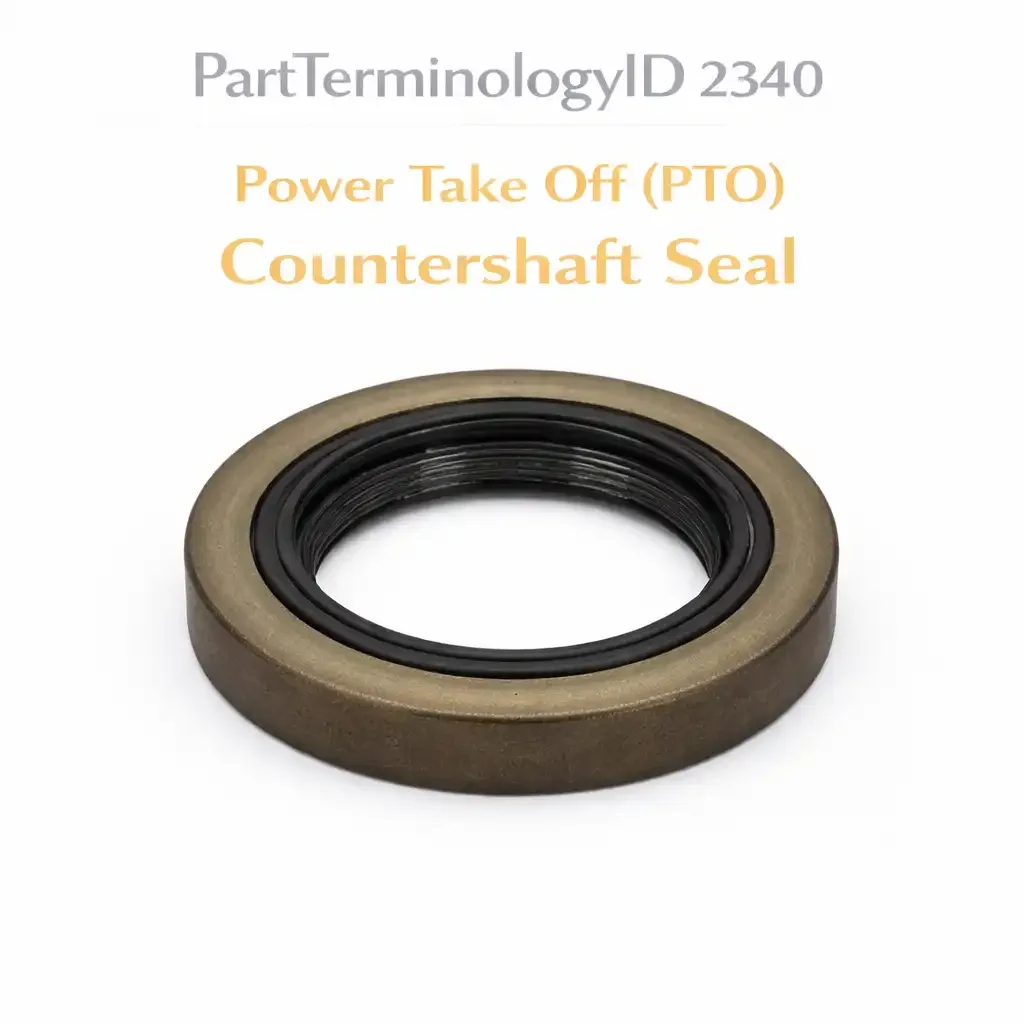
PartTerminologyID 2340, Power Take Off (PTO) Countershaft Seal, is a rotary lip seal that prevents gear oil from escaping the PTO housing along the countershaft at the point where the shaft passes through the housing bore. That definition locates the seal correctly. It does not specify the PTO unit manufacturer and model designation, the shaft diameter at the seal contact surface, the housing bore diameter, the seal width, the lip material, whether the seal is a single-lip or double-lip design, what the exclusion lip configuration is, whether the seal is spring-loaded at the primary lip, what the shaft surface finish requirement is at the seal lip contact zone, what gear oil formulation the lip material is rated for, or whether the countershaft seal is accessible for replacement with the PTO unit on the transmission or requires PTO removal. A listing under PartTerminologyID 2340 that provides vehicle or PTO fitment without the PTO unit designation, the shaft diameter, the bore diameter, the seal width, and the lip material cannot be evaluated by any technician who has the failed seal in hand and needs to confirm the replacement before the PTO is disassembled.
For sellers, the PTO countershaft seal is a component that sits at the boundary between two service categories. It is a seal, which means it belongs to the sealing hardware category. But it is a seal inside a PTO unit, which means the buyer is a commercial vehicle technician, a fleet maintenance professional, or a PTO rebuilder who is servicing a commercial-duty power take off, not a passenger car do-it-yourself buyer. That buyer knows the PTO model designation, knows the shaft diameter, and expects the listing to confirm the seal specification at the same level of technical specificity they bring to the search.
The additional consideration specific to this PartTerminologyID is that the countershaft in a PTO unit is not a single defined shaft position: as established in the PTO countershaft bearing post (PartTerminologyID 2236), the countershaft is the intermediate shaft within the PTO unit that carries the torque from the input gear to the output shaft. The countershaft may pass through the PTO housing at one or both ends, and the seal at each end may have a different shaft diameter, a different bore diameter, and a different lip specification. A listing that does not specify which end of the countershaft the seal is for cannot be evaluated by a technician who knows one end seal has failed and the other has not.
For sellers, the listing under this PartTerminologyID is only useful if it specifies the PTO unit designation, the transmission model, the shaft diameter, the housing bore diameter, the seal width, the lip material, the lip configuration, and the countershaft end the seal covers. Without those eight attributes, the listing cannot serve the technically specific buyer population of this PartTerminologyID.
What the PTO Countershaft Seal Does
Preventing gear oil migration along the countershaft bore
The PTO countershaft rotates continuously when the PTO is engaged and may rotate at a reduced speed when the PTO is in neutral position on some designs. The shaft passes through the PTO housing wall at one or both ends of the countershaft bore, and at each passage point, a rotary lip seal prevents the gear oil inside the housing from migrating along the shaft surface to the exterior.
The primary sealing lip contacts the rotating shaft surface at a controlled interference. The spring behind the primary lip, a garter spring on most designs, maintains this interference contact force as the lip wears over its service life. The spring ensures the lip maintains sealing contact as the lip material compresses and wears, extending the service life of the seal beyond what an unsupported lip could achieve.
A failed countershaft seal allows gear oil to escape along the shaft at the housing bore. The leak appears as a wet film or a dripping trace of gear oil at the seal exit point on the housing face. On a PTO mounted on the side of a transmission, this leak point is typically above or beside the transmission, and the escaping gear oil runs down the transmission housing and collects on the chassis or drips onto the ground. On vehicles in commercial service, a PTO gear oil leak has direct operational consequences: the PTO oil level drops, the countershaft bearing and gear lubrication is degraded, and if the leak is not addressed, the PTO may fail from bearing starvation before the next scheduled service.
Single-lip versus double-lip seal design
A single-lip seal has one primary sealing lip that contacts the shaft surface. The lip is oriented to seal against the gear oil pressure from the interior of the PTO housing. Single-lip seals are appropriate when the PTO exterior environment is relatively clean and the primary requirement is to retain the gear oil inside the housing.
A double-lip seal adds a secondary exclusion lip outboard of the primary lip. The exclusion lip faces outward and prevents road contamination, water, and abrasive grit from entering the PTO housing along the shaft from the exterior. Between the two lips is a small cavity that may be pre-packed with grease to lubricate both lips and to provide a buffer zone against both oil escape and contamination ingress.
PTO countershaft seals on commercial vehicles used in off-road, construction, or municipal applications should use double-lip designs because the operating environment presents significant contamination risk. A single-lip seal on a PTO that is regularly subjected to water crossing, mud, or high-pressure washing will allow contamination to enter the housing between services, degrading the gear oil and accelerating bearing wear. The listing must specify whether the seal is single-lip or double-lip and must note the application environments where each design is appropriate.
Lip material and gear oil compatibility
The seal lip material must be compatible with the gear oil formulation in the PTO unit. The three most common lip materials for PTO countershaft seals are nitrile rubber (NBR), hydrogenated nitrile (HNBR), and polyacrylate (ACM).
Nitrile rubber is the standard material for most conventional gear oil formulations including API GL-4 and GL-5 mineral-based oils. Nitrile has good resistance to the sulfur-phosphorus additives in conventional gear oils and maintains adequate flexibility across the temperature range of most commercial PTO applications.
Hydrogenated nitrile has superior resistance to high-temperature degradation compared to standard nitrile and is specified for PTOs that operate at elevated temperatures from high-duty-cycle applications. HNBR maintains its lip flexibility and contact force at temperatures that would cause standard nitrile to harden and lose sealing contact. A hardened nitrile lip loses its interference contact with the shaft and leaks without any visible cracking or damage to the lip surface.
Polyacrylate is used in PTOs that are specified to use synthetic gear oils. Some modern PTO designs specify a full-synthetic GL-5 gear oil that degrades nitrile and HNBR at elevated temperatures. Polyacrylate maintains its properties in synthetic gear oil at the temperatures these applications reach.
The listing must specify the lip material and the gear oil compatibility. A seal ordered without confirming lip material compatibility with the gear oil specification will fail prematurely regardless of how correctly all dimensional attributes match.
The shaft surface finish requirement at the lip contact zone
The seal lip contacts the shaft at a precise contact band on the shaft surface. The shaft surface at this contact band must meet a minimum surface finish specification for the seal to function correctly. A surface that is too rough wears the lip rapidly at the contact band. A surface that is too smooth may not provide adequate hydrodynamic lubrication at the lip contact zone, which can cause the lip to run dry and to stick-slip rather than slide smoothly.
The typical shaft surface finish requirement for a rotary lip seal contact zone is Ra 0.2 to 0.4 micrometers, achieved by grinding or by high-quality turning. If the countershaft at the seal contact zone has been scored, grooved, or worn to an undersize diameter by a failed seal, the shaft must be reconditioned or replaced before installing the new seal. A new seal on a damaged shaft surface will leak immediately because the lip cannot bridge the surface irregularities at the contact band.
Some replacement seals are available with a shaft repair sleeve that presses over the damaged shaft at the seal contact zone and provides a new, correctly finished surface for the seal lip. The listing should note whether a repair sleeve is available for the application and what the sleeve outer diameter is.
The Specifications That Determine Correct Seal Fitment
PTO unit designation and transmission model
The primary fitment attributes. The countershaft seal dimensions are specific to the PTO model, and the transmission model confirms the PTO application. The same shaft diameter may appear across multiple PTO models with different housing bore diameters, making both attributes necessary for a complete specification.
Shaft diameter
The shaft diameter is the inner diameter of the seal lip at the designed contact interference. The seal inner diameter before installation is slightly smaller than the shaft diameter to produce the interference fit that creates the sealing contact force. State the shaft diameter in millimeters and confirm the seal is designed for this specific shaft size.
Housing bore diameter
The housing bore outer diameter determines the seal outer diameter with the correct press fit interference. A seal outer diameter that is too small will spin in the bore rather than press in. A seal outer diameter that is too large will not press into the bore without damaging the seal body.
Seal width
The seal width must fit within the available bore depth in the housing. A seal wider than the bore depth will protrude from the housing face and prevent the mating component from seating against the housing. A seal that is narrower than the bore depth may not be retained correctly if the bore has no shoulder stop.
Lip material and gear oil compatibility
As described above. State the lip material and the gear oil specifications the material is rated for: API GL-4 only, GL-5 mineral, GL-5 synthetic, or all formulations.
Lip configuration
Single-lip or double-lip. For double-lip designs, state whether the inter-lip cavity is pre-greased or requires field lubrication before installation.
Countershaft end position
State whether the seal is for the input-side housing wall, the output-side housing wall, or another position if the countershaft passes through additional housing bores.
Why This Part Generates Returns
Buyers order the wrong PTO countershaft seal because:
the PTO unit designation is not specified and the housing bore diameter does not match the seal outer diameter
the shaft diameter is not stated and the seal inner diameter is too large or too small for the countershaft journal
the seal width is not stated and the replacement is wider than the bore depth, preventing the adjacent component from seating
the lip material is not specified and the seal is installed in a PTO unit using a synthetic gear oil that degrades the lip material
the single versus double-lip configuration is not stated and a single-lip seal is installed in an application with high contamination exposure
the countershaft end position is not stated and the buyer receives the output-side seal when the input-side seal has failed, with different dimensions between the two ends
Status in New Databases
PIES/PCdb: PartTerminologyID 2340, Power Take Off (PTO) Countershaft Seal
PIES 8.0 / PCdb 2.0: No change
Top Return Scenarios
Scenario 1: "Seal outer diameter undersized, seal spins in housing bore under shaft rotation"
The PTO unit designation was not specified in the listing. The buyer's housing bore is 52mm. The replacement seal outer diameter is 50mm. The 2mm gap between the seal outer diameter and the bore produces insufficient press fit interference. When the countershaft rotates, the friction between the shaft and the seal lip rotates the seal body within the bore rather than holding the seal stationary. Gear oil escapes through the rotating seal-to-bore interface.
Prevention language: "Housing bore diameter: [X]mm. Seal outer diameter: [X]mm. Press fit interference: [X]mm. Verify your housing bore diameter matches before ordering. A seal outer diameter that is undersized for the housing bore will not achieve the press fit required to hold the seal stationary during shaft rotation."
Scenario 2: "Nitrile lip, synthetic GL-5 gear oil, lip hardened within 6 months"
The listing did not specify the lip material or gear oil compatibility. The PTO unit is specified for synthetic GL-5 gear oil. The replacement seal uses a standard nitrile lip. The synthetic oil at operating temperature degraded the nitrile lip elasticity within 6 months. The hardened lip lost its contact interference with the shaft and began leaking without any visible cracking.
Prevention language: "Lip material: [nitrile / HNBR / polyacrylate]. Gear oil compatibility: [API GL-4 and GL-5 mineral / GL-5 synthetic compatible]. Verify the lip material is rated for your PTO unit's specified gear oil. Standard nitrile lips are not rated for synthetic GL-5 gear oils at elevated operating temperatures. Use a polyacrylate or HNBR lip seal for PTOs specified for synthetic gear oil."
Scenario 3: "Single-lip seal installed in municipal truck PTO, water ingress contaminated gear oil within 2,000 miles"
The listing specified a single-lip seal without noting the contamination environment limitation. The PTO is mounted on a municipal water truck that regularly operates in wet conditions and is washed with a pressure washer weekly. The single-lip seal allowed water to enter the housing from the exterior. The gear oil emulsified within 2,000 miles and the countershaft bearings sustained corrosion damage.
Prevention language: "Seal lip configuration: [single-lip / double-lip with exclusion lip]. Application note: single-lip seals are appropriate for clean operating environments. Applications involving water exposure, mud, pressure washing, or off-road use require a double-lip seal with an exclusion lip to prevent contamination ingress from the exterior. For municipal, construction, or agricultural PTO applications, specify the double-lip design."
Scenario 4: "Seal wider than bore depth, PTO cover will not seat against housing"
The replacement seal is 4mm wider than the original. The countershaft bore in the PTO housing is machined to exactly the original seal width with no additional depth. The wider seal protrudes 4mm from the housing face. The PTO cover cannot seat against the housing face with the protruding seal in position.
Prevention language: "Seal width: [X]mm. Housing bore depth: [X]mm. Verify the seal width does not exceed the bore depth before installation. A seal wider than the bore depth will protrude from the housing face and prevent the cover or adjacent component from seating correctly against the housing."
Scenario 5: "Output-side seal received, input-side seal failed, shaft diameters different between ends"
The listing did not specify the countershaft end position. The buyer needed the input-side seal where the countershaft is smaller in diameter because it has not yet stepped up to the output gear engagement diameter. The replacement seal arrived with the larger inner diameter of the output-side seal. The smaller-diameter input-side shaft does not achieve the required contact interference with the output-side seal inner diameter.
Prevention language: "Countershaft seal position: [input-side housing wall / output-side housing wall]. Shaft diameter at this position: [X]mm. This PTO model uses different shaft diameters at the input and output ends of the countershaft. The input-side and output-side seals have different inner diameters and are not interchangeable. Specify the seal position when ordering."
What to Include in the Listing
Core essentials
PartTerminologyID: 2340
component: PTO Countershaft Seal
PTO unit manufacturer and model designation (mandatory)
compatible transmission model (mandatory)
countershaft end position: input-side or output-side (mandatory)
shaft diameter in mm (mandatory)
housing bore diameter in mm (mandatory)
seal width in mm (mandatory)
lip material: nitrile, HNBR, or polyacrylate (mandatory)
gear oil compatibility: GL-4 and GL-5 mineral, GL-5 synthetic, or all (mandatory)
lip configuration: single-lip or double-lip (mandatory)
inter-lip cavity pre-greased: yes or no for double-lip designs (mandatory)
spring type: garter spring or springless (mandatory)
shaft surface finish requirement in Ra micrometers (mandatory)
shaft repair sleeve availability: yes or no (mandatory)
quantity: 1
Fitment essentials
PTO unit manufacturer and model designation (primary fitment attribute)
compatible transmission model
countershaft position in PTO torque path
PTO application environment: clean, wet, off-road, or pressure wash for lip configuration selection
Dimensional essentials
shaft diameter in mm
seal inner diameter before installation in mm
housing bore diameter in mm
seal outer diameter in mm
seal width in mm
press fit interference in mm
lip contact band width in mm
garter spring inner diameter in mm
Image essentials
seal in isolation showing lip configuration with single or double-lip visible
cross-section showing inner lip, spring, and exclusion lip for double-lip designs
shaft contact zone shown with surface finish callout
installed context showing the seal pressed into the housing bore with the shaft in position
repair sleeve shown alongside seal for listings where a repair sleeve is available
Catalog Checklist for ACES/PIES Teams
PartTerminologyID = 2340
require PTO unit designation (mandatory)
require compatible transmission model (mandatory)
require countershaft end position (mandatory)
require shaft diameter in mm (mandatory)
require housing bore diameter in mm (mandatory)
require seal width in mm (mandatory)
require lip material with gear oil compatibility (mandatory)
require lip configuration: single-lip or double-lip (mandatory)
require shaft surface finish specification (mandatory)
differentiate from PTO input shaft seal (PartTerminologyID varies): the input shaft seal is at the point where the PTO input shaft exits the PTO housing toward the transmission; the countershaft seal is at the countershaft bore within the PTO housing; both are rotary lip seals in the PTO but at different shaft positions with different dimensions
differentiate from PTO output shaft seal (PartTerminologyID varies): the output shaft seal seals the PTO output shaft where it exits the housing to connect to the driven equipment; the countershaft seal seals the intermediate countershaft within the housing; the output shaft typically has a larger diameter and a higher-capacity seal than the countershaft
differentiate from PTO gasket (PartTerminologyID 2324): the PTO gasket is a static face seal at the transmission-to-PTO housing interface; the countershaft seal is a rotary lip seal at a rotating shaft exit point within the PTO housing; both prevent gear oil leakage but from different interface types
differentiate from PTO countershaft bearing (PartTerminologyID 2236): the countershaft bearing supports the shaft radially; the countershaft seal prevents oil escape along the shaft at the housing bore; both are at the countershaft position but serve different functions
flag PTO unit designation as primary fitment attribute: countershaft dimensions are PTO-model-specific and vehicle fitment alone does not resolve them
flag countershaft end position as mandatory: input-side and output-side shaft diameters differ on many PTO models; a seal for the wrong end will not achieve the correct contact interference
flag lip material as mandatory: synthetic gear oil incompatibility with nitrile produces a hardened lip that shows no visible damage but loses sealing contact at operating temperature
flag double-lip requirement for contaminated environments as mandatory: commercial PTO applications in municipal, construction, or agricultural environments require the exclusion lip that single-lip seals do not provide
FAQ (Buyer Language)
How do I confirm my countershaft diameter without full PTO disassembly?
On most PTO designs, the countershaft end is accessible from the exterior of the housing after removing the PTO side cover or the bearing retainer plate. With the cover removed, the countershaft end and the seal bore are visible and accessible for measurement. Use an outside micrometer to measure the shaft diameter at the seal contact zone. Measure at two or three points along the contact band to check for taper or wear. Use an inside micrometer or a telescoping gauge to measure the housing bore diameter. Both measurements can typically be taken without removing the countershaft from the housing.
My countershaft seal leaked and the shaft surface is scored at the lip contact zone. Do I need a new countershaft?
A scored shaft surface at the seal contact zone must be addressed before installing a new seal. A shaft with a groove worn by the seal lip will allow the new seal to leak immediately because the groove provides a fluid path past the lip contact band. Options depend on the depth of the scoring. Light scoring less than 0.05mm deep can sometimes be polished to within the acceptable surface finish specification. Deeper scoring requires a shaft repair sleeve pressed over the contact zone, which provides a new finished surface at the correct outer diameter. A repair sleeve is preferred over shaft replacement when the countershaft is otherwise serviceable and the sleeve is available for the application. Full shaft replacement is required when the scoring is severe enough that a sleeve would reduce the shaft diameter below the bearing inner race minimum.
What is the correct installation procedure for a PTO countershaft seal?
Clean the housing bore thoroughly and remove any remnants of the old seal. Lightly lubricate the seal outer diameter with the same gear oil used in the PTO unit. Do not use grease on the outer diameter as it may prevent the press fit from seating correctly. Lubricate the seal inner lip with clean gear oil before installation. Press the seal squarely into the bore using a seal driver of the correct outer diameter that contacts only the outer edge of the seal face. Do not drive the seal with a hammer directly on the seal face. Press to the correct depth so the seal face is flush with or slightly below the housing bore face. Verify the seal is square in the bore before the PTO cover or adjacent component is installed.
Can I replace the countershaft seal with the PTO unit on the transmission?
On some PTO designs, yes. If the countershaft end and the seal bore are accessible after removing a side cover or bearing retainer, the seal can be replaced without removing the PTO from the transmission. The countershaft must be stationary during seal installation, which requires that the PTO is disengaged and the transmission output is stopped. On PTO designs where the countershaft bore is accessible only from inside the housing, full PTO removal and partial disassembly are required. Verify the service manual procedure for the specific PTO model before beginning.
My PTO uses a synthetic gear oil. Which seal lip material should I specify?
For PTOs specified for synthetic GL-5 gear oil, specify a polyacrylate (ACM) lip seal. Polyacrylate maintains its elasticity and contact force in synthetic GL-5 formulations at the elevated operating temperatures that synthetic-specified PTOs typically reach. HNBR is an acceptable alternative for synthetic GL-5 applications at moderate temperatures. Standard nitrile should not be used in synthetic GL-5 applications because the synthetic base oil and additive package degrade nitrile at operating temperature, causing the lip to harden and lose sealing contact before the end of the expected service interval.
Cross-Sell Logic
PTO Countershaft Bearing (PartTerminologyID 2236: the countershaft bearing is adjacent to the countershaft seal; a failed seal that allowed gear oil loss may have starved the adjacent bearing of lubrication; inspect the bearing for roughness or discoloration when replacing the seal)
PTO Gasket Set (PartTerminologyID varies: the complete PTO gasket set covers the transmission mounting gasket and all housing cover gaskets; if the PTO is being opened for seal replacement, the gaskets are replaced at the same service event)
PTO Gear Oil (the gear oil is drained and replaced whenever the PTO is opened; verify the correct API rating and viscosity before refilling)
Shaft Repair Sleeve (if the countershaft contact zone is scored, a repair sleeve must be installed before the new seal can function correctly)
PTO Output Shaft Seal (PartTerminologyID varies: the output shaft seal is inspected at the same service event as the countershaft seal; replace if it shows any weeping or hardening)
Frame as "the countershaft seal keeps the gear oil in at the shaft exit. The countershaft bearing keeps the shaft centered in the bore the seal seals. The gear oil lubricates the bearing and the gears the seal retains. The housing gaskets seal the covers that enclose the shaft and the seal. All are in the same service path when the PTO is opened for seal replacement."
Final Take for PartTerminologyID 2340
PTO Countershaft Seal (PartTerminologyID 2340) is a component where the buyer population, the failure consequence, and the specification requirements all reflect the commercial service context that distinguishes the PTO series from the passenger vehicle drivetrain series. A leaking countershaft seal on a commercial vehicle PTO is not a cosmetic issue or a slow-developing maintenance item: it is a gear oil loss that degrades the lubrication of every rotating component in the PTO housing and that in sustained commercial duty will produce a bearing failure before the next scheduled service.
The PTO unit designation and the countershaft end position resolve the shaft diameter and bore diameter that the seal must fit. The lip material and gear oil compatibility resolve whether the seal will survive the operating temperature and the fluid chemistry of the specific PTO application. The single-lip versus double-lip configuration resolves whether the seal will protect the housing from the contamination environment the PTO operates in. The shaft surface finish requirement resolves whether the shaft condition is appropriate for the new seal before installation.
State the PTO unit designation. State the countershaft end position. State the shaft diameter and bore diameter. State the seal width. State the lip material and gear oil compatibility. State the lip configuration. State the shaft surface finish requirement. That is the same listing strategy as every other PartTerminologyID in this series: the generic PartTerminologyID requires specific attributes at every level to become a listing the technically specific commercial vehicle technician can act on without guessing. For PartTerminologyID 2340, that technician knows the PTO model and the shaft that is leaking. The listing's job is to confirm the seal without ambiguity before the housing is opened.