
Written by Arthur Simitian | PartsAdvisory
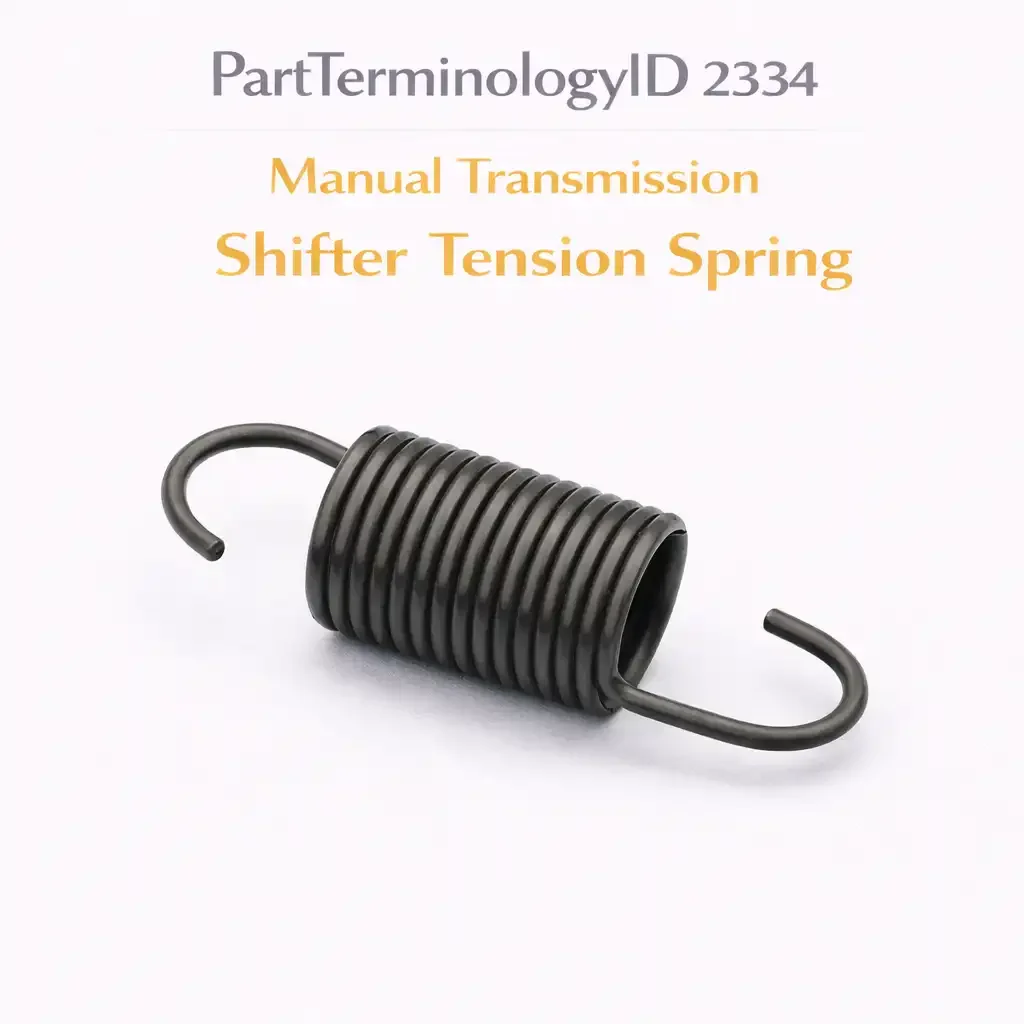
PartTerminologyID 2334, Manual Transmission Shifter Tension Spring, is the spring that returns the shift lever to the neutral centerline position after the driver completes a gear selection and releases the knob. That definition describes the function in one sentence. It does not specify the transmission model designation, the spring free length, the spring rate, the wire diameter, the coil outer diameter, the number of active coils, whether the spring is a compression spring, a tension spring, or a torsion spring, how the spring is retained in the shifter housing, what end hook or tang configuration is required, whether a single spring or a pair of springs is used at this position in the shifter assembly, or what the consequence of a spring that is too soft or too stiff is on shift feel and cross-gate resistance. A listing under PartTerminologyID 2334 that provides vehicle year, make, and model without the transmission model designation, the spring free length, the spring rate, and the end configuration cannot be evaluated by any buyer who has the failed spring in hand and is matching the replacement before ordering.
For sellers, the manual transmission shifter tension spring is a component where the diagnostic trigger is almost always the same: a shift lever that drifts out of the neutral gate toward one side when the driver releases the knob after completing a shift, or a lever that offers no resistance when pushed laterally in neutral, or a lever that falls into a gear gate under the weight of the driver's hand rather than returning to center. All three symptoms indicate a spring that has lost its preload, fractured, or displaced from its retention point. The buyer who has traced that symptom to the spring rather than to the pivot socket wear or the shift rail detent is a technically informed buyer who has already removed the console and inspected the shifter. They need the listing to confirm the replacement spring matches the original in rate and geometry.
The consequence of a spring that is dimensionally close but functionally wrong is not an installation failure: a spring with the wrong rate installs correctly and the problem is not discovered until the vehicle is driven. A spring that is too soft produces a lever that drifts toward the gate of whichever gear position has the nearest detent, which the driver experiences as a tendency to accidentally engage a gear when they expected to be in neutral. A spring that is too stiff produces cross-gate resistance that makes the driver work against the spring on every shift between the two shift planes, producing premature fatigue and a shift feel that no amount of transmission service fluid change will improve. Neither failure produces an obvious visual indicator during installation. Both result in a return after the vehicle has been driven and the wrong spring rate has been experienced.
For sellers, the listing under this PartTerminologyID is only useful if it specifies the transmission model, the spring type, the free length, the spring rate, the wire diameter, the end configuration, and whether the listing covers a single spring or a pair. Without those seven attributes, the listing cannot prevent the spring rate mismatch and the end configuration incompatibility that produce returns after installation.
What the Manual Transmission Shifter Tension Spring Does
Returning the lever to the neutral gate centerline
The shift lever in a manual transmission is free to move in all directions within the shifter housing: fore-aft to select gears within a gate, and laterally to move between gates. In neutral, the lever is in the center of the shift pattern, equally distant from all gate positions. Without a centering spring, the lever would rest at whatever position the driver left it after the last shift, and the lever would not self-center when the driver released the knob. On a vehicle driven without a centering spring, the lever may be in the third or fourth gear gate position even though the transmission is in neutral, which produces no immediate mechanical problem but creates a shift pattern confusion when the driver next attempts to engage first or second gear.
The tension spring pulls the lever back to the neutral centerline when the driver releases the knob. In a typical shifter design, the spring is pre-loaded against the lever in both directions of lateral movement. When the driver pushes the lever toward the first-and-second gear gate, the spring on the opposite side stretches or the spring on the near side compresses, and when the driver releases the knob between shifts, the spring restores the lever to the center position.
On some transmission designs, a pair of tension springs acts symmetrically on either side of the lever pivot, one pulling left and the other pulling right. On others, a single torsion spring at the pivot point produces the centering force in both lateral directions simultaneously. On still others, a single compression spring acting on a detent ball provides the centering force in the fore-aft direction while a separate lateral spring provides the cross-gate centering.
The specific spring design at the neutral centering position is transmission-specific and cannot be inferred from the vehicle model alone.
Cross-gate resistance and its relationship to the tension spring
The same spring that returns the lever to neutral also provides the resistance the driver feels when pushing the lever from one gate to another during a shift. When the driver pushes the lever from the third-and-fourth gate to the first-and-second gate, they are working against the centering spring through the full cross-gate travel distance. The spring rate determines how much force is required to move the lever from center to the gate position and back.
A spring with a higher rate than OE produces a cross-gate resistance that is stiffer than the transmission's designed shift feel. On transmissions that were designed for a light, fluid cross-gate movement, an elevated spring rate makes the shift feel mechanical and heavy. On performance transmissions where the OE spring rate was calibrated for a positive, reassuring cross-gate resistance, a lower-rate spring makes the shift feel vague and indistinct.
The spring rate is therefore not just a functional specification: it is a shift quality specification. A listing that does not state the spring rate cannot confirm the replacement will produce the same shift feel as the original, and a buyer who installs a replacement without confirming the rate may receive a correct mechanical function but an incorrect shift quality.
The torsion spring versus the tension spring versus the compression spring
Torsion springs at the shift lever pivot produce the centering force by resisting angular deflection at the pivot. The spring winds up as the lever moves laterally and unwinds when the lever is released, returning it to the neutral angle. Torsion springs require a specific tang geometry at each end to engage the lever and the housing, and the tang configuration is as critical to correct installation as the spring rate.
Tension springs are coil springs that stretch when the lever moves away from center and contract when it returns. They are retained at both ends by hooks, pins, or slots in the lever and housing. The hook geometry at each end must match the retention points in the shifter assembly.
Compression springs act against a sliding detent ball or a captive cup that bears against the lever base. These springs resist compression when the lever moves away from center and extend when the lever returns. They are retained by the spring seat geometry in the housing.
The spring type must be stated in the listing because the three types are not interchangeable even when the spring dimensions overlap.
Spring fatigue and preload loss
The shifter tension spring is subjected to a cyclic load at every gear change. On a vehicle driven in urban traffic, the spring may complete 50 to 100 load cycles per hour of driving. Over 100,000 miles of urban use, the spring has completed several hundred thousand load cycles. Spring fatigue from this cyclic loading gradually reduces the spring's free length and its rate, which manifests as the neutral drift the buyer is typically diagnosing when they arrive at PartTerminologyID 2334.
A spring that has lost 15 to 20 percent of its free length from fatigue will have a proportionally lower preload at the installed position and will produce a noticeably weaker centering force. The lever will drift toward the nearest gate under its own weight or under a driver's hand resting lightly on the knob. The spring may appear visually intact with no fracture or deformation, which is why spring fatigue is often overlooked in favor of more obvious components when diagnosing a drifting lever.
The Specifications That Determine Correct Spring Fitment
Transmission model designation
The primary fitment attribute. The same vehicle may be available with multiple transmission options whose shifter designs use different spring types, rates, and geometries. A Honda S2000 AP1 uses a different shifter spring than an AP2 despite sharing the same vehicle nameplate. A Mazda Miata NC uses a different spring than an NB. The transmission model designation resolves the spring specification at the source.
Spring type: torsion, tension, or compression
The spring type determines the end configuration, the installation procedure, and the dimensional attributes that must match the housing and lever retention points. State the type as the first specification after the transmission model.
Free length
The free length is the spring length in its unloaded, uninstalled state for tension and compression springs, or the unloaded angular span for torsion springs. The free length determines the preload when the spring is installed at its designed installed length. A spring with a longer free length than OE will have a higher preload at the same installed length, producing stiffer centering and cross-gate resistance. A spring with a shorter free length will have a lower preload, producing weaker centering.
Spring rate
The spring rate in Newtons per millimeter or pounds per inch for tension and compression springs, or Newton-millimeters per degree for torsion springs. The rate determines the centering force at any given deflection from neutral. The listing must state the rate and note whether it matches the OE rate, is higher than OE, or is lower than OE.
Wire diameter and coil outer diameter
The wire diameter and coil outer diameter determine whether the spring fits in the available space in the shifter housing. A spring with the correct rate but a larger coil outer diameter may not fit in the housing bore. A spring with a smaller wire diameter than OE but the same coil count and free length will have a lower rate than OE regardless of its appearance.
End configuration
For tension springs: the hook diameter, hook angle, and hook opening dimension at each end. For torsion springs: the tang length, tang angle, and tang width at each end. For compression springs: the end type, whether closed and ground, closed not ground, or open ended, and the end diameter if different from the coil outer diameter.
Single spring or pair
State whether the listing covers one spring or a pair. Many shifter designs use two springs, one on each side of the lever pivot, and replacing only one spring produces an asymmetric centering force that pushes the lever toward the side with the stronger spring when released.
Why This Part Generates Returns
Buyers order the wrong manual transmission shifter tension spring because:
the transmission model is not specified and the spring type is wrong for the shifter housing design
the spring rate is not stated and the replacement rate is too stiff or too soft, producing incorrect shift quality after installation
the free length is not stated and the replacement spring provides insufficient or excessive preload at the installed position
the end configuration is not stated and the hook or tang geometry does not engage the retention points in the lever and housing
the listing covers a single spring and the application requires a pair, leaving the centering force asymmetric after installation
the wire diameter is not stated and the replacement spring does not fit in the housing bore or has a different rate than specified
Status in New Databases
PIES/PCdb: PartTerminologyID 2334, Manual Transmission Shifter Tension Spring
PIES 8.0 / PCdb 2.0: No change
Top Return Scenarios
Scenario 1: "Spring rate too stiff, cross-gate resistance doubled, shift feel unacceptable"
The replacement spring rate is 40 percent higher than OE. The transmission model was not specified in the listing and the buyer sourced a spring based on free length and wire diameter alone. The installed spring produces a cross-gate resistance that requires noticeably more hand force than the original. The buyer describes the shift feel as mechanical and heavy, unlike the light fluid shift character the transmission was known for.
Prevention language: "Spring rate: [X] N/mm. OE spring rate for this application: [X] N/mm. Verify the spring rate matches the OE specification before ordering. A spring with a higher rate than OE increases cross-gate resistance and changes the shift feel. A spring with a lower rate than OE reduces centering force and may allow the lever to drift from neutral."
Scenario 2: "Single spring received, application requires a pair, lever drifts toward stronger spring side"
The listing covered one spring. The buyer's shifter uses two springs, one on each side of the lever. The buyer installed the single replacement spring on the weaker side. The stronger original spring on the other side pulls the lever off-center toward its side when the driver releases the knob.
Prevention language: "Quantity: [1 spring / 2 springs, one pair]. This application uses [two] springs in the shifter assembly, one on each side of the lever pivot. Replacing only one spring will produce an asymmetric centering force. Replace both springs simultaneously to restore symmetric centering."
Scenario 3: "Wrong end hook geometry, spring disengages from lever retention pin under shift load"
The replacement tension spring has a closed hook at one end. The lever retention pin requires an open hook that allows the spring to be engaged and disengaged without tools. The closed hook cannot be engaged on the lever pin without bending, which weakens the hook. During the second shift cycle, the stressed hook opened and the spring disengaged from the lever.
Prevention language: "End hook configuration: [open hook both ends / closed hook both ends / open hook master cylinder end, closed hook lever end]. Verify the hook geometry matches your lever retention pin and housing anchor before ordering. The hook must engage the retention pin without modification. Bending a spring hook to fit an incompatible retention geometry weakens the hook and will cause premature disengagement."
Scenario 4: "Torsion spring tang angle wrong, spring binds in housing before reaching neutral position"
The replacement torsion spring tang angle at the housing end is 10 degrees different from the original. When installed, the spring reaches its design preload before the lever reaches the neutral position. The lever is pushed past neutral toward the opposite gate by the over-tensioned spring, requiring constant pressure from the driver to hold it in neutral.
Prevention language: "Torsion spring tang angle at housing end: [X] degrees. Tang angle at lever end: [X] degrees. Verify both tang angles match the retention geometry in your shifter housing before ordering. An incorrect tang angle changes the spring preload at the neutral position and can push the lever off-center even when no shift input is applied."
Scenario 5: "Free length shorter than OE, insufficient preload, lever drifts in neutral at highway speed"
The replacement spring free length is 6mm shorter than the original. At the designed installed length, the shorter spring has a lower preload than the OE spring. The centering force is insufficient to return the lever to center against the vibration from the transmission at highway speed. The lever drifts into the third-fourth gate and the driver must consciously hold the lever in neutral during sustained highway cruising.
Prevention language: "Free length: [X]mm. Verify this matches your original spring free length before ordering. A spring with a shorter free length than OE will have a lower preload at the installed position, producing a weaker centering force that may be insufficient to hold the lever at neutral against transmission vibration during sustained highway operation."
What to Include in the Listing
Core essentials
PartTerminologyID: 2334
component: Manual Transmission Shifter Tension Spring
transmission model designation (mandatory)
spring type: torsion, tension, or compression (mandatory)
free length in mm for tension and compression springs (mandatory)
angular span in degrees for torsion springs (mandatory)
spring rate in N/mm for tension and compression, or N-mm per degree for torsion (mandatory)
OE spring rate for comparison on aftermarket listings (mandatory)
wire diameter in mm (mandatory)
coil outer diameter in mm for coil springs (mandatory)
active coil count (mandatory)
end configuration: hook type, tang geometry, or end style (mandatory)
hook or tang dimensions in mm (mandatory)
quantity: single spring or pair (mandatory)
material: steel, stainless steel, or other (mandatory)
finish: zinc, black oxide, uncoated (mandatory)
Fitment essentials
year/make/model/submodel
transmission model designation (primary fitment attribute)
transmission production date range when spring specification changed
shifter position in assembly: lateral centering spring, fore-aft detent spring, or reverse lockout spring
Dimensional essentials
free length in mm
installed length in mm
spring rate in N/mm
wire diameter in mm
coil outer diameter in mm
inner diameter in mm for springs that mount over a post
hook inner diameter and opening dimension for tension spring hooks
tang length and width in mm for torsion spring tangs
Image essentials
spring in isolation with free length callout and wire diameter callout
end configuration shown in detail: hook geometry or tang geometry
installed context showing the spring engaged with the lever and housing retention points
pair shown together for listings that cover two springs
comparison image showing OE spring alongside replacement for rate-upgrade listings
Catalog Checklist for ACES/PIES Teams
PartTerminologyID = 2334
require transmission model designation (mandatory)
require spring type: torsion, tension, or compression (mandatory)
require free length in mm (mandatory)
require spring rate in N/mm or equivalent (mandatory)
require OE rate comparison for aftermarket listings (mandatory)
require wire diameter (mandatory)
require end configuration with dimensions (mandatory)
require quantity: single or pair (mandatory)
differentiate from manual transmission shift detent spring (PartTerminologyID varies): the detent spring holds the lever in the selected gear position and resists unintentional disengagement; the tension spring returns the lever to neutral after the shift; both are springs in the shifter assembly but at different positions with different rates and geometries
differentiate from manual transmission reverse lockout spring (PartTerminologyID varies): the reverse lockout spring provides the resistance that prevents accidental reverse engagement; the tension spring provides the neutral centering force; the two may look similar as hardware but serve different functions
differentiate from manual transmission shifter lever kit (PartTerminologyID 2330): the shifter lever kit replaces the mechanical lever and pivot hardware; the tension spring is a separate consumable that may not be included in the lever kit; verify inclusion status in the lever kit before ordering the spring separately
flag spring rate as mandatory: rate mismatch is the highest-frequency quality complaint for this PartTerminologyID; the spring installs correctly and the problem is discovered only after driving, producing a return that could have been prevented by the rate specification in the listing
flag quantity as mandatory: asymmetric centering from replacing only one spring of a pair is a functional complaint that requires a second return and a second installation to correct
flag end configuration as mandatory: a spring hook or tang that cannot engage the retention point without modification will disengage under cyclic shift load and may disappear inside the transmission housing
FAQ (Buyer Language)
How do I know if my shifter tension spring is the source of a drifting lever?
Remove the center console and inspect the spring visually with the shifter housing accessible. A fractured spring will show a visible break in the wire. A displaced spring will not be engaged with its retention points on both ends. A fatigued spring may appear intact but will measure shorter than its OE free length when removed and measured. Test the centering force by pushing the lever laterally to each side with the engine off and the transmission in neutral. The force required to move the lever to each gate should be equal and consistent. An asymmetric resistance or a lever that drifts to one side without force input indicates a spring that has lost preload on that side.
Can I measure the spring rate of my original spring before ordering a replacement?
Yes, with a simple kitchen or postal scale. Support the spring vertically and hang a known weight from the lower hook or place the known weight on a compression spring. Measure the deflection from the free length with a ruler. The spring rate is the weight divided by the deflection: for example, a 200-gram weight that deflects the spring 10mm indicates a rate of approximately 0.20 N/mm. Repeat with multiple weights to confirm the rate is linear. Take multiple measurements and average them for accuracy. This measurement method is accurate within approximately 10 percent, which is sufficient to confirm whether a replacement spring matches the original rate.
My lever drifts toward the third-fourth gate specifically. Could that be the spring or something else?
A lever that drifts consistently toward one specific gate rather than randomly is more likely to be influenced by a shift fork or detent issue within the transmission than a spring problem. The tension spring produces a symmetric centering force that returns the lever equally toward neutral from all gate positions. If the spring is weak or broken, the lever will drift toward whichever gate position the transmission's internal detents pull it toward, which may appear directional. To isolate the spring as the cause, remove the spring from the shifter assembly and check whether the lever can be held in the neutral position by hand without drifting. If it holds in neutral by hand but drifts when released, the spring is the cause. If it drifts even when held lightly by hand, an internal transmission issue is contributing.
Should I replace the shifter tension spring when I replace the shift lever?
Inspect the spring when the lever is removed. If the spring shows no fracture, measures close to its OE free length when removed, and engages its retention points cleanly without deformation, it can be reused. If the vehicle has high mileage and the shift feel has gradually become less positive over time, replacing the spring at the same service event as the lever is a low-cost improvement that restores the full shift quality of both components together. A new lever with a fatigued spring will not provide the full benefit of the lever replacement.
Cross-Sell Logic
Manual Transmission Shifter Lever Kit (PartTerminologyID 2330: the lever and spring are in the same assembly and are often replaced at the same service event; confirm the lever kit's spring inclusion status before ordering the spring separately)
Manual Transmission Shift Detent Spring (PartTerminologyID varies: the detent spring is adjacent to the tension spring in the shifter assembly and is inspected at the same disassembly event)
Manual Transmission Shift Knob (if the console is being removed for spring access, the shift knob condition is assessed at the same event)
Shifter Housing Bushing (the pivot socket bushing is the most common wear item in the shifter assembly alongside the spring; replace if worn when the spring is being replaced)
Manual Transmission Fluid (inspected and refreshed at any event that involves transmission or shifter service)
Frame as "the tension spring returns the lever to neutral. The detent spring holds the lever in the selected gear. The pivot socket allows the lever to move through both springs' resistance. The lever transmits the driver's input through both springs to the shift rail. All are in the same assembly and the relevant ones are replaced at the same disassembly event."
Final Take for PartTerminologyID 2334
Manual Transmission Shifter Tension Spring (PartTerminologyID 2334) is a small component with a return pattern driven almost entirely by one attribute that most listings omit: the spring rate. A spring that installs correctly, engages its retention points cleanly, and has the correct free length will still produce a quality complaint if the rate is wrong, because the rate is what the driver feels on every gear change and in every moment the lever is released in neutral. A listing that states the free length and the end configuration but not the rate sends a spring that fits but does not perform.
The transmission model designation resolves the spring type and the retention geometry. The spring rate resolves the shift feel and the centering force magnitude. The free length resolves the preload at the installed position. The end configuration resolves the installation compatibility. The quantity resolves whether one purchase restores symmetric centering or whether the buyer needs to return for a second spring.
State the transmission model. State the spring type. State the free length. State the spring rate. State the wire diameter. State the end configuration. State the quantity. That is the same listing strategy as every other PartTerminologyID in this series: the generic PartTerminologyID requires specific attributes at every level to become a listing buyers can act on without guessing. For PartTerminologyID 2334, the spring rate is the attribute that converts a dimensionally correct spring into one that restores the shift quality the buyer paid to recover.