
Written by Arthur Simitian | PartsAdvisory
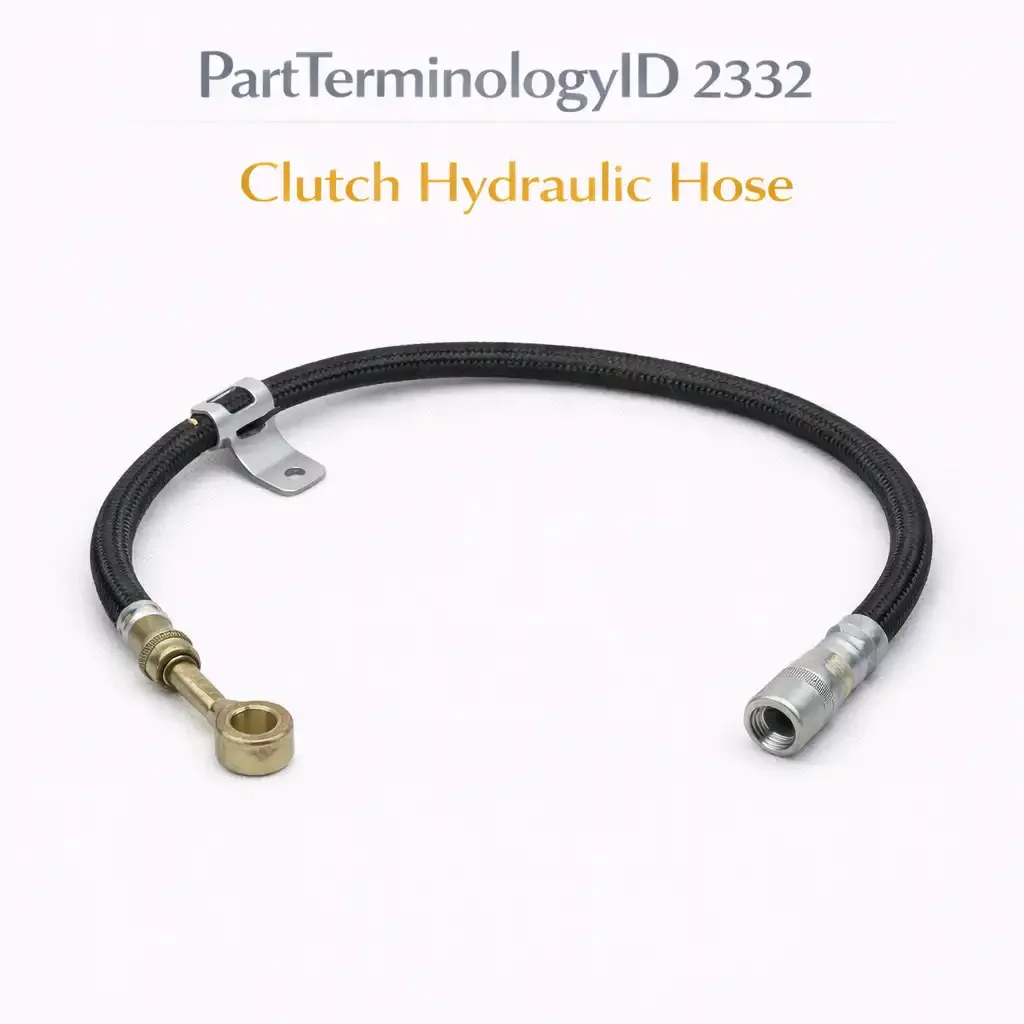
PartTerminologyID 2332, Clutch Hydraulic Hose, is the flexible hydraulic line that carries brake fluid or clutch hydraulic fluid from the clutch master cylinder to the clutch slave cylinder or to a hard line intermediate junction, transmitting the hydraulic pressure generated by the clutch pedal to the release mechanism at the transmission. That definition locates the hose in the hydraulic clutch circuit. It does not specify the hose length, the end fitting type at the master cylinder end, the end fitting type at the slave cylinder or junction end, the thread specification at each fitting, the fitting gender at each end, the hose inner diameter, the hose outer diameter, the working pressure rating, the burst pressure rating, the fluid compatibility, whether the hose is a banjo-to-banjo configuration, a banjo-to-flare configuration, a flare-to-flare configuration, or a male-to-female straight fitting configuration, whether the hose includes the banjo bolts and copper sealing washers where applicable, the routing path the hose must follow, any bracket or retaining clip provisions along the hose body, or whether the hose connects directly to the slave cylinder or terminates at a hard line fitting that then connects to a concentric slave cylinder inside the transmission bellhousing. A listing under PartTerminologyID 2332 that provides vehicle year, make, and model without the hose length, both end fitting specifications, and the fluid compatibility cannot be evaluated by any buyer who has the failed hose in hand and is matching the replacement before ordering.
For sellers, the clutch hydraulic hose is a component where the failure consequence is immediate and total: a hose that develops an external leak or an internal restriction produces a clutch pedal that goes to the floor without releasing the clutch, stranding the vehicle or preventing any gear engagement. The diagnostic path to a hose replacement is typically short: a clutch pedal with reduced or absent pressure, a visible fluid trace on the hose body, or a soft spongy pedal that firms up when the system is bled and immediately softens again as fluid escapes through the hose. A buyer who has completed that diagnosis and is ordering under PartTerminologyID 2332 has already identified the hose as the failed component. They need the listing to confirm the replacement matches the failed hose in length, fitting configuration, and fluid compatibility before the replacement arrives.
The additional complication specific to this PartTerminologyID is that the clutch hydraulic circuit uses brake fluid on most applications, which means a hose with inadequate fluid compatibility will swell internally, partially or completely blocking the hydraulic passage, producing a clutch engagement that cannot be fully released rather than a pedal that falls to the floor. Internal hose swelling from fluid incompatibility is a failure mode that looks identical to a seized slave cylinder or a blocked hard line and is frequently misdiagnosed, leading the buyer through several incorrect repairs before the hose is identified as the cause. A listing that does not confirm the fluid compatibility prevents that diagnostic loop by giving the buyer the specification they need to confirm they are ordering a hose designed for the fluid in their system.
For sellers, the listing under this PartTerminologyID is only useful if it specifies the hose length, both end fitting types with thread specifications, the fluid compatibility, the working pressure rating, and whether banjo bolts and sealing washers are included where applicable. Without those five attributes, the listing cannot be verified against the failed hose and cannot prevent the fitting mismatch and fluid incompatibility failures that produce the most consequential returns in this PartTerminologyID.
What the Clutch Hydraulic Hose Does
Transmitting hydraulic pressure through the flexible section of the clutch circuit
The hydraulic clutch circuit begins at the clutch pedal, which actuates the clutch master cylinder. The master cylinder converts the mechanical pedal force into hydraulic pressure in the brake fluid filling the circuit. That pressure is transmitted through the hydraulic circuit to the clutch slave cylinder, which converts the hydraulic pressure back into a mechanical force to disengage the clutch release bearing from the pressure plate.
Between the master cylinder and the slave cylinder, the hydraulic circuit may be all hard line, all flexible hose, or a combination of hard line sections connected by one or more flexible sections. The flexible section is required at points where the hose must cross the gap between a body-mounted component, typically the master cylinder on the firewall, and a transmission-mounted component, the slave cylinder on the transmission bellhousing, because the engine and transmission move relative to the body on rubber mounts during operation. A rigid hard line across this gap would crack from the vibration and the relative movement between the mounting points. The flexible hose absorbs that movement without transmitting stress to the fittings at either end.
On some vehicles the clutch hydraulic hose is a single line from the master cylinder reservoir output to the slave cylinder input. On others the hose is a short flexible section that bridges the gap between a hard line from the master cylinder and a hard line to the slave cylinder, with the flexible section serving only the movement accommodation function. On vehicles with a concentric slave cylinder (CSC) mounted inside the transmission bellhousing, the hose typically terminates at a hard line fitting at the transmission bellhousing, and a separate hard line runs inside the bellhousing to the CSC. The listing must specify where the hose begins and ends in the circuit.
Internal hose construction and pressure rating
The clutch hydraulic hose is a multi-layer construction similar to a brake hose. The innermost layer is a hydraulic fluid-compatible tube, typically EPDM rubber or a synthetic elastomer, that contacts the brake fluid and must resist swelling, softening, or hardening in the specific fluid formulation. The inner tube is surrounded by one or more braided reinforcement layers of textile or steel wire that carry the hoop stress from the internal pressure. The outer layer is a weather-resistant cover that protects the reinforcement from road chemicals, ozone, and abrasion.
The working pressure rating is the maximum continuous operating pressure the hose is designed to carry without deformation or leakage. The burst pressure is the pressure at which the hose will fail catastrophically and is typically three to four times the working pressure. The working pressure must exceed the maximum line pressure the clutch master cylinder can generate at full pedal force, which on most passenger vehicle hydraulic clutch systems is in the range of 500 to 800 psi. On heavy-duty truck clutch systems with large master cylinder bore diameters and high pedal force ratios, the line pressure can exceed 1,500 psi.
A hose with a working pressure rating below the system's maximum line pressure will deform under full pedal force, expanding like a balloon rather than transmitting the pressure to the slave cylinder. The driver experiences this as a spongy pedal that does not improve with bleeding because the hose itself is absorbing the pressure rather than transmitting it. The listing must state the working pressure rating in psi or bar.
The internal swelling failure mode
A clutch hydraulic hose that is incompatible with the fluid in the circuit will swell internally over time as the inner tube absorbs the fluid. The inner tube's bore diameter decreases as the tube wall expands inward. The restriction increases as the swelling progresses, reducing the flow of fluid through the hose during clutch pedal application and return.
The symptom of a swelling hose is a clutch that is slow to engage or disengage, or a pedal that falls to the floor but is slow to return to the top of its travel. In the advanced stages of internal swelling, the inner bore can close almost completely, leaving enough restriction that the clutch can be disengaged with a slow, firm pedal press but the hydraulic pressure cannot reverse through the swollen bore quickly enough for the clutch to re-engage within the normal pedal return time. The driver experiences this as a clutch that sticks in the disengaged position after the pedal is released.
The internal swelling failure is insidious because the external appearance of the hose is normal. There is no fluid trace, no visible cracking, and no deformation visible from outside the hose. The only way to diagnose it without removing the hose is to verify the fluid compatibility specification and the service history. If the system has been filled with a fluid formulation the hose was not designed for, the hose is the first component to replace regardless of external appearance.
DOT 3 and DOT 4 brake fluids are polyethylene glycol based. DOT 5 is silicone based. EPDM inner tubes are compatible with DOT 3 and DOT 4 but are not compatible with DOT 5. A system that was converted from DOT 3 or DOT 4 to DOT 5 silicone fluid will degrade EPDM hoses over time. A system that was filled with DOT 5.1, which is a high-performance polyethylene glycol formulation and is not the same as DOT 5 silicone despite the similar designation, will be compatible with EPDM hoses.
The listing must specify the DOT fluid compatibility clearly and must distinguish between DOT 5 silicone and DOT 5.1 polyethylene glycol, because the two designations are confused by a significant fraction of buyers and the substitution produces the internal swelling failure described above.
The End Fitting Configurations
Banjo fitting
A banjo fitting is a circular hollow bolt that passes through a banjo eye on the end of the hose. The bolt threads into a port on the master cylinder, slave cylinder, or hard line junction. The hydraulic fluid passes through the hollow center of the banjo bolt and through the angled passages in the banjo eye to flow in and out of the hose. Copper or aluminum sealing washers on each side of the banjo eye, between the eye and the mounting face, seal the joint against fluid leakage.
Banjo fittings are common on both ends of clutch hydraulic hoses on Japanese and European vehicles. The banjo configuration allows the hose to swivel at the fitting, which simplifies routing around tight corners. The thread specification of the banjo bolt must match the port thread on the master or slave cylinder. Common banjo bolt thread specifications include M10 x 1.0, M10 x 1.25, M12 x 1.0, and M12 x 1.25.
The listing must specify the banjo bolt thread at each banjo end and must state whether the banjo bolts and copper sealing washers are included. A buyer who receives a banjo hose without the banjo bolts and sealing washers cannot install the hose because those components are consumed at every removal and must be replaced at every installation.
Inverted flare fitting
An inverted flare fitting uses a 45-degree flare on the end of a tube that seats into a corresponding 45-degree cone in the fitting body. The flare is compressed against the cone by a threaded nut that pulls the flared tube end into contact. Inverted flare fittings are the most common fitting type on domestic vehicle clutch hydraulic hoses and on the hard line connections in the clutch circuit.
The thread specification of the inverted flare nut must match the port it connects to. Common domestic specifications include 3/8-inch-24 UNF, 7/16-inch-24 UNF, and 1/2-inch-20 UNF. Metric inverted flare specifications used on import vehicles include M10 x 1.0 and M12 x 1.0.
An inverted flare fitting cannot substitute for a bubble flare fitting even if the thread specification matches. The 45-degree inverted flare profile and the 45-degree bubble flare profile look similar but have different sealing geometries. A 45-degree inverted flare fitting tightened into a bubble flare port will not seal and will leak immediately under pressure.
Bubble flare fitting
A bubble flare fitting uses a rounded convex bead on the end of the tube that seats into a concave pocket in the fitting body. Bubble flare fittings are used on some European clutch hydraulic hoses and hard lines. The bubble flare is also called an ISO flare or a metric flare. As noted above, it is not interchangeable with an inverted flare despite thread specifications that overlap.
Straight thread O-ring port
Some slave cylinder connections use a straight thread port with an O-ring that seats against the face of the port rather than a flare or banjo configuration. The straight thread O-ring connection requires a fitting with the correct thread specification and a compatible O-ring. The O-ring material must be compatible with the hydraulic fluid in the system.
The Specifications That Determine Correct Hose Fitment
Hose length
The hose length is the most critical dimensional specification. Too short a hose will be stretched across the engine-to-body movement gap, which stresses the end fittings and eventually cracks the hose at the fitting neck. Too long a hose will route against the exhaust, the engine block, or other hot or abrasive surfaces, causing the outer cover to deteriorate and ultimately the hose to fail prematurely. The listing must state the hose length from fitting face to fitting face in millimeters or inches.
End fitting type and thread specification at each end
Both end fitting types and both thread specifications must be stated separately because many clutch hydraulic hoses are asymmetric: one end is a banjo and the other is an inverted flare, or one end is M10 banjo and the other is M12 banjo. A listing that states only one end fitting specification leaves the buyer unable to verify the other end against the component it connects to.
Fluid compatibility
State the DOT fluid specification: DOT 3 and DOT 4 compatible, DOT 5 silicone compatible, or DOT 5.1 compatible. Distinguish DOT 5 silicone from DOT 5.1 polyethylene glycol explicitly in the listing. Do not assume the buyer knows the difference.
Working pressure rating
State the working pressure in psi or bar. For heavy-duty truck applications, confirm the working pressure exceeds the system's maximum line pressure at full pedal force.
Banjo bolt and sealing washer inclusion
For banjo fitting configurations, state whether the banjo bolts and copper sealing washers are included. If not included, state the banjo bolt thread specification and the sealing washer outer diameter so the buyer can source them before installation.
Why This Part Generates Returns
Buyers order the wrong clutch hydraulic hose because:
the hose length is not stated and the replacement is too short to span the master-to-slave circuit gap or too long to route without contacting hot or abrasive surfaces
the end fitting type is not stated for one or both ends and the buyer receives a banjo where an inverted flare is required or vice versa
the thread specification is not stated and the banjo bolt or flare nut does not thread into the master or slave cylinder port
the fluid compatibility is not stated and the buyer installs an EPDM hose in a DOT 5 silicone system, producing internal swelling within the first heat cycles
the DOT 5 and DOT 5.1 distinction is not made and the buyer fills a DOT 5.1-compatible hose with DOT 5 silicone, which damages the inner tube
banjo bolts and sealing washers are not included and the buyer discovers this mid-installation with the old hose already removed
the hose terminates at a hard line junction rather than directly at the slave cylinder and the buyer expected a full master-to-slave length hose
Status in New Databases
PIES/PCdb: PartTerminologyID 2332, Clutch Hydraulic Hose
PIES 8.0 / PCdb 2.0: No change
Top Return Scenarios
Scenario 1: "Hose too short, stretched across engine mount gap, cracked at banjo fitting within 6 months"
The replacement hose is 45mm shorter than the original. At idle, the hose spans the master-to-slave gap without tension. Under engine torque reaction on the rubber mounts, the engine moves rearward relative to the firewall and the hose is stretched across the gap. The repeated stretching stress concentration at the banjo fitting neck cracks the outer cover and eventually the reinforcement layer within 6 months.
Prevention language: "Hose length fitting face to fitting face: [X]mm. Verify this length matches your original hose before ordering. A hose that is shorter than the original will be stretched across the engine-to-body movement gap during engine torque reaction on the motor mounts, concentrating stress at the end fitting necks and accelerating hose failure at those points."
Scenario 2: "Banjo bolt not included, buyer installed without sealing washers, immediate leak at fitting"
The listing did not state whether banjo bolts and sealing washers were included. The buyer assumed they were included with the hose. The hose arrived without banjo bolts or sealing washers. The buyer installed the hose reusing the original banjo bolt without replacing the copper sealing washers. The used washers did not seal against the new banjo eye faces and the joint leaked immediately under pedal pressure.
Prevention language: "Banjo bolt and sealing washer inclusion: [banjo bolt M10 x 1.0 included, 2 copper sealing washers per end included / banjo bolts and sealing washers not included]. Copper sealing washers must be replaced at every banjo fitting disassembly. Do not reuse original copper sealing washers on reinstalled banjo fittings. Banjo bolt thread specification: M10 x 1.0 for sourcing if not included."
Scenario 3: "EPDM inner tube, system filled with DOT 5 silicone, clutch stuck disengaged within 3,000 miles"
The vehicle's clutch hydraulic system was converted to DOT 5 silicone fluid by a previous owner. The replacement hose uses an EPDM inner tube rated for DOT 3 and DOT 4. The EPDM absorbed the silicone fluid and swelled internally. Within 3,000 miles the bore restriction was sufficient to prevent the clutch from re-engaging after pedal release, because the swollen bore blocked the return flow of fluid from the slave cylinder to the master cylinder.
Prevention language: "Inner tube material: [EPDM]. Fluid compatibility: [DOT 3 and DOT 4 compatible only]. This hose is not compatible with DOT 5 silicone brake fluid. Installing this hose in a system containing DOT 5 silicone will cause the inner tube to swell, restricting fluid flow and eventually preventing clutch re-engagement after pedal release. Verify your system uses DOT 3 or DOT 4 fluid before installing."
Scenario 4: "Bubble flare fitting on hose, inverted flare port on slave cylinder, fitting will not seal"
The replacement hose has a bubble flare fitting at the slave cylinder end. The slave cylinder port is machined for an inverted 45-degree flare. The bubble flare seated partially in the inverted flare port and the nut tightened to full torque but the joint leaked under pedal pressure because the two flare profiles do not have the same contact geometry.
Prevention language: "Slave cylinder end fitting type: [inverted 45-degree flare / bubble flare / banjo]. Verify your slave cylinder port matches this fitting type before ordering. Bubble flare and inverted 45-degree flare fittings use the same thread specification on some applications but have different sealing profiles. They are not interchangeable and a mismatched flare type will not seal regardless of the torque applied."
Scenario 5: "Hose terminates at hard line junction, buyer expected full master-to-slave hose, slave cylinder still dry"
The replacement hose is a flexible section that bridges the engine-to-firewall gap and terminates at a hard line junction on the chassis. The buyer expected a full-length hose from the master cylinder to the slave cylinder. After installing the hose and bleeding the system, the slave cylinder showed no pressure because the hard line section between the junction and the slave cylinder was still cracked and had not been replaced.
Prevention language: "Hose circuit position: [master cylinder to chassis hard line junction / master cylinder to slave cylinder direct]. This hose connects [specify the two endpoints]. It does not span the full clutch hydraulic circuit. The complete circuit from master cylinder to slave cylinder may include this hose plus a hard line section. Verify the circuit layout for your vehicle before ordering to confirm which section requires replacement."
Scenario 6: "Wrong banjo bolt thread, M12 bolt attempted in M10 port, port threads damaged"
The listing stated banjo fittings at both ends but did not specify the banjo bolt thread at each end. The buyer sourced M12 banjo bolts because the banjo eye outer diameter looked similar to an M12 application. The master cylinder banjo port is M10. The M12 bolt started into the M10 port for two threads before the thread engagement locked. Extracting the cross-threaded bolt damaged the master cylinder port threads.
Prevention language: "Master cylinder end banjo bolt thread: [M10 x 1.0]. Slave cylinder end banjo bolt thread: [M10 x 1.25]. State both banjo bolt thread specifications explicitly. Banjo eye outer diameters can be similar between M10 and M12 applications. Cross-threading a banjo bolt into a smaller-thread port will damage the port and may require master or slave cylinder replacement."
Scenario 7: "DOT 5.1 hose ordered for DOT 5 silicone system, inner tube degraded within 4 months"
The buyer read the listing's DOT 5.1 compatibility as DOT 5 compatible. The listing did not distinguish between DOT 5 silicone and DOT 5.1 polyethylene glycol. The system contains DOT 5 silicone. The DOT 5.1-compatible hose uses an EPDM inner tube that is not compatible with silicone fluid. The inner tube degraded within 4 months.
Prevention language: "Fluid compatibility: [DOT 3, DOT 4, and DOT 5.1 compatible / DOT 5 silicone compatible]. Important note: DOT 5.1 is a high-performance polyethylene glycol-based fluid and is NOT the same as DOT 5 silicone fluid despite the similar designation. Confirm which DOT specification your system uses before ordering. If your system contains DOT 5 silicone fluid, a hose with silicone-compatible inner tube construction is required."
What to Include in the Listing
Core essentials
PartTerminologyID: 2332
component: Clutch Hydraulic Hose
hose length fitting face to fitting face in mm (mandatory)
master cylinder end fitting type: banjo, inverted flare, bubble flare, or straight thread O-ring (mandatory)
master cylinder end fitting thread specification (mandatory)
slave cylinder or junction end fitting type (mandatory)
slave cylinder or junction end fitting thread specification (mandatory)
fitting gender at each end: male or female where applicable (mandatory)
circuit position: master-to-slave direct, master-to-junction, or junction-to-slave (mandatory)
inner tube material: EPDM or silicone-compatible (mandatory)
fluid compatibility: DOT 3 and DOT 4 only, DOT 5 silicone, or DOT 5.1 (mandatory)
explicit distinction between DOT 5 silicone and DOT 5.1 polyethylene glycol (mandatory)
working pressure rating in psi (mandatory)
burst pressure rating in psi (mandatory)
banjo bolt thread specification and inclusion status for banjo configurations (mandatory)
copper sealing washer inclusion status and quantity for banjo configurations (mandatory)
retaining clip or bracket provisions along hose body: present or not (mandatory)
quantity: 1
Fitment essentials
year/make/model/submodel
transmission type: manual transmission (mandatory to confirm hydraulic clutch application)
engine designation when hose routing or length varies by engine
OE part number cross-reference when available
Dimensional essentials
hose length fitting face to fitting face in mm
hose inner diameter in mm
hose outer diameter in mm
banjo eye inner diameter in mm for banjo bolt sizing
flare nut wrench size for inverted flare configurations
retaining clip position from fitting face in mm where applicable
Image essentials
complete hose shown with length callout from fitting face to fitting face
master cylinder end fitting shown in detail with fitting type and thread callout
slave cylinder end fitting shown in detail with fitting type and thread callout
banjo eye cross-section showing inner passage for banjo configurations
banjo bolt and sealing washers shown alongside hose for kits that include them
hose cross-section showing inner tube, reinforcement layer, and outer cover
fluid compatibility marking visible on outer cover or packaging
Catalog Checklist for ACES/PIES Teams
PartTerminologyID = 2332
require hose length in mm (mandatory)
require fitting type at each end separately (mandatory)
require thread specification at each end separately (mandatory)
require circuit position: master-to-slave, master-to-junction, or junction-to-slave (mandatory)
require inner tube material (mandatory)
require fluid compatibility with explicit DOT 5 silicone versus DOT 5.1 distinction (mandatory)
require working pressure rating in psi (mandatory)
require banjo bolt and sealing washer inclusion status for banjo configurations (mandatory)
differentiate from clutch master cylinder (PartTerminologyID varies): the master cylinder is the hydraulic pump the pedal actuates; the hose carries the fluid from the master cylinder; both may require replacement when the system has lost pressure, but the hose is a lower-cost diagnostic first step
differentiate from clutch slave cylinder (PartTerminologyID varies): the slave cylinder converts the hydraulic pressure back to mechanical force; the hose carries the pressure to the slave cylinder; a failed hose that caused fluid starvation may also have caused slave cylinder damage
differentiate from clutch hard line (PartTerminologyID varies): the hard line is the rigid metal tube section of the hydraulic circuit; the flexible hose bridges the movement gap between body-mounted and transmission-mounted components; both may be required when the complete circuit requires replacement
differentiate from brake hydraulic hose (PartTerminologyID varies): brake hydraulic hoses and clutch hydraulic hoses use the same fluid and similar construction; they are not interchangeable because the length and fitting configurations are specific to each circuit; a brake hose cross-referenced to a clutch hose application will have the wrong length and fitting configuration
flag DOT 5 versus DOT 5.1 distinction as mandatory: this is the highest-frequency fluid confusion in the hydraulic clutch hose category and produces the internal swelling failure that is most difficult to diagnose because it presents no external symptoms
flag banjo bolt inclusion as mandatory: banjo bolts and copper sealing washers are consumable at every removal; a buyer who discovers they are not included after the original hose is removed cannot complete the installation without sourcing them
flag hose length as primary dimensional attribute: a hose that is too short is stretched across the engine movement gap and fails at the fitting neck; a hose that is too long routes against hot or abrasive surfaces; length must be stated for every listing
FAQ (Buyer Language)
How do I measure my original clutch hydraulic hose for a replacement?
Remove the hose from the vehicle and measure from the fitting face at one end to the fitting face at the other end with the hose laid straight. This is the fitting-face-to-fitting-face length used in replacement hose specifications. Do not measure along the routed path of the hose in the vehicle, which will be longer than the straight length due to curves and bends. If the original hose is already discarded, the replacement length can be determined from the vehicle service manual's hose specification or by measuring the distance between the two fitting ports along the intended routing path and adding approximately 10 percent for natural hose curvature at each end.
My clutch pedal goes to the floor but I cannot see any fluid leaking from the hose. Is the hose still the problem?
A clutch pedal that goes to the floor without external fluid evidence can be caused by an internal hose failure rather than an external leak. Internal hose delamination, where the inner liner separates from the reinforcement layer, creates a flap of inner liner that acts as a one-way valve. Fluid flows from the master cylinder to the slave cylinder under pedal pressure, but the flap closes and blocks the return flow when the pedal is released. The clutch disengages when the pedal is pressed and stays disengaged when the pedal is released because the fluid cannot return. There is no external fluid loss. To confirm the diagnosis, disconnect the hose at the slave cylinder end and measure the flow rate through the hose in both directions. A restriction in the return direction confirms internal delamination.
What is the correct torque for banjo bolts on a clutch hydraulic hose?
Banjo bolt torque specifications vary by thread size and application. For M10 x 1.0 banjo bolts, the typical specification is 15 to 18 Nm. For M12 x 1.0 or M12 x 1.25 banjo bolts, the typical specification is 20 to 25 Nm. Always confirm the torque specification in the vehicle service manual for the specific application. Over-torquing a banjo bolt cracks the banjo eye on the hose or strips the port threads in the master or slave cylinder. Under-torquing allows the sealing washer to leak under pedal pressure. Replace the copper sealing washers at every banjo bolt removal: used copper washers do not conform to the sealing surface as reliably as new washers.
Can I use a brake hydraulic hose as a substitute for a clutch hydraulic hose?
Not directly. Brake hydraulic hoses and clutch hydraulic hoses use the same fluid and the same inner tube material, but they are manufactured to specific lengths and fitting configurations for their respective circuits. A brake hose will not have the correct length or the correct fitting configuration to span the master-to-slave clutch circuit. In an emergency where only a brake hose is available, a fabricated hard line adaptation may be possible, but sourcing the correct clutch hose for the application is the correct repair.
My vehicle has a concentric slave cylinder inside the transmission bellhousing. Where does the clutch hydraulic hose terminate?
On vehicles with a concentric slave cylinder, the clutch hydraulic hose typically terminates at a hard line fitting on the outside of the transmission bellhousing. A short hard line or a bulkhead fitting then carries the fluid through the bellhousing to the CSC. The hose itself does not enter the bellhousing. When the clutch hose requires replacement on a CSC application, only the external hose section from the master cylinder or chassis junction to the bellhousing fitting is replaced. The internal hard line section from the bellhousing fitting to the CSC is typically a fixed hard line that is replaced only if the CSC is being replaced or if the line is physically damaged.
My clutch engages very high in the pedal travel after replacing the hose. Is that a hose issue?
A clutch that engages unusually high in the pedal travel after hydraulic circuit service, including hose replacement, is typically a bleeding issue rather than a hose problem. Air remaining in the hydraulic circuit after bleeding compresses under pedal pressure, which means the pedal must travel further before the hydraulic pressure reaches the threshold required to disengage the clutch. Bleed the system thoroughly, starting at the slave cylinder bleeder, and check the fluid level in the master cylinder reservoir before concluding the hose is causing the high engagement point.
Cross-Sell Logic
Clutch Master Cylinder (PartTerminologyID varies: a hose that has been leaking may have depleted the master cylinder reservoir repeatedly and may have allowed air ingestion into the master cylinder piston seal; inspect the master cylinder for corrosion inside the bore or a weeping seal when the hose is replaced)
Clutch Slave Cylinder (PartTerminologyID varies: fluid starvation from a leaking hose accelerates slave cylinder seal wear; inspect the slave cylinder for leakage at the same service event as the hose replacement)
Clutch Hard Line (PartTerminologyID varies: if the hard line sections of the clutch circuit are corroded, the hose replacement is an opportunity to replace the hard lines at the same event before they fail separately)
Brake Fluid (DOT 3 or DOT 4 as specified: the fluid is topped up or replaced at every hydraulic circuit service; confirm the correct DOT specification before adding fluid)
Clutch Bleeder Kit (a one-person bleeder kit simplifies the bleeding procedure after hose replacement and confirms a complete bleed without a helper at the pedal)
Frame as "the hose carries the pressure the master cylinder generates. The master cylinder generates the pressure the pedal applies. The slave cylinder converts the pressure back to force at the release bearing. The fluid transmits the pressure through the hose. All are in the same circuit and relevant ones are inspected at the same hose replacement event."
Final Take for PartTerminologyID 2332
Clutch Hydraulic Hose (PartTerminologyID 2332) is a component where the failure consequence is a stranded vehicle, the diagnostic path is short, and the buyer arriving at the listing has already identified the hose as the failed component. That buyer needs the listing to confirm the replacement matches the failed hose before the part ships, not to discover a fitting mismatch or a fluid incompatibility after the old hose has been removed and the clutch circuit is open.
The hose length prevents the stretch failure and the routing contact failure. The end fitting specifications at both ends prevent the installation incompatibility that is discovered at the fitting face with the circuit open. The fluid compatibility specification prevents the internal swelling failure that presents no external symptoms and is the most difficult consequence to diagnose after the fact. The DOT 5 versus DOT 5.1 distinction prevents the specific version of that failure that results from one of the most common fluid specification confusions in the hydraulic clutch service category. The banjo bolt inclusion status prevents the mid-installation discovery that the consumable sealing hardware is not in the box.
State the hose length. State both end fitting types and thread specifications. State the fluid compatibility with the DOT 5 versus DOT 5.1 distinction explicit. State the working pressure rating. State the banjo bolt and sealing washer inclusion status. State the circuit position. That is the same listing strategy as every other PartTerminologyID in this series: the generic PartTerminologyID requires specific attributes at every level to become a listing buyers can act on without guessing. For PartTerminologyID 2332, the buyer already knows what failed and why. The listing's job is to confirm the replacement is correct before the circuit is opened, not after.