
Written by Arthur Simitian | PartsAdvisory
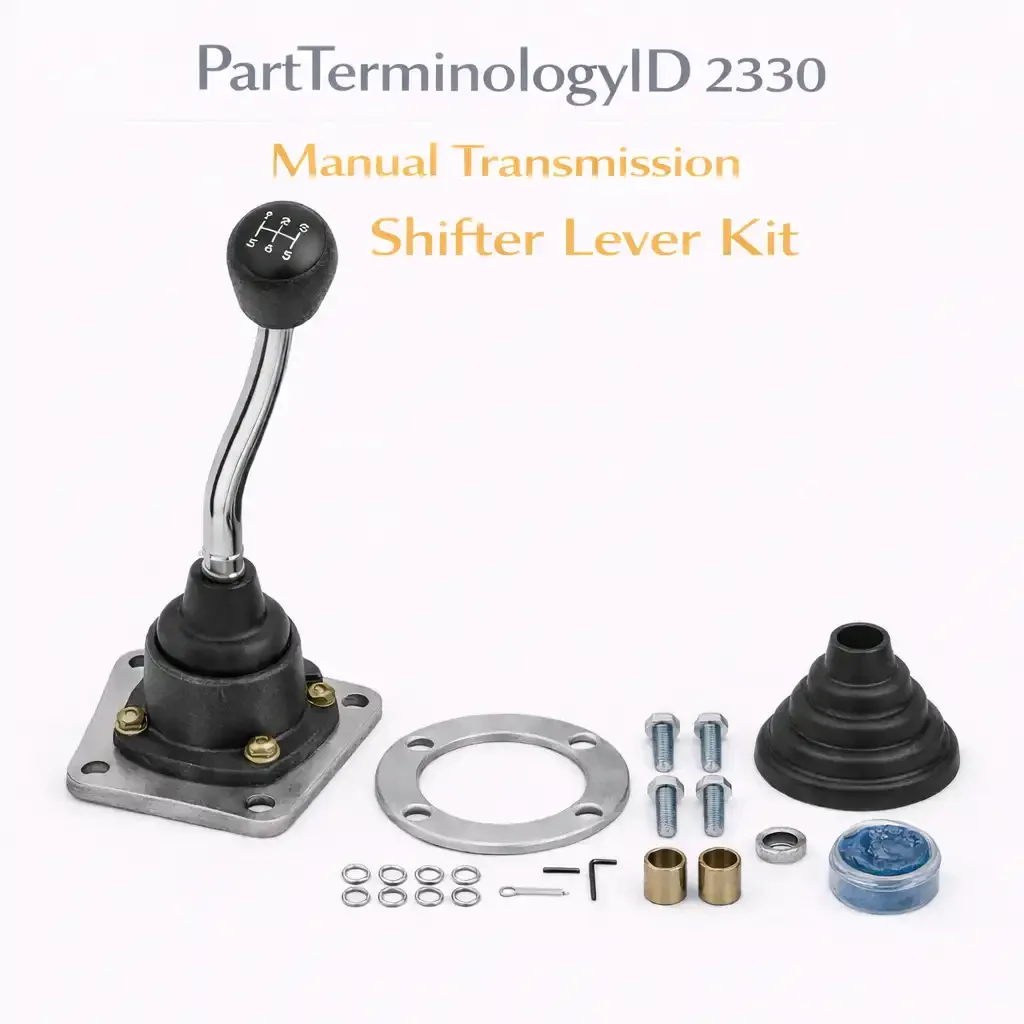
PartTerminologyID 2330, Manual Transmission Shifter Lever Kit, is a kit containing the shift lever and associated components required to replace or upgrade the gear selection mechanism on a manual transmission. That definition identifies the function. It does not specify the transmission model designation, what the kit actually contains beyond the lever itself, what the pivot ball diameter is, what the lever height is above the transmission housing, what the shift knob thread specification is at the top of the lever, whether the lever is a direct OE-replacement height or a short-throw aftermarket design, whether the kit includes a new pivot ball and socket, the shift boot retaining hardware, the reverse lockout mechanism, or the shifter tower housing, what the lever bend geometry is, whether the lever is compatible with the OE shift knob or requires a new knob, or whether the installation requires removal of the transmission or center console only. A listing under PartTerminologyID 2330 that provides vehicle year, make, and model without the transmission model designation, the lever height, the pivot ball diameter, and the complete kit manifest cannot be evaluated by any buyer who is replacing a worn lever or selecting an upgrade lever for a specific shift feel and throw reduction.
For sellers, the manual transmission shifter lever kit occupies a position in the manual transmission service market that spans two buyer populations with opposite motivations. The first is the service buyer whose original lever is worn, bent, cracked at the pivot ball socket, or missing the reverse lockout mechanism. That buyer needs a direct OE-replacement lever that restores the original throw length, the original pivot geometry, and the original feel. The second is the performance buyer who wants to reduce shift throw, improve shift precision, or change the lever height for ergonomic reasons. That buyer is intentionally selecting a lever that differs from the OE specification and needs the aftermarket lever's specific height, throw reduction, and pivot geometry to confirm it meets their objective.
A listing that does not specify the lever height, the throw reduction percentage, the pivot ball diameter, and the complete kit manifest cannot serve either population. The service buyer cannot confirm the replacement matches the original specification. The performance buyer cannot confirm the aftermarket lever achieves the throw reduction and feel they are purchasing for. Both buyers return parts when the listing fails them, and the failure modes are different: the service buyer returns a lever that is the wrong height or has the wrong pivot ball size, and the performance buyer returns a lever that delivers less throw reduction than expected or that requires modification to install.
For sellers, the listing under this PartTerminologyID is only useful if it specifies the transmission model, the lever height above the pivot point, the pivot ball diameter, the throw reduction versus OE, the shift knob thread specification, and the complete kit manifest. Without those six attributes, the listing cannot prevent the geometry mismatch and the expectation gap that drive returns for this PartTerminologyID.
What the Manual Transmission Shifter Lever Does
Translating the driver's hand motion into selector fork movement
The shift lever is the mechanical link between the driver's hand and the transmission's internal gear selector forks. When the driver moves the gear knob, the lever pivots at its ball-and-socket pivot point, which is located in the shifter housing at the top of the transmission. The lever's bottom end, below the pivot point, moves in the opposite direction to the top end and engages the transmission's shift rail or shift rod mechanism. The relationship between the top end travel and the bottom end travel is determined by the ratio of the upper lever length to the lower lever length, measured from the pivot point to each end.
Reducing the upper lever length while keeping the lower lever length constant reduces the shift throw at the knob for the same amount of shift rod movement at the bottom. This is the mechanism behind short-throw shifter kits: a shorter lever above the pivot point produces a shorter throw at the knob. The trade-off is that the shorter upper section requires more hand force per unit of shift rod displacement because the mechanical advantage is reduced proportionally with the lever length reduction.
A lever that is too short at the upper section produces a stiff, heavy shift feel that fatigues the driver in traffic. A lever that is too long produces a vague, imprecise shift feel because small angular deflections of the long upper lever produce large movements at the knob that are difficult to control precisely. The OE lever height is a calibrated compromise between throw length, shift force, and tactile precision for the specific transmission and vehicle application.
The pivot ball and socket as the wear interface
The pivot ball is the spherical bearing surface at the midpoint of the shift lever. The ball seats in a socket machined into the shifter housing or into a separate pivot cup, and this ball-and-socket joint is what allows the lever to pivot in all directions as the driver selects gears and moves between gates. The pivot ball is the highest-wear interface in the shifter assembly because it carries the full shift force through a small contact area on every shift.
A worn pivot ball develops flat spots, pits, or an undersized diameter from wear. A worn socket develops a corresponding enlarged bore. Together, a worn ball and socket produce the loose, sloppy shift feel that sends buyers searching for a replacement shifter lever kit. If the kit does not include a new pivot ball, the worn socket will produce the same sloppy feel with the new lever that it produced with the old one, because the socket wear is the dominant contribution to the lateral play in the worn assembly.
The pivot ball diameter must match the socket diameter in the shifter housing. An undersized ball in the original socket will have the same play as a worn ball. An oversized ball will not seat in the socket and the lever cannot be installed. The listing must state the pivot ball diameter and whether the pivot ball is included in the kit.
The reverse lockout mechanism
Most manual transmissions have a reverse lockout that prevents the driver from accidentally selecting reverse when moving through the gear gates at speed. Common designs include a lift ring under the shift knob that must be lifted before the lever can be moved into the reverse gate, a collar that must be pushed down, or a button that must be pressed. The reverse lockout mechanism is often integrated into the shift lever assembly, and a replacement lever must include a compatible lockout mechanism for the transmission's reverse gate geometry.
A lever that does not include a reverse lockout mechanism on a transmission that requires one is not a complete replacement. The driver can engage reverse without any tactile warning, which is a safety issue that produces both a functional complaint and a return. The listing must state whether a reverse lockout mechanism is included and what type it is.
The shifter tower and its relationship to the lever kit
On some manual transmissions, the shifter tower is a separate casting that bolts to the top of the transmission and contains the pivot socket, the shift boot retaining flange, and the shift rod linkage. On other designs, the shifter tower is integral to the transmission case and the pivot socket is machined directly into the case. A lever kit that includes only the lever and pivot ball is correct for tower-integral designs where only the lever requires replacement. A kit that includes the complete shifter tower is required when the tower itself is cracked, stripped, or worn beyond the lever replacement's ability to restore precision.
The listing must distinguish between a lever-only kit, a lever and pivot hardware kit, and a complete tower and lever kit. Sending a lever-only kit to a buyer who needs the tower will not restore the shift precision the buyer is paying to recover.
The Specifications That Determine Correct Shifter Lever Kit Fitment
Transmission model designation
The transmission model designation is the primary fitment attribute. The same vehicle platform may have been available with multiple manual transmission options. A Honda Civic was available with both the Honda S40 and Honda K-series transmissions at different generations. A Ford Mustang was available with the Tremec T-5 and the Tremec TR-3650 at different model years. The shifter lever geometry, the pivot ball diameter, and the shift rod engagement point are all transmission-specific. A lever for the T-5 will not install correctly in a TR-3650 because the pivot housing geometry and the shift rod contact point differ between the two transmissions.
Lever height above the pivot point
The lever height above the pivot point is the measurement from the center of the pivot ball to the top of the shift knob mounting point. This dimension determines the position of the shift knob relative to the driver's hand in the cabin and the throw length at the knob. The listing must state the height above the pivot in millimeters and must note whether this is shorter, equal to, or taller than the OE height.
For short-throw kits, the throw reduction percentage versus OE must be stated. A 25 percent short-throw kit reduces the knob travel by approximately 25 percent compared to the OE lever at the same pivot geometry. This is meaningful information for the performance buyer selecting a kit and cannot be inferred from the lever height alone without the OE height for reference.
Pivot ball diameter
The pivot ball diameter in millimeters must match the socket in the shifter housing. Common pivot ball diameters on domestic and import manual transmissions range from 16mm to 28mm. A 1mm difference in pivot ball diameter is enough to produce either a loose fit or a non-installable lever. The listing must state the pivot ball diameter and confirm that the replacement ball matches the original socket specification.
Shift knob thread specification
The shift knob mounts to the top of the lever by threading onto the lever end. Common thread specifications include M10 x 1.5, M12 x 1.25, M12 x 1.75, and various proprietary thread specifications used by specific manufacturers. The listing must state the thread specification at the lever top end because a buyer replacing only the lever who intends to reuse their existing shift knob needs to confirm the thread matches.
On short-throw aftermarket levers, the thread specification at the top may differ from the OE thread, requiring a different shift knob or a thread adapter. This must be noted explicitly in the listing because an unexpected thread change produces a return from every buyer who planned to reuse their knob.
Complete kit manifest
The kit manifest determines whether the buyer has everything required to complete the installation. A minimum manifest for a lever kit should include the shift lever, the pivot ball, the pivot cup or socket if it is a separate component, the shift boot retaining hardware if included, and any fasteners required for installation. A manifest that does not include the pivot ball sends the buyer to an installation where the worn original pivot ball produces the same sloppy feel the lever replacement was meant to address. A manifest that does not include the console installation hardware sends the buyer to a disassembled console without a way to reassemble it cleanly.
Why This Part Generates Returns
Buyers order the wrong manual transmission shifter lever kit because:
the transmission model is not specified and the pivot housing geometry and shift rod engagement point do not match the replacement lever
the pivot ball diameter is not stated and the replacement ball is too small or too large for the original socket
the lever height is not stated and the replacement is taller or shorter than expected, changing the knob position and throw length
the throw reduction percentage is not stated for short-throw kits and the buyer receives less throw reduction than they expected
the shift knob thread specification changes from OE on an aftermarket lever and the buyer's existing knob will not thread onto the replacement
the reverse lockout mechanism is not included and the transmission requires one for safe reverse engagement
the kit manifest is not stated and the buyer receives a lever-only kit when the pivot ball and socket also required replacement
Status in New Databases
PIES/PCdb: PartTerminologyID 2330, Manual Transmission Shifter Lever Kit
PIES 8.0 / PCdb 2.0: No change
Top Return Scenarios
Scenario 1: "Pivot ball too small for original socket, sloppy feel identical to worn original"
The listing did not state the pivot ball diameter. The replacement pivot ball is 2mm smaller in diameter than the original socket bore. The lateral play produced by the undersized ball is comparable to the play from the worn original ball. The shift feel is identical to the worn assembly the kit was meant to replace.
Prevention language: "Pivot ball diameter: [X]mm. Verify your shifter housing socket bore matches this diameter before ordering. An undersized pivot ball will produce the same lateral play as a worn original ball. Measure the socket bore in your shifter housing and confirm the replacement ball diameter matches before installation."
Scenario 2: "Aftermarket lever thread M12 x 1.25, OE thread M10 x 1.5, knob will not fit"
The aftermarket short-throw lever uses M12 x 1.25 thread at the top end. The buyer's OE shift knob is threaded for M10 x 1.5. The knob will not thread onto the replacement lever. The listing did not state the thread specification or note the change from OE.
Prevention language: "Shift knob thread specification: [M12 x 1.25]. OE thread specification for this application: [M10 x 1.5]. Note: this lever uses a different thread specification than the OE lever. Your original shift knob will not thread onto this lever without a thread adapter. A compatible replacement shift knob or a thread adapter for M12 x 1.25 to M10 x 1.5 conversion is required."
Scenario 3: "No reverse lockout mechanism, buyer selected reverse at highway speed"
The replacement lever is for a transmission that uses a lift-ring reverse lockout under the shift knob. The kit does not include the lift ring mechanism. The buyer installed the lever without the lockout. During a spirited downshift sequence, the lever passed through the reverse gate without the tactile resistance the lockout would have provided.
Prevention language: "Reverse lockout mechanism: [lift ring included / collar included / not included, reuse OE lockout]. This transmission requires a reverse lockout mechanism to prevent accidental reverse engagement during forward gear changes. Verify the lockout type is included in the kit or that the OE lockout mechanism can be transferred to the replacement lever before installation."
Scenario 4: "Short-throw kit reduced throw by 15 percent, buyer expected 30 percent"
The listing described the kit as a short-throw shifter without stating the throw reduction percentage. The buyer expected a 30 percent reduction based on comparable kits they had researched. The actual throw reduction is 15 percent. The shift feel is noticeably different from OE but not to the degree the buyer expected.
Prevention language: "Throw reduction versus OE: [15 percent]. Lever height above pivot: [X]mm. OE lever height above pivot: [X]mm. This kit reduces shift throw by approximately 15 percent compared to the OE lever at the same pivot geometry. Buyers seeking a 25 to 30 percent throw reduction should verify this specification meets their requirement before ordering."
Scenario 5: "Wrong transmission model, shift rod contact point does not align"
The listing specified the lever by vehicle year and model without the transmission designation. The buyer's vehicle has a Tremec TR-3650, which replaced the T-45 in mid-production on the same vehicle platform. The lever is designed for the T-45. The shift rod contact geometry on the TR-3650 is different from the T-45 and the lever's lower engagement point does not contact the TR-3650 shift rail correctly.
Prevention language: "Transmission model: [Tremec T-45]. This lever fits the T-45 transmission. Verify your transmission model before ordering. This vehicle platform was produced with both the T-45 and the TR-3650 depending on the model year and option package. The shift rail engagement geometry differs between these two transmissions and their shift levers are not interchangeable."
Scenario 6: "Lever-only kit, tower cracked, shift precision not restored"
The buyer's shift precision problem originates from a cracked shifter tower, not from a worn lever or pivot ball. The listing covered a lever and pivot ball kit without noting that the tower is a separate component. The buyer installed the new lever in the cracked tower. The crack in the tower allows the pivot socket to flex under shift loads, producing the same imprecise shift feel the new lever was expected to address.
Prevention language: "Kit contents: [shift lever, pivot ball, pivot cup, hardware]. Shifter tower: [not included]. This kit does not include the shifter tower housing. If your shift precision problem is caused by a cracked or worn shifter tower, the tower must be replaced separately. Inspect the tower for cracks at the pivot socket and at the transmission mounting face before installing this kit."
What to Include in the Listing
Core essentials
PartTerminologyID: 2330
component: Manual Transmission Shifter Lever Kit
transmission manufacturer and model designation (mandatory)
lever type: OE-replacement height or short-throw aftermarket (mandatory)
lever height above pivot point in mm (mandatory)
OE lever height above pivot in mm for comparison (mandatory for aftermarket levers)
throw reduction versus OE as a percentage (mandatory for short-throw kits)
pivot ball diameter in mm (mandatory)
pivot ball included: yes or no (mandatory)
pivot cup or socket included: yes or no (mandatory)
shift knob thread specification at lever top end (mandatory)
OE shift knob thread specification for comparison (mandatory when different from OE)
reverse lockout mechanism: type and inclusion status (mandatory)
shifter tower: included or not included (mandatory)
complete kit manifest listing all included components (mandatory)
lever material: steel, aluminum, or other (mandatory)
finish: zinc, black oxide, anodized, polished (mandatory)
quantity: 1 kit
Fitment essentials
year/make/model/submodel
transmission model designation (primary fitment attribute)
transmission production date range when lever geometry changed mid-production
engine designation when the same transmission uses different lever geometry by engine option
Dimensional essentials
lever height above pivot in mm
lever height below pivot to shift rail contact in mm
pivot ball diameter in mm
pivot ball socket diameter in mm for housing verification
shift knob thread specification: diameter and pitch
throw reduction as a percentage versus OE
gate-to-gate travel at the knob in mm for short-throw verification
Image essentials
lever in isolation with height callout above and below pivot point
pivot ball shown in isolation with diameter callout
reverse lockout mechanism shown in detail
installed context showing the lever in the transmission shifter housing with the console removed
comparison image showing OE lever height and aftermarket lever height at the same scale for short-throw kits
shift knob thread detail with thread specification callout
Catalog Checklist for ACES/PIES Teams
PartTerminologyID = 2330
require transmission model designation (mandatory)
require lever height above pivot in mm (mandatory)
require throw reduction percentage for short-throw kits (mandatory)
require pivot ball diameter (mandatory)
require pivot ball and pivot cup inclusion status (mandatory)
require shift knob thread specification (mandatory)
require note when shift knob thread changes from OE (mandatory)
require reverse lockout mechanism type and inclusion status (mandatory)
require complete kit manifest (mandatory)
differentiate from manual transmission shift linkage (PartTerminologyID varies): the shift linkage connects the external lever to the transmission shift rails on external linkage designs; the shifter lever kit covers the lever and pivot hardware at the transmission top; both may be required when the full shifter assembly requires replacement
differentiate from manual transmission shift knob (PartTerminologyID varies): the shift knob threads onto the top of the lever; the lever kit does not typically include the knob; the thread specification in the lever kit determines whether the original knob is compatible
differentiate from manual transmission shifter boot (PartTerminologyID varies): the boot seals the lever to the console or tunnel; the lever kit may or may not include the boot; the boot inclusion status must be stated
flag transmission model as primary fitment attribute: the same vehicle with different transmission options uses different pivot geometry, shift rod engagement, and lever height
flag pivot ball diameter as mandatory: a 1mm error in pivot ball diameter produces a non-installable lever or a loose joint identical to the worn assembly being replaced
flag shift knob thread as mandatory: an unexpected thread change from OE produces a return from every buyer who intended to reuse their existing knob
flag throw reduction percentage as mandatory for short-throw kits: buyers selecting performance shifter kits compare throw reduction percentages; a listing without this specification cannot be compared and will be passed over or will produce a return when the actual reduction does not match the buyer's expectation
FAQ (Buyer Language)
How do I measure my current shifter throw to know how much reduction to expect from a short-throw kit?
Place a ruler at the center of the shift knob and measure the distance from the first gear knob center position to the second gear knob center position. This is the first-to-second throw. Repeat for second-to-third for the cross-gate measurement. Record both measurements. When evaluating a short-throw kit, the kit's stated throw reduction percentage applied to your measured throw gives the expected throw with the new kit. For example, a 25 percent throw reduction kit on a transmission with a 75mm first-to-second throw will produce approximately 56mm of first-to-second throw after installation.
My shifts are sloppy and imprecise. Is the lever the problem or the pivot socket?
Sloppy shifts with lateral play at the knob are most commonly caused by wear at the pivot ball and socket interface. Remove the center console and inspect the pivot ball for flat spots, pitting, or visible diameter reduction. Grip the lever close to the pivot and move it in all directions: any movement that does not produce a corresponding movement of the shift rail indicates wear at the pivot. If the play is isolated to the pivot, a lever kit that includes a new pivot ball and socket will restore the precision. If the play persists after replacing the pivot hardware, the shifter tower bore or the shift rail mechanism requires inspection.
Will a short-throw shifter make my manual transmission harder to shift?
Yes, proportionally to the throw reduction. A shorter lever above the pivot point produces less mechanical advantage at the shift rail for the same hand force. A 25 percent throw reduction increases the required shift force by approximately 33 percent for the same rail displacement. On transmissions with light shift rail springs and smooth synchros, the increased force is barely noticeable. On transmissions with heavier shift effort, such as close-ratio sport transmissions with heavy-duty synchronizers, a short-throw kit may produce a noticeably stiffer shift feel that some drivers prefer and others find fatiguing in stop-and-go traffic.
Can I install a short-throw shifter kit without removing the transmission?
On most vehicles, yes. The shifter lever is accessed by removing the center console, disconnecting the shift knob and boot, and unbolting the shifter tower from the top of the transmission. The lever can then be replaced without removing the transmission from the vehicle. On some designs where the shifter tower is integral to the transmission case top cover, the top cover must be removed, which may require partial transmission removal or significant underbody access. Verify the service manual procedure for your specific transmission before beginning the installation.
My transmission has a reverse lockout that lifts under the shift knob. Does the replacement lever include this?
Verify the kit manifest before ordering. Lift-ring reverse lockouts on some transmissions are integrated into the shift knob assembly rather than the lever itself: the lift ring is in the knob and lifts a pin that engages a gate in the lever or the housing. On those designs, the lockout is preserved by reusing the original shift knob or by using a new knob with the same lockout design. On designs where the lockout is a collar or detent on the lever body itself, the replacement lever must include the lockout mechanism. The listing must specify which type of lockout the kit includes and whether it is compatible with the OE shift knob.
Cross-Sell Logic
Manual Transmission Shift Knob (if the shift knob thread specification changes from OE on the replacement lever, a new knob of the correct thread is the first concurrent purchase)
Manual Transmission Shifter Boot (the boot is removed for lever access and should be inspected for cracks or tears; replace if worn at the same service event)
Manual Transmission Rebuild Kit (if the shifter imprecision was caused by internal transmission wear rather than the lever, the rebuild kit is the correct repair; the lever kit alone will not restore precision when the shift rails or synchros are worn)
Manual Transmission Fluid (inspected and replaced at any service event that opens the transmission or its top cover)
Center Console Retaining Clips (commonly broken during console removal for shifter access; have replacement clips before beginning to avoid a rattling console after reassembly)
Frame as "the shift lever translates the driver's input into rail movement. The pivot ball carries the shift force at the lever's midpoint. The reverse lockout prevents accidental reverse selection. The knob is the interface between the driver's hand and the lever. The boot seals the lever to the console. All are in the same service event when the lever is replaced."
Final Take for PartTerminologyID 2330
Manual Transmission Shifter Lever Kit (PartTerminologyID 2330) is the PartTerminologyID in the manual transmission series where the buyer population splits most cleanly between a service motivation and a performance motivation, and where a listing that conflates the two or serves neither produces returns from both. The service buyer needs exact-fit geometry confirmation. The performance buyer needs throw reduction percentage and lever height above pivot. Neither set of needs is met by a listing that states only the vehicle year, make, and model.
The transmission model designation resolves which pivot geometry and shift rail engagement the lever is designed for. The lever height and throw reduction percentage resolve the performance buyer's selection criteria. The pivot ball diameter resolves the fit at the wear interface that the kit is most commonly purchased to address. The shift knob thread specification resolves whether the existing knob survives the lever replacement. The kit manifest resolves whether one purchase completes the repair or whether the buyer discovers mid-installation that the pivot ball is worn beyond what the new lever can address.
State the transmission model. State the lever height above pivot. State the throw reduction percentage for short-throw kits. State the pivot ball diameter and inclusion status. State the shift knob thread specification and flag any change from OE. State the reverse lockout type and inclusion. State the complete kit manifest. That is the same listing strategy as every other PartTerminologyID in this series: the generic PartTerminologyID requires specific attributes at every level to become a listing that serves both the service buyer who needs geometry confirmation and the performance buyer who needs throw reduction data, without sending either to an installation where the listing's silence becomes the problem they return.