
Written by Arthur Simitian | PartsAdvisory
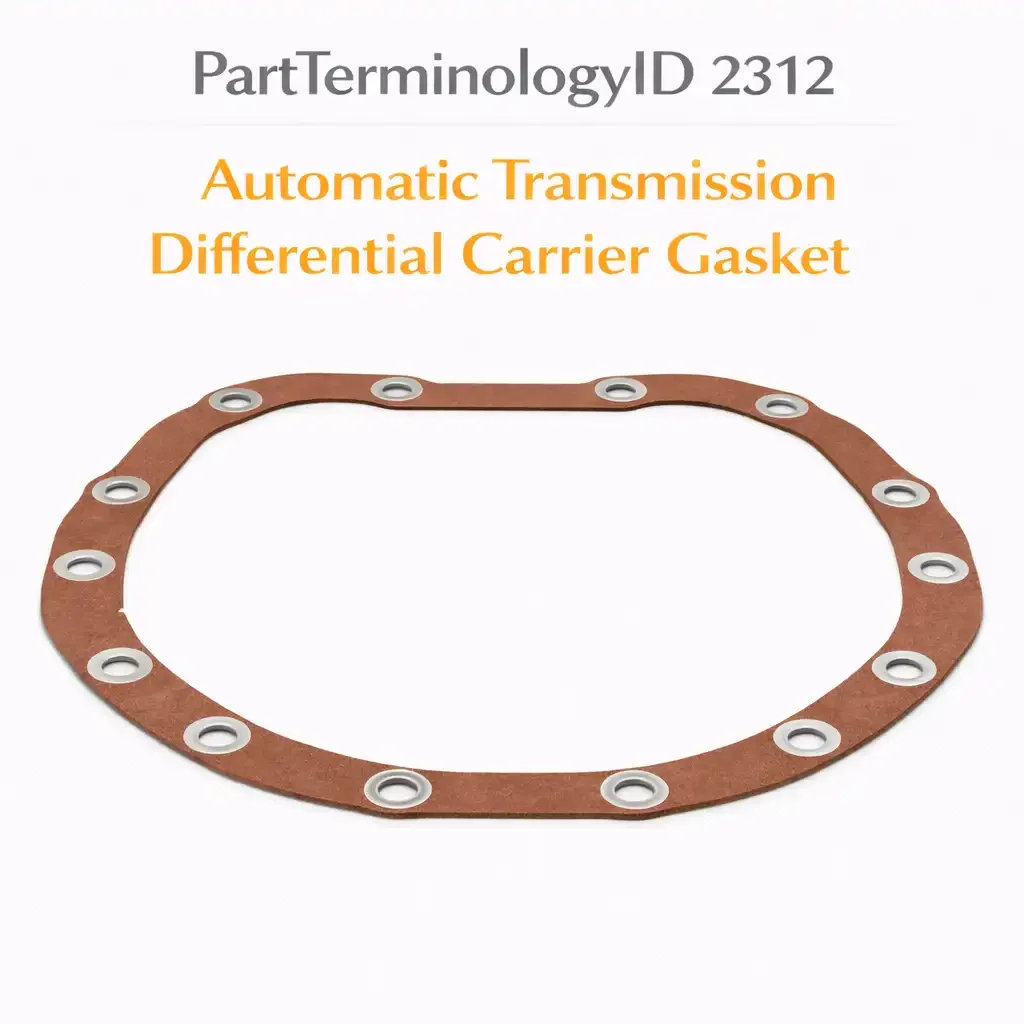
PartTerminologyID 2312, Automatic Transmission Differential Carrier Gasket, is a gasket that seals the differential carrier assembly within an automatic transmission housing, preventing automatic transmission fluid from leaking at the carrier-to-housing interface. That definition identifies both the sealing function and the unusual location: this is not a standalone axle differential gasket but a gasket internal to an automatic transmission, at the point where the transmission's integrated differential carrier meets the transmission housing bore or cover. That distinction immediately narrows the application population to front-wheel-drive and all-wheel-drive vehicles with transaxles, where the differential is built into the transmission housing rather than into a separate axle housing, and to a small number of independent rear drive units that integrate a differential within the gearbox casting. A listing under PartTerminologyID 2312 applied to a vehicle with a conventional longitudinal driveline and a separate rear axle is applied to a vehicle that does not have this component at all.
For sellers, the automatic transmission differential carrier gasket sits at the intersection of two catalog problems. The first is population specificity: only transaxle applications have this gasket, and within transaxle applications the gasket is specific to the transmission model, not just the vehicle model, because the same vehicle may have been produced with multiple transmission options whose carrier gasket specifications differ. The second is consequence severity: a leaking differential carrier gasket inside an automatic transmission does not produce a simple puddle under the vehicle. It allows ATF to migrate from the differential cavity into adjacent transmission cavities or to the exterior, which may contaminate the clutch packs, alter the transmission fluid level in the working circuit, or produce an external leak that is misdiagnosed as a transmission pan gasket leak or an axle shaft seal leak because the fluid path from the internal gasket to the exterior is indirect.
For sellers, the listing under this PartTerminologyID is only useful if it specifies the transmission model designation, the sealing surface profile, the gasket material, the gasket thickness, and whether the carrier must be removed from the transmission for gasket replacement or whether the gasket is accessible with the transmission in place. Without those five attributes, the listing cannot be distinguished from a general transmission gasket listing and cannot be evaluated by the technician who has already diagnosed the leak location and needs a specific replacement.
What the Automatic Transmission Differential Carrier Gasket Does
Sealing the differential carrier at its housing interface within the transaxle
In a front-wheel-drive transaxle, the differential carrier is housed in a cavity that is cast as part of the transmission housing or covered by a separate carrier housing bolted to the main transmission case. The differential ring gear, carrier bearings, and side gears are contained in this cavity. The carrier gasket seals the interface between the carrier housing or cover and the main transmission case, preventing ATF from leaking at this joint.
On some transaxle designs, the differential cavity shares fluid with the transmission's main circuit. In those designs, the carrier gasket is a separator between the differential cavity and an adjacent casting face rather than a seal against the atmosphere. On other transaxle designs, the differential has a separate fluid circuit with its own fill and drain provisions, and the carrier gasket seals the differential cavity against both the adjacent transmission fluid circuit and the external environment. The gasket material and thickness specification differs between these two designs because the fluid pressure differential across the gasket differs.
A carrier gasket that fails in a shared-fluid transaxle allows fluid to migrate between the differential cavity and the adjacent cavity through the gasket leak path. On a design where both cavities use the same ATF specification, this migration may not immediately damage any components, but it alters the fluid distribution within the housing and may cause the fluid level in the main circuit to read incorrectly. On a design where the differential uses a different lubricant from the transmission's main circuit, gasket failure that allows fluid mixing will degrade both lubricants and damage the friction elements that depend on precise fluid chemistry.
The differential carrier gasket versus the transmission pan gasket
The transmission pan gasket seals the removable oil pan at the bottom of the transmission housing, which provides access to the valve body and the filter. The differential carrier gasket seals the differential carrier at a separate location in the transmission housing, typically at the end of the housing or at a side cover. Both are internal-to-transmission gaskets, but they are at different locations, different shapes, different sizes, and require different service procedures to access.
A transmission fluid leak that is visible at the differential end of the transaxle, near the axle shaft outputs, is as likely to be a carrier gasket leak as an axle shaft seal leak. The carrier gasket leak and the axle shaft seal leak both produce fluid at the same general area of the transmission, but the carrier gasket is between the transmission housing faces while the axle shaft seal is at the rotary shaft exit. Distinguishing between them requires either a pressure test or a dye trace, and a technician who orders a carrier gasket based on the leak location without confirming the leak source may receive the correct part for the wrong diagnosis.
The listing must describe the carrier gasket's location clearly enough that the technician can confirm the leak is at the carrier housing joint rather than at the axle shaft seal before ordering.
The relationship between the carrier gasket and ATF chemistry
Automatic transmission fluid formulations have evolved significantly across model generations, and the gasket materials used in transaxle differential carriers have evolved in parallel. An older transmission that was designed for Dexron-II ATF uses a carrier gasket material that is compatible with the mineral-oil-based Dexron-II formulation. The same transmission rebuilt with a modern Dexron-VI synthetic fluid may expose that gasket material to a fluid chemistry it was not designed for, which can cause the gasket to swell, harden, or degrade prematurely.
The listing must specify the ATF compatibility of the gasket material. A gasket marked as compatible with Dexron-VI synthetic formulations is appropriate for modern transmissions and for older transmissions that have been converted to synthetic fluid. A gasket marked only for Dexron-II or Dexron-III compatibility should not be used in transmissions running modern synthetic ATF.
Service access: transmission-in-vehicle versus transmission-removed
The service procedure for replacing the automatic transmission differential carrier gasket varies by transmission design. On some transaxles, the carrier housing or cover is accessible with the transmission in the vehicle, requiring only removal of the axle shafts and the carrier cover bolts. On other designs, the differential carrier is at the end of the transmission housing that faces the engine block, which is not accessible without removing the transmission from the vehicle.
A technician who orders the carrier gasket expecting to replace it with the transmission in place and then discovers the gasket is not accessible without transmission removal has underestimated the job by several hours of labor. The listing must state whether the gasket is accessible with the transmission in the vehicle or requires transmission removal.
The Specifications That Determine Correct Gasket Fitment
Transmission model designation
The transmission model designation is the primary fitment attribute. The same vehicle may have been produced with multiple transmission options, each with a different carrier housing profile and a different carrier gasket specification. A listing applied to the vehicle model without the transmission designation cannot distinguish between those options.
Common transaxle designations where PartTerminologyID 2312 applies include GM 4T65-E, GM 4T40-E, Honda MLYA, Honda SLXA, Chrysler 41TE, Ford AX4S, Toyota A140E, and numerous others. Each has a carrier housing specific to that transmission design.
Sealing surface profile
The carrier housing sealing surface profile determines the gasket's shape, the bolt hole pattern, and the sealing bead geometry. A gasket designed for one carrier housing profile cannot seal a different profile even if the outer dimensions are similar, because the bolt holes will not align and the sealing bead will not contact the sealing surface correctly.
The sealing surface profile must be confirmed against the original gasket or the service manual before ordering. The safest confirmation method is to measure the bolt hole pattern of the original gasket and compare it to the replacement specification.
Gasket material and thickness
The gasket material determines the ATF compatibility, the compressibility under bolt torque, and the temperature resistance. Common carrier gasket materials include cork-rubber composite, fiber-reinforced paper, molded rubber with a steel carrier, and PTFE-coated multi-layer steel (MLS). The material must be compatible with the ATF formulation in the transmission.
The gasket thickness determines how much the gasket compresses under the specified bolt torque to achieve the designed sealing contact pressure. A gasket that is thicker than the original may require more bolt torque than the casting can safely accept. A gasket that is thinner may not achieve the required contact pressure at the specified bolt torque.
Bolt torque specification
The bolt torque specification for the carrier housing bolts must be stated in the listing or in the accompanying instructions. Over-torquing carrier housing bolts on aluminum transaxle cases cracks or strips the threaded bores in the casting, which creates a leak that no gasket can seal.
Why This Part Generates Returns
Buyers order the wrong automatic transmission differential carrier gasket because:
the transmission model designation is not specified and the buyer's carrier housing profile does not match the replacement gasket bolt pattern
the vehicle is a conventional rear-wheel-drive application with a separate axle and does not have this component, and the listing was incorrectly applied by vehicle year, make, and model without confirming the transaxle requirement
the gasket material is not specified and the buyer installs a mineral-oil-compatible gasket in a transmission running modern synthetic ATF, which causes the gasket to degrade within the first heat-cool cycles
the service access requirement is not stated and the buyer discovers the gasket requires transmission removal after ordering the part expecting an in-vehicle repair
the bolt hole pattern does not match because the listing covers a different model year when the carrier housing design changed during the transmission's production run
the gasket is confused with the transmission pan gasket or the axle shaft seal and the buyer has ordered the wrong component for the leak they are diagnosing
Status in New Databases
PIES/PCdb: PartTerminologyID 2312, Automatic Transmission Differential Carrier Gasket
PIES 8.0 / PCdb 2.0: No change
Top Return Scenarios
Scenario 1: "Vehicle has conventional rear axle, no differential carrier gasket exists in this transmission"
The listing was applied to a rear-wheel-drive pickup truck by vehicle year, make, and model without confirming the vehicle has a transaxle with an integrated differential. The buyer's transmission is a longitudinal automatic with a separate rear axle. There is no differential carrier gasket in this transmission. The component does not exist on this application.
Prevention language: "Application note: this gasket applies to transaxle-equipped vehicles where the differential is integrated within the automatic transmission housing. Verify your vehicle has a front-wheel-drive or all-wheel-drive transaxle before ordering. Rear-wheel-drive vehicles with a separate rear axle do not have a differential carrier gasket in the transmission."
Scenario 2: "Transmission model changed mid-production, carrier housing bolt pattern different"
The buyer's vehicle uses a GM 4T65-E transmission. The listing covers the GM 4T40-E, which was also available in the same vehicle. The carrier housing bolt patterns are different between the two transmission models. None of the bolt holes align.
Prevention language: "Transmission model: [GM 4T65-E]. Verify your transmission model designation matches before ordering. This vehicle was available with multiple transmission options. The carrier housing bolt pattern is specific to the transmission model, not the vehicle model. Check the transmission identification tag or VIN decoder for your specific transmission designation."
Scenario 3: "Cork gasket degraded in synthetic ATF within 6 months"
The replacement gasket is a cork-rubber composite material. The buyer's transmission was refilled with a modern full-synthetic ATF during the service. The cork-rubber material swelled and degraded in the synthetic formulation within 6 months. The carrier housing began leaking again.
Prevention language: "Gasket material: [cork-rubber / fiber paper / molded rubber / MLS steel]. ATF compatibility: [Dexron-II, Dexron-III only / Dexron-VI synthetic compatible / all ATF formulations]. Verify the gasket material is compatible with the ATF formulation in your transmission. Cork-rubber gaskets are not rated for modern full-synthetic ATF formulations. Use a fiber paper or MLS gasket for transmissions running Dexron-VI or equivalent synthetic fluid."
Scenario 4: "Transmission removal required, buyer expected in-vehicle repair"
The carrier housing on the buyer's transaxle faces the engine block and is not accessible with the transmission in the vehicle. The listing did not state the service access requirement. The buyer ordered the gasket expecting a straightforward in-vehicle repair. The actual repair requires transmission removal and adds six to eight hours of labor to the job.
Prevention language: "Service access: [accessible with transmission in vehicle / requires transmission removal]. Verify the service access requirement for your specific transaxle before scheduling the repair. On this application, the carrier housing is located at the [front / rear / side] of the transmission case. [Note access requirement here.] Confirm the labor scope before ordering the gasket."
Scenario 5: "Gasket mistaken for axle shaft seal, carrier gasket ordered for an axle shaft seal leak"
The buyer has ATF leaking from the area near the right axle shaft output. The leak was diagnosed as a carrier gasket leak without pressure testing or dye tracing. The buyer ordered the carrier gasket and replaced it. The leak continued because the source was the right axle shaft seal, not the carrier gasket. The carrier gasket and the axle shaft seal are at different locations on the same end of the transmission but produce fluid in overlapping areas.
Prevention language: "Leak location note: ATF leaks near the axle shaft outputs may originate from the carrier gasket at the housing joint or from the axle shaft seal at the shaft exit. These two leak sources produce fluid in the same general area but require different repairs. Confirm the leak source by pressure testing the carrier housing joint or by adding fluorescent dye to the ATF and tracing the leak with a UV light before ordering this gasket."
What to Include in the Listing
Core essentials
PartTerminologyID: 2312
component: Automatic Transmission Differential Carrier Gasket
application confirmation: transaxle application with integrated differential (mandatory)
transmission manufacturer and model designation (mandatory)
transmission production date range (mandatory when the carrier housing specification changed during production)
sealing surface profile: bolt hole count, bolt hole pattern dimensions (mandatory)
gasket material (mandatory)
ATF compatibility specification (mandatory)
gasket thickness in mm (mandatory)
service access requirement: in-vehicle or transmission removal required (mandatory)
bolt torque specification in ft-lbs or Nm (mandatory)
quantity: 1
Fitment essentials
year/make/model/submodel
transmission model designation (primary fitment attribute)
drivetrain: front-wheel drive or all-wheel drive (mandatory to confirm transaxle application)
engine displacement when the transmission specification varies by engine within the same model
Dimensional essentials
gasket outer profile dimensions in mm
bolt hole count and bolt hole diameter
bolt hole pattern dimensions (bolt circle or bolt spacing)
gasket thickness in mm compressed and uncompressed
sealing bead location and width for molded rubber gaskets
Image essentials
gasket in isolation showing the full profile, bolt holes, and sealing bead
gasket installed context showing the carrier housing face and the gasket seated in position
transmission housing diagram showing the carrier gasket location relative to the pan gasket and axle shaft seal locations to aid leak diagnosis
ATF compatibility marking visible on gasket packaging
Catalog Checklist for ACES/PIES Teams
PartTerminologyID = 2312
require application confirmation: transaxle with integrated differential (mandatory before any other attribute)
require transmission model designation (mandatory, primary fitment attribute)
require transmission production date range when carrier housing changed mid-production (mandatory)
require gasket material with ATF compatibility specification (mandatory)
require service access requirement (mandatory)
require bolt torque specification (mandatory)
do not apply to rear-wheel-drive vehicles with separate rear axles: those vehicles do not have this component
differentiate from transmission pan gasket (PartTerminologyID varies): the pan gasket seals the removable oil pan at the bottom of the housing; the carrier gasket seals the differential carrier housing at a separate location; both are transmission gaskets but at different positions requiring different service procedures
differentiate from axle shaft seal (PartTerminologyID varies): the axle shaft seal is a rotary lip seal at the shaft exit point; the carrier gasket is a static face seal at the housing joint; both produce leaks in the same general area of the transaxle; distinguish in the listing to prevent cross-ordering
differentiate from differential cover gasket (PartTerminologyID varies): the differential cover gasket seals a standalone axle differential; this gasket seals the differential carrier within an automatic transaxle; the two components are in entirely different assemblies
flag application confirmation as first mandatory attribute: the most consequential listing error for this PartTerminologyID is applying it to rear-wheel-drive vehicles that do not have this component
flag ATF compatibility as mandatory: synthetic ATF incompatibility with cork or early-generation gasket materials produces a repeat failure within months that a correct material specification would have prevented
flag service access as mandatory: a technician who discovers mid-job that transmission removal is required when they expected an in-vehicle repair will return the part pending a labor estimate revision
FAQ (Buyer Language)
How do I identify my automatic transmission model to confirm this gasket fits?
The transmission model designation is typically on a metal identification tag attached to the transmission housing or stamped into the casting. On GM transaxles, the tag is on the driver's side of the case. On Honda transaxles, the model code is cast into the housing. The VIN decoder for your vehicle will also identify the transmission option code, which cross-references to the transmission model designation. If the tag is missing, the transmission can be identified by the pan shape and bolt count combined with the casting number, which cross-references to manufacturer identification guides.
My transaxle leaks ATF near the right axle output. How do I know if it is the carrier gasket or the axle shaft seal?
The most reliable method without disassembly is a fluorescent dye trace. Add the manufacturer-specified fluorescent ATF dye to the fluid, run the vehicle through several heat cycles, and inspect the area with a UV light. The dye will trace the leak path from its source. A carrier gasket leak will show the dye originating at the housing joint face, which is the flat mating surface between the carrier housing and the main case. An axle shaft seal leak will show the dye originating at the shaft exit point where the seal lip contacts the shaft. The two leak paths often converge at the same drip point, which is why they are easily confused without the dye trace.
Can I replace the carrier gasket with the transmission in the vehicle?
On some transaxle designs, yes. Transaxles where the differential carrier is housed in a cover bolted to the end or side of the main case are often serviceable with the transmission in place after removing the axle shafts and unbolting the carrier cover. On transaxles where the differential carrier is housed in the main casting and the carrier sealing surface faces the engine block, the transmission must be removed. Verify the carrier housing location on your specific transmission before assuming the repair can be done in the vehicle.
What ATF should I use when refilling after replacing the carrier gasket?
Use the ATF specification stated in your vehicle owner's manual or the transmission service manual. Do not mix ATF formulations. If the transmission was previously filled with a Dexron-III mineral-based fluid and the new carrier gasket is rated for Dexron-VI synthetic, the entire fluid volume should be replaced with the correct Dexron-VI fluid at the same service event rather than topping up with a mixed formulation. Some transaxle manufacturers specifically prohibit using previous-generation ATF in updated transmissions because the friction modifier chemistry in the older formulation is incompatible with the revised clutch pack materials.
The carrier housing bolts stripped during removal. What are my options?
Stripped carrier housing bolts in an aluminum transaxle case are a common consequence of over-torquing or of attempting to remove bolts that have corroded in place. Thread repair inserts, either Helicoil or time-sert type, can restore the threaded bore if the casting material around the hole is intact. Time-sert inserts are generally preferred for aluminum transmission cases because they provide a larger thread engagement area than standard Helicoil inserts. If the casting is cracked around the stripped hole, the case must be replaced. Do not over-torque the replacement bolts in a repaired bore: use the specified torque and verify the thread engagement is secure before torquing to spec.
Cross-Sell Logic
Axle Shaft Seal (the axle shaft seals are inspected when the axle shafts are removed for carrier gasket access; replace any seal that shows weeping or hardening at the same service event)
Automatic Transmission Fluid (the ATF is drained and replaced whenever the carrier housing is opened; verify the correct specification and quantity before refilling)
Transmission Pan Gasket (PartTerminologyID varies: if the transmission pan is removed at the same service event for filter replacement, the pan gasket is replaced concurrently)
Transmission Filter (if the ATF is being replaced at the carrier gasket service event, the transmission filter is replaced at the same time)
Carrier Housing Bolt Set (if the original bolts are corroded, stripped, or stretched, a replacement bolt set of the correct thread, length, and torque rating is required)
Thread Repair Insert Kit (if any carrier housing bolt bore is stripped, a thread repair insert kit must be on hand before the service begins)
Frame as "the carrier gasket seals the housing that contains the differential. The ATF lubricates the differential inside the sealed housing. The axle shaft seals seal the shafts that exit the differential. The pan gasket seals the pan that allows access to the transmission below the differential. All are in the same service path on a transaxle and relevant ones are replaced at the same opening event."
Final Take for PartTerminologyID 2312
Automatic Transmission Differential Carrier Gasket (PartTerminologyID 2312) is a narrow-application component whose most consequential listing error is not a dimensional mismatch but an application error: applying the listing to a vehicle that does not have this component because the vehicle has a conventional rear-wheel-drive driveline with a separate axle. The application confirmation is the first attribute in the listing for the same reason that the pilot bearing application confirmation was the first attribute in the differential pinion pilot bearing post (2268): before any dimension is evaluated, the buyer must confirm the component exists in their assembly.
Within the correct transaxle applications, the transmission model designation is the primary fitment attribute because the same vehicle was produced with multiple transmission options whose carrier housing profiles differ. The ATF compatibility of the gasket material is the durability attribute that determines whether the gasket seals for its full service life or degrades within months from exposure to a fluid formulation it was not designed for. The service access requirement is the labor planning attribute that prevents a technician from committing to an in-vehicle repair on a gasket that requires transmission removal.
State the application confirmation. State the transmission model. State the gasket material and ATF compatibility. State the sealing surface profile and bolt pattern. State the service access requirement. State the bolt torque specification. That is the same listing strategy as every other PartTerminologyID in this series: the generic PartTerminologyID requires specific attributes at every level to become a listing buyers can act on without guessing. For PartTerminologyID 2312, the first guess that needs to be eliminated is whether the component exists on the vehicle at all.