
Written by Arthur Simitian | PartsAdvisory
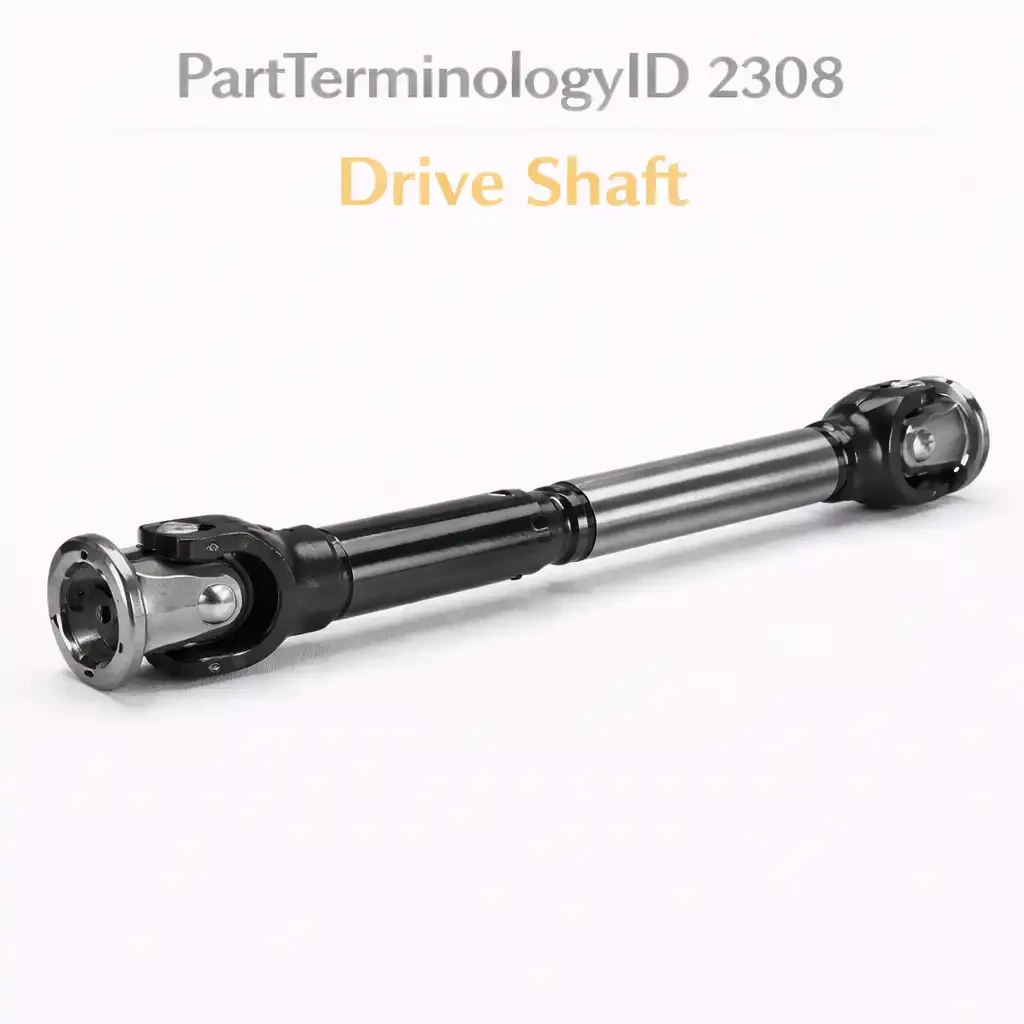
PartTerminologyID 2308, Drive Shaft, is the rotating shaft that transfers torque from the transmission or transfer case output to the differential input, bridging the distance between the driving unit and the driven axle along the vehicle's longitudinal axis. That definition places the shaft correctly in the drivetrain. It does not specify whether the shaft is a one-piece or two-piece design, what the overall length is, what the tube outer diameter is, what the tube wall thickness is, what the end yoke configurations are, what the U-joint series is at each end, whether the slip yoke is at the transmission end or the differential end or both, what the slip yoke spline count and diameter are, what the companion flange bolt circle is at the differential end, whether the shaft is a steel tube or an aluminum tube or a carbon fiber tube, what the critical speed rating is, whether the shaft is balanced as an assembly or requires field balancing after installation, or whether the shaft is a direct OE replacement or an aftermarket shaft built to different specifications. A listing under PartTerminologyID 2308 that provides vehicle year, make, and model without the shaft length, the end configurations, the U-joint series, and the slip yoke specification cannot be evaluated by any buyer who is replacing a shaft against measured original dimensions or sourcing a shaft for a modified vehicle where the stock length no longer applies.
For sellers, the drive shaft is a component where vibration is the dominant failure consequence and where the specifications that prevent vibration are exactly the ones most consistently absent from listings. A shaft that is the wrong length will either bind against the transmission yoke at full suspension compression or will pull off the slip yoke at full suspension extension. A shaft with the wrong U-joint series at either end will not bolt or press into the yoke correctly. A shaft that is not balanced to the correct specification will produce a vibration that varies with vehicle speed and that no amount of wheel balancing, tire rotation, or alignment will resolve because the vibration source is in the driveline, not at the wheels. None of those failure consequences are visible during installation. They are discovered when the vehicle is driven, which means the shaft has been installed, the undercarriage has been reassembled, and the vehicle has been lowered off the lift before the problem announces itself.
For sellers, the listing under this PartTerminologyID is only useful if it specifies the shaft type, the overall collapsed length, the tube outer diameter, the U-joint series at each end, the slip yoke spline specification, the companion flange configuration, the tube material, and the balance specification. Without those eight attributes, the listing cannot prevent the length, configuration, and balance errors that produce the returns and the vibration complaints that dominate this PartTerminologyID.
What the Drive Shaft Does
Transferring torque across a variable-length, variable-angle span
The distance between the transmission output and the differential input changes as the suspension travels. When the suspension compresses, the differential moves toward the transmission and the effective driveshaft length decreases. When the suspension extends, the differential moves away from the transmission and the effective driveshaft length increases. The drive shaft accommodates this length change through a slip yoke at one end that allows the shaft to telescope while maintaining the spline engagement that transfers torque.
The angle between the transmission output and the differential input also changes as the suspension travels. Universal joints at each end of the shaft allow torque transfer through these changing angles. The U-joint at the transmission end and the U-joint at the differential end together define the operating angle of the driveshaft. When the two U-joint angles are equal and the U-joints are phased correctly, the velocity fluctuation introduced by one U-joint is cancelled by the velocity fluctuation of the other, producing a smooth constant velocity output at the differential input. When the two angles are not equal, the velocity fluctuations add rather than cancel and the driveline vibrates at twice the driveshaft rotational frequency.
The one-piece versus two-piece shaft
A one-piece shaft spans the entire distance from the transmission output to the differential input as a single tube. On most passenger cars and short-wheelbase trucks, the distance is short enough that a one-piece steel tube can be rotated at the maximum driveshaft speed without exceeding the tube's critical speed, which is the rotational speed at which the shaft's natural frequency is excited and the shaft begins to whip rather than rotate. A one-piece shaft is simpler, lighter, and less expensive than a two-piece design.
On longer-wheelbase vehicles, a one-piece steel tube long enough to span the full transmission-to-differential distance would require a larger tube diameter to maintain an adequate margin above the critical speed at highway velocity. The larger tube adds weight and reduces the available clearance to the floor and exhaust. A two-piece shaft solves this problem by dividing the total length into two shorter sections, each of which can be a smaller-diameter tube rotating comfortably below its critical speed. The two sections are connected by a center bearing that mounts to the chassis and that supports the midpoint of the driveshaft assembly.
The listing must specify whether the shaft is one-piece or two-piece. On two-piece shaft applications, the listing must specify both front and rear section lengths and the center bearing specification.
The U-joint series and its consequences for fitment
Universal joints are produced in several series defined by the cross and bearing cup dimensions. Common domestic series include the Spicer 1310, 1330, 1350, and 1410 series. The series number encodes the cross width and the bearing cup diameter. A 1310 cross is narrower and uses a smaller bearing cup than a 1350 cross. The yoke at each end of the drive shaft is machined to accept a specific U-joint series. A 1310 yoke cannot accept a 1350 cross because the bearing cup bores in the yoke ears are smaller than the 1350 cup outer diameter.
U-joint series upgrades are common on trucks and four-wheel-drive vehicles where the original 1310-series components are being replaced with 1350-series components for increased torque capacity. A shaft ordered with the wrong U-joint series at either end will not connect to the transmission yoke or the companion flange at the differential.
The listing must specify the U-joint series at the transmission end and the differential end separately because they may differ on the same shaft. Some driveshafts use a smaller series at the transmission end, where the yoke is smaller, and a larger series at the differential end, where the companion flange is larger.
The slip yoke versus the fixed yoke end
Most drive shafts have a slip yoke at one end that slides onto the transmission output shaft and telescopes as the suspension travels. The slip yoke has internal splines that engage the transmission output shaft's external splines. The spline count and pitch circle diameter must match the transmission output shaft exactly.
The other end of most drive shafts is a fixed yoke that connects to the companion flange at the differential pinion by U-bolts or by a flange bolt pattern. The companion flange bolt circle diameter, the bolt count, and the bolt hole diameter must match the differential pinion flange on the axle.
Some drive shafts have a slip yoke at both ends. Some have a fixed yoke at both ends with a separate slip joint in the shaft tube. The end configuration must be specified in the listing because a shaft with the wrong end configuration at either position cannot be connected to the transmission or the differential.
Critical speed and tube diameter
The critical speed of a rotating shaft is the speed at which the shaft's elastic deflection under its own weight is amplified by resonance, causing the shaft to whip violently. For a given tube length, the critical speed is determined by the tube outer diameter, the wall thickness, and the tube material. A larger outer diameter and a thicker wall raise the critical speed. A longer tube lowers the critical speed for a given diameter.
For a one-piece driveshaft on a long-wheelbase vehicle, the critical speed margin must be verified against the maximum vehicle speed times the driveline gear ratio. A shaft that reaches its critical speed at highway velocity will produce a severe vibration that can destroy U-joints, center bearings, and differential pinion bearings within a short distance. The listing must state the tube outer diameter, the wall thickness, and the critical speed rating in RPM so the buyer can verify the margin against the vehicle's maximum driveshaft speed.
The Specifications That Determine Correct Drive Shaft Fitment
Overall collapsed length
The collapsed length is the total shaft length measured with the slip yoke fully compressed. This is the dimension that determines whether the shaft fits in the available space between the transmission output and the differential input at the vehicle's design ride height. The correct collapsed length is specified in the vehicle service manual for the specific transmission, transfer case, and axle combination.
For modified vehicles with suspension lifts, body lifts, or transmission swaps, the collapsed length of the stock shaft may no longer be correct because the geometry has changed. The listing must state the collapsed length and must note any known application caveats for vehicles with suspension modifications.
Extended length and slip travel
The extended length is the shaft length at full suspension extension. The difference between the collapsed length and the extended length is the slip travel, which must cover the full suspension extension range without the slip yoke pulling off the transmission output shaft. A shaft with insufficient slip travel will pull off the transmission splines at full suspension droop, disengaging the drivetrain and potentially damaging the transmission seal and output shaft.
Tube outer diameter and wall thickness
The tube outer diameter determines the critical speed rating and the available underbody clearance. Common domestic drive shaft tube outer diameters range from 2.5 inches to 4.5 inches depending on the torque rating and the shaft length. The wall thickness determines the shaft's torsional strength and its critical speed rating alongside the outer diameter.
U-joint series at each end
State the U-joint series at the transmission end and the differential end separately. Note whether the U-joint series can be upgraded within the same yoke bore on performance applications.
Slip yoke spline specification
The slip yoke spline count and pitch circle diameter must match the transmission output shaft. Common domestic transmission output shaft spline counts include 27, 29, 31, and 32 splines depending on the transmission model. A slip yoke with the wrong spline count will not engage the transmission output shaft.
Companion flange configuration
The companion flange at the differential end must match the differential pinion companion flange in bolt circle diameter, bolt count, and bolt hole size. Some applications use a U-bolt connection rather than a flange bolt connection, and the U-bolt size and U-bolt seat dimensions must match the differential pinion yoke.
Balance specification
OE drive shafts are dynamically balanced at the factory to a specification stated in gram-inches or gram-centimeters of residual imbalance. Aftermarket replacement shafts must be balanced to the same or better specification before shipment. The listing must state the balance specification and confirm the shaft was balanced as a complete assembly, not as individual components.
Why This Part Generates Returns
Buyers order the wrong drive shaft because:
the collapsed length is not stated and the shaft is too long or too short for the transmission-to-differential span
the U-joint series is not specified and the bearing cups do not fit the yoke bores at one or both ends
the slip yoke spline count is not stated and the yoke will not engage the transmission output shaft
the companion flange bolt circle does not match the differential pinion flange
the shaft is not balanced or is balanced to an insufficient specification and produces vibration after installation
the shaft is for a one-piece application and the vehicle has a two-piece shaft with a center bearing, or vice versa
the slip travel is insufficient and the yoke pulls off the transmission output at full suspension extension on a lifted vehicle
Status in New Databases
PIES/PCdb: PartTerminologyID 2308, Drive Shaft
PIES 8.0 / PCdb 2.0: No change
Top Return Scenarios
Scenario 1: "Shaft too short, slip yoke pulls off transmission output at full suspension droop"
The replacement shaft's collapsed length is 18mm shorter than the original. At full suspension droop, the slip yoke reaches the end of its travel and the splines disengage from the transmission output shaft. The drivetrain disconnects and the transmission output seal is damaged by the disengaging yoke.
Prevention language: "Collapsed length: [X.X] inches. Slip travel: [X.X] inches. Verify the collapsed length matches your transmission-to-differential span at ride height and that the slip travel covers your vehicle's full suspension extension range. On vehicles with suspension lifts, the required slip travel increases with lift height. Insufficient slip travel will cause the slip yoke to disengage from the transmission output at full suspension droop."
Scenario 2: "Wrong U-joint series, bearing cups do not fit differential end yoke bores"
The shaft is built with 1350-series U-joints at both ends. The differential companion flange has 1310-series yoke bores. The 1350 bearing cups are too large in outer diameter to press into the 1310 yoke bores.
Prevention language: "U-joint series, transmission end: [1310 / 1330 / 1350 / 1410]. U-joint series, differential end: [1310 / 1330 / 1350 / 1410]. Verify both U-joint series match your transmission output yoke and your differential companion flange yoke bores. U-joint bearing cup outer diameters differ between series and a larger-series bearing cup cannot be pressed into a smaller-series yoke bore."
Scenario 3: "Slip yoke spline count mismatch, yoke will not engage transmission output shaft"
The slip yoke has 27 splines. The transmission output shaft has 29 splines. The yoke will not slide onto the output shaft. The listing specified the shaft by vehicle year, make, and model without stating the slip yoke spline count, and the vehicle was available with two different transmission options that have different output shaft spline counts.
Prevention language: "Slip yoke spline count: [X] splines. Slip yoke pitch circle diameter: [X.XX] inches. Verify your transmission output shaft spline count before ordering. Some vehicle applications were available with multiple transmission options that have different output shaft spline counts. Confirm the transmission model and its output shaft specification before ordering."
Scenario 4: "Shaft vibration at highway speed, balance specification not confirmed"
The replacement shaft produces a vibration at 65 to 75 mph that was not present with the original shaft. The listing did not state the balance specification. The replacement shaft was balanced as individual components but not as a complete assembly. The assembly imbalance, which results from the angular relationship between the components at assembly, was not corrected.
Prevention language: "Balance specification: [X] gram-inches residual imbalance. Balance method: complete assembly dynamic balance. Verify the shaft was balanced as a complete assembly before shipment. A shaft balanced as individual components but not as a final assembly may have residual assembly imbalance that produces a speed-sensitive vibration after installation."
Scenario 5: "One-piece shaft received, vehicle has two-piece shaft with center bearing"
The vehicle has a two-piece driveshaft with a center support bearing mounted to the chassis. The listing specified the shaft by vehicle model without distinguishing one-piece from two-piece applications. The buyer received a one-piece shaft. The one-piece shaft is longer than the rear section of the two-piece assembly and will not fit the installation without removing the center bearing mount bracket.
Prevention language: "Shaft type: [one-piece / two-piece front section / two-piece rear section]. Verify your vehicle's original shaft configuration before ordering. Vehicles with two-piece driveshafts have a center support bearing mounted to the chassis that is not present on one-piece shaft applications. A one-piece shaft cannot substitute for a two-piece shaft system without removing the center bearing mount and modifying the transmission tunnel clearance."
Scenario 6: "Companion flange bolt circle mismatch, U-bolts will not seat on differential yoke"
The differential pinion uses a 1310-series U-bolt connection with a specific U-bolt seat width. The replacement shaft's differential end yoke is machined for a flange bolt connection with a different geometry. The U-bolts from the original shaft cannot seat in the replacement yoke's cap seats.
Prevention language: "Differential end connection type: [U-bolt / flange bolt]. U-bolt seat width: [X.XX] inches for U-bolt applications. Flange bolt circle diameter: [X.XX] inches for flange bolt applications. Verify the differential end connection type matches your differential pinion yoke configuration before ordering."
What to Include in the Listing
Core essentials
PartTerminologyID: 2308
component: Drive Shaft
shaft type: one-piece, two-piece front section, or two-piece rear section (mandatory)
overall collapsed length in inches (mandatory)
extended length in inches (mandatory)
slip travel in inches (mandatory)
tube outer diameter in inches (mandatory)
tube wall thickness in inches (mandatory)
tube material: steel, aluminum, or carbon fiber (mandatory)
U-joint series at transmission end (mandatory)
U-joint series at differential end (mandatory)
slip yoke spline count (mandatory)
slip yoke pitch circle diameter in inches (mandatory)
differential end connection type: U-bolt or flange bolt (mandatory)
companion flange bolt circle diameter and bolt count for flange bolt applications (mandatory)
U-bolt size and seat width for U-bolt applications (mandatory)
critical speed rating in RPM (mandatory)
balance specification in gram-inches (mandatory)
center bearing specification for two-piece rear section shafts (mandatory)
quantity: 1
Fitment essentials
year/make/model/submodel
transmission model (mandatory: slip yoke spline count varies by transmission)
transfer case model on four-wheel-drive applications
axle designation (mandatory: companion flange specification varies by axle)
suspension lift height for lifted vehicle applications
OE or aftermarket application designation
Dimensional essentials
collapsed length in inches
extended length in inches
slip travel in inches
tube outer diameter in inches
tube wall thickness in inches (or tube weight per foot)
U-joint cross width and bearing cup outer diameter for each end
slip yoke spline count and pitch circle diameter
companion flange bolt circle diameter, bolt count, and bolt hole diameter
U-bolt width across cap seats and U-bolt thread size for U-bolt applications
Image essentials
complete shaft shown with length callout
transmission end shown with slip yoke and U-joint series visible
differential end shown with companion flange or U-bolt connection and U-joint series visible
tube cross-section showing outer diameter and wall thickness
balance weight locations shown on the tube exterior
for two-piece shafts, the center bearing shown with its mount bracket
Catalog Checklist for ACES/PIES Teams
PartTerminologyID = 2308
require shaft type: one-piece, two-piece front, or two-piece rear (mandatory)
require collapsed length in inches (mandatory)
require slip travel in inches (mandatory)
require tube outer diameter and wall thickness (mandatory)
require tube material (mandatory)
require U-joint series at each end separately (mandatory)
require slip yoke spline count and pitch circle diameter (mandatory)
require differential end connection type and dimensions (mandatory)
require critical speed rating in RPM (mandatory)
require balance specification and balance method (mandatory)
require transmission model as primary fitment attribute alongside vehicle fitment (mandatory)
differentiate from drive shaft center support bearing (PartTerminologyID varies): the center bearing mounts the midpoint of a two-piece shaft to the chassis; the drive shaft is the rotating tube assembly the bearing supports; both may be required when a two-piece shaft system is serviced
differentiate from drive shaft U-joint (PartTerminologyID varies): the U-joint is the cross-and-bearing-cup assembly at each end of the shaft; the drive shaft is the complete assembly including the tube, yokes, and U-joints; both may be listed separately and the U-joint inclusion status must be stated in the shaft listing
differentiate from halfshaft (PartTerminologyID varies): the halfshaft connects the differential to the wheel hub on front-wheel-drive and independent rear suspension vehicles using CV joints; the drive shaft connects the transmission output to the differential input using U-joints; both are rotating shafts but at different positions in the drivetrain with different joint types
flag collapsed length as primary dimensional attribute: a shaft that is too short pulls off the transmission output at full droop; a shaft that is too long binds against the floor or exhaust at full compression
flag balance specification as mandatory: an unbalanced or insufficiently balanced shaft produces a speed-sensitive vibration that is incorrectly diagnosed as tire imbalance or wheel bearing failure; the listing must confirm complete assembly dynamic balancing
flag U-joint series at each end as mandatory: U-joint series mismatches are discovered at installation after the shaft has been transported and handled; specifying the series prevents the mismatch before shipping
flag transmission model as mandatory fitment attribute: slip yoke spline count is transmission-specific and vehicle year, make, and model alone do not identify the transmission when multiple transmission options were available
FAQ (Buyer Language)
How do I measure my original drive shaft for a replacement?
With the vehicle at ride height and the shaft installed, measure from the center of the front U-joint cross to the center of the rear U-joint cross. This is the installed length. To confirm the collapsed length, measure from the back face of the slip yoke to the center of the rear U-joint cross with the slip yoke fully compressed onto the transmission output shaft. The slip travel is the difference between the installed length and the shortest length with the yoke fully compressed. Document all three measurements before ordering a replacement.
My vehicle has a 4-inch suspension lift. How does that affect the drive shaft specification?
A suspension lift increases the angle of the drive shaft relative to horizontal when the vehicle is at ride height and increases the suspension droop distance the slip yoke must accommodate. Both effects require attention. The increased angle may require U-joint angle correction with adjustable control arms or a transfer case drop to keep both U-joint operating angles equal and within the U-joint's rated range. The increased droop distance requires more slip travel than the stock shaft provides. On most 4-inch lifts, the stock rear driveshaft's slip travel is insufficient and either an extended slip yoke or a longer slip section is required to prevent the yoke from pulling off the transmission output at full droop.
What is the difference between a 1310-series and a 1350-series U-joint and can I upgrade?
The 1310 series has a cross width of 3.219 inches and a bearing cup outer diameter of 1.062 inches. The 1350 series has a cross width of 3.625 inches and a bearing cup outer diameter of 1.188 inches. The 1350 series has a higher torque rating because the larger cross width distributes the torque load over a larger moment arm. Upgrading from 1310 to 1350 requires that the yoke bores at both ends be machined to the larger 1350 cup diameter, or that the yokes be replaced with 1350-compatible yokes. A 1350 cross cannot be pressed into a 1310 yoke without enlarging the bore.
My drive shaft vibrates at highway speed but the wheels are balanced. What should I check?
A vibration that persists after wheel balancing and that varies smoothly with vehicle speed rather than appearing at discrete speeds is consistent with drive shaft imbalance or U-joint wear. Remove the drive shaft and inspect the U-joints for roughness, binding, or play by rotating the crosses by hand. A U-joint with a worn bearing cup or a seized needle roller will produce an irregular resistance that the driveshaft amplifies into a vibration. If the U-joints are serviceable, have the shaft dynamically balanced as a complete assembly on a drive shaft balancer. Balance weights that have fallen off the shaft tube are a common cause of post-service vibration that is otherwise difficult to diagnose from under the vehicle.
Can I use an aluminum or carbon fiber drive shaft instead of the original steel shaft?
Aluminum and carbon fiber shafts offer a higher critical speed than steel shafts of the same outer diameter, which allows a longer or larger-diameter shaft to be used without the weight penalty of a heavier steel tube. Aluminum shafts are approximately one-third the weight of a steel shaft of the same dimensions. Carbon fiber shafts are lighter still and have the highest critical speed of any practical shaft material. Both require end yokes and slip joints of steel or aluminum that must be correctly bonded or pressed to the tube. The primary consideration for a material upgrade is the end fitting connection method: carbon fiber tubes require adhesive-bonded steel end fittings that must be rated for the application's torque and the thermal cycling range of the installation environment.
Cross-Sell Logic
Drive Shaft U-Joint (PartTerminologyID varies: the U-joints at each end of the shaft are replaced whenever the shaft is replaced or whenever a U-joint shows roughness or play; have the correct U-joint series for both ends before beginning the installation)
Drive Shaft Center Support Bearing (PartTerminologyID varies: on two-piece shaft systems, the center bearing is inspected when the shaft is removed and replaced if it shows roughness, play, or rubber deterioration)
Drive Shaft Bushing (PartTerminologyID 2279: the transmission tail housing slip yoke bushing is inspected when the slip yoke is removed and replaced if it is worn beyond its service clearance)
Transmission Tail Shaft Seal (the tail shaft seal is replaced whenever the slip yoke is removed; have the seal before removing the shaft)
Companion Flange (if the differential pinion companion flange is worn at the U-bolt or flange bolt connection, it is replaced at the same service event as the drive shaft)
Gear Oil (if the drive shaft removal reveals a leaking differential pinion seal, the pinion seal and the gear oil are replaced at the same service event)
Frame as "the drive shaft transfers the torque. The U-joints allow the shaft to articulate at the transmission and differential ends. The slip yoke accommodates the length change as the suspension travels. The center bearing supports the midpoint of a two-piece shaft. The tail shaft seal keeps the transmission fluid in at the slip yoke. All are in the same service path and relevant ones are replaced at the same removal event."
Final Take for PartTerminologyID 2308
Drive Shaft (PartTerminologyID 2308) is a component where the consequences of a wrong specification are uniquely time-delayed and uniquely difficult to attribute to the listing once the vehicle is back in service. A wrong bearing is discovered before installation. A wrong CV joint is discovered during installation. A wrong drive shaft may be installed completely correctly, pass every visual inspection, and produce its failure consequence only when the vehicle is driven at highway speed and the vibration appears, or when the suspension reaches full droop and the slip yoke disengages. By that point the shaft has been installed, the undercarriage has been closed, and the vehicle has been delivered.
The collapsed length prevents the length error. The U-joint series at each end prevents the connection error. The slip yoke spline count prevents the transmission engagement error. The companion flange specification prevents the differential end connection error. The balance specification prevents the vibration that nothing else in the drivetrain can correct once it is present. The critical speed rating prevents the catastrophic resonance failure that a too-long or too-small-diameter tube produces at the vehicle's maximum speed.
State the shaft type. State the collapsed length and slip travel. State the tube diameter, wall thickness, and material. State the U-joint series at each end. State the slip yoke spline count. State the companion flange configuration. State the critical speed rating. State the balance specification and method. That is the same listing strategy as every other PartTerminologyID in this series: the generic PartTerminologyID requires specific attributes at every level to become a listing buyers can act on without guessing. For PartTerminologyID 2308, guessing on the length sends a shaft that pulls off the transmission at full droop, and guessing on the balance specification sends a vibration source into a drivetrain that the listing created and that the buyer will spend months diagnosing before tracing it back to the shaft.