
Written by Arthur Simitian | PartsAdvisory
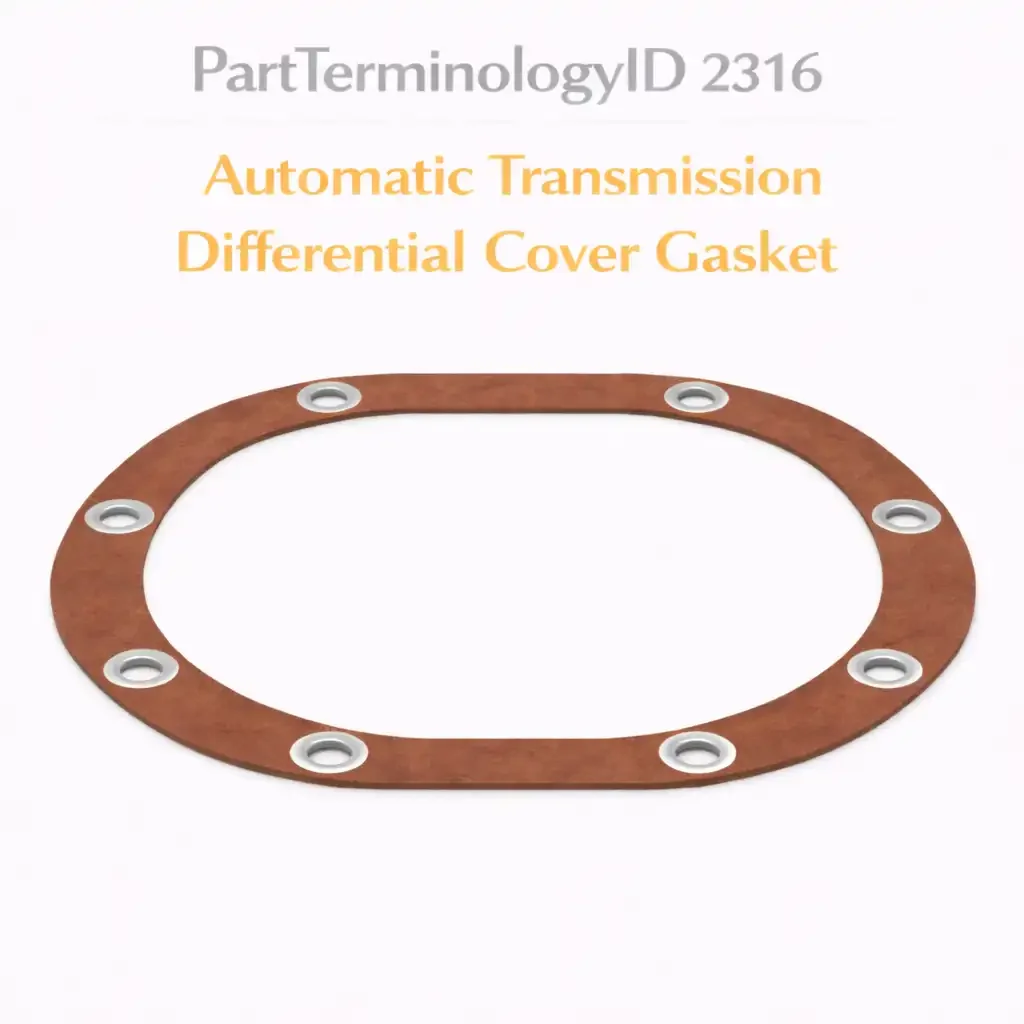
PartTerminologyID 2316, Automatic Transmission Differential Cover Gasket, is a gasket that seals the differential cover to the differential housing within an automatic transaxle, preventing automatic transmission fluid from leaking at the cover-to-housing interface. That definition is specific enough to locate the component. It does not specify the transmission model designation, the cover bolt hole count, the bolt hole pattern, the gasket outer profile dimensions, the gasket material, the ATF compatibility of the material, the gasket thickness, whether the gasket is a formed-in-place type bonded to the cover or a separate cut gasket, whether an RTV sealant procedure is specified for this application, or whether the cover and gasket are accessible with the transmission in the vehicle. A listing under PartTerminologyID 2316 that provides vehicle year, make, and model without the transmission model designation, the gasket profile, and the material specification cannot be evaluated by any technician who has identified a differential cover leak and needs to confirm the replacement gasket matches the cover on the bench.
For sellers, PartTerminologyID 2316 is separated from PartTerminologyID 2312 by a single word: carrier versus cover. Both are gaskets in the automatic transmission differential assembly. The carrier gasket (2312) seals the differential carrier housing to the main transmission case at the structural carrier interface. The cover gasket (2316) seals the removable differential cover that provides service access to the differential cavity and that is removed for differential fluid service, carrier inspection, and side bearing adjustment on transaxle designs that use external adjusters. The two gaskets may look similar in photographs and may share some profile dimensions on certain transmissions, but they are at different locations with different bolt patterns, different access procedures, and different service triggers.
For sellers, the most important distinction in the listing is not between this gasket and the carrier gasket but between the correct transmission model and an adjacent model that was available on the same vehicle. A listing that specifies the vehicle model without the transmission model will send the wrong gasket profile to a buyer whose vehicle was built with a different transmission option than the one the listing covers.
What the Automatic Transmission Differential Cover Gasket Does
Sealing the service access cover over the differential cavity
The differential cover on a transaxle is a removable casting or stamping that closes the differential cavity from the exterior. On most front-wheel-drive transaxles, this cover is on the end of the transmission housing opposite the engine. When the cover is removed, the differential carrier, the side bearings, and the ring gear are accessible for inspection, measurement, and adjustment without removing the transmission from the vehicle on most designs.
The cover gasket seals the flat mating surface between the cover and the housing face. On transaxles that use a separate differential lubricant from the main transmission fluid circuit, the cover gasket is the primary seal against ATF or gear oil leaking from the differential cavity to the exterior. On transaxles that share fluid between the differential cavity and the main circuit, the cover gasket seals the differential cavity against the external environment and against any adjacent cavities at lower pressure.
A failed cover gasket produces a leak at the end face of the transmission that tracks down the bottom of the housing and drips at the lowest point of the cover. On many transaxles, the cover is at the right or left end of the housing depending on the transaxle orientation, which means the leak appears near one of the axle shaft outputs and is frequently misdiagnosed as an axle shaft seal leak. The cover gasket and the axle shaft seal are adjacent components on most transaxles, and the same diagnostic caution noted in the carrier gasket post (2312) applies here: confirm the leak source by dye trace before ordering.
The cover gasket as a service interval component
Unlike most gaskets in the drivetrain series, the differential cover gasket on a transaxle is a planned service interval component on some vehicle manufacturer maintenance schedules. Transaxles that specify a differential fluid drain and fill at a defined mileage interval require the cover to be removed at every service, which destroys the original gasket and requires a new one. On those applications, the cover gasket is a consumable part ordered in quantity by fleet operations and dealership service departments rather than a single-event repair purchase.
The listing should note whether the application specifies a service interval that requires periodic cover removal, because that context changes the buyer's purchase decision: a fleet buyer sourcing gaskets for ten vehicles at a scheduled service needs to know quantity availability, not just fitment confirmation.
The cover gasket versus the carrier gasket on the same transmission
On transaxles where both a carrier gasket and a cover gasket exist, the two gaskets may share the same general shape but differ in bolt hole count, bolt hole diameter, or sealing bead geometry. On some transmissions, one is a formed-in-place rubber gasket and the other is a cut fiber gasket. On others, both use the same material but at different thicknesses.
The listing must state that this is the cover gasket and not the carrier gasket, and must cross-reference PartTerminologyID 2312 to prevent the buyer from ordering the carrier gasket when they need the cover gasket or vice versa.
The Specifications That Determine Correct Fitment
Transmission model designation
The transmission model designation is the primary fitment attribute. Common transaxle designations where both a carrier gasket and a cover gasket exist include the GM 4T65-E, GM 4T80-E, Honda BYBA, Chrysler 62TE, Ford CD4E, Toyota A541E, and others. Each has a differential cover specific to the transmission design, and the cover gasket profile is specific to that cover.
Gasket profile: bolt hole count and pattern
The bolt hole count and the bolt hole spacing determine whether the gasket aligns with the cover and the housing face. A gasket with the correct outer diameter but the wrong bolt hole pattern will be obvious before installation, but a gasket with the same bolt count and a slightly different bolt spacing will fit loosely over the cover bolts and may be installed without the misalignment being noticed until the cover is torqued and the gasket is compressed off-center.
Material and ATF compatibility
The gasket material must be compatible with the ATF formulation in the transmission. The same material compatibility argument developed in the carrier gasket post (2312) applies here: cork-rubber materials rated for older ATF formulations will degrade in modern synthetic fluids. Specify the ATF compatibility alongside the material designation.
Formed-in-place versus separate cut gasket
Some differential covers have a formed-in-place gasket bonded to the cover sealing flange that is reusable through multiple cover removals. On those covers, PartTerminologyID 2316 applies only when the formed gasket is damaged and must be replaced. The replacement formed gasket must match the original bonded profile exactly. A cut gasket cannot substitute for a formed-in-place design on a cover that was designed for the bonded type because the cover sealing flange geometry is machined for the specific formed gasket profile.
On covers that use a separate cut gasket, the cut gasket is a single-use component that is replaced at every cover removal.
RTV specification
Some transaxle differential covers are sealed with RTV silicone rather than a cut or formed gasket. On those applications, a listing for a replacement RTV tube is the correct purchase under this PartTerminologyID rather than a cut gasket. The listing must specify the sealing method and note that a cut gasket is not appropriate for RTV-specified applications.
Why This Part Generates Returns
Buyers order the wrong automatic transmission differential cover gasket because:
the transmission model is not specified and the buyer's cover has a different bolt pattern than the replacement gasket
the carrier gasket and the cover gasket for the same transmission are confused and the buyer orders 2312 when they need 2316 or vice versa
the gasket material is incompatible with the synthetic ATF in the transmission and degrades within the first heat-cool cycles after installation
the sealing method is not specified and the buyer installs a cut gasket on an RTV-specified cover, producing an incomplete seal on a surface that was designed for RTV contact
the formed-in-place gasket design is not identified and the buyer orders a cut gasket that does not match the cover flange geometry
Status in New Databases
PIES/PCdb: PartTerminologyID 2316, Automatic Transmission Differential Cover Gasket
PIES 8.0 / PCdb 2.0: No change
Top Return Scenarios
Scenario 1: "Carrier gasket received, needed cover gasket, bolt patterns different"
The buyer identified a leak at the differential end of the transaxle and ordered a differential gasket without confirming whether the leak was at the carrier or the cover. The listing did not clearly distinguish the two. The buyer received the carrier gasket (2312). The cover gasket (2316) is what is required. The two gaskets have different bolt patterns on this transmission.
Prevention language: "Component: differential cover gasket. This gasket seals the removable differential cover on the exterior face of the transmission. It is not the differential carrier gasket (PartTerminologyID 2312), which seals the carrier housing to the main transmission case at an internal interface. Verify your leak is at the cover joint before ordering. If the cover and carrier gaskets are both required, order both PartTerminologyIDs separately."
Scenario 2: "Wrong transmission model, bolt holes do not align"
The vehicle was available with both the GM 4T65-E and the GM 4T40-E. The listing covered the 4T40-E. The buyer's vehicle has the 4T65-E. The differential cover bolt patterns are different between the two transmissions. The gasket bolt holes do not align with the 4T65-E cover.
Prevention language: "Transmission model: [GM 4T65-E]. Verify your transmission model designation before ordering. This vehicle was available with multiple transmission options. The differential cover bolt pattern is specific to the transmission model. Check the transmission identification tag for the model designation."
Scenario 3: "RTV application, cut gasket installed, cover leaked at low spots"
The transmission specifies RTV sealant at the differential cover. The buyer received a cut gasket and installed it rather than sourcing RTV. The cover surface has minor irregularities that RTV accommodates but a cut gasket cannot bridge. The cover leaked at two low spots on the sealing surface within the first fluid heat cycle.
Prevention language: "Sealing method: [RTV sealant required / cut gasket / formed-in-place gasket]. This application specifies [sealing method]. Do not substitute a cut gasket on an RTV-specified cover. The cover sealing surface on RTV-specified applications may have minor surface irregularities that RTV accommodates and a cut gasket cannot."
Scenario 4: "Formed-in-place gasket cover, cut gasket ordered, does not seat in cover flange"
The differential cover has a formed-in-place rubber gasket bonded to the sealing flange in a machined groove. The replacement cut gasket has no groove to seat in and sits proud of the flange face. The cover bolts cannot pull the cut gasket flat against the housing face.
Prevention language: "Gasket type: [formed-in-place bonded gasket / separate cut gasket]. The differential cover on this application uses a [formed-in-place] gasket bonded to the cover sealing flange. A separate cut gasket cannot be substituted. Order the formed-in-place replacement gasket specifically designed for this cover profile."
Scenario 5: "Cork gasket installed in synthetic ATF transaxle, swelled and extruded within 3,000 miles"
The replacement gasket is a cork-rubber composite rated for Dexron-III. The transaxle uses Dexron-VI full synthetic. The cork material absorbed the synthetic fluid and swelled beyond the bolt clearance, extruding out of the sealing joint and creating a leak path alongside the extruded material.
Prevention language: "Gasket material: [cork-rubber / fiber paper / molded rubber / MLS steel]. ATF compatibility: [Dexron-VI synthetic compatible]. Verify gasket material compatibility with your transmission fluid specification. Cork-rubber gaskets are not rated for Dexron-VI or equivalent full-synthetic ATF. Use a fiber paper, molded rubber, or MLS gasket on transmissions running modern synthetic fluid."
What to Include in the Listing
Core essentials
PartTerminologyID: 2316
component: Automatic Transmission Differential Cover Gasket
explicit statement that this is the cover gasket, not the carrier gasket (mandatory)
application confirmation: transaxle with removable differential cover (mandatory)
transmission manufacturer and model designation (mandatory)
transmission production date range when cover profile changed during production (mandatory)
gasket type: formed-in-place bonded, separate cut gasket, or RTV specified (mandatory)
sealing method: gasket or RTV (mandatory)
gasket material with ATF compatibility specification (mandatory)
bolt hole count and pattern (mandatory)
gasket thickness in mm (mandatory)
service access: in-vehicle or transmission removal required (mandatory)
service interval note if cover removal is a scheduled maintenance event (recommended)
quantity: 1
Fitment essentials
year/make/model/submodel
transmission model designation (primary fitment attribute)
drivetrain: FWD or AWD to confirm transaxle application
engine displacement when transmission varies by engine
Dimensional essentials
gasket outer profile in mm
bolt hole count and bolt hole diameter
bolt hole spacing dimensions
gasket thickness uncompressed in mm
sealing bead location for formed-in-place types
Image essentials
gasket in isolation with bolt holes and profile visible
cover shown with gasket seated in position
transmission housing diagram distinguishing cover gasket location from carrier gasket location
ATF compatibility marking visible on packaging
Catalog Checklist for ACES/PIES Teams
PartTerminologyID = 2316
require explicit cover gasket designation, not carrier gasket (mandatory)
require transaxle application confirmation (mandatory)
require transmission model designation (mandatory)
require gasket type: formed-in-place, cut, or RTV-specified (mandatory)
require gasket material with ATF compatibility (mandatory)
require bolt hole count and pattern (mandatory)
require service access requirement (mandatory)
differentiate from automatic transmission differential carrier gasket (PartTerminologyID 2312): the carrier gasket is at the structural carrier-to-main-case interface; the cover gasket is at the removable service access cover; both exist on some transmissions and are not interchangeable
differentiate from transmission pan gasket (PartTerminologyID varies): the pan gasket is at the oil pan on the bottom of the transmission; the cover gasket is at the differential end cover; both seal transmission fluid but at different locations
differentiate from axle shaft seal (PartTerminologyID varies): the axle shaft seal is a rotary lip seal at the shaft exit; the cover gasket is a static face seal at the cover joint; both are adjacent on the transaxle end face and produce leaks in the same area
flag transmission model as primary fitment attribute
flag carrier-versus-cover distinction as mandatory: the two gaskets are adjacent and frequently confused; the listing must draw this distinction explicitly
flag ATF compatibility as mandatory: synthetic fluid incompatibility produces a repeat gasket failure that a correct material specification would have prevented
FAQ (Buyer Language)
How do I confirm the leak is at the differential cover and not the axle shaft seal or the carrier gasket?
Add fluorescent dye to the ATF, run the vehicle through several heat cycles, and inspect with a UV light. The dye will reveal the leak origin point. A cover gasket leak originates at the flat mating face between the cover and the housing. An axle shaft seal leak originates at the rotating shaft exit point. A carrier gasket leak originates at the carrier housing joint, which is inboard of the cover face on most transaxles. The three leak sources produce fluid in overlapping areas that converge at the drip point, which is why dye tracing is the only reliable pre-disassembly diagnosis.
Is the differential cover gasket the same as the transmission pan gasket?
No. The transmission pan gasket seals the oil pan on the bottom of the transmission housing. The differential cover gasket seals the differential end cover on the side or end of the housing. Both are transmission gaskets and both seal ATF, but they are at different locations, different shapes, and require different service procedures to access. On most transaxles, the pan gasket is at the bottom of the housing and is accessed from below the vehicle. The differential cover gasket is at the end of the housing and may be accessible from the side.
Can I reuse the original gasket if the cover is being removed for inspection only?
On formed-in-place gaskets that are bonded to the cover flange, the gasket can be reused if it is undamaged, not compressed beyond its elastic recovery range, and free of tears or missing sections. Inspect the gasket under good light after cleaning. If it springs back to its original profile after cleaning, it is reusable. On separate cut gaskets, do not reuse. Cut gaskets compress during the original installation and will not seal correctly if reinstalled after removal.
My transaxle specifies a differential fluid change at 30,000 miles. How many gaskets should I stock?
If the service interval requires cover removal rather than a drain plug service, a new cut gasket is required at every fluid change. For a fleet of vehicles on a 30,000-mile differential service schedule, stock one gasket per vehicle per service cycle. For a 100,000-mile vehicle, that is approximately three gaskets over the vehicle's service life. If the cover uses a formed-in-place gasket that can be reused, a spare gasket is needed only when the existing formed gasket shows wear or damage.
The cover bolts stripped in the housing. What is the repair procedure?
Thread repair using time-sert inserts is the standard repair for stripped cover bolt bores in aluminum transaxle housings. The insert must be the correct thread size and pitch for the cover bolt specification. The time-sert installation requires the correct installation tool and a precise drill stop to avoid drilling through the housing wall. If the housing wall is thin at the bolt bore, verify the available drilling depth before selecting the insert length. Do not over-torque the cover bolts during reinstallation: use the specified torque and stop at that value.
Cross-Sell Logic
Automatic Transmission Differential Carrier Gasket (PartTerminologyID 2312: on transaxles where both the cover and the carrier require gasket replacement at the same service event, both gaskets are sourced together)
Axle Shaft Seal (the axle shaft seals are adjacent to the differential cover and are inspected when the cover is removed; replace any seal showing weeping)
Automatic Transmission Fluid (the ATF or differential fluid is replaced whenever the cover is removed; have the correct specification and quantity before beginning)
Transmission Filter (if the ATF is being replaced at the cover service event, the filter is replaced concurrently)
Cover Bolt Set (if original bolts are corroded or stretched, replacement bolts of the correct thread and torque rating are sourced before reassembly)
Frame as "the cover gasket seals the cover that provides differential service access. The carrier gasket seals the carrier that the cover provides access to. The ATF fills the differential cavity both seal. The axle shaft seals seal the shafts that exit the differential cavity. All are inspected and relevant ones replaced at the same cover removal event."
Final Take for PartTerminologyID 2316
Automatic Transmission Differential Cover Gasket (PartTerminologyID 2316) is separated from PartTerminologyID 2312 by one word and by a location within the same assembly that produces indistinguishable leak symptoms from the exterior. The most consequential listing failure for this PartTerminologyID is not a dimensional mismatch but a component identity mismatch: a buyer who receives the carrier gasket when they needed the cover gasket, or vice versa, has the right material in the wrong profile for a different location in the same transmission.
The transmission model designation resolves the profile. The explicit cover-versus-carrier designation resolves the component identity. The gasket type and sealing method resolve the installation procedure. The ATF compatibility resolves the service life. The service access requirement resolves the labor scope.
State the transmission model. State the cover gasket designation explicitly. State the gasket type and sealing method. State the material and ATF compatibility. State the bolt pattern. State the service access requirement. That is the same listing strategy as every other PartTerminologyID in this series: the generic PartTerminologyID requires specific attributes at every level to become a listing buyers can act on without guessing. For PartTerminologyID 2316, the first guess to eliminate is which of two adjacent gaskets in the same assembly the listing covers.