
Written by Arthur Simitian | PartsAdvisory
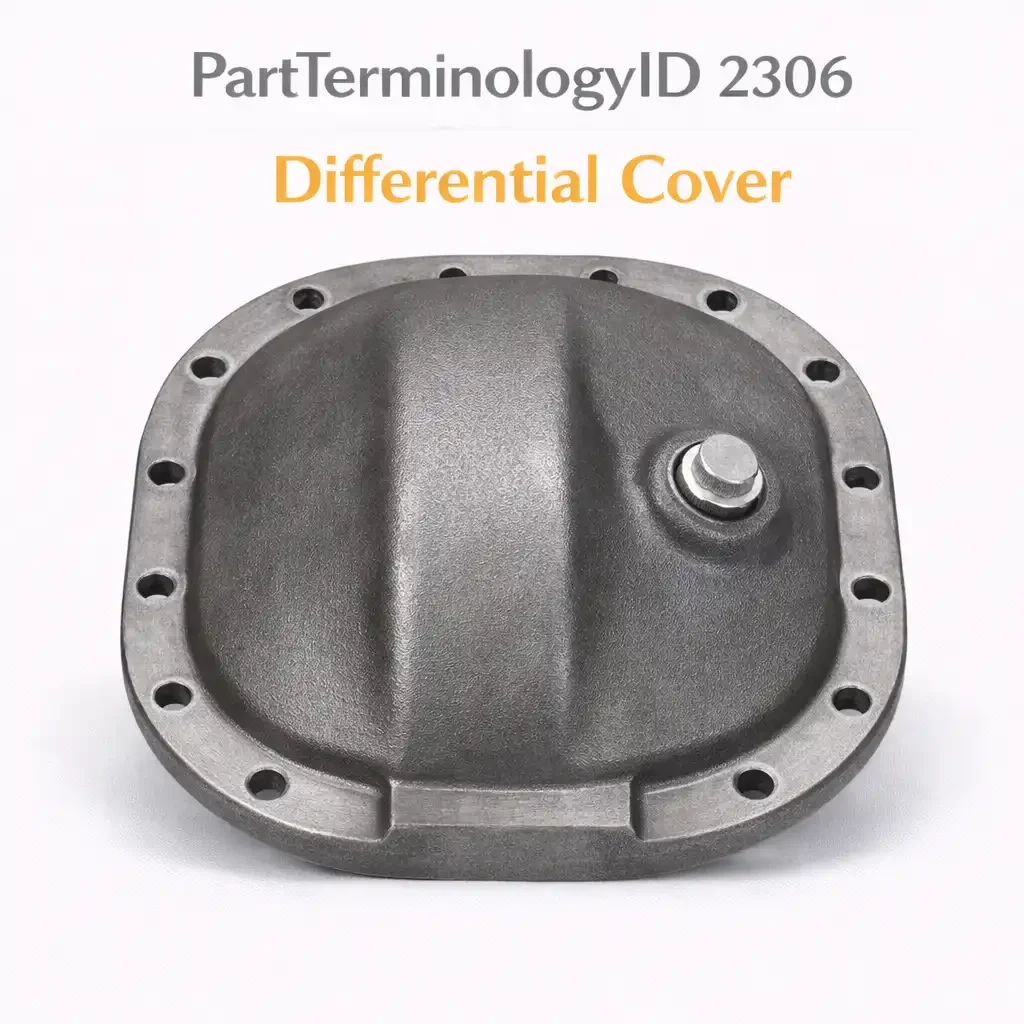
PartTerminologyID 2306, Differential Cover, is the removable plate that closes the rear opening of a differential housing, retains the gear oil inside the housing, and provides access to the differential carrier and ring gear without removing the axle from the vehicle. That definition describes the function correctly and completely omits the specifications that determine whether a replacement cover fits the housing it is intended to seal. It does not specify the axle designation, the bolt hole count, the bolt circle diameter, the cover outer profile dimensions, whether the cover is a stamped steel OE-style cover or a cast aluminum or cast iron aftermarket cover with increased oil capacity, what the gasket situation is, whether the cover uses a formed-in-place gasket or a separate gasket or an RTV sealant, what the drain plug configuration is, whether the cover has a drain plug at all, what the fill plug location is, or whether the cover has any provisions for a differential temperature sensor or a breather. A listing under PartTerminologyID 2306 that covers only the vehicle year, make, and model without the axle designation, the bolt pattern, and the sealing method cannot be evaluated by any buyer who is replacing a cover against a measured original or selecting an upgrade cover for a specific axle designation.
For sellers, the differential cover is a component where the return pattern is split between two distinct buyer populations with different ordering behaviors and different failure modes. The first population is the service buyer replacing a cracked, stripped, or leaking cover on a vehicle being maintained. That buyer needs an exact-fit replacement that matches the original bolt pattern, the original gasket method, and the original profile so that no modification to the housing or the drain procedure is required. The second population is the performance or off-road buyer upgrading from a stamped steel OE cover to a cast cover with greater oil capacity, differential temperature management provisions, or improved impact resistance for off-road use. That buyer needs a cover that fits the axle designation's bolt pattern but intentionally differs from the OE cover in material, capacity, and features.
A listing that does not specify the axle designation and bolt pattern cannot serve either buyer reliably. A listing that does not distinguish between an OE-replacement cover and an upgrade cover may send a cast aluminum upgrade to a service buyer who needed a direct OE replacement that their body shop can paint to match the vehicle underbody, or may send a stamped steel OE replacement to a performance buyer who needed the cast upgrade.
For sellers, the listing under this PartTerminologyID is only useful if it specifies the axle designation, the bolt hole count and bolt circle diameter, the cover material, the sealing method, the drain plug configuration, and whether the cover is an OE-style replacement or an aftermarket upgrade with different capacity or features.
What the Differential Cover Does
Sealing the gear oil and providing service access
The differential housing is an iron or aluminum casting that surrounds the ring and pinion gears and the differential carrier. The rear face of the housing casting is open, which allows the carrier assembly to be installed through the opening during manufacturing and which provides service access to the differential internals without removing the axle from the vehicle. The differential cover closes this opening and seals it against gear oil leakage.
The cover must seal reliably against the gear oil that fills the differential to the specified level, which is typically at the bottom of the fill plug opening on the housing side. The gear oil is under slight positive pressure when the differential is hot and under operation from the expansion of the heated oil and from the splash lubrication of the rotating ring gear. The cover sealing surface must maintain contact with the housing sealing surface through the full thermal cycling range of operating temperature to ambient, which expands and contracts both the cover and the housing by different amounts if they are made of different materials.
A differential cover that develops a leak does not always produce an immediate gear oil puddle under the vehicle. A slow seep at the cover sealing surface wicks oil to the lowest point of the cover and drips at irregular intervals. The leak is often first noticed as a gear oil smell from the axle area or as a low gear oil level found during a routine service. A cover that is cracked, that has stripped bolt holes, or that has a sealing surface that is warped from over-torquing the cover bolts will produce a leak that a replacement gasket alone cannot stop.
The OE stamped steel cover versus the cast aftermarket upgrade cover
The OE differential cover is a stamped steel pressing, typically 1.5 to 2.5mm thick, with a flat sealing flange that mates against the housing sealing surface. The OE cover is designed to minimize cost, weight, and profile. It holds the specified gear oil quantity for the axle and provides no features beyond closure and sealing.
The cast aftermarket upgrade cover is a cast aluminum or cast iron cover with a thicker profile, a greater internal volume than the OE cover, cooling fins on the exterior surface, a drain plug at the lowest point for clean oil changes, and often a differential temperature sensor port. The greater internal volume provides more gear oil capacity, which reduces the operating temperature of the gear oil by increasing the thermal mass and reducing the percentage of heat generated per unit of oil volume. Cast aluminum fins on the exterior surface increase heat rejection from the cover to the surrounding air. The drain plug eliminates the need to remove the cover for routine oil changes, which preserves the cover gasket and reduces service time.
The cast cover increases the loaded differential clearance at the bottom because the cover protrudes further rearward from the housing face than the OE cover. On vehicles with limited differential-to-chassis clearance at the bottom of the housing, a cast cover that adds 30 to 50mm of rearward depth may contact the chassis during full suspension compression. The listing must state the cover depth increase over OE so the buyer can verify the clearance before ordering.
The gasket and sealing method
Differential covers use one of three sealing methods: a formed-in-place gasket molded onto the cover sealing flange, a separate cut gasket supplied with the cover, or RTV silicone sealant applied by the installer at the cover-to-housing interface.
Formed-in-place gaskets are common on OE covers and on some aftermarket replacement covers. The gasket is permanently bonded to the cover sealing flange and does not require a separate gasket to be sourced or installed. The cover is reusable through multiple removals as long as the formed gasket is not torn or compressed beyond its design range.
Separate cut gaskets are supplied with most OE-replacement aftermarket covers and with many cast upgrade covers. The separate gasket must be installed on the cover flange before the cover is installed on the housing. The listing must state whether the gasket is included. A buyer who removes the original cover and finds no gasket in the replacement cover box cannot complete the installation until a gasket is sourced.
RTV silicone sealant is specified for some axle applications, particularly on Dana axles and on some GM axles, where the OE procedure calls for RTV rather than a cut gasket. A cover that includes a separate cut gasket for an RTV application will mislead the buyer into using the gasket rather than the specified RTV, which may not produce the same sealing quality as the RTV procedure.
The listing must specify the sealing method and whether the gasket or RTV is included.
The drain plug and fill plug provisions
An OE stamped steel differential cover typically has no drain plug. To change the gear oil, the cover must be removed, the old oil drained, the cover cleaned, a new gasket installed, and the cover reinstalled before the new oil can be added. This procedure takes significantly longer than a drain-plug oil change and generates a used gasket that must be replaced.
An aftermarket cover with a drain plug at the lowest point of the cover allows gear oil changes without removing the cover. The drain plug is typically a magnetic plug that captures metallic wear debris from the gear oil as it drains, providing a convenient inspection point for differential wear monitoring.
Some covers also have a fill plug at the side or top of the cover that allows the oil level to be checked and topped up without removing the cover. The fill plug position must be at or above the correct gear oil level for the axle to ensure the differential is filled to the specified level when the fill plug is reinstalled.
The listing must state whether the cover has a drain plug, the drain plug thread specification, and whether the drain plug is magnetic.
The Specifications That Determine Correct Cover Fitment
Axle designation and bolt pattern
The bolt hole count and bolt circle diameter are the primary fitment dimensions. Common domestic axle cover bolt patterns include 10-bolt and 12-bolt counts on GM axles, 10-bolt on Ford 8.8-inch axles, 10-bolt on Dana 44 axles, and varying counts on Dana 30, Dana 60, and Chrysler axle designations. Some axle designations that share the same bolt count have different bolt circle diameters that prevent a cover from one axle from fitting another despite the same bolt count.
The bolt hole count is the first filter. The bolt circle diameter is the second filter. Both must be stated in the listing.
Cover outer profile and clearance
The cover outer profile determines whether the cover fits within the available clearance at the axle position on the vehicle. A cast upgrade cover that adds significant depth at the bottom of the housing may contact a crossmember or a skid plate at full suspension compression. A cover that adds width may contact the body at an inboard axle position. The listing must state the cover dimensions relative to OE and must note any known clearance limitations.
Material
Stamped steel covers match the OE specification and require no clearance verification beyond the bolt pattern. Cast aluminum covers are lighter than cast iron and reject heat more efficiently from fins, but are more susceptible to impact damage from rocks and trail debris than cast iron. Cast iron covers provide maximum impact resistance but are heavier and reject heat less efficiently than aluminum. The listing must specify the material and its implications for the buyer's application.
Sealing method and gasket inclusion
As described in the sealing method section. State the sealing method, whether the gasket or RTV tube is included, and the RTV specification for applications where RTV is required.
Drain plug specification
State whether the drain plug is present, the drain plug thread specification in metric or SAE, whether the plug is magnetic, and the torque specification for the drain plug.
Why This Part Generates Returns
Buyers order the wrong differential cover because:
the axle designation is not specified and the cover bolt circle does not match the housing bolt pattern despite the same bolt count
the bolt hole count is not stated and the buyer discovers the count mismatch only after removing the original cover
the sealing method is not specified and the buyer purchases a cover that requires RTV but includes a gasket, or receives a cover with no gasket for an application that does not use RTV
the gasket is not included and not disclosed, and the buyer has already removed the original cover with the old gasket destroyed in the process
the cover depth increase is not stated and the cast upgrade cover contacts the chassis at full suspension compression
the drain plug thread specification is not stated and the buyer cannot source a replacement drain plug if the included plug is lost or damaged
Status in New Databases
PIES/PCdb: PartTerminologyID 2306, Differential Cover
PIES 8.0 / PCdb 2.0: No change
Top Return Scenarios
Scenario 1: "Same bolt count, different bolt circle, cover will not align with housing holes"
The buyer's axle is a GM 8.5-inch with a 10-bolt cover pattern. The listing specified a 10-bolt differential cover by vehicle year, make, and model without stating the axle designation or the bolt circle diameter. The cover received has a 10-bolt pattern sized for a GM 7.5-inch axle, which has a smaller bolt circle diameter. The bolt holes do not align with the GM 8.5-inch housing holes.
Prevention language: "Axle designation: [GM 8.5-inch]. Bolt hole count: [10]. Bolt circle diameter: [X.XX] inches. Verify your axle designation before ordering. Some axle designations share the same bolt count but use different bolt circle diameters. The GM 7.5-inch and GM 8.5-inch axles are both 10-bolt but have different bolt circle diameters and their covers are not interchangeable."
Scenario 2: "No gasket included, cover cannot be installed, original cover already removed"
The listing did not state whether a gasket was included. The buyer removed the original cover and discarded the original gasket. The replacement cover arrived without a gasket. The housing is open and the differential cannot be sealed until a gasket is sourced.
Prevention language: "Gasket: [included / not included]. Sealing method: [formed-in-place gasket / separate cut gasket included / RTV sealant required, tube included / RTV sealant required, not included]. Do not remove the original cover until replacement gasket or RTV is in hand. The differential housing cannot be sealed without the correct sealing material."
Scenario 3: "Cast upgrade cover contacts crossmember at full suspension compression"
The buyer installed a cast aluminum upgrade cover on a truck with a lowered suspension. The cast cover adds 42mm of depth at the bottom of the housing compared to the OE stamped cover. At full suspension compression, the bottom of the cast cover contacts the front crossmember. The listing did not state the cover depth increase over OE.
Prevention language: "Cover depth increase over OE: [X]mm at lowest point. Verify clearance between the installed cover and any crossmembers, skid plates, or body components at full suspension compression before ordering. Cast covers with increased oil capacity protrude further from the housing face than OE stamped covers. Vehicles with lowered suspension, aftermarket suspension, or tight chassis clearance should verify fitment before installation."
Scenario 4: "RTV application, gasket included in box, installer used gasket, cover leaked"
The axle designation specifies RTV sealant for the cover sealing procedure. The replacement cover was packaged with a cut gasket. The buyer used the gasket rather than the specified RTV. The gasket did not produce a complete seal against the housing's slightly irregular surface, which is normal for a cast housing face that is designed for RTV rather than a cut gasket. The cover leaked at low points in the sealing surface.
Prevention language: "Sealing method: [RTV sealant required]. This axle designation specifies RTV silicone sealant at the cover-to-housing interface. Do not use a cut gasket on this application. The housing sealing surface is designed for RTV and may not be flat enough to seal correctly with a cut gasket. The included gasket in this package is for reference only and should not be used for installation."
Scenario 5: "Drain plug thread stripped on first removal, non-standard thread, replacement plug unavailable locally"
The cast cover drain plug uses a metric thread specification that is not stated in the listing. The buyer over-torqued the drain plug on the first oil change and stripped the plug threads in the cover. Without knowing the thread specification, the buyer cannot source a replacement plug or a thread repair insert locally.
Prevention language: "Drain plug thread specification: [M18 x 1.5 / 3/8-inch NPT / other]. Torque specification for drain plug: [X] ft-lbs. The drain plug thread specification is listed above for sourcing replacements if needed. Do not exceed the specified torque on the drain plug. Cast aluminum covers are more susceptible to drain plug thread damage than cast iron or steel covers."
What to Include in the Listing
Core essentials
PartTerminologyID: 2306
component: Differential Cover
axle designation (mandatory)
ring gear diameter in inches (mandatory)
bolt hole count (mandatory)
bolt circle diameter in inches (mandatory)
cover material: stamped steel, cast aluminum, or cast iron (mandatory)
cover type: OE-style replacement or aftermarket upgrade (mandatory)
sealing method: formed-in-place gasket, separate cut gasket, or RTV (mandatory)
gasket included: yes or no (mandatory)
RTV tube included: yes or no for RTV applications (mandatory)
drain plug: included or not, thread specification, magnetic or non-magnetic (mandatory)
fill plug: present or not, location (mandatory)
cover depth increase over OE in mm for cast upgrade covers (mandatory)
gear oil capacity increase over OE in ounces or ml for cast upgrade covers (mandatory)
differential temperature sensor port: present or not (mandatory for upgrade covers)
quantity: 1
Fitment essentials
year/make/model/submodel
axle designation (primary fitment attribute)
ring gear diameter
axle position: front or rear on four-wheel-drive applications
production date range when the housing sealing surface specification changed
Dimensional essentials
bolt hole count
bolt circle diameter in inches
cover outer diameter or profile dimensions
cover depth at lowest point in mm
cover depth increase over OE in mm
drain plug thread specification: metric or SAE thread size and pitch
fill plug thread specification if present
Image essentials
cover exterior showing the bolt hole pattern, drain plug location, and fins if present
cover interior showing the sealing flange and gasket if formed-in-place
drain plug shown in isolation with magnetic end visible
comparison image showing OE stamped cover and cast upgrade cover at the same scale to illustrate the depth difference
installed context on the axle housing showing the cover seated with the drain plug at the lowest point
Catalog Checklist for ACES/PIES Teams
PartTerminologyID = 2306
require axle designation (mandatory, primary fitment attribute)
require bolt hole count and bolt circle diameter (mandatory)
require cover material (mandatory)
require OE-style or upgrade designation (mandatory)
require sealing method (mandatory)
require gasket or RTV inclusion status (mandatory)
require drain plug inclusion and thread specification (mandatory)
require cover depth increase over OE for cast upgrade covers (mandatory)
differentiate from differential cover gasket (PartTerminologyID varies): the cover gasket seals the cover to the housing; the cover itself is the structural closure of the housing; both may be required when the cover is replaced, and the gasket inclusion status in the cover listing determines whether the gasket must be ordered separately
differentiate from differential (PartTerminologyID 2304): the differential is the carrier assembly inside the housing; the cover closes the rear opening of the housing that provides access to the differential; both are in the same assembly path but at different levels of the repair decision
differentiate from differential drain petcock (PartTerminologyID varies): some covers have an integrated drain plug; others have a drain petcock at the housing rather than at the cover; verify the drain provision location before ordering a cover based on drain plug presence
flag bolt circle diameter as mandatory alongside bolt count: covers with the same bolt count but different bolt circle diameters are not interchangeable; listing bolt count without bolt circle diameter produces mismatches on multi-axle platforms with shared bolt counts
flag sealing method as mandatory: RTV applications that receive a cut gasket may not seal correctly against housing surfaces designed for RTV; the sealing method must be stated to prevent the installer from using the wrong method
flag cover depth increase as mandatory for cast upgrade covers: clearance interference from an oversized cover discovered after installation requires cover removal and return; the depth increase must be stated so the buyer can verify clearance before ordering
FAQ (Buyer Language)
How do I identify my axle designation from the differential cover bolt count?
The bolt count is a starting point but is not sufficient alone because multiple axle designations share the same bolt count. Count the cover bolts and measure the bolt circle diameter with a tape measure from the center of one bolt hole to the center of the bolt hole directly opposite. Cross-reference the bolt count and bolt circle diameter to an axle identification guide. For GM axles, the 10-bolt 7.5-inch and the 10-bolt 8.5-inch have different bolt circle diameters and different cover profiles. For Dana axles, the Dana 30 and Dana 44 both use 10 bolts but have different cover shapes. If the bolt circle measurement is ambiguous, remove the cover and measure the ring gear diameter directly.
My cover bolt holes are stripped. Can I repair them instead of replacing the cover?
Yes, on cast iron and cast aluminum covers, thread repair inserts such as Helicoil or time-sert inserts can restore stripped bolt hole threads if the cover casting is not cracked around the hole. The insert must be the correct thread size and pitch for the cover bolt specification. On stamped steel covers, stripped bolt holes indicate that the cover material has been compromised around the hole and the cover should be replaced rather than repaired, because the thin steel cannot adequately retain a thread insert.
Should I use the gasket or RTV for my differential cover?
Use whatever the vehicle service manual specifies for your axle designation. Dana axles and some GM axles specify RTV silicone at the cover-to-housing interface and do not use a cut gasket. Other axle designations specify a cut gasket. Using RTV on an application designed for a cut gasket produces adequate sealing in most cases. Using a cut gasket on an application designed for RTV may not produce adequate sealing if the housing face has the irregular texture typical of RTV-specification surfaces. If the service manual specifies RTV, use a high-quality anaerobic silicone gasket maker rated for gear oil compatibility. Apply a 3mm bead to the clean cover sealing flange, install the cover within the open time specified on the RTV tube, and do not fill the differential with oil for the cure time specified on the RTV product.
Will a cast aluminum upgrade cover fit my stock axle without any modification?
On most domestic axle designations, yes. Cast aluminum upgrade covers are designed to use the existing housing bolt holes and bolt specifications with no modification to the housing. The cover depth increase over OE is rearward and downward from the housing face, which is where clearance must be verified, but the bolt pattern engagement is the same. The OE cover bolts may be reused if their length is sufficient for the cast cover's thicker flange, or the cover manufacturer may supply new bolts of the correct length. Verify the supplied or required bolt length against the OE bolt length before installation.
How much extra gear oil does a cast upgrade cover hold and does that affect performance?
Cast upgrade covers for common domestic axle designations typically increase gear oil capacity by 25 to 50 percent over the OE cover volume. A GM 8.5-inch axle OE cover holds approximately 64 ounces of gear oil. A cast upgrade cover for the same axle may hold 80 to 96 ounces. The additional oil volume reduces operating temperature by increasing the thermal mass of the oil and by providing more oil surface area in contact with the cover's cooling fins. On street-driven vehicles under normal conditions, the temperature reduction from a cast cover is modest. On vehicles used for towing, off-road driving, or high-performance driving where the differential experiences sustained high loads, the temperature reduction from a cast cover can extend gear oil service life and reduce the risk of thermal breakdown of the gear oil film at the gear tooth contact zones.
Cross-Sell Logic
Differential Cover Gasket (PartTerminologyID varies: if the gasket is not included with the cover, the gasket is the first concurrent purchase; the differential cannot be sealed without it)
RTV Silicone Gasket Maker (for RTV-specification axle applications: if the RTV tube is not included with the cover, it is the first concurrent purchase)
Gear Oil (the gear oil is replaced whenever the differential cover is removed; have the correct type and quantity before beginning the service)
Differential Drain Petcock (PartTerminologyID varies: if the original cover had an integrated drain plug and the replacement does not, a housing-mounted drain petcock is an alternative to restore the drain capability)
Cover Bolt Set (if the original cover bolts are corroded or stripped, a replacement bolt set of the correct thread and length is required for reassembly)
Differential (PartTerminologyID 2304: if the cover was removed for differential inspection and the carrier or gears are found to require replacement, the differential listing is the next purchase in the service sequence)
Frame as "the cover seals the housing. The gasket seals the cover to the housing. The gear oil fills the housing the cover seals. The drain plug in the cover allows the oil to be changed without removing the cover. The differential inside the housing is what the cover protects from contamination and gear oil loss."
Final Take for PartTerminologyID 2306
Differential Cover (PartTerminologyID 2306) is a component where the two buyer populations, the service buyer and the upgrade buyer, arrive at the same PartTerminologyID with entirely different expectations and entirely different evaluation criteria, and where a listing that does not distinguish between an OE-style replacement and a cast upgrade cover cannot serve either population without creating the uncertainty that leads to a return.
For the service buyer, the axle designation and bolt circle diameter are the fitment attributes, the sealing method and gasket inclusion are the completion attributes, and an OE-profile cover that fits without clearance verification is the expectation. For the upgrade buyer, the material, the oil capacity increase, the drain plug specification, the cooling fin design, and the cover depth increase over OE are the decision attributes, and a cast cover that delivers measurable temperature reduction at the axle is the expectation.
State the axle designation. State the bolt hole count and bolt circle diameter. State the material and cover type. State the sealing method and gasket inclusion. State the drain plug specification. State the cover depth increase for cast covers. That is the same listing strategy as every other PartTerminologyID in this series: the generic PartTerminologyID requires specific attributes at every level to become a listing buyers can act on without guessing. For PartTerminologyID 2306, a bolt circle mismatch found after the original cover has been removed leaves the differential open on the bench, and a cast cover that contacts the crossmember at full compression requires removal from an axle that was just reassembled.