
Written by Arthur Simitian | PartsAdvisory
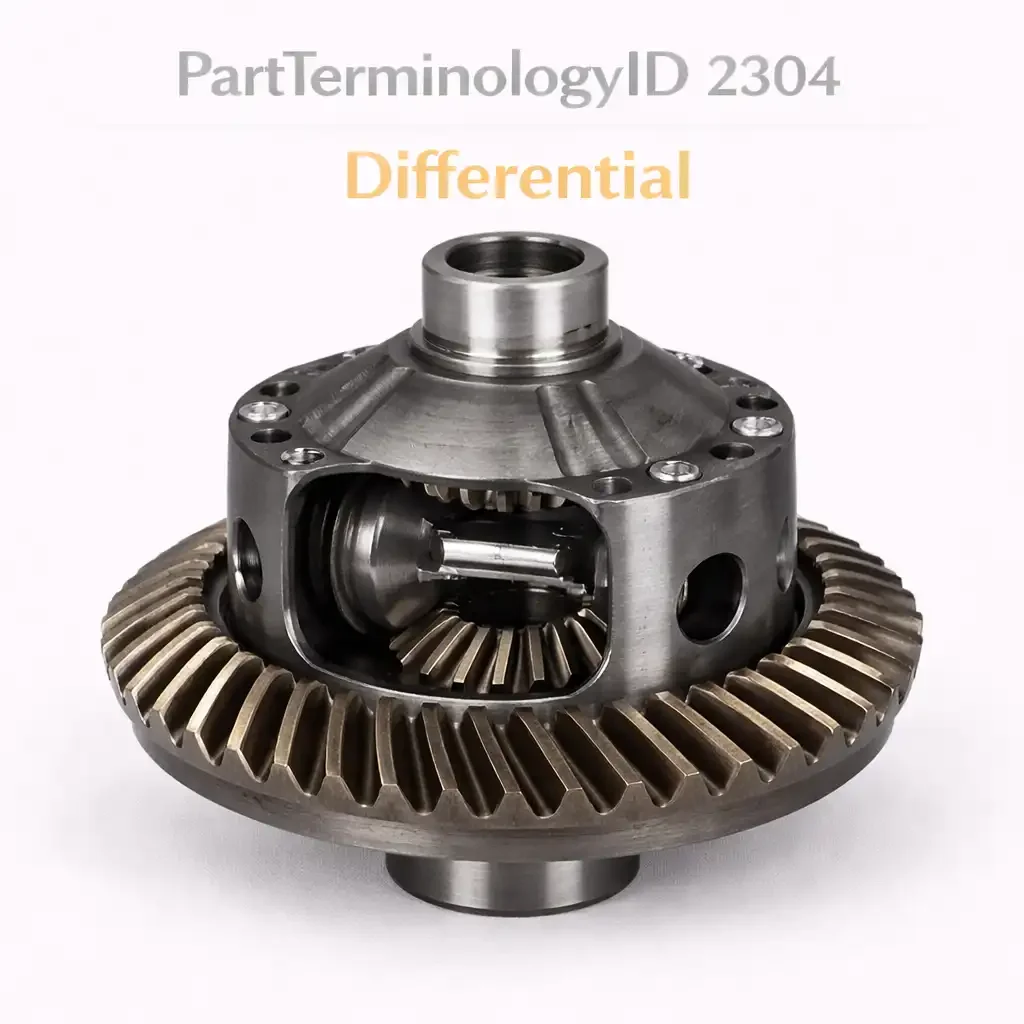
PartTerminologyID 2304, Differential, is a gear assembly that distributes torque between two output shafts while allowing them to rotate at different speeds, which is the mechanical requirement of cornering where the outside wheel must travel farther than the inside wheel in the same time. That definition is complete as a description of function. It does not specify the axle designation, the ring gear diameter, the gear ratio, whether the differential is an open unit, a limited slip unit, an electronic locking differential, a mechanical locker, or a torque-vectoring unit, what the carrier design is, whether the listing covers the carrier assembly only or the complete differential with the ring gear and pinion installed, what the spline count is at the axle shaft engagement, whether the unit requires additional friction modifier or a specific gear oil formulation, or what the relationship is between a replacement differential unit and the ring-and-pinion gear set already installed in the axle housing. A listing under PartTerminologyID 2304 that provides vehicle year, make, and model without the axle designation, the gear ratio, the carrier type, and the complete component manifest cannot be evaluated by any buyer who is replacing a differential unit against a service specification rather than guessing by vehicle fitment alone.
For sellers, the differential is the highest-assembly-level component in the axle PartTerminologyID series. Where previous posts in this series have addressed individual bearings, seals, and joints, PartTerminologyID 2304 covers the assembled differential unit that those individual components support and seal. A wrong bearing sent to a differential rebuild can be returned before disassembly. A wrong differential unit installed in an axle housing, shimmed to the housing, and set to the specified backlash before the error is discovered requires complete disassembly of the axle to remove and return. The stakes of an incomplete listing at this assembly level are proportionally higher than at the component level, and the listing attributes that prevent a wrong-unit installation are correspondingly more numerous.
For sellers, the listing under this PartTerminologyID is only useful if it specifies the axle designation, the ring gear diameter, the gear ratio, the differential type, the carrier design, the axle shaft spline engagement specification, and the complete component manifest. Without those seven attributes, the listing cannot be acted on by any buyer whose repair requires a specific ratio, a specific carrier type, or a specific friction modifier formulation for the differential type they are installing.
What the Differential Does
Allowing speed differentiation while maintaining torque distribution
When a vehicle turns, the outside wheel travels a longer arc than the inside wheel in the same elapsed time. If both wheels were locked to the same shaft rotating at the same speed, one wheel would be forced to scrub sideways rather than roll, which would create understeer, tire wear, and drivetrain stress. The differential allows the two output shafts to rotate at different speeds by routing the torque through a set of spider gears that act as a torque-splitting mechanism.
In an open differential, the torque split is always equal between the two output shafts regardless of the speed difference between them. This means the open differential sends torque to whichever shaft offers the least resistance. On slippery surfaces where one wheel has no traction, the open differential sends all available torque to the spinning wheel and none to the wheel with traction. This is the fundamental limitation of the open differential that the limited slip and locking designs address.
Open versus limited slip versus locking differential designs
The open differential is the standard unit on most passenger vehicles and light trucks. It is the lightest, least expensive, and most mechanically simple differential design. On dry pavement, the open differential provides adequate traction because both wheels have sufficient grip to receive and use the torque directed to them. On slippery surfaces or in off-road conditions, the open differential's tendency to send torque to the path of least resistance limits traction severely.
The limited slip differential uses a clutch pack or a viscous coupling or a Torsen gear mechanism to limit the speed difference between the two output shafts. When one shaft begins to spin faster than the other, the limiting mechanism generates a torque bias toward the slower shaft. The clutch pack design uses friction discs that are preloaded by a spring pack and that engage more firmly as the speed differential increases. The Torsen design uses worm gears that generate a mechanical torque bias proportional to the speed differential without any friction surfaces. Both designs improve traction over the open differential while still allowing speed differentiation during normal cornering.
The locking differential uses a mechanical or electronic mechanism to positively lock both output shafts to rotate at the same speed. When locked, there is no speed differentiation and all available torque is divided equally between both shafts regardless of traction conditions. Locking differentials are used in off-road applications where maximum traction on unpredictable surfaces is required. They must be unlocked for normal road driving because the lack of speed differentiation causes the drivetrain stress and tire scrub that the differential was designed to eliminate.
The carrier as the structural core of the differential
The differential carrier is the housing that contains the spider gears, the side gears, the clutch pack or locking mechanism if equipped, and the carrier bearings at each end. The ring gear bolts to the flange on the carrier body. The carrier rotates within the differential housing on the carrier bearings and is the rotating assembly that the ring and pinion drive.
On most domestic axle designs, the carrier is specific to the gear ratio range installed in the axle. Carriers are produced in two types: a standard-rotation carrier and a limited slip carrier. These two carrier types are not interchangeable because the limited slip carrier has the clutch pack bore and the side gear pockets machined to different dimensions than the open carrier. Installing a limited slip ring and pinion specification with an open carrier, or an open specification ring and pinion with a limited slip carrier, produces an incorrect assembly.
Some axle designations also use different carrier sizes for different gear ratio ranges within the same axle designation. A common example is the Ford 8.8-inch axle, which uses one carrier for gear ratios from 2.73 to 3.55 and a different carrier for gear ratios from 3.73 to 4.56. A replacement carrier ordered for the wrong ratio range will have the ring gear bolt circle and the side gear spline engagement at the wrong geometry for the ring gear and axle shafts in the housing.
The Specifications That Determine Correct Differential Fitment
Axle designation and ring gear diameter
The axle designation is the primary fitment attribute for the same reason established throughout the bearing and seal posts in this series: the same vehicle platform was built with multiple axle options. A GM half-ton pickup may have the GM 7.5-inch or the GM 8.5-inch rear axle. A Ford half-ton may have the Ford 7.5-inch or the Ford 8.8-inch. The differential carrier for each axle designation is sized to fit the ring gear and the housing specific to that axle. The ring gear diameter confirms the axle designation and determines the carrier size.
Gear ratio
The gear ratio is the ratio of the ring gear tooth count to the pinion gear tooth count. Common passenger vehicle and light truck ratios range from 2.73 to 4.56. The gear ratio determines the carrier design within a given axle designation, the ring gear bolt circle diameter on some axles, and the overall vehicle performance characteristics of acceleration, fuel economy, and towing capacity.
A replacement differential unit must match the gear ratio of the ring and pinion already installed in the axle housing, or both the differential and the ring and pinion must be replaced together to achieve the new ratio. Installing a 3.73 ratio differential carrier into a housing with a 3.08 ring and pinion installed will produce a gear ratio mismatch: the ring gear will not bolt to the replacement carrier if the bolt circle differs between the two ratio ranges, or if the ring gear does bolt on, the mesh geometry will be incorrect because the ring gear is designed for the original carrier's ring gear seat diameter.
Differential type: open, limited slip, Torsen, or locking
The differential type must match the vehicle's original equipment specification or the buyer's intentional upgrade. Installing a limited slip differential in a vehicle that originally had an open differential requires the correct gear oil and friction modifier additive for the limited slip clutch pack. Installing a locking differential requires the correct actuator wiring harness for electronic lockers. Installing a Torsen differential requires no special gear oil beyond the standard axle specification.
The differential type also affects the carrier bearing preload and the ring gear backlash setting, because different carrier designs have different carrier bearing journal dimensions and different ring gear flange geometries. A complete differential listing must specify the type and must note any special gear oil or installation requirements.
Axle shaft spline engagement
The side gears inside the differential engage the axle shaft splines when the axle shafts are installed through the housing tubes. The side gear spline count must match the axle shaft spline count. On most domestic axle designations, the side gear spline count is fixed for the axle designation. However, some axle designations are available in different spline counts depending on the engine and powertrain option. A Ford 8.8-inch rear axle may use 28-spline or 31-spline axle shafts depending on the towing package and engine option. The differential carrier side gear spline count must match the axle shafts in the vehicle. If it does not, the axle shafts will not engage the side gears and the vehicle will not be drivable.
The component manifest: carrier only, ring and pinion included, or complete unit
The differential listing may cover any of the following configurations:
Carrier assembly only: the bare carrier with the spider gears, side gears, and clutch pack if limited slip, but without the ring gear. This is the correct purchase when the ring and pinion in the axle housing are within specification and only the carrier requires replacement.
Carrier with ring gear installed: the carrier with the ring gear bolted to the ring gear flange. This is the correct purchase when the ring and pinion must be replaced because the carrier failure damaged the ring gear teeth.
Complete differential unit: the carrier, ring gear, and pinion assembled and set to the correct backlash and pinion depth at the factory. A complete unit requires only installation in the axle housing with correct carrier bearing preload and ring gear backlash verification.
The listing must specify which configuration is covered. A buyer who orders a carrier expecting a complete unit and receives only the carrier cannot complete the installation without separately sourcing the ring gear and having the backlash set, which requires a ring gear installation tool and a dial indicator setup.
Why This Part Generates Returns
Buyers order the wrong differential because:
the axle designation is not specified and the buyer's carrier bearing bore diameter does not match the replacement carrier's bearing journal diameter
the gear ratio is not specified and the replacement carrier's ring gear bolt circle does not match the ring gear installed in the housing
the differential type is not specified and the buyer receives an open carrier for a limited slip application, or vice versa
the axle shaft spline count is not specified and the side gears will not engage the axle shafts
the carrier ratio range is not specified on axle designations that use different carriers for different ratio ranges, and the buyer's ratio falls in the other range
the component manifest is not specified and the buyer receives only the carrier when they expected a complete unit with the ring gear installed
Status in New Databases
PIES/PCdb: PartTerminologyID 2304, Differential
PIES 8.0 / PCdb 2.0: No change
Top Return Scenarios
Scenario 1: "Wrong carrier ratio range, ring gear bolt circle does not match"
The buyer's Ford 8.8-inch axle has a 4.10 gear ratio, which falls in the 3.73-to-4.56 carrier range. The listing specified the Ford 8.8-inch axle without noting the carrier ratio range. The buyer received the 2.73-to-3.55 carrier. The ring gear bolt circle on the 4.10 ring gear does not match the replacement carrier's bolt pattern. The ring gear cannot be bolted to the replacement carrier.
Prevention language: "Axle designation: Ford 8.8-inch. Carrier ratio range: [2.73 to 3.55 / 3.73 to 4.56]. Verify your gear ratio falls within this carrier range before ordering. The Ford 8.8-inch axle uses different carriers for different ratio ranges. The ring gear bolt circle differs between the two carrier ranges and the ring gear from one range cannot be bolted to the carrier of the other."
Scenario 2: "Open carrier received, limited slip application, clutch pack will not fit"
The listing did not specify the differential type. The buyer's axle has a factory limited slip unit. The replacement carrier is an open design without the clutch pack bore. The buyer's limited slip clutch pack and side gear set cannot be installed in the open carrier.
Prevention language: "Differential type: [open / limited slip clutch pack / Torsen / electronic locking]. Verify this matches your axle's differential type. Open and limited slip carriers are not interchangeable. The limited slip carrier has a different side gear pocket and clutch pack bore than the open carrier. Gear oil: limited slip differentials require friction modifier additive in addition to the standard gear oil specification."
Scenario 3: "Side gear spline count mismatch, axle shafts will not engage"
The buyer's Ford 8.8-inch axle uses 31-spline axle shafts. The replacement carrier has 28-spline side gears. The axle shafts cannot be fully inserted through the housing tubes because the 31-spline shaft end will not engage the 28-spline side gear.
Prevention language: "Side gear spline count: [28-spline / 31-spline]. Verify your axle shaft spline count matches this specification. The Ford 8.8-inch axle was built with both 28-spline and 31-spline axle shafts depending on the engine and tow package. Count the splines on your existing axle shaft or check the vehicle build sheet before ordering."
Scenario 4: "Carrier only received, needed ring gear installed, backlash cannot be set in the field"
The listing did not specify the component manifest. The buyer expected a carrier with the ring gear already bolted on and the backlash pre-set. The carrier arrived bare without the ring gear. The buyer does not have the ring gear installation tooling or the dial indicator setup required to bolt the ring gear to the carrier and set backlash correctly.
Prevention language: "Component manifest: [carrier only / carrier with ring gear / complete unit with ring gear and pinion]. Verify this listing includes the components required for your repair. A carrier-only listing does not include the ring gear. Installing the ring gear requires a ring gear press or bolt torquing sequence and a dial indicator backlash verification. If you need the ring gear included, order a carrier with ring gear listing."
Scenario 5: "Carrier bearing journal diameter mismatch, carrier will not fit housing bores"
The axle designation is specified as GM 8.5-inch but the production year of the buyer's axle used a different carrier bearing journal diameter than the listing covers. The replacement carrier's bearing journals are 0.040 inches larger than the original carrier bearing inner race bore. The carrier bearings from the original assembly will not fit the replacement carrier journals.
Prevention language: "Carrier bearing journal diameter: [X.XXX] inches. Axle production date range: [years]. Verify your axle's production date falls within this range. Some axle designations changed carrier bearing journal specifications during production. The carrier bearing journal diameter must match the carrier bearing inner race bore."
What to Include in the Listing
Core essentials
PartTerminologyID: 2304
component: Differential
axle manufacturer: Dana, GM, Ford, Chrysler, Toyota, or other (mandatory)
axle designation: Dana 44, GM 8.5-inch, Ford 8.8-inch, etc. (mandatory)
ring gear diameter in inches (mandatory)
axle position: front or rear on four-wheel-drive applications (mandatory)
gear ratio (mandatory)
carrier ratio range when the axle uses multiple carrier designs (mandatory)
differential type: open, limited slip clutch pack, Torsen, mechanical locker, or electronic locker (mandatory)
side gear spline count (mandatory)
carrier bearing journal diameter in inches (mandatory)
component manifest: carrier only, carrier with ring gear, or complete unit (mandatory)
gear oil type required (mandatory)
friction modifier required: yes or no (mandatory)
break-in procedure required: yes or no (mandatory for limited slip units)
quantity: 1 unit
Fitment essentials
year/make/model/submodel
axle designation (primary fitment attribute)
ring gear diameter for axle confirmation
gear ratio (mandatory)
production date range when the carrier specification changed during the axle production run
axle shaft spline count (mandatory when multiple spline counts were used in the same axle designation)
Dimensional essentials
ring gear diameter in inches
ring gear bolt circle diameter in inches
ring gear bolt count
carrier bearing journal diameter in inches
side gear spline count
side gear spline pitch circle diameter in mm
Image essentials
carrier assembly in isolation showing the ring gear flange, the spider gear windows, and the carrier bearing journals
ring gear shown bolted to the carrier with the bolt circle visible
limited slip clutch pack shown in an exploded view for limited slip listings
side gear shown in isolation with spline count callout
installed context showing the carrier seated in the differential housing with the carrier bearings and adjusters in position
Catalog Checklist for ACES/PIES Teams
PartTerminologyID = 2304
require axle designation (mandatory, primary fitment attribute)
require ring gear diameter (mandatory)
require axle position on four-wheel-drive applications (mandatory)
require gear ratio (mandatory)
require carrier ratio range on axle designations with multiple carrier designs (mandatory)
require differential type: open, limited slip, Torsen, locker (mandatory)
require side gear spline count (mandatory)
require carrier bearing journal diameter (mandatory)
require component manifest (mandatory)
require gear oil type and friction modifier requirement (mandatory)
require break-in procedure note for limited slip units (mandatory)
differentiate from axle differential bearing and seal kit (PartTerminologyID 2224): the kit provides the bearings and seals for a differential rebuild; PartTerminologyID 2304 covers the assembled differential unit itself; a buyer replacing the unit needs 2304; a buyer rebuilding the existing unit needs 2224
differentiate from ring and pinion gear set (PartTerminologyID varies): the gear set is the ring gear and pinion gear only; PartTerminologyID 2304 may include the ring gear as part of a carrier-with-ring-gear listing, but the listing must state which configuration applies
differentiate from limited slip rebuild kit (PartTerminologyID varies): the rebuild kit contains the clutch pack friction discs and steel plates for the limited slip unit; PartTerminologyID 2304 covers the complete differential carrier assembly
flag axle designation as primary fitment attribute: vehicle year, make, and model alone produces fitment errors on all multi-axle platforms
flag gear ratio as mandatory: the gear ratio determines the carrier design within many axle designations; a carrier ordered for the wrong ratio range will not accept the ring gear installed in the housing
flag side gear spline count as mandatory: axle shafts that do not engage the side gears prevent the vehicle from being driven; the spline count mismatch is discovered only after the axle is fully assembled and the axle shafts are inserted
flag component manifest as mandatory: a carrier-only listing sent to a buyer who expected a complete unit requires disassembling the axle to remove the carrier and return it
FAQ (Buyer Language)
How do I identify my axle designation without looking at the axle tag?
Remove the differential cover and measure the ring gear diameter. The diameter directly identifies the axle size. Count the ring gear teeth: a GM 7.5-inch axle has 41 ring gear teeth and a GM 8.5-inch has 43. A Ford 8.8-inch has 41 ring gear teeth. Count the ring gear bolt holes: the number of bolts holding the ring gear to the carrier flange is axle-specific and cross-references to published axle identification guides from Dana, GM, and Ford. The carrier bearing bore count at the adjusting ring location is also axle-specific. Combine ring gear diameter, tooth count, and ring gear bolt count to positively identify the axle designation before ordering.
My limited slip differential chatters during tight parking lot turns. Does the carrier need to be replaced?
Limited slip chatter during low-speed tight turns is almost never a carrier failure. It is the friction modifier additive in the gear oil degrading below the threshold that prevents stick-slip behavior in the clutch pack. Drain and refill the differential with fresh gear oil of the correct specification and the correct quantity of friction modifier additive. Most limited slip differentials specify a break-in procedure with new friction modifier that involves a series of full-lock figure-eight maneuvers to seat the clutch packs and distribute the new additive. If the chatter persists after a fresh fill with the correct additive, inspect the clutch pack friction discs for glazing or wear before condemning the carrier.
Can I change my gear ratio by replacing just the differential carrier?
No. The gear ratio is set by the ring gear tooth count divided by the pinion gear tooth count. Replacing the carrier changes the housing that the ring gear bolts to, but the ring gear and pinion must be replaced together to change the ratio. The carrier must also be the correct design for the new ratio range. A gear ratio change requires a new ring and pinion gear set, a new carrier if the new ratio falls in a different carrier range than the original, new carrier bearings and races, and a complete ring gear backlash and pinion depth setup in the axle housing. It is a complete differential rebuild, not a carrier swap.
My carrier bearings failed and damaged the carrier bearing journals on the carrier. Can the journals be repaired?
Minor surface damage to a carrier bearing journal from a bearing that spun on the journal can sometimes be repaired by knurling the journal surface and pressing a new bearing onto the knurled surface. This is a temporary repair that does not restore the original press fit geometry and is not appropriate for high-load applications. Significant scoring, grooving, or ovality in the carrier bearing journal requires carrier replacement. A carrier with damaged bearing journals cannot maintain correct carrier bearing preload, which allows the carrier to shift position in the housing and changes the ring gear backlash from the set specification.
What gear oil and friction modifier specification does my limited slip differential require?
The gear oil specification is in the vehicle owner's manual under axle lubricant and is typically a 75W-90 or 80W-90 GL-5 gear oil for most domestic limited slip differentials. The friction modifier type and quantity are specific to the limited slip design: GM and Chrysler limited slip differentials typically specify a specific additive concentrate added to the gear oil at a specified percentage of the total oil volume. Ford limited slip differentials may specify a different additive or a gear oil that has the friction modifier pre-blended. Never substitute a friction modifier from one manufacturer for another without confirming compatibility, as incompatible friction modifiers can cause accelerated clutch pack wear rather than preventing chatter.
Cross-Sell Logic
Axle Differential Bearing and Seal Kit (PartTerminologyID 2224: whenever a differential carrier is replaced, the carrier bearings, pinion bearings, and all seals are replaced at the same service event; the bearing and seal kit covers all of those components in a single purchase)
Ring and Pinion Gear Set (PartTerminologyID varies: if the gear ratio is being changed or if the original ring and pinion are damaged, the gear set must be replaced at the same service event as the carrier)
Limited Slip Rebuild Kit (PartTerminologyID varies: on limited slip carriers where the clutch pack has worn beyond specification, the clutch pack components are replaced at the same service event as the carrier)
Differential Cover Gasket (the differential cover gasket is replaced whenever the cover is removed for differential service)
Gear Oil and Friction Modifier (the correct gear oil and friction modifier are required for every differential service; for limited slip differentials, the friction modifier is not optional)
Axle Shaft (if the side gear spline count of the replacement differential does not match the existing axle shafts, the axle shafts must be replaced at the same service event)
Frame as "the differential distributes the torque. The ring and pinion deliver the torque to the differential. The bearings support the differential in the housing. The seals contain the gear oil that lubricates the bearings. The gear oil and friction modifier lubricate the clutch pack. All are in the same service event when the differential is replaced."
Final Take for PartTerminologyID 2304
Differential (PartTerminologyID 2304) is the highest-assembly-level component in the axle PartTerminologyID series and the one where a wrong-unit installation requires the longest reversal sequence to correct. A wrong bearing can be pulled before disassembly. A wrong carrier installed, shimmed, and set to backlash in an axle housing requires complete axle disassembly to remove and return.
The axle designation resolves the carrier physical dimensions. The gear ratio resolves which carrier design within the axle designation applies and whether the ring gear in the housing will bolt to the replacement carrier. The carrier ratio range resolves the bolt circle and ring gear flange geometry on axle designations that use multiple carrier designs. The differential type resolves whether the carrier accepts a clutch pack or a locking mechanism. The side gear spline count resolves whether the axle shafts will engage after the housing is reassembled. The component manifest resolves what arrives in the box and whether the buyer can complete the installation without sourcing the ring gear separately.
State the axle designation. State the ring gear diameter. State the gear ratio. State the carrier ratio range. State the differential type. State the side gear spline count. State the carrier bearing journal diameter. State the component manifest. State the gear oil and friction modifier requirement. That is the same listing strategy as every other PartTerminologyID in this series: the generic PartTerminologyID requires specific attributes at every level to become a listing buyers can act on without guessing. For PartTerminologyID 2304, guessing on the gear ratio sends the wrong carrier to an axle housing where the ring gear bolt circle will not match, and guessing on the component manifest sends a bare carrier to a buyer who needed the ring gear installed and cannot set backlash without it.