
Written by Arthur Simitian | PartsAdvisory
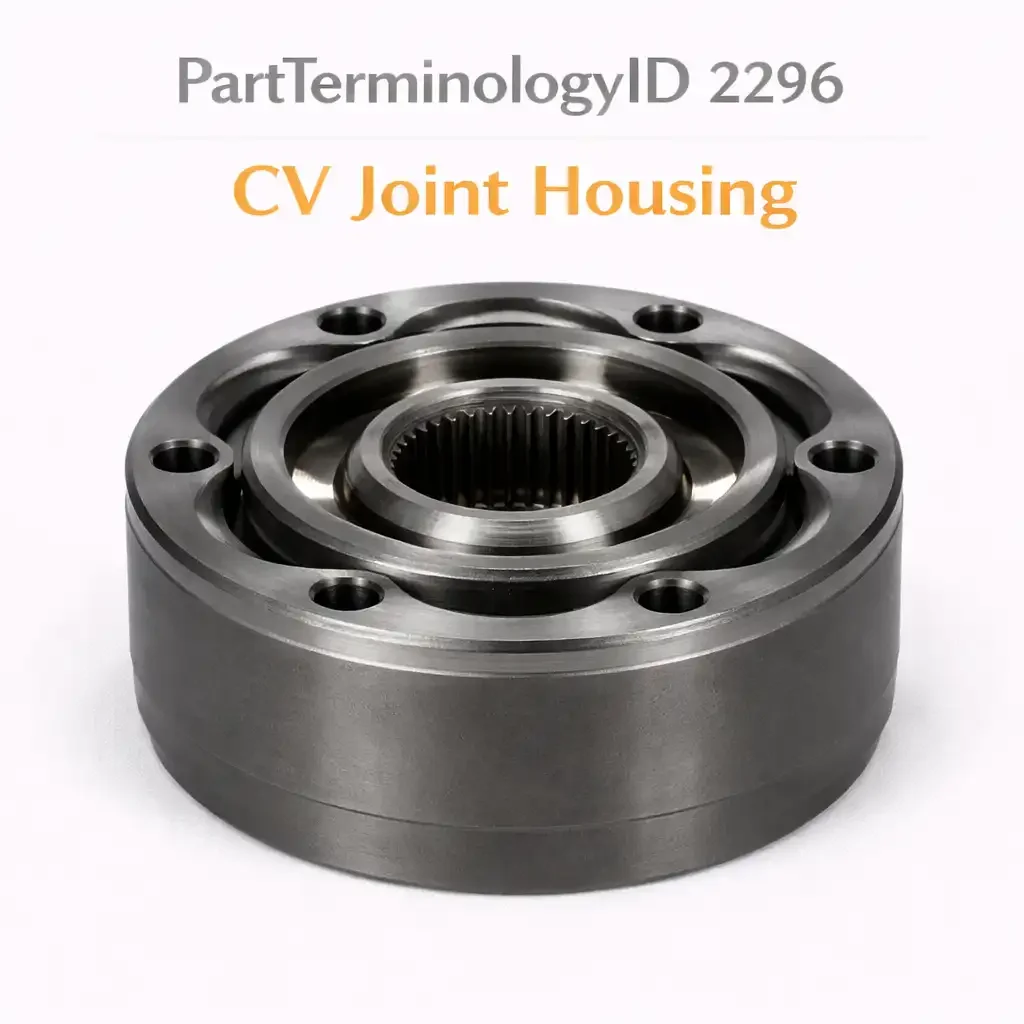
PartTerminologyID 2296, CV Joint Housing, is the outer shell of a CV joint that contains the internal components and connects the joint to the wheel hub, the differential output, or the axle shaft depending on the joint position and design. That definition locates the housing in the assembly. It does not specify whether the housing is an outer Rzeppa housing that accepts the hub stub shaft through its bore, an inner tripod tulip housing that receives the tripod spider and connects to the differential output shaft, a double-offset inner housing, or a cross-groove housing, what the housing bore diameter is, what the internal spline count and diameter are for differential-side connections, what the ball groove count and geometry are, whether the housing is sold as a bare casting or as a partially assembled unit with balls and cage already installed, whether the boot mounting surface dimensions are included in the listing, or what the relationship is between a replacement housing and a complete CV joint replacement under PartTerminologyID 2292. A listing under PartTerminologyID 2296 that provides vehicle fitment without the housing type, the bore specification, the internal geometry, and the component manifest cannot be evaluated by any buyer who is rebuilding a CV joint rather than replacing it as a complete assembly.
For sellers, the CV joint housing is a component that occupies a specific and narrow position in the repair decision hierarchy. A buyer ordering under PartTerminologyID 2296 has already made two decisions that most CV joint buyers do not make: they have decided to rebuild the joint rather than replace it, and they have identified the housing as the failed component rather than the balls, the cage, or the inner race. That level of diagnostic specificity is rare in the aftermarket. The buyer population for PartTerminologyID 2296 consists primarily of professional rebuilders, performance builders who need a housing with modified groove geometry, and commercial fleet operations where the cost of sourcing individual components is justified by the volume of rebuilds performed. A listing that does not serve the technical specificity of that buyer population with equally specific attributes wastes the purchase intent that brought the buyer to the listing.
For sellers, the listing under this PartTerminologyID is only useful if it specifies the housing type, the internal ball groove count and geometry, the bore diameter, the boot mounting surface dimensions, the differential spline specification for inner housing applications, and the component manifest. Without those six attributes, the listing cannot be distinguished from a complete CV joint listing and cannot be evaluated by a rebuilder who needs the housing alone.
What the CV Joint Housing Does
Containing the joint's internal components and transferring torque to the output member
The CV joint housing is the outer structural member of the CV joint. In a Rzeppa outer joint, the housing is the outer race: it contains the curved ball grooves on its inner spherical surface that the balls run in, and its outer surface connects to the wheel hub bearing. In a tripod inner joint, the housing is the tulip: it contains the three longitudinal grooves that the tripod rollers slide in, and its end cap or stub connects to the differential output shaft by spline engagement or by a flange. In a double-offset inner joint, the housing is the outer race of the ball joint combined with the plunge housing that allows the entire joint to slide axially.
The housing is the member that carries the torque reaction from the joint's internal load path to the driven component. In the outer Rzeppa joint, the torque path runs from the axle shaft through the inner race, through the balls, and into the housing outer race, which then drives the wheel hub. The housing must withstand the full output torque of the engine at the wheel end, multiplied by the gear ratios between the engine and the wheel, under the most severe conditions of simultaneous full torque and full articulation angle.
The ball grooves and their relationship to housing integrity
The ball grooves in a Rzeppa outer housing are the curved tracks that the torque-transferring balls run in. The groove geometry, specifically the groove curvature, the groove offset from the housing centerline, and the groove surface finish, determines the contact stress between the ball and the groove under load, the articulation angle the joint can achieve before the ball reaches the end of the groove, and the noise and efficiency of the joint during operation.
A housing with worn or pitted ball grooves cannot be salvaged by replacing the balls and cage. The worn groove surface has lost the precise curvature required for correct ball-to-groove contact geometry. A new ball running in a worn groove contacts only the worn high spots rather than the full designed contact patch, which concentrates the load on a small area and produces accelerated wear of both the new ball and the remaining groove surface. Replacing the housing is the only correct repair when the ball grooves are worn or pitted.
A housing with a single groove that is pitted from a ball that has spalled is a common presentation in CV joint rebuilding. The failure is visible as a dark spot or a rough patch in one groove that contrasts with the smooth polished surface of the other five grooves. This is the most common reason a buyer searches for a replacement housing rather than a complete joint: the inner race, the balls, and the cage are serviceable, and only the housing requires replacement.
The outer Rzeppa housing and the hub connection
The outer surface of the Rzeppa housing fits into the wheel hub bearing's inner bore on some designs, or sits against the outer face of the hub on other designs. On most current front-wheel-drive passenger vehicle applications, the Rzeppa housing outer surface is spherical and fits into the hub bearing's inner race bore. The housing outer diameter at this spherical surface must match the hub bearing bore exactly. An undersize housing outer diameter will allow the housing to move within the hub bearing bore under torque, producing noise and accelerating hub bearing wear. An oversize housing outer diameter will not seat correctly in the hub bearing bore.
The housing also has the boot mounting groove at the outboard end where the outer CV boot's large-diameter neck seats and is retained by the outer boot band. The boot groove outer diameter and the groove profile must match the boot's large-diameter neck inner diameter for the boot to seal correctly against the housing.
The tripod tulip housing and the differential connection
The tripod tulip housing connects to the differential output at its inboard end. The connection is either a splined stub shaft that fits into the differential output bore, or an internal splined bore in the tulip that receives the differential output stub shaft. Both configurations require a snap ring for axial retention.
The three grooves inside the tulip that receive the tripod rollers determine the plunge range of the inner joint. The groove length sets the maximum axial travel of the tripod spider within the housing. A replacement tulip housing with shorter grooves than the original will limit the plunge range and will bind at the extremes of suspension travel, exactly as described in the plunge range discussion in the CV joint post (PartTerminologyID 2292).
The boot mounting surface at the outboard end of the tulip housing receives the large-diameter inner boot neck. The boot groove dimensions must match the boot specification.
The Specifications That Determine Correct Housing Fitment
Housing type
The housing type is the primary specification because it determines every other attribute. Rzeppa outer housing, tripod tulip housing, double-offset outer housing, and cross-groove housing are the four main types. Each type has different internal geometry, different connection methods at the driven end, and different boot mounting surface geometry.
Ball groove count and geometry for Rzeppa housings
Six-ball and eight-ball designs are the two counts used in passenger vehicle Rzeppa joints. A six-ball housing and an eight-ball housing of the same outer diameter are not interchangeable because the groove count, the groove spacing, and the cage window count all differ between the two designs. A six-ball inner race and cage cannot be installed in an eight-ball housing and vice versa.
The groove offset angle, which is the angle of the groove centerline relative to the housing centerline, determines the joint's maximum articulation angle. This angle is set at manufacture and cannot be changed by the replacement housing selection. The replacement housing must have the same groove offset angle as the original to produce the same maximum articulation angle.
Housing bore diameter for Rzeppa outer housings
The spherical outer diameter of the Rzeppa housing at the hub interface must match the hub bearing bore. This dimension is often not listed in replacement housing catalogs because it is assumed to be implied by the vehicle fitment. It should not be assumed. Measure the hub bearing bore and confirm the replacement housing outer diameter before ordering.
Tulip groove length and plunge range for inner housings
The tulip groove length determines the plunge range. State the groove length in mm and the corresponding plunge range in mm. A buyer who is replacing a tulip housing because one groove is damaged needs to confirm the replacement provides the same plunge range as the original.
Differential connection specification for inner housings
The differential connection on the tulip housing end must match the differential output stub shaft or the differential output bore. For splined stub shaft connections, specify the spline count, the spline diameter, and the snap ring groove specification. For flange connections, specify the bolt circle diameter, the bolt count, and the bolt thread specification.
Boot mounting surface dimensions
The boot groove outer diameter, the groove width, and the groove depth at the boot seating location must match the boot's mating neck inner diameter. If the replacement housing has a different boot groove profile than the original, the original boot and bands cannot be reused and replacement boot components must be sourced.
Why This Part Generates Returns
Buyers order the wrong CV joint housing because:
the housing type is not specified and the buyer receives a Rzeppa outer housing when they need a tripod tulip for the inner position
the ball groove count is not stated and the buyer receives a six-ball housing when the original joint uses an eight-ball design
the hub interface outer diameter is not confirmed and the replacement housing does not seat correctly in the hub bearing bore
the tulip groove length is not stated and the replacement tulip has a shorter plunge range than the original, producing binding at full suspension travel
the differential spline count on the tulip is not specified and the housing spline does not match the differential output stub shaft
the boot groove dimensions differ from the original and the original boot cannot be reused on the replacement housing
Status in New Databases
PIES/PCdb: PartTerminologyID 2296, CV Joint Housing
PIES 8.0 / PCdb 2.0: No change
Top Return Scenarios
Scenario 1: "Six-ball housing received, original joint is eight-ball, cage will not fit"
The listing did not specify ball groove count. The buyer's original outer Rzeppa joint is an eight-ball design. The replacement housing is a six-ball design. The eight-ball cage cannot be installed in the six-ball housing because the groove spacing and the cage window geometry do not match.
Prevention language: "Ball groove count: [6-ball / 8-ball]. Verify your original CV joint's ball count before ordering the housing. Six-ball and eight-ball housings of the same outer diameter are not interchangeable. The cage and inner race from a six-ball joint cannot be installed in an eight-ball housing and vice versa."
Scenario 2: "Tulip groove length short, plunge range insufficient, binds at full compression"
The replacement tulip housing has grooves that are 14mm shorter than the original. The plunge range is reduced from 51mm to 37mm. At full suspension compression on the vehicle's sport-tuned suspension, the tripod rollers reach the end of the grooves and the joint binds.
Prevention language: "Tulip groove length: [X]mm. Plunge range: [X]mm. Verify this plunge range meets or exceeds the suspension travel requirement at the inner joint position. A tulip housing with shorter grooves than the original will limit the plunge range and produce binding at the extremes of suspension travel."
Scenario 3: "Differential spline count mismatch, tulip housing will not engage differential stub shaft"
The tulip housing internal spline count is 22. The differential output stub shaft spline count is 25. The housing will not engage the differential stub shaft. The listing specified the housing by vehicle fitment without stating the differential spline count.
Prevention language: "Differential side spline count: [X] splines. Verify this matches your differential output stub shaft before ordering. The differential side spline specification must match the stub shaft exactly. A spline count mismatch prevents the housing from engaging the differential output and cannot be corrected without a different housing."
Scenario 4: "Hub bore diameter mismatch, housing rocks in hub bearing under torque"
The replacement Rzeppa housing spherical outer diameter is 0.8mm smaller than the hub bearing bore. Under driving torque, the slight clearance allows the housing to rock microscopically within the hub bearing bore on every torque application and release. Within 15,000 miles, the hub bearing inner race bore has been worn oval and the hub bearing must be replaced.
Prevention language: "Housing spherical outer diameter: [X.X]mm. Verify this matches your hub bearing bore diameter before installation. A housing outer diameter that is smaller than the hub bore will allow the housing to rock under torque, which wears the hub bearing bore and accelerates hub bearing failure."
Scenario 5: "Boot groove profile different, original boot will not seal on replacement housing"
The replacement housing boot groove is 3mm narrower than the original. The original boot's large-diameter neck seating bead is sized for the original groove profile. The bead sits proud of the replacement groove and the boot band cannot clamp it fully into the groove. The boot leaks grease at the housing connection within 2,000 miles.
Prevention language: "Boot groove outer diameter: [X]mm. Boot groove width: [X]mm. Verify the boot groove dimensions match your replacement boot before assembly. If the replacement housing has a different boot groove profile than the original, source a boot sized for the replacement housing's groove dimensions rather than reusing the original boot."
What to Include in the Listing
Core essentials
PartTerminologyID: 2296
component: CV Joint Housing
housing type: Rzeppa outer, tripod tulip inner, double-offset inner, or cross-groove (mandatory)
joint position: inner or outer (mandatory)
ball groove count for Rzeppa housings: 6-ball or 8-ball (mandatory)
housing spherical outer diameter in mm for Rzeppa hub interface (mandatory)
tulip groove length in mm for inner tulip housings (mandatory)
plunge range in mm for inner tulip housings (mandatory)
differential spline count and diameter for inner housings (mandatory)
differential retention method: snap ring or flange (mandatory)
snap ring specification and inclusion status (mandatory for snap-ring retained)
boot groove outer diameter in mm (mandatory)
boot groove width in mm (mandatory)
component manifest: housing only, or housing with specified internal components (mandatory)
quantity: 1
Fitment essentials
year/make/model/submodel
axle position: front left, front right, rear left, rear right
inner or outer joint position (mandatory)
transmission or transaxle model when differential spline specification varies
OE part number cross-reference when available
Dimensional essentials
housing spherical outer diameter in mm for Rzeppa designs
ball groove count and groove offset angle for Rzeppa designs
tulip groove length and plunge range in mm for inner designs
differential spline count, pitch circle diameter, and spline length for inner designs
snap ring groove diameter and wire diameter for retention snap rings
boot groove outer diameter, width, and depth in mm
maximum articulation angle in degrees
Image essentials
housing in isolation showing the internal groove geometry from the open end
ball groove detail with groove count visible for Rzeppa housings
boot groove detail with outer diameter and width callouts
tulip housing with the three grooves visible and the groove length callout
differential connection end showing the spline or flange configuration
installed context showing the housing as part of the complete joint assembly
Catalog Checklist for ACES/PIES Teams
PartTerminologyID = 2296
require housing type: Rzeppa, tripod tulip, double-offset, cross-groove (mandatory)
require joint position: inner or outer (mandatory)
require ball groove count for Rzeppa housings (mandatory)
require housing spherical outer diameter for Rzeppa hub interface (mandatory)
require tulip groove length and plunge range for inner housings (mandatory)
require differential spline count and diameter for inner housings (mandatory)
require boot groove outer diameter and width (mandatory)
require component manifest (mandatory)
differentiate from CV joint (PartTerminologyID 2292): the CV joint listing covers the complete joint assembly including inner race, balls, cage, and housing; PartTerminologyID 2296 covers the housing alone for rebuilding applications where only the housing requires replacement; do not list complete joints under 2296
differentiate from halfshaft assembly (PartTerminologyID varies): the halfshaft includes the housing as part of the complete shaft assembly; PartTerminologyID 2296 is the housing in isolation for rebuilders
flag housing type as mandatory first attribute: a Rzeppa outer housing and a tripod tulip inner housing are entirely different components; a listing without the housing type cannot be evaluated
flag ball groove count as mandatory for Rzeppa housings: six-ball and eight-ball housings of the same outer diameter are not interchangeable because the cage geometry differs
flag plunge range as mandatory for inner housings: a tulip with shorter grooves than the original limits suspension travel
flag boot groove dimensions as mandatory: a housing with a different boot groove profile requires a different boot; the buyer must know before ordering whether the original boot can be reused
FAQ (Buyer Language)
How do I know if my CV joint housing is the failed component or if the whole joint needs replacement?
Remove the CV joint from the vehicle and disassemble it. Clean all components and inspect under good light. The housing ball grooves should be smooth, uniformly polished, and free of pitting, spalling, or dark heat-discolored patches. A groove with a pitted or spalled area is the failed component. If only the housing grooves show damage and the balls, cage, and inner race are smooth and undamaged, the housing replacement is the correct repair. If the balls show flat spots, the cage shows cracking or deformation, or the inner race grooves show pitting, those components must be replaced alongside or instead of the housing.
Can I reuse the original balls, cage, and inner race with a replacement housing?
Yes, provided all three pass inspection. Each ball must be spherical with no flat spots, no pitting, and no spalling. The cage windows must be undamaged and the cage body must be free of cracks. The inner race grooves must be smooth with no pitting or spalling. If all original internal components pass inspection, they can be assembled into the replacement housing with new grease. The assembly process requires pressing the balls into the cage and housing grooves in the correct sequence and confirming the joint articulates smoothly through its full range before installing the boot and bands.
The boot groove on my replacement housing is slightly different from the original. Can I modify the boot to fit?
No. Do not attempt to modify the boot to fit a differently profiled boot groove. The boot's large-diameter neck seating bead is molded to a specific profile that matches the housing groove. Stretching or cutting the boot neck to fit a different groove profile destroys the sealing geometry that the boot band clamps against. Source a boot that is sized for the replacement housing's boot groove dimensions rather than modifying the boot.
My tulip housing has one damaged groove but the other two are perfect. Can I repair the single damaged groove?
Not in the field. The tulip groove surface is case-hardened during manufacture and the groove profile is precision-machined to a tolerance that field repair tools cannot achieve. A groove that has a dent, a nick, or a spalled area cannot be ground or filed to a correct profile without removing the hardened case and altering the groove geometry. Replace the tulip housing when any groove shows damage. Operating the joint with one damaged groove will rapidly damage the roller that contacts the damaged groove, which will then damage the adjacent grooves as the debris from the first failure circulates in the joint grease.
Is the replacement housing compatible with my vehicle's ABS reluctor ring if my original housing has one?
Some Rzeppa outer housings have an ABS reluctor ring pressed onto the housing body or an integral toothed ring machined into the housing flange. The reluctor ring tooth count must match the ABS wheel speed sensor's calibration for the vehicle. A housing with the wrong tooth count will produce incorrect wheel speed signals and will trigger ABS fault codes even when the ABS system is functioning correctly. Verify whether your original housing has an integral reluctor ring, and if it does, confirm the replacement housing has the same tooth count before ordering.
Cross-Sell Logic
CV Joint (PartTerminologyID 2292: if the inspection reveals that the balls, cage, or inner race also require replacement in addition to the housing, the complete joint may be more economical than sourcing the housing and individual internal components separately)
CV Joint Boot (PartTerminologyID 2284: if the replacement housing has different boot groove dimensions than the original, a replacement boot sized for the new housing is required)
CV Joint Boot Band (PartTerminologyID 2280: new bands are required at both boot ends whenever the boot is removed for housing replacement)
CV Joint Grease (fresh grease of the correct type and quantity is required for every CV joint assembly; never reuse old grease from a disassembled joint)
Snap Ring (the differential side retention snap ring is replaced whenever the inner tulip housing is removed from the differential stub shaft)
Halfshaft Assembly (PartTerminologyID varies: if the shaft, the inner race, the balls, and the cage all require replacement in addition to the housing, a complete halfshaft assembly is the more economical repair than sourcing all components individually)
Frame as "the housing contains the joint. The balls and races transfer the torque inside the housing. The boot seals the grease the balls need. The bands retain the boot on the housing. The snap ring retains the housing on the differential. All are inspected and relevant ones replaced when the housing is replaced."
Final Take for PartTerminologyID 2296
CV Joint Housing (PartTerminologyID 2296) serves the narrowest and most technically specific buyer population in the CV joint PartTerminologyID series. A buyer ordering a housing has already performed the disassembly, completed the inspection, identified the housing as the failed component, and determined that the remaining joint components are serviceable. That buyer is not browsing. They are sourcing a specific component against a specific failure and they need the listing to match their inspection findings to a part specification without ambiguity.
The housing type resolves which of four fundamentally different designs the listing covers. The ball groove count resolves which internal component set is compatible with the housing. The boot groove dimensions resolve whether the original boot can be reused or must be replaced. The tulip groove length resolves whether the suspension travel range is preserved. The differential spline count resolves whether the housing can connect to the differential output. The component manifest resolves what arrives in the box.
State the housing type. State the ball groove count for Rzeppa designs. State the spherical outer diameter for hub interface verification. State the boot groove dimensions. State the tulip groove length and plunge range for inner designs. State the differential spline count for inner designs. State the component manifest. That is the same listing strategy as every other PartTerminologyID in this series: the generic PartTerminologyID requires specific attributes at every level to become a listing that the technically specific buyer of PartTerminologyID 2296 can act on. For this PartTerminologyID, the buyer already knows more about their joint than any listing without those attributes can serve.