
Written by Arthur Simitian | PartsAdvisory
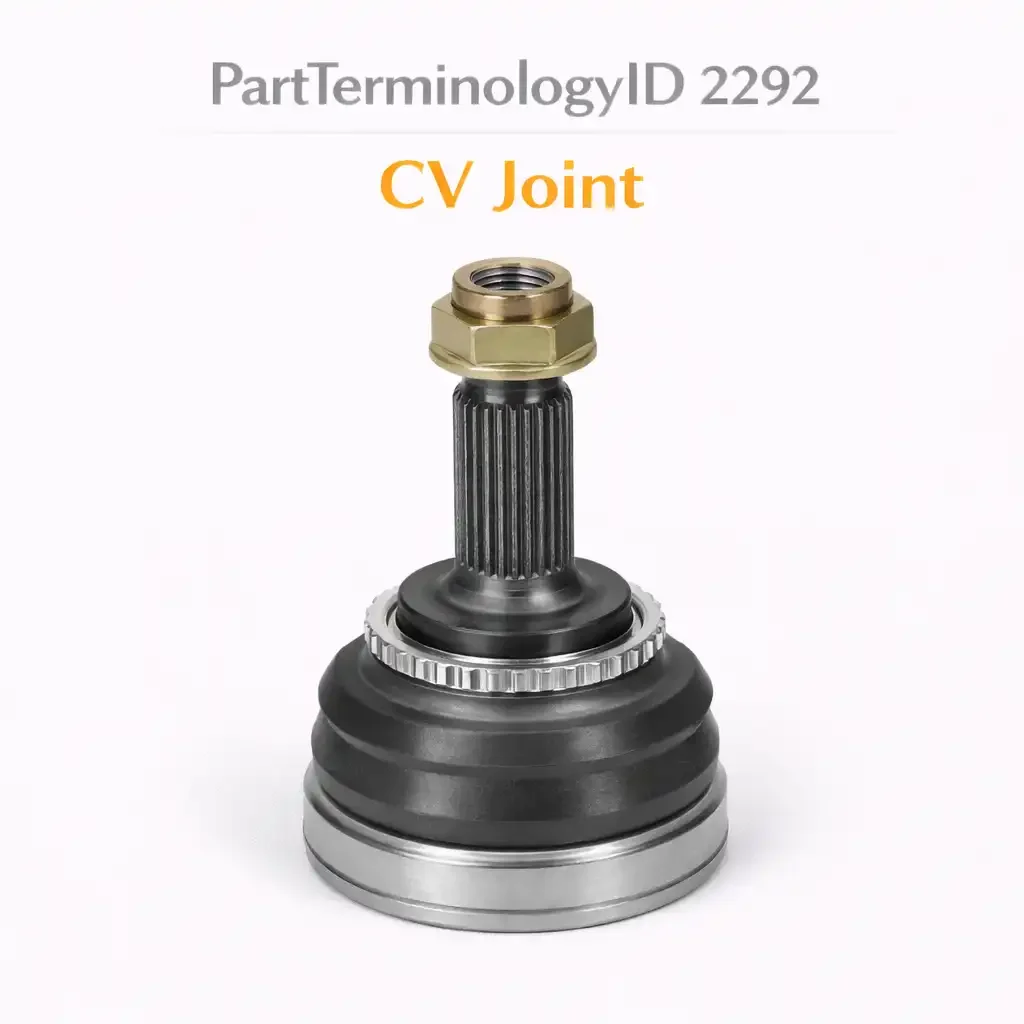
PartTerminologyID 2292, CV Joint, is a constant velocity joint that transfers torque between two shafts while accommodating the angular difference between them without the velocity fluctuation produced by a simple universal joint. That definition captures the engineering principle. It does not specify whether the joint is a Rzeppa outer joint, a tripod inner joint, a double-offset inner joint, a cross-groove joint, or a fixed-ball joint, what the spline count is at the stub shaft or the differential side, what the spline diameter is, what the joint's maximum articulation angle is, whether the joint includes a stub shaft or connects to a separate shaft, what the plunge range is for inner joints, what the bolt circle diameter is for flange-mounted joints, whether the boot and grease are included, what the snap ring configuration is for retention in the hub or differential, or what the relationship is between this PartTerminologyID and the halfshaft assembly (PartTerminologyID varies) that contains the joint as a component. A listing under PartTerminologyID 2292 that provides vehicle year, make, and model without the joint type, the spline specification, and the retention configuration cannot be evaluated by any buyer who has measured the original joint or who is sourcing the replacement against a service manual specification.
For sellers, the CV joint is the highest-consequence individual component in the halfshaft assembly category. A wrong boot band (PartTerminologyID 2280) prevents a seal. A wrong boot (PartTerminologyID 2284) prevents a grease enclosure. A wrong CV joint prevents torque transfer entirely, and does so in a way that may not be discovered until the joint is fully assembled onto the shaft, the shaft is installed in the vehicle, and the wheel is attached, at which point the spline mismatch or the wrong retention snap ring is discovered and the entire disassembly sequence must be repeated. The CV joint is also the component in this series where the relationship between PartTerminologyID 2292 and the halfshaft assembly PartTerminologyID is most consequential: a buyer who needs only the joint because the shaft is intact must order under 2292, and a buyer who needs the shaft as well must order the halfshaft assembly. A listing that does not clarify what is included, whether that is the joint alone, the joint with a stub shaft, the joint with a boot and bands, or the joint with a boot, bands, and grease, produces a return from every buyer whose expectation does not match what arrives.
For sellers, the listing under this PartTerminologyID is only useful if it specifies the joint type, the spline count, the spline diameter, the retention configuration, the plunge range for inner joints, the articulation angle for outer joints, and the complete component manifest. Without those seven attributes, the listing cannot prevent the spline mismatch and configuration errors that are the primary return drivers for this PartTerminologyID.
What the CV Joint Does
Transferring torque at a constant velocity through an articulation angle
A standard universal joint transfers torque through an angle by allowing the output shaft to accelerate and decelerate twice per revolution as the joint articulates. At small angles this velocity fluctuation is negligible. At the articulation angles required by front-wheel-drive steering geometry, which can reach 47 degrees at full steering lock, the velocity fluctuation from a universal joint would produce a severe driveline vibration and would subject the half shaft to twice-per-revolution torque spikes that would accelerate wear throughout the drivetrain.
The CV joint eliminates this velocity fluctuation by maintaining a constant velocity ratio between the input and output shafts regardless of the articulation angle. It does this by constraining the torque-transferring elements, whether balls in grooves or tripod rollers on trunnions, to always bisect the angle between the two shafts. When the balls or rollers always operate at the bisecting plane, the output velocity equals the input velocity at every instant throughout the rotation, which is where the constant velocity name comes from.
The Rzeppa outer joint
The Rzeppa joint is the standard outer CV joint on front-wheel-drive passenger vehicles and on the outer position of rear-wheel-drive independent rear suspension halfshafts. It consists of an inner race splined to the stub shaft, an outer race that connects to the wheel hub, and six or eight balls running in paired curved grooves in the inner and outer races. A cage between the inner and outer races constrains the balls to the bisecting plane at all articulation angles.
The Rzeppa joint is a fixed joint: it articulates but does not plunge. The axle shaft does not telescope within the Rzeppa joint. The plunge that accommodates suspension travel is provided by the inner joint. The Rzeppa joint's articulation range of up to 47 degrees is the highest of any CV joint design and is why it is universally used at the outer position where full steering lock angles must be accommodated.
The outer race of the Rzeppa joint has a smooth spherical outer surface that fits into the wheel hub bearing. The stub shaft extending from the inner race passes through the hub bearing bore and is retained by the hub nut. The splines on the stub shaft mate with the internal splines of the hub bearing bore. The spline count and the spline diameter must match the hub exactly. A joint with one additional or one fewer spline than the hub cannot be installed.
The tripod inner joint
The tripod joint is the most common inner CV joint design on front-wheel-drive passenger vehicles. It consists of a tripod spider with three trunnions, each carrying a spherical or barrel-shaped roller, that fits onto the stub shaft and engages three longitudinal grooves in the tulip housing. The tripod design accommodates both articulation and axial plunge: the rollers can slide along the grooves to accommodate changes in shaft length as the suspension travels.
The tripod joint's maximum articulation angle is lower than the Rzeppa, typically 18 to 23 degrees, which is sufficient for the inner joint position where suspension travel rather than steering angle is the primary articulation demand. The plunge range, which is the total axial distance the rollers can travel within the grooves, must accommodate the full suspension travel range of the vehicle. A replacement tripod joint with a shorter plunge range than the original will bind at the extremes of suspension travel, producing a clunk or a jerk in the driveline during full compression or full extension.
The tulip housing of the tripod joint connects to the differential output shaft by one of two methods. On most passenger vehicle applications, the housing has internal splines that engage the differential output stub shaft and is retained by a snap ring. On some applications, the housing has an external flange that bolts to the differential output flange. Both configurations must be specified in the listing.
The double-offset inner joint
The double-offset joint (DOJ) is an inner joint design used on some European and Asian vehicles where the plunge range requirement exceeds what the tripod design can provide at the same shaft diameter. The DOJ uses the same ball-and-groove principle as the Rzeppa but with an offset between the inner and outer race centers that allows the entire joint assembly to plunge axially within the outer housing. The plunge capacity of the DOJ at a given joint diameter is greater than that of the tripod.
The DOJ inner joint requires the same spline and retention specifications as the tripod inner joint, plus a specification of the plunge range and the maximum articulation angle, both of which differ from the Rzeppa outer joint values.
The cross-groove joint
The cross-groove joint is used at the outer position on some rear-wheel-drive independent rear suspension vehicles where a fixed Rzeppa joint is not suitable because the rear suspension geometry requires the outer joint to provide limited plunge in addition to articulation. The cross-groove joint uses balls running in alternating right-hand and left-hand angled grooves that allow a small amount of axial plunge while maintaining the constant velocity ratio. The listing must specify whether the outer joint is a fixed Rzeppa or a plunging cross-groove design because they are not interchangeable even when the spline and hub specifications match.
The Spline Specification: The Most Consequential Fitment Attribute
Why the spline count and diameter are the first dimensional attributes in the listing
The spline specification determines whether the CV joint can physically connect to the hub, the shaft, or the differential. A spline mismatch is the most common cause of a CV joint return because it is discovered at the end of the installation sequence, after the shaft has been installed and the hub nut torqued, when the wheel fails to rotate correctly or the hub nut cannot be tightened to specification because the splines do not fully engage.
On the stub shaft end of the outer Rzeppa joint, the spline count must match the hub internal spline count exactly. Common spline counts on domestic passenger vehicles include 26, 28, 29, 30, and 32 splines. A 28-spline stub shaft will start into a 29-spline hub bore and appear to engage for several splines before locking against the mismatched tooth spacing. The engagement is tight enough to require a press or a puller to separate, which means the buyer discovers the mismatch only after the shaft has been installed, the hub nut has been run down, and the mismatch has produced a seized joint-to-hub connection.
The spline diameter is the second spline attribute. The same spline count at different pitch circle diameters produces splines of different tooth height and width. A spline that matches the count but not the diameter will engage at the tips of the teeth without full flank contact, which transfers torque through a small contact area and produces accelerated spline wear.
The listing must state the spline count and the spline diameter at every spline interface: the stub shaft-to-hub interface on the outer joint, the shaft-to-inner-race interface if the shaft is separate, and the inner joint housing-to-differential interface on the inner joint.
The differential side spline and retention snap ring
On inner joints that connect to the differential output stub shaft by spline engagement, the internal spline of the joint housing must match the differential output stub shaft spline count and diameter. The joint is retained axially on the differential stub shaft by a snap ring that seats in a groove on the differential stub shaft and engages a recess in the joint housing bore.
The snap ring specification is the second most consequential fitment attribute after the spline count. Snap rings for CV joint retention are produced in different diameters, different wire diameters, and different expanded diameters. A snap ring that is the correct wire diameter but the wrong expanded diameter will not engage the recess in the joint housing bore correctly. A snap ring that is correctly dimensioned but made of the wrong spring steel alloy will not produce the correct retention force and will allow the joint to pull off the differential stub shaft under the axial load of suspension travel.
The listing must specify the snap ring and whether it is included.
Articulation Angle and Plunge Range
Why articulation angle matters for outer joint selection
The outer CV joint on a front-wheel-drive vehicle must accommodate the full steering lock articulation angle. On passenger vehicles, this ranges from 42 to 47 degrees depending on the vehicle's steering geometry. A replacement outer joint with a maximum articulation angle below the vehicle's full steering lock angle will reach its internal mechanical stop during full-lock turns and will either bind, produce a click, or transfer the excess angle as a shock load into the balls and cage.
The articulation angle is determined by the joint's internal geometry and cannot be changed by altering installation parameters. The listing must state the maximum articulation angle and it must meet or exceed the vehicle's full steering lock requirement.
Why plunge range matters for inner joint selection
The inner CV joint must accommodate the full suspension travel range without the rollers or balls reaching the end of the housing grooves. The plunge range is the total axial distance the joint can extend or compress from its centered position. The vehicle's suspension travel determines the required plunge range at the inner joint position.
A replacement inner joint with a shorter plunge range than the original will bind at the extremes of suspension travel. On smooth roads this may produce only an occasional clunk during large suspension events. On roads with significant surface irregularities, the binding will be frequent and will transmit suspension shock loads into the differential output shaft and the transmission.
The listing must state the plunge range for all inner joint listings.
The Component Manifest
What the CV joint listing may or may not include
The CV joint listing under PartTerminologyID 2292 may cover any of the following combinations:
Joint only: the bare CV joint without a boot, grease, bands, or stub shaft. This is the correct purchase when the shaft is being transferred from an old joint to a new one and the boot and grease are being sourced separately.
Joint with boot and bands: the joint with the boot pre-installed or included in the kit, along with the bands for both boot ends. This is the most common configuration for an outer Rzeppa joint replacement kit.
Joint with boot, bands, and grease: the complete kit including everything required to install the joint and seal it. This is the preferred configuration for DIY buyers who want to confirm all required components are in one purchase.
Joint with stub shaft: some inner joints and some outer joints are supplied with a stub shaft already attached, particularly when the joint-to-shaft interface uses a press fit or a staked connection rather than a splined separable connection.
The listing must specify exactly which components are included. A buyer who receives a joint-only listing when they expected a kit with grease and bands either returns the joint or installs it without grease, which destroys it immediately.
The Relationship Between PartTerminologyID 2292 and the Halfshaft Assembly
When to order the joint versus the halfshaft assembly
The CV joint under PartTerminologyID 2292 is the correct purchase when the axle shaft is intact, undamaged, and the failure is isolated to the joint itself. A shaft that is straight, with undamaged splines and no cracks or corrosion at the boot grooves, can have its CV joint replaced without replacing the shaft. This is the lower-cost repair when the shaft condition justifies it.
The halfshaft assembly is the correct purchase when the shaft itself is damaged, when the shaft boot grooves are corroded to the point that a boot band cannot seal against them, when the shaft splines at either end are worn or damaged, or when the total cost of the joint, boot, bands, grease, and labor for the individual repair approaches the cost of a remanufactured halfshaft assembly that includes all of those components assembled and tested.
The listing must clarify whether it covers the joint alone or the joint as part of a larger assembly, and must cross-reference the halfshaft assembly PartTerminologyID for buyers whose shaft condition requires the complete assembly rather than the joint alone.
Why This Part Generates Returns
Buyers order the wrong CV joint because:
the spline count is not stated and the stub shaft engages the hub or differential for several splines before locking against the mismatched tooth spacing
the joint type is not specified and the buyer receives a fixed Rzeppa when they need a plunging inner joint for the inner position, or a tripod when the application uses a double-offset design
the retention snap ring is not included and not disclosed, and the inner joint cannot be retained on the differential stub shaft after installation
the plunge range is not stated for an inner joint and the replacement joint binds at full suspension travel
the articulation angle is not stated for an outer joint and the replacement joint reaches its internal stop at full steering lock
the component manifest is not specified and the buyer installs the joint without grease because they assumed grease was included
the listing conflates the joint with the halfshaft assembly and the buyer receives only the joint when they needed the complete shaft
Status in New Databases
PIES/PCdb: PartTerminologyID 2292, CV Joint
PIES 8.0 / PCdb 2.0: No change
Top Return Scenarios
Scenario 1: "Spline count mismatch, stub shaft locked in hub, required press to separate"
The replacement outer Rzeppa joint has a 29-spline stub shaft. The hub internal splines are 28-count. The 29-spline shaft engaged the 28-spline hub for the first several splines before locking. The buyer torqued the hub nut, which further forced the mismatched splines together. Separating the joint from the hub required a hydraulic press, and the hub splines were partially damaged in the process.
Prevention language: "Stub shaft spline count: [X] splines. Stub shaft spline diameter: [X]mm. Verify your hub internal spline count and diameter before installing. Spline count mismatches engage for several threads before locking and may require a press to separate. Verify the spline specification against your vehicle service manual before installation."
Scenario 2: "Fixed Rzeppa joint received for inner position, no plunge accommodation, binds at full compression"
The buyer ordered a CV joint by vehicle fitment. The listing did not specify joint type or position. The inner joint position requires a plunging tripod or double-offset joint. The buyer received a fixed Rzeppa. At full suspension compression, the fixed joint reached its articulation limit and locked, producing a severe binding clunk during the first suspension cycle after installation.
Prevention language: "Joint type: [Rzeppa fixed outer / tripod inner / double-offset inner]. Joint position: [outer / inner]. Inner CV joint positions require a plunging joint design that accommodates axial shaft length change during suspension travel. A fixed Rzeppa joint installed at the inner position will bind at the extremes of suspension travel. Verify the joint type matches the position before ordering."
Scenario 3: "Snap ring not included, inner joint pulled off differential stub shaft on first suspension cycle"
The listing did not disclose that the retention snap ring was not included. The buyer installed the inner joint on the differential stub shaft without a snap ring. On the first significant suspension travel event, the axial force of the joint reaching full extension pulled the joint off the stub shaft. The halfshaft dropped and contacted the subframe.
Prevention language: "Retention snap ring: [included / not included, order part number XXXXX separately]. The inner CV joint is retained on the differential stub shaft by a snap ring that must snap into the groove on the stub shaft with a positive click. Do not install the inner joint without the snap ring. An inner joint installed without a snap ring will separate from the differential stub shaft under suspension travel axial loads."
Scenario 4: "Grease not included, joint installed dry, failed within 200 miles"
The kit was described as a complete CV joint kit. The listing did not specify whether grease was included. The buyer assumed grease was included because the listing described the kit as complete. The boot and bands were in the box but no grease was included. The buyer installed and sealed the boot without filling it with grease. The joint failed within 200 miles from dry running.
Prevention language: "Kit contents: [joint, boot, bands, grease / joint, boot, bands / joint only]. CV joint grease type: [specify type]. Grease quantity: [X] grams. Verify the kit includes grease before beginning installation. A CV joint installed without grease will fail within a short distance. If grease is not included in this listing, source the correct grease type and quantity before installing the boot."
Scenario 5: "Plunge range insufficient, clunking at full suspension travel"
The replacement tripod inner joint has a plunge range of 42mm. The vehicle's full suspension travel requires 51mm of plunge at the inner joint position. At full suspension compression, the tripod rollers reach the end of the tulip housing grooves. The joint cannot compress further and the axial load is transmitted as a sharp clunk into the driveline and the differential.
Prevention language: "Plunge range: [X]mm. Verify this plunge range meets or exceeds your vehicle's suspension travel requirement at the inner joint position. A plunge range that is shorter than the suspension travel requirement will cause the joint to bind at full compression or extension, producing a clunking noise and transmitting shock loads into the differential."
Scenario 6: "Articulation angle insufficient, outer joint clicks at full steering lock"
The replacement outer Rzeppa joint has a maximum articulation angle of 40 degrees. The vehicle's full steering lock requires 45 degrees of articulation at the outer joint. During full-lock parking maneuvers, the joint reaches its internal stop and produces a clicking noise identical to the noise of a worn joint.
Prevention language: "Maximum articulation angle: [X] degrees. Verify this angle meets or exceeds your vehicle's full steering lock articulation requirement at the outer joint position. A joint with an insufficient articulation angle will produce a clicking or binding sensation during full-lock turns that is identical to the noise of a worn joint and will accelerate wear in the balls and cage from contact with the internal stop."
Scenario 7: "Joint-only listing, buyer assumed halfshaft included, shaft left in garage"
The listing covered the CV joint without a shaft. The buyer assumed the listing included the complete halfshaft assembly with the shaft. The joint arrived without a shaft. The buyer's original shaft was already removed and was not in condition to reuse. The repair could not be completed without sourcing the shaft separately.
Prevention language: "This listing covers: [CV joint only / CV joint with boot and bands / CV joint with boot, bands, and grease]. The axle shaft is not included. If your axle shaft is damaged, corroded at the boot grooves, or has worn splines, order a complete halfshaft assembly rather than the joint alone."
What to Include in the Listing
Core essentials
PartTerminologyID: 2292
component: CV Joint
joint type: Rzeppa fixed outer, tripod inner, double-offset inner, cross-groove, or other (mandatory)
joint position: outer or inner (mandatory)
stub shaft spline count at hub end for outer joints (mandatory)
stub shaft spline diameter at hub end for outer joints (mandatory)
differential side spline count for inner joints (mandatory)
differential side spline diameter for inner joints (mandatory)
retention method: snap ring retained or flange bolted (mandatory)
snap ring specification and inclusion status (mandatory for snap-ring retained designs)
maximum articulation angle in degrees for outer joints (mandatory)
plunge range in mm for inner joints (mandatory)
component manifest: joint only, joint with boot and bands, or joint with boot, bands, and grease (mandatory)
grease type and quantity if included (mandatory when grease is included)
boot type if included: TPE, silicone, or rubber (mandatory when boot is included)
quantity: 1 joint or 1 kit as specified
Fitment essentials
year/make/model/submodel
axle position: front left, front right, rear left, rear right
inner or outer joint position
transmission or transaxle model when the differential side spline specification varies by transmission within the same vehicle model
OE part number cross-reference when available
Dimensional essentials
stub shaft spline count
stub shaft pitch circle diameter in mm
stub shaft spline length in mm
hub nut thread specification (diameter and pitch) when stub shaft thread varies by application
differential side housing spline count and diameter for inner joints
snap ring wire diameter and expanded diameter for snap-ring retained joints
flange bolt circle diameter and bolt count for flange-mounted joints
plunge range in mm for inner joints
maximum articulation angle in degrees
Image essentials
joint in isolation showing the stub shaft, the outer race, and the boot mounting surface
stub shaft spline detail with spline count callout
snap ring shown in position in the housing groove with the retention detail visible
for inner tripod joints: the tulip housing shown with the tripod spider removed to show the groove length and the plunge range
for outer Rzeppa joints: the articulation range shown with the joint at maximum angle
component manifest image showing all included components laid out together
Catalog Checklist for ACES/PIES Teams
PartTerminologyID = 2292
require joint type: Rzeppa, tripod, double-offset, cross-groove (mandatory)
require joint position: inner or outer (mandatory)
require stub shaft spline count and diameter for outer joints (mandatory)
require differential side spline count and diameter for inner joints (mandatory)
require retention method: snap ring or flange (mandatory)
require snap ring specification and inclusion status (mandatory for snap-ring retained designs)
require maximum articulation angle for outer joints (mandatory)
require plunge range for inner joints (mandatory)
require complete component manifest (mandatory)
require grease type and quantity if included (mandatory)
differentiate from CV joint boot (PartTerminologyID 2284): the boot covers the joint; the joint is the mechanism the boot covers; a cracked boot does not require joint replacement unless the joint has been damaged by grease loss
differentiate from CV joint boot band (PartTerminologyID 2280): the band retains the boot on the joint; the joint is the mechanism the band indirectly seals
differentiate from halfshaft assembly (PartTerminologyID varies): the halfshaft assembly includes the shaft, both joints, both boots, and all bands; PartTerminologyID 2292 covers the joint alone; both may be appropriate depending on the shaft condition; the listing must clarify what is included and cross-reference the halfshaft assembly for buyers whose shaft requires replacement
flag spline count as primary fitment attribute: spline count mismatches are the highest-volume return driver for this PartTerminologyID; the count must be stated explicitly and not implied by vehicle fitment alone
flag snap ring inclusion as mandatory: an inner joint installed without a retention snap ring will separate from the differential stub shaft under suspension travel axial loads; the listing must disclose whether the snap ring is included
flag plunge range as mandatory for inner joints: a plunge range shorter than the suspension travel requirement produces binding and driveline shock loads that damage the differential and the joint
flag component manifest as mandatory: a joint ordered as a kit that arrives without grease sends the buyer to an installation without lubrication, which destroys the joint within the first few hundred miles
FAQ (Buyer Language)
How do I identify my outer CV joint spline count without removing the axle?
The easiest method without disassembly is to look up the spline count in the vehicle service manual for your year, make, model, and engine. The spline count is listed under axle shaft or halfshaft specifications and is specific to the engine and drivetrain configuration. If the service manual is not available, the spline count can be confirmed by looking at the hub nut size: on many domestic front-wheel-drive vehicles, the hub nut size correlates with the stub shaft diameter, which correlates with the spline count. A definitive count requires either the service manual specification or direct measurement after removing the axle shaft.
My outer CV joint clicks during turns but is quiet on straight roads. Is that definitely the outer joint?
Clicking during turns at low speed that disappears on straight roads at the same speed is the classic symptom of a worn outer Rzeppa joint. The clicking occurs because the worn balls skip in their grooves when the joint is articulated at a high angle during a turn. On straight roads, the joint operates near zero degrees of articulation and the worn ball-to-groove contact produces no clicking because there is no angular loading of the balls. Confirm by turning the vehicle in a tight circle in a parking lot: slow, full-lock turns that produce a consistent click on one side indicate the outer CV joint on that side. If the click occurs equally in both directions, both outer joints may require replacement.
Can I replace only the outer CV joint and leave the inner joint in place?
Yes, provided the inner joint is serviceable. If the inner joint boot is intact, the grease is uncontaminated, and the joint has no roughness or play, the inner joint does not require replacement at the same service event as the outer. The axle shaft must be removed from the vehicle to replace the outer joint, which means the inner joint is accessible during the same service event without additional labor. Inspect the inner joint while the shaft is out and replace it at the same time if it shows any wear, rough rotation, or a boot that is cracked or deteriorated.
What type and quantity of grease do I need if it is not included in the kit?
The grease type is specified in the vehicle service manual and on the OE joint specification. Outer Rzeppa joints on most domestic passenger vehicles use a molybdenum disulfide (moly) grease specifically formulated for CV joint applications. The quantity for a standard passenger vehicle outer joint is typically 80 to 120 grams. Inner tripod joints use the same moly grease type in a larger quantity, typically 120 to 180 grams, because the tulip housing volume is larger than the Rzeppa outer race cavity. Do not use wheel bearing grease, general chassis grease, or lithium grease in a CV joint. Those formulations do not have the film strength required for the high-contact-stress ball-to-groove or roller-to-trunnion interface and will fail to protect the joint within the first few hundred miles.
My inner joint pulled off the differential stub shaft. Is the stub shaft damaged?
Inspect the stub shaft snap ring groove for deformation or wear. If the groove is clean and the snap ring seats in it with a positive snap when a new snap ring is installed, the stub shaft is serviceable. If the groove is worn, deformed, or if the snap ring does not produce a positive retention click when seated, the stub shaft or the differential output flange must be replaced. Also inspect the differential stub shaft splines for damage from the joint pulling off under load. A joint that separated under load will typically cause some spline damage from the forced disengagement. Light surface marks on the spline flanks are acceptable. A spline with missing or deformed teeth must be replaced.
The replacement joint articulates smoothly but the hub nut will not reach the specified torque. What is wrong?
A hub nut that will not reach the specified torque on a correctly splined stub shaft indicates one of three problems. First, the stub shaft thread is damaged: inspect the thread for crossed threads or impact damage and repair or replace the shaft. Second, the hub nut is the wrong thread specification for the stub shaft: verify the thread pitch and diameter against the vehicle service manual. Third, the stub shaft is not fully seated in the hub bore and the splines have not fully engaged: verify the stub shaft is fully through the hub bearing bore and that the retaining washer, if used, is correctly positioned before torquing the hub nut.
Cross-Sell Logic
CV Joint Boot (PartTerminologyID 2284: if the boot is not included with the joint, it is the highest-priority concurrent purchase; a joint installed without a boot will be contaminated immediately)
CV Joint Boot Band (PartTerminologyID 2280: if bands are not included with the boot or the joint kit, two bands are required per joint, one at the inner shaft end and one at the outer housing end)
CV Joint Grease (the correct grease type and quantity are required for every joint installation; if not included in the kit, must be sourced before assembly)
Halfshaft Assembly (PartTerminologyID varies: if the shaft has damaged splines, corroded boot grooves, or visible cracks, the complete halfshaft assembly is the appropriate purchase rather than the joint alone; cross-reference explicitly)
Hub Nut (the hub nut is a torque-to-yield or staked component on many vehicles and must be replaced whenever it is removed; have the replacement hub nut before beginning the axle installation)
Wheel Bearing (if the wheel bearing shows any roughness or play when the hub is disassembled for joint access, replace it at the same service event; the labor to access the wheel bearing is largely shared with the CV joint replacement)
Axle Shaft Seal (the differential-side axle shaft seal should be inspected when the inner joint is removed from the differential stub shaft and replaced if it shows any leakage or hardening)
Frame as "the CV joint transfers the torque. The boot retains the grease the joint needs. The bands seal the boot to the joint and shaft. The grease lubricates the balls and races. The hub nut retains the stub shaft in the hub. The shaft seal keeps the differential oil out of the joint cavity. All are in the same service path and should be in hand before the axle is removed."
Final Take for PartTerminologyID 2292
CV Joint (PartTerminologyID 2292) is the highest-consequence component in the halfshaft service category and the one where a wrong specification is most likely to be discovered at the worst possible moment: after the shaft has been installed, the hub nut has been torqued, the wheel has been remounted, and the vehicle has been lowered off the lift, at which point the spline mismatch, the insufficient plunge range, or the missing snap ring announces itself as a binding clunk, a separated shaft, or a hub nut that will not reach torque.
The spline count is the primary fitment attribute because it is the most common source of returns and because a spline mismatch is physically destructive to both the joint and the hub if the nut is torqued before the mismatch is identified. The joint type is the second because a fixed joint at an inner position that requires plunge will bind within the first suspension cycle. The snap ring is the third because an inner joint without a snap ring will separate from the differential under the first significant axial load. The plunge range and the articulation angle are the fourth and fifth because both produce operational failures that do not appear until the vehicle is driven under the conditions that expose the shortfall. The component manifest is the sixth because a joint installed without grease fails within the first few hundred miles from dry running.
State the joint type. State the position. State the spline count and diameter at every interface. State the retention configuration and snap ring inclusion. State the articulation angle for outer joints. State the plunge range for inner joints. State the complete component manifest. Cross-reference the halfshaft assembly for buyers whose shaft condition requires it. That is the same listing strategy as every other PartTerminologyID in this series: the generic PartTerminologyID requires specific attributes at every level to become a listing buyers can act on without guessing. For PartTerminologyID 2292, guessing on the spline count sends a locked stub shaft into a hub that requires a press to separate, and guessing on the component manifest sends a joint into a boot with no grease, where 200 miles is all the time the incorrect listing buys before the consequence arrives.