
Written by Arthur Simitian | PartsAdvisory
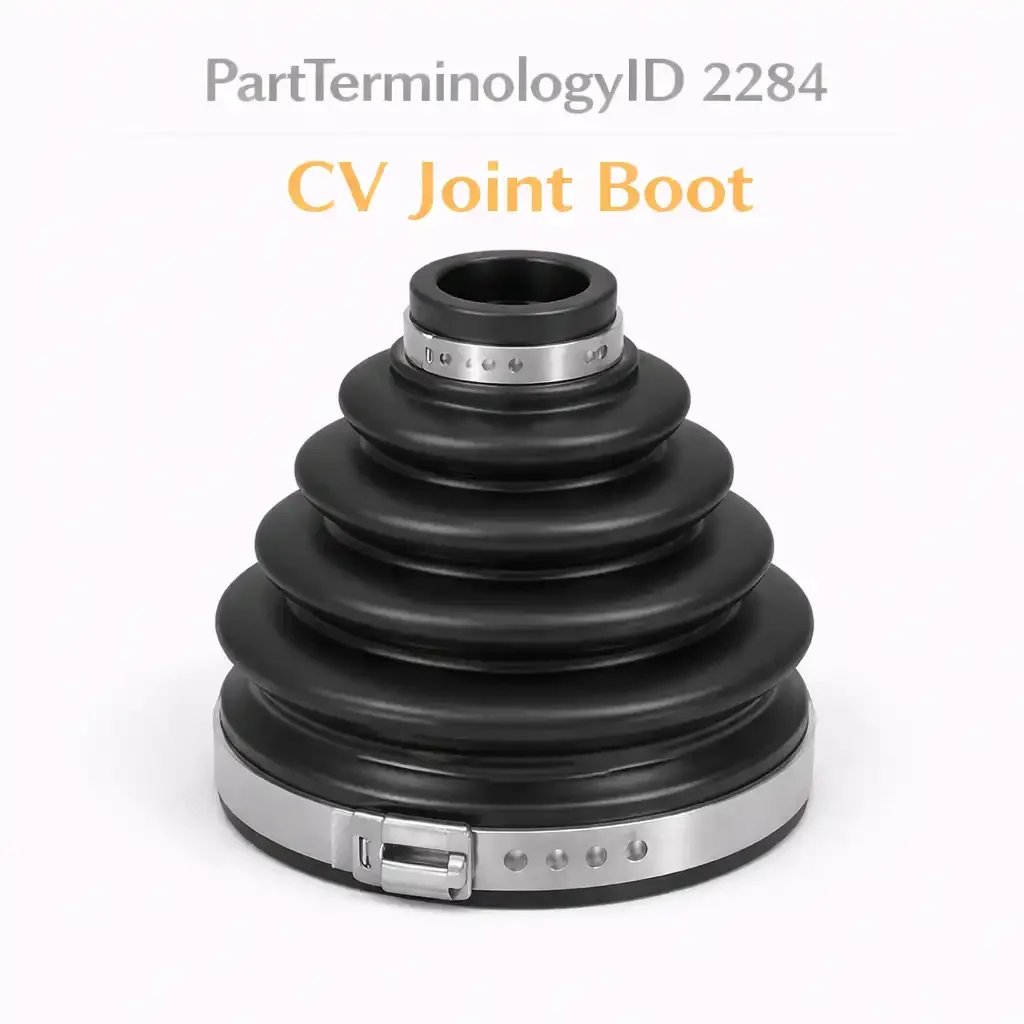
PartTerminologyID 2284, CV Joint Boot, is the flexible bellows-shaped boot that covers a constant velocity joint and retains the grease that lubricates it. That definition is sufficient to identify the part category. It does not specify whether the boot is for the inner CV joint or the outer CV joint, what the small-diameter neck inner diameter is, what the large-diameter body or neck inner diameter is, what the boot body length is, what the material is, whether the material is thermoplastic elastomer, rubber, silicone, or thermoplastic polyurethane, how many bellows convolutions the boot has, whether the boot is a standard closed boot or a split boot that can be installed without removing the axle shaft, what the band type is and whether the bands are included, or which axle and CV joint the boot is designed for. A listing under PartTerminologyID 2284 that covers only the vehicle year, make, and model without the inner neck diameter, the outer body diameter, the boot length, and the material cannot be evaluated by any buyer who has removed the original boot and is matching the replacement to measurements, and it cannot be evaluated by any buyer who is selecting between a standard boot and a split boot based on whether they have the tools and space to remove the axle.
For sellers, the CV joint boot is the only component in the CV joint assembly that can be replaced independently of the joint itself when the boot fails before the joint wears out. The entire value proposition of a boot replacement, rather than a complete halfshaft or CV joint replacement, depends on the boot fitting the joint correctly and being made of material durable enough to survive the operating temperature, the articulation range, and the environmental exposure of its specific position. An outer CV joint boot on a front-wheel-drive vehicle operates at higher articulation angles during steering than the inner boot. An inner CV joint boot on a front-wheel-drive vehicle operates through greater suspension travel range than the outer boot. A boot made of the wrong material for its operating temperature will crack prematurely. A boot with the wrong neck diameter will not seal against the shaft groove or the joint housing groove regardless of how tightly the band is torqued. A boot that is too short will be stretched beyond its design range at full suspension travel and will crack at the convolution roots.
For sellers, the listing under this PartTerminologyID is only useful if it specifies the joint position, the inner neck diameter, the outer body diameter, the boot body length, the material, whether the boot is standard or split, and whether the bands are included. Without those seven attributes, the listing cannot prevent the dimensional mismatch and material durability failures that drive returns for this PartTerminologyID.
What the CV Joint Boot Does
Retaining grease and excluding contamination throughout the joint's articulation range
The CV joint operates by transferring torque through a set of ball bearings running in precision-machined grooves in the inner and outer races. The balls require a continuous film of grease to separate the ball surface from the race surface and prevent metal-to-metal contact. The grease is packed into the joint cavity at assembly and is retained there by the boot. The boot flexes through the full articulation range of the joint while maintaining a sealed enclosure around the grease.
A boot that cracks at a convolution root, that separates from a shaft or housing groove, or that develops a pinhole from road debris impact allows the grease to escape and allows water, dirt, and abrasive grit to enter. The joint will typically operate normally for several months after the boot fails because the residual grease provides some lubrication. The clicking noise that indicates a dry outer CV joint usually appears after the grease is fully expelled, by which point the joint's balls and races have sustained permanent damage from dry running and contaminated grease.
The inner versus outer CV joint boot
The inner and outer CV joint boots on the same halfshaft are different sizes and often different materials because the two joints operate at different articulation angles and different temperature ranges.
The outer CV joint is a Rzeppa design on most front-wheel-drive passenger vehicles. It operates at articulation angles up to 47 degrees during full steering lock and sustains those angles under driving torque when turning. The outer joint generates more heat per degree of articulation than the inner joint because the Rzeppa design transfers torque through balls running in curved grooves, and the higher the articulation angle, the higher the ball-to-groove contact stress and the higher the friction-generated heat.
The inner CV joint is typically a tripod design or a double-offset design. It operates at lower maximum articulation angles than the outer joint, typically 18 to 23 degrees on passenger vehicle applications, but it accommodates more axial plunge than the outer joint because it must allow the halfshaft to shorten and lengthen as the suspension travels. The inner boot must accommodate this plunge by having enough slack in the bellows to allow the shaft to translate axially without stretching or compressing the boot beyond its design range.
A boot designed for the inner joint installed on the outer joint may not have enough convolutions or convolution depth to accommodate the higher outer joint articulation angles without cracking. A boot designed for the outer joint installed on the inner joint may not have enough axial slack to accommodate the plunge range without pulling off the housing groove during suspension travel.
Boot material and its effect on service life
Thermoplastic elastomer (TPE) is the most common boot material on current-production replacement boots. TPE boots are flexible at low temperatures, resistant to the grease formulations used in CV joints, and moderately resistant to the oils, fuels, and road chemicals in the engine bay and undercarriage environment. TPE is adequate for most passenger vehicle applications within its rated temperature range.
Rubber boots, specifically chloroprene rubber (neoprene), were standard on older vehicles and are still available as replacement boots for those applications. Rubber boots are more flexible at very low temperatures than most TPE formulations and have better resistance to ozone degradation. They are less consistent in dimensional uniformity than injection-molded TPE boots.
Silicone boots are used on high-performance and high-temperature applications where the operating temperature at the CV joint exceeds the rated range of TPE or rubber. Silicone maintains its flexibility and tensile strength at temperatures that would cause TPE boots to harden and crack. Silicone boots are more expensive than TPE and are specified when the operating temperature requires them, not as a universal upgrade.
Thermoplastic polyurethane (TPU) boots are used on some current-production vehicles as an OE specification where the combination of high articulation angle, high operating temperature, and road chemical exposure exceeds what TPE can sustain. TPU has higher tensile strength than TPE and better resistance to tearing at the convolution roots, which is the primary failure location for boots on high-articulation outer joints.
The material specification in the listing is not a marketing attribute. It is a compatibility specification. A boot made of a material that is not rated for the operating temperature of the application will fail before the joint it covers, which defeats the entire purpose of a boot replacement.
Standard boot versus split boot
A standard CV joint boot is a one-piece closed boot that can only be installed by sliding it over the axle shaft before the CV joint is assembled onto the shaft. On most vehicles, this requires removing the axle shaft from the vehicle, which means unbolting the hub, unbolting the inboard joint from the differential, and withdrawing the shaft from the vehicle. This is a significant labor event.
A split boot is a boot that has a longitudinal seam that allows it to be opened, placed around the CV joint housing, and closed without removing the axle shaft. The seam is bonded or mechanically fastened after installation. Split boots reduce labor significantly because the axle shaft does not need to be removed. They are a practical choice when the boot failure is caught early and the joint is still serviceable.
The trade-off is durability. The seam in a split boot is a potential leak point that does not exist in a one-piece boot. A correctly installed split boot with a properly bonded or fastened seam will last for several years, but the seam is more likely to fail before the boot material itself than a one-piece boot that has no seam. On high-articulation outer joint positions, split boots are generally not recommended because the seam experiences high stress at every steering lock cycle.
The listing must specify whether the boot is a standard one-piece design or a split design, and the trade-offs must be noted in the listing or in a linked installation guidance note.
The Dimensional Specifications That Determine Correct Fitment
Inner neck diameter
The inner neck is the small-diameter end of the boot that clamps to the axle shaft. The inner neck inner diameter must match the outer diameter of the axle shaft at the boot seating groove. A boot whose inner neck is too small cannot be seated over the shaft groove. A boot whose inner neck is too large will not be adequately sealed by the boot band regardless of how tightly the band is clamped.
Outer body diameter
The outer end of the boot clamps to the CV joint housing at the outer joint or to the tripod housing at the inner joint. The outer body inner diameter must match the outer diameter of the housing or housing groove at the boot seating point. On most outer CV joint boots, the outer end is a large-diameter open neck that slides over the housing and is clamped by the outer boot band. On some inner joint boots, the outer end is a stepped design with two diameters.
Boot body length
The boot body length determines how much slack is available in the bellows when the joint is at its natural centered position. Too short a boot will be stretched at full articulation or full plunge and will crack at the convolution roots. Too long a boot will have excess slack that collapses and folds during operation, which creates pinch points where the boot contacts itself and eventually cracks from repeated compression at the fold.
Convolution count and depth
The convolution count and depth determine the boot's articulation capacity and plunge capacity. More convolutions and deeper convolution profiles allow greater articulation and plunge. A boot with fewer convolutions than the original will reach its articulation limit at a smaller angle than the joint's full range requires, producing cracking at the convolution roots at angles the original boot handled without stress.
Why This Part Generates Returns
Buyers order the wrong CV joint boot because:
the inner neck diameter is not stated and the boot cannot be seated over the axle shaft groove
the outer body diameter is not stated and the boot body cannot be fitted to the CV joint housing
the joint position is not specified and the buyer receives an outer boot for an inner joint application with a different plunge accommodation length
the material is not specified and the replacement boot cracks prematurely because it is not rated for the operating temperature of the application
the boot type is not specified and the buyer receives a standard one-piece boot for an application where they needed a split boot to avoid axle removal, or vice versa
the bands are not included and not disclosed, and the buyer discovers this after the boot is installed but before it can be clamped
Status in New Databases
PIES/PCdb: PartTerminologyID 2284, CV Joint Boot
PIES 8.0 / PCdb 2.0: No change
Top Return Scenarios
Scenario 1: "Inner neck too small, boot will not seat over axle shaft groove"
The inner neck inner diameter of the replacement boot is 24mm. The axle shaft outer diameter at the boot seating groove is 27mm. The boot cannot be stretched over the shaft groove without tearing the neck. The original boot inner neck was 28mm to allow installation with a small amount of compression against the groove.
Prevention language: "Inner neck inner diameter: [X]mm. Verify your axle shaft outer diameter at the boot seating groove matches this specification before ordering. The boot inner neck must be sized to slide over the shaft groove and compress against it under the inner boot band. A boot neck that is smaller than the shaft groove diameter cannot be installed without tearing."
Scenario 2: "Boot body too short, cracked at convolution root within 4 months"
The replacement boot body is 18mm shorter than the original. At full suspension travel on the inner joint, the boot is stretched to its maximum convolution extension. The convolution root at the inner neck cracks from the repeated stretch cycles within 4 months of installation.
Prevention language: "Boot body length: [X]mm. Verify this length matches your original boot. A boot that is shorter than the original will be stretched beyond its designed extension at full suspension travel or full articulation, causing premature cracking at the convolution roots. Measure the original boot before ordering."
Scenario 3: "Outer boot installed on inner joint, no plunge accommodation, boot failed on first speed bump"
The inner CV joint requires a boot with sufficient axial slack to accommodate the joint's plunge range during suspension travel. The replacement boot is designed for the outer joint and has a shorter body with fewer convolutions. On the first significant suspension travel event, the boot was stretched axially beyond its capacity and separated from the inner joint housing groove.
Prevention language: "Joint position: [inner CV joint / outer CV joint]. Inner CV joint boots must accommodate axial plunge in addition to angular articulation. A boot designed for the outer joint does not have the axial slack required for the inner joint's plunge range. Verify the boot is specified for the correct joint position."
Scenario 4: "TPE boot cracked within one year, high-temperature application required silicone"
The replacement boot is a standard TPE formulation. The application is a turbocharged front-wheel-drive vehicle where the CV joint operating temperature exceeds the TPE boot's rated range from radiated heat from the turbocharger and exhaust components. The boot hardened and cracked at the convolution roots within one year.
Prevention language: "Boot material: [TPE / silicone / TPU]. Verify the boot material is appropriate for the operating temperature at your CV joint location. Applications near turbocharger, exhaust, or brake heat sources may exceed the rated temperature of standard TPE boots. A silicone or TPU boot is required for high-temperature applications."
Scenario 5: "Bands not included, boot installed without bands, boot separated from housing at speed"
The listing did not state whether bands were included. The buyer assumed bands were included as they are in most CV boot kits. The boot was installed without bands because none were in the box. At highway speed, centrifugal force lifted the outer boot neck off the housing groove and the boot separated. Grease was expelled over a wide area of the undercarriage.
Prevention language: "Boot bands: [included, quantity 2 / not included, order PartTerminologyID 2280 separately]. CV joint boots must be secured with correctly sized bands at both the inner neck and the outer body. A boot installed without bands will separate from the shaft or housing groove under centrifugal force at driving speed."
What to Include in the Listing
Core essentials
PartTerminologyID: 2284
component: CV Joint Boot
joint position: inner CV joint or outer CV joint (mandatory)
boot type: standard one-piece or split (mandatory)
inner neck inner diameter in mm (mandatory)
outer body inner diameter in mm (mandatory)
boot body length in mm (mandatory)
material: TPE, rubber, silicone, or TPU (mandatory)
convolution count
boot bands included: yes or no, with band type if included (mandatory)
grease included: yes or no, with grease type and quantity if included
quantity: 1 boot
Fitment essentials
year/make/model/submodel
axle position: front left, front right, rear left, rear right
inner or outer joint position (mandatory)
OE part number cross-reference when available
Dimensional essentials
inner neck inner diameter in mm
inner neck outer diameter in mm for band diameter selection
outer body inner diameter in mm
outer body outer diameter in mm for band diameter selection
boot body length in mm
convolution count and maximum convolution depth in mm
Image essentials
boot in isolation showing both ends, the convolution profile, and the body length
inner neck close-up with inner diameter callout
outer body close-up with inner diameter callout
for split boots, the seam location and bonding method shown
installed context showing the boot on the joint with bands correctly seated at both ends
material callout noting the boot material
Catalog Checklist for ACES/PIES Teams
PartTerminologyID = 2284
require joint position: inner or outer (mandatory)
require boot type: standard or split (mandatory)
require inner neck inner diameter in mm (mandatory)
require outer body inner diameter in mm (mandatory)
require boot body length in mm (mandatory)
require material with temperature rating (mandatory)
require boot band inclusion status (mandatory)
require grease inclusion status (mandatory)
differentiate from CV joint boot band (PartTerminologyID 2280): the band is the clamp that retains the boot; the boot is the bellows enclosure; both are required for a complete boot replacement and must be cross-referenced when either is sold without the other
differentiate from CV joint boot kit (PartTerminologyID varies): the kit includes the boot, the bands, and the grease as a set; the boot alone is listed under 2284 for applications where only the boot requires replacement
differentiate from CV joint (PartTerminologyID varies): the CV joint is the articulating mechanism; the boot covers it; a cracked boot does not necessarily mean the joint requires replacement, but a joint that has run dry from a cracked boot usually does
differentiate from halfshaft assembly (PartTerminologyID varies): the halfshaft includes the CV joints, the shaft, and the boots as a complete assembly; the boot alone is the lowest-cost repair option when the joints are still serviceable
flag inner versus outer position as mandatory: the two boots on the same halfshaft are different dimensions with different plunge accommodation requirements
flag boot type standard versus split as mandatory: the split boot eliminates axle removal labor but has a seam that is a potential failure point; both attributes must be disclosed
flag band inclusion as mandatory: a boot installed without bands will separate from the shaft at driving speed; the buyer must know whether bands are included before beginning the installation
FAQ (Buyer Language)
How do I know if the CV joint is still serviceable before replacing just the boot?
Clean all expelled grease from the joint and the surrounding area. With the boot removed and the joint cleaned, rotate the shaft while holding the outer housing and feel for roughness, grinding, or resistance that varies with rotation angle. With both hands, rock the shaft and housing in opposing directions to check for play between the inner and outer races. A serviceable joint will have no perceptible play and will rotate smoothly with consistent resistance throughout the full rotation. If the joint has any roughness, any detectable play, or produces a clicking noise when rotated while articulated, the joint is damaged and requires replacement. Installing a new boot on a damaged joint is money and labor that will need to be repeated when the joint fails.
What is the correct grease type and quantity for a CV joint boot replacement?
The correct grease type is specified on the OE service information for your vehicle's CV joint. Most passenger vehicle CV joints use a molybdenum disulfide grease (moly grease) or a specific lithium-based grease. The quantity is typically 80 to 120 grams for an outer Rzeppa joint and 120 to 180 grams for an inner tripod joint, depending on the joint size. Do not use wheel bearing grease or general-purpose chassis grease in a CV joint boot. These greases do not have the film strength required for the high-contact-stress ball-to-race interface in the CV joint and will fail to protect the joint under driving loads.
Is a split boot as durable as a standard one-piece boot?
Under normal passenger vehicle operating conditions, a correctly installed split boot will last three to five years in most climates. The one-piece boot, which has no seam, will typically outlast a split boot of the same material because the seam is a stress concentration point that experiences the same articulation and thermal cycling as the rest of the boot without the uniform material properties of the molded boot body. On high-articulation outer joint applications, the seam experiences additional stress at full steering lock. For a boot replacement on a vehicle that will be kept for many more years, the labor investment to install a one-piece boot with axle removal is justified by the longer service life. For a vehicle being sold or for a repair that must be done quickly without axle removal tools, a split boot is a practical choice.
My boot is cracked but the joint clicks when turning. Do I need a new boot or a new joint?
The clicking sound during turns at low speed indicates the outer CV joint is running dry or nearly dry from grease expelled through the cracked boot. A joint that clicks is a joint that has sustained ball-to-race contact damage from dry running. Replacing the boot and repacking with grease will not restore the smooth rolling surface the balls need. The clicking will return within a short distance because the damaged ball and race surfaces cannot be repaired by fresh grease. Replace the CV joint or the complete halfshaft assembly. The boot that covers the new joint should also be new, either as part of a boot kit included with the joint or ordered separately.
Can I install the boot without removing the axle shaft from the vehicle?
A standard one-piece boot cannot be installed without removing the axle shaft, because the boot must be slid over the shaft before the CV joint is assembled onto the shaft end. A split boot can be installed without removing the shaft by opening the seam, placing the boot around the joint housing, and bonding or fastening the seam closed. If the vehicle's design does not allow sufficient access to the joint for a split boot installation, axle removal is required regardless of the boot type.
Cross-Sell Logic
CV Joint Boot Band (PartTerminologyID 2280: bands are required at both the inner neck and the outer body of the boot; if bands are not included with the boot listing, they are the first concurrent purchase)
CV Joint Grease (the correct grease type and quantity are required to fill the boot at installation; if grease is not included, it must be sourced before the boot is installed)
CV Joint (PartTerminologyID varies: if the joint shows roughness or play on inspection, the joint must be replaced at the same service event as the boot; a boot on a worn joint is a temporary repair)
Halfshaft Assembly (PartTerminologyID varies: for a joint that is already damaged, a complete halfshaft replacement is often more cost-effective than sourcing the joint, boot, bands, and grease separately)
Axle Shaft Seal (on inner CV joint boot replacements, the transmission side axle shaft seal should be inspected when the inner joint is disturbed and replaced if it shows any leakage)
Frame as "the boot covers the joint. The bands seal the boot to the shaft and housing. The grease lubricates the joint the boot covers. The joint transfers the torque the shaft carries. If the boot fails and the joint runs dry, the halfshaft is next. A boot replaced when it cracks costs a fraction of the halfshaft it protects."
Final Take for PartTerminologyID 2284
CV Joint Boot (PartTerminologyID 2284) is the lowest-cost intervention point in the CV joint service category and the one where a correctly specified replacement has the highest ratio of value preserved to cost incurred. A boot replaced when it cracks, before the joint runs dry, saves the cost of a CV joint or a complete halfshaft. A boot ordered with the wrong inner neck diameter, the wrong body length, or the wrong material installs once and fails, sending the buyer back to the same repair with a damaged joint that now requires replacement.
Seven attributes determine whether the boot will install correctly, seal for its service life, and survive the operating conditions of its specific position. The joint position determines whether the boot needs plunge accommodation. The boot type determines whether axle removal is required. The inner neck diameter determines whether the boot can be seated on the shaft. The outer body diameter determines whether the boot can be fitted to the joint housing. The body length determines whether the boot can articulate without cracking. The material determines whether the boot survives the operating temperature. The band inclusion status determines whether the boot can be sealed after installation.
State all seven. That is the same listing strategy as every other PartTerminologyID in this series: the generic PartTerminologyID requires specific attributes at every level to become a listing buyers can act on. For PartTerminologyID 2284, a boot ordered without those seven attributes may fit nothing, seal nothing, and last nothing, while costing the buyer the joint it was purchased to protect.