
Written by Arthur Simitian | PartsAdvisory
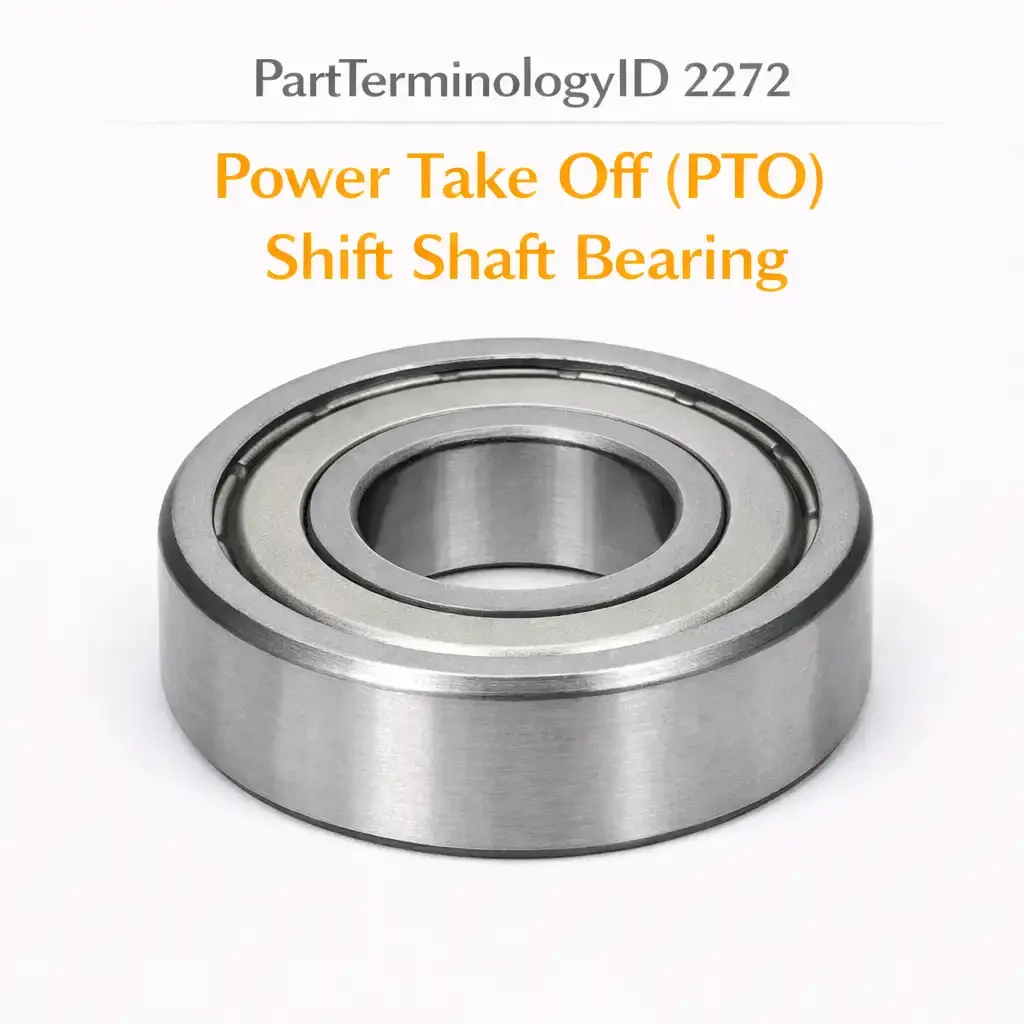
PartTerminologyID 2272, Power Take Off (PTO) Shift Shaft Bearing, is a bearing that supports the shift shaft within a power take off unit. The shift shaft is the shaft that moves the engagement mechanism, whether a sliding gear, a shift fork, or a clutch actuator rod, from the disengaged to the engaged position when the PTO is activated. That definition places the bearing at the engagement mechanism rather than in the torque path. It does not specify the PTO unit manufacturer, the PTO model designation, the bearing type, the inner diameter, the outer diameter, the bearing width, what load the shift shaft bearing carries during engagement and during sustained PTO operation, whether the bearing is a needle roller, a plain bushing, or a sliding bearing surface machined into the housing, how the bearing is retained, or whether the bearing is accessible without full PTO disassembly. A listing under PartTerminologyID 2272 that does not specify the PTO unit designation, the bearing type, and all three primary dimensions cannot be evaluated by any buyer who is replacing the bearing as part of a PTO engagement reliability repair.
For sellers, the PTO shift shaft bearing occupies a position in the PTO assembly that is functionally different from every other bearing covered in the PTO series. The input shaft bearing (2244), the countershaft bearing (2236), the intermediate shaft bearing (2252), and the output shaft bearing (2260) are all in the torque path and carry loads proportional to the torque being transmitted. The shift shaft bearing is not in the torque path. It supports the shaft that actuates the engagement mechanism. The load it carries is the engagement force from the shift actuator, which may be a pneumatic cylinder, a hydraulic cylinder, a mechanical lever, or an electric solenoid depending on the PTO design, plus the reaction load from the engagement mechanism as the gear teeth or clutch packs engage under spring pressure or actuator force.
The consequence of a worn or failed shift shaft bearing is not a bearing noise under load. It is incomplete engagement, partial disengagement under load, erratic engagement behavior, or a shift shaft that binds in the housing bore and prevents engagement or disengagement entirely. Those symptoms are engagement reliability problems rather than load-carrying bearing failures, and the listing must describe them accurately so the buyer diagnosing an engagement problem can identify the shift shaft bearing as a potential cause.
For sellers, the listing under this PartTerminologyID is only useful if it specifies the PTO unit designation, the shift shaft actuator type, the bearing type, and all three primary dimensions. Without those four attributes, the listing cannot be evaluated and cannot describe the engagement reliability consequence that motivates the replacement.
What the PTO Shift Shaft Bearing Does
Guiding the shift shaft through its engagement stroke
The shift shaft slides or rotates within the PTO housing to move the engagement mechanism between the disengaged and engaged positions. The shift shaft bearing provides the low-friction interface between the shift shaft and the housing bore that allows the shaft to move smoothly through its engagement stroke under the actuator force.
On pneumatic-actuated PTOs, the air cylinder pushes the shift shaft against a return spring with a force of several hundred pounds at standard operating air pressure. The shift shaft bearing must guide this force accurately along the shaft's axis without allowing lateral deflection that would bind the shift fork or gear against the housing. Lateral deflection from a worn shift shaft bearing produces the incomplete engagement that manifests as a PTO that appears to engage but delivers less than full torque, or that disengages spontaneously under high load.
On mechanical cable-actuated PTOs, the cable pull force is smaller than a pneumatic actuator force but the engagement must be reliable through the cable's entire stroke. A worn shift shaft bearing that allows the shaft to cock slightly in the bore increases the friction in the engagement stroke and may prevent full engagement at the end of the cable stroke.
The shift shaft bearing load profile
The load on the shift shaft bearing during engagement is an axial load along the shift shaft axis from the actuator force, plus a radial load from the shift fork or engagement mechanism reaction as the gear teeth or clutch packs come into contact. The radial load from the engagement mechanism reaction is a brief, high-magnitude load spike at the moment of tooth engagement, followed by a lower sustained radial load during the engagement hold position.
During sustained PTO operation with the engagement mechanism held in the engaged position, the shift shaft bearing carries only the low sustained radial load from the engagement mechanism's contact force against the engaged gear or clutch pack. This is a much lower load than the engagement transient, which means the shift shaft bearing is most stressed at engagement, not during operation. This is the opposite of the torque-path bearings, which are most stressed during sustained operation at full load.
The engagement-transient peak load characteristic means a shift shaft bearing that appears serviceable during inspection, with no roughness or play detectable at the low sustained load, may still be failing at the engagement transient load. A PTO with erratic engagement on every cycle but smooth, quiet operation during sustained running often has a worn shift shaft bearing that is adequate for the sustained load but insufficient for the engagement transient.
Bearing types used at the shift shaft position
Plain bronze bushings are the most common shift shaft bearing type on commercial PTO applications. The low speed of the shift shaft, which oscillates rather than rotates continuously, makes a plain bushing appropriate because the bushing's higher friction coefficient at low speed is irrelevant when the shaft is not rotating and its excellent resistance to edge loading from the engagement transient radial spike makes it more durable than a rolling element bearing at this position.
Needle roller bearings are used on some PTO designs where the shift shaft rotates as well as translates during the engagement stroke, as on some rotary shift mechanisms. The needle roller accommodates both the axial translation and the limited rotation without the high friction of a plain bushing at rotational speeds that exceed the bushing's design range.
Sliding surfaces machined directly into the housing or into a hardened insert are used on some compact PTO designs where the shift shaft bore is too small to accept a separate bearing element. Those designs are not serviceable with a replacement bearing under PartTerminologyID 2272: the housing bore is the bearing surface and housing replacement is required when the bore is worn.
Actuator type and its effect on shift shaft bearing load
The PTO shift actuator type determines the magnitude of the engagement force the shift shaft bearing must guide:
Pneumatic cylinder: highest engagement force, typically 200 to 600 pounds depending on cylinder bore and operating pressure. The shift shaft bearing experiences the highest radial reaction load during tooth engagement at pneumatic pressures.
Hydraulic cylinder: similar force to pneumatic but with smoother force application because hydraulic fluid is less compressible than air. The engagement transient load spike is lower than pneumatic because the hydraulic cylinder's force buildup is more gradual.
Mechanical lever: lowest engagement force in most designs, typically 40 to 120 pounds at the shift shaft from the lever geometry. The shift shaft bearing load is proportionally lower.
Electric solenoid: fast actuation with a moderate force of typically 50 to 150 pounds. The solenoid's fast travel produces a sharper engagement transient than a pneumatic cylinder despite the lower force magnitude.
The Specifications That Determine Correct Fitment
PTO unit designation and actuator type
The PTO unit designation determines the shift shaft diameter, the housing bore diameter, and the bearing type used at the shift shaft position. The actuator type affects the bearing load magnitude but typically does not change the bearing specification within a given PTO model.
Bearing type: bronze bushing, needle roller, or machined bore
The bearing type determines the installation procedure, the shaft surface requirement, and all three primary dimensions. A bronze bushing for the shift shaft and a needle roller bearing for the same shaft diameter have different outer diameters and different running clearances.
Inner diameter, outer diameter, and length
All three must be stated. The inner diameter matches the shift shaft diameter. The outer diameter matches the housing bore. The length determines the bearing surface area available to distribute the engagement transient radial load. A shorter bearing concentrates the radial load over a smaller area and wears faster under the engagement transient spike.
Why This Part Generates Returns
Buyers order the wrong PTO shift shaft bearing because:
the PTO unit designation is not specified and the shift shaft diameter does not match the listed bearing inner diameter
the bearing type is not specified and the buyer receives a needle roller for an application that uses a bronze bushing
the listing is applied to a machined-bore PTO design that has no separate bearing element and requires housing replacement
the length is not stated and the replacement is shorter than the original, reducing the bearing surface area and accelerating wear at the engagement transient load
the buyer diagnoses an engagement problem as an actuator or gear problem and does not consider the shift shaft bearing until after replacing those components
Status in New Databases
PIES/PCdb: PartTerminologyID 2272, Power Take Off (PTO) Shift Shaft Bearing
PIES 8.0 / PCdb 2.0: No change
Top Return Scenarios
Scenario 1: "No separate bearing in this PTO, shift shaft runs in machined housing bore"
The listing was applied to a compact PTO design where the shift shaft runs directly in a hardened housing bore with no separate bearing element. The buyer received a bronze bushing that cannot be installed because the housing bore is machined to the shift shaft diameter with no additional bore depth for a separate bushing.
Prevention language: "Bearing type: [separate bronze bushing / separate needle roller bearing]. Application note: this bearing fits PTO designs that use a separate bearing element in the shift shaft bore. Some compact PTO designs use a machined housing bore as the shift shaft bearing surface with no separate bearing. Verify your PTO has a separate shift shaft bearing before ordering."
Scenario 2: "PTO engages erratically, shift shaft bearing not identified as cause"
The buyer replaced the PTO engagement gear and the shift fork before identifying the shift shaft bearing as the cause of erratic engagement. The worn bushing allowed the shift shaft to cock laterally in the bore under the engagement transient load, preventing full gear engagement on every cycle. The replacement engagement components did not resolve the problem.
Prevention language: "Symptom indication: erratic PTO engagement, incomplete engagement under high load, or shift shaft that binds or drags during engagement stroke may indicate a worn shift shaft bearing. Inspect the shift shaft bearing before replacing engagement gears or shift forks. A shift shaft bearing that is worn beyond its running clearance allows lateral shaft deflection that prevents complete gear engagement regardless of the condition of the engagement components."
Scenario 3: "Inner diameter too small, shift shaft will not enter bushing bore"
The PTO unit designation was not specified. The buyer's shift shaft diameter is 22mm. The listed bushing inner diameter is 18mm, which fits a different PTO model from the same manufacturer with a smaller shift shaft.
Prevention language: "Inner diameter: [X]mm. PTO unit: [specific designation]. Verify your shift shaft diameter matches this inner diameter before ordering. Shift shaft diameters vary by PTO model even within the same manufacturer's product line."
Scenario 4: "Replacement bushing shorter than original, engagement reliability decreased"
The replacement bushing is 8mm shorter than the original. The shorter bearing surface distributes the engagement transient radial load over a smaller area, producing higher unit pressure at the bushing inner surface. The bushing wore beyond its service clearance within 50,000 engagement cycles rather than the expected 200,000-plus cycles of the original.
Prevention language: "Bushing length: [X]mm. Verify this length matches your original shift shaft bushing. A shorter bushing reduces the bearing surface area available to distribute the engagement transient radial load, which accelerates wear at the shift shaft position."
Scenario 5: "Needle roller received for rotating-and-translating shaft, bushing needed for translation-only shaft"
The listing specified a needle roller bearing. The buyer's PTO shift shaft translates axially only, without rotation, during the engagement stroke. The needle roller bearing, designed to accommodate rotation, is not the correct type for a purely translating shaft where a plain bushing provides better edge-load resistance.
Prevention language: "Shaft motion type: [translation only / rotation and translation]. Bearing type: [bronze bushing for translation-only shafts / needle roller for shafts with rotational motion during engagement]. Verify your shift shaft motion type before ordering. A plain bronze bushing is preferred for translation-only shift shafts because of its superior edge-load resistance under the engagement transient radial spike."
What to Include in the Listing
Core essentials
PartTerminologyID: 2272
component: PTO Shift Shaft Bearing
application confirmation: PTO uses a separate shift shaft bearing element (mandatory)
PTO unit manufacturer and model designation (mandatory)
shift actuator type: pneumatic, hydraulic, mechanical lever, or electric solenoid (mandatory)
shaft motion type: translation only or rotation and translation (mandatory)
bearing type: bronze bushing, needle roller, or other (mandatory)
inner diameter in mm and inches (mandatory)
outer diameter in mm and inches (mandatory)
bearing length in mm (mandatory)
retention method: press fit, snap ring, or set screw
material alloy specification for bronze bushing applications
quantity: 1
Fitment essentials
PTO unit manufacturer and model designation (primary fitment attribute)
compatible transmission model
vehicle year/make/model as tertiary reference
shift actuator type
Dimensional essentials
inner diameter in mm and inches
outer diameter in mm and inches
bearing length in mm
running clearance specification for the shift shaft diameter
housing bore diameter for press fit interference verification
Image essentials
bearing in isolation with dimensional callouts
shift shaft assembly showing the bearing position within the housing bore
engagement mechanism context showing the shift shaft, the bearing, and the actuator connection
Catalog Checklist for ACES/PIES Teams
PartTerminologyID = 2272
require application confirmation: PTO uses a separate shift shaft bearing element (mandatory)
require PTO unit designation (mandatory)
require shift actuator type (mandatory)
require shaft motion type: translation only or rotation and translation (mandatory)
require bearing type (mandatory)
require inner diameter, outer diameter, and length
do not apply to machined-bore PTO designs that have no separate bearing element
differentiate from PTO countershaft bearing (2236), input shaft bearing (2244), intermediate shaft bearing (2252), and output shaft bearing (2260): all of those are torque-path bearings; the shift shaft bearing is in the engagement mechanism, not the torque path; the load profile, failure mode, and buyer diagnostic context are all different
flag engagement symptom description as mandatory context: buyers replacing a shift shaft bearing are typically diagnosing an engagement reliability problem, not a noise problem; the listing must connect the shift shaft bearing to the engagement symptom
FAQ (Buyer Language)
How do I access the shift shaft bearing without fully disassembling the PTO?
On many PTO designs, the shift shaft and its bearing are accessible by removing the actuator and the shift cover on the PTO housing without removing the PTO from the transmission. The shift shaft can then be withdrawn from the housing bore, and the bearing or bushing can be pressed out and replaced. Verify the service manual procedure for your PTO model before beginning. Some designs require full disassembly to access the shift shaft bearing position.
My PTO engages but disengages randomly under high torque load. Is the shift shaft bearing the cause?
Random disengagement under high torque load is more often caused by a worn or broken engagement detent, a fatigued engagement spring, or insufficient air pressure at the actuator than by the shift shaft bearing. However, if the shift shaft bearing is worn to the point that the shaft can cock laterally under the engagement transient load, the engagement gear may not fully seat in every engagement cycle. A gear that is not fully engaged will disengage under high torque load because the tooth contact area is insufficient to resist the torque reaction force. Inspect the shift shaft bearing alongside the detent and engagement spring before concluding which component is causing the random disengagement.
Can I substitute a standard off-the-shelf bronze bushing for the PTO-specific shift shaft bushing?
Yes, if the inner diameter, outer diameter, and length match and the material alloy is appropriate for the operating conditions. A standard SAE 660 leaded bronze bushing (bearing bronze) is appropriate for most PTO shift shaft positions. Measure the shift shaft diameter, the housing bore diameter, and the bearing bore depth to identify the correct off-the-shelf bushing dimensions.
Cross-Sell Logic
PTO Engagement Gear (if the shift shaft bearing wear caused incomplete engagement that damaged the engagement gear teeth, the gear must be replaced along with the bearing)
PTO Shift Fork (the shift fork is inspected when the shift shaft is removed; replace if worn or bent)
PTO Gasket Set (replaced when the PTO is opened for shift shaft bearing replacement)
Gear Oil (replaced after every PTO internal service)
Frame as "the shift shaft bearing guides the shaft that moves the engagement mechanism. The engagement gear is what the shift shaft positions. The gasket seals the housing the shift shaft operates in. The gear oil lubricates the bearing that guides the shaft."
Final Take for PartTerminologyID 2272
PTO Shift Shaft Bearing (PartTerminologyID 2272) is the only bearing in the PTO series that is in the engagement mechanism rather than the torque path, and that distinction changes everything about how the buyer diagnoses the need for it and how the listing must describe the consequence of a worn bearing. The listing must connect the worn shift shaft bearing to the engagement reliability symptom that brought the buyer to the search. A listing that describes only the bearing dimensions without describing the engagement symptom leaves the buyer uncertain whether the shift shaft bearing is the cause of the problem they are trying to solve.
State the PTO unit designation. State the actuator type. State the shaft motion type. State the bearing type. State all three dimensions. Connect the bearing to the engagement reliability symptom. That is the same strategy as every other PartTerminologyID in this series: the generic PartTerminologyID requires specific attributes at every level to become a listing buyers can act on.