
Written by Arthur Simitian | PartsAdvisory
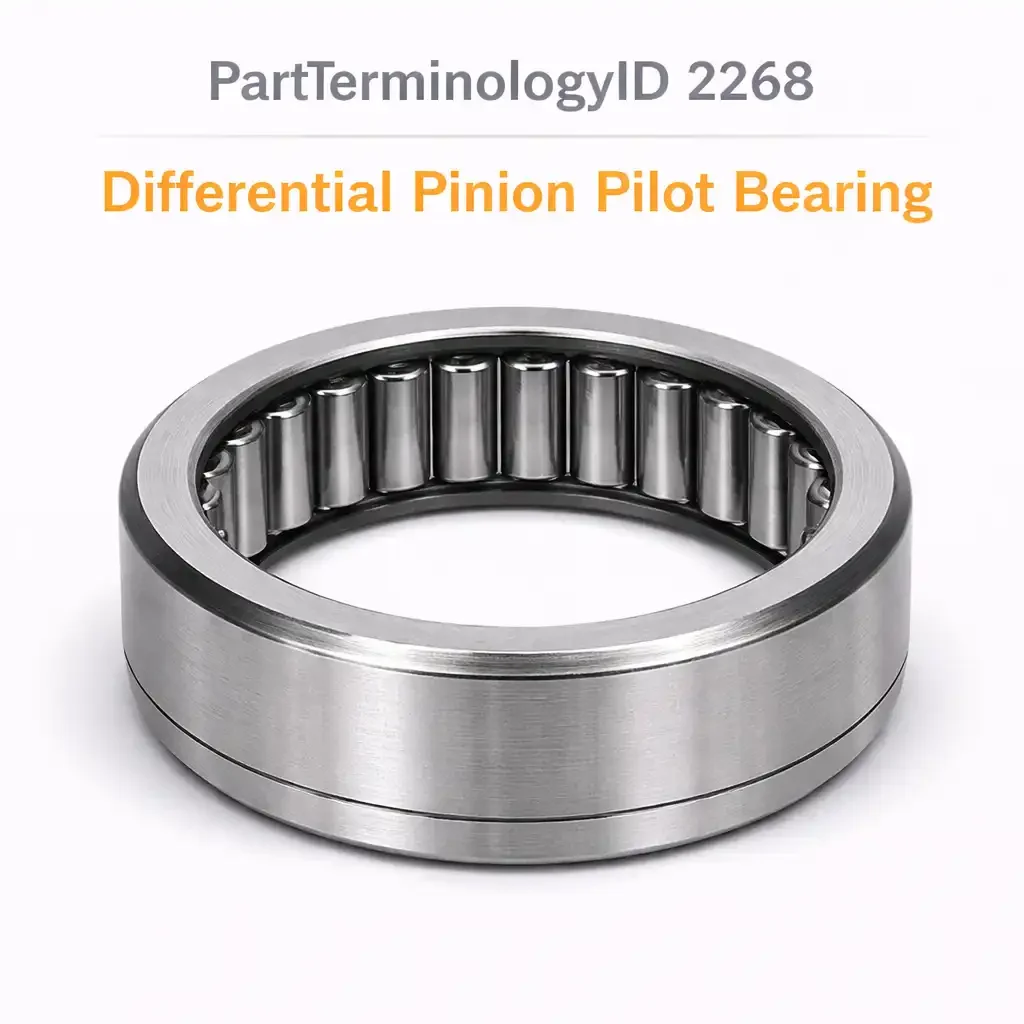
PartTerminologyID 2268, Differential Pinion Pilot Bearing, is a bearing at the pilot bore of the differential pinion shaft that centers and supports the pinion's inboard end within the differential carrier or ring gear. That definition locates the bearing correctly within the differential assembly. It does not specify the axle designation, the bearing type, the inner diameter, the outer diameter, the bearing width, whether the bearing is a needle roller bearing or a ball bearing or a bronze bushing, what the pilot bore diameter is in the carrier, what the pinion shaft pilot journal diameter is, whether the bearing is a press fit into the carrier bore or a slip fit retained by the pilot shaft, or whether this bearing is present on the buyer's axle at all. A listing under PartTerminologyID 2268 that does not specify the axle designation, confirm the application uses a pilot bearing, state the bearing type, and provide all three primary dimensions cannot be evaluated by any buyer who does not already know the exact part number they need.
For sellers, the differential pinion pilot bearing is a component that does not exist on every differential. Many modern differential designs, including most current-production independent rear suspension differentials and most Dana axles in common passenger vehicle use, do not use a pilot bearing at the pinion inboard end. The pinion shaft is supported entirely by the front and rear pinion bearings in the housing. A pilot bearing exists on older domestic solid axle designs, on some heavy-duty axles, and on some Asian and European axle designs where the pinion inboard end extends into a pilot bore in the differential carrier or in a separate pilot bore in the ring gear carrier. A listing under PartTerminologyID 2268 applied to an axle that does not have a pilot bore produces a return from every buyer who disassembles the differential and finds no location to install the bearing.
For sellers, the listing under this PartTerminologyID is only useful if it confirms the application uses a pilot bearing, specifies the axle designation, states the bearing type and all three primary dimensions, and notes the pilot bore location: whether the bearing seats in the carrier or in the ring gear. Without those five attributes, the listing serves only buyers who already have the bearing in hand and are matching by measurement, which is the smallest and most self-sufficient segment of the buyer population.
What the Differential Pinion Pilot Bearing Does
Centering the pinion inboard end to maintain contact pattern geometry
The pinion shaft in a differential with a pilot bore extends through the rear pinion bearing position and continues inboard to a pilot journal that seats in the pilot bearing. The pilot bearing centers this inboard extension of the pinion shaft within the carrier bore or ring gear bore. By supporting the pinion at three points, the front pinion bearing, the rear pinion bearing, and the pilot bearing, the differential provides a more stable platform for the pinion under the gear mesh loads than a two-bearing arrangement provides.
The primary function of the pilot bearing is to minimize the deflection of the pinion under the radial load component of the hypoid gear mesh force. When the pinion deflects radially, the contact pattern between the pinion and ring gear teeth shifts across the tooth face. A shifted contact pattern concentrates the gear mesh load on a smaller area of the tooth face, which accelerates wear and can produce gear noise. The pilot bearing resists this deflection by supporting the inboard end of the pinion shaft close to the gear mesh point, where the deflection-inducing load is applied.
The needle roller bearing as the standard pilot bearing design
Most differential pinion pilot bearings are needle roller bearings. The needle roller design provides high radial load capacity in a minimal radial space because the needle rollers have a large length-to-diameter ratio and occupy most of the available bearing envelope. The pilot bore in the carrier or ring gear is typically small, because it must fit within the ring gear bore geometry, and the pinion shaft at the pilot journal is also small because it is an extension of the pinion shaft beyond the rear pinion bearing, which is sized for the rear pinion position journal rather than for a larger structural shaft.
The needle roller bearing in the pilot bore may be a caged needle bearing with a separate inner race, a drawn cup needle bearing where the cup is pressed into the pilot bore and the needle rollers contact the hardened and ground pinion pilot journal directly, or a solid needle bearing assembly with both inner and outer races. The type must be specified in the listing because the installation procedure, the required pilot journal surface specification, and the inner diameter depend on which configuration is used.
A drawn cup needle bearing without a separate inner race requires the pinion pilot journal to be hardened to a minimum of 58 HRC and ground to a surface finish of Ra 0.2 to 0.4 micrometers. If the pilot journal does not meet those specifications, the needle rollers will wear the journal surface rapidly and the bearing will fail long before its design life. A listing that does not specify the pilot journal surface requirement for a drawn cup bearing is omitting information that directly determines whether the installation will succeed.
The bronze bushing as an alternative pilot support design
Some older domestic differentials use a bronze bushing at the pinion pilot bore rather than a needle roller bearing. The bushing is pressed into the carrier bore and the pinion pilot journal runs in the bushing with a running clearance similar to that described for bronze bushings in the water pump bushing post (PartTerminologyID 2216). Bronze bushing applications require the same inner and outer diameter specifications as the needle bearing applications, plus the material and the alloy specification for coolant compatibility reasoning that applies to any bearing-grade bushing.
A listing that does not specify whether the pilot support is a needle bearing or a bronze bushing cannot be evaluated by a buyer who is replacing a bronze bushing and searching under PartTerminologyID 2268. The two components are not interchangeable.
What happens when the pilot bearing fails
A failed pilot bearing allows the pinion inboard end to deflect under the radial gear mesh load. The first symptom is a contact pattern that shifts under load, which the driver experiences as a differential whine that changes character under acceleration and deceleration. As the pilot bearing wear progresses, the deflection increases and the contact pattern shift becomes severe enough to produce audible gear noise at all speeds and loads. In the final stages of pilot bearing failure, the pinion inboard end contacts the carrier or ring gear bore directly, producing a grinding noise and accelerating damage to both the pinion shaft and the bore.
The pilot bearing failure is often misdiagnosed as a pinion bearing failure or a ring-and-pinion gear set failure because the noise profile is similar. A differential that continues to produce noise after new front and rear pinion bearings have been installed, and whose ring-and-pinion contact pattern is within specification when checked statically, should have the pilot bearing inspected before the ring-and-pinion gear set is condemned.
The Specifications That Determine Correct Fitment
Axle designation and pilot bore location
The axle designation determines the pilot bore diameter, the pinion pilot journal diameter, and the bearing type used at the pilot position. The pilot bore location, whether in the differential carrier or in the ring gear bore, determines the outer diameter and the seating procedure for the bearing.
Bearing type: needle roller, ball bearing, or bronze bushing
The bearing type determines the installation procedure, the pilot journal surface specification, and all three primary dimensions. A needle bearing and a bronze bushing of the same inner diameter have different outer diameters and different installation requirements.
Inner diameter
For drawn cup needle bearings: the pinion pilot journal outer diameter, which the needles contact directly. For needle bearings with a separate inner race: the inner race bore diameter. For bronze bushings: the bore diameter after installation with running clearance, not the pressed bore.
Outer diameter
The pilot bore inner diameter in the carrier or ring gear. The bearing outer diameter must match this bore with the correct press fit interference.
Width or length
The axial length of the bearing in the pilot bore. The bearing must not be wider than the available pilot bore depth. A bearing that protrudes from the pilot bore will contact the rear of the pinion gear and prevent correct pinion seating.
Why This Part Generates Returns
Buyers order the wrong differential pinion pilot bearing because:
the axle does not have a pilot bearing and the buyer orders one after seeing the PartTerminologyID without verifying the application
the axle designation is not specified and the buyer's carrier bore is a different diameter than the listed bearing's outer diameter
the bearing type is not specified and the buyer receives a needle bearing for an application that uses a bronze bushing, or vice versa
the inner diameter is not stated and the drawn cup bearing's needle contact surface does not match the pinion pilot journal diameter
the bearing width is not stated and the replacement is wider than the pilot bore depth, preventing correct pinion seating
the pilot bore location is not specified and the buyer receives a bearing sized for the carrier bore when their pilot bearing is in the ring gear bore, which has a different diameter
Status in New Databases
PIES/PCdb: PartTerminologyID 2268, Differential Pinion Pilot Bearing
PIES 8.0 / PCdb 2.0: No change
Top Return Scenarios
Scenario 1: "No pilot bore in this differential, bearing has no installation location"
The listing was applied by vehicle year, make, and model without confirming the axle uses a pilot bearing. The buyer disassembled the differential and found no pilot bore in the carrier or ring gear. The pinion shaft has no inboard extension journal. There is no location in the differential to install the pilot bearing.
Prevention language: "Application note: this bearing fits differentials with a pinion pilot bore in the carrier or ring gear. Not all differentials use a pilot bearing. Verify your differential has a pinion pilot bore before ordering. The pilot bore is a small-diameter bore at the center of the carrier or ring gear that accepts the inboard end of the pinion shaft."
Scenario 2: "Drawn cup needle bearing, pilot journal not hardened, bearing failed within 2,000 miles"
The listing specified a drawn cup needle bearing without noting the pilot journal surface hardness requirement. The buyer's pinion pilot journal was not hardened to the required specification. The needle rollers wore the journal surface within 2,000 miles and the pilot bearing lost its centering function.
Prevention language: "Bearing type: drawn cup needle roller. Pilot journal surface requirement: minimum 58 HRC hardness, Ra 0.2 to 0.4 micrometer surface finish. Verify your pinion pilot journal meets these specifications before installing a drawn cup needle bearing. Journals that do not meet these specifications will wear rapidly at the needle contact zone and must be replaced or reconditioned before installation."
Scenario 3: "Needle bearing received, application uses bronze bushing"
The listing did not specify the bearing type. The buyer's differential uses a bronze bushing at the pilot bore. The needle bearing outer race geometry does not match the bronze bushing bore in the carrier.
Prevention language: "Pilot support type: [needle roller bearing / bronze bushing]. Verify your differential uses [the specified type] at the pinion pilot bore before ordering. Needle roller bearings and bronze bushings are not interchangeable at the pilot bore position."
Scenario 4: "Bearing too wide, pinion cannot seat to correct depth"
The replacement pilot bearing is 4mm wider than the original. The pilot bore depth equals the original bearing width. The wider bearing protrudes from the pilot bore and contacts the rear face of the pinion gear, preventing the pinion from seating to the correct depth. The ring-and-pinion contact pattern is incorrect.
Prevention language: "Bearing width: [X]mm. The pilot bore depth on this axle is [X]mm. A bearing wider than the pilot bore depth will prevent the pinion from seating to the correct depth and will produce an incorrect ring-and-pinion contact pattern."
Scenario 5: "Outer diameter sized for ring gear bore, needed carrier bore size"
The listing did not specify the pilot bore location. The buyer's pilot bearing is in the differential carrier bore. The listed bearing is sized for the ring gear pilot bore on the same axle, which has a larger diameter. The bearing cannot be retained in the smaller carrier bore with the required press fit.
Prevention language: "Pilot bore location: [differential carrier bore / ring gear bore]. Outer diameter: [X]mm. Verify your pilot bearing is in the carrier bore or the ring gear bore before ordering. These two bore locations have different diameters on many axle designs."
What to Include in the Listing
Core essentials
PartTerminologyID: 2268
component: Differential Pinion Pilot Bearing
application confirmation: this axle uses a pinion pilot bearing (mandatory)
axle designation (mandatory)
ring gear diameter (mandatory)
pilot bore location: differential carrier or ring gear bore (mandatory)
bearing type: drawn cup needle roller, caged needle roller with inner race, full complement needle roller, ball bearing, or bronze bushing (mandatory)
pilot journal surface hardness and finish requirement for drawn cup needle bearings (mandatory)
inner diameter in mm and inches (mandatory)
outer diameter in mm and inches (mandatory)
bearing width or length in mm (mandatory)
quantity: 1
Fitment essentials
year/make/model/submodel
axle designation (primary fitment attribute)
ring gear diameter
explicit confirmation that the application uses a pilot bearing
Dimensional essentials
inner diameter in mm and inches
outer diameter in mm and inches
bearing width in mm
pilot bore depth in mm for width verification
pilot journal diameter in mm for drawn cup needle bearing journal verification
Image essentials
bearing in isolation with dimensional callouts
pilot bore location shown in a differential housing cross-section or diagram
pinion shaft pilot journal shown with the bearing installed in context
for drawn cup needle bearings, the needle roller detail showing the contact surface
Catalog Checklist for ACES/PIES Teams
PartTerminologyID = 2268
require application confirmation: axle uses a pinion pilot bearing (mandatory before any other attribute)
require axle designation (mandatory)
require pilot bore location: carrier or ring gear (mandatory)
require bearing type: needle roller type or bronze bushing (mandatory)
require pilot journal surface specification for drawn cup needle bearings (mandatory)
require inner diameter, outer diameter, and width
do not apply to axle designations that do not use a pinion pilot bearing
differentiate from differential pinion bearing (PartTerminologyID 2264): the pinion bearing supports the pinion shaft in the housing wall bores at the front and rear positions; the pilot bearing supports the inboard end of the pinion shaft within the carrier or ring gear bore; both are on the pinion shaft but at different positions and with different dimensions and bearing types
differentiate from axle differential bearing (PartTerminologyID 2240): 2240 covers all differential bearings; 2268 covers only the pilot bearing at the pinion inboard end
flag application confirmation as the first mandatory attribute: the most consequential listing error for this PartTerminologyID is applying it to differentials that do not have a pilot bore
FAQ (Buyer Language)
How do I know if my differential has a pinion pilot bearing?
Remove the differential cover and the carrier assembly. Examine the center of the carrier or ring gear bore. If there is a small-diameter bore at the center of the carrier into which the inboard end of the pinion shaft fits, your differential uses a pilot bearing. The pilot bearing will be visible in the bore as a needle roller bearing or a bronze bushing. If the carrier has no central bore and the pinion shaft ends at the rear pinion bearing position without an inboard extension, your differential does not use a pilot bearing and PartTerminologyID 2268 does not apply.
My differential still whines after replacing the front and rear pinion bearings. Could it be the pilot bearing?
Yes. A failed pilot bearing allows pinion shaft deflection that shifts the ring-and-pinion contact pattern under load, producing noise that is identical in character to pinion bearing noise or ring-and-pinion gear noise. If the noise persists after new front and rear pinion bearings are installed and the contact pattern is within specification statically, inspect the pilot bearing by removing the carrier and checking the bearing for roughness, wear, or play. A pilot bearing that allows visible radial movement of the pinion inboard end should be replaced before condemning the ring-and-pinion gear set.
The pilot journal on my pinion shaft is worn. Do I need a new pinion shaft?
For drawn cup needle bearings that use the journal surface directly as the inner raceway, yes. A worn journal surface will not provide the smooth, hard surface the needle rollers require. The journal can sometimes be reconditioned by grinding to a slightly smaller diameter and installing an undersize bearing, but that requires sourcing an undersize pilot bearing. In most cases, replacing the pinion shaft is the more practical repair. For pilot bearings with a separate inner race, a worn journal can be addressed by replacing the inner race with a new one, provided the journal is not worn beyond the inner race's minimum press fit diameter.
Cross-Sell Logic
Differential Pinion Bearing (PartTerminologyID 2264: the front and rear pinion bearings are replaced at the same service event as the pilot bearing when the pinion is removed for pilot bearing replacement)
Pinion Seal (replaced whenever the pinion nut is removed)
Crush Sleeve (replaced at every pinion nut removal)
Axle Differential Bearing and Seal Kit (PartTerminologyID 2224: for a complete rebuild, the full kit is more efficient than ordering individual bearings)
Gear Oil (replaced after every internal differential service)
Frame as "the pilot bearing centers the inboard end. The pinion bearings support the shaft in the housing. The pinion seal keeps the gear oil in. The crush sleeve sets the preload. All are serviced at the same pinion removal event."
Final Take for PartTerminologyID 2268
Differential Pinion Pilot Bearing (PartTerminologyID 2268) is the narrowest-application bearing in the differential series and the one where the first question is not which specification to match but whether the application has the component at all. The application confirmation must precede every other attribute in the listing because a bearing ordered for a differential that has no pilot bore cannot be installed regardless of how well every other specification matches.
State the application confirmation. State the axle designation. State the pilot bore location. State the bearing type. State the pilot journal surface requirement for drawn cup designs. State all three dimensions. That is the same listing strategy as every other PartTerminologyID in this series: the generic PartTerminologyID requires specific attributes at every level to become a listing buyers can act on. For PartTerminologyID 2268, the first attribute is confirming the listing applies at all.