
Written by Arthur Simitian | PartsAdvisory
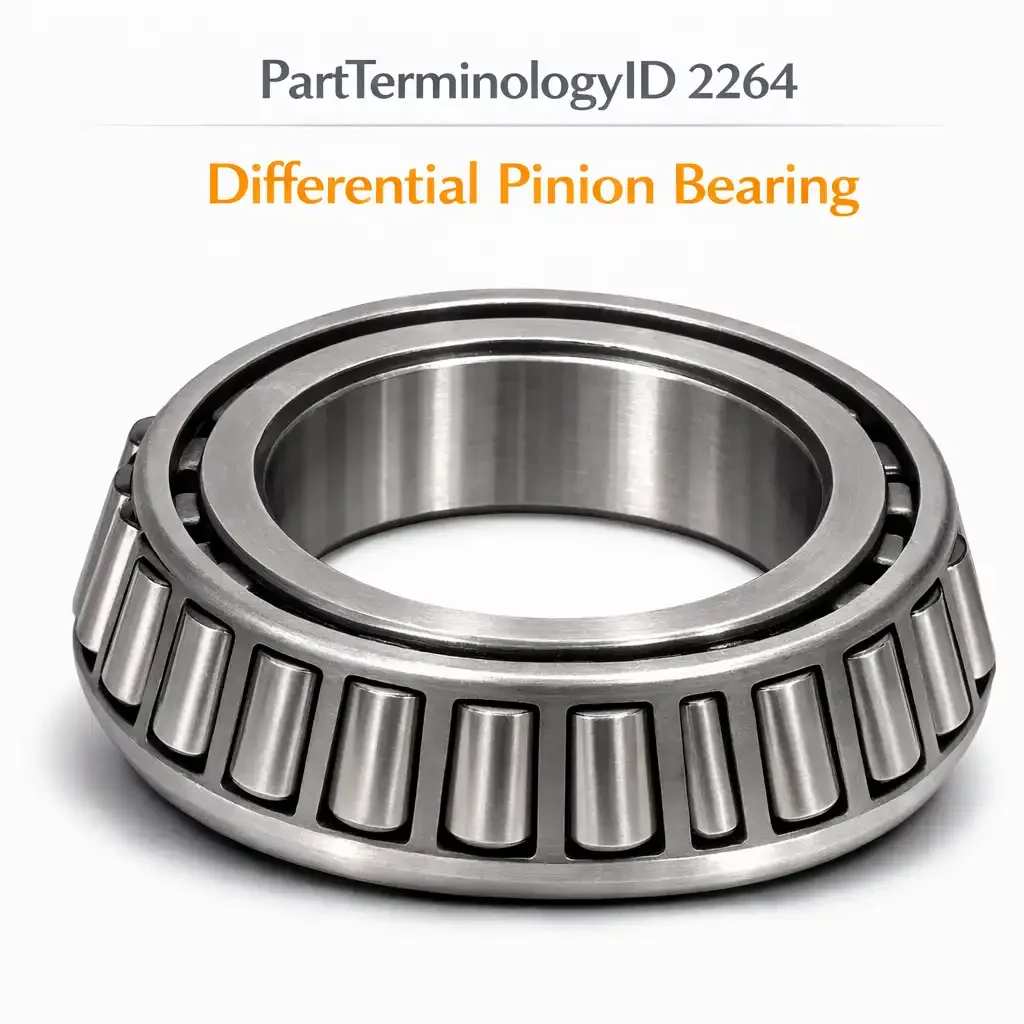
PartTerminologyID 2264, Differential Pinion Bearing, is a bearing that supports the pinion shaft within a differential housing. That definition is correct and immediately insufficient. It does not specify whether the bearing is the front pinion bearing, the rear pinion bearing, or both, what the axle designation is, what the ring gear diameter is, what the bearing inner diameter is, what the bearing outer diameter is, what the bearing width is, whether the listing covers the cone only, the cup only, or the complete cup-and-cone set, whether the crush sleeve is included, or what the relationship is between this PartTerminologyID and PartTerminologyID 2240, which covers the broader Axle Differential Bearing category that the pinion bearing is a subset of. A listing under PartTerminologyID 2264 that provides vehicle fitment without the axle designation, the pinion position, and the cup-and-cone status is a listing where the buyer cannot determine which of the two pinion bearings they are receiving or whether the cup that must be replaced when the pinion is pressed from the housing is included in the purchase.
For sellers, PartTerminologyID 2264 is a more specific PartTerminologyID than 2240. Where 2240 covers any bearing within the differential, including carrier bearings, 2264 covers only the pinion shaft bearings. That specificity should work in the listing's favor: a buyer who knows they have a pinion bearing failure and searches under PartTerminologyID 2264 is a more qualified buyer than one browsing the broader differential bearing category. But specificity only helps if the listing resolves the two questions that every pinion bearing buyer arrives with: which pinion position does this cover, and does it include the cup. A listing that answers neither question sends a qualified buyer to a return.
For sellers, the listing under this PartTerminologyID is only useful if it specifies the axle designation, the pinion position, the cup-and-cone status, all three primary dimensions, and the crush sleeve inclusion status. Without those five attributes, the specificity of PartTerminologyID 2264 relative to 2240 produces no catalog value.
What the Differential Pinion Bearing Does
Supporting the pinion shaft under the highest combined load in the differential
The pinion shaft runs through the differential housing from the drive flange end to the ring gear mesh. The pinion gear at the end of the shaft meshes with the ring gear at a 90-degree angle in a hypoid geometry. The hypoid gear mesh produces a gear tooth force that has three components: a radial component perpendicular to the shaft, a tangential component that produces the output torque, and an axial component from the spiral tooth geometry that pushes the pinion shaft axially toward or away from the ring gear depending on the direction of rotation and the hand of the spiral.
The front pinion bearing, at the drive flange end of the shaft, carries primarily the axial load from the gear mesh thrust and from the pinion bearing preload. The rear pinion bearing, positioned immediately behind the pinion gear and closest to the ring gear mesh, carries primarily the radial load from the gear mesh force. Both bearings are tapered roller bearings on virtually all domestic passenger vehicle and light truck differentials because the tapered roller geometry handles the combined radial and axial loading at both positions without a separate thrust element.
The front and rear pinion bearings on the same axle are different sizes. The rear pinion bearing is larger in all three dimensions because it carries the higher radial load from the gear mesh. A buyer who needs the rear pinion bearing and receives the front, or the reverse, has a bearing that will not fit the pinion shaft journal or the housing bore at the required position.
The hypoid gear mesh and its effect on bearing load direction
The hypoid gear mesh geometry in a differential produces axial thrust on the pinion shaft in a direction that depends on the hand of the spiral and the direction of rotation. Under driving load, where the ring gear is being driven by the pinion, the thrust acts in one direction. Under overrun or coast, where the ring gear is driving the pinion through engine braking, the thrust acts in the opposite direction. Both the front and rear pinion bearings must handle thrust in both directions to cover the full driving cycle, which is why both positions use tapered roller bearings oriented in opposite directions to handle opposing axial loads.
A replacement bearing with a different cone angle than the original will set the pinion preload incorrectly when the original spacer or shim pack is reused. Tapered roller bearings for the same nominal dimensions are produced in different cone angle families, and substituting a bearing with a different cone angle requires resetting the preload with a different spacer or shim pack. The listing must confirm the bearing is the correct cone angle family for the application, which is most reliably done by stating the OE or TIMKEN cross-reference.
Pinion bearing preload and its effect on differential noise and gear life
Pinion bearing preload is the axial clamping force applied to the front and rear pinion bearings by the pinion nut and the crush sleeve or solid spacer between them. The preload determines how much the tapered roller bearing cones are pressed toward each other along the shaft. Correct preload minimizes shaft deflection under the gear mesh load, which keeps the ring-and-pinion contact pattern within the designed tooth face area and produces quiet, efficient gear mesh operation.
Insufficient preload allows the pinion shaft to deflect under the gear mesh load. The contact pattern shifts toward one edge of the tooth face, which concentrates the load on a smaller contact area and accelerates ring and pinion tooth wear. The pinion bearing noise, rather than disappearing with a new bearing, may persist or return quickly because the underlying contact pattern issue destroys the new bearing on the same schedule as the original.
Excessive preload over-loads the tapered roller elements and generates heat in the bearing. The heat reduces the gear oil viscosity at the bearing contact zone, which reduces the oil film thickness and accelerates wear. An over-preloaded differential will run hot and fail bearings prematurely.
The crush sleeve is a single-use component. It must be replaced whenever the pinion nut is removed. A listing that does not disclose whether the crush sleeve is included produces a mid-rebuild sourcing delay when the buyer discovers the original crush sleeve cannot be reused.
The relationship between PartTerminologyID 2264 and PartTerminologyID 2240
PartTerminologyID 2240 covers the broader axle differential bearing category, which includes both pinion bearings and carrier bearings. PartTerminologyID 2264 covers only pinion bearings. A buyer searching under 2264 has already narrowed their need to the pinion shaft. The catalog must not list carrier bearings under PartTerminologyID 2264 and must not list pinion bearings under PartTerminologyID 2240 without also listing them under 2264. The two PartTerminologyIDs serve the same axle but at different shaft positions and for buyers at different stages of diagnosis specificity.
The Specifications That Determine Correct Fitment
Axle designation and ring gear diameter
The axle designation is the primary fitment attribute for the same reason stated in the differential bearing post (2240): the same vehicle platform was built with multiple axle options depending on the engine, the tow package, and the production date. The front and rear pinion bearing dimensions are specific to the axle designation, not to the vehicle model. A GM 7.5-inch axle front pinion bearing is a different dimension from a GM 8.5-inch axle front pinion bearing. The ring gear diameter confirms the axle designation.
Pinion position: front or rear
The front pinion bearing is at the drive flange end of the shaft, outside the gear mesh in the housing. The rear pinion bearing is behind the pinion gear, closest to the ring gear mesh. Both are tapered roller bearings but at different dimensions on the same axle. The listing must specify which position it covers.
On some rebuild kits and some supplier catalogs, a listing titled pinion bearing set covers both the front and rear bearings as a matched pair. A buyer who needs only one position and receives a set has paid for a bearing they did not need. A buyer who needs both and orders what they believe is the set and receives only one position cannot complete the rebuild. The listing must state explicitly whether it covers one position or both.
Cup-and-cone status
The cup is the outer race of the tapered roller bearing. It presses into the differential housing bore and remains there when the pinion shaft is removed during disassembly. On many differential rebuilds, removing the pinion shaft does not require removing the cups, and the original cups can be reused if they pass visual inspection. On other rebuilds, particularly those prompted by a bearing failure that has damaged the race surface, both the cup and cone must be replaced.
A listing that covers the cone only is correct for a rebuild where the cups are being reused. A listing that covers the cup-and-cone set is correct for a complete rebuild where both races are being replaced. A listing that does not state which it is produces a return from either buyer group: the buyer who needed the cup and received only the cone, or the buyer who needed only the cone and received and paid for the complete set.
Bearing dimensions: inner diameter, outer diameter, and width
All three must be stated in both metric and imperial. The inner diameter matches the pinion shaft journal at the bearing position. The outer diameter matches the housing bore at the bearing position. The width determines the axial space the bearing occupies and its relationship to the spacer or shim pack that sets preload.
Crush sleeve or solid spacer inclusion
The crush sleeve is replaced at every pinion nut removal. If it is not included in the bearing listing, it must be sourced before disassembly begins. The listing must state whether the crush sleeve is included. On applications where the OE specification is a crush sleeve but the buyer may want to convert to a solid spacer, the listing should note whether a solid spacer is available as an alternative.
Why This Part Generates Returns
Buyers order the wrong differential pinion bearing because:
the axle designation is not specified and the buyer's axle uses different pinion journal dimensions than the listed bearing
the pinion position is not specified and the buyer receives the front bearing when they need the rear, or vice versa
the cup-and-cone status is not stated and the buyer who has pressed the pinion from the housing, destroying the original cup in the process, receives only a cone
the listing covers both front and rear as a set but the buyer needed only one position, or the listing appears to be a set but covers only one position
the crush sleeve is not included and not disclosed, and the buyer discovers this after disassembly when the original collapsed sleeve cannot be reused
the bearing cone angle is not confirmed by OE cross-reference and the replacement bearing has a different cone angle that requires resetting preload with a different spacer
Status in New Databases
PIES/PCdb: PartTerminologyID 2264, Differential Pinion Bearing
PIES 8.0 / PCdb 2.0: No change
Top Return Scenarios
Scenario 1: "Front bearing received, rear bearing needed, pinion journal diameter does not match"
The listing stated differential pinion bearing with the correct axle designation but did not specify front or rear. The buyer needed the rear pinion bearing, which has a larger inner diameter than the front. The received bearing does not fit the rear pinion journal.
Prevention language: "Pinion position: [front pinion bearing / rear pinion bearing / front and rear set]. The front and rear pinion bearings on this axle are different sizes. The rear pinion bearing has a larger inner diameter than the front because it carries the higher radial load from the gear mesh. Verify which position requires replacement before ordering."
Scenario 2: "Cone received, cup needed, housing bore is already open"
The buyer removed the differential cover, extracted the pinion shaft, and pressed the cups from the housing bores. The listing did not specify that it covered the cone only. Both cups were destroyed during removal. The buyer received two cones without cups. The housing bores are open and no cups are in hand.
Prevention language: "Cup-and-cone status: [cone only / cup only / complete cup-and-cone set]. Do not press the original cups from the housing bores until replacement cups are in hand. Pressing cups from a differential housing typically destroys the original cups. If this listing covers the cone only and you need the cups, order them before beginning disassembly."
Scenario 3: "Crush sleeve not included, cannot set pinion preload"
The buyer installed the new pinion bearings and attempted to set preload with the original crush sleeve. The original sleeve had been previously collapsed and could not be re-collapsed to produce additional preload. No new sleeve was included in the listing. The buyer could not complete the assembly to the specified drag torque without a new sleeve.
Prevention language: "Crush sleeve: [included / not included]. The pinion crush sleeve is a single-use component that must be replaced every time the pinion nut is removed. If the crush sleeve is not included in this listing, source it before beginning disassembly. Attempting to reuse a previously collapsed crush sleeve will not produce correct pinion bearing preload."
Scenario 4: "Wrong axle designation, bearing outer diameter does not fit housing bore"
The buyer's vehicle has a Dana 44 rear axle. The listing was applied to the vehicle model without specifying the axle designation. The vehicle was also produced with a GM 8.5-inch axle in other build configurations. The buyer received a GM 8.5-inch front pinion bearing. The outer diameter does not fit the Dana 44 housing bore.
Prevention language: "Axle designation: [Dana 44]. Ring gear diameter: [8.5 inches]. Verify your axle designation before ordering. This vehicle was produced with multiple rear axle options. The pinion bearing dimensions are specific to the axle designation, not the vehicle model. Check the axle identification tag or measure the ring gear diameter to confirm your axle."
Scenario 5: "Replacement bearing has different cone angle, preload cannot be set with original spacer"
The replacement bearing is dimensionally correct but has a different cone angle from a different bearing series than the original. When the original solid spacer is reinstalled and the pinion nut is torqued, the drag torque reading does not reach the specified range before the nut reaches its torque limit. A different spacer thickness is required for the replacement bearing's cone angle.
Prevention language: "OE cross-reference: [TIMKEN XXXXX / SKF XXXXX]. Verify the replacement bearing cross-references to the OE specification before installing. Tapered roller bearings of the same nominal dimensions but different cone angle families require different spacer or shim pack thicknesses to achieve the specified pinion preload. Do not substitute a bearing without confirming the OE cross-reference."
What to Include in the Listing
Core essentials
PartTerminologyID: 2264
component: Differential Pinion Bearing
axle manufacturer: Dana, GM, Ford, Chrysler, Toyota, or other (mandatory)
axle designation: Dana 44, GM 8.5-inch, Ford 8.8-inch, etc. (mandatory)
ring gear diameter in inches (mandatory)
axle position: front axle or rear axle on four-wheel-drive applications (mandatory)
pinion position: front pinion bearing, rear pinion bearing, or front and rear set (mandatory)
cup-and-cone status: cone only, cup only, or complete cup-and-cone set (mandatory)
inner diameter in mm and inches (mandatory)
outer diameter in mm and inches (mandatory)
bearing width in mm (mandatory)
crush sleeve included: yes or no (mandatory)
OE or TIMKEN cross-reference (mandatory for cone angle family verification)
quantity: 1 bearing or 1 set as specified
Fitment essentials
year/make/model/submodel as secondary fitment reference
axle designation as primary fitment attribute
ring gear diameter for axle size confirmation
gear ratio when bearing specification varies by ratio
production date range when housing bore specification changed
Dimensional essentials
cone inner diameter in inches to four decimal places and mm
cup outer diameter in inches to four decimal places and mm
cone width in mm
cup width in mm when different from cone width
bearing series designation for cone angle family identification
Image essentials
front pinion bearing cup and cone shown separately with dimensional callouts
rear pinion bearing cup and cone shown separately with dimensional callouts
comparison image showing front and rear pinion bearings side by side to illustrate size difference
crush sleeve shown if included
installed context showing both pinion bearing positions in the differential housing cross-section
Catalog Checklist for ACES/PIES Teams
PartTerminologyID = 2264
require axle designation (mandatory, primary fitment attribute)
require ring gear diameter (mandatory)
require axle position: front or rear on four-wheel-drive applications (mandatory)
require pinion position: front, rear, or set (mandatory)
require cup-and-cone status (mandatory)
require inner diameter, outer diameter, and width
require crush sleeve inclusion status (mandatory)
require OE or TIMKEN cross-reference for cone angle family verification (mandatory)
differentiate from axle differential bearing (PartTerminologyID 2240): 2240 covers all differential bearings including carrier bearings; 2264 covers only pinion shaft bearings; do not list carrier bearings under 2264
differentiate from axle differential bearing and seal kit (PartTerminologyID 2224): the kit covers all bearings and seals for a complete rebuild; 2264 covers individual pinion bearings for targeted pinion shaft service
differentiate from carrier bearing: the carrier bearing supports the differential carrier at the housing journals; the pinion bearing supports the pinion shaft; both are in the same differential housing but at different shafts with different dimensions and different failure symptoms
flag axle designation as mandatory: vehicle year/make/model alone produces mismatches on multi-axle platforms at a high rate
flag pinion position as mandatory: front and rear pinion bearings on the same axle are different dimensions; a listing without the position attribute cannot be verified against the buyer's failed component
flag cup-and-cone status as mandatory: pressing the original cups from the housing destroys them; a cone-only listing sent to a buyer who has pressed the cups produces an incomplete rebuild and a stopped vehicle
FAQ (Buyer Language)
How do I diagnose which pinion bearing has failed without full disassembly?
Pinion bearing noise is characterized by a whine or rumble that tracks with vehicle speed and changes with load rather than with turning direction. To distinguish between the front and rear pinion bearing without full disassembly, note when the noise changes. Noise that intensifies under driving load and decreases significantly under coast is typically the rear pinion bearing, which carries the higher radial load from the gear mesh under driving torque. Noise that is more consistent between drive and coast but changes with the pre-load on the drive shaft, for instance when towing or when accelerating from a stop, is more often the front pinion bearing, which carries more of the axial preload component. A definitive diagnosis requires removing the driveshaft, installing a drag torque wrench on the pinion flange, and checking the rotational drag while rotating the flange by hand. A bearing with worn rollers or a damaged race will show rough or irregular drag rather than the smooth, consistent drag of a correctly preloaded healthy bearing.
Can I reuse the original pinion bearing cups if only the cones show wear?
Inspect the cup races under good light with a magnifying glass. The race surface must be smooth, uniformly reflective, and free of pitting, spalling, brinelling, and heat discoloration. A cup that passes that inspection with moderate mileage on the differential can be reused with new cones. However, on any differential where the bearing failed from overload or from a shock event such as a severe impact on the drive axle, replace both cups and cones regardless of visual appearance, because subsurface fatigue damage from the overload event is not visible until it propagates to the surface. On a high-mileage differential being rebuilt as a precaution rather than because of a failure, new cups are not strictly required if the originals pass inspection, but replacing them eliminates the risk of a cup failure shortly after the new cones are installed.
What is the correct pinion bearing preload and how do I measure it?
Pinion bearing preload is measured as rotational drag torque on the pinion shaft with the carrier assembly removed and no ring gear in contact with the pinion. The pinion nut is tightened progressively, collapsing the crush sleeve incrementally, until the measured drag torque reaches the specified range. For new bearings on most domestic differentials, the specified drag torque range is approximately 16 to 29 inch-pounds. For used bearings being reassembled without new bearings, the range is lower, approximately 8 to 14 inch-pounds, because used bearings have already seated their rollers and require less preload to achieve the same shaft stiffness. The factory service manual for your axle designation specifies the exact range. Do not exceed the maximum: a crush sleeve that has been over-collapsed cannot be un-collapsed and requires a new sleeve and a complete repeat of the pinion installation sequence.
My differential has a solid spacer rather than a crush sleeve. How does that change the preload procedure?
A solid spacer is a precision-machined spacer of fixed length that sets the pinion bearing preload to a specific dimension rather than by progressive collapse. Solid spacer preload is set by selecting the correct spacer thickness from a range of available thicknesses rather than by progressively torquing the pinion nut against a crush sleeve. The correct spacer thickness is determined by measuring the pinion shaft bearing seat dimensions and calculating the required spacer length to achieve the target preload. Solid spacer setups require more time to set up correctly than crush sleeve setups but are reusable: unlike a crush sleeve, the solid spacer can be removed and reinstalled at future service events. The solid spacer is not a single-use component.
The pinion noise returned within 10,000 miles of replacing the bearing. What caused the failure?
Early return of pinion bearing noise after a replacement typically indicates one of four root causes. First, incorrect preload during assembly: insufficient preload allows the shaft to deflect under load and the contact pattern shifts to the tooth edges, which destroys the new bearing on an accelerated schedule. Second, a reused crush sleeve that was over-collapsed on the previous installation and produced insufficient preload on the replacement bearing. Third, gear oil that was not replaced at the time of the bearing replacement and was contaminated with metallic debris from the original bearing failure, which contaminated the new bearing from the first operation. Fourth, a ring-and-pinion contact pattern that is outside the designed tooth face area regardless of bearing condition, which indicates a pinion depth or ring gear backlash adjustment problem that the bearing replacement did not address.
Cross-Sell Logic
Pinion Seal (the pinion seal at the drive flange is replaced whenever the pinion nut is removed; it is the most predictable concurrent purchase with any pinion bearing listing)
Crush Sleeve (replaced at every pinion nut removal; if not included in the bearing listing, it is the second most predictable concurrent purchase)
Axle Differential Bearing and Seal Kit (PartTerminologyID 2224: for a complete rebuild, the full kit covering all bearing positions plus seals is more efficient than ordering individual bearings separately)
Carrier Bearings (PartTerminologyID 2240: if the differential is being disassembled for pinion bearing replacement, inspect the carrier bearings and replace if at the same service age)
Ring and Pinion Gear Set (if the contact pattern inspection after bearing replacement reveals a pattern that cannot be corrected by shimming, the ring and pinion require replacement)
Differential Cover Gasket (the differential cover is removed to access the carrier and inspect the pinion; the cover gasket is replaced on reinstallation)
Gear Oil (replaced after every internal differential service)
Frame as "the pinion bearing supports the shaft that drives the ring gear. The pinion seal keeps the gear oil in at the drive flange end. The crush sleeve sets the preload the bearing requires. The gear oil lubricates the bearing the seal protects. All are replaced at the same pinion service event."
Final Take for PartTerminologyID 2264
Differential Pinion Bearing (PartTerminologyID 2264) is a more specific PartTerminologyID than the Axle Differential Bearing (2240) it sits within, and that specificity creates an expectation in the qualified buyer that the listing will resolve the two questions specificity implies: which pinion position, and does the cup come with it. A listing that answers neither question has used the specificity of PartTerminologyID 2264 to attract a qualified buyer and then failed them with the same incomplete attributes that a generic listing would have provided.
The axle designation resolves the physical dimensions. The pinion position resolves which of two different-sized bearings at two different positions on the same shaft is being ordered. The cup-and-cone status resolves whether the buyer can complete the rebuild without a second order. The crush sleeve inclusion status resolves whether the preload can be set after the new bearing is installed. The OE cross-reference resolves whether the replacement bearing's cone angle is compatible with the original spacer or shim pack.
State the axle designation. State the ring gear diameter. State the pinion position. State the cup-and-cone status. State the crush sleeve inclusion. State all three dimensions in metric and imperial. State the OE cross-reference. That is the same listing strategy as every other PartTerminologyID in this series: the generic PartTerminologyID requires specific attributes at every level to become a listing buyers can act on without guessing. For PartTerminologyID 2264, the qualified buyer who arrives knowing they have a pinion bearing problem deserves a listing that resolves that problem without creating a new one.