
Written by Arthur Simitian | PartsAdvisory
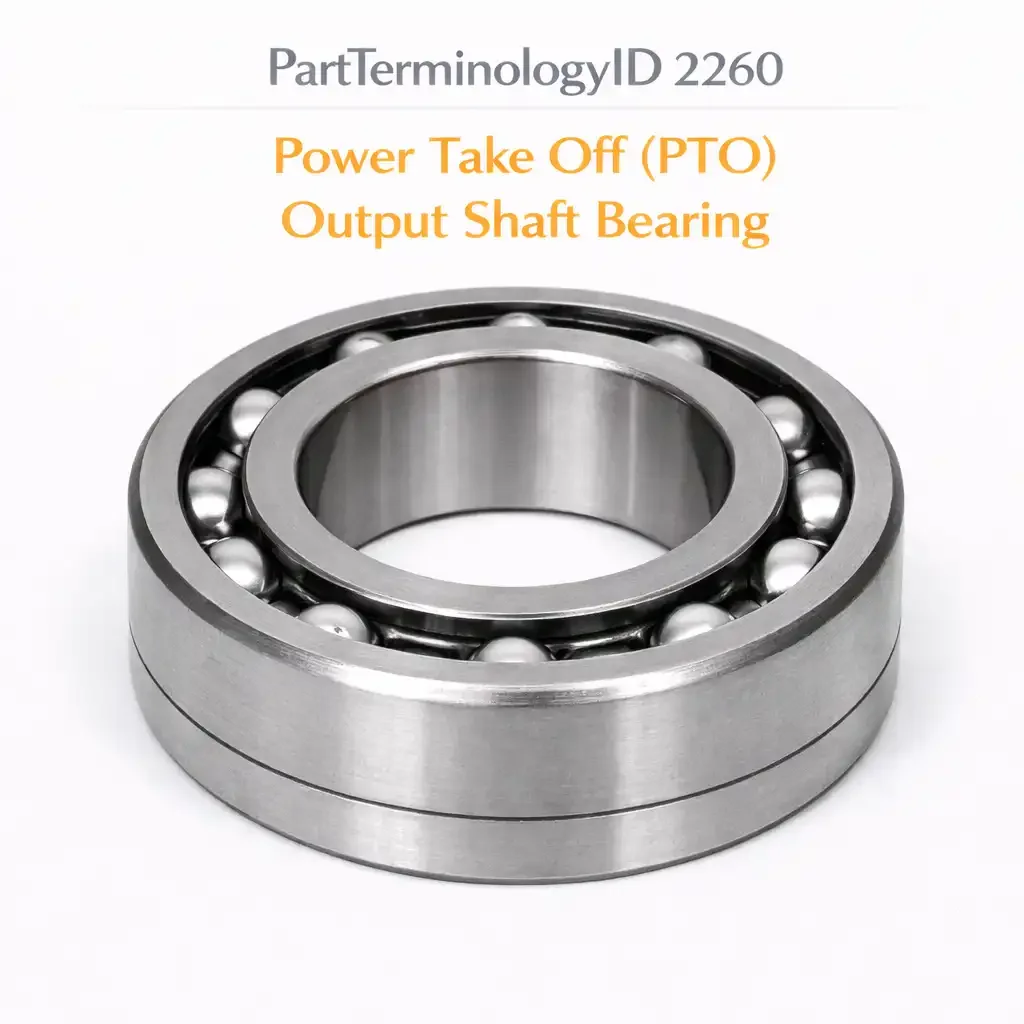
PartTerminologyID 2260, Power Take Off (PTO) Output Shaft Bearing, is a bearing that supports the output shaft of a power take off unit at the point where torque exits the PTO to the driven equipment. That definition identifies the position at the end of the torque path. It does not specify the PTO unit manufacturer, the PTO model designation, the compatible transmission, the bearing type, the inner diameter, the outer diameter, the bearing width, whether the driven equipment coupling produces axial loading that affects the bearing type selection, whether the output shaft is supported by one bearing or two, whether the output shaft seal is in the same bore as the bearing or in a separate bore adjacent to it, or whether the bearing is a sealed unit or requires external lubrication from the PTO gear oil. A listing under PartTerminologyID 2260 that does not specify the PTO unit designation, the bearing type, the coupling-induced axial load characteristic of the application, and all three primary dimensions cannot be verified by any buyer sourcing the replacement before or during the teardown.
For sellers, the PTO output shaft bearing has a load profile that is fundamentally different from the input shaft bearing and the intermediate shaft bearing in the same PTO unit. The input shaft bearing carries the full gear mesh force from the transmission drive gear. The intermediate shaft bearing carries a load determined by the gear reduction sequence. The output shaft bearing carries the final output torque load, which after gear reduction is higher in torque than the input but is applied at a lower speed. In addition, the output shaft bearing carries an external radial and axial load from the driven equipment's coupling. A flange-coupled driven equipment produces a different load vector than a splined shaft coupling. A driven equipment with a flexible coupling produces a different load than a rigid coupling. A hydraulic pump that loads the PTO shaft axially from fluid pressure reaction produces a load component that the input and intermediate shaft bearings do not experience. All of those external load contributions are unique to the output shaft position and determine whether the bearing type appropriate for the input shaft position is also appropriate for the output shaft position.
For sellers, the listing under this PartTerminologyID is only useful if it specifies the PTO unit designation, the compatible transmission, the bearing type with the axial load capacity appropriate for the driven equipment coupling, and all three primary dimensions. Without those four attributes, the listing may supply a bearing that is adequate for the internal PTO load but not for the combined internal and external load that the output shaft position actually experiences.
What the PTO Output Shaft Bearing Does
Supporting the shaft at the torque delivery point under combined internal and external load
The output shaft exits the PTO housing and connects to the driven equipment. The output shaft bearing supports the shaft at the point where it passes through the housing wall. Inside the housing, the output gear mesh produces a radial load from the gear tooth force. Outside the housing, the driven equipment coupling may produce additional radial load from misalignment, axial load from thrust-producing couplings, or both.
The output shaft bearing must handle the vector sum of the internal gear mesh load and the external coupling load simultaneously. On a PTO driving a hydraulic pump through a close-coupled flange connection, the axial load from pump fluid pressure can be several times the internal gear mesh radial load. A bearing selected only for the internal PTO load at this position will be inadequate when the external pump axial load is added.
On a PTO driving a rotating shaft through a universal joint or a flexible coupling, the coupling misalignment produces a continuous rotating bending load at the coupling point. This bending load adds a moment to the output shaft that the bearing must resist. A bearing with low moment stiffness, such as a deep-groove ball bearing, will allow shaft deflection under this moment load that a tapered roller bearing or an angular contact bearing would prevent.
The output shaft seal relationship to the output shaft bearing
The output shaft seal prevents gear oil from escaping the PTO housing at the output shaft exit point. The seal is installed adjacent to the output shaft bearing in the housing bore. On many PTO designs, the seal and the bearing share the same bore: the bearing is at the inner end of the bore and the seal is at the outer end. On other designs, the seal is in a separate bore in a housing cap that bolts to the main housing, and the bearing is in the main housing bore.
The relationship between the seal and the bearing determines the disassembly sequence and the replacement procedure. On shared-bore designs, the seal must be removed before the bearing can be pressed out. On separate-bore designs, the seal cap can be removed independently of the bearing housing. The listing must identify which configuration applies and whether the output shaft seal is included with the bearing or must be ordered separately.
On output shaft positions where the external coupling produces radial load on the shaft, the shaft seal experiences a cycling contact load as the shaft deflects under the external load. A shaft that deflects significantly at the seal contact zone will wear the seal lip unevenly and produce a premature seal leak. Verifying the output shaft bearing is correctly specified to minimize shaft deflection at the seal contact zone is therefore part of preventing output shaft seal failures as well.
Single-bearing versus two-bearing output shaft support
On most standard commercial PTO designs, the output shaft is supported by a single bearing at the housing wall where the shaft exits. The shaft's connection to the output gear on the internal side of the housing wall and its connection to the driven equipment on the external side are both cantilevered from this single bearing. The bearing must carry both the internal gear mesh load and the external coupling load in this single-bearing design.
On high-torque PTOs and on PTOs designed for close-coupled heavy equipment, the output shaft is supported by two bearings: a primary bearing at the housing wall and a secondary bearing at the end of the output shaft housing extension. The two-bearing design converts the cantilevered shaft into a simply supported shaft, which dramatically reduces the bearing load at each position and allows a lighter bearing at each position than the single-bearing design would require.
The listing must specify whether it covers the primary housing wall bearing or the secondary extension bearing on two-bearing output shaft designs. Both bearings have different dimensions and cannot substitute for each other.
The PTO output shaft bearing in relation to the driveshaft and the driven equipment
The output shaft bearing is the last bearing in the PTO torque path. Beyond it, the connection to the driven equipment is the responsibility of the driveshaft, the universal joints, the coupling flanges, and the driven equipment's own input bearing. The PTO output shaft bearing carries loads from within the PTO and from the coupling geometry at the output. It does not carry loads from the driven equipment's internal components except those transmitted back through the coupling.
Understanding this boundary is important for diagnosing output shaft bearing failures. A bearing that fails at the output shaft position on a PTO with a correctly maintained coupling alignment is failing from an internal cause: incorrect bearing type, incorrect preload, contaminated gear oil, or overload of the PTO beyond its rated capacity. A bearing that fails at the output shaft position on a PTO with coupling misalignment is failing from an external cause that will destroy the replacement bearing on the same timeline as the original if the misalignment is not corrected.
The Specifications That Determine Correct Output Shaft Bearing Fitment
PTO unit designation and output shaft configuration
The PTO unit designation determines the output shaft journal diameter and the housing bore diameter. The output shaft configuration, single-bearing or two-bearing, determines how many bearings are required and which position the listing covers.
Bearing type matched to the coupling load profile
Deep-groove ball bearing: appropriate for output shaft positions where the external coupling produces minimal axial load and the shaft alignment is close-coupled with low misalignment. The deep-groove ball bearing's moderate axial load capacity and low friction at moderate speeds make it adequate for many standard commercial PTO output shaft positions.
Tapered roller bearing: required at output shaft positions where the driven equipment produces significant axial thrust, such as close-coupled hydraulic pumps with high fluid pressure, or where the shaft operates under combined high radial and axial loads from the gear mesh and the coupling simultaneously.
Angular contact ball bearing: used at output shaft positions where a consistent axial preload is required to maintain the correct shaft position relative to the output gear mesh and the coupling geometry. Single-row or double-row depending on the axial load magnitude.
Spherical roller bearing: used on some heavy-duty output shaft positions where the driven equipment coupling produces angular misalignment that the bearing must accommodate without imposing moment loads on the shaft. The spherical roller bearing's self-aligning capability absorbs the misalignment that a rigid bearing would transmit to the shaft as bending.
Inner diameter, outer diameter, and width
All three must be stated. The inner diameter matches the output shaft journal. The outer diameter matches the housing bore. The width determines the available axial space for the bearing and the adjacent seal.
Output shaft seal inclusion status
The output shaft seal is replaced whenever the output shaft bearing is replaced. The listing must state whether the seal is included. On shared-bore designs, the seal is integral to the bearing service and should be included in the listing or explicitly noted as separately required.
Why This Part Generates Returns
Buyers order the wrong PTO output shaft bearing because:
the PTO unit designation is not specified and the buyer's output shaft journal diameter does not match the listed bearing's inner diameter
the bearing type is not matched to the driven equipment coupling load and the buyer installs a ball bearing at a position where the hydraulic pump axial thrust requires a tapered roller bearing
the output shaft configuration is not specified and the buyer receives the secondary extension bearing when they need the primary housing wall bearing on a two-bearing design
the output shaft seal is not included and not disclosed, leaving the buyer to source the seal separately after the bearing has already been pressed into the housing
the bearing width is not stated and the replacement is too wide to allow the output shaft seal to seat in the adjacent bore
the coupling-induced load is not addressed in the listing and the buyer installs a bearing that is adequate for the internal PTO load but fails within months from the combined internal and external load at the output position
Status in New Databases
PIES/PCdb: PartTerminologyID 2260, Power Take Off (PTO) Output Shaft Bearing
PIES 8.0 / PCdb 2.0: No change
Top Return Scenarios
Scenario 1: "Ball bearing failed within 300 hours, hydraulic pump application"
The replacement deep-groove ball bearing was installed at the output shaft position on a PTO driving a close-coupled hydraulic pump. The pump's fluid pressure reaction produces a sustained axial load at the output shaft. The ball bearing carried this axial load at the ball-to-race contact points, which induced race indentation within 300 operating hours. The listing did not specify that the driven equipment type affects the bearing type selection.
Prevention language: "Bearing type: [deep-groove ball / tapered roller / angular contact]. Driven equipment consideration: close-coupled hydraulic pumps produce axial thrust at the output shaft from fluid pressure reaction. A tapered roller or angular contact bearing is required at this position when driving a hydraulic pump. A deep-groove ball bearing at a pump-driven output shaft position will fail prematurely from sustained axial overload."
Scenario 2: "Extension bearing received, needed housing wall bearing"
The PTO has a two-bearing output shaft design. The listing specified output shaft bearing without identifying the position. The buyer received the secondary extension bearing with a smaller outer diameter than the primary housing wall bearing. The housing wall bore will not accept the smaller extension bearing.
Prevention language: "Output shaft bearing position: [primary housing wall bearing / secondary extension bearing]. This PTO uses two output shaft bearings. The primary housing wall bearing has an inner diameter of [X]mm and an outer diameter of [X]mm. The secondary extension bearing has an inner diameter of [X]mm and an outer diameter of [X]mm. Verify which position requires replacement before ordering."
Scenario 3: "Output shaft seal not included, gear oil leaked immediately after installation"
The bearing was installed in the housing bore. The output shaft seal was not included in the listing and was not noted as separately required. The buyer did not source a seal before the repair. The PTO was reassembled without a new seal. The original seal was destroyed during bearing removal. The PTO leaked gear oil from the first operation after the repair.
Prevention language: "Output shaft seal: [included / not included, order separately before beginning teardown]. The output shaft seal is replaced whenever the output shaft bearing is replaced. On this PTO design, the seal shares the housing bore with the bearing and is destroyed during bearing removal. Source the output shaft seal before beginning disassembly."
Scenario 4: "Bearing too wide, seal cannot seat in adjacent bore"
The replacement bearing is 5mm wider than the original. The housing bore accommodates the original bearing width plus the seal. The wider bearing occupies the seal's designated space in the bore. The seal cannot be fully seated and the output shaft leaks gear oil at the seal lip.
Prevention language: "Bearing width: [X]mm. The output shaft housing bore is sized for the bearing and the adjacent shaft seal. A bearing wider than [X]mm will occupy the seal's space in the bore and prevent the seal from seating correctly. Verify the bearing width does not exceed this specification."
Scenario 5: "Coupling misalignment destroyed replacement bearing on same timeline"
The output shaft bearing failed from coupling misalignment between the PTO output flange and the driven equipment input flange. The replacement bearing was installed correctly but the misalignment was not corrected. The replacement bearing failed within the same operating hours as the original.
Prevention language: "If the output shaft bearing has failed from an external cause such as coupling misalignment, correct the misalignment before installing the replacement bearing. Verify the driven equipment input flange is within the coupling manufacturer's specified misalignment tolerance. A correctly installed replacement bearing will fail on the same timeline as the original if the root cause misalignment is not addressed."
What to Include in the Listing
Core essentials
PartTerminologyID: 2260
component: PTO Output Shaft Bearing
PTO unit manufacturer: Chelsea, Muncie, Parker Chelsea, Bezares, or other (mandatory)
PTO unit model designation (mandatory)
compatible transmission model or family (mandatory)
output shaft configuration: single-bearing or two-bearing (mandatory)
bearing position: primary housing wall bearing or secondary extension bearing for two-bearing designs (mandatory)
bearing type: deep-groove ball, tapered roller, angular contact, or spherical roller (mandatory)
driven equipment coupling type consideration: note when hydraulic pump or other thrust-producing coupling requires tapered roller or angular contact bearing (mandatory)
inner diameter in mm and inches (mandatory)
outer diameter in mm and inches (mandatory)
bearing width in mm (mandatory)
output shaft seal included: yes or no (mandatory)
seal bore dimensions if seal is not included and must be separately sourced
ISO bearing designation (recommended)
retention method: snap ring, press fit, or housing cap
quantity: 1
Fitment essentials
PTO unit manufacturer and model designation (primary fitment attribute)
compatible transmission model
driven equipment type when the bearing type recommendation varies by driven equipment
vehicle year/make/model as tertiary reference
PTO gear ratio when the output shaft bearing specification varies by ratio
Dimensional essentials
inner diameter in mm and inches
outer diameter in mm and inches
bearing width in mm
for tapered roller bearings: cup and cone dimensions separately
for angular contact bearings: contact angle in degrees
seal bore inner diameter, outer diameter, and width adjacent to bearing if seal is not included
Image essentials
bearing in isolation with all three dimensional callouts
output shaft seal shown alongside the bearing with its dimensional callouts
PTO housing cross-section or exploded diagram showing the output shaft, the bearing position, and the adjacent seal bore
for two-bearing designs, both bearing positions labeled in the diagram
driven equipment coupling shown in context to illustrate the axial load direction
Catalog Checklist for ACES/PIES Teams
PartTerminologyID = 2260
require PTO unit manufacturer and model designation (mandatory)
require compatible transmission model (mandatory)
require output shaft configuration: single-bearing or two-bearing (mandatory)
require bearing position for two-bearing designs: primary or secondary (mandatory)
require bearing type (mandatory)
require driven equipment coupling consideration note for thrust-producing applications (mandatory)
require inner diameter, outer diameter, and width
require output shaft seal inclusion status (mandatory)
require ISO bearing designation or cross-reference
differentiate from PTO input shaft bearing (PartTerminologyID 2244): the input shaft bearing is at the torque entry point and carries the transmission drive gear mesh load; the output shaft bearing is at the torque exit point and carries the final output load plus the external coupling load; both are in the same PTO unit but with fundamentally different external load contributions
differentiate from PTO countershaft bearing (PartTerminologyID 2236) and PTO intermediate shaft bearing (PartTerminologyID 2252): countershaft and intermediate shaft bearings carry only internal PTO gear mesh loads; the output shaft bearing carries both internal gear mesh loads and external coupling loads from the driven equipment
differentiate from the driven equipment's input bearing: the PTO output shaft bearing is inside the PTO housing; the driven equipment's input bearing is inside the driven equipment; the PTO output shaft bearing carries loads up to the coupling; the driven equipment's bearing carries loads from the coupling onward
flag driven equipment coupling as mandatory context: the output shaft bearing is the only bearing in the PTO series where the external application determines the required bearing type; a listing that ignores the driven equipment type will supply an incorrectly typed bearing for pump-driven and other thrust-loaded applications
flag output shaft seal inclusion status as mandatory: the seal is destroyed during bearing removal on shared-bore designs and must be replaced; not disclosing its inclusion status sends the buyer to a sealed reassembly without a new seal
flag two-bearing output shaft designs: the primary and secondary output shaft bearings are different dimensions; a listing that does not identify the position within a two-bearing system cannot be evaluated
FAQ (Buyer Language)
How do I identify whether my PTO output shaft uses one bearing or two?
Look at the output shaft housing. If the output shaft exits the PTO through a single housing wall bore that contains both the bearing and the adjacent seal, it is a single-bearing design. If the output shaft is supported by a bearing at the main housing wall and then passes through an extended housing tube or a shaft extension bracket where a second bearing is located, it is a two-bearing design. Two-bearing output shaft designs are typically found on higher-torque PTOs and on PTOs designed for close-coupled equipment where the cantilevered load from a single-bearing design would be excessive.
My PTO drives a hydraulic pump. What bearing type do I need at the output shaft?
A tapered roller bearing or an angular contact ball bearing is required at the output shaft position on a PTO driving a close-coupled hydraulic pump. Hydraulic pumps generate axial thrust at their input shaft from the fluid pressure reaction inside the pump. This axial thrust is transmitted to the PTO output shaft through the coupling flange. A deep-groove ball bearing at this position will carry the axial load at the ball-to-race contact zones, which are not designed for sustained thrust loading, and will develop race indentation within a few hundred hours of operation. Replace the failed bearing with a tapered roller or angular contact type and do not reinstall a ball bearing at this position.
The output shaft seal was destroyed when I removed the bearing. Is the seal available separately?
Yes, on most PTO applications. The output shaft seal is a standard lip seal sized to the output shaft diameter and the housing seal bore inner diameter. If the seal is not included in the bearing listing, measure the output shaft diameter at the seal contact zone and the housing seal bore inner diameter and cross-reference those dimensions to a standard lip seal. Have the seal in hand before pressing the new bearing into the housing, because the seal must be installed in the bore before the output shaft is reinstalled.
My replacement output shaft bearing failed in less than 200 hours. What went wrong?
The most common causes of rapid output shaft bearing failure are incorrect bearing type for the driven equipment coupling load, coupling misalignment that was not corrected when the bearing was replaced, contaminated gear oil that was not changed at the time of bearing replacement, incorrect bearing preload on tapered roller designs, and exceeding the PTO's rated output torque. Check the gear oil for metallic contamination and replace it if contaminated. Verify the coupling alignment between the PTO output flange and the driven equipment input flange. Verify the driven equipment type does not produce axial thrust that requires a tapered roller bearing at the output shaft position.
Can I install a sealed bearing at the output shaft position to eliminate the need for a separate shaft seal?
On some PTO designs, yes. A sealed deep-groove ball bearing at the output shaft position eliminates the need for a separate lip seal and provides contamination protection for the bearing itself. However, the sealed bearing must fit within the available bore space that the original bearing and seal occupied combined. On many PTO designs, the housing bore is sized for the bearing and the seal as two separate components, and a sealed bearing of the same outer diameter as the original bearing will leave a gap at the seal bore position that is not filled. Verify the housing bore dimensions against the sealed bearing's overall envelope before selecting a sealed bearing as a substitute for the bearing-plus-seal original configuration.
Cross-Sell Logic
PTO Output Shaft Seal (the output shaft seal is replaced whenever the bearing is replaced; it is the most predictable concurrent purchase for every output shaft bearing listing)
PTO Input Shaft Bearing (PartTerminologyID 2244: replaced at the same service event when the PTO is disassembled for output shaft bearing replacement)
PTO Countershaft Bearing (PartTerminologyID 2236: replaced at the same disassembly event on single-stage PTO designs)
PTO Intermediate Shaft Bearing (PartTerminologyID 2252: replaced at the same service event on multi-stage PTO designs)
PTO Gasket Set (the housing gaskets are replaced when the PTO is opened; have the gasket set on hand before disassembly)
Gear Oil (PTO gear oil is replaced after every internal service; verify the correct viscosity and specification for the unit)
Coupling Alignment Tools (if coupling misalignment contributed to the bearing failure, the alignment must be verified and corrected before the replacement bearing is put in service; a straight edge or a laser alignment tool is required for this verification)
Frame as "the output shaft bearing delivers the torque the PTO produces to the driven equipment. The output shaft seal keeps the gear oil in at the delivery point. The input shaft bearing brings the torque in. The gear oil lubricates the bearing that delivers it out. The coupling alignment determines whether the external load the output bearing carries is within its rated capacity."
Final Take for PartTerminologyID 2260
PTO Output Shaft Bearing (PartTerminologyID 2260) is the bearing at the end of the PTO torque path where the internal gear mesh load and the external driven equipment coupling load combine into a single load vector that the bearing must support continuously during every hour of PTO operation. It is the only bearing in the PTO PartTerminologyID series where the driven equipment type is a required specification attribute, because the driven equipment determines whether the output shaft position experiences axial thrust that changes the required bearing type from a ball bearing to a tapered roller or angular contact design.
The driven equipment coupling consideration is the attribute most commonly absent from output shaft bearing listings and is the root cause of the most consequential return events in this category: a ball bearing installed at a hydraulic pump-driven output shaft position that fails within months from axial overload, requiring another PTO removal and another bearing replacement on a timeline set by the pump's pressure, not by the bearing's rated life.
State the PTO unit designation. State the compatible transmission. State the output shaft configuration. State the bearing position on two-bearing designs. State the bearing type with the driven equipment coupling consideration. State all three dimensions. State the output shaft seal inclusion status. That is the same listing strategy as every other PartTerminologyID in this series: the generic PartTerminologyID requires specific attributes at every level to become a listing buyers can act on without guessing. For PartTerminologyID 2260, guessing on the driven equipment coupling sends a ball bearing to a pump-driven shaft that needs a tapered roller, and the pump will determine the failure timeline regardless of how correctly everything else was specified.