
Power Take Off (PTO) Intermediate Shaft Bearing (PartTerminologyID 2252): Where Shaft Position Within the Gear Train Determines Every Specification
Written by Arthur Simitian | PartsAdvisory
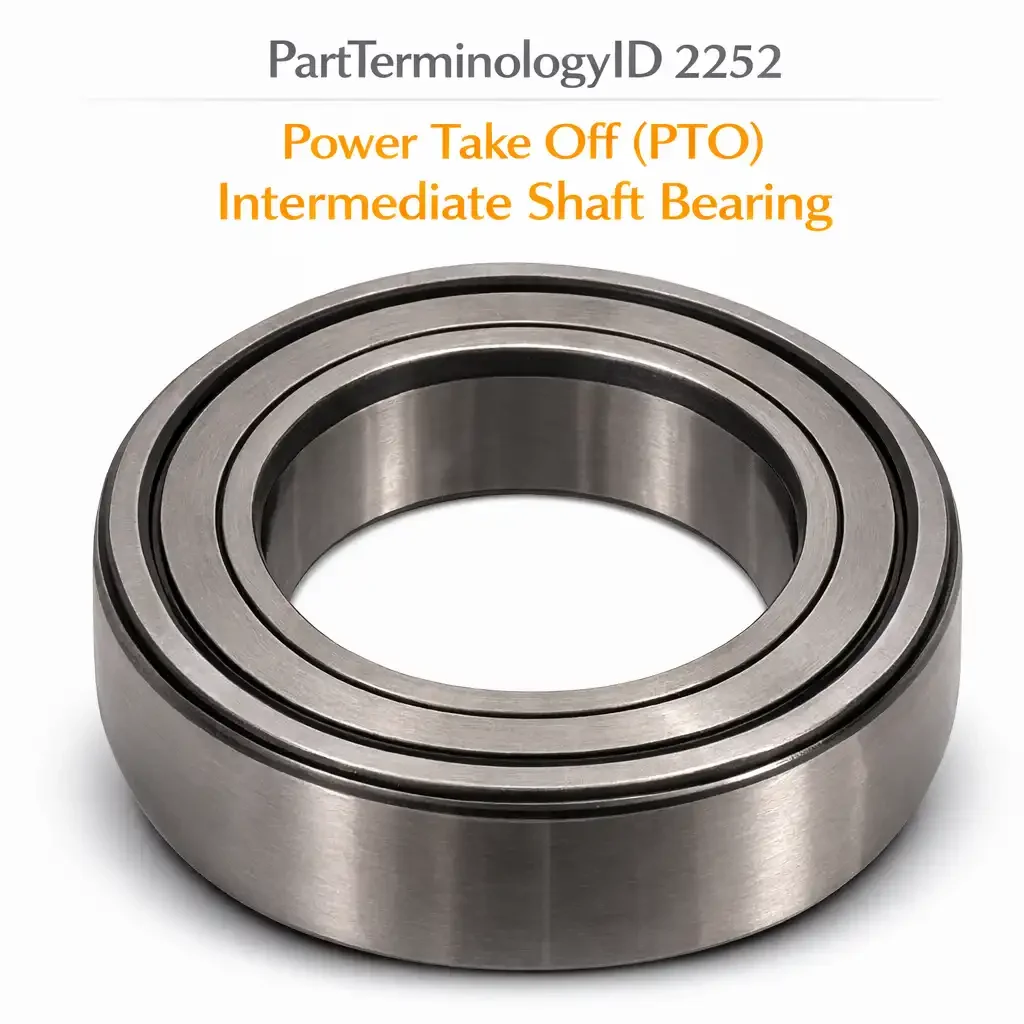
PartTerminologyID 2252, Power Take Off (PTO) Intermediate Shaft Bearing, is a bearing that supports an intermediate shaft within a power take off unit at a position between the input shaft and the output shaft. That definition places the bearing in the torque path. It does not specify the PTO unit manufacturer, the PTO model designation, the compatible transmission, the bearing type, the inner diameter, the outer diameter, the bearing width, how many intermediate shaft positions exist in the PTO unit, which intermediate shaft position this bearing supports when multiple positions are present, whether the bearing is at the housing wall or at a mid-span support within the housing, what the load magnitude is at this shaft position relative to the input and output positions, or whether the intermediate shaft in this PTO design is the same shaft as the countershaft covered under PartTerminologyID 2236. A listing under PartTerminologyID 2252 that does not resolve the relationship between this PartTerminologyID and PartTerminologyID 2236, specify the PTO unit designation, and state the bearing position within the intermediate shaft cannot be evaluated by the buyer who has a PTO on the bench and needs to identify which bearing they are replacing.
For sellers, the PTO intermediate shaft bearing sits at the intersection of two catalog problems that are compounding. The first is definitional: the boundary between a countershaft bearing (PartTerminologyID 2236) and an intermediate shaft bearing (PartTerminologyID 2252) is not self-evident from the PartTerminologyID names. In some PTO designs, the countershaft and the intermediate shaft are the same component: a single shaft that steps torque between the input gear and the output gear. In those designs, PartTerminologyID 2236 and PartTerminologyID 2252 refer to bearings at different positions on the same shaft. In other PTO designs, the intermediate shaft is a separate shaft in a two-stage or three-stage gear reduction, and the intermediate shaft bearing is at a distinct shaft that is neither the input shaft nor the output shaft. The listing must state which architecture applies and where within that architecture the bearing is located.
The second problem is load profile: the intermediate shaft position in a multi-stage PTO reduction carries a different load than the input shaft and a different load than the output shaft. If the gear reduction is in the first stage, the intermediate shaft carries a higher-torque, lower-speed load than the input shaft. If the reduction is in the second stage, the intermediate shaft carries a lower-torque, higher-speed load. The bearing type and load rating must match the actual load at the specific intermediate shaft position, not a generic intermediate load assumption.
For sellers, the listing under this PartTerminologyID is only useful if it specifies the PTO unit designation, the intermediate shaft position within the gear train, the bearing type, and all three primary dimensions. Without those four attributes, the listing cannot be distinguished from a countershaft bearing listing for the same PTO unit, and the buyer cannot verify which of several bearing positions the listing covers.
What the PTO Intermediate Shaft Bearing Does
Carrying a reduced or increased load relative to the input shaft
The load at the intermediate shaft position depends on where in the gear reduction sequence the intermediate shaft sits. In a two-stage reduction PTO where the first stage reduces speed and increases torque before the second stage delivers the output, the intermediate shaft carries the output of the first stage. That means the intermediate shaft rotates slower than the input shaft and carries higher torque. The bearing at the intermediate shaft position therefore carries a higher radial load from the gear mesh force than the input shaft bearing, because higher torque at the same gear geometry produces a larger gear mesh force, and the bearing also operates at a lower speed, which affects its load rating because bearing dynamic load capacity is referenced to a specific speed.
In a two-stage PTO where the first stage is an overdrive and the second stage is the reduction, the intermediate shaft rotates faster than the input and carries lower torque. The bearing at the intermediate shaft position carries a lower radial load than the input shaft bearing and operates at a higher speed, which requires attention to the bearing's speed limit specification.
Neither load profile is self-evident from the PartTerminologyID. The listing must state the gear stage position of the intermediate shaft to allow the buyer to verify the bearing type and load rating are appropriate.
Supporting the shaft at the housing wall versus at a mid-span position
On shorter intermediate shafts, the shaft is supported at each end by a bearing at the housing wall. There is no mid-span support. The bearing at each housing wall end carries the full radial load from the gear mesh at that section of the shaft. These are the bearings listed under PartTerminologyID 2252 on most standard commercial PTO designs.
On longer intermediate shafts, which are found in extended-range PTOs and in PTOs designed for high torque at large center distance between the input and output shaft positions, an additional mid-span bearing may be used to prevent shaft deflection. This mid-span bearing carries a smaller radial load than the housing wall bearings but must be specified for the correct shaft diameter and the correct housing bore at the mid-span support location.
The listing must specify whether the bearing is at the housing wall or at a mid-span position. A housing wall bearing and a mid-span bearing on the same intermediate shaft are different dimensions and cannot substitute for each other.
The relationship between PartTerminologyID 2252 and PartTerminologyID 2236
On single-stage PTO designs where the input shaft and the countershaft are the same component, there is no separate intermediate shaft. The bearings on that shaft are listed under PartTerminologyID 2236 (PTO Countershaft Bearing). On multi-stage PTO designs where the torque path passes through a true intermediate shaft between the input and output stages, the bearings on that intermediate shaft are listed under PartTerminologyID 2252. On some PTO designs, the manufacturer uses the terms countershaft and intermediate shaft interchangeably for the same component, which means the same bearing may appear in catalogs under both PartTerminologyIDs depending on the catalog source.
The listing must clarify which architecture applies and must cross-reference PartTerminologyID 2236 when the application is a single-stage countershaft PTO where PartTerminologyID 2252 may not apply. This disambiguation prevents the buyer from ordering under 2252 on a single-stage PTO where the correct listing is under 2236.
Bearing types at the intermediate shaft position
Deep-groove ball bearings are the most common at intermediate shaft positions on lower-torque, higher-speed PTO designs where the radial load is moderate and the axial load from helical gear geometry is within the ball bearing's capacity. The ball bearing's low friction at higher speeds makes it appropriate for intermediate shaft positions in overdrive-first PTO designs where the intermediate shaft rotates faster than the input.
Cylindrical roller bearings are used at intermediate shaft positions where the radial load is high but the axial load is negligible or is carried by a separate thrust element. The cylindrical roller bearing provides substantially higher radial load capacity than a ball bearing of the same bore diameter, which is important on intermediate shaft positions in reduction-first PTO designs where the intermediate shaft carries higher torque than the input.
Tapered roller bearings are used at intermediate shaft housing wall positions where both the radial and the axial load are significant. On PTO designs where the intermediate shaft gear geometry produces substantial thrust, a tapered roller bearing handles the combined load without a separate thrust bearing.
Needle roller bearings are used at mid-span support positions on longer intermediate shafts where the bore space is limited and the load is predominantly radial. The needle roller's high radial load capacity in a minimal radial envelope is the design driver at these positions.
The Specifications That Determine Correct Fitment
PTO unit designation and gear stage position
The PTO unit designation identifies the physical bearing dimensions. The gear stage position of the intermediate shaft within that PTO unit identifies which of potentially several different bearings at different positions within the intermediate shaft system the listing covers. Both must be stated.
Bearing position on the intermediate shaft
End-of-shaft housing wall bearing at the input-side end, end-of-shaft housing wall bearing at the output-side end, or mid-span support bearing. On a PTO with a true intermediate shaft, both housing wall end bearings may be the same type and size, or they may differ because the gear mesh loads at each end of the shaft are different. If they differ, the listing must specify which end it covers.
Inner diameter, outer diameter, and width
All three primary dimensions must be stated. The inner diameter matches the intermediate shaft journal diameter at the bearing position. The outer diameter matches the housing wall bore or the mid-span support bore. The width must fit the available axial space. A bearing that is wider than the housing bore depth will prevent the shaft from seating correctly.
Load rating verification
For high-torque intermediate shaft positions in reduction-first PTO designs, the bearing's dynamic load rating (C rating) must meet or exceed the calculated load at the operating speed. The listing should state the bearing's dynamic load rating in kilonewtons alongside the dimensional specifications for buyers who are performing a load calculation rather than ordering by direct dimensional replacement.
Why This Part Generates Returns
Buyers order the wrong PTO intermediate shaft bearing because:
the PTO unit designation is not specified and the buyer's PTO uses a different intermediate shaft diameter than the listed bearing
the gear stage position is not stated and the buyer receives a bearing sized for the output-side housing wall when they need the input-side housing wall bearing on a PTO where those two positions use different dimensions
the relationship between PartTerminologyID 2252 and 2236 is not clarified and the buyer orders under 2252 for a single-stage countershaft PTO where the bearing is correctly listed under 2236
the bearing type is not specified and the buyer receives a ball bearing for a high-torque intermediate shaft position that requires a cylindrical roller bearing
the mid-span versus housing wall position is not specified and the buyer receives a bearing with the correct inner diameter but an outer diameter sized for the housing wall bore rather than the smaller mid-span support bore
the bearing width is not stated and the replacement is too wide for the housing bore, preventing the intermediate shaft from seating
Status in New Databases
PIES/PCdb: PartTerminologyID 2252, Power Take Off (PTO) Intermediate Shaft Bearing
PIES 8.0 / PCdb 2.0: No change
Top Return Scenarios
Scenario 1: "Ordered under 2252, PTO is a single-stage countershaft unit, part number is under 2236"
The buyer's PTO is a single-stage design where the input shaft and the countershaft are the same component. The bearing they need is correctly listed under PartTerminologyID 2236. They searched under 2252 and found a listing that matched their vehicle, but the bearing dimensions do not correspond to any shaft in their PTO.
Prevention language: "PTO architecture: [single-stage countershaft / multi-stage with true intermediate shaft]. If your PTO is a single-stage design, the countershaft bearing is listed under PartTerminologyID 2236. PartTerminologyID 2252 applies to PTO units with a true intermediate shaft that is separate from both the input shaft and the output shaft. Verify your PTO architecture before ordering under this PartTerminologyID."
Scenario 2: "Input-side and output-side intermediate shaft bearings are different sizes, wrong end received"
The intermediate shaft in the buyer's PTO has a larger-diameter journal at the input-side housing wall, where the load is higher, than at the output-side housing wall. The listing specified intermediate shaft bearing without identifying the end. The buyer received the output-side bearing, which has a smaller inner diameter than the input-side journal.
Prevention language: "Bearing position: [input-side housing wall / output-side housing wall / mid-span support]. On this PTO unit, the intermediate shaft uses different bearing dimensions at the input-side and output-side housing walls. Verify which end requires replacement before ordering. The input-side bearing has an inner diameter of [X]mm. The output-side bearing has an inner diameter of [X]mm."
Scenario 3: "Ball bearing installed at high-torque intermediate shaft position, failed within 200 hours"
The listing specified a deep-groove ball bearing. The buyer's PTO is a reduction-first design where the intermediate shaft carries higher torque than the input shaft. The ball bearing's radial load capacity was insufficient for the gear mesh force at the intermediate shaft position. The bearing failed within 200 operating hours from overload at the ball-to-race contact zones.
Prevention language: "Bearing type: [deep-groove ball / cylindrical roller / tapered roller / needle roller]. Dynamic load rating (C): [X] kN. Verify the bearing type and load rating are appropriate for your intermediate shaft gear stage position. Reduction-first PTO designs carry higher torque at the intermediate shaft than at the input shaft. A ball bearing at a high-torque intermediate shaft position will be overloaded and will fail prematurely."
Scenario 4: "Housing wall bearing received, mid-span support bore is smaller"
The buyer's PTO has a long intermediate shaft with a mid-span support bore machined into an internal housing rib. The bearing at the mid-span support has a smaller outer diameter than the bearing at the housing wall. The listing specified intermediate shaft bearing without identifying the position as mid-span versus housing wall. The buyer received the housing wall bearing with the larger outer diameter. It will not press into the smaller mid-span bore.
Prevention language: "Bearing position: [housing wall / mid-span support]. Outer diameter: [X]mm. The mid-span support bore on this PTO unit has a smaller diameter than the housing wall bore. Verify whether your failed bearing is at the housing wall or the mid-span support before ordering. The housing wall bearing outer diameter is [X]mm. The mid-span support bearing outer diameter is [X]mm."
Scenario 5: "Bearing width too wide, intermediate shaft will not seat"
The replacement bearing is 6mm wider than the original. The intermediate shaft shoulder spacing is sized for the original bearing width. The wider bearing contacts the adjacent gear face before the shaft reaches its fully seated position, preventing snap ring installation in the shaft groove.
Prevention language: "Bearing width: [X]mm. Verify this width does not exceed the available axial space between the shaft shoulders or snap ring grooves at the intermediate shaft bearing position. A wider bearing will prevent the shaft from seating fully and will prevent snap ring installation."
What to Include in the Listing
Core essentials
PartTerminologyID: 2252
component: PTO Intermediate Shaft Bearing
PTO architecture clarification: multi-stage with true intermediate shaft (mandatory; single-stage countershaft applications are listed under PartTerminologyID 2236)
PTO unit manufacturer: Chelsea, Muncie, Parker Chelsea, Bezares, or other (mandatory)
PTO unit model designation (mandatory)
compatible transmission model or family (mandatory)
gear stage position of the intermediate shaft: reduction-first or overdrive-first (mandatory)
bearing position on the intermediate shaft: input-side housing wall, output-side housing wall, or mid-span support (mandatory)
bearing type: deep-groove ball, cylindrical roller, tapered roller, or needle roller (mandatory)
inner diameter in mm and inches (mandatory)
outer diameter in mm and inches (mandatory)
bearing width in mm (mandatory)
dynamic load rating in kN for high-torque intermediate shaft positions
ISO bearing designation (recommended)
retention method: snap ring, press fit, or housing cap
quantity: 1
Fitment essentials
PTO unit manufacturer and model designation (primary fitment attribute)
compatible transmission model (mandatory)
vehicle year/make/model as tertiary reference
PTO gear ratio and reduction stage when the intermediate shaft bearing specification varies by ratio within the same PTO model
production date range when the intermediate shaft bearing changed during the PTO model run
Dimensional essentials
inner diameter in mm to two decimal places and inches to four decimal places
outer diameter in mm and inches
bearing width in mm
for tapered roller bearings: cup outer diameter and cone bore separately
for needle bearings: shaft surface hardness and finish requirements
dynamic load rating (C) in kN
static load rating (C0) in kN for high-load applications
Image essentials
bearing in isolation with dimensional callouts
PTO unit exploded diagram or cut-away showing the intermediate shaft, its gear stage position, and the bearing positions at each end and at any mid-span support
bearing position callout on the diagram distinguishing input-side, output-side, and mid-span positions
installed context showing the bearing at the intermediate shaft position within the PTO housing
Catalog Checklist for ACES/PIES Teams
PartTerminologyID = 2252
require PTO architecture clarification: multi-stage with true intermediate shaft (mandatory)
require PTO unit manufacturer and model designation (mandatory)
require compatible transmission model (mandatory)
require gear stage position: reduction-first or overdrive-first (mandatory)
require bearing position: input-side housing wall, output-side housing wall, or mid-span (mandatory)
require bearing type (mandatory)
require inner diameter, outer diameter, and width
require dynamic load rating for high-torque reduction-first intermediate shaft positions
require ISO bearing designation or cross-reference
differentiate from PTO countershaft bearing (PartTerminologyID 2236): on single-stage PTO designs, the countershaft and the intermediate shaft are the same component and its bearings are listed under 2236; PartTerminologyID 2252 applies only to multi-stage designs with a true separate intermediate shaft; the listing must clarify which architecture applies and cross-reference 2236 for single-stage applications
differentiate from PTO input shaft bearing (PartTerminologyID 2244): the input shaft bearing is at the torque entry point; the intermediate shaft bearing is at a shaft that is neither the torque entry point nor the output; both are in the same PTO unit but at different positions with different load profiles and different dimensions
differentiate from PTO output shaft bearing (PartTerminologyID varies): the output shaft bearing supports the shaft that exits the PTO to the driven equipment; the intermediate shaft bearing supports a shaft internal to the PTO
flag the PartTerminologyID 2236 disambiguation as mandatory: the most consequential catalog error for PartTerminologyID 2252 is applying it to single-stage PTO applications where the bearing is correctly listed under 2236; buyers ordering under 2252 for single-stage PTOs will receive either nothing or the wrong bearing unless the disambiguation is in the listing
flag gear stage position as mandatory: the load profile at the intermediate shaft position varies fundamentally between reduction-first and overdrive-first designs; a bearing type that is correct for one load profile may be underrated for the other
flag bearing position within the intermediate shaft as mandatory: input-side and output-side housing wall bearings on the same intermediate shaft may use different dimensions
FAQ (Buyer Language)
How do I know whether my PTO has a true intermediate shaft or a countershaft?
Open the PTO housing and count the distinct shafts in the gear train. A single-stage PTO has three shafts: the input shaft, the countershaft, and the output shaft. The countershaft meshes with both the input gear and the output gear. A two-stage PTO has four shafts: the input shaft, a first-stage countershaft or intermediate shaft, a second-stage intermediate shaft, and the output shaft. If your PTO has a shaft that meshes only with intermediate gears on both sides and does not connect directly to either the transmission drive gear or the driven equipment, that shaft is a true intermediate shaft and its bearings are listed under PartTerminologyID 2252. If every internal shaft connects to either the input or the output gear on at least one side, your PTO is a single-stage design and bearings are listed under PartTerminologyID 2236.
The PTO manufacturer's parts list shows two intermediate shaft bearings with different part numbers. Which one do I need?
Two different part numbers for the intermediate shaft bearings typically means the input-side and output-side housing wall bearings are different dimensions. Compare the part numbers to the bearing dimensions in the manufacturer's parts list. Identify whether your failed bearing is at the input-side end of the intermediate shaft or the output-side end by measuring the shaft journal diameter at each bearing position. The journal diameter at each end corresponds to the inner diameter of the bearing at that end. Order the bearing whose inner diameter matches the journal diameter of the failed bearing's position.
Can I use a standard industrial bearing with the correct ISO designation instead of a PTO-specific part?
Yes, if the ISO designation is confirmed from the original bearing markings or the PTO service manual. PTO intermediate shaft bearings are standard industrial bearing types produced to ISO tolerances. Any major bearing manufacturer's product with the same ISO designation will meet the dimensional and load rating requirements. The advantage of ordering by ISO designation rather than by vehicle or PTO application is that it allows sourcing from any bearing distributor, which may have faster availability than a PTO-specific catalog part.
My PTO has been making a rattling noise at low load but quiet at high load. Could that be an intermediate shaft bearing?
A rattling or clattering noise that decreases at high load and increases or appears at low load or at idle is more characteristic of gear backlash or worn gear teeth than of a bearing failure. Bearing noise from a worn bearing typically increases with load because the load increases the contact stress at the worn race, which increases the noise. An intermediate shaft bearing that is producing load-sensitive noise in the decreasing-at-high-load pattern should prompt a gear inspection as well as a bearing inspection when the PTO is disassembled.
How do I verify the correct bearing for the intermediate shaft position if the PTO service manual is unavailable?
Remove the PTO from the transmission and disassemble it to the point where the intermediate shaft is accessible. Measure the shaft journal diameter at each bearing position with a micrometer. Measure the housing bore diameter at each bearing position with a bore gauge. The inner diameter of the replacement bearing must match the shaft journal diameter within the standard running clearance for the bearing type. The outer diameter must match the housing bore with the standard press fit interference for the housing material. Cross-reference both dimensions to an ISO bearing designation using a bearing manufacturer's dimensional catalog to identify the correct bearing.
Cross-Sell Logic
PTO Input Shaft Bearing (PartTerminologyID 2244: the input shaft bearing is replaced at the same service event when the PTO is disassembled for intermediate shaft bearing replacement; sourcing both before teardown avoids a second disassembly)
PTO Countershaft Bearing (PartTerminologyID 2236: on PTOs where both countershaft and intermediate shaft bearings are present, all internal bearings are replaced at the same service event)
PTO Gasket Set (the PTO housing gaskets are replaced when the housing is opened; have the gasket set on hand before beginning disassembly)
PTO Input Shaft Seal and Output Shaft Seal (both seals are replaced whenever the PTO is disassembled; their replacement requires no additional labor when the unit is already open)
Gear Oil (PTO gear oil is replaced after every internal service event; verify the correct viscosity and specification)
Bearing Installation Press and Drivers (intermediate shaft bearings require a press and correctly sized drivers for installation; using a hammer produces uneven seating and bearing damage)
Frame as "the intermediate shaft bearing supports the shaft that steps the torque between the input stage and the output stage. The input shaft bearing carries the torque in. The output shaft bearing delivers it out. The seals contain the gear oil that lubricates all three. The gasket seals the housing that contains all of them. All are serviced at the same disassembly event."
Final Take for PartTerminologyID 2252
PTO Intermediate Shaft Bearing (PartTerminologyID 2252) is the bearing in the torque path that is most difficult to specify correctly because its load profile, its dimensions, and its catalog identity all depend on the PTO architecture and the position within that architecture that no other PartTerminologyID in the PTO series makes explicit. The boundary with PartTerminologyID 2236 must be drawn in the listing. The gear stage position of the intermediate shaft must be stated. The housing wall or mid-span position must be identified. The bearing type must be matched to the load profile at that specific position.
A listing that does not draw the PartTerminologyID 2236 boundary sends buyers to the wrong listing for single-stage PTO applications. A listing that does not state the gear stage position sends the wrong bearing type to a high-torque intermediate shaft that the wrong type cannot support. A listing that does not state the bearing position within the intermediate shaft sends the wrong dimensions to a shaft with different journal diameters at different ends.
State the PTO architecture. State the PTO unit designation. State the compatible transmission. State the gear stage position. State the bearing position within the intermediate shaft. State the bearing type. State all three dimensions. That is the same listing strategy as every other PartTerminologyID in this series: the generic PartTerminologyID requires specific attributes at every level to become a listing buyers can act on without guessing. For PartTerminologyID 2252, guessing on any one of those attributes sends the wrong bearing to a commercial PTO that must come back off the transmission to correct it.