
Written by Arthur Simitian | PartsAdvisory
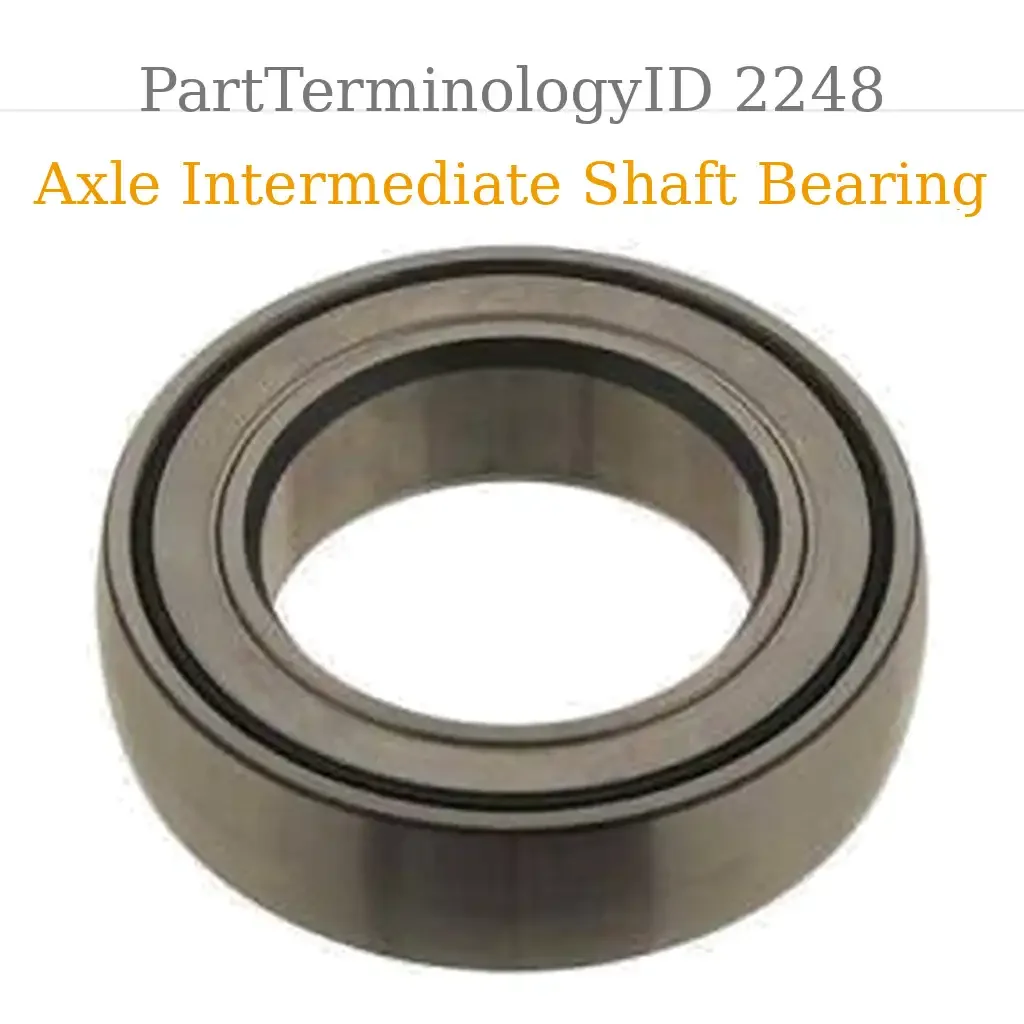
PartTerminologyID 2248, Axle Intermediate Shaft Bearing, is a bearing that supports an intermediate shaft within an axle assembly at a point between the differential and the wheel end. That definition places the bearing correctly in the drivetrain. It does not specify the axle designation, the bearing type, the inner diameter, the outer diameter, the bearing width, whether the bearing is a ball bearing, a cylindrical roller bearing, a tapered roller bearing, or a needle roller bearing, whether the bearing mounts in a carrier bracket bolted to the chassis, in the axle housing itself, or in a separate bearing hanger assembly, what the shaft journal surface specification is, or which axle and vehicle the bearing fits. A listing under PartTerminologyID 2248 that covers only the vehicle year, make, and model without specifying the axle designation, the bearing type, and all three primary dimensions cannot be evaluated by any buyer working from a measured original bearing or by any buyer sourcing the part before the axle is disassembled.
For sellers, the axle intermediate shaft bearing is a component that appears primarily on front-wheel-drive and all-wheel-drive vehicles where a longer-than-standard halfshaft is required to span the distance between the differential and the wheel hub on one side of the vehicle. On many transverse front-wheel-drive platforms, the halfshaft on the driver's side is shorter than the halfshaft on the passenger side because the differential is offset toward the driver's side. To equalize the halfshaft lengths and eliminate torque steer caused by unequal shaft lengths, an intermediate shaft is used on the longer side. The intermediate shaft runs from the differential output to a bearing bracket on the engine block or on the transaxle case, and then a shorter stub shaft continues from the bearing to the wheel hub. The bearing at the bracket is the axle intermediate shaft bearing under PartTerminologyID 2248.
For sellers, this part has two distinct failure modes with two different return patterns. A bearing that fails from wear produces noise and vibration before it fails completely, giving the buyer time to source a replacement. A bearing that fails from bracket corrosion or from seal failure that allows water into the bearing produces a seized shaft that requires significant disassembly before the bearing can be assessed and sourced. Both failure modes converge on the same requirement: the listing must specify the bearing type and dimensions accurately enough that the buyer can verify the replacement before committing to the disassembly the repair requires.
For sellers, the listing under this PartTerminologyID is only useful if it specifies the axle designation or transaxle model, the bearing type, the mounting configuration, all three primary dimensions, and whether the bearing is sold as a standalone unit or as part of a bracket-and-bearing assembly. Without those five attributes, the listing cannot be acted on without a separate research step that a complete listing would have made unnecessary.
What the Axle Intermediate Shaft Bearing Does
Supporting the intermediate shaft under combined bending and rotational loads
The intermediate shaft rotates at wheel speed and transmits torque from the differential to the outboard CV joint or stub shaft. The intermediate shaft bearing supports the shaft at the midpoint of its span, which prevents the shaft from deflecting under the combined weight of the shaft itself and the reaction loads from the CV joint angles at each end.
Without the intermediate shaft bearing, the shaft would be cantilevered from the differential output, with its only support at the differential end. The unsupported span would allow the shaft to deflect under its own weight and under the dynamic loads from driving, which would change the CV joint operating angles from the designed values and accelerate wear at both CV joints. The bearing bracket converts the cantilevered shaft into a simply supported beam, which dramatically reduces the deflection at the midpoint and maintains the CV joint angles within their designed operating range.
The bearing carries primarily a radial load from the shaft weight and the dynamic loading. On some designs, particularly those where the bracket is rigidly fixed to the engine block and the shaft passes through the bearing at a slight angle, there is also a continuous axial preload component that the bearing must accommodate.
The bracket-mounted bearing versus the press-fit housing bearing
Two mounting configurations are used for the axle intermediate shaft bearing. The first is a bracket-mounted design where the bearing is pressed into a bracket that bolts to the engine block, the transaxle case, or the subframe. The bracket is a separate casting or stamping. The bearing outer race presses into the bracket bore. The bracket bolt holes allow the bracket to be positioned for correct shaft alignment.
The second is a housing-integral design where the bearing seats in a bore machined directly into the transaxle case or the engine block, without a separate bracket. On those designs, the bearing is a press-fit into the case bore and is replaced by pressing the old bearing out and pressing the new one in. No separate bracket is involved.
The listing must specify the mounting configuration because a bracket-mounted bearing and a housing-integral bearing of the same inner diameter are not interchangeable. The bracket-mounted bearing has an outer diameter sized for the bracket bore. The housing-integral bearing has an outer diameter sized for the case bore. Those two diameters may be different even when the shaft diameter and the inner diameter are the same.
The sealed bearing versus the bearing with a separate shaft seal
On some intermediate shaft bearing designs, the bearing itself is a sealed unit: the outer race includes integral seals or shields that retain grease and exclude contamination. No separate shaft seal is required. The bearing is a self-contained unit that can be pressed out and replaced without addressing a separate seal.
On other designs, the bearing is an open or shielded bearing that requires a separate lip seal to prevent water and dirt from reaching the bearing bore. The lip seal is installed in the bracket or the housing bore adjacent to the bearing. When the bearing is replaced, the lip seal must also be replaced because it is typically destroyed during the bearing removal process.
The listing must specify whether the bearing is sealed or open, and whether a separate shaft seal is required and whether it is included in the listing.
Torque steer and the consequence of a worn intermediate shaft bearing
On front-wheel-drive vehicles with unequal-length halfshafts, worn or failed intermediate shaft bearing allows the longer shaft to deflect. The deflection changes the effective operating angle of the CV joint at the differential end. Under hard acceleration, unequal CV joint angles on the left and right halfshafts produce different torque reaction forces at the steering rack, causing the vehicle to pull to one side under power. This is torque steer, and it is the functional symptom that most often prompts the intermediate shaft bearing replacement.
A buyer who is diagnosing torque steer on a front-wheel-drive vehicle may not immediately identify the intermediate shaft bearing as the cause. The bearing failure must be distinguished from a worn CV joint, a damaged halfshaft, and a worn engine mount, all of which can produce similar symptoms. A listing that describes the torque steer symptom as an indicator of intermediate shaft bearing wear serves the diagnostic buyer who has not yet identified the specific failed component.
The Specifications That Determine Correct Fitment
Axle designation or transaxle model
The axle intermediate shaft bearing is specific to the transaxle or rear axle design. On front-wheel-drive vehicles, the transaxle model, not just the vehicle model, determines the intermediate shaft dimensions because the same vehicle may have been offered with multiple transmission options that use different intermediate shaft configurations. On all-wheel-drive vehicles with a rear intermediate shaft, the rear axle designation is the primary fitment attribute.
Bearing type
Deep-groove ball bearings are the most common type for intermediate shaft applications because the load is predominantly radial with only a small axial component, and the ball bearing's low friction at moderate speeds suits the continuous rotation at wheel speed. Single-row ball bearings are the standard. Double-row ball bearings are used on applications where higher radial load capacity is required at the same shaft diameter.
Angular contact ball bearings are used on some designs where the shaft mounting angle produces a consistent axial preload component. The contact angle of the angular contact bearing must match the designed preload direction.
Cylindrical roller bearings are used on some high-load intermediate shaft applications, particularly on AWD vehicles with larger shaft diameters where the radial load from the heavier shaft requires greater radial load capacity than a ball bearing of the same bore diameter can provide.
Inner diameter, outer diameter, and width
All three dimensions must be specified. The inner diameter must match the shaft journal. The outer diameter must match the bracket bore or the housing bore. The width must fit within the available axial space in the bracket or housing. An intermediate shaft bearing that is wider than the available space will prevent the bracket from closing or will prevent the shaft snap ring from seating in its groove.
Snap ring groove or flange retention
The bearing must be retained axially within the bracket or housing bore. The retention method affects the bearing selection. Some bearings have a snap ring groove on the outer race that accepts a snap ring seated in a corresponding groove in the housing bore. Others are retained by a press fit only, relying on the interference fit to prevent axial migration. Still others are flanged: the outer race has a flange that seats against a shoulder in the housing bore.
The retention method must match the bracket or housing design. A bearing without a snap ring groove installed in a housing designed for snap ring retention will not be retained axially. A flanged bearing installed in a housing without a flange shoulder will not seat to the full depth of the bore.
Why This Part Generates Returns
Buyers order the wrong axle intermediate shaft bearing because:
the transaxle model is not specified and the buyer's vehicle uses a different intermediate shaft diameter than the listed bearing's inner diameter
the mounting configuration is not specified and the buyer receives a bracket-mounted bearing for a housing-integral application, or vice versa
the bearing width is not stated and the replacement is too wide for the bracket bore, preventing the bracket from closing
the bearing is open and requires a separate shaft seal that is not included and not disclosed, leaving the new bearing immediately exposed to contamination
the outer diameter does not match the bracket bore because the listing is for a different production year when the bracket design changed
the retention method is not specified and the buyer installs a press-fit bearing in a snap-ring-retained housing without the snap ring groove, allowing axial shaft migration
Status in New Databases
PIES/PCdb: PartTerminologyID 2248, Axle Intermediate Shaft Bearing
PIES 8.0 / PCdb 2.0: No change
Top Return Scenarios
Scenario 1: "Inner diameter does not match shaft journal, bearing will not fit"
The transaxle model is not specified. The listing is applied to the vehicle model only. The buyer's vehicle has a 25mm intermediate shaft journal. The bearing listed has a 22mm inner diameter, which fits a different transaxle option on the same vehicle platform.
Prevention language: "Inner diameter: [X]mm. Transaxle model: [specific transaxle designation]. Verify your intermediate shaft journal diameter and your transaxle model before ordering. The same vehicle platform was available with multiple transaxle options. The intermediate shaft journal diameter varies between transaxle models."
Scenario 2: "Bearing too wide, bracket will not close"
The replacement bearing is 4mm wider than the original. The bracket housing bore depth equals the original bearing width. The wider bearing protrudes from the bore and prevents the bracket halves from closing. The bracket bolts cannot be torqued to specification.
Prevention language: "Bearing width: [X]mm. Verify the bearing width does not exceed your bracket housing bore depth. A bearing wider than the available bore space will prevent the bracket from closing and the shaft snap ring from seating."
Scenario 3: "Open bearing, no shaft seal included, bearing contaminated within weeks"
The replacement bearing is an open design requiring a separate shaft seal. The listing did not disclose that the bearing was open or that a shaft seal was required. The buyer installed the bearing without a shaft seal. Road spray contaminated the bearing bore within the first few thousand miles and the bearing failed.
Prevention language: "Bearing type: [sealed / open requires separate shaft seal]. Shaft seal: [included / not included]. If this bearing requires a separate shaft seal, order the seal before installing the bearing. An open bearing without a shaft seal will be contaminated by road spray and will fail rapidly."
Scenario 4: "Mounting configuration wrong, bracket-mount bearing in housing-integral application"
The buyer's intermediate shaft bearing seats directly in a bore in the transaxle case. The replacement bearing has an outer race sized for a separate bracket bore, which has a smaller outer diameter than the case bore. The bearing cannot be retained in the case bore with the required press fit.
Prevention language: "Mounting configuration: [bracket-mounted / housing-integral]. Verify your intermediate shaft bearing mounts in a separate bracket or directly in the transaxle case before ordering. Bracket-mounted and housing-integral bearings have different outer diameters for the same shaft size and are not interchangeable."
Scenario 5: "No snap ring groove on bearing, shaft migrates axially after installation"
The housing bore uses a snap ring to retain the bearing axially. The replacement bearing does not have a snap ring groove on the outer race. The bearing is installed press-fit only. Under normal driving loads, the shaft migrates axially within the bearing, changing the CV joint operating angles and producing a clunking noise during direction changes.
Prevention language: "Outer race retention: [snap ring groove / press fit only / flanged]. Verify the bearing's outer race retention method matches your housing design. A housing designed for snap ring retention requires a bearing with a corresponding snap ring groove on the outer race. A press-fit-only bearing in a snap-ring-retained housing will allow axial shaft migration under load."
What to Include in the Listing
Core essentials
PartTerminologyID: 2248
component: Axle Intermediate Shaft Bearing
vehicle platform and transaxle or axle designation (mandatory)
mounting configuration: bracket-mounted or housing-integral (mandatory)
bearing type: deep-groove ball, double-row ball, angular contact ball, or cylindrical roller (mandatory)
sealed or open: with or without integral seals or shields (mandatory)
shaft seal required: yes or no; shaft seal included: yes or no (mandatory for open bearings)
inner diameter in mm (mandatory)
outer diameter in mm (mandatory)
bearing width in mm (mandatory)
outer race retention method: snap ring groove, press fit only, or flanged (mandatory)
ISO bearing designation (recommended)
snap ring included: yes or no for snap-ring-retained designs
quantity: 1
Fitment essentials
year/make/model/submodel
transaxle model or rear axle designation (primary fitment attribute on multi-transmission platforms)
engine displacement when the intermediate shaft configuration varies by engine within the same model
production date range when the bearing specification changed during the model run
drivetrain: front-wheel drive, all-wheel drive, or four-wheel drive
Dimensional essentials
inner diameter in mm
outer diameter in mm
bearing width in mm
snap ring groove position and width on outer race if applicable
flange outer diameter and thickness for flanged bearings
shaft journal surface finish specification for open bearing applications
Image essentials
bearing in isolation showing outer race, seals or shields, and any snap ring groove
end view showing inner diameter with callout
side profile with width and outer diameter callouts
snap ring groove detail on outer race if present
bracket assembly showing the bearing installed with the shaft in place
for sealed bearings, seal lip detail showing the contact surface
Catalog Checklist for ACES/PIES Teams
PartTerminologyID = 2248
require transaxle model or axle designation (mandatory, primary fitment attribute on multi-transmission platforms)
require mounting configuration: bracket-mounted or housing-integral (mandatory)
require bearing type (mandatory)
require sealed or open designation (mandatory)
require shaft seal inclusion status for open bearing applications (mandatory)
require inner diameter, outer diameter, and width (mandatory)
require outer race retention method (mandatory)
require ISO bearing designation or cross-reference
differentiate from axle differential bearing (PartTerminologyID 2240): the differential bearing supports the pinion shaft or carrier inside the differential housing; the intermediate shaft bearing supports the shaft between the differential and the wheel end in an external bracket or housing bore
differentiate from wheel bearing (PartTerminologyID varies): the wheel bearing supports the hub at the wheel end; the intermediate shaft bearing supports the shaft at a midpoint bracket; both are in the halfshaft assembly path but at different locations with different mounting configurations and different load profiles
differentiate from CV joint bearing (PartTerminologyID varies): the CV joint bearing elements are inside the joint itself; the intermediate shaft bearing is a discrete bearing at the midpoint bracket, not part of the joint
flag transaxle model as primary fitment attribute on platforms with multiple transmission options: vehicle year/make/model alone produces mismatches on these platforms at a high rate
flag mounting configuration as mandatory: bracket-mounted and housing-integral bearings have different outer diameters for the same shaft diameter and are not interchangeable
flag open bearing shaft seal requirement: an open bearing installed without a shaft seal will fail rapidly from road contamination; the seal inclusion status must be disclosed
FAQ (Buyer Language)
How do I know if my vehicle has an intermediate shaft bearing?
On front-wheel-drive vehicles with a transversely mounted engine, look at the halfshafts from underneath the vehicle. If one halfshaft is significantly longer than the other, look for a bearing bracket mounted to the engine block or transaxle case near the middle of the longer shaft. If you see a bracket with the shaft passing through it, your vehicle has an intermediate shaft bearing. Vehicles with equal-length halfshafts achieved through a longer differential housing extension do not use an intermediate shaft bearing.
My vehicle pulls to one side under hard acceleration. Could the intermediate shaft bearing be the cause?
Torque steer on acceleration is one symptom of a worn intermediate shaft bearing. A worn bearing allows the shaft to deflect, changing the CV joint operating angle and producing unequal torque reaction forces at the steering. However, the same symptom can be caused by a worn CV joint on the longer halfshaft, unequal tire pressures, a worn engine mount that allows the drivetrain to shift under torque, or a worn suspension bushing. Confirm the intermediate shaft bearing diagnosis by inspecting the bearing bracket for looseness, listening for bearing noise with the vehicle on a lift while rotating the shaft by hand, and checking for shaft wobble at the bearing bracket location.
How do I remove the intermediate shaft bearing without damaging the bracket?
Support the bracket securely in a press or a vise. Use a bearing driver of the correct outer diameter to press the bearing out from the shaft side of the bracket bore. Do not use a hammer and punch, which will damage the bracket bore and distort the bearing. If the bearing is seized in the bore from corrosion, apply penetrating fluid to the bearing-to-bore interface and allow it to soak before pressing. On housing-integral applications, support the case on a press bed or use a slide hammer adapter designed for bearing removal in confined housings.
Do I need to replace the shaft seal when I replace the bearing?
If the bearing is an open design with a separate shaft seal, yes. The shaft seal is typically adjacent to the bearing in the bracket bore and is disturbed during bearing removal. Even if the seal appears undamaged, it should be replaced because its sealing lip may have taken a set against the shaft and may not seal correctly when reseated after the bearing replacement. If the bearing is a sealed unit with integral seals, no separate shaft seal is required.
The bracket on my vehicle is corroded. Can I reuse it with a new bearing?
Inspect the bracket bore surface carefully. A bracket bore with uniform, light surface rust that can be cleaned to a smooth surface is reusable. A bracket bore with pitting, scoring from a spinning bearing, or out-of-round distortion from a bearing that was pressed in crooked will not retain a new bearing with the correct interference fit. A pitted or scored bore must be honed to the next oversize if an oversize bearing is available, or the bracket must be replaced. Pressing a new bearing into a scored bore will produce insufficient retention and the bearing may spin in the bore under load.
Cross-Sell Logic
Intermediate Shaft Seal (if the bearing is an open design, the shaft seal is replaced at the same time as the bearing; it is the most predictable concurrent purchase for open intermediate shaft bearing listings)
Halfshaft Assembly (PartTerminologyID varies: if the intermediate shaft is bent, cracked, or worn at the bearing journal, the shaft must be replaced; the bearing alone cannot compensate for a worn shaft surface)
CV Joint or Boot Kit (PartTerminologyID varies: the CV joints at each end of the intermediate shaft experience the same service conditions as the bearing; inspect both CV joints when the intermediate shaft bearing is replaced and replace any joint with damaged boots or worn internal components)
Bearing Bracket (if the bracket bore is damaged from a spinning bearing or from corrosion, the bracket must be replaced with the bearing; some aftermarket suppliers offer the bracket and bearing as a pre-assembled unit)
Snap Ring (if the bearing is snap-ring retained and the snap ring was damaged during removal, a new snap ring must be installed with the replacement bearing)
Frame as "the bearing supports the shaft. The seal protects the bearing from contamination. The shaft transmits torque past the bearing to the wheel end CV joint. The bracket holds the bearing in position relative to the engine and the chassis. All are inspected and relevant ones replaced at the same service event."
Final Take for PartTerminologyID 2248
Axle Intermediate Shaft Bearing (PartTerminologyID 2248) is a bearing whose primary fitment challenge is the combination of a platform-specific mounting configuration and a transaxle-specific shaft diameter that cannot both be resolved by vehicle year, make, and model alone. The mounting configuration, bracket-mounted or housing-integral, determines the outer diameter. The transaxle model determines the inner diameter. Both must be specified in the listing for the buyer to verify fitment before ordering.
The sealed-versus-open designation and the shaft seal inclusion status are the most consequential safety attributes in the listing: an open bearing installed without a shaft seal will be contaminated by road spray within the first few thousand miles and will fail, sending the buyer back through the same disassembly and replacement process that the listing created. The retention method, snap ring groove or press fit or flanged, is the axial migration prevention attribute: a bearing installed without the correct retention method allows the shaft to migrate and changes the CV joint geometry that the bearing exists to maintain.
State the transaxle model. State the mounting configuration. State the bearing type. State the sealed or open designation. State all three dimensions. State the retention method. Disclose the shaft seal requirement and inclusion status. That is the same listing strategy as every other PartTerminologyID in this series: the generic PartTerminologyID requires specific attributes at every level to become a listing buyers can act on without guessing. For PartTerminologyID 2248, guessing on the mounting configuration sends the wrong outer diameter to a housing that cannot accept it, and guessing on the sealed designation sends an unprotected bearing into a road-spray environment.