
Written by Arthur Simitian | PartsAdvisory
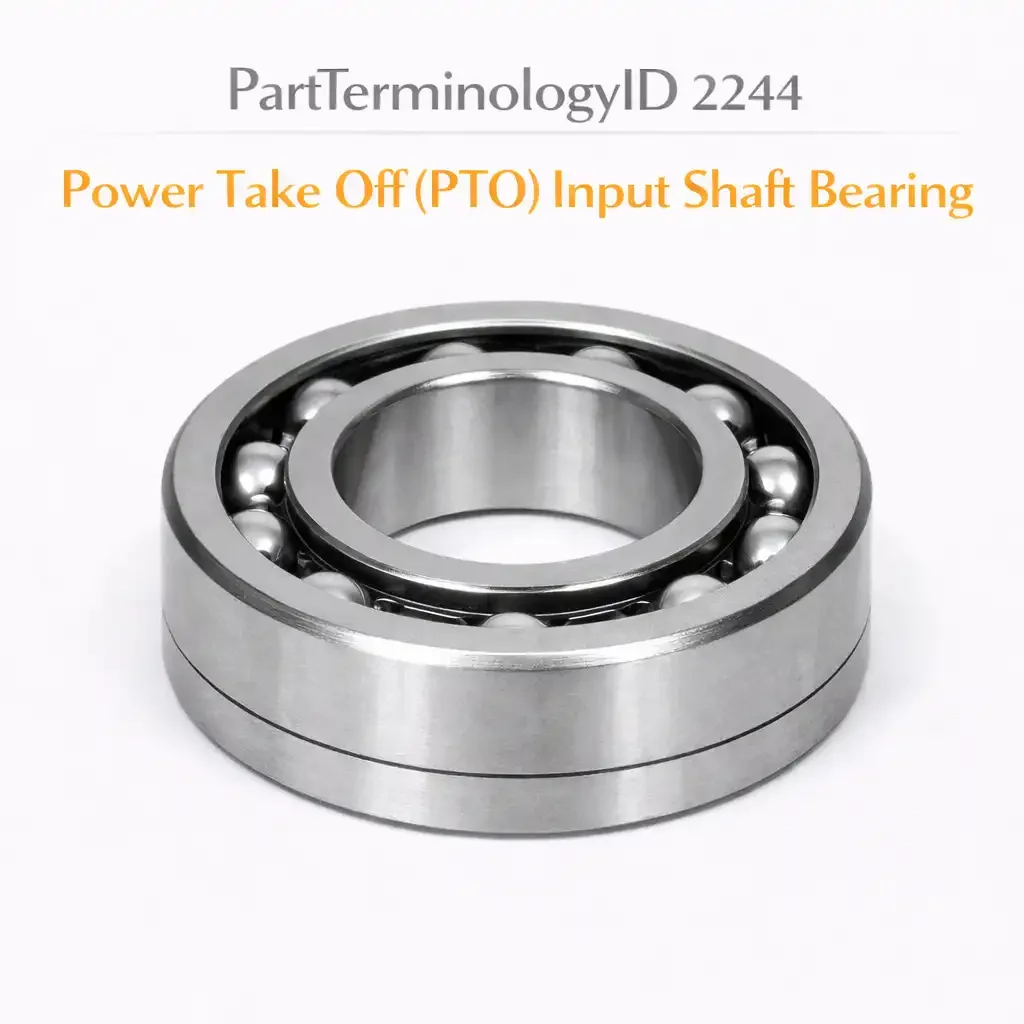
PartTerminologyID 2244, Power Take Off (PTO) Input Shaft Bearing, is a bearing that supports the input shaft of a power take off unit at the point where torque enters the PTO from the transmission. That definition identifies the location within the drivetrain. It does not specify the PTO unit manufacturer, the PTO model designation, the compatible transmission, the bearing type, the inner diameter, the outer diameter, the bearing width, whether the bearing is a tapered roller, a deep-groove ball bearing, or a needle roller, whether the bearing is a single-row or double-row design, how the bearing is retained within the PTO housing, or what the shaft surface specification is at the bearing contact zone. A listing under PartTerminologyID 2244 that does not include the PTO unit designation, the bearing type, and all three primary dimensions is a listing that cannot be evaluated by the rebuilder who has the PTO on the bench or by the fleet maintenance buyer who is sourcing the part before the unit comes out of service.
For sellers, the PTO input shaft bearing occupies a narrow but consequential position in the commercial drivetrain parts market. The input shaft bearing is the first bearing the drivetrain torque encounters as it enters the PTO from the transmission. It carries the radial load from the input gear mesh and, on some designs, a significant axial load from the helical gear tooth geometry. When this bearing fails, the PTO cannot transfer power without noise, vibration, or accelerating housing damage. The repair requires removing the PTO unit from the transmission, which on a vocational truck in service is a significant labor event. A wrong bearing discovered after the PTO is on the bench extends that downtime by the time required to source and receive the correct part.
For sellers, the listing under this PartTerminologyID is only useful if it specifies the PTO unit manufacturer and model, the compatible transmission, the bearing type, and all three primary dimensions. Without those five attributes, the listing cannot prevent the mid-teardown sourcing delay that wrong-fitment bearings produce on commercial equipment.
What the PTO Input Shaft Bearing Does
Carrying the radial and axial loads at the torque entry point
The PTO input shaft is the shaft that receives torque from the transmission output gear or from the transmission PTO opening. The input shaft carries the input drive gear, which meshes directly with the transmission's output or idler gear. The gear mesh force at this interface is the highest load in the PTO unit because it represents the full torque being transferred into the PTO before any gear reduction within the unit.
The input shaft bearing must support this load continuously during PTO operation and intermittently during PTO engagement cycling. On vocational equipment, a single-reduction dump truck PTO may cycle on and off hundreds of times per day. Each engagement cycle imposes a dynamic load on the input shaft bearing as the gear mesh torque builds from zero to operating level. The bearing must handle both the steady-state operating load and the repeated engagement transient loads without fatigue failure.
The radial load component at the input shaft bearing comes from the gear mesh force acting perpendicular to the shaft. The axial load component comes from the helical tooth geometry of the input gear, which converts some of the transmitted torque into an axial thrust force along the shaft. The bearing type must be selected to handle both components at the operating speed and load of the PTO application.
The input shaft bearing versus the countershaft bearing and the output shaft bearing
The PTO input shaft bearing, the countershaft bearing (PartTerminologyID 2236), and the output shaft bearing are at three different shaft positions within the PTO unit. Each carries a different load magnitude and a different load direction ratio between radial and axial components. The input shaft bearing carries the highest total load. The countershaft bearing carries a reduced load after any gear reduction in the input stage. The output shaft bearing carries the load delivered to the driven equipment and is sized for the output torque and the coupling geometry of the driven equipment.
All three bearing positions use different dimensions even within the same PTO unit. A listing that does not specify the shaft position cannot be evaluated for a specific bearing replacement need. A buyer ordering a PTO input shaft bearing and receiving a countershaft bearing or an output shaft bearing has the wrong dimensions at every measurement point.
The engagement mechanism and its effect on input bearing load
PTO units use different engagement mechanisms depending on the application: sliding gear engagement, clutch pack engagement, and synchronizer engagement are the common types. Each mechanism produces a different dynamic load profile on the input shaft bearing during the engagement transient.
Sliding gear engagement produces a high impact load as the input gear teeth engage the transmission gear teeth. This impact load is an axial spike that the input shaft bearing must absorb without the rollers or balls skidding on the races. Tapered roller bearings handle this axial spike better than deep-groove ball bearings at the input position because the tapered roller geometry distributes the axial load across the roller length rather than concentrating it at a ball-to-race contact point.
Clutch pack engagement produces a more gradual torque buildup that does not impose the same axial spike as sliding gear engagement. On clutch-pack PTOs, a deep-groove ball bearing at the input shaft position is adequate for the load profile because the engagement transient is controlled by clutch slip rather than by a gear teeth impact.
The listing must identify the PTO engagement type so the buyer can verify the bearing type is appropriate for the engagement mechanism their unit uses.
The PTO Input Shaft Bearing Configurations
Tapered roller bearing: the standard for high-load input shaft positions
Tapered roller bearings are the most common bearing type at the PTO input shaft position on high-torque commercial applications. The tapered roller geometry handles the combined radial and axial load from the helical input gear mesh without a separate thrust element. The bearing is assembled with a preload set by a spacer or shim pack between the front and rear input shaft bearings on designs that use two bearings, or by a single adjustable nut on single-bearing designs.
Tapered roller bearings at the PTO input shaft are sold as cup-and-cone sets on most domestic PTO applications. The cup presses into the PTO housing bore. The cone rides on the input shaft journal. The listing must specify whether it covers the cone only, the cup only, or the complete cup-and-cone set.
Deep-groove ball bearing: used on lower-torque and clutch-pack PTO designs
Deep-groove ball bearings are used at the input shaft position on lower-torque PTO units and on units with clutch-pack engagement where the axial spike during engagement is absent. The sealed deep-groove ball bearing requires no preload adjustment and no external lubrication, which simplifies reassembly compared to a tapered roller setup.
The bearing series and internal clearance classification must be specified for the application. A standard C3 clearance bearing is appropriate for most PTO input shaft positions. A standard C0 or CN clearance bearing installed where a C3 is specified will run tight at operating temperature, reducing bearing life.
Double-row angular contact ball bearing: used on high-axial-load compact designs
Some compact PTO designs use a double-row angular contact ball bearing at the input shaft position to handle the combined radial and axial load in a single-bearing installation that occupies less axial space than a pair of single-row tapered roller bearings. The double-row design must be replaced with the same configuration: substituting two single-row bearings in a housing designed for one double-row bearing will not produce the same preload geometry and may not fit in the available axial space.
Needle roller bearing: used at intermediate positions on some multi-shaft designs
On PTO designs where the input shaft passes through an intermediate housing wall before reaching the main bearing position, a needle roller bearing at the intermediate wall supports the shaft radially without adding significant axial length to the shaft span. Needle roller bearings at this position require the shaft surface to be hardened and ground to serve as the inner raceway.
Why This Part Generates Returns
Buyers order the wrong PTO input shaft bearing because:
the PTO unit designation is not specified and the buyer's PTO uses different input shaft journal dimensions than the listed bearing
the bearing type is not specified and the buyer receives a ball bearing for a sliding-gear PTO that requires a tapered roller bearing at the input position
the cup-and-cone status is not stated and the buyer receives a cone when they needed the complete set, or vice versa
the transmission model is not specified and the same PTO unit was built with different input gear configurations when mated to different transmissions, which changes the input shaft bearing load rating requirement
the bearing position is not identified as input shaft, and the buyer receives a countershaft bearing or an output shaft bearing instead
the internal clearance classification is not stated for ball bearing applications and the buyer installs a standard clearance bearing in an application that specifies C3 clearance
Status in New Databases
PIES/PCdb: PartTerminologyID 2244, Power Take Off (PTO) Input Shaft Bearing
PIES 8.0 / PCdb 2.0: No change
Top Return Scenarios
Scenario 1: "Ball bearing received, PTO uses tapered roller at input shaft"
The listing specified a deep-groove ball bearing. The buyer's PTO unit uses a tapered roller bearing at the input shaft position because it is a sliding-gear engagement unit with high axial spike loads during engagement. The ball bearing outer race profile does not seat correctly in the tapered roller housing bore geometry.
Prevention language: "Bearing type: [tapered roller cup and cone / deep-groove ball / double-row angular contact]. PTO engagement type: [sliding gear / clutch pack / synchronizer]. Verify the bearing type matches your PTO unit's input shaft design. Sliding-gear PTOs require tapered roller bearings at the input shaft to handle axial spike loads during engagement. Substituting a ball bearing at this position will cause premature race indentation under engagement transient loads."
Scenario 2: "Cone received, needed cup and cone set, housing bore is already open"
The buyer removed the PTO from the transmission and pressed the input shaft out of the housing, destroying the original cup in the process. The listing did not specify whether the cup was included. The buyer received the cone only. The housing bore is open and the original cup is destroyed.
Prevention language: "Cup and cone status: [cone only / cup only / complete cup and cone set]. Verify this listing includes the cup (outer race) before pressing the original input shaft from the housing. Once the input shaft is pressed out, the original cup cannot be reused. If this listing covers the cone only and you need the cup, order it before beginning disassembly."
Scenario 3: "Wrong PTO designation, input shaft diameter does not match"
The buyer ordered by vehicle year, make, and model. The listing was for a Chelsea 489 series. The buyer's PTO is a Chelsea 442 series installed on the same truck chassis. The input shaft journal diameter on the 442 is different from the 489. The bearing inner diameter does not fit the input shaft.
Prevention language: "PTO unit: [Chelsea 442 / Chelsea 489 / Muncie SP20 / Parker Chelsea 844]. Verify your PTO unit designation from the nameplate on the housing before ordering. Vehicle year, make, and model do not identify the PTO unit. Multiple PTO models are available for the same chassis. The PTO designation is cast into the housing or shown on the nameplate tag."
Scenario 4: "Standard clearance ball bearing runs hot, C3 required"
The buyer installed a standard C0 clearance deep-groove ball bearing at the input shaft position. The PTO specification calls for C3 internal clearance to accommodate thermal expansion of the shaft at operating temperature. The standard clearance bearing runs tight when hot, generating additional heat that accelerates the tightening and leads to premature bearing failure within the first hundred hours of operation.
Prevention language: "Internal clearance classification: [C3 / standard C0/CN]. Verify the internal clearance matches your PTO specification. C3 clearance bearings have greater internal clearance than standard and are specified for applications where shaft thermal expansion would cause a standard clearance bearing to run tight at operating temperature. Installing a standard clearance bearing where C3 is specified will result in premature bearing failure from thermal overload."
Scenario 5: "Countershaft bearing received instead of input shaft bearing"
The listing covered PTO bearings for the unit by model designation but did not distinguish between the input shaft and the countershaft positions. The buyer received the countershaft bearing, which is a smaller diameter than the input shaft bearing on this unit. The bearing will not fit the input shaft journal.
Prevention language: "Shaft position: [input shaft]. This bearing fits the input shaft position only. The countershaft and output shaft bearings for this PTO unit are different dimensions. Verify the shaft position before ordering. The input shaft bearing is at the PTO mounting face where the unit connects to the transmission."
What to Include in the Listing
Core essentials
PartTerminologyID: 2244
component: PTO Input Shaft Bearing
PTO unit manufacturer: Chelsea, Muncie, Parker Chelsea, Bezares, or other (mandatory)
PTO unit model designation (mandatory)
compatible transmission model or family (mandatory)
PTO engagement type: sliding gear, clutch pack, or synchronizer (mandatory)
shaft position: input shaft (mandatory, to distinguish from countershaft and output shaft bearings)
bearing type: tapered roller, deep-groove ball, double-row angular contact, or needle roller (mandatory)
cup-and-cone status for tapered roller bearings: cone only, cup only, or complete set (mandatory)
inner diameter in mm and inches (mandatory)
outer diameter in mm and inches (mandatory)
bearing width in mm (mandatory)
internal clearance classification for ball bearings: C3 or standard (mandatory)
ISO or TIMKEN bearing designation (recommended)
retention method: snap ring, press fit, or housing cap
quantity: 1 bearing or 1 cup-and-cone set
Fitment essentials
PTO unit manufacturer and model designation (primary fitment attribute)
compatible transmission model (secondary fitment attribute)
vehicle year/make/model as tertiary reference
PTO gear ratio when the input shaft bearing specification varies by gear ratio within the same PTO model
production date range when the input shaft bearing specification changed during the PTO model's production run
Dimensional essentials
inner diameter in mm to two decimal places and inches to four decimal places
outer diameter in mm and inches
bearing width in mm
for tapered roller bearings: cone bore, cup outer diameter, cone width, cup width separately
for needle bearings: shaft surface hardness and finish requirements
for double-row angular contact: overall width and contact angle
Image essentials
bearing in isolation showing outer race and seal or shield configuration
end view showing inner diameter with callout
side profile with width callout
for tapered roller, cup and cone shown separately with individual dimensional callouts
installed context showing the bearing at the input shaft position within the PTO housing
PTO housing cut-away or exploded diagram showing the input shaft position relative to the countershaft and output shaft positions
Catalog Checklist for ACES/PIES Teams
PartTerminologyID = 2244
require PTO unit manufacturer and model designation (mandatory, primary fitment attribute)
require compatible transmission model (mandatory)
require PTO engagement type: sliding gear, clutch pack, or synchronizer (mandatory)
require shaft position: input shaft (mandatory, to distinguish from PartTerminologyID 2236 countershaft and output shaft)
require bearing type (mandatory)
require cup-and-cone status for tapered roller bearings (mandatory)
require inner diameter, outer diameter, and width
require internal clearance classification for ball bearing applications
require ISO or TIMKEN cross-reference
differentiate from PTO countershaft bearing (PartTerminologyID 2236): the countershaft bearing supports the intermediate shaft; the input shaft bearing supports the shaft at the torque entry point; both are in the same PTO unit but at different positions with different dimensions and different load profiles
differentiate from PTO output shaft bearing (PartTerminologyID varies): the output shaft bearing supports the shaft that exits the housing to the driven equipment; the input shaft bearing is at the opposite end of the torque path
differentiate from transmission PTO opening cover bearing (PartTerminologyID varies): some transmissions have a bearing at the PTO opening in the transmission housing that supports the transmission's PTO drive gear; that bearing is in the transmission, not in the PTO unit; PartTerminologyID 2244 covers the bearing within the PTO unit itself
flag PTO unit designation as primary fitment attribute: vehicle year/make/model cannot identify the PTO unit on vehicles where multiple PTO options were available
flag bearing type as mandatory for engagement-type compatibility: sliding-gear PTOs require tapered roller at the input shaft; substituting ball bearings produces engagement transient failures
flag cup-and-cone status: pressing the original shaft from the housing destroys the cup; the buyer must know whether the cup is included before beginning disassembly
FAQ (Buyer Language)
How do I find the PTO unit designation?
The PTO unit designation is on the nameplate attached to the PTO housing or cast into the housing itself. On Chelsea units, the model number is typically cast into the housing on the side facing away from the transmission mounting face. On Muncie units, a metal identification plate is riveted to the housing and shows the model number, the gear ratio, and the build date. If the nameplate is missing, the unit can be tentatively identified by the mounting face bolt pattern and the number of output shaft positions, but the exact model should be confirmed by cross-referencing those measurements to the manufacturer's product guide before ordering internal components.
What is the difference between the input shaft bearing and the transmission PTO opening bearing?
The transmission PTO opening bearing is inside the transmission housing at the point where the transmission's internal PTO drive gear is supported. That bearing is part of the transmission and is replaced during transmission rebuilds, not PTO rebuilds. The PTO input shaft bearing is inside the PTO unit itself, at the shaft that connects to the transmission's PTO drive gear through the mounting face opening. When the PTO unit is removed from the transmission, the input shaft bearing remains with the PTO unit. The transmission opening bearing remains with the transmission.
My PTO is noisy only when fully loaded. Is that the input shaft bearing?
Load-sensitive noise in a PTO unit is a strong indicator of a bearing problem rather than a gear problem, because worn gear teeth produce noise that is more consistent across load levels. A noise that appears or increases significantly under high-torque conditions at the PTO input is consistent with input shaft bearing wear, because the input bearing carries the highest load in the unit and will show load-sensitive noise as its radial clearance increases from wear. Compare the noise level at light load versus full load to isolate whether the noise tracks with load or with speed, then use that information when describing the symptom to confirm the bearing position before ordering.
Can I order just the cone if the cup in my housing looks serviceable?
Inspect the cup race surface carefully before deciding. The cup race must be smooth and free of pitting, spalling, and heat discoloration. If the cup passes that inspection and the differential has moderate mileage, ordering the cone only is acceptable. On high-mileage units or units where the bearing failed from overload, replace both the cup and the cone. A cup that looks acceptable may have subsurface fatigue damage that is not visible and will produce a short service interval on the new cone.
What causes PTO input shaft bearing failure on units that are relatively new?
Premature input shaft bearing failure on a PTO with low operating hours is most commonly caused by incorrect preload during the previous assembly, incorrect bearing type for the engagement mechanism, contaminated gear oil, or operation at torque levels beyond the PTO's rated capacity. Check the gear oil for contamination by metal particles, which indicates bearing or gear wear debris in the lubricant. Check whether the PTO is being operated within its rated torque capacity: PTOs that are overloaded beyond their nameplate rating will fail bearings at the input shaft position first because that is the highest-load position in the unit.
Cross-Sell Logic
PTO Countershaft Bearing (PartTerminologyID 2236: the countershaft bearing is typically replaced at the same service event as the input shaft bearing when the PTO is disassembled; sourcing both before teardown avoids a second disassembly)
PTO Input Shaft Seal (the input shaft seal prevents gear oil from leaking at the transmission mounting face; it is accessible when the PTO is removed and should be replaced at every input shaft service)
PTO Output Shaft Seal (the output shaft seal is replaced whenever the PTO is disassembled; its replacement requires minimal additional labor when the unit is already off the transmission)
PTO Gasket Set (the housing gaskets are replaced whenever the PTO is opened; have the gasket set on hand before beginning disassembly to avoid delaying reassembly)
Gear Oil (the PTO gear oil is replaced after every internal service; verify the correct viscosity specification for the PTO unit and the operating temperature range)
Bearing Preload Setting Tools (tapered roller bearing preload at the input shaft requires measuring rotational drag torque; the correct torque wrench and drag torque adapter must be available before assembly)
Frame as "the input shaft bearing carries the torque the transmission delivers to the PTO. The input shaft seal keeps the gear oil in and the transmission oil out at the mounting face. The gear oil lubricates the bearing the seal protects. The gasket seals the housing the gear oil fills. All are serviced at the same disassembly event."
Final Take for PartTerminologyID 2244
PTO Input Shaft Bearing (PartTerminologyID 2244) supports the shaft at the highest-load position in the PTO unit and is the first component the transmission's torque passes through on its way to the driven equipment. A wrong bearing at this position, whether in type, in dimensions, or in clearance classification, either fails during the first engagement transient or runs for a reduced service interval before the load profile the wrong bearing cannot handle produces the failure.
The PTO unit designation is the primary fitment attribute because vehicle year, make, and model cannot distinguish between PTO models on vehicles where multiple options were available for the same chassis. The engagement type is the bearing type selection attribute because sliding-gear PTOs require tapered roller bearings that ball bearings cannot substitute. The cup-and-cone status is the mid-teardown protection attribute because a pressed housing bore with no cup in the kit stops the rebuild until the cup arrives.
State the PTO unit designation. State the compatible transmission. State the engagement type. State the shaft position as input shaft. State the bearing type. State the cup-and-cone status. State all three dimensions. That is the same listing strategy as every other PartTerminologyID in this series: the generic PartTerminologyID requires specific attributes at every level to become a listing buyers can act on without guessing. For PartTerminologyID 2244, guessing on the bearing type sends the wrong bearing to the highest-load position in the unit, and guessing on the cup-and-cone status stops a commercial vehicle rebuild mid-teardown.