
Written by Arthur Simitian | PartsAdvisory
PartTerminologyID 2240, Axle Differential Bearing, is a bearing that supports a rotating shaft or a carrier assembly within an axle differential housing. That definition is correct and insufficient. It does not specify whether the bearing supports the pinion shaft or the carrier, whether the bearing is at the front of the pinion shaft, the rear of the pinion shaft, or at the carrier journal, what the bearing type is, what the inner diameter is, what the outer diameter is, what the width is, what the axle designation is, or whether the bearing is a cup-and-cone tapered roller assembly or a single-piece unit. A listing under PartTerminologyID 2240 that covers only the year, make, and model without specifying the axle designation, the bearing position, and all three primary dimensions is a listing that cannot be evaluated by any buyer who is mid-rebuild with the housing open and the original bearing in hand.
For sellers, the axle differential bearing generates a distinctive return pattern compared to most other bearings in the drivetrain category. The buyer population for PartTerminologyID 2240 is split between two groups with very different ordering behaviors. The first group is professional rebuilders who know their axle designation, know the bearing position, and know the ISO or TIMKEN cross-reference they need. Those buyers can evaluate a listing in seconds and will move to a different listing if the specifications are not present. The second group is do-it-yourself buyers who know their vehicle and know they have a noisy differential, but who are ordering before disassembly and may not know whether they need a pinion bearing, a carrier bearing, or both. That second group cannot evaluate a listing that does not connect the bearing position to the symptom that prompted the repair.
For sellers, the listing under this PartTerminologyID is only useful if it specifies the axle designation, the bearing position, the bearing type, and all three primary dimensions. Without those four attributes, the listing serves neither buyer group reliably.
What the Axle Differential Bearing Does
Supporting the pinion shaft under high combined loading
The pinion shaft runs through the differential housing and carries the pinion gear that meshes with the ring gear. The pinion shaft is supported by two bearings: a front bearing at the pinion flange end and a rear bearing behind the pinion gear, close to the ring gear mesh. The front pinion bearing carries the axial load from the helical gear mesh and from the pinion flange preload. The rear pinion bearing carries the higher radial load from the gear mesh reaction force, which acts perpendicular to the shaft.
Both pinion bearings are tapered roller bearings on most passenger vehicle and light truck differentials. The tapered roller design handles the combined radial and axial loading at the pinion position without a separate thrust element. The front and rear pinion bearings on the same axle are different sizes: the rear pinion bearing is larger in all three dimensions because it carries the higher radial load from the gear mesh.
Pinion bearing failure produces a characteristic whine or rumble that changes pitch with vehicle speed and disappears or changes character when the vehicle coasts. The noise increases under load and decreases during deceleration. Bearing noise that does not change with load or speed direction is more likely to be a wheel bearing than a pinion bearing.
Supporting the carrier at the differential housing journals
The differential carrier rotates within the differential housing on two carrier bearings, one at each end of the carrier body. The carrier bearings carry the reaction load from the ring gear mesh, which acts as a combined radial and axial load at the carrier journal. On most domestic passenger vehicle and light truck differentials, the carrier bearings are tapered roller bearings. On some European and Asian applications, the carrier bearings are angular contact ball bearings.
Carrier bearings are larger in outer diameter than pinion bearings on the same axle because the carrier journal diameter is larger than the pinion shaft diameter. The carrier bearing outer diameter must match the differential housing bearing bore. This bore is precision-machined and is not adjustable. An incorrect outer diameter will either not press into the bore or will press in with insufficient interference to retain the bearing under the operating loads.
Carrier bearing failure produces noise that does not change with vehicle speed in the same way that pinion bearing noise does. Carrier bearing noise often changes with lateral load: turning left loads the right carrier bearing and turning right loads the left carrier bearing. A noise that increases when turning in one direction and decreases in the other often indicates a failed carrier bearing rather than a failed pinion bearing.
The cup-and-cone assembly and replacement conventions
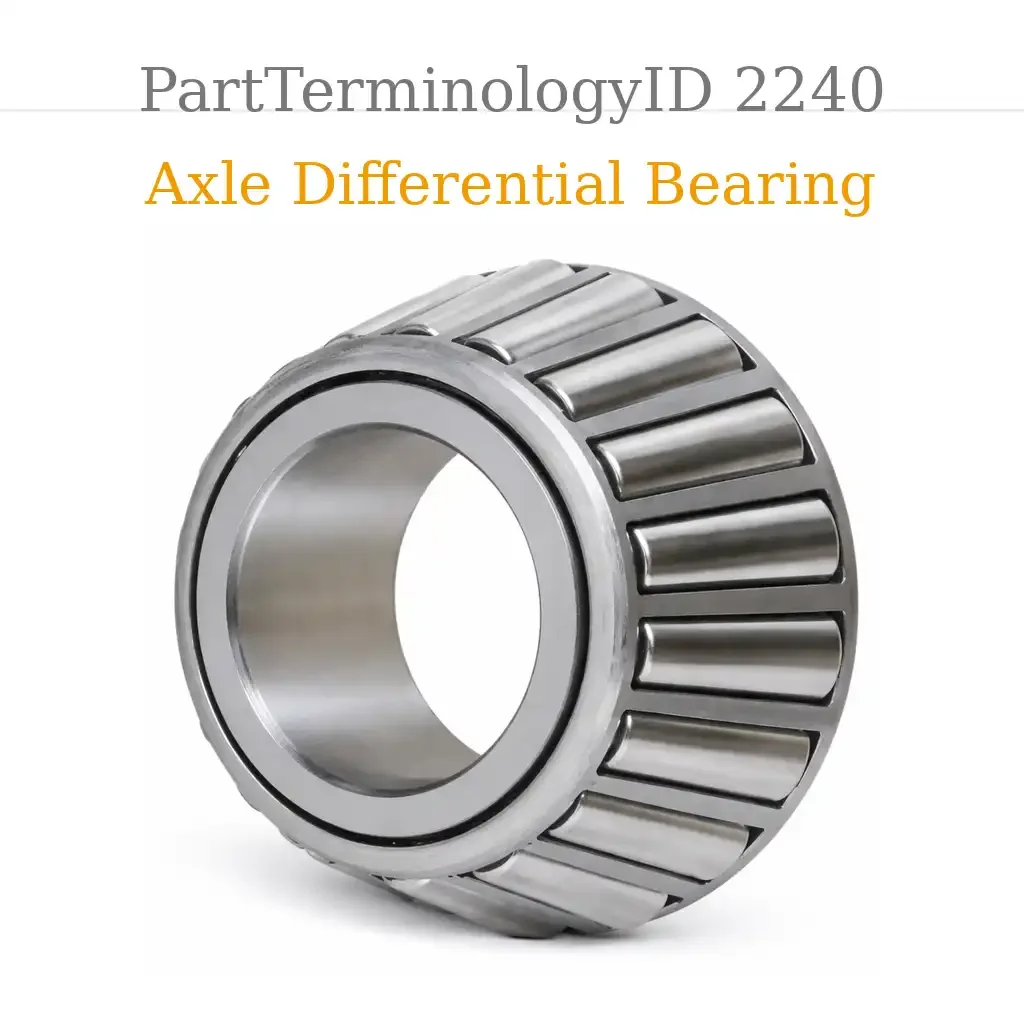
Tapered roller bearings used in differential applications are typically sold as cup-and-cone sets. The cone is the inner race with the tapered rollers and cage. The cup is the outer race that presses into the housing bore. On most domestic axle applications, the cup is pressed into the housing bore and remains there when the shaft or carrier is removed. The cone rides on the shaft or carrier journal and is removed with the shaft.
This has a practical consequence for replacement ordering. On some axle rebuilds, the cup is retained and only the cone is replaced because the cup is in good condition. On complete rebuilds, both the cup and cone are replaced. The listing must specify whether it covers the cone only, the cup only, or the complete cup-and-cone set. A buyer who needs the complete set and receives only the cone cannot complete the rebuild.
Bearing preload and its relationship to the replacement bearing
Differential pinion and carrier bearings are assembled with a specific preload that affects gear mesh geometry, noise, and bearing service life. Pinion bearing preload is set by a crush sleeve or a solid spacer between the front and rear pinion bearings. Carrier bearing preload and ring gear backlash are set by shims or adjusting rings at the carrier bearing positions.
When a replacement bearing is installed, the preload must be set to the factory specification even if the crush sleeve or spacer from the original assembly is reused. The original crush sleeve is a single-use component on most axles and must be replaced whenever the pinion nut is removed. A listing that includes the crush sleeve in the kit and a listing that does not include the crush sleeve produce different repair outcomes, and the buyer must know which situation applies to their order.
The Bearing Specifications That Determine Fitment
Axle designation
The axle designation is the primary fitment attribute and is more specific than the vehicle year, make, and model. The same vehicle platform was built with different axle options depending on the engine, the tow package, and the production date. A GM half-ton truck may have a GM 7.5-inch rear axle or a GM 8.5-inch rear axle depending on those variables. The front and rear pinion bearings are different sizes on those two axles. The carrier bearings are different sizes. A listing that does not state the axle designation and relies only on vehicle fitment will send a GM 7.5-inch bearing to a buyer with a GM 8.5-inch axle or vice versa.
Bearing position
Front pinion bearing, rear pinion bearing, and carrier bearing are the three positions in the differential. Each position uses a different bearing with different dimensions. The listing must specify the position. A buyer ordering a pinion bearing without knowing whether they need the front or the rear is ordering before disassembly. The listing should describe the noise profile that typically indicates each bearing position, as discussed in the what-the-part-does section, to help that buyer identify the failed position before ordering.
Bearing type
Tapered roller bearing, angular contact ball bearing, and cylindrical roller bearing are the primary types used in differential applications. Most domestic applications use tapered roller bearings at all positions. Some European and Asian applications use angular contact ball bearings at the carrier position and tapered roller bearings at the pinion position. The bearing type must be stated because a buyer attempting to order a ball bearing replacement for a tapered roller application will receive a part with a different outer race geometry that cannot be pressed into the housing bore correctly.
Inner diameter, outer diameter, and width
All three primary dimensions must be stated in both metric and imperial. The inner diameter must match the shaft journal or carrier journal at the bearing seat. The outer diameter must match the housing bore at the bearing position. The width must match the housing bore depth and the shaft shoulder spacing for the bearing to seat correctly and for the preload spacer to produce the correct preload.
Why This Part Generates Returns
Buyers order the wrong axle differential bearing because:
the axle designation is not specified and the buyer's axle uses different bearing dimensions than the listed part
the bearing position is not specified and the buyer receives a front pinion bearing when they need the rear, or a carrier bearing when they need a pinion bearing
the listing covers the cone only and the buyer needs the complete cup-and-cone set, or vice versa
the outer diameter does not match the housing bore because the axle designation or the production year introduced a different housing bore specification
the bearing type is a tapered roller bearing on an application that uses an angular contact ball bearing at the carrier position
the vehicle fitment in the listing matches the buyer's vehicle but corresponds to a different axle option than the one installed
Status in New Databases
PIES/PCdb: PartTerminologyID 2240, Axle Differential Bearing
PIES 8.0 / PCdb 2.0: No change
Top Return Scenarios
Scenario 1: "Wrong axle size, bearing outer diameter does not fit housing bore"
The buyer has a GM 8.5-inch rear axle. The listing covered the vehicle year, make, and model but was for the GM 7.5-inch axle. The carrier bearing outer diameter for the 7.5-inch is smaller than the 8.5-inch housing bore. The bearing will not press into the bore with the required interference fit.
Prevention language: "Axle designation: [GM 8.5-inch]. Ring gear diameter: [8.5 inches]. Verify your rear axle designation before ordering. GM half-ton and three-quarter-ton trucks were built with both the 7.5-inch and the 8.5-inch rear axle depending on the engine and tow package. Measure your ring gear diameter or check the axle tag to confirm your axle designation."
Scenario 2: "Received cone only, needed cup and cone set"
The listing stated pinion bearing without specifying whether the cup was included. The buyer pressed the original cup and cone out of the housing and found the kit contains only the cone. The housing bore is now empty and the original cup has been destroyed during removal. The buyer cannot proceed without a replacement cup.
Prevention language: "Kit contents: [cone only / cup only / cup and cone set]. Verify whether this listing includes the cup (outer race) before ordering. The pinion bearing cup is pressed into the differential housing bore. If you are replacing the cup, confirm it is included in this listing. A cone-only listing does not include the cup."
Scenario 3: "Front pinion bearing received, noise is from rear pinion bearing"
The buyer ordered a pinion bearing by vehicle and axle fitment. The listing did not distinguish between front and rear pinion bearings. The front pinion bearing dimensions are different from the rear. The buyer receives the front bearing, which is not the failed component.
Prevention language: "Bearing position: [front pinion / rear pinion / carrier]. The front and rear pinion bearings on this axle are different sizes. The rear pinion bearing is larger and carries the higher radial load from the gear mesh. Pinion noise that increases under acceleration and decreases during coasting is typically the rear pinion bearing. Noise that correlates with axial load from the propshaft is more often the front pinion bearing."
Scenario 4: "Crush sleeve not included, pinion preload cannot be set"
The buyer ordered the pinion bearing set. The listing did not state whether the crush sleeve was included. The original crush sleeve was collapsed during the original assembly and cannot be reused. The buyer cannot set pinion preload without a new crush sleeve and the differential cannot be assembled to specification.
Prevention language: "Crush sleeve: [included / not included]. The pinion crush sleeve is a single-use component that must be replaced whenever the pinion nut is removed. If the crush sleeve is not included in this listing, order it before beginning disassembly. Pinion preload cannot be correctly set without a new crush sleeve."
Scenario 5: "Carrier bearing outer diameter too small, spins in housing bore"
The replacement carrier bearing has an outer diameter 0.003 inches smaller than the housing bore. The press fit interference is insufficient. The bearing spins in the bore under operating load, generating metallic debris and allowing the carrier to shift position within the housing. Ring gear backlash increases beyond specification and gear noise develops.
Prevention language: "Carrier bearing outer diameter: [X.XXX] inches / [X.XX]mm. Verify your differential housing carrier bearing bore diameter before ordering. The carrier bearing must press into the bore with 0.001 to 0.002 inches of diametral interference. An undersized bearing will spin in the bore under load."
What to Include in the Listing
Core essentials
PartTerminologyID: 2240
component: Axle Differential Bearing
axle manufacturer: Dana, GM, Ford, Chrysler, Toyota, or other (mandatory)
axle designation: Dana 44, GM 8.5-inch, Ford 8.8-inch, etc. (mandatory)
ring gear diameter in inches (mandatory)
axle position: front axle or rear axle (mandatory on four-wheel-drive applications)
bearing position: front pinion, rear pinion, or carrier (mandatory)
bearing type: tapered roller, angular contact ball, or cylindrical roller (mandatory)
cup-and-cone status: cone only, cup only, or complete cup-and-cone set (mandatory for tapered roller bearings)
inner diameter in mm and inches (mandatory)
outer diameter in mm and inches (mandatory)
bearing width in mm (mandatory)
ISO or TIMKEN cross-reference designation (recommended)
crush sleeve included: yes or no (mandatory when crush sleeve is relevant to the repair scope)
quantity: 1 bearing or 1 cup-and-cone set
Fitment essentials
year/make/model/submodel as secondary fitment reference
axle designation as primary fitment attribute
ring gear diameter for axle size confirmation
gear ratio when the bearing specification varies by gear ratio within the same axle designation
production date range when housing bore specification changed during the axle's production run
Dimensional essentials
cone inner diameter (bore) in inches to four decimal places and mm
cup outer diameter in inches to four decimal places and mm
bearing width (cone width) in mm
cup width in mm when different from cone width
for carrier bearings: carrier journal diameter and housing bore diameter for interference fit verification
Image essentials
cup and cone shown separately with dimensional callouts
cone inner diameter callout
cup outer diameter callout
bearing width callout on cone
installed context showing the bearing at its position in the differential housing
comparison image showing front pinion bearing and rear pinion bearing side by side to illustrate the dimensional difference
Catalog Checklist for ACES/PIES Teams
PartTerminologyID = 2240
require axle designation (mandatory, primary fitment attribute)
require ring gear diameter (mandatory)
require axle position: front or rear on four-wheel-drive applications (mandatory)
require bearing position: front pinion, rear pinion, or carrier (mandatory)
require bearing type (mandatory)
require cup-and-cone status for tapered roller bearings (mandatory)
require inner diameter in mm and inches
require outer diameter in mm and inches
require bearing width in mm
require ISO or TIMKEN cross-reference
require crush sleeve inclusion status when listing covers pinion bearings
differentiate from axle shaft bearing (PartTerminologyID varies): the axle shaft bearing supports the axle shaft in the axle tube at the wheel end; the differential bearing supports the pinion shaft or the carrier within the differential housing; both are in the axle assembly but at different locations
differentiate from axle differential bearing and seal kit (PartTerminologyID 2224): the kit contains multiple bearings and seals for a complete rebuild; this PartTerminologyID covers a single bearing at a single position; both serve the same differential but at different purchase decision points
flag axle designation as primary fitment attribute: vehicle year/make/model produces axle fitment errors at a high rate on platforms where multiple axle options were used; the axle designation from the axle tag or ring gear measurement is the required verification
flag cup-and-cone status as mandatory for tapered roller bearings: a cone-only listing sent to a buyer who pressed the original cup from the housing produces an incomplete rebuild
flag bearing position as mandatory: front pinion and rear pinion bearings on the same axle are different sizes; a listing without the position attribute cannot be verified against the buyer's failed component
FAQ (Buyer Language)
How do I identify which differential bearing has failed?
The noise profile is the first diagnostic tool. Pinion bearing noise increases under driving load and decreases during coasting. It typically produces a whine or rumble that tracks with vehicle speed and does not change significantly during turning. Carrier bearing noise often changes during turning: turning in one direction loads one carrier bearing and turning in the other direction loads the other. A noise that increases when turning right and decreases when turning left, or the reverse, typically indicates the carrier bearing on the more heavily loaded side. Confirm the diagnosis by measuring pinion bearing preload drag torque after disassembly: a bearing with worn rollers or a damaged race will show reduced preload torque or rough rotation.
My axle tag is missing. How do I identify the axle designation?
Remove the differential cover and measure the ring gear diameter. A ring gear diameter of 7.5 inches is a GM 7.5-inch axle. A ring gear diameter of 8.5 inches is a GM 8.5-inch axle. For Ford axles, an 8.8-inch ring gear indicates a Ford 8.8-inch. For Dana axles, count the cover bolts: a Dana 44 has 10 cover bolts and a Dana 30 has 10 smaller cover bolts on a smaller cover. The ring gear tooth count also identifies the axle: a GM 7.5-inch has 41 ring gear teeth and a GM 8.5-inch has 43. Cross-reference the tooth count and diameter combination to the axle manufacturer's identification guide before ordering bearings.
Should I replace just the failed bearing or all differential bearings at the same time?
On a high-mileage differential where one bearing has failed, the other bearings have experienced the same number of load cycles and the same operating conditions. Replacing only the failed bearing and reassembling the differential means the remaining original bearings will be the first components to fail at the next service event, requiring another complete disassembly. Replacing all differential bearings at the same service event is the lower total cost strategy on any differential with more than 100,000 miles. The axle differential bearing and seal kit (PartTerminologyID 2224) covers all bearing positions in a single purchase and is the appropriate product for a complete rebuild.
What is the correct pinion bearing preload and how is it measured?
Pinion bearing preload is measured as rotational drag torque on the pinion shaft with the carrier removed and the ring gear not installed. The pinion nut is tightened progressively, collapsing the crush sleeve, until the measured drag torque falls within the specified range for the axle designation. Common specifications for domestic differentials are 10 to 30 inch-pounds of drag torque for new bearings and 5 to 15 inch-pounds for used bearings being reassembled without new bearings. The factory service manual for the axle designation specifies the exact range. Exceeding the maximum preload collapses the crush sleeve past the correct point and requires a new crush sleeve and a new assembly sequence.
Can I reuse the original bearing cups if the cones are the only components showing wear?
Inspect the cup races with a light and a magnifying glass. The cup race surface should be smooth and uniformly reflective with no pitting, no spalling, no brinelling marks from stationary loading, and no discoloration from heat. If the cup surface passes visual inspection, it can be reused with a new cone on a low-mileage differential where the total operating hours are well below the bearing's rated life. On high-mileage differentials, replace both cups and cones even if the cups pass visual inspection. The fatigue life of the cup race is not visible: a cup that looks serviceable may be approaching the end of its fatigue life and will fail shortly after the new cone is installed.
Cross-Sell Logic
Axle Differential Bearing and Seal Kit (PartTerminologyID 2224: for a complete differential rebuild, the full kit covering all bearing positions plus seals and the crush sleeve is the appropriate purchase rather than individual bearings; the individual bearing listing serves buyers replacing a single failed component without a full rebuild)
Pinion Seal (PartTerminologyID varies: the pinion seal is always replaced when the pinion is removed for bearing replacement; it is the most predictable concurrent purchase with any pinion bearing listing)
Crush Sleeve (the crush sleeve is replaced whenever the pinion nut is removed; if not included in the bearing listing, it must be sourced before beginning the repair)
Ring and Pinion Gear Set (PartTerminologyID varies: if the differential noise was caused by gear damage rather than bearing failure alone, the gear set requires replacement at the same service event; new bearings are always required with a new gear set)
Differential Cover Gasket (the differential cover must be removed to access the carrier and carrier bearings; the cover gasket is replaced on reinstallation)
Gear Oil and Limited Slip Friction Modifier (the differential oil is replaced after every internal service event; limited slip differentials require friction modifier additive)
Frame as "the bearing supports the pinion or the carrier. The seal contains the gear oil that lubricates the bearing. The crush sleeve sets the preload the bearing requires. The gear oil fills the housing the bearing operates in. The cover gasket seals the housing after reassembly."
Final Take for PartTerminologyID 2240
Axle Differential Bearing (PartTerminologyID 2240) is a precision component where the axle designation and the bearing position together specify a unique combination of dimensions that cannot be substituted by vehicle year, make, and model alone. The same vehicle was built with multiple axle options. The same axle has three bearing positions with three different dimensional specifications. A listing that does not resolve both of those variables cannot be acted on by either the professional rebuilder who needs the ISO cross-reference or the DIY buyer who needs the noise profile description to confirm which bearing position has failed.
State the axle designation. State the ring gear diameter. State the bearing position. State the bearing type. State the cup-and-cone status. State all three dimensions in both metric and imperial. State the crush sleeve inclusion status. That is the same listing strategy as every other PartTerminologyID in this series: the generic PartTerminologyID requires specific attributes at every level to become a listing buyers can act on without guessing. For PartTerminologyID 2240, guessing on the axle designation sends the wrong size to an open housing, and guessing on the cup-and-cone status sends a cone to a buyer whose housing bore is already empty.