
Written by Arthur Simitian | PartsAdvisory
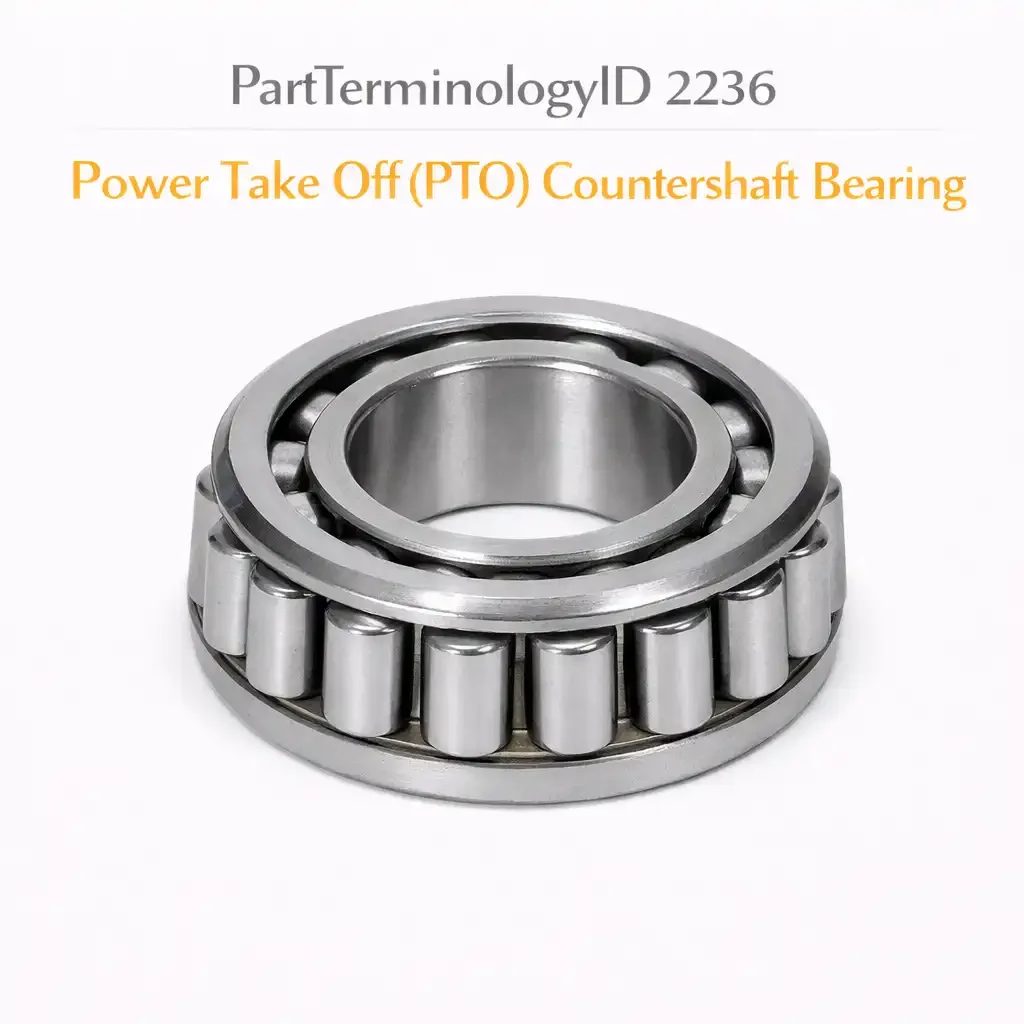
PartTerminologyID 2236, Power Take Off (PTO) Countershaft Bearing, is a bearing that supports the countershaft within a power take off unit. That definition locates the component. It does not specify the bearing type, the bearing inner diameter, the bearing outer diameter, the bearing width, whether the bearing is a ball bearing, a roller bearing, a tapered roller bearing, or a needle roller bearing, what the PTO unit designation is, whether the bearing is at the input end or the output end of the countershaft, whether the bearing is retained by a snap ring or pressed into a housing bore, what the load rating is, or which transmission or engine the PTO unit is attached to. A listing under PartTerminologyID 2236 that does not specify the bearing type, the three primary dimensions, and the PTO unit designation is asking the buyer to order a precision machine element by category name alone, which is not a basis on which any precision bearing can be evaluated for fitment.
For sellers, the PTO countershaft bearing sits at the intersection of two catalog challenges that compound each other. The first is that PTO units are found primarily on commercial, agricultural, and heavy-duty applications where the same vehicle platform may be equipped with several different PTO options depending on the original equipment specification. The same truck chassis may have been ordered with a Muncie SP20, a Chelsea 489, a Parker Chelsea 442, or no PTO at all, and the countershaft bearing specifications differ between those units even though they attach to the same transmission. The second challenge is that the word countershaft does not identify whether the bearing is on the input side of the countershaft, the output side, or an intermediate position where the shaft passes through a housing wall. Different positions on the same countershaft may use different bearing types and different dimensions. A listing that does not address both challenges cannot be evaluated by the buyer who knows their PTO unit designation but not the bearing position, or the buyer who knows the bearing position but not the PTO unit designation.
For sellers, the listing under this PartTerminologyID is only useful if it includes the PTO unit manufacturer and model, the bearing type, the three primary dimensions, the shaft position the bearing supports, and the retention method. Without those five attributes, the listing cannot be acted on by any buyer who is not already holding the original bearing in their hand and comparing it to the listing image.
What the PTO Countershaft Bearing Does
Supporting the countershaft under combined radial and axial load
The power take off countershaft transmits torque from the transmission output or the engine crankshaft to the PTO's driven output shaft. The countershaft runs through the PTO housing supported at each end, and in some designs at an intermediate point, by bearings. These bearings carry the radial load from the gear mesh forces and the axial load from helical gear thrust. The bearing type at each position is selected for the load profile at that position.
At the input end of the countershaft, where the drive gear meshes with the transmission output gear, the radial load is highest because the gear mesh force acts perpendicular to the shaft. A tapered roller bearing or a deep-groove ball bearing is common at this position, depending on the magnitude of the combined radial and axial load and the PTO's design speed range.
At the output end of the countershaft, where the output gear meshes with the driven equipment's input gear or where the output shaft exits the housing, the load profile depends on the driven equipment's coupling geometry. If the output connection produces significant axial thrust, a tapered roller bearing or an angular contact ball bearing is used. If the output is primarily radial loaded, a cylindrical roller bearing or a deep-groove ball bearing is appropriate.
At intermediate housing wall positions on longer countershafts, needle roller bearings are common because they provide high radial load capacity in a minimal radial space, which allows the housing wall thickness to be minimized.
The consequence of a wrong bearing type at the countershaft position
Installing the wrong bearing type at a countershaft position does not always produce an immediate failure. A ball bearing installed at a position that requires a tapered roller bearing will carry the radial load adequately but will carry the axial load at the ball-to-race contact point, which is not the geometry ball bearings are designed for. Under sustained axial load, the balls will indent the inner and outer races at the axial contact zone, which produces a characteristic vibration and noise before the bearing fails. The failure develops over months rather than hours, which means the wrong bearing type may not be identified as the cause when the noise first appears.
A needle roller bearing installed at a position that requires a ball bearing will carry the radial load but will not carry any axial load. On a countershaft with helical gears that generate thrust, the needle bearing will allow the shaft to migrate axially until the gear teeth disengage or until the shaft contacts a housing wall, producing gear damage or housing damage rather than bearing damage as the first observed failure.
The PTO countershaft versus the PTO output shaft
The countershaft is an intermediate shaft that steps the gear ratio between the transmission output and the PTO's driven output. It is distinct from the PTO output shaft, which exits the housing and connects to the driven equipment. A bearing for the countershaft is at a different diameter, a different position within the housing, and under a different load profile than a bearing for the output shaft. The listing must specify countershaft as the supported shaft, not just shaft or output shaft.
The PTO unit designation and its relationship to the transmission
PTO units are specified by the transmission they attach to and by the PTO model within that application. A Muncie SP20 attaches to a specific range of Fuller and Eaton transmissions through a side-mount opening and uses countershaft bearings sized for the SP20's gear geometry. A Chelsea 489 attaches to a different set of transmissions and uses different countershaft bearing dimensions. The bearing specifications do not transfer between PTO models even when two models are used on the same truck chassis, because the countershaft geometry is specific to the PTO unit.
The transmission model and the PTO unit designation together form the primary fitment specification for this PartTerminologyID. Vehicle year, make, and model alone are insufficient because the same vehicle may have been ordered with any of several PTO options.
The Bearing Specifications That Determine Correct Fitment
Bearing type
The four bearing types used on PTO countershafts and their typical applications:
Deep-groove ball bearing: handles combined radial and moderate axial loads, used at both ends of lower-load countershafts, available in open, shielded, and sealed configurations.
Tapered roller bearing: handles high combined radial and axial loads, used at the input end of high-load countershafts, requires preload setting during assembly.
Cylindrical roller bearing: handles high radial loads with minimal axial load capacity, used where the countershaft gear mesh load is predominantly radial and the shaft is constrained axially by a separate thrust element.
Needle roller bearing: handles very high radial loads in a minimal radial space, used at intermediate housing wall positions, requires a hardened and ground shaft surface as the inner raceway on caged needle designs.
Inner diameter
The inner diameter must match the countershaft journal diameter at the bearing position. PTO countershaft journal diameters vary by PTO unit and shaft position. The inner diameter must be specified in both millimeters and inches because PTO units from different manufacturers and production eras use both measurement systems.
Outer diameter
The outer diameter must match the housing bore at the bearing position. The housing bore diameter determines the press fit interference required to retain the bearing in the bore. An undersized outer diameter produces insufficient retention. An oversized outer diameter will crack the housing bore on installation.
Width
The bearing width determines the axial space occupied by the bearing within the housing. A replacement bearing that is wider than the original will prevent the countershaft from being seated to the correct axial position. A bearing that is narrower than the original will leave an axial gap that allows the shaft to move under gear thrust.
Radial clearance or preload classification
For tapered roller bearings, the preload specification must match the original. Tapered roller bearings are assembled with a specific preload set by the bearing spacer or by a shim pack. A replacement tapered roller bearing with a different preload classification will require a different spacer or shim pack to achieve the correct preload. The listing must specify the bearing's preload class or the bearing ISO designation from which the preload class can be determined.
Why This Part Generates Returns
Buyers order the wrong PTO countershaft bearing because:
the PTO unit designation is not specified and the buyer's PTO uses different countershaft dimensions than the listed bearing
the bearing type is not specified and the buyer receives a ball bearing for a position that requires a tapered roller bearing, or a needle bearing for a position that requires a ball bearing
the inner diameter is not specified and the bearing does not fit the countershaft journal
the bearing position is not specified and the buyer has a PTO with different bearing specifications at different countershaft positions
the bearing width is not stated and the replacement bearing is wider than the housing allows
the transmission model is not specified and the same PTO unit was built in different countershaft configurations when mated to different transmissions
Status in New Databases
PIES/PCdb: PartTerminologyID 2236, Power Take Off (PTO) Countershaft Bearing
PIES 8.0 / PCdb 2.0: No change
Top Return Scenarios
Scenario 1: "Wrong bearing type, axial failure at input end"
The replacement bearing is a deep-groove ball bearing. The countershaft input end position requires a tapered roller bearing because the helical input gear generates significant axial thrust. The ball bearing carries the radial load correctly but begins to indent under the sustained axial thrust within 200 operating hours. Noise and vibration develop before the bearing fails.
Prevention language: "Bearing type: [deep-groove ball / tapered roller / cylindrical roller / needle roller]. Bearing position: [input end / output end / intermediate]. Verify the bearing type matches the original at this countershaft position. Installing a ball bearing at a position designed for a tapered roller bearing will produce axial race indentation under sustained thrust load."
Scenario 2: "Inner diameter does not match the countershaft journal"
The countershaft journal diameter is 35mm. The replacement bearing inner diameter is 30mm, the same nominal size used on a different PTO model from the same manufacturer. The bearing will not slide onto the shaft.
Prevention language: "Inner diameter: [X]mm / [X.XXX] inches. Verify this matches your countershaft journal diameter at the bearing position before ordering. PTO countershaft journal diameters vary by PTO model and shaft position even within the same manufacturer's product line."
Scenario 3: "PTO unit designation not verified, wrong bearing dimensions throughout"
The buyer ordered by vehicle year, make, and model. The vehicle has a Chelsea 442 PTO. The listing was for the Muncie SP20 bearing kit, which fits a different PTO on the same transmission. All three bearing dimensions are different between the two units. None of the bearings in the kit fit the Chelsea 442 countershaft.
Prevention language: "PTO unit: [Muncie SP20 / Chelsea 442 / Chelsea 489 / Parker Chelsea 844]. Verify your specific PTO unit designation before ordering. Multiple PTO units are available for the same transmission. Vehicle year, make, and model alone do not identify the PTO unit. The PTO unit designation is on the unit nameplate or housing casting."
Scenario 4: "Needle bearing installed where ball bearing required, shaft migrates axially"
The input end of the countershaft requires a deep-groove ball bearing that carries both radial and axial loads. The replacement is a needle roller bearing with no axial load capacity. After installation, the helical input gear's thrust force migrates the shaft axially until the gear mesh contact pattern is outside the tooth face width, producing accelerated gear tooth wear.
Prevention language: "Bearing type at input end: [deep-groove ball bearing]. Do not substitute a needle roller bearing at this position. The helical input gear generates axial thrust that requires a bearing with axial load capacity. A needle roller bearing at this position will allow axial shaft migration and gear damage."
Scenario 5: "Bearing wider than housing bore depth, countershaft cannot seat"
The replacement bearing is 4mm wider than the original. The housing bore is machined to accept the original bearing width. The wider bearing protrudes from the bore and prevents the countershaft from seating to the correct axial position. The PTO housing cover cannot be closed.
Prevention language: "Bearing width: [X]mm. Verify this matches the housing bore depth at the bearing location. A bearing wider than the housing bore depth will prevent the countershaft from seating correctly and will prevent the PTO housing from closing."
What to Include in the Listing
Core essentials
PartTerminologyID: 2236
component: PTO Countershaft Bearing
PTO unit manufacturer: Muncie, Chelsea, Parker Chelsea, Bezares, or other (mandatory)
PTO unit model designation (mandatory)
compatible transmission model (mandatory)
bearing type: deep-groove ball, tapered roller, cylindrical roller, or needle roller (mandatory)
shaft position: input end, output end, or intermediate (mandatory)
inner diameter in mm and inches (mandatory)
outer diameter in mm and inches (mandatory)
bearing width in mm (mandatory)
ISO bearing designation (recommended: allows independent verification)
preload class for tapered roller bearings
retention method: snap ring, press fit, or housing cap retained
seal or shield configuration: open, shielded, or sealed
quantity: 1
Fitment essentials
PTO unit manufacturer and model designation (primary fitment attribute)
compatible transmission model or transmission family
vehicle year/make/model as secondary fitment reference
shaft position on the countershaft: input, output, or intermediate
Dimensional essentials
inner diameter in mm (to two decimal places) and inches (to four decimal places)
outer diameter in mm and inches
bearing width in mm
for tapered roller bearings: cone bore, cup outer diameter, and bearing series designation
for needle bearings: shaft surface hardness requirement and minimum shaft diameter for raceway use
Image essentials
bearing in isolation showing outer race, seal or shield configuration, and marking
end view showing inner diameter
side view with width callout
for tapered roller bearings, the cup and cone shown separately with dimensional callouts
installed context showing the bearing at the countershaft position within the PTO housing
Catalog Checklist for ACES/PIES Teams
PartTerminologyID = 2236
require PTO unit manufacturer and model designation (mandatory, primary fitment attribute)
require compatible transmission model (mandatory)
require bearing type (mandatory)
require shaft position: input, output, or intermediate (mandatory)
require inner diameter in mm and inches
require outer diameter in mm and inches
require bearing width in mm
require ISO bearing designation or equivalent cross-reference
require preload class for tapered roller bearings
differentiate from PTO output shaft bearing (PartTerminologyID varies): the output shaft bearing supports the shaft that exits the PTO housing and connects to the driven equipment; the countershaft bearing supports the intermediate shaft inside the housing; both are in the PTO unit but at different shaft positions with different dimensional specifications
differentiate from transmission countershaft bearing (PartTerminologyID varies): the transmission countershaft bearing is inside the transmission housing; the PTO countershaft bearing is inside the PTO unit; the two are adjacent in the drivetrain but are separate parts at separate locations
flag PTO unit designation as primary fitment attribute: vehicle year/make/model alone cannot identify the PTO unit because multiple PTO options were available for the same vehicle; the PTO unit nameplate designation is required
flag bearing type as mandatory: the wrong bearing type at a thrust-loaded position produces a delayed failure that is difficult to trace back to the bearing selection
flag shaft position as mandatory: different positions on the same countershaft use different bearing types and different dimensions; a listing that does not state the shaft position is a listing for an unspecified component on an unspecified shaft
FAQ (Buyer Language)
How do I identify my PTO unit designation?
The PTO unit designation is on the nameplate or casting on the PTO housing. The nameplate shows the manufacturer, the model number, the gear ratio, and the build date. On Chelsea units, the model number is typically cast into the housing near the mounting face. On Muncie units, a metal tag is riveted to the housing. If the nameplate is missing or illegible, the unit can be identified by measuring the mounting face bolt pattern and the input gear tooth count and matching those to the manufacturer's application guide. Identify the PTO unit designation before ordering any internal component.
How do I know which bearing position requires replacement without fully disassembling the PTO?
Bearing noise in a PTO unit can often be localized by listening with a mechanics stethoscope while the PTO is engaged at low load. The input end bearing is typically the noisiest component when it fails because it carries the highest load. Bearing roughness at the input end produces a rumble that increases with PTO engagement load. Output end bearing failure often produces noise that correlates with PTO output speed rather than input speed. Intermediate position needle bearings that fail produce a higher-frequency hiss rather than a rumble. If the bearing position cannot be localized before disassembly, replace all countershaft bearings at the same service event to avoid a repeat disassembly.
Can I use a standard off-the-shelf bearing with the correct dimensions instead of a PTO-specific part?
Yes, if the ISO bearing designation matches. PTO countershaft bearings are standard bearing types produced to ISO tolerances. A bearing with the correct ISO designation from any major bearing manufacturer will meet the dimensional and load rating requirements for that position. Verify the ISO designation from the original bearing marking or from the PTO service manual before ordering. A bearing identified only by inner diameter and outer diameter without the ISO designation may have a different internal geometry, a different radial clearance classification, or a different load rating than the original.
My tapered roller bearing requires preload. How do I set it correctly?
Tapered roller bearing preload on a PTO countershaft is typically set by a spacer between the two bearings or by a shim pack behind the outer bearing cup. The correct preload produces a specific rotational drag torque on the shaft measured in inch-pounds with the shaft seal removed. The factory service manual for your PTO unit specifies the target drag torque and the procedure for adjusting the spacer or shim pack. Do not assemble a tapered roller bearing without verifying the preload. A bearing assembled with insufficient preload will allow the shaft to deflect under axial load. A bearing assembled with excessive preload will generate heat and fail prematurely from overloading the rolling elements.
The countershaft uses a needle roller bearing at an intermediate position. What shaft surface specification is required?
Caged needle roller bearings that use the shaft surface directly as the inner raceway require the shaft to be hardened to a minimum surface hardness of 58 to 64 HRC and ground to a surface finish of Ra 0.2 to 0.4 micrometers. A shaft that does not meet these specifications will wear rapidly at the needle contact zone, producing accelerating radial clearance and eventual shaft failure. If the original shaft is worn or scored at the needle bearing contact zone, the shaft must be replaced or reconditioned before installing the new needle bearing. Installing a new needle bearing on a worn shaft will produce the same failure within a fraction of the original bearing's service life.
Cross-Sell Logic
PTO Output Shaft Bearing (PartTerminologyID varies: the output shaft bearing is typically replaced at the same service event as the countershaft bearing when the PTO is disassembled for bearing replacement; sourcing both bearings before disassembly avoids a second teardown)
PTO Input Shaft Seal (the input shaft seal is accessible when the PTO is disassembled; inspect and replace if it shows any sign of weeping or hardening)
PTO Output Shaft Seal (the output shaft seal is replaced whenever the PTO is disassembled; it is the most common PTO seal failure and should be replaced as a matter of course at every bearing service)
PTO Gasket Set (the PTO housing gaskets must be replaced when the housing is opened for bearing replacement; have the gasket set on hand before disassembly)
Gear Oil (the PTO gear oil is replaced after every internal service; verify the correct viscosity and specification for the PTO unit)
Torque Wrench and Drag Torque Measurement Tool (setting tapered roller bearing preload requires measuring rotational drag torque; the correct tools must be available before assembly begins)
Frame as "the countershaft bearing supports the shaft that transfers power through the PTO. The output shaft bearing supports the shaft that delivers that power to the driven equipment. The seals contain the gear oil that lubricates both bearings. The gasket seals the housing that contains all of them. All are serviced at the same disassembly event."
Final Take for PartTerminologyID 2236
PTO Countershaft Bearing (PartTerminologyID 2236) is a precision machine element in a specialized drivetrain component where the buyer population is small, technically knowledgeable, and operating equipment whose downtime has a direct cost. A buyer who receives the wrong bearing type, the wrong dimensions, or a bearing for the wrong PTO unit loses time that the listing could have prevented with five correctly stated attributes.
The PTO unit designation is the primary fitment attribute and is more specific than vehicle year, make, and model because multiple PTO options were available for the same vehicle. The bearing type is the most consequential functional attribute because the wrong type at a thrust-loaded position produces a delayed failure that mimics other drivetrain problems. The three dimensional attributes, inner diameter, outer diameter, and width, are the verification attributes that allow the buyer to confirm the bearing before installation.
State the PTO unit designation. State the compatible transmission. State the bearing type. State the shaft position. State all three dimensions in both metric and imperial. That is the same listing strategy as every other PartTerminologyID in this series: the generic PartTerminologyID requires specific attributes at every level to become a listing buyers can act on without guessing. For PartTerminologyID 2236, guessing on the bearing type produces a drivetrain that fails under the load conditions the PTO was specified to handle.