
Written by Arthur Simitian | PartsAdvisory
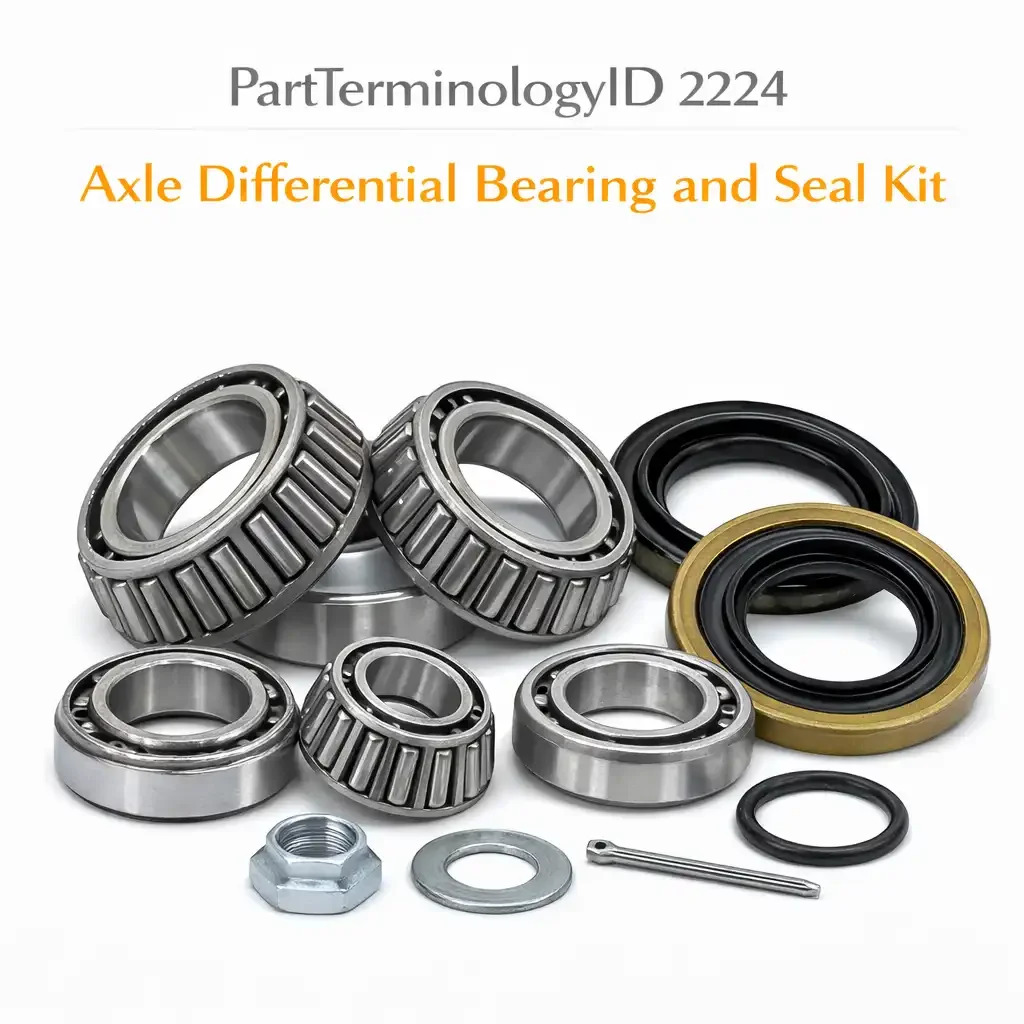
PartTerminologyID 2224, Axle Differential Bearing and Seal Kit, is a kit containing the bearings and seals required to rebuild an axle differential. That definition establishes the category. It does not specify which differential the kit fits, whether the kit covers a front axle, a rear axle, or a transfer case differential, what the ring gear diameter is, what the gear ratio is, whether the kit includes the pinion bearing, the carrier bearing, the pinion seal, the axle shaft seals, the crush sleeve, the pinion shims, the carrier shims, or some combination of those, or whether the kit is a master overhaul kit that includes all of those components or a partial kit that covers only the seals. A listing under PartTerminologyID 2224 without a complete component manifest is the same fundamental problem as every other kit PartTerminologyID in this series: the kit name implies completeness that only the manifest can define, and a buyer who cannot verify what is in the kit cannot verify whether the kit covers the rebuild they are performing.
For sellers, the axle differential bearing and seal kit has a higher consequence of an incomplete manifest than most kit PartTerminologyIDs because differential rebuilds are high-skill, high-labor operations where missing components are discovered mid-rebuild after the carrier has been disassembled and the original bearings have been pressed off. A buyer who presses the carrier bearings off their differential and finds the replacement carrier bearings are not in the kit must source them before the differential can be reassembled. Reassembling a differential with the original bearings that were pressed off to remove them is not acceptable practice: pressing a bearing off its race work-hardens and distorts the bearing and the race beyond reliable reuse. The buyer is stuck with a disassembled differential, missing components, and a vehicle that cannot be driven until the correct parts arrive.
For sellers, the listing under this PartTerminologyID is only useful if it specifies the axle manufacturer and model, the ring gear diameter, the gear ratio range the kit fits, the complete component manifest with quantity and specification for every included component, and what the buyer must supply in addition. Without those five attribute groups, the return rate is set by how many buyers happen to have the correct differential and happen to receive a kit that covers the repair scope they need.
What the Axle Differential Bearing and Seal Kit Contains
The master overhaul kit
The most complete offering under PartTerminologyID 2224. A master overhaul kit contains every bearing and seal required to completely rebuild the differential: the front and rear pinion bearings, the carrier bearings, the pinion seal, the axle shaft seals for both sides, the crush sleeve or solid spacer, the pinion shims in a range of thicknesses, and the carrier shims or carrier bearing adjusters. Some master kits also include the differential side gear thrust washers, the spider gear thrust washers, and the pinion gear thrust washers.
The master overhaul kit is the correct choice when the differential has been disassembled due to noise, significant mileage, or a failure event, and all wear components are being replaced at once. It is the only kit type that provides everything needed to complete a full rebuild without sourcing additional components.
The listing must state explicitly that this is a master kit and must list every component by name, quantity, and specification. A kit called a master kit that is missing the carrier bearings, the pinion shims, or the crush sleeve is not a master kit. The missing components will be discovered mid-rebuild.
The bearing kit without seals
Some differential rebuild kits include only the bearings: the front and rear pinion bearings and the carrier bearings, without the seals. This kit type is appropriate when the seals are being replaced separately, when only the bearings require replacement, or when the builder is sourcing seals from a different supplier for material or specification reasons. The listing must clearly state that seals are not included so the buyer can source them before disassembly.
The seal kit without bearings
A seal-only kit containing the pinion seal and the axle shaft seals. This is the correct kit for a differential that has developed a seal leak without bearing noise or bearing wear, where the bearings are within specification and do not require replacement. It is also the correct kit for a differential that is being resealed after a bearing replacement using separately sourced bearings.
A seal kit that does not include dimensional specifications for each seal cannot be verified for fitment to a specific differential housing. The pinion seal inner diameter, outer diameter, and height must all match the pinion flange and the differential housing pinion bore. The axle shaft seal inner diameter must match the axle shaft outer diameter at the seal contact zone.
The pinion bearing and seal kit
A partial kit that includes only the pinion front bearing, the pinion rear bearing, the pinion seal, and the crush sleeve. This is the correct kit for a differential with pinion bearing noise and a leaking pinion seal, where the carrier bearings are within specification. It is the most common partial kit because pinion bearing failure is the most common differential rebuild trigger on high-mileage vehicles.
The listing must specify the front pinion bearing dimensions, the rear pinion bearing dimensions, the pinion seal dimensions, and whether the crush sleeve is included and whether it is a standard crush sleeve or a solid spacer replacement.
The Axle Specifications That Determine Kit Fitment
Axle manufacturer and housing designation
The axle differential bearing and seal kit is specific to the axle manufacturer and the axle housing designation. Common domestic axle designations include the Dana 30, Dana 44, Dana 60, GM 7.5-inch, GM 8.5-inch, GM 8.6-inch, Ford 8-inch, Ford 8.8-inch, Ford 9-inch, Chrysler 8.25-inch, and Chrysler 9.25-inch. Each of those designations is a different axle with different bearing and seal specifications. A kit for a Dana 44 will not fit a Ford 8.8-inch axle even though both axles are found in similar vehicle applications and can be confused by buyers ordering by vehicle model alone.
Ring gear diameter
The ring gear diameter is the most direct specification for identifying which axle is in the vehicle. A GM 7.5-inch axle has a 7.5-inch ring gear. A GM 8.5-inch axle has an 8.5-inch ring gear. The ring gear diameter determines the pinion bearing dimensions because the pinion gear size scales with the ring gear diameter. A kit designed for a 7.5-inch ring gear will have smaller pinion bearings than a kit designed for an 8.5-inch ring gear. Both ring gear sizes are found in GM vehicles, and the listing must specify the ring gear diameter to distinguish between them.
Gear ratio range
Some bearing and seal kits are designed for a specific gear ratio range within a given axle designation because the pinion bearing preload specification varies with the gear ratio. High-ratio (numerically high, short gearing) differentials, such as 4.10 or higher, use different pinion shim thicknesses and in some cases different pinion bearing preload than low-ratio (numerically low, tall gearing) differentials such as 3.08 or 3.23. A shim kit or a complete overhaul kit that includes pinion shims must specify the gear ratio range the shims are designed for. A kit with shims sized for a 3.23 gear ratio will not correctly set pinion depth on a 4.10 gear ratio axle.
Front axle versus rear axle
On four-wheel-drive vehicles, the front axle and the rear axle are different assemblies. The front differential may use a Dana 30 or Dana 44 and the rear differential may use a Dana 44 or a Dana 60. The bearing and seal specifications are different between the two axles. A kit listed for the front axle on a vehicle where the buyer needs the rear axle will have wrong bearing dimensions for both the pinion and the carrier.
The listing must specify front axle or rear axle. On two-wheel-drive vehicles this is unnecessary, but on four-wheel-drive applications it is mandatory.
Limited slip or open differential
On axles equipped with a factory limited slip differential, the carrier assembly is different from an open differential carrier. The carrier bearings are the same on both open and limited slip carriers for the same axle designation. The side gear thrust washers and the clutch pack components are different. A master overhaul kit that includes side gear thrust washers for an open differential will not include the correct components for a limited slip carrier. The listing must specify whether the kit is for an open differential, a limited slip differential, or both.
Why This Part Generates Returns
Buyers order the wrong axle differential bearing and seal kit because:
the axle designation is not specified and the buyer's vehicle uses a different axle than the one the kit was designed for
the component manifest is not provided and the buyer discovers mid-rebuild that carrier bearings, pinion shims, or the crush sleeve are not included
the ring gear diameter is not specified and the buyer's axle uses a different ring gear size than the kit's bearings are dimensioned for
the kit covers an open differential and the buyer's axle has a limited slip carrier requiring different thrust washers or clutch pack components
the kit is for the front axle and the buyer needs the rear axle on a four-wheel-drive application
the gear ratio range is not specified and the shim pack in the kit does not cover the buyer's axle ratio
the listing is for a master kit but does not include the pinion shims, and the buyer discovers after disassembly that shims must be sourced separately
Status in New Databases
PIES/PCdb: PartTerminologyID 2224, Axle Differential Bearing and Seal Kit
PIES 8.0 / PCdb 2.0: No change
Top Return Scenarios
Scenario 1: "Carrier bearings not in the kit, differential cannot be reassembled"
The kit was described as a master overhaul kit. The buyer pressed the original carrier bearings off to remove the carrier. The kit contains the pinion bearings, the pinion seal, and the axle seals, but no carrier bearings. The buyer cannot reassemble the differential until carrier bearings are sourced. The original bearings that were pressed off cannot be reused.
Prevention language: "Kit contents: [complete manifest]. Carrier bearings: [included / not included]. If this kit does not include carrier bearings, do not press the original carrier bearings off until carrier bearings are in hand. Pressing carrier bearings off their races renders them non-reusable. Verify the complete manifest covers your rebuild scope before disassembling the differential."
Scenario 2: "Wrong axle designation, pinion bearing does not fit the housing"
The buyer's vehicle has a Dana 44 rear axle. The listing was for a GM 8.5-inch axle kit. The vehicle fitment in the listing matched the buyer's vehicle year, make, and model, but the vehicle was built with a Dana 44 rather than the more common GM 8.5-inch in that model year. The pinion bearing outer diameter does not match the Dana 44 housing bore.
Prevention language: "Axle designation: [GM 8.5-inch]. Verify your rear axle designation matches before ordering. Some vehicle platforms were built with multiple axle options depending on the build date, the engine, or the tow package. Identify your specific axle by measuring the ring gear diameter or by the axle tag before ordering."
Scenario 3: "Kit is for open differential, vehicle has limited slip"
The master kit includes side gear thrust washers for an open differential carrier. The buyer's axle has a factory limited slip unit with clutch packs and a different side gear configuration. The thrust washers in the kit do not fit the limited slip carrier.
Prevention language: "Differential type: [open / limited slip / Torsen / electronic locker]. This kit is designed for [open / limited slip] differentials. Verify your carrier type before ordering. Limited slip carriers use different clutch pack components and thrust washers than open carriers. Installing open differential thrust washers in a limited slip carrier will not provide the correct clutch preload."
Scenario 4: "Front axle kit received, needed rear axle kit"
The buyer's four-wheel-drive vehicle has a Dana 30 front axle and a Dana 44 rear axle. The listing specified the vehicle year, make, and model but not the axle position. The buyer received the Dana 30 front axle kit. The rear axle Dana 44 bearings are a different specification.
Prevention language: "Axle position: [front / rear]. Verify this kit fits your [front / rear] axle before ordering. On four-wheel-drive vehicles, the front and rear axles are different assemblies with different bearing and seal specifications. The front axle designation on this vehicle is [Dana 30]. The rear axle designation is [Dana 44]."
Scenario 5: "Pinion shims not included, cannot set pinion depth"
The kit was described as a master overhaul kit. The buyer disassembled the differential, cleaned all components, and began assembly. The kit does not include pinion shims. Pinion depth cannot be set without shims and the differential cannot be assembled to specification.
Prevention language: "Pinion shims: [included in range X.XXX to X.XXX inches / not included]. If pinion shims are not included, source the correct shim set for your axle designation and gear ratio before beginning disassembly. Pinion depth cannot be set without shims and the differential cannot be assembled to the backlash specification without correct pinion depth."
What to Include in the Listing
Core essentials
PartTerminologyID: 2224
component: Axle Differential Bearing and Seal Kit
kit type: master overhaul kit, bearing kit without seals, seal kit without bearings, pinion bearing and seal kit (mandatory)
axle manufacturer: Dana, GM, Ford, Chrysler, Toyota, or other (mandatory)
axle designation: Dana 30, Dana 44, GM 8.5-inch, Ford 8.8-inch, etc. (mandatory)
ring gear diameter in inches (mandatory)
axle position: front, rear, or both (mandatory on four-wheel-drive applications)
differential type: open, limited slip, Torsen, or locker (mandatory)
gear ratio range the kit is designed for (mandatory for kits including shims)
complete component manifest with quantity and specification for every included component (mandatory)
explicit statement of what is not included (mandatory)
quantity: 1 kit
Component manifest must include for each component:
front pinion bearing: part number or dimensions (bore diameter, outer diameter, width)
rear pinion bearing: part number or dimensions
carrier bearings (quantity 2): part number or dimensions
pinion seal: inner diameter, outer diameter, height
axle shaft seals (quantity 2): inner diameter, outer diameter, height
crush sleeve or solid spacer: included or not, type
pinion shims: included or not, range of thicknesses if included
carrier shims or adjuster rings: included or not
side gear thrust washers: included or not, for open or limited slip
spider gear thrust washers: included or not
Fitment essentials
year/make/model/submodel for vehicle-level fitment
axle designation (primary fitment attribute, more specific than vehicle fitment)
ring gear diameter
gear ratio
axle tag number when available
Image essentials
all kit components laid out together with each component labeled
pinion bearings in isolation with dimensional callouts
carrier bearings in isolation with dimensional callouts
pinion seal with inner diameter, outer diameter, and height callouts
axle shaft seals with dimensional callouts
shim pack showing thickness range if included
crush sleeve or solid spacer
Catalog Checklist for ACES/PIES Teams
PartTerminologyID = 2224
require kit type: master, bearing only, seal only, or pinion kit (mandatory)
require axle designation (mandatory, more specific than vehicle fitment)
require ring gear diameter (mandatory)
require axle position: front or rear on four-wheel-drive applications (mandatory)
require differential type: open or limited slip (mandatory)
require gear ratio range for shim-included kits
require complete component manifest (mandatory, non-negotiable)
require explicit not-included statement (mandatory)
differentiate from axle shaft bearing (PartTerminologyID varies): the axle shaft bearing supports the axle shaft in the axle tube; the differential bearings in this kit support the pinion shaft and the carrier within the differential housing; both are in the axle assembly but at different locations
differentiate from ring and pinion gear set (PartTerminologyID varies): the gear set is the ring gear and pinion gear themselves; this kit provides the bearings and seals that support and seal those gears, not the gears themselves
differentiate from limited slip clutch pack kit (PartTerminologyID varies): the clutch pack kit contains the friction discs and steel plates for the limited slip unit; the bearing and seal kit contains the bearings and seals; both may be required for a complete limited slip rebuild but are separate kits
flag component manifest as mandatory: a kit listing without a complete manifest is the primary return driver for this PartTerminologyID
flag carrier bearing inclusion explicitly: carrier bearings are the most consequential missing component because they cannot be recovered from a mid-rebuild disassembly once the original bearings have been pressed off
flag axle designation specificity: vehicle year/make/model alone is insufficient because multiple axle designations were used in the same vehicle over different production periods
FAQ (Buyer Language)
How do I identify which axle is in my vehicle?
The most reliable method is to look for the axle identification tag, which is typically on the differential cover or on the axle tube. The tag shows the axle model, the gear ratio, and the build date. On Dana axles, the tag is usually on the axle tube near the differential housing. On GM axles, the tag may be stamped on the axle tube or on the differential cover. If the tag is missing or illegible, measure the ring gear diameter after removing the differential cover, which directly identifies the axle size. A 7.5-inch ring gear is a GM 7.5-inch axle. An 8.5-inch ring gear is a GM 8.5-inch axle. The measurement is the most reliable identification when the tag is not available.
What is the difference between a crush sleeve and a solid spacer, and which one does my kit include?
A crush sleeve is a thin-walled collapsible tube that collapses under pinion nut torque to set the pinion bearing preload. It is a one-time-use component: once collapsed, it must be replaced any time the pinion nut is removed. A solid spacer is a precision-machined spacer of fixed thickness that sets the pinion bearing preload to a precise dimension without collapsing. Solid spacers are used in performance and racing applications where repeatable preload setting is required and the added cost of the machined spacer is acceptable. A differential rebuilt with a solid spacer requires a shim pack to fine-tune the preload, which adds time to the setup process. If your differential originally used a crush sleeve, replace it with a new crush sleeve unless you are intentionally converting to a solid spacer setup.
Can I reuse the original bearings if they are in good condition?
Not if they were pressed off their races. Pressing a bearing off its race deforms the race and the bearing elements beyond reliable reuse. If you are servicing the differential for a seal replacement only and are not removing the carrier or the pinion from the housing, the original bearings can remain in place and do not need to be replaced. If disassembly requires pressing the carrier bearings off or pressing the pinion out of the housing, replace all affected bearings with new ones from the kit, regardless of apparent condition.
My differential has a factory limited slip unit. Does the kit include the clutch packs?
Standard bearing and seal kits do not include the limited slip clutch friction discs and steel plates. Those components are in a separate limited slip rebuild kit. A master overhaul kit for a limited slip application may include the side gear thrust washers specific to the limited slip carrier, but the clutch pack components are typically sold separately. Verify the kit's component manifest before ordering to confirm which limited slip components are or are not included.
How do I know which shim thickness I need from the shim pack?
Pinion depth shim selection requires measuring the pinion depth using a pinion depth gauge or a dial indicator setup referenced to the differential housing bearing bores. The correct shim thickness is determined by the difference between the measured pinion depth and the specified pinion depth for your axle designation. The shim pack in a master kit provides a range of thicknesses to allow this adjustment. The factory service manual for your axle designation specifies the pinion depth measurement procedure and the target specification. Shim selection cannot be done by estimation.
Cross-Sell Logic
Ring and Pinion Gear Set (PartTerminologyID varies: if the rebuild is being performed because of gear wear or damage rather than just bearing and seal failure, the ring and pinion gear set is replaced at the same service event; the bearing and seal kit is always required when a ring and pinion set is installed)
Limited Slip Rebuild Kit (PartTerminologyID varies: on limited slip differentials, the clutch pack may require replacement at the same service event as the bearings and seals, particularly on high-mileage units or units that have been run dry of friction modifier)
Gear Oil and Limited Slip Friction Modifier (the differential oil is replaced after every rebuild; limited slip differentials require a specific friction modifier additive; verify the correct specification before filling)
Axle Shaft Seals (if the kit does not include axle shaft seals, they must be ordered separately before beginning the rebuild)
Differential Cover Gasket (PartTerminologyID varies: the differential cover must be removed to access the carrier; the cover gasket is replaced on reinstallation and must be on hand before starting the job)
Pinion Flange (if the pinion flange is worn at the seal contact surface, it should be replaced at the same service event as the pinion seal to ensure the new seal seats on an undamaged surface)
Frame as "the kit rebuilds the differential. The gear set is what the differential bearings support. The gear oil fills the rebuilt differential. The friction modifier conditions the limited slip clutch. The cover gasket seals the differential cover after the rebuild. The pinion flange is what the pinion seal rides on."
Final Take for PartTerminologyID 2224
Axle Differential Bearing and Seal Kit (PartTerminologyID 2224) is a rebuild kit where a missing component is discovered at the worst possible moment: mid-disassembly, after the original bearings have been pressed off and cannot be put back. The component manifest is not a secondary detail in this listing. It is the primary specification that determines whether the buyer can complete the rebuild without a parts run, without a delay, and without a vehicle that sits disassembled while a missing component is sourced.
The axle designation is the primary fitment attribute, more specific and more reliable than the vehicle year, make, and model, because the same vehicle was built with multiple axle options across production years. The ring gear diameter confirms the axle size. The differential type, open or limited slip, determines which thrust washer components are required. The kit type, master or partial, determines the rebuild scope the kit covers. And the component manifest defines exactly what all of those designations mean in terms of what arrives in the box.
State the kit type. State the axle designation. State the ring gear diameter. State the differential type. State the axle position on four-wheel-drive applications. State the complete manifest. State what is not included. That is the same listing strategy as every other PartTerminologyID in this series: the generic PartTerminologyID requires specific attributes at every level to become a listing buyers can act on without guessing. For PartTerminologyID 2224, guessing on the manifest produces a disassembled differential and a vehicle that cannot move until the missing parts arrive.