
Written by Arthur Simitian | PartsAdvisory
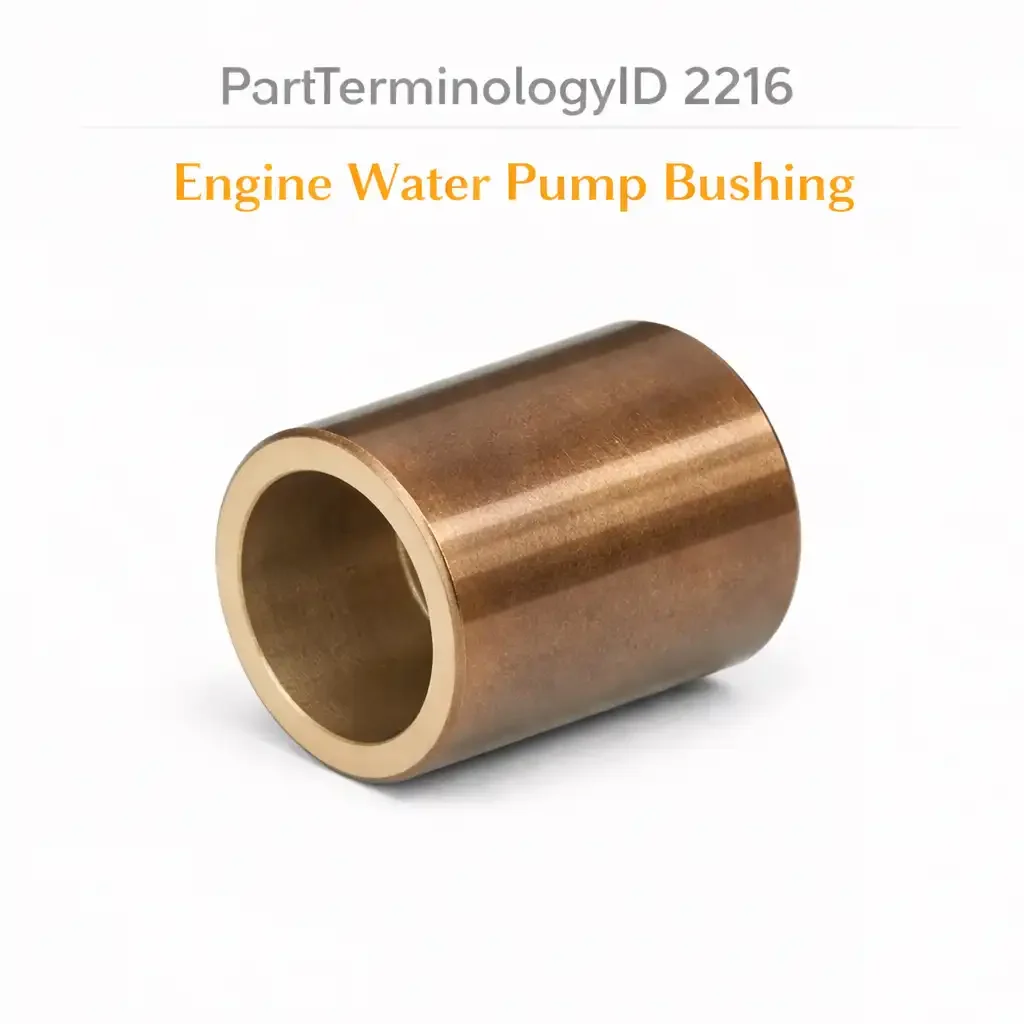
PartTerminologyID 2216, Engine Water Pump Bushing, is a bearing surface that supports the water pump shaft within the pump housing bore. That definition identifies the function. It does not specify the bushing inner diameter, the bushing outer diameter, the bushing length, the material, whether the bushing is a plain sleeve, a flanged bushing, or a split bushing, whether the bushing is pressed into the housing or retained by a snap ring or a set screw, what the surface finish specification of the shaft it supports is, or which pump the bushing belongs to. A listing under PartTerminologyID 2216 that does not include the inner diameter, the outer diameter, the length, and the material is a listing that cannot be verified by any buyer who measures their original bushing before ordering, and it cannot be verified by any buyer who has no original to measure because the pump housing bore has already been damaged by the failed bushing.
For sellers, the engine water pump bushing is a component that sits at the edge of the standard OE service category. Most production water pumps are serviced by replacing the complete pump assembly rather than by rebuilding the pump with individual components. The water pump bushing is ordered primarily in four contexts: engine rebuilding where original-specification components are being sourced for a period-correct restoration, marine and industrial engine applications where pump housings are thicker and more suitable for bushing replacement than automotive applications, heavy-duty diesel applications where pump housings are cast iron and bushing replacement is standard practice, and performance applications where an upgraded bushing material is being fitted to reduce shaft deflection under high-coolant-pressure conditions. Each of those contexts requires different dimensional and material specifications, and a listing that does not address the context cannot be evaluated by any of those buyer populations.
For sellers, the listing under this PartTerminologyID is only useful if it specifies the inner diameter, the outer diameter, the length, the material, the retention method, and the application context. Without those six attributes, the listing is a cylindrical object of unknown dimension that the buyer must order on faith.
What the Engine Water Pump Bushing Does
Supporting the shaft and maintaining radial clearance
The water pump shaft runs through the pump housing and carries the impeller at one end and the drive pulley or sprocket at the other. The bushing provides the bearing surface between the rotating shaft and the stationary housing bore. It maintains the radial clearance between the shaft and the housing that allows the shaft to rotate freely while preventing the shaft from deflecting under the radial loads imposed by the belt tension at the drive end and the hydraulic pressure reaction at the impeller end.
A bushing that has worn beyond its service clearance allows the shaft to deflect. Shaft deflection tilts the shaft seal away from its designed seating angle, which allows coolant to bypass the seal and leak through the pump weep hole or directly through the housing bore. Shaft deflection also causes the impeller to run eccentrically within the pump housing, which reduces the impeller's efficiency and introduces a cyclic loading pattern that accelerates wear at the impeller edge and on the housing bore surface.
The bushing versus the bearing
Many water pump designs use a ball bearing or a roller bearing rather than a plain bushing to support the shaft. On those designs, PartTerminologyID 2216 does not apply. The distinction between a plain bushing and a rolling element bearing is fundamental and must be verified before ordering under this PartTerminologyID. A listing for a plain bushing applied to a pump that uses a ball bearing will produce a return every time because the buyer cannot install a plain bushing in a housing designed for a ball bearing outer race.
The applications where plain bushings are used instead of ball bearings include older domestic and European engines with cast iron pump housings, marine inboard engines where the pump operates submerged in water and the housing provides external cooling for the bushing, heavy-duty diesel truck applications where pump speeds are lower and radial loads are more consistent than in automotive applications, and some agricultural engine applications. A listing under PartTerminologyID 2216 applied to a modern passenger vehicle pump that uses a ball bearing produces a return from every buyer who attempts to source a rebuild component for a pump that does not have a rebuildable bushing.
Wear modes that require bushing replacement
The bushing wears from the inside surface where the shaft contacts it. Normal wear produces a gradual increase in radial clearance that eventually exceeds the shaft seal's ability to compensate, producing a weeping seal. Abnormal wear from coolant contamination of the bushing, which occurs when the shaft seal has already failed and allowed coolant to reach the bushing bore, produces rapid material removal from the bushing inner surface and from the shaft outer surface. If coolant has contaminated the bushing, the shaft must be inspected for wear before a new bushing is installed. A new bushing installed on a worn shaft will not maintain the required radial clearance and will fail rapidly.
Corrosion wear from degraded coolant is the second wear mode. Bushings in bushings that are bronze or brass are subject to dezincification in coolant formulations with high inhibitor concentration or with low pH from long-overdue coolant service. Dezincification selectively removes zinc from the bronze or brass alloy, leaving a porous copper structure that has lost its mechanical strength and bearing properties.
The Dimensional Specifications That Determine Bushing Fitment
Inner diameter
The inner diameter of the bushing is the bore that the shaft runs through. The shaft's outer diameter at the bushing contact zone determines the correct bushing inner diameter, with a running clearance of typically 0.001 to 0.003 inches for a standard passenger vehicle pump shaft. A bushing with insufficient inner diameter will not accept the shaft. A bushing with excessive inner diameter will allow the shaft to deflect beyond the seal's compensation range and will cause premature seal failure.
The inner diameter must be specified in the listing in both metric and imperial dimensions because pump shaft diameters in the water pump category span both measurement systems depending on the engine origin and the production era.
Outer diameter
The outer diameter of the bushing is the surface that presses into the housing bore. The housing bore inner diameter determines the correct bushing outer diameter, with a press fit interference of typically 0.001 to 0.002 inches for cast iron housings and slightly less for aluminum housings. A bushing with insufficient outer diameter will spin in the housing bore rather than remaining stationary, which eliminates the bushing's function. A bushing with excessive outer diameter will crack the housing bore during installation or will distort the housing bore to the point that the inner diameter is reduced below the shaft clearance requirement.
Length
The bushing length determines the journal surface area that supports the shaft. A longer bushing distributes the shaft's radial load over a greater surface area, which reduces the unit pressure at the bushing surface and extends the bushing's service life. The replacement bushing length must match or exceed the original. A shorter bushing installed in a bore sized for a longer bushing will not fill the bore and will allow the shaft to misalign at the unsupported section of the bore.
Material
Bronze is the most common bushing material for water pump applications. Bronze combines adequate bearing strength, excellent corrosion resistance in glycol-based coolants, good thermal conductivity for heat dissipation through the housing, and a low coefficient of friction against steel shafts. Leaded bronze provides better embedability for small particles that enter the clearance gap, which is important in coolant circuit applications where debris from corroded system components can reach the bushing.
Brass bushings are used in some applications but are subject to dezincification in aggressive coolant formulations. The listing must disclose the specific alloy when brass is the material, not just the generic term brass.
Cast iron bushings are used in heavy-duty and industrial pump applications where the pump housing and the bushing are the same material, which eliminates differential thermal expansion between the bushing and the housing bore. Cast iron bushings require the shaft to have a harder surface finish than bronze bushings require.
Polymer bushings, including PTFE-lined and PEEK materials, are used in some marine and chemical-resistant pump applications. These materials have excellent corrosion resistance but lower load capacity than bronze and are not appropriate for high-load pump applications.
Retention method
The retention method determines how the bushing is held in the housing bore. Press-fit retention is the most common: the bushing's interference fit with the bore holds it in place under operating loads. Some bushing installations use a set screw through the housing wall into a groove in the bushing outer diameter. Others use a flanged bushing where the flange prevents the bushing from migrating axially through the bore.
The retention method affects the installation procedure. A press-fit bushing requires a driver or a press with a driver of the correct outer diameter to seat it without distorting the bore. A flanged bushing requires the housing bore step to match the flange diameter. A set-screw retained bushing requires the housing to have an existing set screw hole at the correct location.
Why This Part Generates Returns
Buyers order the wrong engine water pump bushing because:
the inner diameter is not specified and the replacement bushing does not accept the pump shaft
the outer diameter is not specified and the replacement bushing is undersized and spins in the housing bore rather than pressing in
the listing is applied to a pump that uses a ball bearing rather than a plain bushing, and the buyer receives a part they cannot install
the material is not specified and the buyer installs a brass bushing in a coolant formulation that causes dezincification
the length is not specified and the replacement bushing does not fill the full bore depth, leaving an unsupported shaft section
the engine code or pump application is not specified and the bushing dimensions do not match the pump the buyer has in hand
Status in New Databases
PIES/PCdb: PartTerminologyID 2216, Engine Water Pump Bushing
PIES 8.0 / PCdb 2.0: No change
Top Return Scenarios
Scenario 1: "This pump uses a ball bearing, not a plain bushing"
The listing was applied to a current-production passenger vehicle water pump that uses a sealed ball bearing cartridge to support the shaft. The buyer attempting to rebuild the pump received a plain bushing. The housing has no bore for a plain bushing and the ball bearing is a press-fit cartridge, not a serviceable bearing with replaceable inner components.
Prevention language: "Application: [plain bushing application / verify your pump uses a plain bushing and not a ball bearing before ordering]. This bushing fits pump designs with a plain bushing bore in the housing. Many current-production water pumps use a sealed ball bearing cartridge that is not serviceable with a plain bushing. Confirm your pump housing has a plain bushing bore before ordering."
Scenario 2: "Bushing spins in the housing bore, pump shaft vibrates"
The outer diameter of the replacement bushing is 0.003 inches smaller than the housing bore. The press fit interference is insufficient to retain the bushing. The bushing spins with the shaft rather than remaining stationary, producing metal-on-metal contact between the bushing outer surface and the housing bore and generating fine metallic debris in the coolant circuit.
Prevention language: "Outer diameter: [X.XXX] inches / [X.XX]mm. Verify your housing bore inner diameter requires this outer diameter with the standard press fit interference for your housing material. Cast iron housings require 0.001 to 0.002 inches of press fit interference. Aluminum housings require slightly less. Measure your housing bore before ordering."
Scenario 3: "Bushing inner diameter too small, shaft will not enter"
The replacement bushing inner diameter is 0.004 inches smaller than the pump shaft outer diameter at the bushing journal. The shaft cannot be installed through the bushing without damaging either the shaft surface or the bushing bore.
Prevention language: "Inner diameter: [X.XXX] inches / [X.XX]mm. This is the as-installed bore diameter. Verify your pump shaft outer diameter at the bushing journal matches this specification with the standard running clearance of 0.001 to 0.003 inches. Measure the shaft before ordering."
Scenario 4: "Dezincification failure at first coolant service"
The replacement bushing is standard brass. The buyer's cooling system uses an OAT extended-life coolant. The OAT formulation's inhibitor package attacked the zinc content of the brass bushing, which dezincified within the first 12,000 miles and left a porous copper structure that had lost its bearing properties. The shaft seal failed from excessive shaft deflection.
Prevention language: "Bushing material: [bronze / leaded bronze / brass / cast iron / polymer]. Bronze bushings are recommended for cooling systems using OAT or HOAT extended-life coolant formulations. Brass bushings may be subject to dezincification in coolant formulations with high inhibitor concentration. Verify coolant formulation compatibility with the bushing material before installing."
Scenario 5: "Bushing length shorter than bore, shaft deflects at unsupported section"
The replacement bushing is 8mm shorter than the housing bore depth. The bushing seats at the drive end of the bore but leaves 8mm of bore at the impeller end unsupported. The shaft deflects at the unsupported section under impeller hydraulic pressure, causing the shaft seal to leak within the first 5,000 miles.
Prevention language: "Bushing length: [X]mm. Verify this length equals or exceeds your housing bore depth. A bushing shorter than the housing bore will leave a section of the shaft unsupported, causing shaft deflection and premature shaft seal failure."
What to Include in the Listing
Core essentials
PartTerminologyID: 2216
component: Engine Water Pump Bushing
application context: OE restoration, marine, heavy-duty diesel, or performance (mandatory)
compatible pump manufacturer and part number or engine code (mandatory)
inner diameter in inches and mm (mandatory)
outer diameter in inches and mm (mandatory)
length in mm (mandatory)
material: bronze, leaded bronze, brass, cast iron, or polymer (mandatory)
retention method: press fit, flanged, or set screw (mandatory)
coolant formulation compatibility note for brass and polymer materials
quantity: 1
Fitment essentials
engine code for OE service applications
pump manufacturer and model number for direct pump-specific applications
application type: passenger vehicle, marine, heavy-duty diesel, or industrial
shaft outer diameter the bushing supports in inches or mm
Dimensional essentials
inner diameter in inches (to four decimal places) and mm (to two decimal places)
outer diameter in inches (to four decimal places) and mm (to two decimal places)
length in mm
flange outer diameter in mm for flanged bushings
flange thickness in mm for flanged bushings
wall thickness in mm (outer diameter minus inner diameter divided by two)
Image essentials
bushing in isolation against a white background showing both ends and the outer surface
end view showing the bore with inner diameter callout
side view showing the length and the outer diameter callout
for flanged bushings, the flange shown with diameter and thickness callouts
cross-section showing wall thickness
installed context showing the bushing in the housing bore with the shaft in place
Catalog Checklist for ACES/PIES Teams
PartTerminologyID = 2216
require inner diameter in both inches and mm (mandatory)
require outer diameter in both inches and mm (mandatory)
require length in mm (mandatory)
require material with alloy specification for bronze and brass (mandatory)
require retention method: press fit, flanged, or set screw (mandatory)
require application context: OE restoration, marine, heavy-duty diesel, or performance (mandatory)
require application verification note for plain bushing versus ball bearing pump designs
require coolant formulation compatibility note for brass and polymer bushing materials
differentiate from engine water pump (PartTerminologyID 2208): the pump is the complete assembly; the bushing is a serviceable internal component of the pump housing; the bushing is only available and useful on pump designs with rebuildable plain bushing housings
differentiate from engine water pump bearing (PartTerminologyID varies): a ball bearing or roller bearing is a rolling element assembly; a plain bushing is a sliding contact surface; they are not interchangeable and the listing must confirm which type the application uses
differentiate from engine water pump seal (PartTerminologyID varies): the shaft seal prevents coolant from reaching the bushing; the bushing supports the shaft the seal contacts; both are replaced when shaft deflection from bushing wear has damaged the seal
flag that this PartTerminologyID is not applicable to modern passenger vehicle pumps that use sealed ball bearing cartridges: the most consequential listing error for this PartTerminologyID is applying it to a non-rebuildable pump application
flag that inner and outer diameters must be specified to four decimal places in inches for bearing-grade fits: dimensional specifications that are rounded to two decimal places in inches are insufficient for press fit and running clearance verification
FAQ (Buyer Language)
How do I know if my water pump uses a plain bushing or a ball bearing?
Remove the water pump from the engine and examine the housing. If the pump shaft is supported by a sealed bearing cartridge that can be seen at the drive end of the housing and that does not have an oil or grease fitting, the pump uses a ball bearing and PartTerminologyID 2216 does not apply. If the pump housing has an open bore that the shaft runs through, with no sealed bearing visible, and if the pump has historically been rebuilt with replacement bushings and seals rather than replaced as a complete assembly, it uses a plain bushing. Most modern passenger vehicle water pumps use sealed ball bearings. Most marine inboard engine pumps and many heavy-duty diesel engine pumps use plain bushings.
My housing bore is worn from the failed bushing. Can I install a new bushing in a worn bore?
A housing bore that has been worn by a spinning bushing or by shaft contact after bushing failure will not hold a new standard-dimension bushing with the correct press fit interference. The worn bore must be honed or bored to the next oversize and an oversize bushing installed. Oversize bushings are available in some applications in 0.010-inch and 0.020-inch oversize outer diameters. If oversize bushings are not available for your application, the housing requires sleeve repair or replacement. Installing a standard bushing in a worn bore will produce the same spinning bushing failure within a short service interval.
The shaft is scored where the bushing rides. Do I need to replace the shaft?
Inspect the depth and extent of the scoring. Minor surface marks that do not produce a measurable undersize at the journal can be polished smooth with fine abrasive to restore the surface finish. Deep scoring that produces a measureable undersize of more than 0.002 inches requires the shaft to be replaced or built up and re-ground to standard dimension. A scored shaft installed in a new bushing will produce an uneven contact pattern that accelerates bushing wear and may also damage the shaft seal contact surface.
What is the correct press fit for installing a new bushing?
For cast iron housings with bronze bushings, the standard press fit is 0.001 to 0.002 inches of diametral interference: the bushing outer diameter is larger than the housing bore by that amount. For aluminum housings with bronze bushings, the fit is slightly less because aluminum expands more than bronze at operating temperature, which increases the effective interference during operation. Use a hydraulic or arbor press with a driver that contacts only the end face of the bushing, never the bore surface. Do not use a hammer and punch, which can distort the bushing and produce an irregular bore that does not provide even shaft support.
Do I need to replace the shaft seal at the same time as the bushing?
Yes. Shaft seal failure is typically the symptom that prompts bushing inspection, and bushing wear is the root cause of shaft seal failure from shaft deflection. Replacing the bushing without replacing the seal leaves a seal that was damaged by shaft deflection in service, which may not seal correctly even after the shaft deflection is corrected by the new bushing. Replace both the bushing and the seal at the same service event.
Cross-Sell Logic
Engine Water Pump Seal (PartTerminologyID varies: the shaft seal is replaced at the same service event as the bushing; bushing wear causes shaft deflection that destroys the seal, and seal failure allows coolant to contaminate and accelerate bushing wear; the two parts are always serviced together)
Engine Water Pump (PartTerminologyID 2208: if the housing bore is worn beyond the capability of a bushing replacement to correct, or if the pump housing is cracked, the complete pump assembly must be replaced rather than rebuilt)
Engine Coolant (if the shaft seal failed before the bushing was replaced, coolant contaminated the bushing bore and may have entered the engine's lubrication circuit on pumps where the shaft runs adjacent to an oil seal; flush and replace the coolant and inspect the oil for coolant contamination)
Engine Cooling System Pressure Tester Adapter (PartTerminologyID 2054: pressure test the cooling system after installing the replacement bushing and seal to confirm the new seal is seating correctly and the housing bore is not cracked from the bushing installation)
Shaft Seal Installation Tool (a correctly sized seal driver is required to install the shaft seal without distorting the seal lip; a bushing driver of the correct outer diameter is required to install the bushing without distorting the housing bore)
Frame as "the bushing supports the shaft. The seal prevents coolant from reaching the bushing. The shaft connects the impeller to the drive. All three are replaced at the same service event when any one of them fails, because the failure of any one damages the others."
Final Take for PartTerminologyID 2216
Engine Water Pump Bushing (PartTerminologyID 2216) is a precision bearing component where the inner diameter and outer diameter must be specified to four decimal places in inches to allow the buyer to verify the running clearance with the shaft and the press fit interference with the housing bore. A listing that rounds those dimensions to two decimal places in inches, or that states only the metric equivalents without the inch specification, cannot be used by a buyer performing a bearing-grade fit verification.
The listing must begin by confirming that the application uses a plain bushing and not a ball bearing, because the most common return for this PartTerminologyID is a buyer who ordered a bushing for a pump that has a sealed ball bearing and has no plain bushing bore to accept the part. After that confirmation, the inner diameter, outer diameter, length, material, and retention method are the five attributes that determine whether the bushing can be installed with the correct fits and will last in service.
State the application context. State the inner diameter to four decimal places in inches. State the outer diameter to four decimal places in inches. State the length. State the material with the alloy specification. State the retention method. State the coolant formulation compatibility. That is the same listing strategy as every other PartTerminologyID in this series: the generic PartTerminologyID requires specific attributes at every level to become a listing buyers can act on without guessing.