
Engine Water Pump Adapter (PartTerminologyID 2212): The Part Where Application Context Is the Only Specification That Distinguishes a Usable Listing from an Unusable One
Written by Arthur Simitian | PartsAdvisory
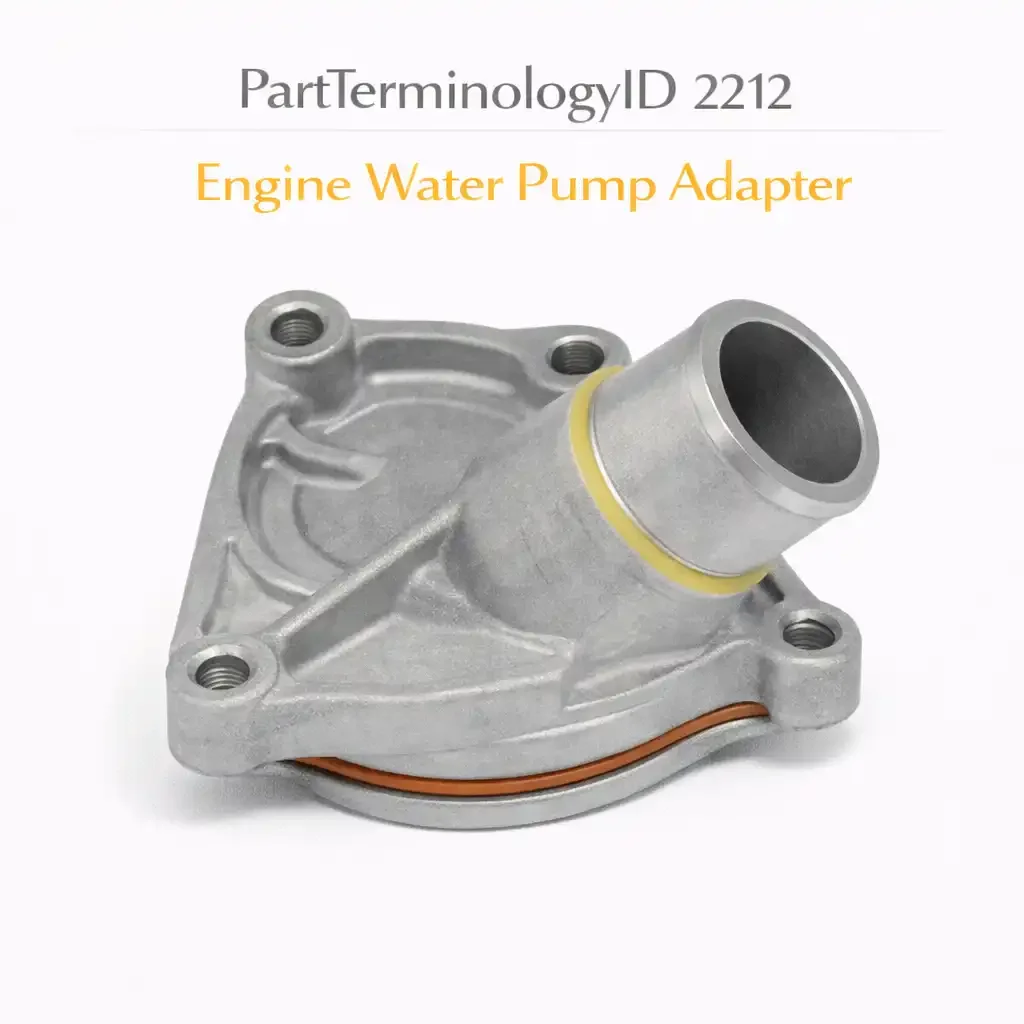
PartTerminologyID 2212, Engine Water Pump Adapter, is a component that adapts the engine water pump to a mounting interface, a drive configuration, or a coolant circuit connection that differs from the pump's native specification. That definition is broader than most parts in this series and that breadth is the problem. The adapter category under PartTerminologyID 2212 covers at least four functionally distinct components: a mounting adapter that allows a pump designed for one engine to be installed on a different engine block; a port adapter that allows a pump with one inlet or outlet diameter to connect to a hose or a circuit fitting of a different diameter; a drive adapter that converts between a direct-drive camshaft or crankshaft connection and a belt-driven pulley connection; and a coolant passage adapter that bridges between two cooling circuit architectures. Each of those adapter types has different dimensional requirements, different material requirements, and a different buyer population. A listing under PartTerminologyID 2212 that does not specify the adapter type and the application context is a listing that cannot be evaluated by any buyer who does not already know exactly what adapter their application requires.
For sellers, the water pump adapter is a part that is rarely needed on standard OE replacement applications and is most commonly ordered in three contexts. The first is a performance or engine swap application where a builder is fitting an engine from one vehicle into a platform that was not designed for it and needs to adapt the pump mounting or the drive configuration. The second is a repair application where the original pump inlet or outlet has corroded or been damaged and an adapter allows a standard replacement pump to connect to the repaired or resized port. The third is an application where a specific OE adapter was used between the pump and the engine and must be replaced because it has cracked, corroded, or failed. Each of those contexts requires different information in the listing to be actionable.
For sellers, the listing under this PartTerminologyID is only useful if it specifies the adapter type, the application context, the inlet specification, the outlet specification, the mounting bolt pattern if applicable, and the material. Without those six attributes, the listing cannot serve any of the three buyer populations reliably.
What the Engine Water Pump Adapter Does
Bridging a dimensional mismatch between the pump and the engine
The most common water pump adapter in the OE service context is a port adapter: a fitting that connects a pump with one inlet or outlet inner diameter to a hose connection or engine passage of a different diameter. On some engines, the water pump inlet is a different diameter than the lower radiator hose, and an adapter reduces or enlarges the connection to allow a standard hose to seat correctly. On engines where the pump was superseded during production and the replacement pump has a slightly different port diameter than the original, an adapter allows the replacement pump to connect to the original hose without sourcing a new hose.
Port adapters are simple in function but must be specified with both the pump-side inner diameter and the hose-side inner diameter. A listing that states only one diameter is half a specification, the same problem that reducer connectors (PartTerminologyID 2076) create when only one end diameter is stated. Both end diameters are required and both must be specified as inner diameters of the adapter bore, not as outer diameters of the fittings the adapter connects to.
Converting between drive configurations
On engine swap and performance build applications, a water pump drive adapter converts between a direct-drive connection at the crankshaft or camshaft and a belt-driven pulley connection, or converts between different pulley bolt patterns to allow a pulley from one application to be used on a pump from a different application. This adapter type is primarily sold in the performance aftermarket and is not a standard OE service part. The listing must specify the input drive type, the output drive type, the input bolt pattern or shaft specification, and the output bolt pattern.
Adapting the pump mounting face to a different engine block
On engine swap applications, a mounting face adapter spaces the water pump away from the block to accommodate a different timing cover or a different front accessory drive configuration. These adapters are typically billet aluminum and are sold as performance components. The mounting face bolt pattern on both the block side and the pump side must be specified. The adapter thickness determines the pump position in the engine bay and affects belt alignment and hose routing. A listing that does not specify the bolt pattern on both faces and the adapter thickness cannot be verified for the swap application.
The OE coolant passage adapter
On some production engines, a cast aluminum or plastic adapter bridges between the engine block's coolant outlet and the water pump inlet where the two components are not directly compatible due to differences in port height, port angle, or port diameter between the block casting and the pump casting. This adapter is a factory component, listed under PartTerminologyID 2212, and is replaced when it cracks, corrodes, or develops a leak. On these applications, the adapter is engine-specific and must be listed with the engine code and the OE part number cross-reference.
The Adapter Types and Their Specifications
Port reducer or port enlarger adapter
The most service-common adapter type. Connects two different bore diameters in the coolant circuit at or near the water pump. The listing must specify the larger bore inner diameter, the smaller bore inner diameter, the adapter length, the material, and whether the adapter seals with O-rings, hose clamps, or threaded interfaces at each end.
Material is critical. The adapter is in the coolant circuit at the highest-pressure point on the pump outlet side. Plastic adapters on the outlet side of the pump are subject to higher sustained pressure than adapters at the inlet. The material must be compatible with the coolant formulation and must be rated for the system operating temperature and pressure.
Drive conversion adapter
Used in performance and swap applications. The listing must specify the input type (crankshaft snout diameter and thread, camshaft thread specification, or pulley bolt pattern), the output type (pulley bolt pattern and pilot diameter), the adapter material, and any offset or spacing the adapter introduces between the input and output.
Mounting face spacer adapter
Used in engine swap applications. The listing must specify the block-side bolt pattern (bolt count, bolt diameter, and bolt circle diameter), the pump-side bolt pattern, the adapter thickness, the coolant passage bore diameter through the adapter, and the material. The coolant passage bore must not be undersized relative to the pump inlet bore: an undersized bore through the adapter restricts coolant flow to the pump.
OE coolant passage bridge adapter
Engine-specific. The listing must specify the engine code, the OE part number cross-reference, the sealing method at each end (gasket, O-ring, or RTV), and whether the sealing elements are included. A buyer replacing a failed OE adapter needs the same information they would need for any engine-specific coolant component.
Why This Part Generates Returns
Buyers order the wrong engine water pump adapter because:
the adapter type is not specified and the buyer receives a port reducer when they need a mounting face adapter, or vice versa
only one port diameter is stated for a two-diameter adapter, and the unstated diameter does not match the buyer's application
the mounting bolt pattern is not stated and the adapter does not align with the pump flange or the engine block
the coolant passage bore through the adapter is smaller than the pump inlet bore, restricting coolant flow after installation
the material is not compatible with the coolant formulation or the operating pressure at the adapter location
the adapter thickness introduces more offset than the application requires, misaligning the belt drive or preventing the hose from routing correctly
the engine code is not specified for an OE coolant passage bridge adapter and the buyer receives an adapter from a different engine variant with a different port angle
Status in New Databases
PIES/PCdb: PartTerminologyID 2212, Engine Water Pump Adapter
PIES 8.0 / PCdb 2.0: No change
Top Return Scenarios
Scenario 1: "Wrong adapter type, received a port reducer for a mounting application"
The listing did not specify the adapter type. The buyer needed a mounting face spacer for an engine swap application. They received a hose port reducer. The mounting face spacer has a completely different geometry and function.
Prevention language: "Adapter type: [port reducer / port enlarger / drive conversion adapter / mounting face spacer / OE coolant passage bridge]. Verify the adapter type matches your application before ordering. Water pump adapters serve different functions and are not interchangeable between types."
Scenario 2: "Only one diameter stated, second end does not match"
The listing stated the adapter reduces from 1-1/2 inch to 1-1/4 inch. The buyer's pump outlet is 1-1/2 inch and their hose is 1-1/8 inch inner diameter. The 1-1/4 inch end of the adapter does not match the 1-1/8 inch hose.
Prevention language: "Pump-side inner diameter: [X] inch / [X]mm. Hose-side inner diameter: [X] inch / [X]mm. Both inner diameters must match your pump port and hose inner diameters exactly. Verify both dimensions before ordering."
Scenario 3: "Adapter bore is undersized, pump outlet is restricted"
The mounting face spacer has a coolant passage bore of 38mm. The pump inlet bore is 44mm. The undersized adapter bore restricts coolant flow by approximately 25 percent, reducing the pump's effective output and causing the engine to overheat under sustained load.
Prevention language: "Coolant passage bore through adapter: [X]mm. Verify the adapter's internal coolant passage bore is equal to or larger than your pump's inlet bore. An adapter bore that is smaller than the pump inlet will restrict coolant flow and reduce cooling capacity."
Scenario 4: "Bolt pattern does not align with pump flange"
The mounting face adapter's pump-side bolt pattern is 4-bolt at 80mm bolt circle. The buyer's pump flange is 4-bolt at 75mm bolt circle. The bolts do not align. The adapter cannot be mounted.
Prevention language: "Block-side bolt pattern: [X]-bolt at [X]mm bolt circle, [X]mm bolt diameter. Pump-side bolt pattern: [X]-bolt at [X]mm bolt circle, [X]mm bolt diameter. Measure both the block face and the pump flange bolt patterns before ordering. A bolt circle mismatch of even 5mm will prevent installation."
Scenario 5: "Adapter offset misaligns the serpentine belt"
The mounting face spacer adds 12mm of offset between the pump and the block. The buyer's swap application required only 6mm of offset to clear the timing cover. The additional 6mm pushes the pump pulley out of alignment with the serpentine belt path, causing belt misalignment and accelerated belt wear.
Prevention language: "Adapter thickness: [X]mm. Verify your application requires [X]mm of offset between the water pump mounting face and the engine block before ordering. Belt drive alignment must be verified after installation with a straightedge across the pulleys. Excessive offset will misalign the serpentine belt and cause accelerated belt and pulley wear."
What to Include in the Listing
Core essentials
PartTerminologyID: 2212
component: Engine Water Pump Adapter
adapter type: port reducer, port enlarger, drive conversion, mounting face spacer, or OE coolant passage bridge (mandatory)
application context: OE service replacement, engine swap, or performance build (mandatory)
engine code for OE coolant passage bridge adapters (mandatory for OE applications)
pump-side inner diameter in mm and inches for port adapters (mandatory)
hose or circuit-side inner diameter in mm and inches for port adapters (mandatory)
adapter length or thickness in mm (mandatory)
material: aluminum, cast iron, brass, or plastic (mandatory)
sealing method at each end: O-ring, hose clamp, threaded, or gasket (mandatory)
sealing elements included: yes or no
coolant passage bore inner diameter in mm for mounting face spacers (mandatory)
block-side bolt pattern for mounting face spacers: bolt count, bolt circle diameter, bolt diameter (mandatory)
pump-side bolt pattern for mounting face spacers: bolt count, bolt circle diameter, bolt diameter (mandatory)
input and output specifications for drive conversion adapters (mandatory)
quantity: 1
Fitment essentials
year/make/model/submodel for OE service applications
engine code for OE coolant passage bridge adapters
compatible pump manufacturer and part number for performance and swap applications
compatible engine block and compatible pump specified for mounting face spacer applications
Dimensional essentials
pump-side inner diameter in mm
circuit-side inner diameter in mm
adapter overall length or thickness in mm
coolant passage bore inner diameter in mm
bolt circle diameter in mm for mounting face spacers
bolt hole diameter in mm for mounting face spacers
sealing O-ring groove dimensions for O-ring sealed ends
Image essentials
adapter in isolation showing both ends, the sealing features, and any bolt holes
cross-section view showing the internal coolant passage bore and both end inner diameters with dimensional callouts
for mounting face spacers, both face views showing the bolt hole patterns
for port reducers, both end views showing the inner diameter difference
installed context showing the adapter connecting the pump to the block, hose, or drive component
Catalog Checklist for ACES/PIES Teams
PartTerminologyID = 2212
require adapter type as first attribute: this PartTerminologyID covers multiple functionally distinct components; the type must be stated before any other specification
require application context: OE service, engine swap, or performance build
require engine code for OE coolant passage bridge applications
require both end inner diameters for port adapters: listing only one diameter is an incomplete specification that produces returns
require adapter thickness or length
require coolant passage bore inner diameter for mounting face spacers: this dimension must equal or exceed the pump inlet bore
require bolt pattern specifications on both faces for mounting face spacers
require material
require sealing method at each end
require sealing element inclusion status
differentiate from engine water pump (PartTerminologyID 2208): the pump is the rotating assembly that circulates coolant; the adapter connects the pump to the engine or the circuit; they are separate parts
differentiate from engine coolant hose connector (PartTerminologyID 2076): the hose connector is a rigid fitting that connects a coolant hose to a component; the water pump adapter connects two components at the pump in a dimensional or architectural mismatch condition; both may be at the pump location but serve different structural roles
differentiate from engine water pump gasket (PartTerminologyID 2148): the gasket seals the pump face to the engine or to the adapter; the adapter is the structural bridging component; both may be required at the same installation
flag that both port diameters are mandatory for port adapters: this is the most common single-attribute omission for this PartTerminologyID and the most predictable source of returns
flag that coolant passage bore must equal or exceed pump inlet bore for mounting face spacers: an undersized bore is a flow restriction that causes overheating under load
FAQ (Buyer Language)
What is a water pump adapter and do I need one?
A water pump adapter is a component that bridges a dimensional or architectural mismatch between the water pump and the engine, the cooling circuit, or the drive system. Most standard OE replacement water pump installations do not require an adapter because the replacement pump matches the original's port diameters, mounting face, and drive configuration. You need an adapter if you are fitting a pump with different port diameters than your original hose connections, performing an engine swap where the donor engine's pump mounting face does not match the host vehicle's engine bay architecture, or replacing a factory-installed adapter that has failed. If your OE replacement pump installs directly with the original gasket and connects to the original hoses without modification, you do not need an adapter.
How do I measure the inner diameters I need for a port adapter?
Measure the outer diameter of the fitting or nipple that the adapter will connect to on the pump side and on the hose side. For a rubber hose connection, the hose inner diameter is the dimension to match to the adapter's hose-side inner diameter. The adapter's inner diameter at each end must match the outer diameter of the fitting it slides over, or the inner diameter of the hose it accepts, depending on whether the connection is push-on or slip-fit. Use a caliper to measure both connection points before ordering.
My engine swap requires a water pump adapter. What information do I need before ordering?
You need the block-side bolt pattern from the engine block's water pump mounting face: the number of bolts, the bolt circle diameter, and the bolt thread specification. You need the pump-side bolt pattern from the replacement pump's mounting flange: the same three specifications. You need the required offset thickness between the pump and the block, which is determined by the timing cover depth and the belt drive geometry of your swap configuration. You need the pump's inlet bore diameter so you can verify the adapter's internal coolant passage bore is not undersized. Gather all of those measurements before searching for an adapter.
The adapter I need is for an OE factory component that cracked. How do I find it?
Use the OE part number from the original adapter if it is visible on the casting or in the parts catalog for your vehicle. Search by the OE part number rather than by the generic PartTerminologyID to find the correct application-specific replacement. If the OE part number is not available, use the engine code and the vehicle production date to narrow the search. Some production runs of the same engine used different adapter designs at different production dates, so the production date is a relevant attribute for OE adapter fitment.
Can I use a rubber reducer hose instead of a rigid adapter for a port size mismatch?
On the inlet side of the pump, a flexible rubber reducer hose can work as an alternative to a rigid adapter if the hose is rated for the coolant temperature and pressure at that location and if it can be secured with standard hose clamps at both ends. On the outlet side of the pump, where pressure is higher than the inlet, a rigid adapter is preferred because flexible reducer hoses at the high-pressure outlet can balloon over time and may fail under sustained high-pressure operation. Verify the pressure rating of any flexible reducer hose before using it as a substitute for a rigid adapter at the pump outlet.
Cross-Sell Logic
Engine Water Pump (PartTerminologyID 2208: the adapter connects the pump to the engine or the circuit; the pump and the adapter are selected together on engine swap and performance applications; the adapter specification follows from the pump selection)
Engine Water Pump Gasket (PartTerminologyID 2148: on OE coolant passage bridge applications, a gasket seals the adapter at one or both interfaces; the gasket must be replaced when the adapter is replaced)
Engine Coolant Hose Connector (PartTerminologyID 2076: on port adapter applications, the hose connector at the pump may also require replacement if the adapter changes the connection geometry)
Engine Coolant (the cooling circuit must be drained when any adapter in the circuit is replaced; fresh coolant of the correct formulation is required after reassembly)
Engine Cooling System Pressure Tester Adapter (PartTerminologyID 2054: pressure test the system after installing the water pump adapter to confirm all sealing interfaces hold at full operating pressure before the vehicle returns to service)
RTV Sealant (on OE coolant passage bridge applications where the factory procedure specifies RTV at the adapter sealing surfaces, the correct RTV formulation must be on hand at installation time)
Frame as "the adapter bridges the mismatch. The pump moves the coolant through the adapter. The gasket seals the adapter to the pump or the block. The coolant fills the circuit the adapter is part of. The pressure test confirms all adapter sealing interfaces before the engine runs."
Final Take for PartTerminologyID 2212
Engine Water Pump Adapter (PartTerminologyID 2212) is the most application-context-dependent part in the cooling system PartTerminologyID series. A buyer searching for a water pump adapter knows they have a mismatch to bridge, but the nature of that mismatch determines which of four functionally distinct adapter types they need, and each type requires a completely different set of dimensional specifications to be actionable.
The adapter type is the first and most essential attribute. Without it, the listing cannot be evaluated by any buyer regardless of what other specifications are provided. The application context is the second, because the same adapter type used in an OE service context and in an engine swap context requires different supporting specifications. The port diameters are mandatory for port adapters and must both be stated. The bolt pattern specifications are mandatory for mounting face adapters and must be stated for both faces. The coolant passage bore must be stated for mounting face adapters and must equal or exceed the pump inlet bore.
State the adapter type. State the application context. State the engine code for OE applications. State both port diameters for port adapters. State both bolt patterns and the thickness for mounting face adapters. State the material. That is the same listing strategy as every other PartTerminologyID in this series: the generic PartTerminologyID requires specific attributes at every level to become a listing buyers can act on without guessing. For PartTerminologyID 2212, the generic name covers four different components, and guessing which one is needed produces a return every time.