
Written by Arthur Simitian | PartsAdvisory
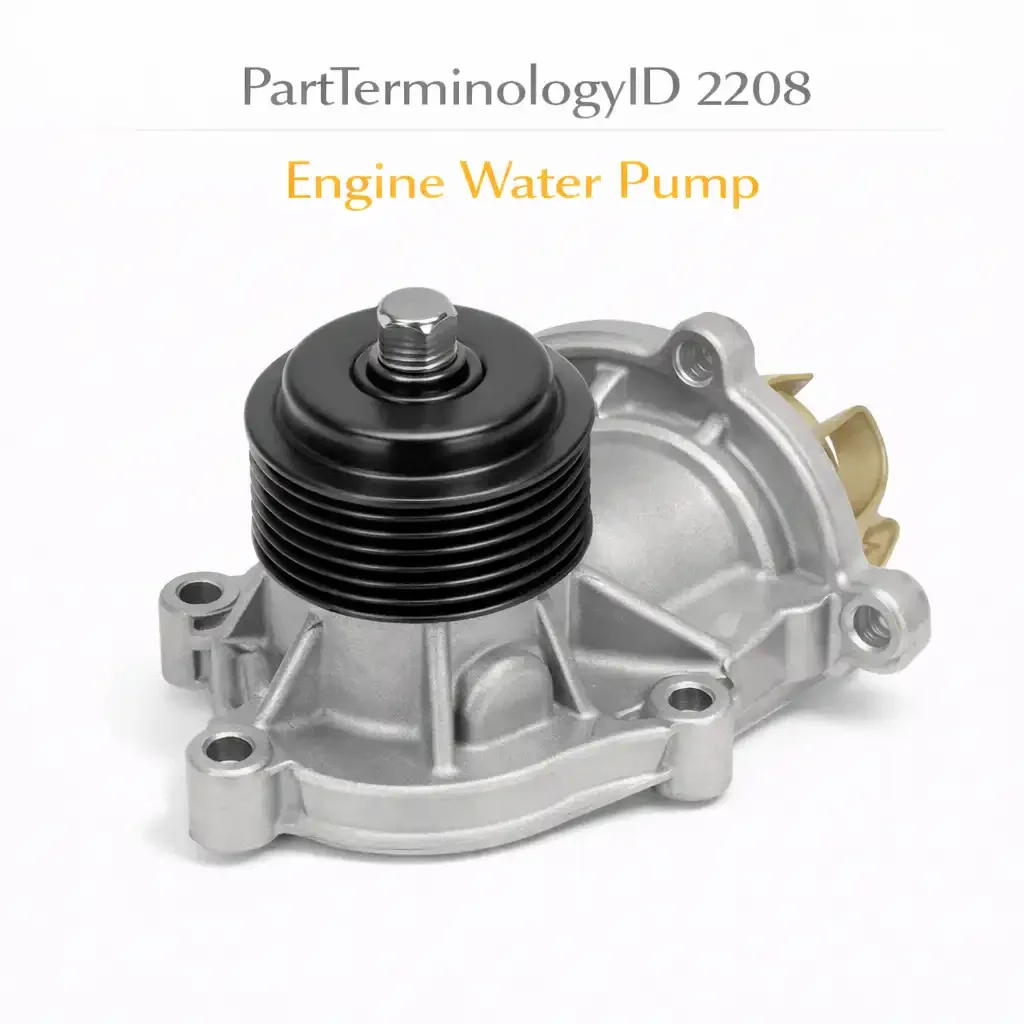
PartTerminologyID 2208, Engine Water Pump, is the mechanical pump that circulates coolant through the engine cooling system. That definition is understood by every buyer who searches for this part. It does not specify whether the pump is driven by the serpentine belt, the timing belt, the timing chain, or the camshaft; whether the pump rotates clockwise or counterclockwise when viewed from the drive end; whether the impeller is stamped steel or cast iron or plastic; what the inlet and outlet port diameters and orientations are; whether the pump includes the gasket, the pulley, and the mounting bolts; whether the pump is a direct OE-style replacement or an aftermarket design with a different impeller geometry; what the shaft thread specification is for the pulley nut; or which engine the pump is machined for. A listing under PartTerminologyID 2208 that does not specify the engine code, the drive type, the rotation direction, and the impeller material is asking the buyer to guess at four specifications where any one wrong answer produces a pump that either cannot be installed, circulates coolant in the wrong direction, fails prematurely, or is incompatible with the coolant formulation in the system.
For sellers, the engine water pump is the highest-consequence part in the cooling system series in terms of secondary damage risk. A pump that fails in service, leaks externally, or fails internally from impeller erosion allows the engine to overheat. Overheating damages the cylinder head gasket, warps the cylinder head, and in severe cases causes piston or bore damage. The water pump that costs one hundred to three hundred dollars to replace can set off a repair cascade that costs ten to thirty times that amount. A pump that is wrong in rotation direction circulates coolant backward, which reduces heat rejection efficiency and may cause localized hot spots. A pump with a plastic impeller installed on an engine running aggressive coolant chemistry will shed impeller material into the coolant circuit within months, contaminating the thermostat, the heater core, and the radiator passages with plastic debris.
For sellers, the listing under this PartTerminologyID is only useful if it includes the engine code, the drive type, the rotation direction, the impeller material, the inlet and outlet port configuration, the gasket inclusion status, the pulley inclusion status, and whether the pump is OE-equivalent or a modified aftermarket design. Without those eight attributes, the return rate for this PartTerminologyID is determined by how many buyers happen to have the correct engine variant and happen to receive a pump with matching rotation direction, impeller material, and port configuration.
What the Engine Water Pump Does
Circulating coolant through the engine water jacket and the external cooling circuit
The water pump maintains continuous coolant flow from the engine water jacket, through the thermostat, to the radiator, and back to the pump inlet. The pump is centrifugal: the impeller spins at a speed proportional to the engine's rotating assembly speed and imparts velocity to the coolant through centrifugal force. Coolant enters the pump at the center of the impeller through the inlet and exits at the impeller's outer diameter through the outlet at higher velocity and pressure.
The pump's flow rate at any given engine speed is determined by the impeller diameter, the impeller vane geometry, and the pump's internal clearances. An impeller with eroded or broken vanes, or an impeller that has detached from the shaft due to corrosion between a steel shaft and a plastic impeller hub, can spin at full speed while moving little or no coolant. This failure mode produces no external leak and no noise. The engine overheats with the pump appearing to operate normally. The only way to diagnose it is to measure coolant flow rate or to remove the pump and inspect the impeller.
The timing belt-driven pump and the service interval consequence
On engines where the water pump is driven by the timing belt, the pump is located inside the timing belt cover and is only accessible by removing the timing belt. On those engines, the water pump is part of the timing belt service kit, and replacing the timing belt without replacing the water pump leaves a high-mileage pump in service that must be accessed again at the next timing belt interval. The additional labor cost of replacing the pump separately after the timing belt fails is several times the cost of the pump itself. The listing must identify timing belt-driven applications clearly so the buyer understands the service scope and the recommendation to replace the pump as part of the timing belt kit.
On engines where the water pump is driven by the serpentine belt or the timing chain, the pump is externally mounted and accessible without major engine disassembly. These pumps are replaced when they show signs of failure: shaft seal weeping at the weep hole, bearing roughness or noise, or external leakage at the pump face gasket.
The electric water pump
On some current-production engines, particularly hybrid vehicles and engines with advanced thermal management, the water pump is electrically driven rather than mechanically driven by the engine. An electric water pump can operate independently of engine speed, which allows the cooling system to continue circulating coolant after the engine shuts off, to operate at reduced speed during cold starts to allow faster warm-up, and to run at maximum speed under high thermal load regardless of engine rpm.
An electric water pump listing under PartTerminologyID 2208 requires different attributes than a mechanical pump listing: the motor voltage, the flow rate at rated voltage, the connector pin count and configuration, and whether the pump requires initialization or programming after installation. A listing that presents an electric pump with only mechanical pump attributes cannot be verified by a buyer on an electric pump application.
Coolant flow direction and rotation direction
The water pump's impeller moves coolant in a specific direction determined by the impeller's vane angle. The impeller vane angle is designed for a specific rotation direction. A pump that rotates in the correct direction moves coolant from the inlet port to the outlet port at the designed flow rate and pressure. A pump that rotates in the wrong direction moves coolant from the outlet back toward the inlet at a significantly reduced rate, or in some impeller designs moves no coolant at all and allows the coolant to stagnate.
Rotation direction is specified from the drive end of the pump: looking at the pulley or the sprocket from outside the engine, the pump shaft rotates either clockwise or counterclockwise. This convention must be stated explicitly in the listing because the same engine platform may have been produced with different drive configurations in different model years that require different rotation directions.
The Eight Specifications That Determine Water Pump Fitment
Drive type
The drive type is the first and most fundamental specification. A timing belt-driven pump cannot be substituted with a serpentine belt-driven pump. The mounting boss, the shaft length, the impeller size, and the inlet and outlet port locations are all specific to the drive architecture. Drive types include serpentine belt via pulley, timing belt via toothed sprocket, timing chain via toothed sprocket, camshaft via gear mesh, and electric motor.
Rotation direction
Clockwise or counterclockwise when viewed from the drive end. This must be stated. Two pumps with identical mounting configurations and identical port layouts but opposite rotation directions are not interchangeable. The listing must state the rotation direction, not leave it implicit.
Impeller material
Steel stamped impellers are the most durable and are the standard on most domestic and Asian passenger vehicle engines. They do not erode in properly maintained coolant circuits and maintain their vane geometry throughout the pump's service life.
Cast iron impellers are used on heavy-duty and diesel applications. They are durable but add weight and are subject to rust scaling if the coolant is not maintained and inhibitor depletion allows water to contact the iron.
Plastic impellers, also called composite impellers, are used on some European engines and on some current-production economy applications. They are lighter than steel and are not subject to rust scaling in degraded coolant, but they are subject to erosion and chemical attack from certain coolant formulations, particularly those with high inhibitor concentration or with inhibitor packages that were not designed for compatibility with the specific plastic formulation. A plastic impeller in an incompatible coolant will shed material into the circuit. The debris accumulates in the thermostat, the heater core, and the radiator passages and is very difficult to flush completely.
The listing must state the impeller material. On applications where the OE pump used a steel impeller and aftermarket pumps are available with plastic impellers, the substitution must be disclosed. The buyer who purchases what they believe is an OE-equivalent pump and receives a plastic impeller replacement has not been given the information needed to verify compatibility with their coolant formulation.
Inlet port diameter and orientation
The inlet port is where coolant enters the pump from the lower radiator hose connection or from the engine block's coolant return passage. The inlet port inner diameter and orientation must match the original. A pump with an inlet port 5mm smaller than the original restricts coolant flow into the pump and reduces the pump's effective output. A pump with an inlet port facing a different direction requires the lower radiator hose to be modified or replaced to connect correctly.
Outlet port diameter and orientation
The outlet port carries pressurized coolant from the pump to the engine water jacket. On most engines the outlet is at the pump face and ports directly into the block passage when the pump is bolted on. On some engines the outlet is a hose connection. The outlet port inner diameter must match the engine's coolant passage bore. An outlet that is undersized restricts coolant flow to the engine jacket.
Gasket inclusion status
The pump face gasket (PartTerminologyID 2148) seals the pump flange to the engine block. It is always replaced when the pump is replaced. A listing that does not disclose whether the gasket is included leaves the buyer uncertain about what they need to source before starting the repair. A buyer who begins the pump replacement and discovers the gasket is not included must source it before completing the installation, which delays the repair on a vehicle that is already in pieces.
Pulley inclusion status
On serpentine belt-driven pumps, the pulley transfers the belt's drive force to the pump shaft. The pulley is typically transferred from the original pump to the replacement pump on most applications. On some applications, the pulley is not transferable because the original is pressed onto the shaft and cannot be removed without a puller, or because the original pulley is corroded beyond reuse. The listing must state whether the pulley is included so the buyer can prepare the correct puller tool or order a replacement pulley before starting the repair.
OE-equivalent versus modified aftermarket design
Some aftermarket water pumps are OE-equivalent direct replacements. Others include modifications intended to improve performance: different impeller geometry, different impeller material, increased flow rate, or a redesigned seal arrangement. The modifications may or may not be beneficial for a given application. An aftermarket pump with a redesigned impeller that increases flow rate on a performance engine may over-circulate coolant on a low-output stock engine, reducing the time coolant spends in the radiator and lowering heat rejection efficiency. A listing that does not disclose whether the pump is OE-equivalent or a modified design does not give the buyer the information needed to evaluate the substitution.
Why This Part Generates Returns
Buyers order the wrong engine water pump because:
the engine code is not specified and the same vehicle platform uses different pumps on different engine variants with different rotation directions, inlet port orientations, and impeller sizes
the rotation direction is not stated and the replacement rotates in the wrong direction, circulating coolant inefficiently or not at all
the impeller material is not stated and the buyer installs a plastic impeller pump in a system running a coolant formulation that is incompatible with the plastic, leading to impeller erosion and coolant contamination
the drive type is not specified and the buyer orders a serpentine belt-driven pump for an engine that uses a timing belt-driven pump, or vice versa
the gasket is not included and not disclosed, and the buyer discovers this only after the old pump has been removed
the pulley is not included and not disclosed, and the buyer has no puller to transfer the original pressed-on pulley
the inlet port orientation is different from the original, preventing the lower radiator hose from connecting without modification
the listing does not disclose that the pump is a modified aftermarket design with a different impeller geometry, and the buyer installs it on a stock engine expecting OE-equivalent performance
Status in New Databases
PIES/PCdb: PartTerminologyID 2208, Engine Water Pump
PIES 8.0 / PCdb 2.0: No change
Top Return Scenarios
Scenario 1: "Engine overheats at idle despite new pump, impeller failed"
The replacement pump has a plastic impeller that was incompatible with the coolant formulation in the circuit. The impeller eroded over the first several thousand miles and is no longer moving coolant at the designed flow rate. The engine overheats at idle where fan airflow is the primary cooling contribution and coolant flow rate is most critical.
Prevention language: "Impeller material: [stamped steel / cast iron / composite plastic]. Verify your coolant formulation is compatible with the impeller material before installing. Plastic impellers require a coolant formulation specifically compatible with the composite material. Incompatible coolant chemistry will erode the impeller and contaminate the cooling circuit with plastic debris. Steel impellers are compatible with all standard glycol-based coolant formulations."
Scenario 2: "Fan belt-driven pump ordered, engine uses timing belt-driven pump"
The listing did not specify the drive type. The buyer's engine is an interference engine with a timing belt-driven pump inside the cover. The replacement is a serpentine belt-driven pump with a pulley and an external mounting configuration. The pump cannot be installed in the timing belt cavity and the pulley cannot be accommodated within the belt cover.
Prevention language: "Drive type: [serpentine belt / timing belt / timing chain / electric]. This pump is driven by the [drive type]. Verify your engine's water pump drive type before ordering. Timing belt-driven pumps are located inside the timing belt cover and use a toothed sprocket rather than a pulley. They are not interchangeable with externally mounted belt-driven pumps."
Scenario 3: "Coolant circulates backward, engine overheats under load"
The rotation direction is not stated in the listing. The replacement pump rotates clockwise when viewed from the drive end. The original rotated counterclockwise. The pump's impeller vanes move coolant in the wrong direction. Coolant flow rate is severely reduced. The engine temperature rises to the overheating threshold under sustained highway load.
Prevention language: "Rotation direction: [clockwise / counterclockwise] when viewed from the drive end (pulley side). Verify your original pump's rotation direction matches before ordering. A pump with the opposite rotation direction will not circulate coolant correctly and will cause the engine to overheat under load despite the pump appearing to operate."
Scenario 4: "Gasket not included, pump removal required to source gasket"
The pump face gasket was not included in the listing and was not disclosed as excluded. The buyer removed the old pump, cleaned both mating surfaces, and discovered no gasket was in the box. The engine block's coolant passages were open and the vehicle could not be operated. The buyer had to source the gasket locally before completing the installation.
Prevention language: "Gasket: [included / not included]. If the gasket is not included, order PartTerminologyID 2148 (Engine Water Pump Gasket) for your engine before beginning the pump replacement. The mating surfaces should not be left exposed to air or contamination while the gasket is being sourced."
Scenario 5: "Pulley pressed onto old pump shaft, cannot transfer to replacement"
The listing stated the pulley is not included and must be transferred from the original. The buyer's original pulley is pressed onto the pump shaft and requires a puller to remove. The buyer did not have the correct puller and could not complete the transfer. The engine could not be reassembled without the pulley.
Prevention language: "Pulley: [included / not included. Transfer from original pump]. If the pulley must be transferred, verify whether your original pulley is bolted or pressed onto the shaft before beginning the repair. A pressed-on pulley requires a pulley puller tool for removal. Have the correct puller available before removing the original pump."
Scenario 6: "Inlet port faces wrong direction, lower hose will not connect"
The inlet port on the replacement pump faces upward. The original inlet faced downward toward the lower radiator hose connection. The lower hose cannot reach the upward-facing inlet without being forced into a severe bend that contacts the serpentine belt.
Prevention language: "Inlet port orientation: [downward / forward / rearward / [X] degrees from pump face]. Verify the inlet port orientation matches your original pump before ordering. An inlet port facing a different direction will prevent the lower radiator hose from connecting without modification and may cause the hose to contact rotating components."
Scenario 7: "Timing belt service completed, pump failed 6 months later"
The buyer replaced the timing belt without replacing the timing belt-driven water pump. The pump, which was at the same high mileage as the belt, failed six months later. The timing belt must be removed again to access the pump, repeating the majority of the labor from the timing belt service.
Prevention language: "Drive type: timing belt. This pump is driven by the timing belt and is accessible only with the timing belt removed. Replace this pump at every timing belt service interval to avoid repeating the timing belt removal labor at a separate pump replacement event. Timing belt kits that include the pump, belt, tensioner, and idler are available and recommended for this application."
Scenario 8: "Modified aftermarket impeller caused overcirculation on stock engine"
The aftermarket pump's impeller produces 20 percent higher flow rate than the OE specification. On the buyer's stock engine, the increased flow rate reduces the coolant's dwell time in the radiator, lowering the radiator's heat rejection efficiency. The engine runs at a consistently higher temperature than before the pump replacement, staying within the normal range but 15 degrees warmer than with the original pump.
Prevention language: "Pump design: [OE-equivalent direct replacement / performance modified design with [X]% increased flow rate]. OE-equivalent pumps are recommended for stock engine applications. Performance-modified pumps with increased flow rates are designed for high-output or modified engines where additional coolant circulation is required. Verify your application's requirement before ordering a performance-modified pump."
What to Include in the Listing
Core essentials
PartTerminologyID: 2208
component: Engine Water Pump
engine code (mandatory)
drive type: serpentine belt, timing belt, timing chain, camshaft gear, or electric (mandatory)
rotation direction: clockwise or counterclockwise from drive end (mandatory)
impeller material: stamped steel, cast iron, or composite plastic (mandatory)
pump design: OE-equivalent or performance-modified with flow rate change (mandatory)
gasket included: yes or no (mandatory)
pulley included: yes or no, with note on transfer procedure if not included (mandatory)
inlet port inner diameter in mm and orientation (mandatory)
outlet port inner diameter in mm and orientation for hose-connected outlets
sealing method at pump face: cut gasket, RTV, or O-ring
coolant formulation compatibility note for plastic impeller applications
quantity: 1
Fitment essentials
year/make/model/submodel
engine code (mandatory, non-negotiable)
timing belt kit compatibility note for timing belt-driven applications
compatible timing belt, tensioner, and idler part numbers for timing belt-driven applications
engine displacement when the same engine family uses different pump specifications at different displacements
Dimensional essentials
pump body dimensions in mm for engine bay clearance verification
inlet port inner diameter in mm
outlet port inner diameter in mm for hose-connected outlets
mounting flange bolt hole count and spacing in mm
shaft diameter in mm for pulley fitment verification
impeller outer diameter in mm
pump body height and width in mm
Image essentials
pump in isolation showing body, inlet port, outlet port, mounting flange, shaft, and drive end
drive end view showing rotation direction arrow and drive type (pulley, sprocket, or gear)
inlet port close-up showing orientation and inner diameter callout
impeller visible through the inlet or outlet showing vane count and material
gasket shown separately if included, with dimensional callouts
pulley shown separately if included
for timing belt-driven pumps, the sprocket showing tooth profile and tooth count
installed context showing the pump on the engine with all connections made
Catalog Checklist for ACES/PIES Teams
PartTerminologyID = 2208
require engine code (mandatory, non-negotiable)
require drive type: serpentine belt, timing belt, timing chain, camshaft gear, or electric (mandatory)
require rotation direction from drive end: clockwise or counterclockwise (mandatory)
require impeller material: steel, cast iron, or composite plastic (mandatory)
require coolant formulation compatibility note for composite plastic impeller applications
require pump design: OE-equivalent or performance-modified (mandatory)
require gasket inclusion: yes or no (mandatory)
require pulley inclusion: yes or no with transfer procedure note (mandatory)
require inlet port inner diameter and orientation
require timing belt kit cross-reference for timing belt-driven applications
differentiate from engine water pump gasket (PartTerminologyID 2148): the gasket seals the pump flange to the engine; the pump is the rotating assembly; both are always replaced together but are separate parts
differentiate from engine coolant thermostat (PartTerminologyID 2200): the thermostat controls where coolant flows; the pump moves it; both are in the cooling circuit but at different locations and with different replacement triggers
differentiate from timing belt kit (PartTerminologyID varies): on timing belt-driven pump applications, the pump is part of the timing belt service kit; the listing should cross-reference the full kit and note that the pump and belt are replaced at the same service interval
differentiate from electric water pump (if applicable): electric pumps require motor voltage, flow rate, and connector configuration attributes not required for mechanical pumps; the listing must distinguish clearly between mechanical and electric pump applications
flag rotation direction as mandatory: a pump with the wrong rotation direction circulates coolant inefficiently or not at all and causes overheating that mimics thermostat or radiator failure
flag impeller material as mandatory: plastic impeller compatibility with the coolant formulation is a known failure mode; the listing must disclose the impeller material and the compatibility requirement
flag timing belt-driven applications: the pump service interval is the timing belt interval on those engines; failing to note this causes buyers to replace the belt without replacing the pump, leading to a repeat repair
FAQ (Buyer Language)
How do I determine my engine's water pump drive type?
Look at the water pump location on the engine. If the pump has a pulley on the front and is connected to the serpentine belt system, it is serpentine belt-driven. If you cannot see a pump with a pulley on the front of the engine and there is a timing belt cover on the side or front of the engine, the pump is likely timing belt-driven and is behind the cover. Consult the factory service manual for your engine code to confirm the drive type and location. The water pump drive type is specified in the cooling system section of the service manual.
What is the correct rotation direction for my water pump?
The rotation direction is specified in the factory service manual for your engine code. As a general reference: most front-engine rear-wheel-drive domestic vehicles with clockwise-rotating engines use a counterclockwise water pump when viewed from the front of the engine. However, this is not universal and must be verified for your specific engine. Do not assume the rotation direction based on general convention. Look at the original pump's impeller vane angle if the pump is being removed: the vanes curve in the direction that moves fluid forward in the correct rotation direction.
My original pump has a plastic impeller. Is that the correct specification for my engine?
Verify the OE specification by checking the factory parts catalog for your engine code and the production date of your vehicle. Some manufacturers transitioned from steel impellers to plastic impellers during production runs of the same engine. A replacement with a steel impeller is generally acceptable as an upgrade on applications that originally used plastic, provided the impeller diameter and vane geometry produce the same flow rate and pressure as the original. Verify with the replacement pump manufacturer that the steel impeller is dimensionally equivalent to the original plastic impeller before installing.
Do I need to replace the pulley when I replace the water pump?
Inspect the original pulley. If the pulley is bolted to the pump shaft, it can be removed and reused if the belt contact surface is smooth and undamaged and the hub bore is not worn. If the pulley is pressed onto the shaft, a puller is required to remove it. Inspect the contact surface for grooves from the belt and inspect the hub for cracks. A pulley with a grooved surface will wear the new belt prematurely. Replace the pulley if it shows any of those signs. On timing belt-driven pumps, there is no external pulley: the pump drive sprocket is part of the pump body and is replaced with the pump.
I replaced the water pump and the engine is still overheating. What else could it be?
Verify the replacement pump is rotating in the correct direction by observing the flow direction at the open radiator or overflow reservoir immediately after startup with the thermostat cold and closed. If the coolant in the reservoir is being pulled toward the overflow tube rather than staying level, the pump may be circulating in the wrong direction. Also verify the pump gasket is sealing correctly by pressure testing the cooling system. Check the thermostat by confirming the engine reaches operating temperature within the expected warm-up time. If the engine reaches temperature but then overheats under load, check the radiator for blockage and the fan for correct operation. An overheating engine immediately after a water pump replacement is most commonly caused by air in the cooling system that was not bled correctly after the repair.
How do I bleed the air from the cooling system after replacing the water pump?
The bleeding procedure depends on the engine. Most passenger vehicle engines have a bleed port or bleed valve at the thermostat housing or at a high point in the cooling circuit. With the system cold, open the bleed port and fill the radiator or reservoir until coolant flows from the bleed port without bubbles, then close the port. Start the engine with the heater set to maximum heat and allow it to warm to operating temperature. Monitor the temperature gauge for any spike above normal, which indicates remaining air at the thermostat. If the temperature spikes, turn the engine off, allow it to cool, and repeat the bleed procedure. On systems without a dedicated bleed port, the bleed procedure involves running the engine with the radiator cap off and the heater at maximum until the thermostat opens and bubbles stop rising from the radiator filler neck.
The original pump was a timing belt-driven unit. Should I also replace the timing belt when I replace the pump?
Yes, and the reverse applies as well. On timing belt-driven water pump applications, the pump and belt are serviced at the same interval because accessing either one requires removing the other. Replacing the belt without replacing the pump leaves the pump in service at the same high mileage. If the pump fails before the next belt interval, the belt must be removed again to access the pump, repeating most of the timing belt replacement labor. Replace the pump, the belt, the tensioner, and the idler pulley as a set at every timing belt service interval.
Cross-Sell Logic
Engine Water Pump Gasket (PartTerminologyID 2148: the gasket is always replaced when the pump is replaced; if the gasket is not included in the pump listing, it is the first cross-sell; the mating surface must be clean and flat for the gasket to seal)
Timing Belt Kit (PartTerminologyID varies: on timing belt-driven pump applications, the timing belt, tensioner, and idler are replaced at the same service event as the pump; a complete kit that includes all four components is the recommended repair scope)
Engine Coolant Thermostat and Housing Gasket (PartTerminologyID 2200 and 2136: the thermostat is at the same service interval as the water pump on many engines; replacing both at the same coolant drain event avoids repeating the drain for a separate thermostat service within the same mileage band)
Engine Coolant (the cooling system must be completely drained to replace the water pump; fresh coolant of the correct formulation is required after reassembly; verify the formulation is compatible with the replacement pump's impeller material)
Serpentine Belt (PartTerminologyID varies: on serpentine belt-driven pump applications, the belt is removed or loosened to access the pump pulley; inspect the belt and replace if at the same service age as the pump)
Engine Cooling System Pressure Tester Adapter (PartTerminologyID 2054: pressure test the system after the pump is installed to confirm the pump face gasket seals at full operating pressure and to identify any air remaining in the circuit before the vehicle returns to service)
Coolant Temperature Sensor (PartTerminologyID 2188: if an overheating event caused the water pump failure, the coolant temperature sensor that should have activated the warning light should be tested for correct operation; a sensor that failed to warn the driver of the overheating event should be replaced along with the pump)
Fan Shroud (the fan shroud is often removed during water pump replacement on front-engine applications; inspect for cracks and distortion and replace if damaged)
Frame as "the pump circulates the coolant. The gasket seals the pump to the block. The thermostat controls where the coolant the pump moves is directed. The timing belt drives the pump on belt-driven engines and is replaced at the same interval. The coolant refills the system the pump circulates. The pressure test confirms the gasket and all connections before the engine runs. The temperature sensor confirms the system is protecting the engine after the repair."
Final Take for PartTerminologyID 2208
Engine Water Pump (PartTerminologyID 2208) is the mechanical heart of the cooling system and the component where a wrong fitment most directly enables the engine damage events the entire cooling system exists to prevent. A pump with the wrong rotation direction circulates coolant inefficiently while appearing fully operational. A pump with a plastic impeller in an incompatible coolant erodes invisibly for months before the overheating symptoms appear. A timing belt-driven pump replaced without replacing the timing belt sets up a repeat of the most labor-intensive service event in the engine bay. These failure modes are preventable with a listing that discloses the eight attributes that determine whether the pump will work correctly from the first startup.
The engine code is the primary attribute because every dimensional specification of the pump follows from it. The drive type is the second attribute because it determines the access procedure and the service kit scope. The rotation direction is the third and most consequential functional attribute because getting it wrong produces overheating that looks like every other cooling system problem except the one it actually is. The impeller material is the fourth attribute because it determines coolant compatibility and long-term reliability. The gasket and pulley inclusion attributes prevent the mid-repair discovery that the repair cannot be completed. The port orientation attributes prevent the post-installation discovery that the hoses cannot connect.
State the engine code. State the drive type. State the rotation direction. State the impeller material. State the gasket and pulley inclusion status. State the inlet port orientation. State whether the pump is OE-equivalent or modified. That is the same listing strategy as every other PartTerminologyID in this series: the generic PartTerminologyID requires specific attributes at every level to become a listing buyers can act on without guessing. For PartTerminologyID 2208, guessing on rotation direction produces an engine that overheats while the pump runs, and guessing on impeller material produces a coolant circuit that contaminates itself for months before the symptom appears.