
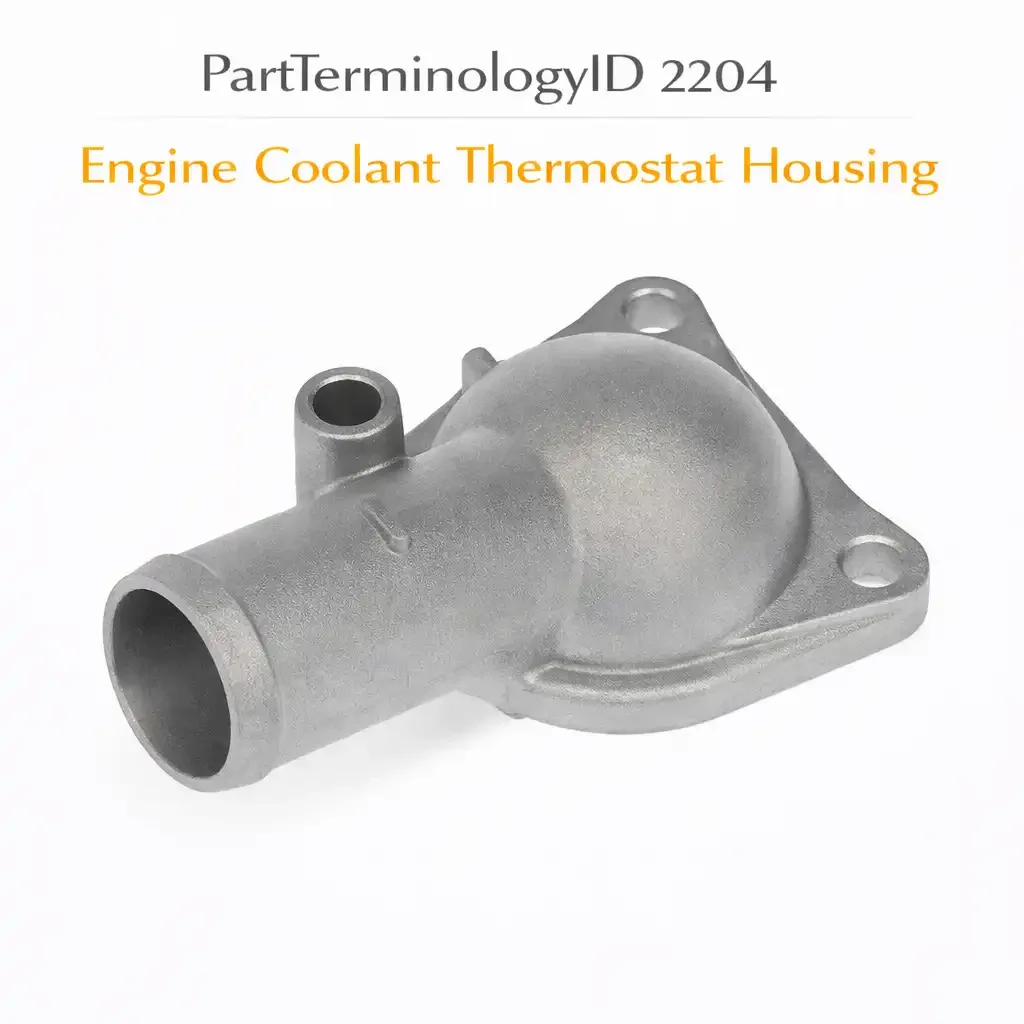
Engine Coolant Thermostat Housing (PartTerminologyID 2204): The Casting Where Material, Port Count, and Sensor Boss Configuration All Determine Whether the Replacement Completes the Repair
Written by Arthur Simitian | PartsAdvisory
PartTerminologyID 2204, Engine Coolant Thermostat Housing, is the casting or housing assembly that contains the thermostat and connects the engine's coolant outlet to the upper radiator hose. That definition locates the component correctly. It does not specify the material the housing is made from, whether the housing is a standalone casting or part of an integrated assembly that includes the water outlet and the thermostat, how many ports the housing has and what each one connects to, whether the housing includes a sensor boss for a coolant temperature sensor or a coolant level sensor, whether the housing includes a bleeder port or a bleed valve, what the bolt pattern and bolt count are, or which engine the housing is machined for. A listing under PartTerminologyID 2204 that relies on year, make, and model without specifying the engine code, the material, and the port configuration is a listing that produces returns every time the buyer has a different engine variant on the same platform, or every time the buyer's original housing has a sensor boss that the replacement is missing.
For sellers, the thermostat housing is a part where the most damaging returns are not caused by the housing failing to fit the engine but by the housing fitting the engine while missing a port or a boss that a sensor or hose was connected to on the original. A housing that bolts on correctly but has no coolant temperature sensor boss leaves the buyer with an unconnected sensor harness and a check engine light for an open coolant temperature sensor circuit. A housing that is missing the heater hose port leaves the heater circuit open and the cooling system unable to be sealed. A housing that does not have the bleed port the original had creates an air pocket in the system on every coolant fill. None of those problems are visible before the housing is installed. All of them are discovered after the old housing has been removed and cannot be put back.
For sellers, the listing under this PartTerminologyID is only useful if it specifies the engine code, the housing material, every port and boss on the housing with its specification, whether the thermostat is included, and whether the gasket or seal is included. Without those five groups of attributes, the return event is determined by what the buyer finds missing after the housing is bolted to the engine.
What the Engine Coolant Thermostat Housing Does
Containing the thermostat and routing coolant at the engine outlet
The thermostat housing provides the enclosure for the thermostat valve and the structural connection between the engine's coolant outlet passage and the upper radiator hose. The thermostat seats within the housing bore, sealed by an O-ring or rubber gasket. The housing bolts to the engine block or cylinder head over a gasket that seals the housing flange to the engine. The upper radiator hose connects to the housing outlet. When the thermostat opens, coolant flows through the housing from the engine passage to the radiator hose connection.
The housing also serves as a junction point for secondary coolant circuits. On most engines, the bypass circuit port is in the housing. On many engines, the heater supply port is at or near the housing. On engines with a coolant temperature sensor at the thermostat housing, the sensor boss is on the housing body. On engines with a bleeder system that purges air from the thermostat location, the bleed port or bleed valve is on the housing. Every one of those secondary features is specific to the housing design for that engine code.
The plastic housing versus the aluminum housing versus the cast iron housing
The thermostat housing material is one of the most consequential attributes in the listing because it determines the service life expectation, the failure mode, and the installation procedure for the replacement.
Plastic thermostat housings are the most common material on current-production passenger vehicle engines. They are light, do not corrode, and are inexpensive to manufacture. They are also brittle after extended thermal cycling and may crack when the mounting bolts are removed during thermostat service. A plastic housing replacement that is installed on a high-mileage engine where the original cracked during the previous thermostat service must be handled carefully. Over-torquing the mounting bolts on the new plastic housing will produce the same crack pattern on the first subsequent thermostat service.
Aluminum thermostat housings are common on European engines, performance engines, and as aftermarket upgrades on applications where the original plastic housing has a known failure rate. Aluminum housings are more durable under thermal cycling than plastic but are subject to electrolytic corrosion in degraded coolant and may develop porosity leaks at the casting as mileage accumulates. An aluminum replacement on a plastic original application requires verifying the bolt torque specification, because aluminum can accommodate more clamping force than plastic and the OE bolt torque may be calibrated for the plastic housing.
Cast iron housings are found on older domestic engines and on some heavy-duty applications. They are the most durable material but the heaviest, and they are subject to external rust and scaling in climates with road salt exposure.
The listing must state the housing material. A buyer who orders a replacement expecting an aluminum housing and receives a plastic housing has a material expectation mismatch that may lead to a return even if the housing fits correctly.
The integrated thermostat housing assembly
On many current-production engines, the thermostat housing is not a standalone casting. It is an integrated assembly that combines the thermostat housing, the water outlet, and in some cases the coolant crossover passage, into a single molded plastic component. On those applications, replacing the thermostat housing means replacing the entire integrated assembly, which may require disconnecting multiple hose connections, multiple sensor connectors, and multiple coolant circuit ports.
A listing for a standalone thermostat housing under PartTerminologyID 2204 on an integrated assembly application produces a return because the standalone housing does not include the water outlet passage and the other integrated components that must also be replaced. The listing must specify whether the housing is a standalone casting or an integrated assembly.
The Port and Boss Configuration That Must Match the Original
Upper radiator hose outlet port
Every thermostat housing has an outlet port for the upper radiator hose. The outlet port inner diameter and the outlet direction, whether it faces upward, forward, rearward, or at an angle, must match the original for the upper hose to connect without modification. A housing with the correct bolt pattern and bore but an outlet port facing a different direction than the original will prevent the upper radiator hose from seating without being forced, which creates kinking and potential hose contact with rotating components.
Coolant temperature sensor boss
On engines where the coolant temperature sensor is at the thermostat housing, the replacement housing must include the sensor boss in the same thread specification and at the same location as the original. A housing without a sensor boss on an application that requires one leaves the buyer with an unconnected coolant temperature sensor harness, an open-circuit fault code, and in some cases an engine protection mode that limits power until the sensor circuit is restored.
The thread specification of the sensor boss must match the sensor's thread: common specifications include M12x1.5 and M14x1.5. A housing with a sensor boss in the wrong thread specification requires a thread adapter or a different sensor, neither of which the buyer anticipated.
Bypass circuit port
The bypass port connects the thermostat housing to the engine's coolant bypass circuit via the bypass hose (PartTerminologyID 2155). The bypass port inner diameter and position must match the original. A housing without a bypass port on an application that requires one blocks the bypass circuit, which prevents coolant circulation when the thermostat is closed and can cause rapid localized overheating during engine warm-up.
Heater supply port
On some engine designs, the heater supply circuit draws coolant from a port on the thermostat housing rather than from a separate port on the engine block or cylinder head. If the original housing has a heater supply port and the replacement does not, the heater circuit cannot be connected at that location and the heater core will not receive coolant flow.
Bleed port or bleed valve
Some thermostat housing designs include a small bleed port or a bleed screw that allows air to be purged from the thermostat housing location during coolant fills. The bleed port is particularly important on housings where the thermostat location is at the highest point of the cooling circuit. A replacement housing without the bleed port or bleed valve traps air at the housing on every coolant fill, which causes the irregular thermostat behavior and temperature gauge fluctuation discussed in the thermostat housing cap post (PartTerminologyID 2069) and the thermostat post (PartTerminologyID 2200).
Coolant level sensor boss
On some vehicles, the coolant level sensor (PartTerminologyID 2184) is mounted in the thermostat housing rather than in the overflow reservoir. A replacement housing without the level sensor boss on an application that requires one leaves the level sensor uninstalled and the low coolant warning circuit open.
Why This Part Generates Returns
Buyers order the wrong engine coolant thermostat housing because:
the engine code is not specified and the same vehicle platform uses different thermostat housings on different engine variants with different port configurations and different sensor boss locations
the housing is missing a sensor boss that the original had, producing an open coolant temperature sensor circuit and a check engine light after installation
the housing is missing a heater supply port, leaving the heater circuit unable to be connected
the housing is missing the bypass port, blocking the bypass circuit and causing warm-up overheating
the housing material is different from what the buyer expected based on the listing description or image
the outlet port direction is different from the original, preventing the upper radiator hose from connecting without modification
the listing is for a standalone housing on an integrated assembly application, and the buyer discovers the water outlet and other integrated components are not included
the thermostat and gasket inclusion attributes are not stated, and the buyer finds the thermostat and gasket must be sourced separately to complete the repair
Status in New Databases
PIES/PCdb: PartTerminologyID 2204, Engine Coolant Thermostat Housing
PIES 8.0 / PCdb 2.0: No change
Top Return Scenarios
Scenario 1: "Missing coolant temperature sensor boss, check engine light after installation"
The original housing had a coolant temperature sensor boss at M14x1.5. The replacement housing has no sensor boss. The buyer installed the housing, connected all hoses, filled the system, started the engine, and found a P0115 or P0116 code for the coolant temperature sensor circuit. The sensor cannot be installed because there is no boss.
Prevention language: "Coolant temperature sensor boss: [included / not included]. Thread specification: [M14x1.5 / M12x1.5 / not applicable]. Verify your original thermostat housing includes a coolant temperature sensor boss and that this replacement matches that configuration before ordering. A housing without a sensor boss cannot accept the coolant temperature sensor."
Scenario 2: "Heater hose has no connection point on the new housing"
The original housing had a heater supply nipple at 3/4 inch inner diameter. The replacement housing has no heater supply port. The buyer disconnected the heater supply hose from the original housing and found no corresponding port on the replacement.
Prevention language: "Heater supply port: [included at X-inch inner diameter / not included]. Verify your original thermostat housing includes a heater supply port before ordering. A housing without a heater supply port on a heater-circuit-at-housing application leaves the heater hose without a connection point and the heater core without coolant flow."
Scenario 3: "Outlet port faces wrong direction, upper hose will not reach"
The outlet port on the replacement housing faces rearward toward the firewall. The original outlet faced upward. The upper radiator hose cannot reach the rearward-facing outlet without a 90-degree adapter that was not part of the original installation.
Prevention language: "Outlet port direction: [upward / forward / rearward / [X]-degree angle from housing face]. Verify the outlet port direction matches your original thermostat housing before ordering. An outlet port facing a different direction from the original will prevent the original upper radiator hose from connecting without modification."
Scenario 4: "Bypass circuit is blocked, engine overheated during warm-up"
The replacement housing has no bypass port. The original housing had a bypass port connecting to the coolant bypass hose. The buyer installed the housing and capped the bypass hose. During the first cold start, the thermostat was closed and the pump had nowhere to circulate coolant. The engine overheated within 90 seconds.
Prevention language: "Bypass port: [included at X-inch inner diameter / not included]. Do not install a thermostat housing without verifying the bypass circuit port configuration. A housing without a bypass port on a bypass-circuit application blocks coolant circulation when the thermostat is closed, causing rapid overheating from the first cold start."
Scenario 5: "Plastic housing ordered, aluminum housing expected"
The listing did not state the housing material. The product image showed a generic housing shape. The buyer expected an aluminum replacement for their original plastic housing. They received a plastic housing identical in material to the cracked original.
Prevention language: "Housing material: [plastic / aluminum / cast iron]. If you are ordering an aluminum replacement for an original plastic housing, verify the listing states aluminum construction. Plastic and aluminum housings for the same application may have identical port configurations but different material properties and different recommended bolt torque values."
What to Include in the Listing
Core essentials
PartTerminologyID: 2204
component: Engine Coolant Thermostat Housing
engine code (mandatory)
housing type: standalone casting or integrated assembly (mandatory)
housing material: plastic, aluminum, or cast iron (mandatory)
outlet port direction and inner diameter in mm (mandatory)
coolant temperature sensor boss: included or not, thread specification if included (mandatory)
bypass port: included or not, inner diameter if included (mandatory)
heater supply port: included or not, inner diameter if included (mandatory)
bleed port or bleed valve: included or not (mandatory)
coolant level sensor boss: included or not (mandatory on applications where the level sensor is at the housing)
thermostat included: yes or no (mandatory)
gasket or seal included: yes or no (mandatory)
bolt count and bolt specification
quantity: 1
Fitment essentials
year/make/model/submodel
engine code (mandatory, non-negotiable)
compatible thermostat part number when thermostat is not included
compatible gasket part number (PartTerminologyID 2136) when gasket is not included
OE part number cross-reference when available
Dimensional essentials
housing flange bolt hole count and spacing in mm
housing bore inner diameter in mm (thermostat bore)
outlet port inner diameter in mm
bypass port inner diameter in mm if present
heater supply port inner diameter in mm if present
sensor boss thread specification if present
housing overall dimensions in mm for fitment in engine bay
Image essentials
housing in isolation showing all ports, bosses, and the outlet direction with callouts
flange face showing bolt hole pattern and thermostat bore
sensor boss close-up showing thread profile
outlet port close-up showing inner diameter and direction
for integrated assembly listings, all integrated components identified
installed context showing the housing on the engine with all connections made
Catalog Checklist for ACES/PIES Teams
PartTerminologyID = 2204
require engine code (mandatory, non-negotiable)
require housing type: standalone or integrated assembly (mandatory)
require housing material: plastic, aluminum, or cast iron (mandatory)
require outlet port direction and inner diameter
require coolant temperature sensor boss configuration: present or absent, thread specification if present
require bypass port configuration: present or absent, inner diameter if present
require heater supply port configuration: present or absent, inner diameter if present
require bleed port or bleed valve configuration: present or absent
require thermostat included attribute: yes or no
require gasket included attribute: yes or no
differentiate from engine coolant thermostat (PartTerminologyID 2200): the thermostat is the valve inside the housing; the housing is the casting; they are separate parts that are replaced together on assembly-replacement applications and separately on standalone applications
differentiate from engine coolant thermostat housing gasket (PartTerminologyID 2136): the gasket seals the housing flange to the engine; the housing is the casting the gasket seals; both are required at every housing replacement
differentiate from engine coolant thermostat housing cap (PartTerminologyID 2069): the cap seals a secondary bore in the housing; the housing is the primary casting
differentiate from engine coolant outlet gasket (PartTerminologyID 2144): on engines where the thermostat housing is also the water outlet, both PartTerminologyIDs may apply; distinguish clearly in the listing which interface each gasket covers
flag integrated assembly applications: a standalone housing listing on an integrated assembly application misleads the buyer about the scope of the replacement
flag sensor boss as mandatory attribute: a housing missing the coolant temperature sensor boss that the original had produces a check engine light immediately after installation
flag bypass port as mandatory attribute: a housing without the bypass port on a bypass-circuit application causes warm-up overheating from the first cold start
FAQ (Buyer Language)
How do I identify all the ports on my original thermostat housing before ordering a replacement?
With the housing in place and before disconnecting anything, photograph the housing from multiple angles and label each connection: the upper radiator hose outlet, the bypass hose connection, the heater supply hose connection if present, the coolant temperature sensor or sensors, the bleed port or bleed valve if present, and the coolant level sensor if present at this location. Count the bolts holding the housing to the engine. Record the outlet port direction. Compare that information to the replacement housing listing before ordering to confirm every port and boss is present on the replacement.
My thermostat housing is cracked. Do I need to replace the thermostat at the same time?
Inspect the thermostat before deciding. If the thermostat is within its service interval and the thermostat O-ring or seal will be replaced, the thermostat can be transferred to the new housing. However, the thermostat O-ring or seal must always be replaced because it was compressed on the original installation. If the cracked housing had been leaking for any period before the repair, replace the thermostat as well, because prolonged low coolant levels or air exposure at the thermostat location can affect thermostat performance.
The replacement housing does not have the bleed port my original has. What do I do?
Do not install a housing without the bleed port on an application that requires it. The bleed port exists to purge air from the highest point in the cooling circuit at the thermostat housing location. Without it, air will be trapped in the housing on every coolant fill and will cause erratic thermostat operation and temperature gauge fluctuation. Source a replacement housing with the bleed port, or contact the seller to confirm whether the bleed port is present and was omitted from the listing description.
Can I use an aluminum aftermarket housing as a replacement for my original plastic housing?
Yes on most applications, with two considerations. First, verify the bolt torque specification for the aluminum housing. Plastic housing bolt torque is limited by the plastic's resistance to crush deformation. Aluminum can handle higher clamping forces, and some aftermarket aluminum housings specify a different torque value than the OE plastic specification. Second, verify the port configuration is identical to the original plastic housing, including the sensor boss thread specification. Most aftermarket aluminum housings are designed as direct replacements with matching port configurations, but verify before ordering.
The thermostat housing I received has an extra port that was not on my original. Is it plugged?
IInspect the extra port closely before you install the housing. If it is factory-plugged with a pressed-in plug (a smooth metal cap that looks staked or swedged into place) or a threaded plug (usually hex or internal hex), that is typically a shared casting feature used across multiple applications. In other words, the housing was designed with a port location that some vehicles use, but your specific engine or trim does not. In that case, leave the plug exactly as-is. It is meant to stay in place, and removing it can create a leak path or force you into chasing threads, sealant, and an unnecessary repair.
Do not remove the plug just because the port exists. Don’t assume it is a bonus connection for an extra hose, heater line, coolant bypass, or sensor unless you have a confirmed requirement for your application. Many engines have versions where that port feeds a throttle body heater circuit, a degas/bleed line, a heater return, or a temperature sensor boss. If your original housing did not use it, your cooling hose routing and system pressure balance were designed without it, so adding a connection can create air pockets, incorrect flow, or routing issues that show up later as overheating or inconsistent cabin heat.
If the port is open and unplugged, treat it as a problem that must be resolved before the cooling system is filled. An open port will leak immediately once coolant is added, and on a pressurized system it can spray coolant quickly. Source the correct plug for that housing: match the thread type if it is threaded (and use the proper thread sealant if required), or use the correct style of press-in plug if the casting is designed for one. Don’t “make it work” with a random bolt, rubber cap, or glue. Once the plug is installed, pressure test if possible, then fill and bleed the system normally.Cross-Sell Logic
Engine Coolant Thermostat (PartTerminologyID 2200: the thermostat is inside the housing and is replaced at the same service event when the housing is replaced; the thermostat bore diameter and flange design must be compatible with the replacement housing)
Engine Coolant Thermostat Housing Gasket (PartTerminologyID 2136: the housing gasket seals the housing flange to the engine and is always replaced when the housing is replaced; it is the most predictable concurrent purchase with any thermostat housing listing)
Engine Coolant Thermostat Seal (PartTerminologyID 2182: the thermostat bore seal must be replaced when the housing is replaced on standalone-seal applications; cross-reference when the housing listing's seal-included attribute is no)
Engine Coolant Bypass Hose (PartTerminologyID 2155: the bypass hose connects to the thermostat housing bypass port; inspect when the housing is replaced and replace if the hose is cracked or hardened)
Engine Coolant Temperature Sensor (PartTerminologyID 2188: if the coolant temperature sensor is at the thermostat housing and has not been recently replaced, inspect it when the housing is replaced and replace if at the same service age)
Upper Radiator Hose (connects to the thermostat housing outlet; inspect when the housing is disturbed and replace if at the same service age)
Engine Coolant (partial or complete coolant drain is required for housing replacement; fresh coolant is required after reassembly)
Engine Cooling System Pressure Tester Adapter (PartTerminologyID 2054: pressure test after housing replacement to confirm the housing gasket and the thermostat seal both seal at full system pressure)
Frame as "the housing contains the thermostat. The gasket seals the housing to the engine. The thermostat seal seals the thermostat in the housing bore. The bypass hose routes coolant through the housing bypass port. The sensor reads temperature at the housing boss. The upper hose carries coolant from the housing outlet to the radiator. Every one of those connections must be restored when the housing is replaced."
Final Take for PartTerminologyID 2204
Engine Coolant Thermostat Housing (PartTerminologyID 2204) is the junction point for more cooling system connections than any other single casting in the series. The upper radiator hose, the bypass hose, the heater supply hose, the coolant temperature sensor, the coolant level sensor, and the bleed port all may terminate at the thermostat housing depending on the engine architecture. A replacement housing that is missing any one of those connections produces a repair that cannot be completed without sourcing the correct housing.
The engine code is the primary fitment attribute because the same vehicle platform may use different engine variants with different housing architectures. The material is the second attribute because it determines the service life and the bolt torque the housing can accept. The port and boss configuration is the third, fourth, fifth, sixth, and seventh attribute, one for every connection point that may or may not be present on the replacement.
State the engine code. State the housing type and material. State every port and boss with its specification. State whether the thermostat and gasket are included. That is the same listing strategy as every other PartTerminologyID in this series: the generic PartTerminologyID requires specific attributes at every level to become a listing buyers can act on without guessing. For PartTerminologyID 2204, the missing port is discovered after the old housing is off the engine, and the correct housing cannot arrive before the vehicle is already in pieces.