
Engine Coolant Thermostat (PartTerminologyID 2200): The Component Where Opening Temperature, Diameter, and Housing Architecture All Determine Whether the Engine Reaches Its Designed Operating Point
Written by Arthur Simitian | PartsAdvisory
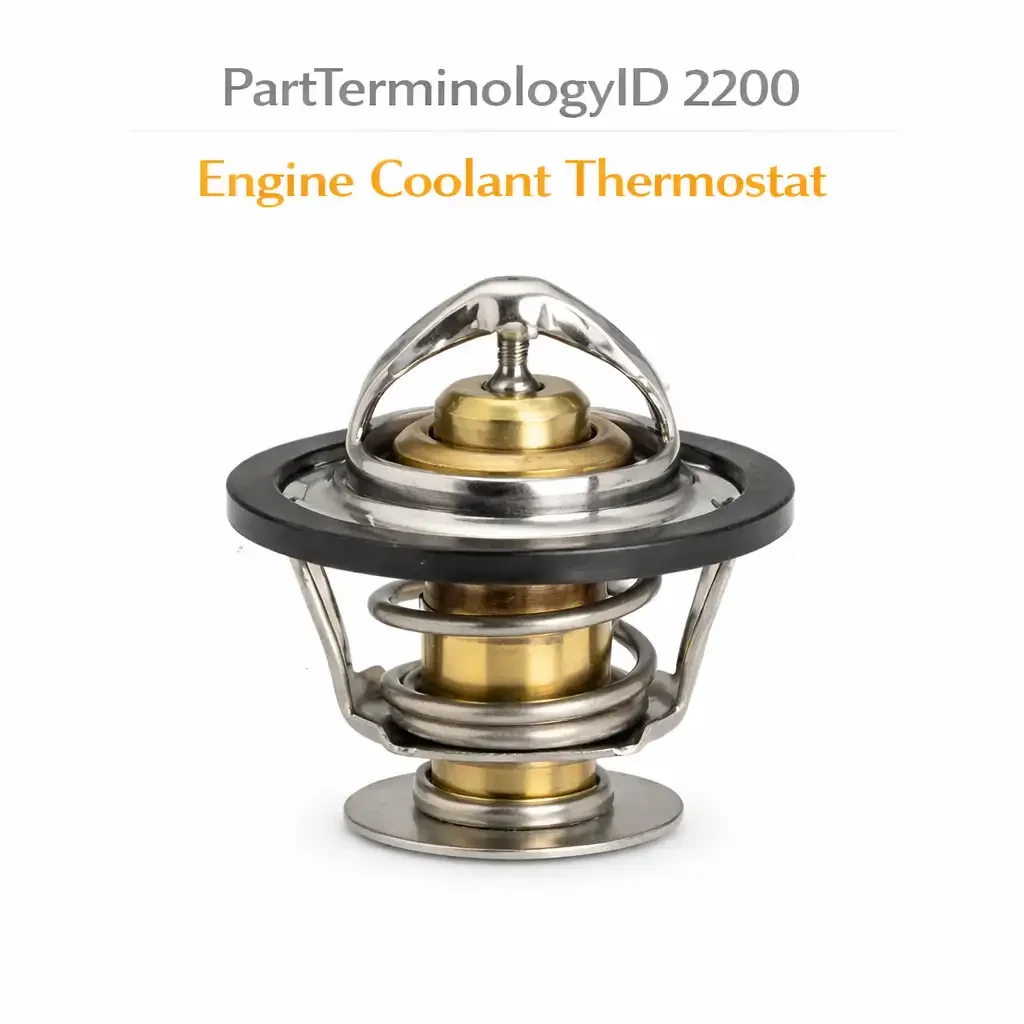
PartTerminologyID 2200, Engine Coolant Thermostat, is a temperature-sensitive valve that controls coolant flow between the engine and the radiator. That definition is understood by every buyer who searches for this part. It does not communicate the thermostat's opening temperature, the thermostat's outer diameter, whether the thermostat seats in the housing or in the engine block, whether the housing is included or sold separately, whether the thermostat is a pellet-style or bimetallic design, whether it includes a jiggle pin or a bleed notch for air purging, what the thermostat flange design is and whether a separate seal is required, or whether the application requires a fail-safe thermostat that defaults to open on failure rather than closed. A listing under PartTerminologyID 2200 that includes only the year, make, and model is a listing where every buyer who receives a thermostat with the correct outer diameter but the wrong opening temperature is running their engine on the wrong thermal operating point, and every buyer who receives a thermostat with the wrong outer diameter or the wrong flange design cannot complete the installation.
For sellers, the engine coolant thermostat is the component that sets the engine's operating temperature. Every other component in the engine management system is calibrated for the temperature the thermostat establishes. Ignition timing maps, fuel injection maps, oil viscosity selection, emissions control activation temperatures, and the catalyst's light-off strategy are all built around the assumption that the engine reaches a specific coolant temperature within a specific time after startup and sustains that temperature within a narrow band during normal operation. A thermostat with an opening temperature that is 10 degrees Fahrenheit lower than the OE specification runs the engine perpetually 10 degrees cold. The fuel maps see a slightly cold engine and trim fuel delivery accordingly. The catalyst does not reach optimal operating temperature as reliably. The oil does not shed water vapor as effectively. None of those consequences trigger a fault code or a warning light. They accumulate silently.
For sellers, the listing under this PartTerminologyID is only useful if it includes the engine code, the opening temperature, the thermostat outer diameter, the flange and seal configuration, whether the housing is included, and whether a jiggle pin or bleed notch is present. Without those six attributes, the buyer ordering a thermostat is rolling a temperature die on one of the most calibration-sensitive components in the engine's thermal management system.
What the Engine Coolant Thermostat Does
Regulating coolant temperature by controlling flow to the radiator
The thermostat sits at the coolant outlet from the engine, typically at the thermostat housing on the cylinder head or the engine block. On a cold engine, the thermostat is closed. Coolant circulates through the bypass circuit, the heater core, and the engine water jacket, but does not enter the radiator. The engine warms quickly because no heat is being rejected to the ambient air through the radiator.
As the coolant reaches the thermostat's opening temperature, the wax pellet inside the thermostat expands, pushing the valve open. Coolant begins flowing to the radiator. The thermostat modulates continuously between partially open and fully open positions to maintain the coolant temperature within a narrow band around its designed opening point. On most passenger vehicle engines, the operating temperature band is between the thermostat's opening temperature and approximately 15 to 20 degrees Fahrenheit above it. If the coolant rises above that band, the thermostat is fully open and the radiator and fan system must provide sufficient heat rejection to prevent further temperature rise.
Why the opening temperature matters for engine calibration
The opening temperature is not an interchangeable variable. OE thermostats for passenger vehicle gasoline engines typically open between 185 and 203 degrees Fahrenheit. European engines tend toward the higher end of that range. Domestic engines vary by platform and production year. The ECM's calibration is matched to the thermostat's opening temperature in several ways.
Fuel trim learning is one example. The ECM uses long-term fuel trim to compensate for air/fuel ratio deviations from the target. On a cold engine, the fuel trim target is different from the warm-engine target. The transition between cold and warm trim occurs at the coolant temperature threshold stored in the ECM. If the thermostat opens 15 degrees before the ECM's transition threshold, the ECM is applying warm-engine fuel trim to an engine that is slightly below warm-engine temperature, which produces a lean condition that may be subtle but is persistent.
Emissions calibration is another example. Cold-start enrichment strategies and catalyst heating strategies are calibrated for the expected warm-up time associated with the OE thermostat's opening temperature. An aftermarket thermostat with a lower opening temperature shortens the warm-up phase, which may allow the catalyst to reach light-off temperature faster but also means the cold-start enrichment strategy runs for a shorter time than calibrated, which can produce lean conditions during the transition.
The ECM on many current-production vehicles includes thermostat monitor diagnostics that evaluate the rate of coolant temperature rise during warm-up and the sustained temperature during normal operation. If a thermostat opens too early, the monitor will log a code for a thermostat that is stuck open or has failed open. A thermostat with a lower opening temperature than the OE specification may trigger this monitor even though the thermostat is functioning correctly for its rated temperature.
The fail-safe thermostat
On some current-production engines, the thermostat is designed to fail open rather than fail closed. A conventional thermostat that fails closed traps coolant in the engine, which causes rapid overheating and potential engine damage. A conventional thermostat that fails open allows coolant to flow to the radiator continuously, which prevents overheating but runs the engine perpetually cold. A fail-safe thermostat uses a secondary mechanism that forces the valve open if the primary wax pellet fails. The secondary mechanism may be a bimetallic spring that opens the valve in the event of wax pellet loss or housing failure.
A conventional thermostat installed on an application that specifies a fail-safe thermostat removes the thermal protection the fail-safe design provides. On a fail-safe application, the listing must specify the fail-safe attribute and the replacement must be a fail-safe design.
The thermostat and housing assembly versus the standalone thermostat
On many current-production engines, particularly those with plastic or composite thermostat housing designs, the thermostat is available both as a standalone part and as part of a thermostat housing assembly that includes the thermostat, the housing, the seal, and the bolts. Some applications, particularly those where the housing is a non-serviceable plastic component that is prone to cracking during thermostat removal, are designed to be replaced as an assembly every time the thermostat is serviced.
A listing for a standalone thermostat on an assembly-replacement application creates a repair that the buyer cannot complete without also sourcing the housing, the seal, and the bolts. The listing must specify whether the application is a standalone thermostat replacement or an assembly replacement.
The Thermostat Specifications That Determine Correct Installation and Correct Engine Operation
Opening temperature
The opening temperature is the most important functional specification in the listing. Common opening temperatures for passenger vehicle applications include 160 degrees Fahrenheit (71 degrees Celsius), 180 degrees Fahrenheit (82 degrees Celsius), 185 degrees Fahrenheit (85 degrees Celsius), 190 degrees Fahrenheit (88 degrees Celsius), 195 degrees Fahrenheit (90 degrees Celsius), and 203 degrees Fahrenheit (95 degrees Celsius). The difference between a 180-degree thermostat and a 195-degree thermostat is 15 degrees Fahrenheit, which is enough to affect fuel economy, catalyst performance, oil service life, and ECM thermostat monitor diagnostics.
The opening temperature must be matched to the OE specification for the engine code. A listing that does not state the opening temperature communicates that it is probably the common value for that application, which is not a sufficient basis for ordering a component this calibration-sensitive.
Thermostat outer diameter
The thermostat seats in a bore in the thermostat housing or the engine block. The outer diameter must match the bore diameter. Common outer diameters for passenger vehicle thermostats range from approximately 45mm to 68mm. A thermostat that is 2mm undersize for the bore will rattle and may not seat the seal correctly. A thermostat that is 2mm oversize will not fit in the bore.
Flange design and seal configuration
The thermostat flange is the rim at the top of the thermostat body that seats against the housing or the bore shoulder. The flange design determines how the thermostat is retained in the housing and how it is sealed. Configurations include a flat flange with a separate O-ring on the body, a flange with a molded rubber seal, a flange that clamps directly between the housing halves, and a flange with locating tabs that index the thermostat to a specific orientation in the housing.
The seal configuration determines whether the buyer needs to order the seal separately. A thermostat that requires an O-ring that is not included in the listing requires the buyer to source and install the O-ring before the thermostat can seal the housing. A listing that does not disclose whether the seal is included or not sends the buyer to an installation without the information needed to prepare for it.
Jiggle pin or bleed notch
Most thermostats include a small hole or notch in the thermostat body called a jiggle pin or a bleed notch. This feature allows a small amount of coolant to flow past the closed thermostat, which serves two functions: it prevents a vacuum from forming at the thermostat when the engine cools and the coolant contracts, and it allows air bubbles to escape past the thermostat on initial coolant fill. A thermostat without a jiggle pin or bleed notch installed in a system that relied on one for air purging will trap air in the thermostat housing on every coolant fill, which causes the irregular warm-up behavior and temperature gauge fluctuation discussed in the thermostat housing cap post (PartTerminologyID 2069).
The presence and position of the jiggle pin or bleed notch must be noted in the listing. On applications where the thermostat has locating tabs that index it to a specific orientation, the jiggle pin must be at a specific position in the housing when installed. A listing that does not note the jiggle pin orientation requirement sends the buyer to an installation where the pin may end up in the wrong position, blocking rather than facilitating air purging.
Housing included or not included
The listing must clearly state whether the thermostat is sold as a standalone part or as part of an assembly that includes the housing. On assembly-replacement applications, the standalone thermostat price may appear attractive compared to the assembly price, but the repair cannot be completed without the housing, and the buyer who orders the standalone thermostat and finds the housing is required will either return the thermostat or order the housing separately and repeat the repair.
Why This Part Generates Returns
Buyers order the wrong engine coolant thermostat because:
the opening temperature is not stated and the buyer receives a thermostat that runs the engine 10 to 15 degrees from the OE operating point, triggering the ECM's thermostat monitor fault code
the engine code is not specified and the same vehicle platform uses different thermostats on different engine variants with different opening temperatures and different outer diameters
the thermostat outer diameter is not stated and the replacement does not fit the housing bore
the listing does not specify whether the housing is included, and the buyer's housing is cracked from the original thermostat removal and must be replaced as well
the seal is not included and the buyer discovers this only after the original seal is destroyed during housing removal
a conventional thermostat is listed for an application that specifies a fail-safe thermostat
the jiggle pin orientation is not noted and the buyer installs the thermostat with the pin in the wrong position, trapping air in the housing on every coolant fill
the thermostat opening temperature listed is incorrect for the market the listing is sold in: a thermostat listed in Celsius on a market that uses Fahrenheit, or vice versa, produces an ordering error when the buyer converts incorrectly
Status in New Databases
PIES/PCdb: PartTerminologyID 2200, Engine Coolant Thermostat
PIES 8.0 / PCdb 2.0: No change
Top Return Scenarios
Scenario 1: "Check engine light for thermostat stuck open after replacement"
The replacement thermostat has an opening temperature of 180 degrees Fahrenheit. The OE thermostat opens at 195 degrees Fahrenheit. The ECM's thermostat monitor evaluates the sustained coolant temperature during normal driving and determines the thermostat is opening 15 degrees below the expected operating range. A P0128 (Coolant Temperature Below Thermostat Regulating Temperature) code is set.
Prevention language: "Opening temperature: [X] degrees Fahrenheit / [X] degrees Celsius. Verify this opening temperature matches the OE specification for your engine before ordering. The ECM's thermostat monitor will set a P0128 code if the coolant temperature does not reach the expected operating range for your engine's calibration. The OE specification for [engine code] is [X] degrees Fahrenheit."
Scenario 2: "Thermostat does not fit the housing bore"
The outer diameter is not stated in the listing. The replacement thermostat has an outer diameter that is 3mm smaller than the housing bore. The thermostat rattles in the bore and the O-ring cannot seal the gap between the thermostat body and the bore wall.
Prevention language: "Thermostat outer diameter: [X]mm. Verify your thermostat housing bore diameter matches before ordering. A thermostat that is undersized for the bore will not seal correctly regardless of O-ring compression. A thermostat that is oversized will not fit in the bore."
Scenario 3: "Housing cracked during removal, seal not included, cannot complete repair"
The buyer was replacing the thermostat on an application designed for assembly replacement. The original plastic housing cracked when the bolts were removed. The standalone thermostat listing did not include the housing or the seal. The buyer cannot complete the repair without both.
Prevention language: "Housing: [not included / included]. Seal: [not included / included]. This application uses a plastic thermostat housing that may crack during removal on high-mileage vehicles. If the housing is cracked, a housing replacement assembly (includes thermostat, housing, seal, and bolts) is required. Verify housing condition before ordering a standalone thermostat."
Scenario 4: "Engine temperature fluctuates after thermostat replacement"
The jiggle pin orientation is wrong. The buyer installed the thermostat with the jiggle pin at the bottom of the housing rather than at the top. Air accumulates at the top of the housing and is not purged by the pin in its incorrect position. The trapped air causes the thermostat to cycle erratically because the thermistor element is occasionally surrounded by air rather than coolant.
Prevention language: "Jiggle pin position: [top of housing / marked position / factory index tab alignment]. The jiggle pin must be positioned at the top of the thermostat housing or at the marked position when installed. An incorrectly positioned jiggle pin traps air in the housing, causing erratic thermostat cycling and temperature gauge fluctuation."
Scenario 5: "Fail-safe application received a conventional thermostat"
The buyer's engine specifies a fail-safe thermostat. The listing did not identify the fail-safe attribute and shipped a conventional thermostat. The buyer installed it and the engine runs correctly. At the next service, the technician notes the conventional thermostat was installed on a fail-safe specification engine and flags the replacement as incorrect.
Prevention language: "Thermostat type: [conventional / fail-safe]. Fail-safe thermostats are designed to open in the event of wax pellet failure, preventing a closed-thermostat overheat event. Installing a conventional thermostat on a fail-safe application removes this protection. Verify your engine specification before ordering."
Scenario 6: "Opening temperature listed in Celsius, buyer converted incorrectly"
The listing stated 88 degrees C. The buyer read this as 88 degrees Fahrenheit, which is well below any standard thermostat opening temperature, and assumed the listing was a typo or error. They ordered a thermostat they believed was rated at 190 degrees Fahrenheit from a different listing. The two thermostats have the same opening temperature: 88 degrees Celsius equals 190 degrees Fahrenheit. Both were correct and the buyer returned one as duplicate.
Prevention language: "Opening temperature: [X] degrees Fahrenheit ([X] degrees Celsius). Both values are stated to prevent unit conversion errors. Verify the opening temperature in the unit most familiar to you before ordering."
Scenario 7: "New thermostat leaks at the housing, original seal was not included"
The original thermostat's rubber seal was bonded to the housing and tore on removal. The replacement thermostat did not include a new seal. The buyer installed the replacement thermostat without a new seal and the housing leaked at the thermostat bore interface on the first fill.
Prevention language: "Seal included: [yes / no]. If the seal is not included, order the replacement seal before removing the original thermostat. The original seal is typically destroyed during housing removal and cannot be reused. Attempting installation without a new seal will result in a coolant leak at the thermostat bore on the first pressurized fill."
What to Include in the Listing
Core essentials
PartTerminologyID: 2200
component: Engine Coolant Thermostat
engine code (mandatory)
opening temperature in both Fahrenheit and Celsius (mandatory)
thermostat outer diameter in mm (mandatory)
thermostat type: conventional or fail-safe (mandatory)
housing included: yes or no (mandatory)
seal included: yes or no (mandatory)
jiggle pin or bleed notch: present or absent, and position or orientation requirement (mandatory)
flange design: flat with O-ring, molded seal, clamp-between-housing-halves, or indexed tab
material: wax pellet steel body, plastic housing integration
quantity: 1 thermostat
Fitment essentials
year/make/model/submodel
engine code (mandatory, non-negotiable)
OE opening temperature for the engine code (to allow buyers to compare against the listing specification)
OE part number cross-reference when available
compatible thermostat housing part number when the thermostat is available as an assembly
Dimensional essentials
thermostat outer diameter in mm (the primary fitment dimension)
thermostat body height in mm
flange outer diameter in mm
O-ring outer diameter in mm and cross-sectional diameter in mm if O-ring sealed
fully open stroke in mm (valve lift at full opening temperature)
Image essentials
thermostat in isolation showing the full body, flange, jiggle pin position, and seal surface
top view showing jiggle pin position relative to the flange
cross-section or profile view showing the fully open valve lift
seal in isolation if included, with dimensional callouts
installed context showing the thermostat seated in the housing with the jiggle pin at the correct position
for assembly listings, all components laid out together showing the thermostat, housing, seal, and bolts
Catalog Checklist for ACES/PIES Teams
PartTerminologyID = 2200
require engine code (mandatory, non-negotiable)
require opening temperature in both Fahrenheit and Celsius (mandatory)
require thermostat outer diameter in mm
require thermostat type: conventional or fail-safe
require housing inclusion attribute: yes or no
require seal inclusion attribute: yes or no with seal specifications if included
require jiggle pin presence and orientation requirement
differentiate from engine coolant thermostat housing (PartTerminologyID varies): the housing is the casting that contains the thermostat; the thermostat is the valve inside the housing; on assembly-replacement applications, both are replaced as a unit
differentiate from engine coolant thermostat housing gasket (PartTerminologyID 2136): the housing gasket seals the housing to the engine; the thermostat seal (PartTerminologyID 2182) seals the thermostat within the housing bore; both are distinct from the thermostat itself
differentiate from engine coolant thermostat seal (PartTerminologyID 2182): the thermostat seal is the O-ring or rubber seal that seals the thermostat body within the housing bore; it is a separate part from the thermostat on standalone-seal applications; on integrated-seal thermostats, the seal is part of the thermostat assembly
flag opening temperature as mandatory in both units: conversion errors are a documented return cause for this PartTerminologyID
flag fail-safe applications: a conventional thermostat on a fail-safe specification engine must be identified as an incorrect substitution in the listing
flag assembly-replacement applications: a standalone thermostat listing on an assembly-replacement application misleads the buyer about the scope of the repair required
flag jiggle pin orientation: this attribute is absent from most listings but is required for correct air purging on initial coolant fill
FAQ (Buyer Language)
How do I find the correct opening temperature for my engine?
The opening temperature is specified in the factory service manual for your engine code in the cooling system section. It is also often stamped or molded on the thermostat body itself: look for a temperature number near the base of the thermostat valve. The ECM's thermostat monitor diagnostic is calibrated for the OE opening temperature, so installing a thermostat with a lower opening temperature than specified will typically trigger a P0128 fault code (Coolant Temperature Below Thermostat Regulating Temperature) even if the replacement thermostat is functioning correctly at its own rated temperature.
What is the P0128 fault code and does it mean my thermostat failed?
P0128 (Coolant Temperature Below Thermostat Regulating Temperature) means the ECM's thermostat monitor detected that the coolant temperature did not reach the expected operating range within the expected warm-up time, or that the sustained operating temperature is below the expected range. This code is set by a thermostat that is stuck partially open, a thermostat that has failed open, or a replacement thermostat with a lower opening temperature than the OE specification. If the thermostat was recently replaced and the opening temperature of the replacement is lower than the OE specification for the engine, the thermostat is the cause of the code. Replace it with a thermostat that matches the OE opening temperature specification.
My engine runs hotter than it used to but the temperature gauge is within the normal range. Could the thermostat be the cause?
A thermostat that is beginning to stick closed will cause the engine to run at higher temperatures within the normal range before it reaches the point of causing overheating. The temperature gauge may stay within the normal range while the coolant is consistently at the upper end of that range. Inspect the thermostat if the engine consistently runs warmer than it did at lower mileage with the same cooling system condition. A thermostat that opens late or sticks partially closed in the upper position cannot maintain the designed operating temperature band and will allow the coolant to exceed it before the radiator and fan can reject sufficient heat.
Do I need to replace the thermostat housing when I replace the thermostat?
Inspect the housing before deciding. On metal thermostat housings, the housing can typically be reused if the mating surfaces are flat and undamaged and the coolant passages are clear. On plastic thermostat housings, inspect the plastic for cracking, crazing, and brittleness. Plastic that has become brittle from age and thermal cycling may crack when the mounting bolts are removed. If the housing shows any of those signs, replace the housing at the same time as the thermostat. An assembly replacement kit that includes the thermostat, housing, seal, and bolts is the lowest-risk repair strategy on high-mileage plastic housing applications.
What is a fail-safe thermostat and does my engine need one?
A fail-safe thermostat includes a secondary mechanism, typically a bimetallic spring, that forces the thermostat valve open if the primary wax pellet fails or if the thermostat housing seal is breached. This prevents a failed-closed thermostat from causing an overheat event. Fail-safe thermostats are specified by some European and Japanese manufacturers for applications where a conventional failed-closed thermostat would cause rapid and severe engine damage. The factory service manual or the OE parts catalog for your engine code will specify whether a fail-safe thermostat is required. Installing a conventional thermostat on a fail-safe application is permissible for function but removes the overheat protection the fail-safe design provides.
Can I install a lower opening-temperature thermostat to help my engine run cooler in summer?
Technically yes, but with consequences. A lower opening temperature reduces the engine's sustained coolant temperature, which reduces the temperature differential at the radiator and lowers the heat rejection rate. It does not necessarily reduce the maximum temperature the engine can reach under high load because the radiator's heat rejection capacity is determined by the temperature differential between coolant and ambient air. More importantly, the ECM is calibrated for the OE thermostat's opening temperature. A lower opening temperature will cause the ECM's thermostat monitor to set a P0128 code, may affect fuel trim and catalyst performance, and may reduce the effectiveness of the heater on cold days. For a high-temperature application, the correct approach is to address radiator capacity, coolant flow rate, and fan operation rather than installing a lower-temperature thermostat.
Cross-Sell Logic
Engine Coolant Thermostat Housing (PartTerminologyID varies: on plastic housing applications, the housing should be inspected and replaced if brittle or cracked; an assembly kit that includes both is the preferred repair on high-mileage applications)
Engine Coolant Thermostat Housing Gasket (PartTerminologyID 2136: the housing gasket seals the housing to the engine and is replaced at every thermostat service; this is the most predictable concurrent purchase with the thermostat)
Engine Coolant Thermostat Seal (PartTerminologyID 2182: on applications where the thermostat seal is a standalone part, it must be replaced at every thermostat service; cross-reference this part whenever the thermostat listing's seal-included attribute is no)
Engine Coolant Bypass Hose (PartTerminologyID 2155: the bypass hose connects to the thermostat housing and is disturbed during thermostat service; inspect for cracking and replace if at the same service age)
Engine Coolant (the cooling system must be partially or fully drained for thermostat service; fresh coolant of the correct formulation is required after reassembly)
Engine Cooling System Pressure Tester Adapter (PartTerminologyID 2054: pressure test after thermostat installation to confirm the housing gasket and the thermostat seal are sealing correctly at full system pressure before the vehicle returns to service)
Upper Radiator Hose (the upper radiator hose connects to the thermostat housing outlet; inspect it when the housing is removed and replace if at the same service age)
Scan Tool (the ECM's thermostat monitor can only be verified with a scan tool that reads coolant temperature live data; after replacing the thermostat, confirm the engine reaches the expected operating temperature within the expected warm-up time to verify the new thermostat is functioning correctly)
Frame as "the thermostat sets the operating temperature. The housing gasket seals the housing the thermostat is in. The thermostat seal seals the thermostat within the housing bore. The bypass hose routes coolant while the thermostat is closed. The coolant fills the system after the thermostat is installed. The pressure test confirms all seals. The scan tool confirms the operating temperature matches the new thermostat's specification."
Final Take for PartTerminologyID 2200
Engine Coolant Thermostat (PartTerminologyID 2200) is the component that establishes the engine's operating temperature, and every calibration in the engine management system was built around the temperature that thermostat is designed to maintain. A thermostat with a lower opening temperature than the OE specification does not just run the engine slightly cooler. It shifts the engine's operating point out of the range the ECM, the fuel maps, the catalyst, and the oil formulation were designed for, and it triggers the ECM's thermostat monitor diagnostic in the process.
Six attributes determine whether the replacement thermostat will install correctly, seal correctly, purge air correctly, and run the engine at the correct temperature. The opening temperature is the most important functional specification. The outer diameter is the most important dimensional specification. The fail-safe designation is the most important safety specification. The housing and seal inclusion attributes are the most important repair scope specifications. The jiggle pin orientation is the most commonly omitted specification.
State the engine code. State the opening temperature in both Fahrenheit and Celsius. State the outer diameter. State the thermostat type. State whether the housing and seal are included. State the jiggle pin position. That is the same listing strategy as every other PartTerminologyID in this series: the generic PartTerminologyID requires specific attributes at every level to become a listing buyers can act on without guessing. For PartTerminologyID 2200, guessing on the opening temperature runs the engine on wrong calibration data and sets a fault code. Guessing on everything else prevents the installation from being completed at all.